







Abstract

Generations ago, “Go West” was generic advice given to the young. The advice was based on the success of industrialized Western societies as they had developed a positive correlation between travelling west and achievements (which often starts with making a living). Volume 11, Issue 3, of the International Journal of Lower Extremity Wounds is a special issue reporting on the current state of the art of wound healing and tissue repair in China. The industrial and economic achievements of modern-day China are ringing bells everywhere: we decided to check out what happens in our area of interest. As Academician Professor Xiao Bing Fu states in his guest editorial, in China today, there is a growing problem with chronic wounds over and beyond the burden imposed by trauma. The prevalence of diabetes is high in a populous society; correctly an enormous problem with diabetic foot disease is anticipated.
In China, chronic wounds are managed by mainly plastic surgeons. A strong core of plastic and trauma surgeons formed the Chinese Tissue Repair Society (CTRS). The CTRS has developed guidelines for wound management for use by doctors and nurses and functions similarly to the other wound healing societies. However, the focus of the CTRS, which appeared to be research based, is changing: their vision has cannily widened to include clinical wound healing. As the focus of the CTRS has widened, wound healing centers have begun to develop in cities such as Shanghai, and others are likely to follow. This begs the question, “Are they committed to translational medicine?” To engage in translational research (in medicine), every thought must be associated with the query “what is in it for the patient?” There is an example to share with readers.
Professor Lu and Dr Xie (from Shanghai) have successfully used 4G high-speed communication links to develop internet based clinical practice in wound healing based on a philosophy of small wards but large clinics. This paradigm is as important as it is pragmatic: commuting in Shanghai costs time and, therefore, money. Web-based medicine permits hospital-based specialists and general practitioners to collaborate and manage patients more effectively. Reductions associated with hospitalization may also be anticipated. We may anticipate similar evolution in other cities.
Education (and training) in this specialist area is provided through academic meetings—as in Western societies, India, and so on. To further meet this need, in April 2011 colleagues from the CTRS and the European Academy of Wound Technology agreed to form the Sino-European Wound Healing Union (see Figure 1).
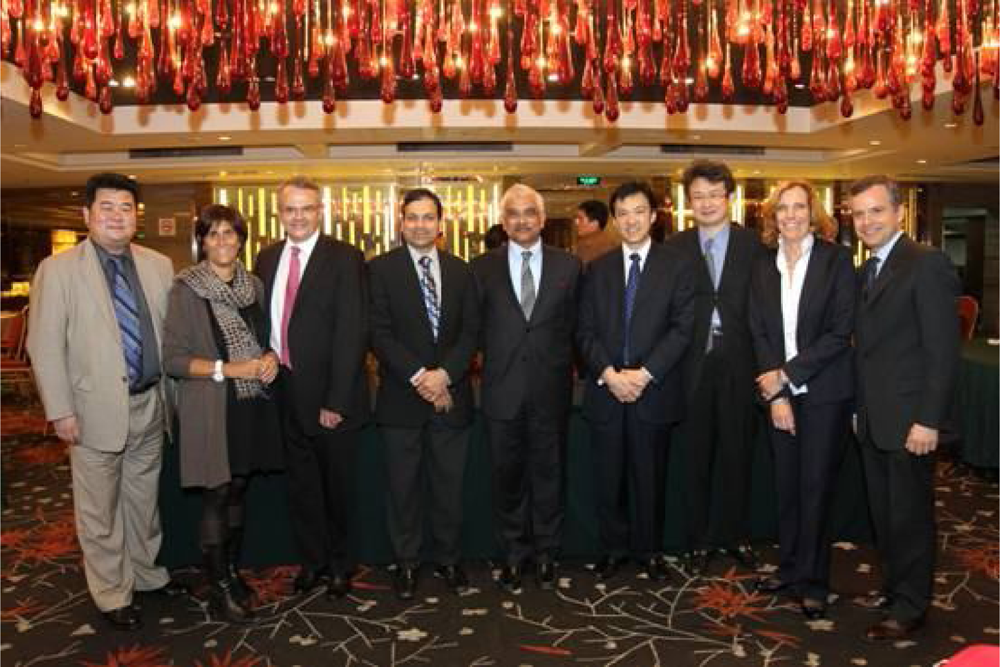
At the first Sino-European Joint Wound Healing Meeting, April 2011
Alongside these developments, there exists at least one clinical and academic collaboration—I refer to that between Shanghai Jiao Tong University Hospitals and the University of Southampton Hospital NHS Foundation Trust through the Faculty of Medicine. It is likely there is more collaborative activity at individual levels. Will wound healing and tissue repair translate into a subspecialty with training for clinicians, nurses, and others? You may wish to “Go East.”
There are other articles and regular features in this issue that celebrates IJLEW’s impact factor. No matter the specialty area, research must benefit the patient.