







Abstract

Sir,
The Toll-like receptor 4 (TLR4) plays an important role in immunity, tissue repair, and regeneration. 1 TLR4 is also an important regulator of wound inflammation and plays an important role in restoring damaged tissue integrity during normal wound healing. 2 Any imbalance in TLR4 mediated signaling may abrogate the proper wound healing cascade. Type 2 diabetes mellitus (T2DM) wounds are hard to heal and altered TLR4-mediated signaling may be contributing for the same. 3 Genetic alterations in TLR4 signaling are generally manifested by 2 ways: Either there is inadequate TLR4 expression on cell surface or the receptor itself is not able to bind properly with its ligands.4,5 This altered binding of TLR4 with its ligands may be due to the single nucleotide polymorphisms (SNPs) in the extracellular domain of TLR4. Some of the well-known SNPs in the TLR4 promoters are rs4986790, rs4986791, rs11536858 (merged into rs10759931), rs1927911, and rs1927914, which have the capacity to modulate the balance between pro- and anti-inflammatory cytokines, thereby supporting chronic inflammation. 5 As reported by us previously, TLR4 message and proteins are downregulated in wounds of patients with T2DM as compared with control subjects. 4 This downregulation of TLR4 is aided by epigenetic silencing of TLR4 gene by virtue of its hypermethylated promoter. It was interesting to observe that males had comparatively lesser TLR4 transcripts as compared with females. This TLR4 expression modulation by estrogens in females may be one of the reasons for less incidence of diabetic foot ulcer (DFU) in females than that observed in males. 4 In another study, our group associated the aforementioned common SNPs of TLR4 promoter with the risk of DFU in a north Indian population. 5 This case control study, which involved 125 DFU cases and 130 controls, suggested that risk genotypes of all SNPs except rs1927914 were significantly associated with DFU. The haplotypes and linkage disequilibrium between the SNPs were determined using Haploview software. Haplotype ACATC (P = 9.3 × 10⁻⁵) showed strong association with DFU risk. Two haplotypes ATATC (P = .0119) and ATGTT (P = .0087) were found to be protective against DFU. 5
Based on these prior observations, we tried to associate the different genotypes of TLR4 polymorphisms (rs4986790, rs4986791, rs11536858, rs1927911, and rs1927914) with TLR4 message in DFU subjects to see the effect of these genotypes on expression of TLR4 in 95 DFU cases. This study was approved by the Institutional Human Ethics Committee of the Institute of Medical Sciences, Banaras Hindu University, Varanasi, India. Our data suggested that TLR4 expression was lower in patients harboring risk genotypes of all studied TLR4 SNPs except for rs4986790 (Figure 1). One-way analysis of variance between groups indicated that mean expression of TLR4 message significantly differed among the non risk and risk genotypes for 2 of these SNPs (P = .04, t = 3.6 for rs11536858 and P = .007, t = 5.1 for rs1927911; Figure 1). In conclusion, the impairment of wound healing in patients with T2DM can be correlated to combined effect of lower expression of TLR4 in wound microenvironment along with the presence of risk genotypes of TLR4 SNPs.
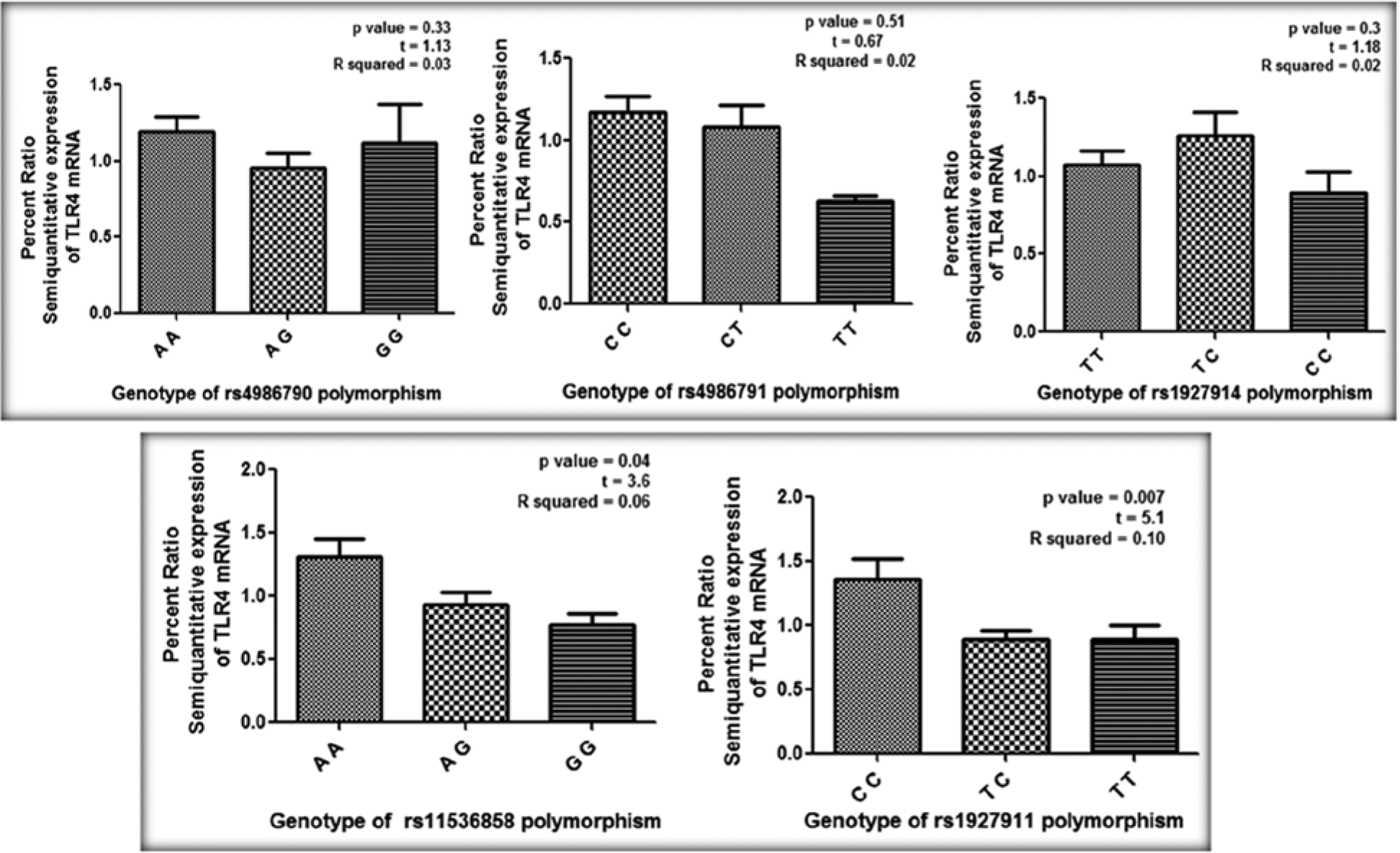
Bar graph showing the comparison of semi-quantitaive Toll-like receptor 4 (TLR4) mRNA expression, as determined by semi-quantitative reverse transcription polymerase chain reaction method, and normalized to GAPDH (glyceraldehyde 3-phosphate dehydrogenase). Graphs are stratified according to genotypes of TLR4 single nucleotide polymorphisms (SNPs) rs4986790, rs4986791, rs11536858, rs1927911, and rs1927914. One-way analysis of variance test was used to check the differences between means of TLR4 mRNA among the groups. A 2-tailed P value <.05 was considered as statistically significant. TLR4 message was found to be significantly different among the nonrisk and risk genotypes for 2 of studied SNPs (P = .04, t = 3.6 for rs11536858 and P = .007, t = 5.1 for rs1927911).
Footnotes
Declaration of Conflicting Interests
The author(s) declared no potential conflicts of interest with respect to the research, authorship, and/or publication of this article.
Funding
The author(s) disclosed receipt of the following financial support for the research, authorship, and/or publication of this article: This work was funded by Department of Science and Technology, New Delhi, India. Financial assistance by the Department of Biotechnology, Ministry of Science and Technology, New Delhi, India in form of a Senior Research fellowship to the first author is gratefully acknowledged.