







Abstract
Buerger’s disease or thromboangiitis obliterans causes pain, ulceration, or gangrene in the lower or upper extremity. It is associated with chronic cigarette smoking and is believed to be an immune mediated vasculitis. The pathogenesis is still unknown but recent postulate of its association with odontal bacteria has generated much renewed interest. Despite its recognition more than a century ago, little progress has been made in its treatment. Until the pathogenesis is elucidated, abstinence from cigarette is the only effective therapy.
Buerger’s disease or thromboangiitis obliterans commonly presents as pain, ulcer, or gangrene secondary to chronic arteritis involving the lower and upper limb arteries. The inflammation also affects peripheral veins and nerves. Buerger 1 first reported the cellular nature of arterial thrombosis in relationship to smoking way back in 1924. The disease had seen an increasing incidence and prevalence after the great wars. Interestingly, the incidence of Buerger’s disease has declined in the past few decades.2 -4 Whether reduction in smoking has a direct causal effect to the reduction in incidence is largely unknown. Buerger’s disease afflicts the small and medium sized vessels in a segmental distribution. The commonly involved vessels are those in the upper and lower extremities. Histopathologically, it has been divided into 3 phases.5,6 In the acute phase, inflammatory thrombi with characteristic polymorphonuclear leukocytes, micro-abscesses and multinucleated giant cells develop in the lumen of arteries and veins. The internal elastic lamina of the vessel wall is spared. In the subacute phase, the thrombi organize but retain the inflammatory characteristics. In the chronic phase, the organized thrombi cause fibrosis of the vessel.
Diagnostic Criteria
Central to the diagnosis is the history of smoking, current or past, as the main etiological agent causing the disease. Distinction is made between Buerger’s disease and other arteritis that may have similar presentation in patients of the same age group. At present, there are two popular criteria being used to diagnose Buerger’s disease.
Shionoya’s 7 criteria for diagnosing Buerger’s include the following 7 :
History of smoking
Onset of ischemia before the age of 50 years
Infrapopliteal occlusion
Involvement of upper limb arteries or phlebitis migrans (Figure 1)
Absence of other atherosclerotic risk factors other than smoking
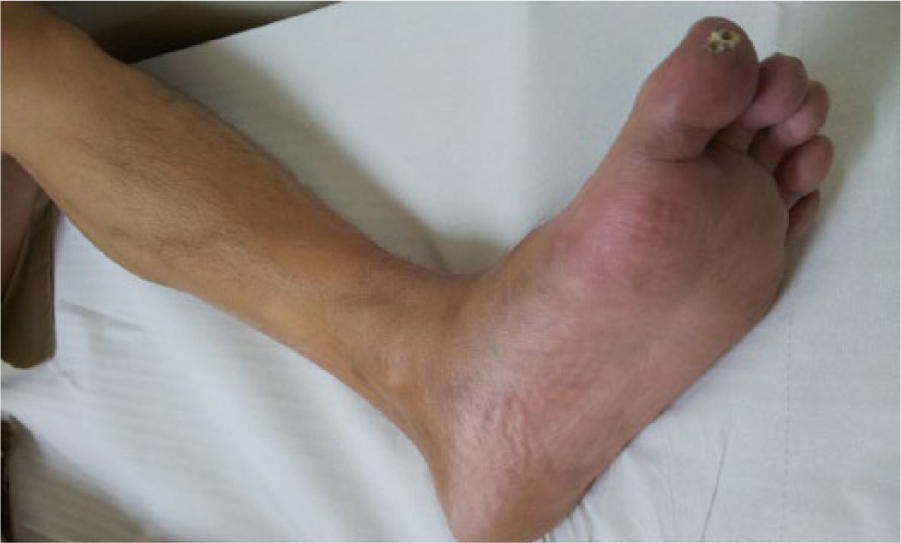
Superficial thrombophlebitis involving medial calf veins.
Olin 8 suggested the following criteria:
Age of onset less than 45 years
Current or recent history of tobacco use
Presence of distal extremity ischemia with claudication, rest pain, ulcers, or gangrene (Figures 2 and 3)
Exclusion of autoimmune disease, hypercoagulable states, diabetes mellitus, and proximal source of embolism
Consistent arteriographic findings in the clinically affected and unaffected limbs
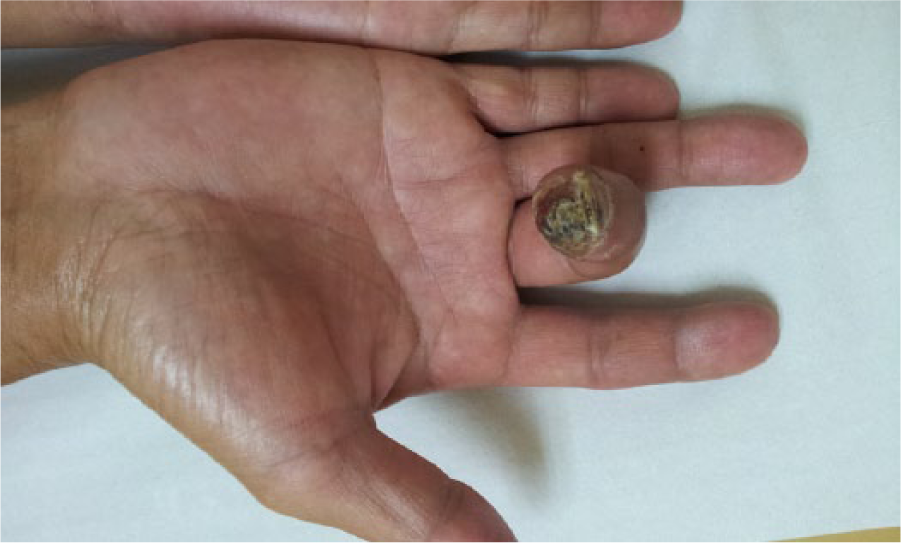
Gangrene at the tip of right middle finger and flexion deformity of proximal interphalangeal joint.
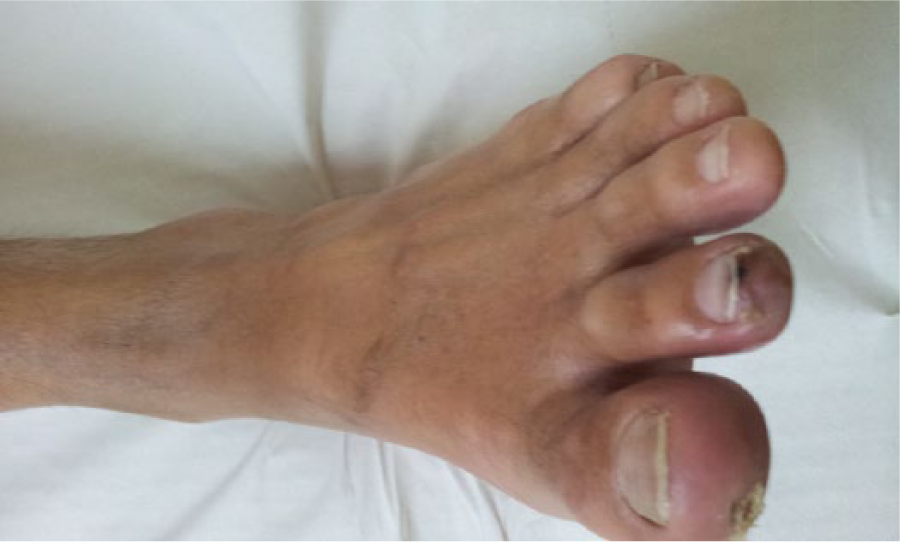
Ulcers at the tip of left big and second toes.
Pathogenesis
There are currently 4 hypotheses of the pathogenesis of Buerger’s disease:
Variant of atherosclerosis
Immunologic arteritis
Odontal bacterial thrombosis
Hyperhomocysteinemia
Buerger’s disease occurs in young and middle-aged men who are heavy smokers and many of them have had a history of smoking for more than 10 years. Women are less often afflicted but the prevalence is increasing possibly due to increasing number of women who smoke.2,9,10 Nicotine itself is atherogenic and whether Buerger’s is a variant of this atherosclerotic process is still unknown. 11 What is inconsistent with this hypothesis is the predilection for involvement of the muscular and small arteries with sparing of the larger arteries. Atherosclerosis cannot explain the migratory thrombophlebitis associated with this condition. It cannot correlate with the characteristic histopathological findings of inflammatory thrombi and the infiltration of mononuclear cells in the vessel wall suggestive of an immune response.
More likely, Buerger’s disease is a manifestation of immune-mediated arteritis. Researches using immunocytochemical studies have demonstrated deposition of immunoglobulins and complement factors in the vessel wall. 12 There is also increased cellular immunity to type I and type III collagens. 13 The inciting agent, however, remains uncertain. In some patients, high titers of antiendothelial antibodies have been detected, suggesting immune reaction towards the endothelium. 14
This draws some similarity to pathogenesis of rheumatic heart disease where streptococcal antigen M-protein mimics human cardiac myosin and anti-myosin antibody, which is directed at the heart valve causing inflammation. 15 This has generated the hypothesis of infective element in the causation of Buerger’s disease. The Japanese group has demonstrated a possible link between oral bacteria and presence of DNA of microbacteria in the vessel wall of Buerger’s patients.16,17 It is postulated that smoking causes chronic gingivitis and proliferation of porphyromonas gingivalis in the oral flora. This bacteria get engulfed by platelets to form an infective thrombus. 18 This infective thrombus then traverses the blood stream causing thrombosis of the small vessels or secondarily occluding the vasa vasorum and vasa nervosum. This may explain the observed association with migratory superficial thrombophlebitis. In one study using polymerase chain reaction technique to detect DNA, 3 of 4 samples of vein biopsy of phlebitis migrans in Buerger’s disease have shown positive periodontal bacteria DNA. 19 What is controversial with this hypothesis is the association of nicotine to porphyromonas gingivalis and whether non-smokers too have such bacteria in the oral flora and whether they too become pathogenic without the effect of nicotine.
Hyperhomocysteinemia is an important risk factor in early onset atherosclerosis and may be implicated in Buerger’s disease. In one study, methionine loading has significantly increased homocysteine level in 55% of patients with Buerger’s disease compared with only 24% of smokers and 19% of non-smokers in the group without vascular disease. 20 A study in Italy noted that there was significantly increased level of homocysteine level in nine patients with Buerger’s disease as compared with healthy comparative subjects. 21 The authors also reported 4 of 9 and 5 of 9 Buerger’s patients were homozygous and heterozygous, respectively, for C677T mutation of MTHFR as compared with only 3 in the control group, suggesting a possible role of homocysteine in the pathogenesis of Buerger’s. Whether increase in homocysteine level is secondary to the damaged endothelium in Buerger’s disease is still unknown. Further studies need to be carried out because hyperhomocysteinemia is curable with folic acid.
Management
Management of Buerger’s disease has remained largely unchanged in the past century. The angiographic findings of distal vessel occlusion with fibrosis of run-off vessels make vascular reconstruction difficult. As the patients are generally young and diagnosis of Buerger’s disease is largely clinical, it is imperative to make a correct diagnosis of Buerger’s by excluding other diseases like atherosclerotic occlusion, popliteal entrapment syndrome, cervical rib and embolic diseases. Other arteritis such as rheumatoid arthritis, Takayasu’s disease, and polyarthritis nodosa must be ruled out. Unlike Buerger’s disease, this arteritis may be amenable to immunosuppressive therapy. Current management of Buerger’s includes the following:
Nicotine cessation
Antiplatelet therapy
Prostaglandin analogue
Cilostazol
Bosentan
Surgery
Sympathectomy
Stem cell therapy
Patients with Buerger’s disease have a strong affinity for nicotine and quitting smoking is a monumental task for them. Studies have nevertheless shown that cessation of nicotine aborts the progression of disease. There have been no studies to show if quitting smoking causes regression of the disease. At present, various measures such as electronic cigarettes and nicotine inhalers have emerged as smoking cessation aid. Their benefits and health risk are still uncertain. Since Buerger’s-afflicted patients are ardent smokers, some form of quit-smoking program may benefit them rather than leaving them to their own effort.
Aspirin and clopidogrel are commonly used in claudicants in atherosclerotics for prevention of secondary vascular events. There are no studies to demonstrate its effectiveness in Buerger’s disease either in improvement of claudication, healing of ulcers, or prevention of vascular events.
Intravenous iloprost, a prostaglandin analogue, has been shown in a randomized controlled trial to be superior to aspirin in the healing of ulcers. 22 A large European thromboangiitis obliterans study involving 319 patients in a randomized controlled trial using oral iloprost compared with placebo has shown significant improvement in rest pain but no significant effect in ulcer healing. 23
Cilostazol is a phosphodiesterase III inhibitor. It acts as a vasodilator and weak antiplatelet. It also decreases viscosity of the blood. There are several isolated case reports that demonstrate the effectiveness of cilostazol in improving digital ischemia. 24
A small study involving 12 Buerger’s disease patients with a median follow-up of 20 months has demonstrated clinical and angiographic improvement after administration of oral bosentan. 25
Surgical reconstruction is rarely possible due to fibrosis of the run-off vessels. In a study involving 216 patients in Turkey, only 10% had undergone arterial revascularization. The majority underwent either lumbar or thoracic sympathetomy. 26 A larger study conducted by Sasajima et al 27 reported a 5-year primary patency of 49% and secondary patency of 62% in 61 patients who were subjected to infrainguinal bypass.
Lumbar and thoracic sympathectomies have been popular modalities in the 1990s to reduce digital pain and improve ulcer healing.25,28 With the advent of minimally invasive procedure, laparoscopic lumbar sympathectomy, and thoracoscopic sympathectomy on Buerger’s are increasingly reported. Several studies have demonstrated the safety and efficacy of both procedures to reduce pain and promote ulcer healing in Buerger’s disease and peripheral arterial disease.29,30 The role of sympathectomy in Buerger’s remains controversial because there are no long term data to affirm its benefits.
Stem cell therapy is widely used to promote angiogenesis in nonreconstructable peripheral arterial disease. A preliminary study involving seven patients with Buerger’s disease have reported limited success in relief of rest pain and healing of ulcers using intramuscular vascular endothelial growth factors. 31 Several studies that followed used autologous bone marrow mononuclear cells to achieve angiogenesis. They reported reasonable outcome in pain relief, ulcer healing, 32 and amputation-free interval. 33 In a long-term observational study, however, adverse events involving life or limb have been reported in patients with Buerger’s disease using bone marrow transplantation. 34 While angiogenesis may be a promising option, more studies are needed to affirm its long-term efficacy and safety.
Conclusion
Buerger’s disease is not an uncommon vascular disorder presenting with extremity pain, ulcer, and gangrene in young to middle-aged adults with a history of chronic smoking. Diagnosis is mainly clinical and exclusion of other vascular diseases is of paramount importance because the treatment modality is different. The mainstay of Buerger’s disease is cigarette abstinence, which may arrest the progression of the disease. Medical therapy with cilostazol or intravenous iloprost may be useful. Vascular reconstruction is rarely feasible and produces poor graft patency rate, especially when the patient continues to smoke.
Footnotes
Declaration of Conflicting Interests
The author(s) declared no potential conflicts of interest with respect to the research, authorship, and/or publication of this article.
Funding
The author(s) received no financial support for the research, authorship, and/or publication of this article.