







Abstract
Bandages are common in many health-related treatments, including management of edema of the lower limb where they may remain in place for several days. The behavior of 2 bandage fabrics was investigated after exposure for up to 5 days to a multiaxial extension laboratory setup on a tensile tester in compression mode. The fabrics were extended 20% and remained under that machine setting. Stress-relaxation over time was determined by analyzing the rate of change over 24 hours and over 5 days. Most change, a rapid drop in force, occurred during the first 15 minutes; thereafter, for the next 12-hour period, a slower rate of decrease was observed. Both fabrics continued to relax gradually during the next 12 hours and continued to do so for up to 5 days. Little further change was evident during the last 12 hours or so. This phenomenon suggests that rewrapping may be appropriate (albeit not practical) after 12 hours of compression therapy to optimize the compression given to the lower leg. Relaxation behavior of these 2 fabrics can be explained using the generalized Maxwell-Wiechert model.
Introduction
Compression bandaging systems are used as a part of several health-related treatments (eg, management of venous disorder, lymphatic disease, and muscle injury). Effectiveness of bandaging depends on the interface pressure applied, the elastic properties of the bandage fabric particularly over time, the physical activity of the patient/user, and ambient conditions. 1 Investigation of bandaging systems commonly includes subjecting them to multiaxial stress, for example, by applying them to a manikin lower leg and measuring the interface pressure between the leg and the fabric (a static setup). However, this measurement is consequential to response of the fabric itself to stress over time. We do know in general terms that stress developed in a textile structure decreases over time due to viscoelastic behavior, 2 but fabric behavior under multiaxial loading is not well understood. From the perspective of a patient for whom bandaging is the treatment, this viscoelastic behavior results in a pressure drop during compression treatment. Differences in the circumference of parts of the lower leg contribute to sub-bandage pressure differences, as does the changing volume of the leg and the consistency of the health care worker in the initial wrapping operation. Therefore, understanding stress-relaxation behavior of fabrics used in bandaging could improve decision-making on properties of fabrics selected and on treatment options faced by health care workers. This work focuses on stress-relaxation of 2 common bandage fabrics, tested under standard laboratory ambient conditions.
Method
Fabric Preparation and Structural Properties
Bandages were selected from those available off the shelf at the time the research was conducted. Two woven cotton structures were selected, crepe and plain, with differences in the structure of both yarn and fabric. A thin plastic film was used as a reference material, and tested before and after each specimen. Fabrics were conditioned at 20 ± 2°C, 65 ± 4% relative humidity in accordance with EN ISO 139:2005 Textiles—Standard Atmospheres for Conditioning and Testing, for a minimum of 24 hours prior to testing. 3 All testing was conducted under these conditions.
Thickness was measured in accordance with ISO 5084: 1996 (E) Textiles—Determination of Thickness of Textiles and Textile Products, 4 using a SDL Atlas thickness gauge, model MO34, foot area 200 mm2, applied pressure = 1000 Pa (accuracy ± 0.01 mm). Measurements were taken at 3 random positions on each specimen (n = 5). Mass per unit area of each fabric (n = 3) was determined in accordance with EN 12127: 1997 Textiles—Fabrics—Determination of Mass Per Unit Area Using Small Samples, and calculated in g/m2. 5 The number of warp and weft yarns per 10 mm was determined at 5 locations on each fabric following ISO 7211/2:1984 Textile—Woven Fabrics—Construction—Methods of Analysis—Part 2: Determination of Number of Threads Per Unit Length. 6
Stress-Relaxation Test Protocol
The effect of fabric type and time on stress-relaxation was determined using a 2 × 2 factorial experiment. Also of interest was the effect of using a sphere or hemisphere of different dimensions to apply force multiaxially (to represent a curved body part). Two polished stainless steel “ball” fittings, a sphere (24.5-mm diameter) and a hemisphere (50-mm diameter) fitted to the crosshead of an Instron bench model tester, were used in 2 separate but related experiments. The specimens and reference fabrics were extended multiaxially by lowering the ball-shaped device, the Instron operating in compression mode. The decision to test in separate experiments was to avoid variability likely if fittings required changing during an experiment. Fabric replicates were arranged in randomized blocks for testing. For each fabric type in each experiment, 3 replicates were tested: 2 replicates for 24 hours, and the third tested continuously for five 24-hour periods.
Fabric specimens were cut in squares (120 mm × 120 mm) with a test area of 78-mm diameter within each square. Each specimen, not previously extended, was placed as a single layer between the lower and upper plates of a circular clamping ring mounted in the lower grip of the tensile tester and secured. The ring clamp used for both ball fittings was the same, and each specimen was positioned at the center of the clamping ring. The clamping ring was manually operated, and bolts holding the ring in place were tightened to 10 N m using a torque wrench. A load cell of 1000 N was used, with a 0.5-N preload applied to the specimen prior to commencing the test. The preloaded point was set as zero extension. The ball was pressed perpendicularly on the technical rear of each specimen (as would be the case when the fabric was in use), to an extension of 20%, at a crosshead speed 200 mm/min. Extension of the fabric was determined from preliminary tests, and 20% was selected as appropriate (Figure 1).
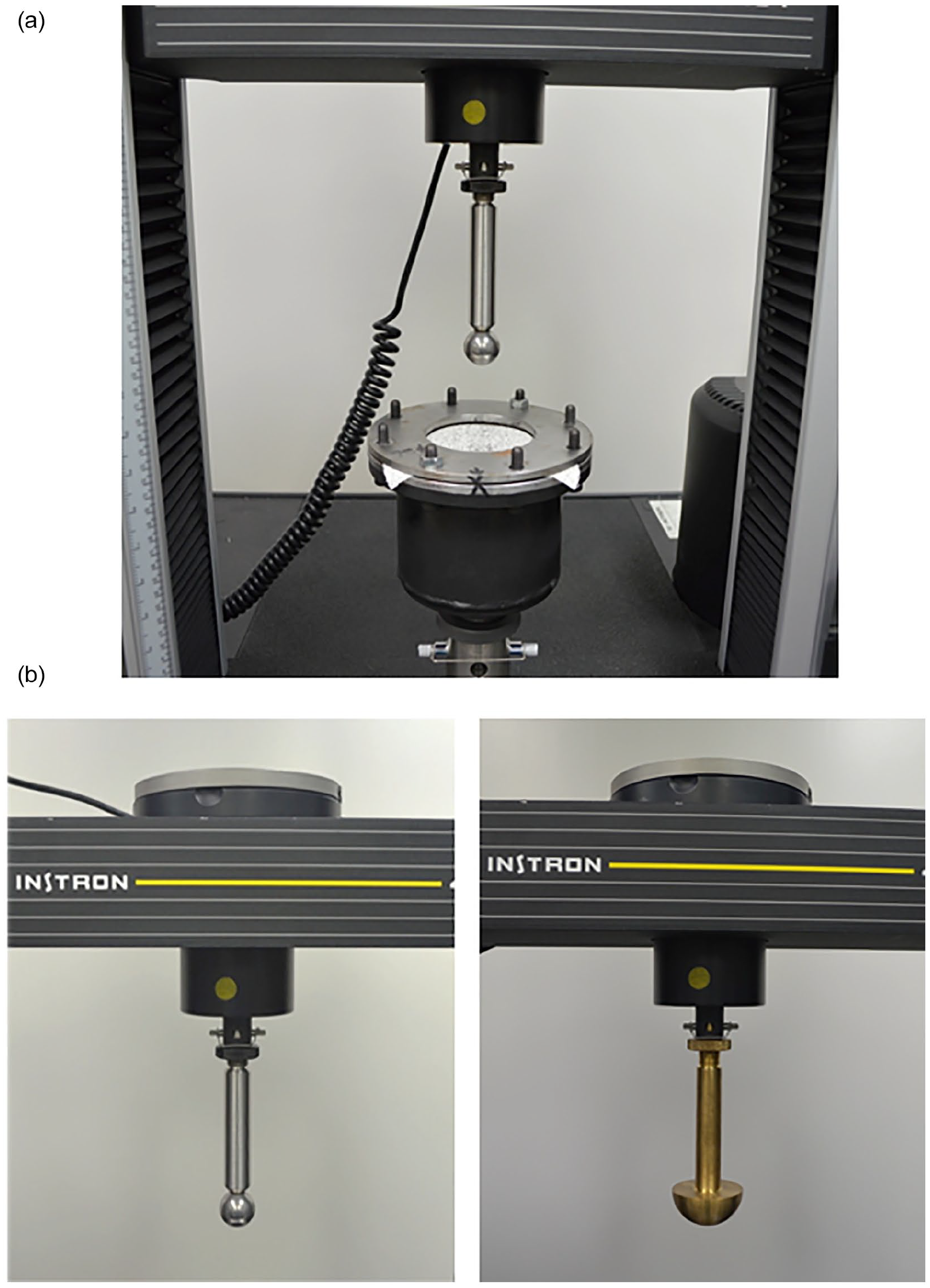
Instrumental setup. (a) Ring clamp and ball attachments; (b) ball fittings (left, 24.5 mm; right, 50 mm).
Data Collection and Analysis
Data were collected using PowerLab 16SP and LabChart 7.4.2 for Windows, with 1 data point per second recorded as force against time coordinates. Data from LabChart 7.4.2 were transferred to Microsoft Excel. 7 In compression mode, data were recorded as negative values and then converted to positive values to facilitate interpretation. All data were normalized to adjust values measured on different scales to a notionally common scale. The equation used to normalize data was force value/maximum force value. Curves (force over duration) were constructed from the normalized data using Microsoft Excel. 7
The data for maximum force and decreasing force over time were extracted from the curves as follows: every minute for the first 15 minutes from peak maximum force; every hour for the first 12 hours; every hour for 24 hours; and 31 time-independent data points selected over the 24-hour period based on their contribution to describing the character of the different curves over the test period. Differences between maximum forces were determined using data before normalization, while normalized data were used to determine stress-relaxation over time. When examining maximum force, data were first checked using the Levene’s equality of variance test to ensure the assumptions of the analysis were met. 8 Repeated-measures analyses were undertaken to determine the effect of time on stress-relaxation (ie, over 15 minutes, 12 hours, 24 hours, and points selected as characteristics of the curve). 8 Mauchly’s test of sphericity was used to test the covariance matrix for equal variance, and when Mauchly’s test of sphericity was significant or undefined, the Greenhouse-Geisser correction was applied. 8
The normalized stress-relaxation curve fitting procedure was conducted using R program. Elements of the Maxwell model (a spring and a dashpot in series) used in Maxwell-Wiechart mechanical model were used to represent an exponential term of the following equation,9,10

where P(t) is the normalized force as a function of time, P0 is the magnitude of the residual force after t = ∞, and P1 and τ1 are the constants of the ith term in the function. 9 The springs connected in the model are parallel, representing the asymptomatic residual force over a period of time. 9
Results
Structural Properties of Fabrics
Structural properties of the fabrics are as follows: thickness—crepe 1.32 ± 0.02 mm, plain 1.04 ± 0.01 mm; mass per unit area—crepe 182.5 ± 1.81 g/m2, plain 303.5 ± 6.26 g/m2; and yarns per 10 mm warp/weft—crepe 58.4 ± 0.55/61.2 ± 0.84; plain 87.2 ± 0.84/80.0 ± 1.00. The crepe bandage was thicker than the plain by ~27% (1.32 mm, 1.04 mm, respectively), but approximately two thirds of the mass per unit area, and with different sett.
Stress-Relaxation
There was no evidence of significant machine drift, change in ambient conditions, or operator change over the experimental period, the maximum force not differing significantly (24.5 mm F1,6 = 0.35, not significant [NS]; 50 mm F1,6 = 0.02, NS). The effect of differences in the fabric/yarn structure was apparent initially (initial force) with the 50-mm ball but not the 24.5-mm ball (F1,4 = 1.36, NS; F1,4 = 14.62, P ≤ .001, respectively), thus providing the rationale for normalizing data prior to further analysis.
The stress-relaxation curve from the first 15 minutes shows force dropped rapidly during the first minute of the cycle, thereafter more slowly to 15 minutes. This pattern was evident for both fabrics and ball sizes (Table 1 and Figure 2). Time dominated the response patterns irrespective of the ball type. When differences between fabrics were examined over time, no difference in the pattern of force to extend the fabrics was identified when using the 24.5-mm ball (F2.14,8.55 = 1.06, NS), although this was not so with the 50-mm ball (F1.41,5.63 = 6.14, P ≤ 05). The cumulative change evident in the crepe was less than that with the plain fabric for both balls after 15 minutes (24.5 mm = 36.7%, 42.9%, respectively; 50 mm = 33.8%, 49.0%, respectively).
Significance of Differences in Fabric Stress-Relaxation at Selected Times.
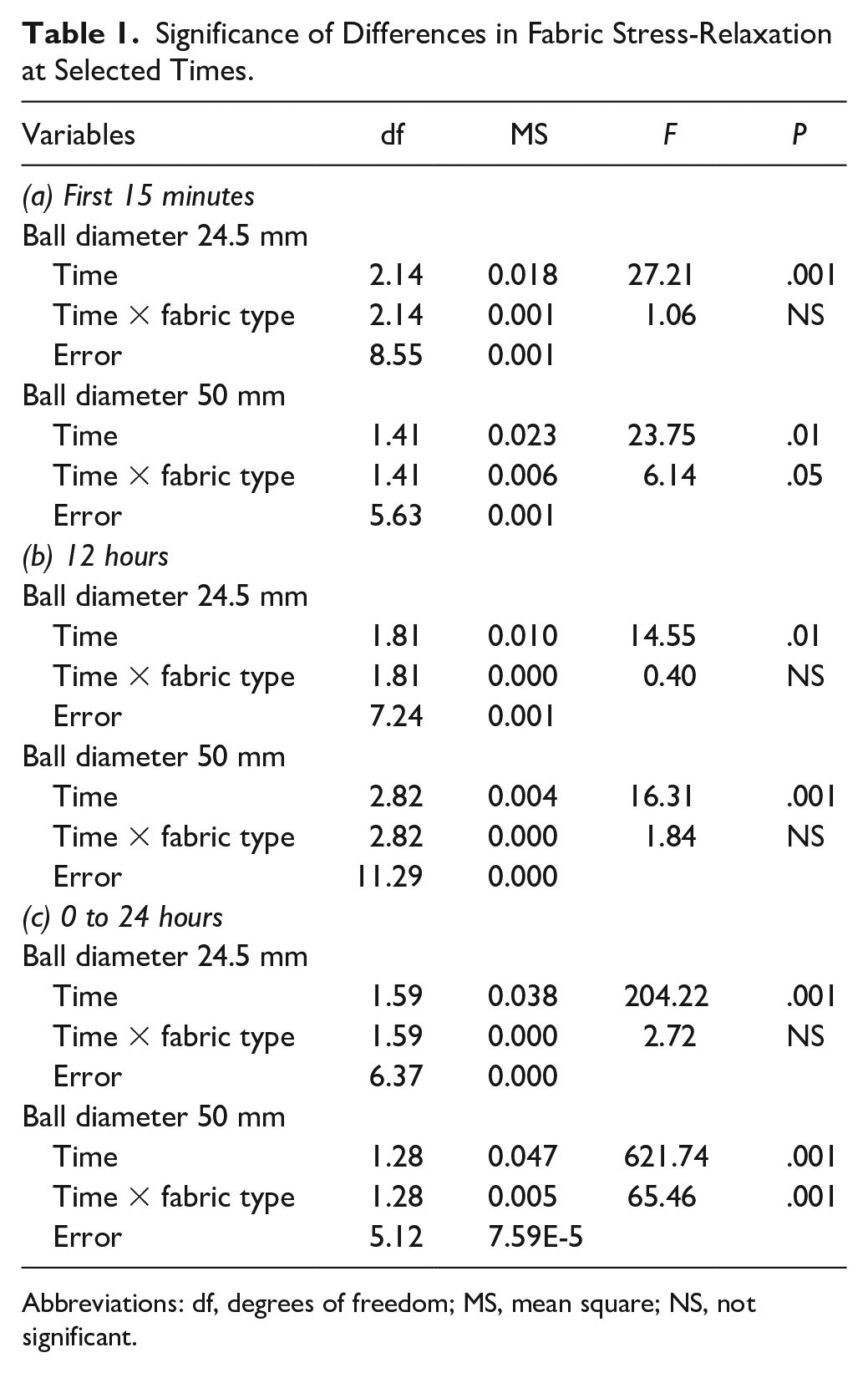
Abbreviations: df, degrees of freedom; MS, mean square; NS, not significant.

Force-time curves of fabric stress relaxation over different exposure times using different ball sizes. (a) First 15 minutes, 24.5 mm; (b) first 15 minutes, 50 mm; (c) first 12 hours, 24.5 mm; (d) first 12 hours, 50 mm; (e) 24 hours, 24.5 mm; (f) 24 hours, 50 mm.
The force required to hold the specimen extended continued decreasing, relatively quickly for the first hour and more slowly over the first 12 hours, with both fabrics behaving similarly (Figure 2). The trend was similar for both balls with force changing significantly over time (F1.81,7.24 = 14.55, P ≤ .01; F2.82,11.29 = 16.31, P ≤ .001, respectively).
Both fabrics exhibited important time-related differences during the period 0 to 24 hours (24.5 mm F1.59,6.37 = 204.22, P ≤ .001; 50 mm F1.28,5.12 = 621.74, P ≤ .001), with force decreasing more slowly over the period 12 to 24 hours. What did differ was the effect of the different balls on the response, not significant with the 24.5-mm ball (F1.59,6.37 = 2.72, NS) and significant with the 50-mm ball (F1.28,5.12 = 65.46, P ≤ .001). Less cumulative change was evident with the crepe than the plain fabrics after 24 hours (24.5 mm = 47.4%, 52.9%, respectively; 50 mm = 46.9%, 54.6%, respectively). The plain fabric, heavier and with a less extensible yarn and a closer yarn construction, required greater force to remain extended than the crepe fabric. After 24 hours and up to 5 consecutive days, the force curves continued to decrease relatively steeply until 72 hours, beginning to plateau after 72 hours, and continuing along this plateau to the end of day 5. This pattern was evident irrespective of ball dimension.
Characterizing the 24-Hour Curve: Curve Fitting Using an Exponential Decaying Function
A few points on the curve that represented visual differences were selected for further analysis of the 24-hour period. The stress-relaxation behavior of the fabrics under all 4 test combinations was well described using the Maxwell-Wiechert mechanical model, using an exponential decaying function. For the stress-relaxation studied, all combinations were well predicted by their associated functions with R2 > 0.99 in all cases (Table 2).
Estimates of Maxwell-Wiechert Parameters and R2 Values, Both Fabrics and Both Balls After Analysis Using an Exponential Decaying Function.
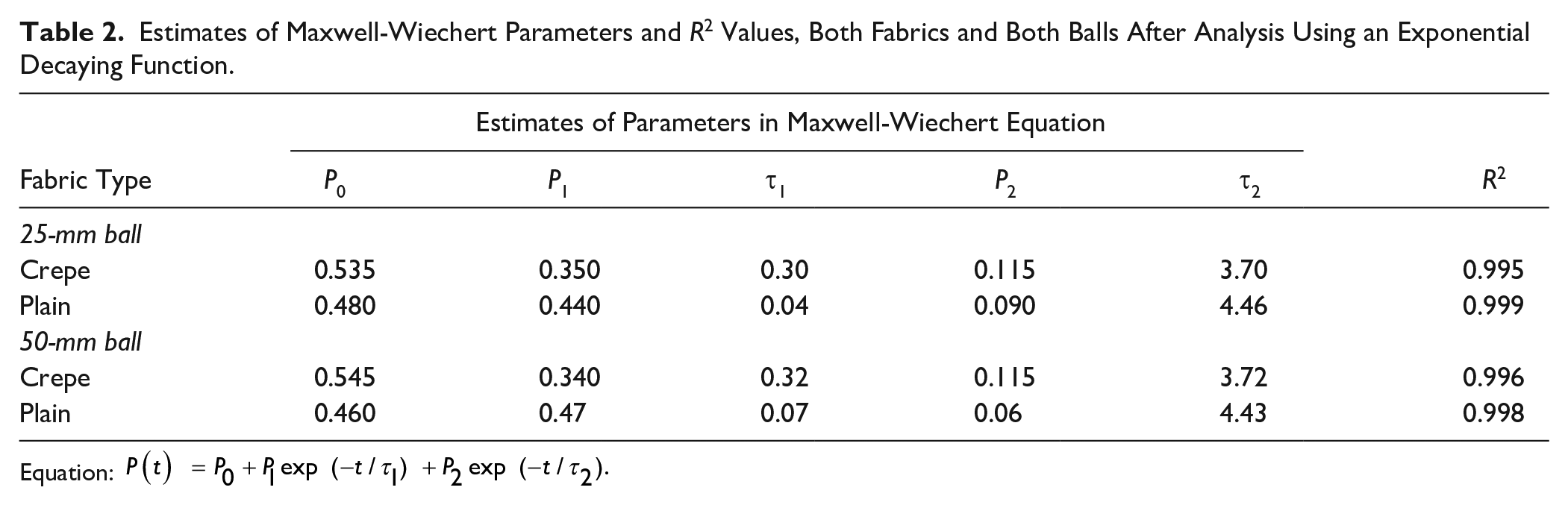
Equation:
Discussion
The time during which stress was applied to fabrics and the effect of this on the fabrics is directly relevant to health-related treatments. Stress-relaxation was evident within minutes, rapid changes at first, then more slowly, eventually plateauing around 4 days. The pattern of response was similar with the 2 fabrics, although the plain weave fabric was more resistant to stress-relaxation, likely due to the more extensible yarn of the crepe fabric (crepe yarn is highly twisted). The practical consequence of this shows that external tension applied to a fabric results in change in pressure applied over the lower leg over time, attributable to differences in structure and material type.11,12 In our study, the fiber composition of the bandages was the same (ie, 100% cotton); thus, it was the fabric/yarn structure that accounted for the differences observed, the plain weave fabric requiring greater force to extend and maintain extension over time than the crepe structure. Fabrics with tighter structure show a greater percentage of force reduction after a 24-hour period than fabric with looser structure, consistent with the work of Kumar et al. 11
The capability of a fabric to maintain pressure when used as a bandage on a body part greatly depends on the capacity of that fabric to sustain the internal stress imposed on the fabric by extension. 11 The stress developed in the fabrics decreases over time because the fiber and yarns in the materials tend to organize themselves into arrangements that impart the least stress in the system.13-15 Both fabrics showed that the force (N) diminished relatively swiftly over the first 12-hour period, and continued to decrease, but more slowly over the next 12-hour period. The force continued decreasing then began to stabilize between 24 and 72 hours (day 3), and to begin plateauing at a similar rate for the remainder of the test (up to 5 days). These results are consistent with previous studies on shorter time periods, where more than 50% of the reduction in the initial interface pressure took place within the first 12 hours, with the internal pressure diminished after 2 days.13-15 Most changes were in the first 3 hours.
The relaxation behavior of fabrics used in bandaging can be explained using the generalized Maxwell-Wiechert model by describing the basic elements in the spring and dashpot models.10,16,17 The spring represents the linear elastic behavior, while the dashpot denotes the viscous behavior of the Newtonian fluid.18-20 Stress-relaxation was observed in all replicates during testing, where both fabrics changed to a new and relaxed state. All combinations of tests (2 ball dimensions, 2 fabrics) show good fit, suggesting that the Maxwell-Wiechert model is suitable to describe what happens to the fabrics.
Factors such as yarn twist, yarn dimensions, ambient temperature and humidity, movement of a leg or other body part, not considered in the present investigation, may also influence the stress-relaxation behavior of fabrics over time and warrant clarification. Findings of the present study do suggest that a bandage needs to be changed or rewrapped earlier than indicated by other investigators, that is, 24 to 48 hours.13-15 In real applications, a patient needs to be rewrapped to maintain the pressure required and thus optimize healing.2,19,21,22
Conclusion
Knowledge of stress-relaxation behavior of bandage (and other) fabrics over time is critically important in that it contributes to better understanding losses in efficacy of a treatment in which bandages and other textile products are applied, to manage edema, for example. This form of treatment typically remains in place for several days before rewrapping or replacement. Experimental work described here shows that stress-relaxation occurs quite quickly and continues over several days, and the practical consequence of which is that the interface pressure exerted on a limb will decrease over time; thus, the effectiveness of bandaging as the treatment is reduced. A confounding factor is the concurrent reduced venous volume resulting from the treatment, reducing the limb circumference, potentially further reducing efficacy of bandaging treatment. Reducing the rate of stress-relaxation through improved design of bandage structures is a technical challenge yet to be resolved, but meanwhile practitioners need to be aware of these changes to the fabrics during use.
Footnotes
Declaration of Conflicting Interests
The author(s) declared no potential conflicts of interest with respect to the research, authorship, and/or publication of this article.
Funding
The author(s) received no financial support for the research, authorship, and/or publication of this article.
