







Abstract
Pyoderma gangrenosum (PG) is a neutrophilic inflammatory dermatosis, whose management still represents a clinical challenge due to frequent unresponsive cases. The aim of our study was to evaluate the efficacy of a novel, combined approach including local wound management, based on the principle of PG-TIME and a systemic therapy with an anti interleukin (IL)-17A monoclonal antibody (mAb). We presented a case of a 37-year-old female patient, affected by multi-refractory PG. The patient was treated with a combined approach of both local and systemic therapy. Wound clinical improvement was assessed by Wound Bed Score (WBS), wound size was evaluated through 3D camera laser scanner, and pain was evaluated with visual analog scale (VAS). After 52 weeks of therapy, the association of local wound management with ixekizumab 80 mg [160 mg at time (T) 0; 80 mg every 2 weeks until week 12; 80 mg every 4 weeks] allowed us to perform skin grafting and obtain complete wound healing. Our clinical case demonstrated the efficacy of a novel combination therapy for the treatment of recalcitrant PG based on IL-17 mAbs and local wound management built on the main features of PG-TIME.
Keywords
Background and Aim
Pyoderma gangrenosum (PG) is a neutrophilic inflammatory dermatosis that presents with rapidly developing skin ulcers, which often occur after a minor trauma (pathergy phenomenon). 1 Treatment of PG involves both local and systemic therapies, even if multi-refractory PG cases represent a frequent clinical challenge.2,3 The aim of our study was to evaluate the efficacy of a novel combined approach of local therapy guided on the basis of PG-TIME and systemic therapy with ixekizumab, an anti-interleukin (IL)-17A monoclonal antibody (mAb). 3
Case Report
A 37-year-old female patient was admitted to our clinic on March 2021 with a painful ulcerative lesion on the left lower limb. The ulcer presented with necrotic adherent tissue, inflammatory edges, signs of critical bacterial colonization, and tendon exposure (Figure 1a). A diagnosis of hidradenitis suppurative (HS) and PG was made in 2015 and 2017, respectively. The patient previously failed multiple therapies, including steroids, cyclosporine, dapsone, and adalimumab, interrupted after 1 month because of the patient's pregnancy. PG ulcer was initially treated with negative pressure wound therapy (NPWT), using antiseptic polyurethane foam, silicone interface covering the tendon, and compression bandage (Figure 1b). At each follow-up, we performed wound bed score (WBS), and we measured ulcer dimensions using a 3D camera laser scanner (Star™, Aranz, New Zealand) and pain assessment using the visual analog scale (VAS).
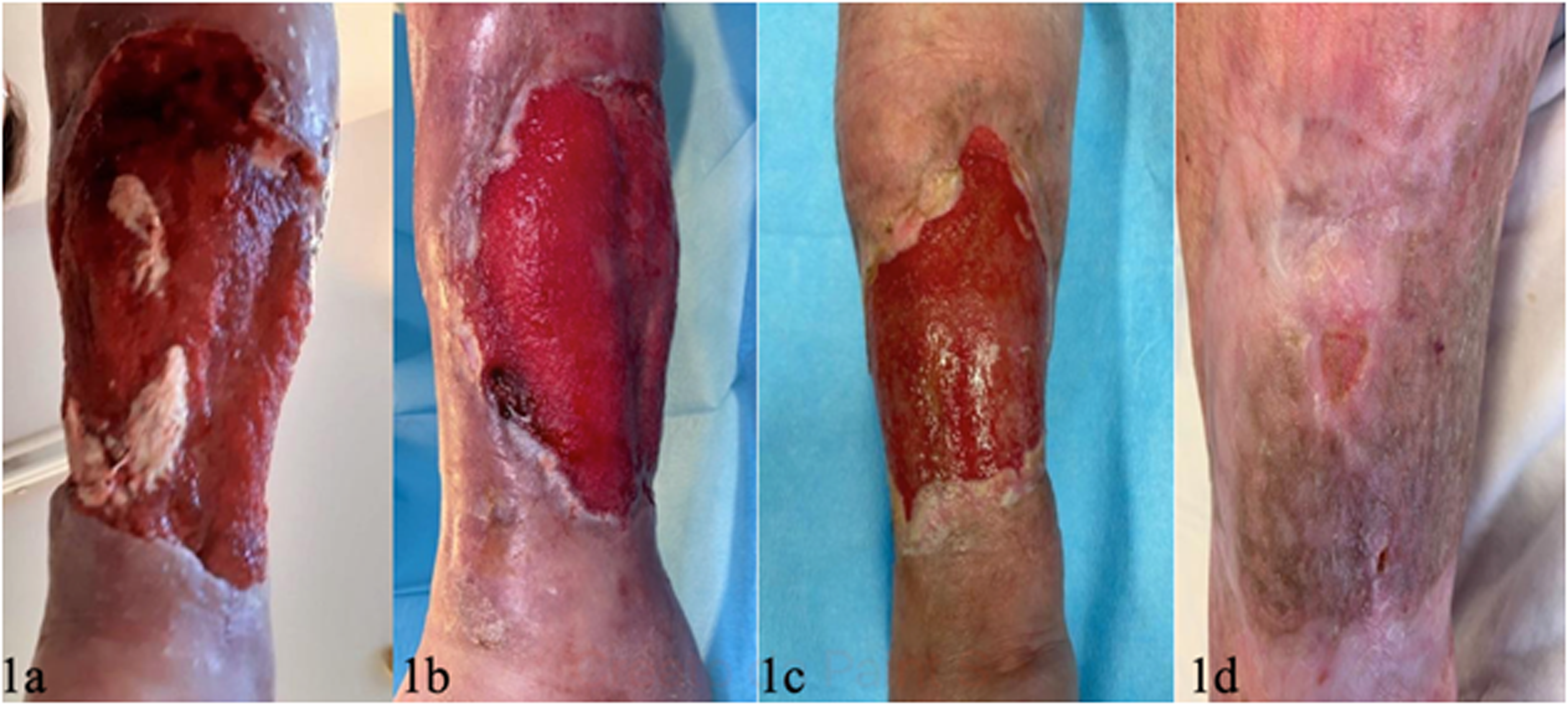
(1a) Clinical image at first visit time (March 2021). (1b) Clinical image after 1 month of negative pressure wound therapy (NPWT), right before the start of ixekizumab 80 mg (April 2021). (1c) Clinical image after 52 weeks of ixekizumab (April 2022). (1d) Clinical image of complete healing after autologous skin graft (July 2022).
In April 2021, due to the reduction of clinical signs of bacterial colonization, we started a systemic therapy with ixekizumab 80 mg (160 mg at time [T] 0; 80 mg every 2 weeks until week 12; 80 mg every 4 weeks). In July 2021, we observed a clinical improvement and decided to perform a homologous skin graft, which did not lead to a satisfactory healing (WBS: 3, area: 25 cm2, VAS score 12). After 52 weeks (WBS: 10; area: 12 cm2, VAS score: 4), the improvement in WBS and the reduction in size (Figure 1c) allowed us to attempt a new surgical approach with an autologous skin graft from the anterior surface of the right thigh, resulting in complete wound healing (Figure 1d).
Discussion and Conclusion
PG represents a challenging disease since no standardized therapies or international guidelines are available for its management. 2 Local wound management plays a key role in the healing process, and skin grafting is regarded as a successful therapeutic tool for PG management. 4 Particularly, NPWT is a well-established method for the treatment of complex wounds, 5 though its use in patients affected by PG is controversial due to the possibility of pathergy phenomenon. NPWT is able to decrease tissue edema, improving blood circulation and reducing the local bacterial load. 5 Recently, it was suggested that a pivotal role played by adaptive immunity, particularly the one promoted by T helper-17 (Th-17) cells and IL-17 in the development of PG skin lesions. 6 They are preferentially Th1 or Th17 cells, and they can produce different inflammatory cytokines like IL-17A, which induces other cells to release chemokines that support the migration of neutrophils and monocytes. 7 Moving from these molecular evidences, several clinical trials have been carried out on the use of IL-17 inhibitors for PG. 1 Biological therapy induced the PG transition to the noninflammatory phase, thus allowing us to perform an autologous skin graft.
This case report demonstrates the successful management of PG lesions through the association of systemic therapy with an anti-IL-17A mAb and a PG-TIME-guided local therapy based on advanced dressings, skin grafting, and NPWT. Moreover, our novel combination would allow the clinician to obtain a clinical improvement of the ulcerative lesions and inflammatory state, avoiding the pathergy phenomenon.
Footnotes
Declaration of Conflicting Interests
The author(s) declared no potential conflicts of interest with respect to the research, authorship, and/or publication of this article.
Funding
The author(s) received no financial support for the research, authorship, and/or publication of this article.
