






Abstract
Diabetic Foot in Primary and Tertiary (DEFINITE) Care is an inter-institutional, multidisciplinary team (MDT) program for patients with diabetic foot ulcers (DFU) within a healthcare cluster in Singapore. This is one of our subgroup analyses within DEFINITE Care, assessing clinical outcomes of lower extremity amputation prevention program (LEAPP), a multidisciplinary diabetic foot clinic, and non-LEAPP patients within the program. From June 2020 to June 2022, 2798 patients within the DEFINITE cohort completed a minimum of 12-month follow up. Of these patients, 20.6% were managed by LEAPP, whereas 79.4% were non-LEAPP patients. Patients in the LEAPP cohort were older with co-existing metabolic conditions and complications of diabetes. Using non-LEAPP cohort as the reference group and after adjusting for age, gender, ethnicity, comorbidities, and medications, there was a significantly lower risk of death (odds ratio [OR] 0.60, P = .001) and composite major lower extremity amputation (LEA) or death (OR 0.66, P = .002) among LEAPP patients at 1 year with longer mean days from enrollment to minor LEA, major LEA, and death. The adjusted 1-year healthcare utilization outcomes for LEAPP patients demonstrated an increase in inpatient admissions, primary care polyclinic visits, hospital specialist outpatient clinic (SOC) visits and elective day surgery procedures. Despite the increased in inpatients admissions, cumulative hospital length of stay in LEAPP patients were lower. This subgroup analysis has demonstrated that the MDT approach to caring for patients with DFU in tertiary centers not only improves mortality by 40%, but also delayed the incidence of minor LEA, major LEA, and death.
Introduction
Diabetes mellitus (DM) is a global health problem with more than half a billion people living with DM around the world, 1 with a consequent rise of diabetes-related complications and mortality. In 2019, DM and its complications caused almost 2 million deaths, with 48% of all deaths due occurring before the age of 70 years. 2 One major complication of DM is diabetic foot ulcers (DFU). The lifetime incidence of DFU is estimated to be between 19% and 34%, 3 and is the leading cause of nontraumatic lower extremity amputation (LEA). Peripheral neuropathy and peripheral arterial disease (PAD) contributes to the underlying pathophysiology of DFU, which leads to diabetic foot infections and subsequently LEA. Furthermore, it has been well demonstrated that PAD is at least 2 times more prevalent in individuals with DM compared to those without DM.4-8 In these individuals, the risk of LEA may be 4-fold higher.9-10 In addition, DFU with PAD are associated with poorer wound healing, higher mortality and LEA rate when compare to individual with DFU without PAD. 11 Patients with DFU are 10 to 20 times more common to have LEA than those without diabetes. 12 DFU poses significant impact on mortality, with a 5-year survival after an amputation at 70%. 13 It is also associated with loss of mobility, reduced overall productivity, and poorer quality of life. 14
Among Singapore residents aged 18 to 69 years, the prevalence of DM was 8.6% in 2017. 15 This is expected to rise, and the International Diabetes Federation estimates a DM prevalence of 13.7% for the entire adult population of Singapore by 2030. 16 Although the prevalence of diabetes echoes global trends, Singapore has one of the highest rates of LEA in the world, with major LEA rate 3 times the Organisation for Economic Co-operation and Development average of 60 LEA per 100 000 population in 2015. 17 A significant clinical and economic burden of DFU has been shown in Singapore, 18 with an average length of hospital stay (LOS) for each wound episode at 17.7 days 18 ; 2.4 times that of an average acute admission. 18 The estimated gross healthcare cost per patient was up to US $17 761 across wound categories. 18
Multidisciplinary team (MDT) approach in the management of DFU have shown to improve outcomes in limb preservation,19-21 and is the recommended current standard of care in international guidelines.13,22 In 2017, we have instituted a DFU multidisciplinary rapid access clinic termed as lower extremity amputation prevention program (LEAPP) in our hospital. With this, we have previously demonstrated a significant reduction in minor and major amputation rates with an annual cost avoidance of US $1.86 million. 23 LEAPP has made early access to specialist care possible, expedited vascular investigations and intervention, and improved podiatry attendances. 23 Scaling up the success of our LEAPP to the broader community, Diabetic Foot in Primary and Tertiary (DEFINITE) Care was developed in June 2020. 24 This is an inter-institutional MDT program within a healthcare cluster in Singapore, consisting of 7 primary care polyclinics and 2 tertiary hospitals, to coordinate the care of patients with DFU from primary to tertiary care, with subsequent co-management between primary and tertiary care until complete DFU healing. 24
In this study, we performed a cohort study, evaluating the clinical outcomes of patients with DFU within DEFINITE Care who were managed in the LEAPP clinic versus those who were not managed by the LEAPP clinic.
Methods
From June 2020, all patients who present with DFU to the 7 primary care polyclinics, and 2 tertiary hospital LEAPP clinics and DFU-related inpatient admissions are recruited within DEFINITE Care. 24 Detailed methodology of DEFINITE Care has been described in our previous publication. 24 Data from all patients prospectively recruited within DEFINITE Care are stored within this standing database. Prospective clinical, administrative, and direct healthcare costs follow-up data are captured within the healthcare cluster's chronic disease management registry for diabetes, with relevant International Classification of Diseases (ICD10) diagnosis codes, surgical procedure codes, and service codes. 24 This study will focus on the tertiary care component of DEFINITE Care, assessing clinical outcomes of LEAPP and non-LEAPP patients within the program.
In brief, at a tertiary care level, LEAPP clinic services were scaled up across both hospitals, with key interventions including early access, optimization of glycaemic control and medical risk factors, prompt revascularization, active wound care, appropriate offloading footwear, and patient education. 24 Members of the LEAPP MDT include podiatrist, diabetic nurse clinicians, wound nurses, vascular, orthopedic, plastic and reconstructive surgeons, endocrinologist, and infectious disease physicians. Referral sources to the clinic include patients with DFU from primary care, emergency department (ED), specialist outpatient clinic (SOC), and from inpatient wards for review postdischarge. 23 In accordance with the International Working Group of the Diabetic Foot (IWGDF) guidelines, 22 our MDT LEAPP clinic provide a coordinated and expedited access for patients with DFU. The selection criteria for LEAPP clinic include patient above 21 years of age, with pre-existing DM and foot ulcers distal to the malleolus. 23 Patients with venous ulcers or ulcers of mixed arteriovenous etiology were excluded from the study. 23
For this study, only patients in DEFINITE Care who were followed up for at least 12 months at the time of analysis were included. Demographic factors and outcomes were described using descriptive statistics. 23 Percentages were used for categorical data; and means with standard deviations (SDs) as well as medians and interquartile ranges (IQR) were used for continuous data. 23 The distribution of continuous outcomes was examined using Shapiro-Wilk W test. Unadjusted differences in 1-year outcomes (including number of inpatient admissions, cumulated length of stay [LOS], number of episodes at Day Surgery, Polyclinics, and SOC, number of minor and major LEA, death, as well as their composite outcomes) between LEAPP and non-LEAPP cohort were examined using Mann-Whitney U tests for continuous outcomes (since all continuous outcomes were not normally distributed) and chi-squared tests for binary outcomes. Poisson regression for continuous outcomes and logistic regression for binary outcomes were carried out, with and without adjusting for age in years, gender, race, diagnosis of diabetic retinopathy, ischemic heart disease (IHD), end-stage renal failure (ESRF), stroke; severity of chronic kidney disease (CKD), prescription of antiplatelet drug, anticoagulant drug, anti-hypertensive drug, anti-DM drug, lipid lowing drug; and LEA in past year. A P value of <.05 was considered statistically significant, and all P values were 2-tailed. Statistical analyzes were performed using Microsoft Excel 2016 (Microsoft, Redmond, Washington) and R software version 3.6.1 (R Foundation, Vienna, Austria).
This study had been approved by the institutional ethics review board (National Healthcare Group Domain Specific Review Board 2021/01154), with data from the approved standing database TTSH/2020-00032. 24
Results
There were a total of 4274 patients within DEFINITE Care, with 2798 patients completing a minimum of 12-month follow up (Figure 1). Of the 2798 patients, 577 (20.6%) LEAPP patients and 2221 (79.4%) non-LEAPP patients who presented between June 2020 and June 2022 were included in the analysis. Baseline characteristics of both groups are shown in Table 1. Patients in the LEAPP cohort were older with a mean age of 67.4 versus 65.3 years in the non-LEAPP cohort (P < .001). There was no difference in gender, smoking status, mean HbA1c, and mean creatinine clearance. There were higher proportion of Chinese (58.6% vs 55.0%, P = .002) and Indians (21.3% vs 17.2%, P = .002) in the LEAPP compared to the non-LEAPP cohort.
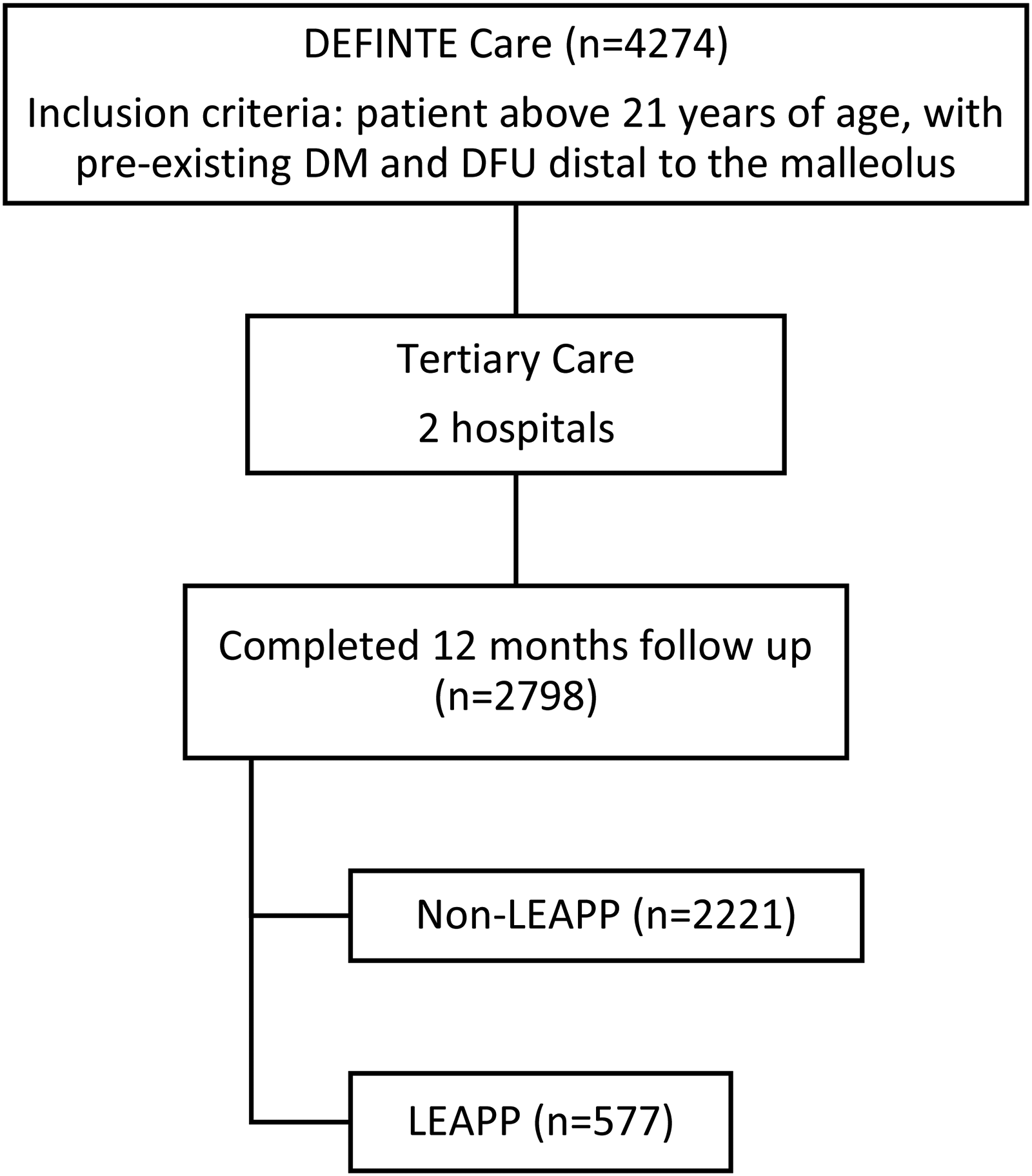
Methodology and patient selection for analysis.
Baseline characteristics.
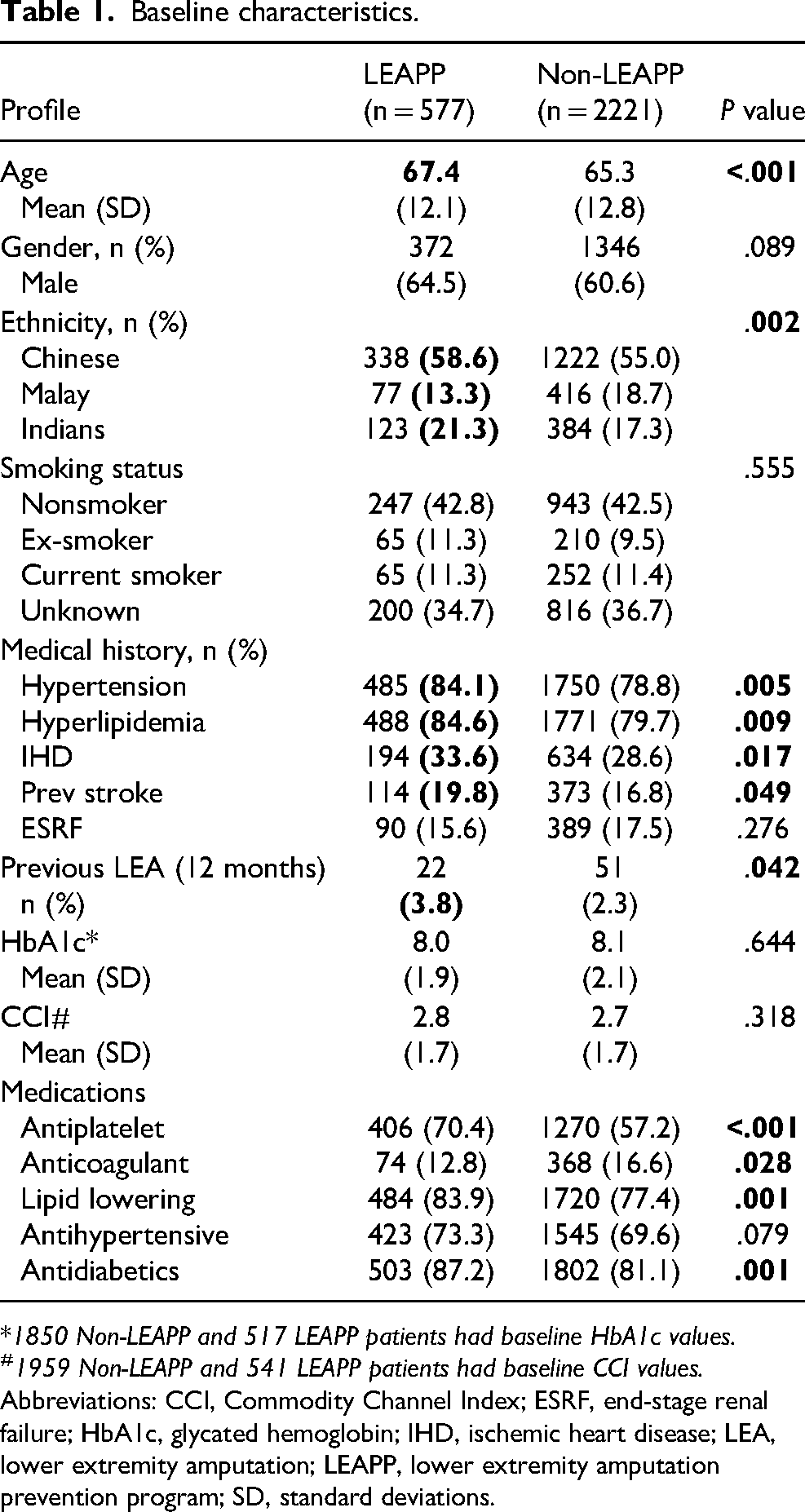
*1850 Non-LEAPP and 517 LEAPP patients had baseline HbA1c values.
# 1959 Non-LEAPP and 541 LEAPP patients had baseline CCI values.
Abbreviations: CCI, Commodity Channel Index; ESRF, end-stage renal failure; HbA1c, glycated hemoglobin; IHD, ischemic heart disease; LEA, lower extremity amputation; LEAPP, lower extremity amputation prevention program; SD, standard deviations.
Patients in the LEAPP cohort had higher prevalence of other co-existing metabolic conditions of hypertension (84.1% vs 78.8%, P = .005) and dyslipidaemia (84.6% vs 79.7%, P = .009). They were also more likely to suffer from complications such as ischemic heart disease (IHD) (33.6% vs 28.6%, P < .02), stroke (19.8% vs 16.8%, P < .05) and had a LEA in the past 1 year (3.8% vs 2.3%, P < .05). There was no difference in the prevalence of end-stage renal failure (ESRF), severity of chronic kidney disease or diabetic retinopathy (adjusted). Patients in the LEAPP cohort were more likely to be on an antiplatelet (70.4% vs 57.2%, P < .001), anticoagulant (12.8% vs 16.6%, P < .03), lipid lowering (83.9% vs 77.4%, P = .001), and antidiabetic agent (87.2% vs 81.1%, P = .001).
Healthcare utilization was more frequent in the LEAPP cohort (Table 2). Attendances at Day Surgery (mean: 0.58 vs 0.37, P < .001), SOC (mean: 8.32 vs 4.89, P < .001), and polyclinics (mean: 4.10 vs 2.69, P < .001) were significantly higher in the LEAPP cohort. These remained elevated after adjusting for differences for baseline characteristics. Additionally, inpatient admissions (IRR 1.09, 95% confidence interval [CI] 1.01-1.18, P = .03) and ED presentations (internal rate of return (IRR) 1.10, 95% CI 1.02-1.19, P = .01) were higher in the LEAPP cohort. There was, however, no difference in number of ED presentations after adjusting for difference in baseline characteristics. Despite the increased rate of admission, cumulative LOS was shorter in the LEAPP cohort (IRR 0.95, 95% CI 0.93-0.97, P < .001). Adjusted rate of minor and major LEA showed no difference between cohorts. Mean days to a minor LEA (91 vs 61; P < .001), major LEA (146 vs 87; P < .001), and death (211 vs 155; P < .001) were significantly longer in the LEAPP cohort compared to the non-LEAPP cohort (Table 3).
Unadjusted comparison in 1-year outcomes between LEAPP and non-LEAPP patients.

*Only patients with respective event were included for analysis.
#P value was generated using Mann-Whitney U test for continuous outcomes and chi-squared test for binary outcomes.
Abbreviations: ED, emergency department; IQR, interquartile range; LEA, lower limb amputation; LEAPP, lower extremity amputation prevention program; LOS, length of stay; SD, standard deviation; SOC, specialist outpatient clinic.
Poisson regression results for associations between LEAPP and healthcare utilization in 1-year follow up.

*Only patients with respective event were included for analysis.
#Adjusted for age in years, gender, race, diagnosis of Diabetic Retinopathy, IHD, ESRF, stroke; severity of CKD, prescription of antiplatelet drug, anticoagulant drug, anti-HBP drug, anti-DM drug, lipid lowing drug; LEA history in past year.
Abbreviations: CI, confidence interval; CKD, chronic kidney disease; DM, diabetes mellitus; ED, emergency department; ESRF, end-stage renal failure; IHD, ischemic heart disease; LEA, lower limb amputation; LEAPP, lower extremity amputation prevention program; LOS, length of stay; IRR, incidence rate ratio; SOC, Specialist Outpatient Clinic.
Patients in the LEAPP cohort had lower risk of all-cause mortality at 1 year (odds ratio [OR] 0.60, 95% CI 0.44-0.82; P = .001), and improved amputation free survival (OR 0.66, 95% CI 0.51-0.86, P = .002) (Table 4).
Logistic regression results for associations between LEAPP and LEAs, mortality, and their composite outcomes in 1-year follow up.

*Adjusted for age in years, gender, race, diagnosis of Diabetic Retinopathy, IHD, ESRF, stroke; severity of CKD, prescription of antiplatelet drug, anticoagulant drug, anti-HBP drug, anti-DM drug, lipid lowing drug; LEA history in past year.
Abbreviations: CI, confidence interval; CKD, chronic kidney disease; DM, diabetes mellitus; ESRF, end-stage renal failure; IHD, ischemic heart disease; LEA, lower limb amputation; LEAPP, lower extremity amputation prevention program; OR, odds ratio.
Discussion
MDT management of DFU is known to achieve the best outcomes for limb preservation19-21,23-26 and is the recommended standard of care.13,22 More than a decade ago, our institution demonstrated that an inpatient DFU MDT program resulted in significantly lower LEA rate, lower DFU-related death rate, and fewer in-hospital days per patient. 19 Recently, we conducted a study evaluating the clinical and economic outcomes of an MDT approach to LEA prevention in an ambulatory care setting. 23 This study has shown a significant reduction in both minor and major LEA rates, along with significant cost avoidance, 23 supporting the benefits of MDT in an Asian population. In this study, we compared clinical outcomes after 1 year of follow up at the LEAPP MDT clinic versus non-LEAPP clinic among patients in a DFU limb prevention program.
Patients referred to our MDT LEAPP clinic were older, and medically more complex with co-existing metabolic disorders, macrovascular, and microvascular complications of diabetes and previous LEA. Given this medical complexity, it is also not surprising that healthcare utilization is higher in this cohort of patients. At each LEAPP clinic appointment, patients are seen by a vascular surgeon, an endocrinologist, and a podiatrist. The clinic focuses on (i) optimization of metabolic profile such as glycemia, lipids, and blood pressure control; (ii) infection control; (iii) podiatric wound debridement, foot offloading management and education; and (iv) rapid access to revascularization procedures. 23 The other subspecialty members of the MDT such as orthopedics, plastic and reconstructive surgeons, infectious disease physicians, diabetes, and wound nurses review on an as-required basis. Patients are reviewed every 2 to 4 weekly to ensure infection control and optimization for wound healing. In between LEAPP clinic visits, patients are seen regularly at primary care for wound review and dressing changes. These factors partially explain the increased healthcare utilization in Day Surgery for revascularization procedures, polyclinic and SOC visits. Given their complex medical profiles, other contributors to this increase in healthcare utilization include follow-up appointments for their other medical conditions such as cardiologist for underlying cardiac disease.
Older patients with more complex medical conditions and DFU are more likely to require emergency evaluation and admission. After adjusting for differences in baseline characteristics however, the rate of inpatient admissions but not ED presentations were higher in the LEAPP cohort. Despite this increase in admission rate, LOS is lower in the LEAPP cohort. The frequent LEAPP clinic reviews allow early detection and recognition of ulcer deterioration; and hence prompt direct hospital admission for further management, bypassing the ED, which may contribute to the increased admission rate with a shorter LOS. The higher prevalence of previous LEA in the LEAPP cohort suggest previous DFU with poor wound healing and underlying peripheral arterial disease. These high-risk patients are more likely to require Day Surgery admissions for revascularization procedures. Surprisingly, despite the medical complexities and increased admission rates in the LEAPP cohort, there is no difference in the rate of minor and major LEA between both cohorts. In fact, mean days to a minor LEA, major LEA and death were all delayed by at least 1.3 to 1.6 times in the LEAPP compared to the non-LEAPP cohort. This study has also shown significant reduction in mortality rates among patients in LEAPP. The 1-year overall mortality rate is reduced by 40% compared to the non-LEAPP cohort. In those who had a major LEA, the 1-year mortality rate is reduced by 34%.
In this analysis, the majority of patients that completed a 12-month follow up were non-LEAPP (79%). One reason for this higher proportion of non-LEAPP cohort is that patients with reasonable glycaemic control and small DFU may not be referred to the LEAPP clinic. This contributes to the potential bias in patient selection. In addition, our MDT LEAPP clinic manages patients with DFU acutely. Patients are discharged to their primary healthcare physicians once the ulcer has healed, hence most LEAPP patients may have a shorter duration of follow up of less than 12 months and were excluded from this study.
The improved health outcomes in this study were coupled with an increased in healthcare utilization. The financial viability of this program however remains uncertain, and further cost-benefit analyses will aid in determining its financial sustainability. Another limitation of this study is the clinical outcomes without stratification of DFU severity, classification, or wound healing. Further studies evaluating these aspects will be important to guide interventions for a risk-stratified population and to assess the healthcare economics to build a sustainable diabetic limb preservation program.
Conclusion
Management of DFU in these high-risk complex patients require a coordinated and multidisciplinary approach to allow collaborative efforts from all specialties involved in foot care. Our study has demonstrated that the MDT approach to caring for patients with DFU in tertiary centers not only improves mortality by 40%, but also mean time to a minor LEA, major LEA, and death in older patients with complex underlying co-morbidities. This benefit however is coupled with increased healthcare visits for our patients. As part of DEFINITE Care, we will further conduct risk-stratified subgroup analyses to demonstrate the long-term financial sustainability of the program.
Footnotes
Declaration of Conflicting Interests
The authors declared no potential conflicts of interest with respect to the research, authorship, and/or publication of this article.
Funding
The authors received no financial support for the research, authorship, and/or publication of this article.
