







Abstract
Two graduate students and a professor/clinical supervisor from the art therapy department at New York University discuss their experiences in the wake of September 11, 2001. The authors describe their personal experiences in working soon after the World Trade Center attacks along with their roles as art therapists at a grief camp for traumatically bereaved children. Clinical work with child victims of the attacks is discussed as well as grief experiences of other children. The article addresses how the language of imagery offers an alternative to words in the expression of pain and loss and a glimpse at the resilience of children when allowed a safe haven for grief work, the emergence of universal symbols after a national tragedy, and the unexpected concomitant healing of the trauma experienced by both therapists and children through symbolic imagery.
Keywords
Even now, ten years later, a beautiful clear blue sky and cool crisp air ironically continue to remind us of the national tragedy of September 11, 2001 and the ways in which it has influenced our lives as art therapists. As a clinical supervisor and two graduate students from the Art Therapy program at New York University in 2001 we shared in the anxiety and trauma that immediately affected the lives of our patients, families, and friends after the terrorist attack. Our perspectives come from witnessing the burning and collapse of the Word Trade Center first hand, from being at the center of the tragedy and working in the surrounding areas, walking down eerily empty NYC streets, and listening to constant radio alerts and television news flashes. We coped both personally and professionally in the weeks that followed with our first knowledge of the attack clearly etched in our minds, putting us all in a state of hyper vigilance. As art therapy interns working at different settings within New York City and as a consultant and supervisor who worked with children and families relocating to the suburbs, we dealt with constant terrorist travel alerts as we traveled to and from work. Our work included helping those who remained in New York piece together their lives and helping others who relocated as they all mourned the loss of loved ones, and faced finding new schools, jobs, and homes. The trauma of 9/11 affected many people of all ages by debasing their sense of trust in the world as they experienced terror, anger, fear, grief, and sadness. The world, once a safe place, had become unpredictable.
In New York City spontaneous artwork began to emerge immediately in public spaces, constructively creating a forum for shared expression that words could not convey. Much of this work included art as a visual communication of deep emotion—powerful expressions of pain, anger, fear, and loneliness—as many affected by the tragedy created a sea of public images through posters, murals, poetry, and memorials in communal mourning. An example of the spontaneous art occurred at Union Square, 10 blocks north of the center of the New York University (NYU) campus. Here, the park was filled with rolls of mural paper as New Yorkers worked together constructively, creating tangible artwork expressing trauma and grief. Walking through the space provided one with a sense of interactive participation. It was this experience of shared grief by visual representation that now connected us in a much different way to our community as well as to our clients.
As art therapists, we believe that through the act of the creative process healing occurs. In our work that followed the tragedy we found that traditional boundaries between client and therapist became blurred as we realized that witnessing the healing in the creative processes of our clients created opportunities for healing within ourselves. We return to this topic again in the Reflections section at the end of this article.
In the summer following the 9/11 tragedy, the authors worked together at a grief camp for children. The purpose of this article is to explore and describe the experiences of three art therapists from the NYU community working with children in this setting. Here images created by children suggested that symbol making after a public tragedy can have universal meaning to others experiencing grief, that image making helps process traumatic experiences so that they may be translated into words, and that therapists and clients who have experienced a common public tragedy share in processing traumatic events through artistic creations.
The Setting: Camp Good Grief
Camp Good Grief, located on the eastern end of Long Island, is a weeklong summer day camp for children aged 4 to 15 who have experienced the death of a family member or relative. The camp was founded in 1997 by East End Hospice’s multidisciplinary team who identified the need for specialized work with bereaved children. Theoretical frameworks from the disciplines of psychiatry, social work, art therapy, nursing, child development, and psychology are the basis for the design of the children’s bereavement program. In developing the camp program, the founders were and continue to be of the belief that using supportive nondirective techniques is most helpful in the treatment of traumatically bereaved children. The children at the camp are provided experiences in play therapy, art therapy, and group therapy. Therapists work along with other trained staff members who help with activities and games that encourage participation and foster friendships. Approximately 70 to 100 campers attend each summer. Students from the graduate Art Therapy program at New York University are offered an internship at Camp Good Grief for credit in their practicum (for further information about the camp, see DiSunno, Zimmerman, & Ruffin, 2004)
Theoretical Perspectives on Art Therapy: Processing Trauma With Images
The death of a close friend or relative is one of the most stressful events in life. The experience is even more difficult when the bereaved individual is a child who has lost a parent. A prime concern when working with bereaved children is whether such a loss in childhood may lead to a greater sensitivity to loss as an adult, thus creating a risk for future emotional difficulties (Bowlby, 1988; Kirwin, 2005). How children are influenced by both the process of mourning and family relationships before and after the loss can greatly affect a child’s ability to resolve the grief process. Peer group experiences in processing grief often help children to feel less isolated and alone in their grief.
Art therapy has been an integral part of the therapeutic milieu of the camp, providing children with a way to explore difficult feelings without words. Drawings, paintings, and sculpture made by bereaved children have helped them to express the emotions of anger, frustration, guilt, sadness, and hope that are universal to the grieving process (Furman, 1974; Worden, 1996). Because children respond to and cope differently with traumatic experiences, the flexible use of art as a therapeutic tool is helpful for children who experience a variety of grief responses.
When trauma occurs it is thought that the brain stores it differently than it stores nontraumatic memories. Van Der Kolk (2002) suggests that traumatic memories become fragmented and encoded as sensory feelings and emotions rather than as narratives. Creating art uses both sensory and emotional stimuli, thus making the artistic process a beneficial vehicle to access and integrate traumatic memories (Lusebrink, 2004). Through the constructive process of creating art, clients shift from a helpless position to one of mastery and empowerment over their experiences. A study by Gantt and Tinnin (2007) documents that short intensive treatment predominantly using art therapy appears to help in the treatment of posttraumatic stress. Anxiety is reduced as children gain access to memories in a safe, controlled environment. Traumatic experiences expressed safely through artwork may actively help process destructive memories, allowing the trauma to be integrated into other existing memories without the intense re-exposure or re-traumatization that often occurs when clients are asked to verbally recount their traumatic experiences. Clients who experience this retraumatization often stop therapy, thus prolonging a return to emotional health and well-being (Van Der Kolk, 1994, 2002). Through the process of artistic creation, the child may reexamine intense memories that then become reorganized into a memory that can be more easily worked on in treatment. It has been suggested by some theorists that a detailed narrative constructed by the client is essential to healing trauma (Lev-Wiesel & Liraz, 2007). We believe that helping the child to learn how to negotiate these difficult intense feelings through pictorial description can in turn be helpful in encouraging their creation of a narrative about their experiences.
Children’s Experiences in Art Therapy
As art therapists we assess children’s levels of cognitive and emotional development to appropriately select art materials that will afford individual expression in grief work. It is our main goal to facilitate the process of assimilating the loss for each child (Pynoos, 1992). In the camp setting children are divided into groups according to age and developmental level. A group theme or idea is introduced in a structured way that provides a safe and supportive environment for the art making. The art therapists help each child to explore the idea in a self-directed fashion allowing for individual metaphors to be created in their imagery. Children often find unique ways of expressing their thoughts with the art materials. Many times the artwork that is created stimulates discussion and allows difficult feelings to then be talked about.
Although not all of the children at the camp had experienced the death of a loved one from the terrorist attack, both the campers and staff members were enormously impacted by the World Trade Center tragedy. Everyone knew someone, had worked with someone, or had experienced his or her own loss from the tragedy. The processing of trauma, tragedy, and death was influenced by this universal experience in both the children and the counselors. As the children began to speak of their grief experiences in a language of symbols, both the campers and their counselors were moved by the intensity of feeling portrayed within the artwork. There were many images that spoke to the tragedy of 9/11 from children who were grieving for parents who died from illness and other unrelated causes.
As we worked with the children we hoped that through their language of symbols they would begin to attach words to their process to better communicate their grief. Working in the art studio the children began to understand through imagery that others who had experienced a loss as great as their own surrounded them. Their stories and emotions became more accessible within the safety of the camp environment.
Integrating Traumatic Memories Through the Process of Creation
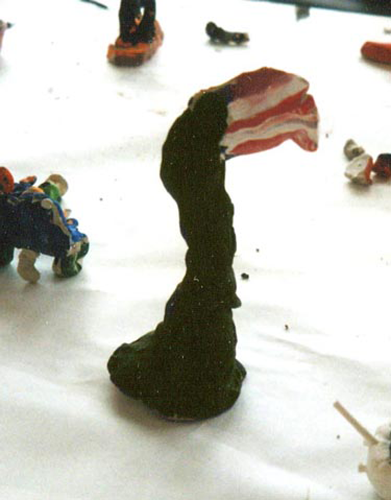
On the first day of camp, the children were given clay and asked to create a memory of something about their deceased loved one. Almost immediately a striking image was created by one of the children whose father had died in the World Trade Center. He squeezed, pulled, and pounded the clay, seemingly releasing pent-up feelings. As he worked, a precariously standing flag emerged. As he continued to squeeze and pull, unable to construct a firm base, the flag toppled over and over again.
Seeing his struggle, the art therapist intern intervened by suggesting that more clay might be used to help secure the base of his flag. However, this was not to be. He continued to squeeze and pull until the flag sculpture lost all support. His artistic process reflected something of this young boy’s internal state. Life without father left him ungrounded, with difficulty standing on his own. Later on, another intervention of adding support to the flagpole allowed his flag sculpture to remain standing. When the standing sculpture dried, he painted it with bold red and white stripes tightly secured to a firm base that reflected strength and life (Figure 1.). The sculpture reminded us of the flag flying at Ground Zero that we witnessed daily in the news media. The meaning behind this clay image and the process of its creation signified his daily internal struggle of coming to terms with grief and loss and the continued hope and strength that occur when one shares this process with others. This was the first of many symbolic images produced by children at the camp that identified resilience along with trauma and death.
During the same art therapy group, another child created a small sculpture of the twin towers. When this child participated in the sharing part of the art directive, he disclosed his individual story of loss, which was separate from the 9/11 tragedy. However, his image stood for an indescribable emotional reaction that symbolized his own trauma and grief. The cause of death does not have to meet the criteria for the classification of trauma for a child to experience traumatic grief (Eth & Pynoos, 1985). It is the child’s perception of the death that matters most.
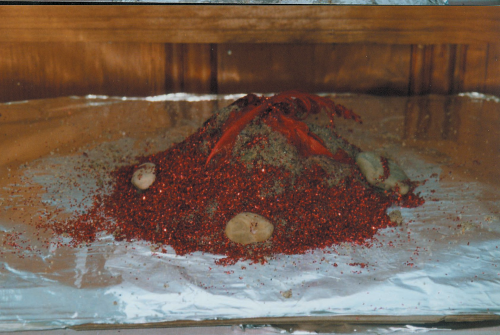
Mid week, an art directive devised for children of all ages proved to demonstrate that 9/11 images became universal symbols to address the effects of trauma and grief. Sand glue and water were offered to the children to allow for creative play. The image of an erupting sand volcano covered in red glitter, red crayon, and red feathers mixed together with glue allowed a young boy to disclose his anger surrounding the traumatic death of his mother (Figure 2). Outwardly this child presented as quiet and sweet, longing for affection. Here in the art room he was able to access his suppressed emotions of anger, hurt, and aggression that were intolerable on a conscious level. The act of creating and the image produced allowed this child to process some of his traumatic experiences nonverbally, giving him an outlet for pent-up feelings and allowing the therapists some insight into his internal state.
The dichotomy of words and images was evidenced in a mask created by a latency-aged boy. Children are aware that they are often required to present to the world a face or mask that does not portray what they are feeling inside. With that idea in mind, the campers were asked to create a mask that identified how they presented to the outside world and then, on the inside of the mask, represent what internal feelings they might be experiencing. As a group the children had difficulty distinguishing difficult emotions when they verbally tried to articulate them. This difficulty was evidenced in the mask described here. The forehead and upper portion of the head of the mask were painted blue with the mouth area of the face painted red, thus seemingly dividing thought from speech. The sensory areas of the face were exaggerated, with cutout eyes and mouth and a prominently painted nose. Behind the cutout of the mouth were carefully penciled in clenched teeth, creating a boundary that did not allow information to enter or exit. On the inside of the mask, the boy created what appeared to be an unfinished, angry devil. The child described this as his state of confusion, saying that he experienced many emotions at the same time when given the art directive and was unable to single out one emotion to depict. This communicated to us his need for time to integrate the fragmented images of his trauma before being able to translate it into words.
Lessons Learned: Concomitant Healing
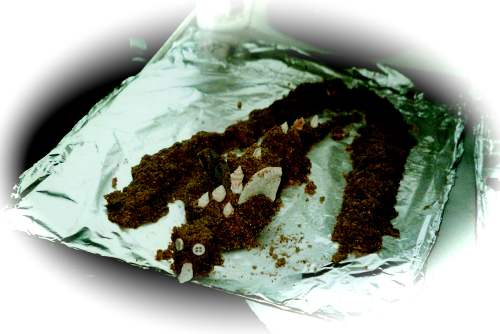
Daily supervision sessions with the staff of therapists became a new learning experience for us about transference and countertransference phenomena. As we processed this most public tragedy, our individual reactions became intertwined with those of the campers. In an attempt to help other staff members understand more about some of the campers who were unable to speak about their experiences, we invited the staff to view the artwork of the campers. A collective sigh was heard as all the therapists viewed the image in Figure 3. Raw and emotionally charged, a small child’s sand sculpture of a monster appeared to also resemble the tip of lower Manhattan. This child’s father had died in the World Trade Center collapse.
As therapists, it became a struggle to keep our personal reactions in check. Each of us was processing our own very deep feelings tied to the images of 9/11. In our supervisory discussions with the entire staff, we observed tears welling, arms caressing the shoulders of one another, and heads bowed. Elissa Bowes (coauthor) reflects that in our art therapy groups, “I remember holding back tears many times, and using the strength I saw in the kids to help keep me strong.” Throughout the camp days clinical staff visited the art room seeking out the art therapists to share particularly difficult moments and reflect on what the children were creating. Being part of a large group of people who were vulnerably linked by a national tragedy created a forum where many unprocessed feelings were confronted simply by witnessing the symbolic imagery of others. The courage displayed in the creative processes of the children allowed us all to process immediate and generalized fears about our safety and security and, ultimately, our trust in the world.
In our attempt to reach out to help grieving children who were also part of a public tragedy, we found that our own reactions, feelings, thoughts, and projections greatly influenced our work. We found that filtering transference and countertransference material was quite difficult when working as a group that had been influenced by a common tragedy. In addition to viewing counter transference as related to unresolved personal issues of the therapist (Gorkin, 1987), Bromberg (2001) persuades us to take note of our unspoken responses to our clients as elemental material for the therapeutic process. We must recognize that it is the dynamic between therapist and client that is illuminating rather than the clients issues alone. Navigating through our own intense traumatic feelings related to 9/11, as well as witnessing those of the children at Camp Good Grief, we were understandably left feeling raw and exposed. Our countertransference reactions seemed to be a blend of both our personal traumatic experiences and compassion fatigue (Figley, 1995).
As described by Saakvitne (2002), the entire framework for therapy shifts with a shared tragedy, and we must recognize our own vulnerability as well as the effect it has upon our work. Through the work of Judith Herman (1992), we are reminded that in working with traumatized children, some of our countertransference reactions are related to what the children share with us pictorially and in sculpture form. Trying to help the children with their traumatic grief elicited more strong reactions from us as we felt less able to soothe their pain from the loss of a loved one or to reconcile the meaninglessness of their suffering from a terrorist attack.
The children demonstrated to us repeatedly that they were communicating their individual experiences of grief through a universal language of symbols. In order for concomitant healing to unfold, we were forced to create a space to witness the children’s trauma as we simultaneously experienced and processed our own trauma. The healing process for all who experienced this shared tragedy began as we made new meaning with our clients. Through witnessing and supporting the creative process we viewed the powerful artwork that ensued (Saakvitne, 2002). Both the children’s and our own experiences of a public tragedy offered the child–therapist relationship a commonality in which losses could be shared—albeit silently by the therapists and actively by the children—thus allowing for concomitant healing.
Reflections
As therapists working with groups who have experienced the same traumatic event, we need to be mindful of our own experiences in acknowledging and addressing how this work affects us both professionally and personally. In doing so, we may begin to consider that, along with transference and countertransference issues, there can also be concomitant healing and that this healing occurs when some of the traditional boundaries of therapy become blurred by a common tragedy.
In this article we discussed how our traditional goal of a therapeutic distance was breached. We were unable to keep our own memories of the tragedy from affecting us as we viewed what the children produced. Kristin Linton (coauthor) describes what happened when the staff was invited to view the children’s art work: “I remember everyone recounting their own personal stories about where they were during 9/11” before they could relate to the artist/camper’s grief experience. “Rarely do you hear therapists retelling their own stories during a large group supervision. I think it was healing to do this as a group, but highly unusual—an example of blurred boundaries.” Saakvitne (2002) calls for therapists to come together to create supportive and forgiving community where vulnerabilities can be shared with each other. She stresses the importance of self-care, so that as therapists we may go back to our work, able to bear witness to our clients’ experiences and facilitate concomitant healing.
Although we did not discuss this in our supervisory sessions at the camp, the experiences we had shared became more obvious to us as authors in writing this article. Similar to the experiences described by Ellen Boyer (2008) when writing about her work following Hurricane Katrina, or the experiences of Howie, Silver, Burch, Conrad, and Shambaugh (2002) and in their work with children after the Pentagon attack on 9/11, in helping these children we were also helping ourselves. It may be useful for us as art therapists to look closely at our work and write more about how witnessing the creative processes of our clients after a shared tragedy may heal difficulties we personally experience. By exploring these issues further, professionals in the field may add to the body of literature not only on transference and countertransference but also on concomitant healing within the therapeutic process of symbol making.
Footnotes
The author(s) declared no potential conflicts of interest with respect to the research, authorship, and/or publication of this article.
The author(s) received no financial support for the research, authorship, and/or publication of this article.