







Abstract
The population for this study was drawn from an institution to which juveniles are sent by court order if they are found by a judge to be physically or psychologically abused at home. Sixteen males, aged 12-17, were randomized into two groups. They were assessed using subjective distress (SUD), and the Impact of Events Scale (IES), which measures two components of PTSD: intrusive memories and avoidance symptoms. The experimental group was treated with a single session of EFT (emotional freedom techniques), a brief and novel exposure therapy that has been found efficacious in reducing PTSD and co-occurring psychological symptoms in adults, but has not been subject to empirical assessment in juveniles. The wait list control group received no treatment. Thirty days later, participants were reassessed. No improvement occurred in the wait list (IES total mean pre = 32 SD ±4.82, post = 31 SD ±3.84). Posttest scores for all experimental-group participants improved to the point where all were nonclinical on the total score, as well as the intrusive and avoidant symptom subscales, and SUD (IES total mean pre = 36 SD ±4.74, post = 3 SD ±2.60, p < .001). These results are consistent with those found in adults, and indicates the utility of single-session EFT as a fast and effective intervention for reducing psychological trauma in juveniles.
EFT (emotional freedom techniques) is one of a group of therapies collectively referred to as energy psychology (EP). EP has been used to treat traumatic stress in various groups, and is establishing itself as an evidence-based treatment for posttraumatic stress disorder (PTSD), depression, anxiety, phobias, and other psychological disorders (Feinstein, 2008a). EFT has been shown to normalize EEG patterns in traumatized participants (Lambrou, Pratt, & Chevalier, 2003), and to successfully treat accident victims with PTSD (Swingle, Pulos, & Swingle, 2004). EFT lowers PTSD symptoms in war veterans, with participants typically going from clinical to subclinical levels (Church, 2010; Church et al. 2010; Church, Geronilla, & Dinter, 2009). A review of published EP research, outlining its physiological mechanisms of action in PTSD, especially its effect on the brain’s limbic system, suggests that EP “quickly and permanently reduces maladaptive fear responses to traumatic memories and related cues” (Feinstein, 2010).
One characteristic of clinical reports of EP therapies in highly traumatized populations is the parsimony of application required to obtain reductions in symptoms. Studies of veterans with traumatic stress typically use six sessions (Church et al., 2009, 2010). Reports of refuges, and adults in disaster zones, also typically employ a single-session protocol (Folkes, 2002; Green, 2002; Johnson, 2000). A study of children successfully treated with EP also used a single session (Sakai, 2007). Carbonell and Figley (1999) reviewed recently developed therapies for trauma, and found EP interventions efficacious in attenuated time frames. A review of the use of EP in natural and human-caused disasters (Feinstein, 2008b) noted the frequency of success with single-session protocols.
Several institutions, including the American Psychiatric Association, Britain’s National Institute for Clinical Excellence (NICE), and the U.S. Veterans Administration, have investigated the efficacy of various therapies for PTSD. Meta-analyses have found EMDR (eye movement desensitization and reprocessing), CBT (cognitive behavior therapy), and exposure therapy to be effective (Benedek, Friedman, Zatzick, & Ursano, 2009; Bradley, Greene, Russ, Dutra, & Western, 2005; Institute of Medicine, 2006, 2007; NICE, 2005; Seidler & Wagner, 2006; van Etten & Taylor, 1998). EFT employs brief forms of certain components of these therapies that have demonstrated efficacy, such as cognitive restructuring and exposure, which have also been shown to reduce PTSD symptoms by as much as 60% in a single session (Salcıoglu & Basoglu, 2010). To these established interventions, EFT adds a somatic component, having therapists or participants tap with their fingers on prescribed acupuncture points while cognitive statements are made. The somatic stimulation of acupuncture points during exposure to traumatic memories is observed to have a calming effect, and to reinforce cognitive change (Feinstein, 2009). The stimulation of acupuncture points by pressure alone, without using needles, has been shown to be as efficacious as needling in a randomized controlled trial (Cherkin et al., 2009). Acupuncture stimulation has been shown to reduce fear and pain in the limbic system of the brain as measured by MRI screening (Dhond, Kettner, & Napadow, 2007). Hui et al. (2000) found acupuncture to send fear- dampening signals directly to the amygdala.
Other hypothesized mechanisms of action of EFT include boosting the production of serotonin (Ruden, 2009), and activation of stress-dampening genes in the hippocampus and hypothalamus (Church, 2009), especially regulatory genes such as EGR-1 and C-fos which are activated during stressful experiences (Davis, Bozon, & Laroche, 2003; Sabban & Kvetnansky, 2001). A review of the epigenetic potential of EFT and similar therapies finds that they may regulate physiology in a systemic manner. These include “(a) exaggerated limbic system responses to innocuous stimuli, (b) distortions in learning and memory, (c) imbalances between sympathetic and parasympathetic nervous system activity, (d) elevated levels of cortisol and other stress hormones, and (e) impaired immune functioning” (Feinstein & Church, 2010, p. 283). LeDoux (2006) describes these limbic responses to traumatic memories as the “hostile takeover of consciousness by emotion.” When stressfully treated, these memories are not reinstated in their existing form. Instead, they are reconsolidated to include cues from the proximate environment (Davis et al., 2003; LeDoux, 2002). If the environment contains therapeutic cues from EP treatment, memories may be reconsolidated without their past ability to trigger hyperarousal of the amygdala (Lane, 2009).
EFT is a simple method that has participants pair the memory of a highly traumatic event (exposure) with a statement of self-acceptance. A typical example might be, “Even though my father hit me when he got drunk after my seventh birthday party . . .” (exposure) . . . “I deeply and completely accept myself” (cognitive shift). After describing the traumatic incident, and formulating the statement, the participant repeats the statement while tapping prescribed acupuncture points. Emotional distress is self-assessed using a Likert-type scale from 0 to 10, called subjective units of distress or SUD (Wolpe, 1973). EFT sometimes brings SUD down to 0 with a single application, but several “rounds” of EFT may be required. Progress is client-rated using SUD scores. When SUD is 0, this indicates no client distress associated with the traumatic memory.
EFT was developed by Gary Craig in the early 1990s as a brief form of an earlier EP method called thought field therapy or TFT (Callaghan, 2000). It is administered in a uniform manner though a free downloadable manual, also available in print (Craig, 2011). EFT has been shown to reduce a range of psychological disorders including phobias, anxiety, and depression (Church & Brooks, 2010; Rowe, 2005; Wells, Polglase, Andrews, Carrington, & Baker, 2003). In EFT for PTSD, Craig (2009) summarizes clinical procedures and research findings for using EFT as a treatment for traumatic stress. A study performed by Britain’s National Health Service compared the efficacy of EFT to EMDR in adult patients, and found that both were effective for clinical PTSD in four treatment sessions (Karatzias et al., 2011) These characteristics make EFT a suitable candidate for empirical investigation with populations of traumatized adolescents and children.
Van der Kolk (2007) has emphasized that recall of traumatic memories may retraumatize a client. This danger is moderated with EFT and other EP methods (Mollon, 2008); clients typically report a steady reduction of distress. However, given the potentially retraumatizing effect of recalling recent traumas on a vulnerable population, the current pilot study sought to minimize risk by using only two brief assessments, SUD and IES, and only two data points.
Method
Subjects were confined to the St. Joseph’s House (“Hogar San Jose”) residential treatment facility in Trujillo, Peru. The institution is one to which children are sent by a judge if their parents or guardians have a history of sexual, physical, or psychological abuse, or abandonment or negligence of their children. At the time of the study, there were 51 children in residence. Inclusion criteria were as follows: Male; ability to understand IES instructions, age 12 to 17, and a history of physical, psychological, or sexual abuse, or parental abandonment or negligence. Exclusion criteria were as follows: Organic or neurological conditions; prior clinical psychiatric diagnoses, and concurrent pharmacological treatment. Ethical review was performed at Cesar Vallejo University, and approval was granted by the departmental head of the Psychological Training Center. Informed consent and permission to conduct the study was obtained from the director of St. Joseph’s House, who was also the legal guardian of the participants. Thirty-five participants were assessed and did not meet these criteria; the 16 who did were enrolled.
The investigators assigned participants into two groups of eight each using random allocation. The experimental group received a 1-h single session of EFT from either the second or the third author. Data were collected by a supervisor for these two authors. The control group did not receive any intervention. Control participants completed the baseline assessments and returned in one month for the follow-up assessment. Given the novelty of the intervention and the possibility of retraumatization during the recall by the participants of emotionally triggering memories, a minimally invasive experimental design was used, with only two data points: pretest, and 30-day posttest. Assessments and treatments took place in the same location at the institution for both groups. Data was scored subsequently, offsite and blind, by a biostatistician (the fourth author). EFT was administered with fidelity to the Spanish translation of the EFT manual (www.eftuniverse.com), and included a supplemental EFT procedure outlined in the manual, called the nine gamut technique, which is intended for bilateral stimulation of the brain. The investigators trained with other psychologists in EFT, clinical supervisors monitored fidelity to the method during training sessions, and the first author has both an EFT Cert-1 certification from EFT and is licensed by ACEP, the Association for Comprehensive Energy Psychology.
The investigator providing the intervention asked the child to recall the most troubling specific incident of abuse. An EFT method called the movie technique was used. The participant imagines the traumatic incident as though it were a movie with a start, finish, and end. The participant then gives the movie a title. The participant associates the movie with a SUD level. EFT is then performed, and the participant-rated SUD level is reassessed while recalling the movie. If the SUD has not gone down, EFT is repeated till SUD is at or near zero. The purpose of the movie technique is to focus the client on a specific event, and avoid generalization of distress to other times and incidents. The purpose of the movie title is to provide the participant with a brief reminder phrase to keep the distressful incident in memory while the acupressure points are being tapped.
Participants were assessed using the IES or Impact of Events Scale, the Spanish-language version of which has been validated (Báguena et al., 1998; Horowitz, Wilner, & Alvarez, 1979). The IES is subdivided into an Intrusive Symptoms Scale (items 1, 4, 5, 6, 10, 11, 14) and an Avoidance Symptoms Scale (Items 2, 3, 7, 8, 12, 13, 15), and also yields a total score. A score of 26-42 (moderate) indicates that an event has had a powerful impact, and scores 43 or higher indicate an impact so severe that the ability to function may be affected. A score of 27 or more indicates a 75% likelihood of a PTSD diagnosis, with a number of PTSD symptoms (Coffee & Berglind, 2006). A score of 35 indicates a probable diagnosis of clinical PTSD (Neal et al., 1994). The results of the participants’ IES tests are reported below.
The second assessment used in the present study, SUD, is associated with autonomic arousal (Thyer, Papsdorf, Davis, & Vallecorsa, 1984). Participants are asked to recall a traumatic incident, and rate its intensity from 0 (no intensity) to 10 (highest possible intensity). When a participant provides a high SUD, physiological symptoms of stress increase. These include heart rate, vasoconstriction, respiration, and galvanic skin response (Sheeringa, Zeanah, Myers, & Putnam, 2004). Physiological signs reverse when therapy is successful at producing a lowering of SUD (Wilson, Silver, Covi, & Foster, 1996). The failure of a traumatic memory to elicit a stress response in the body is an indication of recovery (Horowitz, 1986). Although self-rated, SUD is therefore a useful indicator of the efficacy of treatment.
Results
Data were received for 16 male participants, eight in the control group and eight in the experimental. Ages ranged from 12 to 17 with an average age of 13.9 years. There was no significant difference in age between the two groups. All participants scored in the “moderate clinical” range on the IES total. Participant IES scores ranged between 27 and 42, with an average score of 34.2 (SD ±5.4). There was no statistically significant difference between the groups at baseline on the IES total, t(14) = 1.71, p < .11, intrusive memories subscale, t(14) = 0.35, p < .73, and avoidance subscale, t(14) = 1.93, p < .07, demonstrating similar prognostic indicators at baseline. Posttest administration of the IES occurred 1 month after pretest. In the experimental group, the initial SUD level ranged from 7 to 9 with an average SUD level of 8.25 (SD ±0.71). The number of applications of EFT ranged from 2 to 4, with an average of 2.87 applications (SD ±0.41), with the final SUDS level ranging between 0 and 1 with an average of 0.25 (SD ±0.46).
To examine change-over time in the IES total and subscale scores between the two groups, a repeated measures general linear model was conducted. Post-hoc Tukey tests were conducted on significant findings. The time by group interaction was statistically significant (p < .001) for the IES total and both subscales. Statistically significant differences were found in the post-hoc analyses for all three IES variables. The experimental group demonstrated a statistically significant decrease in distress on the IES total and both subscales following the intervention as seen in the decrease between the pretest and posttest scores. In addition, the experimental group’s posttest was significantly lower than the posttest for the control group on each of the IES variables. There was no difference between the pretest and posttest for the control group. All participants in the control group were still in the “moderate clinical” range on the IES at posttest, with scores ranging from 27 to 40, whereas none of the participants in the experimental group scored in the clinical range at posttest, with scores ranging between 0 and 7. Thus the observed results were both statistically and clinically significant. The IES total and subscale scores for experimental and control groups are presented in Table 1 and Figure 1 below.
IES Total Score, Memories, and Avoidance Subscales Pre and Posttest Means and Standard Deviations by Treatment Group
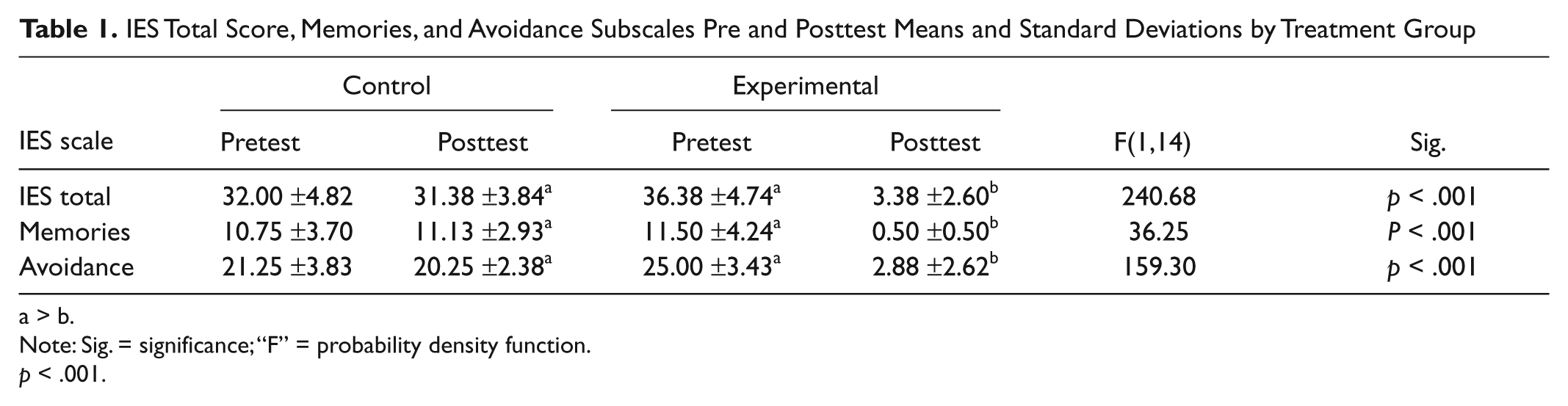
a > b.
Note: Sig. = significance; “F” = probability density function.
p < .001.
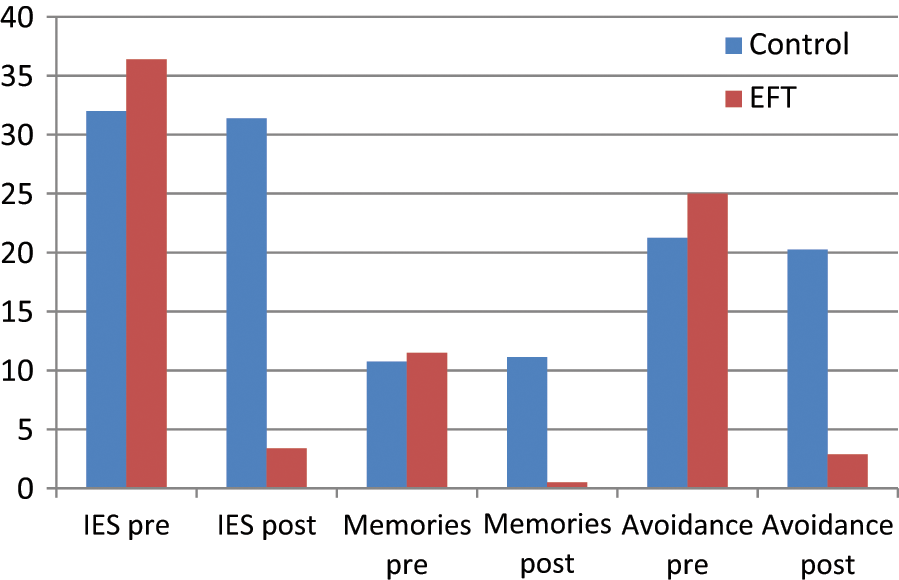
IES total score, memories, and avoidance subscales pre and posttest means by treatment group
There were no dropouts. No adverse events, or increase in participant distress, were reported. After data analysis, the investigators recommended to the director of St. Joseph’s House that the control group also receive EFT.
Discussion
The literature airs different opinions as to whether PTSD can be remediated. Some reviews state that PTSD should be regarded as an intractable condition such as dissociative identity disorder (Johnson, Fontana, Lubin, Corn, & Rosenheck, 2004). Vasterling and Brewin (2005) found that PTSD produces neurological changes that make it treatment resistant. Others hold out hope for a cure (Foa, Keane, & Friedman, 2000). A review by the Institute of Medicine cited a study by Monson et al. (2006) as a hopeful sign that PTSD can be remediated. Studies of highly traumatized war veterans have also found them to test PTSD negative on average after EFT sessions (Church, 2010; Church et al., 2009). The current study supports the position that elements of PTSD such as avoidance, and intrusive memories, may be successfully treated. The benefits of successful trauma treatment do not benefit just the individual; they radiate outward to produce positive effects on family and communities (McFarlane & van der Kolk, 1996/2007). Epidemiological research has shown untreated childhood emotional trauma to correlate highly with diseases in adults, including cardiac events, hypertension, cancer, diabetes, smoking, and depression (Felliti, Koss, & Marks, 1998). Childhood sexual abuse correlates highly with adult PTSD (Shakespeare-Finch & de Dassel, 2009). The benefits of early treatment of childhood trauma thus extend over time, and encompass both the psychological and physical health of the individuals and communities affected.
There were two cases in the current study in which the child’s SUD level was not reduced to 0. In one of these, the child stated that he would need to meet the stepmother who had neglected him, face-to-face, to test whether or not the memory still affects him (at the time, the stepmother was not visiting him). In the second case, the child stated that he would need to receive an apology from his father, who had physically abused him, to put the memory behind him.
The investigators delivering the intervention noted a phenomenon called the apex effect (Craig, 2011). The apex effect, described for three decades in clinical reports of EP interventions, is that after EP treatment, the participant typically forgets how intense the emotionally triggering event was before treatment. Clinical observation of the apex effect is one reason that SUD levels are noted before and after treatment. A concurrent cognitive shift by participants, from a victim point of view, to an observer’s point of view, is also typical.
The current pilot study had a number of limitations. It did not test EFT against a placebo intervention such as a supportive interview, to determine the effect of nonspecific factors such as the sympathetic attention found in a therapeutic alliance, and expectancy effects. It also did not test EFT against efficacious methods such as exposure and cognitive therapies. Further limitations are that the brevity of the design did not permit the evaluation of treatment fidelity; also, the unblinded nature of data collection makes participant gains participant to demand characteristics. The lack of a follow-up data point makes it impossible to determine if the results hold over time. Feinstein (2008a) notes in a review of EP research that in every study employing a long-term follow-up, for periods of up to 1 year, participant gains are maintained to a statistically significant degree, and an extension of this study should include a long-term follow-up.
Another limitation of the present study that it used self-report rather than observer-rated measures such as the CAPS-CA. However, children’s self-report of PTSD symptoms on the IES has convergent validity with observer-rated diagnoses of PTSD (Horowitz & Sundin, 2002; Shemesh et al., 2005). To encourage client-centered approaches, self-rating methodologies are encouraged (Glasgow, Magid, Beck, Ritzwoller, & Estabrooks, 2005). An extension of this study would use observer-rated assessments in addition to client-rated evaluations, to determine whether the correlations found in other published literature are maintained.
Because of the affect-reduction properties of EP, therapists report preferring it over other methods when dealing with emotionally charged memories (Flint, Lammers & Mitnick, 2005; Mollon, 2007). A survey of therapists found that they preferred EP when treating adult survivors of childhood sexual abuse (Schulz, 2009). Reduced affect is noted with EFT even when highly traumatized clients recall memories so emotionally evocative that they have been reluctant to access them before (Church, 2010; Mollon, 2007). The authors of this article would therefore argue that participant safety will not be unduly compromised by the use of additional assessments immediately postintervention, as well as 3 and 6 months postintervention.
Conclusions
In the current study, 16 institutionalized male children with intrusive memories and avoidant symptoms were evaluated using the Impact of Events Scale (IES). After randomization, the experimental group of eight participants was treated with a single session of EFT. The control group did not receive treatment. After 1 month, the two groups were reassessed. All members of the EFT group no longer reported intrusive or avoidant symptoms and their total scores on the IES had normalized. There was no change in the group that received no treatment. All results were statistically significant, indicating that EFT may be an effective treatment for trauma in juveniles. Further research is needed to determine if these effects hold over greater periods of time, how they compare to a placebo or active comparator, and whether client-rated assessments agree with observer-rated instruments.
Footnotes
Declaration of Conflicting Interests
The author(s) declared the following potential conflicts of interest with respect to the research, authorship, and/or publication of this article: Author Dawson Church derives income from publications and presentations on EFT. There is no other conflict.
Funding
The author(s) received no financial support for the research, authorship, and/or publication of this article.