







Abstract
This article describes the rationale, developmental process, and content of a resilience-building program that has been implemented with new recruits to a police academy. The process of extensive consultation with the police service (consistent with community-based participatory research principles) has helped to provide a sustainable and pragmatic program framework. The Promoting Resilient Officers (PRO) program is a seven-session strength-based program that integrates CBT and interpersonal perspectives within a salutogenic paradigm. PRO also includes two “refresher” sessions delivered online up to 18 months post the initial face-to-face sessions. PRO was delivered with high fidelity as an integral part of police recruit training and made sustainable by using psychologists within the police service to deliver the intervention. Implementation incorporated a Randomized Controlled design by which a rigorous evaluation of program effectiveness is being conducted. Initial data presented indicates a high level of engagement and acceptability of the PRO program.
Within the work context, mental health problems have devastating social and productivity costs, for example, a person with depression works at 40% of his or her capacity and may take 3 or 4 days off work per month (Hilton, 2007). Increasingly, the workplace has been identified as an important locality to introduce proactive interventions by way of screening and early intervention or prevention of mental health problems. One approach that seems to show considerable promise is to implement either universal or targeted approaches to prevention within a strength-focused resilience intervention paradigm (Rapee et al., 2006). Such interventions have already shown considerable promise in the school context (Shochet et al., 2001) and there have been some promising results of pilot trials of resilience interventions in the workplace (Liossis, Shochet, Millear, & Biggs, 2009; Millear, Liossis, Shochet, Biggs, & Donald, 2008). This work formed the basis of the development of a resilience-building intervention that would be applicable to the context of policing. The challenge was to develop an approach to a resilience-building intervention that met the criteria of being ecologically valid, practical, and sustainable (Marchand, Stice, Rohde, & Black Becker, 2010).
In a context where employees are in high-stress occupations (e.g., police, paramedics, fire fighters), it has been proposed that personnel are at greater risk for mental health problems, such as PTSD and substance misuse, than people who do not occupy such work roles (Davey, Obst, & Sheehan, 2000; Maia et al., 2007). Hence, there is an urgent need to find effective approaches to promote and maintain positive mental health within such workplaces. In this article, we describe the development and implementation of a promising and sustainable resilience intervention with police recruits that appears to overcome many of the pragmatic difficulties associated with recruitment, time-tabling, engagement, program fidelity and acceptability, and sustainability. The Promoting Resilient Officers (PRO) program is a selective and universal approach that has elicited preliminary data indicating the program has been well received by the participants.
Mental Health in the High Risk Occupations and the Emerging Resilience Paradigm
Given the prevalence, undertreatment, extensive social cost, and economic burden of mental illness, the promotion of positive mental health and psychological well-being in community settings is identified as a national and international research priority area (e.g., Üstün, Ayuso-Mateos, Chatterji, Mathers, & Murray, 2004; World Health Organisation [WHO], 2002). With mental health problems (such as depression) being a leading cause of nonpermanent disability worldwide (Mathers & Loncar, 2006; WHO, 2001), the promotion of positive mental health and psychological well-being in the workplace is now recognized as a global research priority (e.g., WHO, 2002).
Within high risk occupations, there is an increased risk of specific mental health problems such as posttraumatic stress disorder (PTSD) symptoms (Maia et al., 2007) and binge drinking (Davey et al., 2000). Green (2004) identified PTSD as being four to six times more prevalent in police than in the general public. The association between alcohol misuse and the psychological consequences of traumatic event exposure is also well documented (e.g., Young et al., 2002). The Australasian Centre for Policing Research (McNeill & Wilson, 1993) reported that approximately 16% of male and 32% of female officers were classified as binge drinkers, being substantially higher than the general population (Lawford, Young, Noble, Kann, & Ritchie, 2006). The sequelae of these mental health problems for police also extend to the family (Davidson, Berah, & Moss, 2006), work absenteeism (Tang & Hammontree, 1992), physiological problems including heart disease (Violanti et al., 2006), and compromise in neurological structures, such as a small hippocampus (Lindauer et al., 2004). For such reasons, at the organizational level there is a readiness and political will to undertake proactive interventions to address the adverse impact of occupational stress.
The willingness to embrace proactive interventions is also due to the stress and trauma experienced by emergency service personnel, which have resulted in workers compensation claims, especially claims of psychological injury. In recent years, a number of successful common law psychiatric injury claims involving former police officers (e.g., Pennington v. New South Wales Commissioner of Police, 2004; State of New South Wales v. Seedsman, 2000) have found that police officers and their supervisors have not been provided with adequate training to identify and manage symptoms of psychological distress. It is clear from the litigation that training with respect to stress management and the development of coping skills needs to be systematic and skills based.
Recent research has provided greater clarity on the risk and protective factors that underpin mental health problems in emergency service personnel. Workplace risk factors for psychological well-being in high-stress occupations (including police) are best classified as operational or organizational job demands (e.g., Brough & Williams, 2007). Operational job demands include hoax calls, armed confrontations, and attending road accidents. Organizational job demands include poor management and communication, unresponsive organizational structures, inadequate social support, and lack of recognition (Brough & Williams, 2007; Collins & Gibbs, 2003). In general, research has demonstrated that organizational factors appear to be stronger predictors of posttrauma outcomes than operational demands and are also amenable to intervention.
The past 15 years has also seen the beginning of a paradigm shift in the conceptualization of psychological trauma and its sequelae. There has been an increasing body of research into the organizational and individual factors that lead to posttraumatic growth (Tedeschi & Calhoun, 1995). The Posttraumatic Growth (PTG) model (Calhoun & Tedeschi, 2006) describes processes and positive outcomes that may follow the struggle in which people engage after a traumatic event. This paradigm shift toward a salutogenic approach (i.e., the origins of health) is based on the fostering and enhancement of resilience and growth and identifying predictors of adaptation and positive outcomes. A positive climate of peer support, appreciation of a varied repertoire of coping strategies, extraversion, openness, and clear communication between all levels of the organization are the characteristics that best promote positive adaptation to traumatic events (Shakespeare-Finch, Gow, Smith, Embelton, & Baird, 2003; Shakespeare-Finch, Smith, & Obst, 2002; Tedeschi & Calhoun, 1996). Importantly, reports of PTG in emergency service personnel are vastly more prevalent than PTSD symptoms (Shakespeare-Finch, 2007; Shakespeare-Finch et al., 2003).
The salutogenic approach is both consistent with resilience interventions and also complements such interventions and can assist enormously in an approach to managing the increased risk of negative long-term traumatic response. With the emerging paradigm shift, it is timely to develop, trial, and evaluate resilience interventions for employees in high risk occupations.
Advantages of a Universal Resilience and Strength Focused Approach
The mental health intervention spectrum classifies preventive interventions into three categories: universal, selective, and indicated (Mrazek & Haggerty, 1994). Universal approaches are designed to prevent the incidences of new clinical cases and tend to be directed toward whole populations as opposed to working with identified people already at risk. Selective or indicated approaches tend to target people who can be identified as increased risk either because they belong to an at-risk population or because they already have symptoms. The intervention described in this article can be identified as a selective intervention because the targeted population have an increased risk of difficulties by virtue of their occupation. However, within the police service the intervention is being conducted on a universal basis, as opposed to screening the recruits for signs of mental health problems. This approach offers a number of important advantages: (a) the population health benefits as identified by Rose (1992); (b) increased recruitment and reach; (c) decreased screening and stigmatisation; and (d) strength-focused approach and narrative.
The proponents of the population-based universal approaches in the prevention science literature propose that there is great value in targeting not only the at-risk group, but also to ensure that the healthy remain healthy. The axiom developed by Rose (1992) states that a large number of people exposed to a low risk will ultimately generate more mental health problems than a small group of people exposed to a high risk. Similarly from an intervention point of view, a small effect cast over a large population will prevent more problems than a large effect on a small number of participants. Related to this argument is the well recognized and researched argument that mild elevations of symptoms can be associated with quite significant psychosocial impairment. In a meta-analysis, Horowitz and Garber (2006) concluded that the negative correlates of subclinical levels of depression, and their tendency to persist over many years, suggest that prevention of depression symptoms, regardless of whether a clinical diagnosis is warranted, is a goal worthy of investigation. For example, a study conducted by Korten and Henderson (2000) concluded that mild or subsyndromal symptoms account for 50% of impairment in overall national functionality.
Adaptation of an Existing Program for the Police Context
There are examples of positively focused universal resilience-building programs that have been through randomized controlled trials and other rigorous evaluations in a number of settings with encouraging results. For example, the Resourceful Adolescent Program (RAP; Shochet et al., 2001) is aimed at reducing the incidence of depression in the school context and has been demonstrated to be effective through teaching cognitive, behavioral, and reflective skills (e.g., Merry, McDowell, Wild, Bir, & Cunliffe, 2004; Shochet & Ham, 2004). RAP is an 11-session program for 12- to 15-year-old students and is designed to be an integral part of the school curriculum. Through a series of controlled trials RAP has been shown to be effective in preventing teenage depression (e.g., Merry et al., 2004; Shochet et al., 2001; Shochet & Ham, 2004) and has been endorsed as evidence-based by a number of agencies, including the commonwealth governments of Australia and Canada.
The Penn Resiliency Program (Reivich, Gillham, Chaplin, & Seligman, 2005) has a different approach but has a shared goal with RAP and begins with children as young as 8. The Aussie Optimism Program (Roberts et al., 2002) has also found support in developing children’s social competence. These programs vary in terms of their strength-focused paradigm with RAP being particularly committed to that approach.
Following the success of RAP, Shochet and colleagues piloted an adult version of the program (Promoting Adult Resilience; PAR) implemented through the workplace. The PAR program focuses on both the intrapsychic (e.g., stress management, attribution styles) and work-related (e.g., work–life balance, relationships at work) risk and protective factors. A pilot trial of the program produced substantial improvements for participants in depressive symptoms, stress, and coping self-efficacy, compared to a matched control (Liossis et al., 2009; Millear et al., 2008). A defining feature of both RAP and PAR is the extent to which all aspects of the program are based on a strength-focused narrative. The programs eschew reference to words like “depression” and “mental illness” and participants are constantly invited to reflect on their strengths and resources.
Industry Partner Participation Process
When creating and adapting programs for a particular context, it is vital to take appropriate steps to ensure program acceptability and ecological validity. Ecological validity refers to the extent to which the program has acceptability in the real world (Brewer, 2000). To achieve this move from what is essentially efficacy research to effectiveness research, it is important that the project involves “shared ownership between researchers and community partners” (Marchand et al., 2010, p. 34). During the development and implementation of the PRO program, extensive steps were taken to ensure the process of collaboration adhered to the tenets of Community-based participatory research (CBPR; e.g., Ahmed, Ann-Gel, & Palermo, 2010; Israel, Eng, Schulz, & Parker, 2005; Savage et al., 2006) where the police service were equal partners in every aspect. The CBPR approach views the community partner as equal in all aspects of the research and is not seen to compromise the rigor of the study (Savage et al., 2006). In fact many important outcomes are made possible because of appropriate engagement. This includes more meaningful research questions, higher recruitment response and retention rates, and enhanced effectiveness (Ahmed et al., 2010).
Given the importance of CBPR in determining the effectiveness of an intervention program, the Promoting Resilient Officers (PRO) program is a specific adaptation of the PAR program. In this setting it was particularly pertinent to make a resilience-building program specific to the police context when the impact of the organizational climate on the well-being of police is well published, as is the relatively higher levels of PTSD and alcohol misuse in this population. It was essential that PRO added new content to address these issues, to engage the participants in material that reflected their new work context, and therefore, to promote the likelihood of the program meeting the needs of the organization. Thus PRO has extensive components on both promoting more optimal organizational climate and managing less optimal organizational climates. For example, PRO includes a module about posttraumatic growth and applies motivational interviewing techniques with a view to preventing alcohol misuse. The program includes two “online refresher sessions,” delivered at various time points up to 18 months postintervention. Ensuring applicability and shared ownership, the adaptation of the RAP and PAR programs to a police context was guided by two complimentary objectives. The first was an adherence to an evidence base, both in terms of intervention effects and the risk and protective factors. The second was to apply the principles of community-based participatory research.
The adaptation occurred in close collaboration following a pilot of the PAR program with six senior management staff in the Queensland Police Service (QPS). This criterion-based sample was invited to participate based on seniority and the units/squads they were involved with. The participants’ ranks included 3 senior sergeants, 2 commissioned officers, and 1 acting commissioned officer. There were 5 males and 1 female. Structured interviews with the facilitator (a QPS psychologist) and written process evaluations probed for implementation experiences and views on the acceptability of program content for police. For example, questions included, “What do you think was the best thing about today’s training session?” and “If you were going to change something when using this training with police officers, what would it be?” Each of these responses were evaluated by the research team (that included internal QPS staff) and changes were made to adapt the PAR into the PRO program, such that language, examples, and activities were altered to better reflect the needs of the police population. This included more police-focused examples, discourse, and terminology. In addition, the seven sessions were restructured to include components on motivational interviewing (MI) and posttraumatic growth (PTG) and promoting positive relationships in the organization. Typical examples of program content adaptation included changing workbook examples to better reflect police recruit experiences at the Academy and also included in the program were video clips of a QPS senior police officer recounting his career experiences.
Introducing online refreshers
One of the important innovations to emerge from the CBPR process was the development of online refreshers. To our understanding this is the first trial of a resilience intervention that can be considered a hybrid of face-to-face and online interventions. It is now widely accepted that health promotion and prevention interventions work best when there are follow-up refreshers or boosters (Nation et al., 2003). From our consultation with the Queensland Police Service, it soon became apparent that it would not be ecologically valid (i.e., pragmatic) to implement face-to-face refreshers after the recruits had dispersed into their various locations throughout the state. Instead it appeared quite feasible to deliver these refreshers through online media. To this end two refreshers have been developed and implemented. Again, to help ensure program continuity and acceptability, the “talking head” in the video components of the online refresher is one of the face-to-face program facilitators, a police psychologist from the ranks of the police service. Details of these refreshers are outlined below as well as the very encouraging uptake and completion rates.
The refreshers are an important part of the new PRO program. The first of these refreshers covers stress management and cognitive restructuring skills from the CBT perspective. The second of these refreshers is essentially aimed at promoting a more harmonious work place. With the growing empirical evidence of the vicissitudes of self-worth being very strongly linked to a person’s perception about their sense of belonging (Cockshaw & Shochet, 2007), the interpersonal component that we particularly wanted to refresh was the prevention and management of work place conflict.
Program content
The PRO program includes 7 × 2-hr weekly sessions. These are delivered in class sizes of about 20 recruits. The program also consists of regular email contact from the facilitator to the participants. These emails remind the participants of the “homework task” referred to as the “resilience challenge” for the week and are usually accompanied by some personal examples from the facilitator about how they used a particular skill that was covered in the previous session. In addition, the program consists of two online refreshers. Table 1 below provides a summary of each session and the content and goals of the various components in each session. As can be seen from this table, in addition to the standard Cognitive Behavioral Therapy (CBT) approaches to stress management and cognitive restructuring, the program focuses extensively on the promotion of improved work relationships. The research on the impact of organizational connectedness and a sense of belonging would suggest that this sense of workplace belonging is a vital protective factor against depression, accounting for 29% of the variance in one study (Cockshaw & Shochet, 2007). As mentioned, this is consistent with findings specific to the police service in which organizational factors were shown to have a greater impact on people’s levels of distress than operational factors (Brough & Williams, 2007).
PRO Content
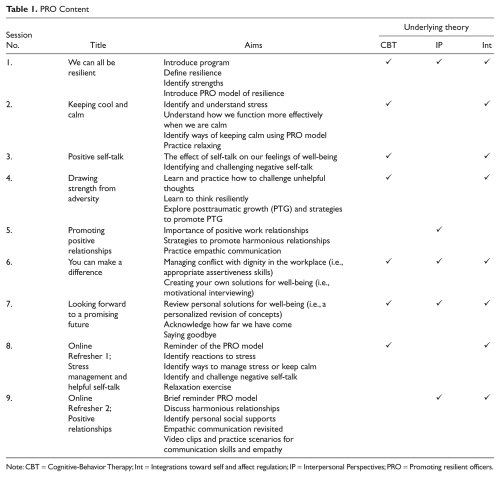
Note: CBT = Cognitive-Behavior Therapy; Int = Integrations toward self and affect regulation; IP = Interpersonal Perspectives; PRO = Promoting resilient officers.
Integrating CBT and Interpersonal Perspectives
As can be seen in Table 1, an important feature of the PRO program is the careful integration of CBT and interpersonal perspectives. CBT and Interpersonal Therapy (IPT) have both developed a strong evidence base in the treatment of many disorders such as depression (Barkham & Hardy, 2001). In parallel there has been a significant amount of research on the cognitive and interpersonal risk and protective factors for mental illness. With regard to the treatment paradigms, both the CBT and IPT approaches appear to have equal merit and have given rise to the notion of the “dodo bird verdict” (Luborsky et al., 2002) with regard to treatment effects. Similarly, in the examination of risk and protective factors, the putative cognitive and interpersonal variables have generally both shown strong and consistent links to mental illness or well-being (Bonanno, 2004; Durlak, 1998). While there is more longitudinal research needed to extract the interaction between cognitive and interpersonal variables, there is no doubt that the two approaches can be harnessed collectively. PRO and its precursors (RAP and PAR) are based on a careful integration of CBT and interpersonal perspectives. There is some evidence that prevention programs that include an interpersonal component combined with strong cognitive-behavioral training (e.g., RAP and the Penn Prevention Program; Jaycox, Reivich, Gillham, & Seligman, 1994) may be particularly effective (Gerber, Kocsis, Milrod, & Roose, 2006).
The overarching purpose of the PRO program, in line with the central tenet of resilience, is to improve self and affect regulation in the face of stress and stressful life events. The CBT components of PRO include cognitive restructuring and stress management approaches. Both of these provide participants with the capacity to either reappraise the stressful event or situation (positive self-talk) or to approach these events with greater calmness. The interpersonal components provide the vital capacity for improved relations as well as the management of difficult interpersonal conflict situations. These in turn also extend the capacity for self and affect regulation. The CBT skills developed in the first half of the program can be used in service of the skills needed to improve relationships or manage conflict constructively. Figure 1 provides the overall theoretical basis of the program.
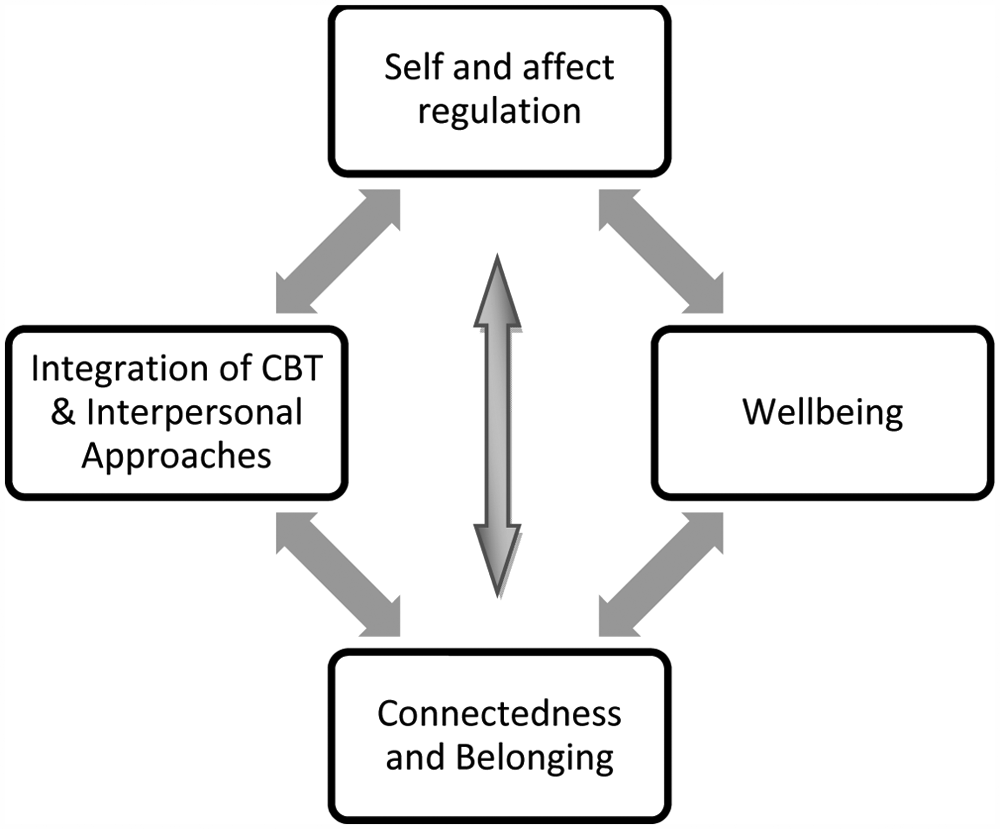
Theoretical rationale of Promoting Resilient Officers program
The PRO Randomized Controlled Trial: From Efficacy to Effectiveness
There is increased recognition that research needs to deliver trials of interventions that translate into the real world. This focus on translational research, or move from efficacy to effectiveness, sometimes involves the agency personnel in recruitment and the use of agency personnel to conduct the intervention, even when there are other competing job duties (Marchand et al., 2010). As Marchand and colleagues point out, for a program to be sustainable the focus needs to be on feasibility, acceptability to community members, and attractiveness to program providers. Ideally such effectiveness trials, or a hybrid of efficacy and effectiveness trials, should also be delivered as close to the gold standard of randomized controlled trials as possible.
Recruitment and Design
In the development and implementation of PRO, the community consultation process was the only feasible way to deliver the program as it was optimal to include the program as an integral part of training in the police academy. It was simply not feasible to deliver PRO to groups of trained officers, given the competing shifts and schedules and work demands. In this context, strong support to conduct the intervention as part of the academy curriculum was obtained, as was permission to conduct a random allocation into intervention versus curriculum-as-usual groups. The curriculum-as-usual contains a 1-day training session on resilience that covers pychoeducational topics such as stress, trauma, potential negative symptoms from exposure to trauma, and highlights various coping strategies. The academy trains a number of cohorts every year and each cohort is divided into approximately four classes of 20 recruits per class. Thus the randomization was conducted per class per cohort, in keeping with the Consort Guidelines (Schulz, Altman, & Moher, 2010). As the intervention is part of the curriculum, participants are invited to consent to complete questionnaires; they are not consenting to participate in the intervention or not, as completion of PRO or completion of the curriculum-as-usual is required for police recruit training.
Facilitator Selection Training
A major decision in the conduct of this trial was to use “endogenous resources” to deliver the program. This decision was made not because of a lack of funding resources for this particular project but because it had a direct bearing on the acceptability and sustainability of the project. Our consultation revealed that police officers and recruits would consider the program to be far more credible if delivered by personnel who have worked as police officers and could speak from experience. It was felt that participation and engagement in the material would increase if the facilitators related the material to personal operational or organizational examples. At the same time, use of in-house police resources strongly increases the sustainability of the program. Program sustainability could be maximized if the program delivery becomes an integral part of paid permanent employees of the police service. There was political will and support to deploy such resources.
That being said, there is also much research about therapist or facilitator effects in psychological prevention and treatment. It is well documented that adherence to orientation, program fidelity, and appropriate training and supervision all enhance intervention effects (Dane & Schneider, 1998; Middlemiss, 2005). It was important that suitably trained qualified staff delivered the intervention with appropriate fidelity. In this case, facilitators were police officers who had also obtained qualifications and registration as Psychologists. Their qualifications provided an excellent skill base and credibility for program delivery. They were considered by the recruits to be suitably professionally qualified to deliver the material and suitably experienced in police matters. The facilitators completed a day of PRO training and were provided with fortnightly supervision for the program delivery to the first two cohorts.
Evidence of Program Fidelity and Acceptability
As the program is fully manualized, a check list was developed for each session that related to all aspects of the delivery of the program. This checklist included all didactic and practical activities of each session. Facilitators completed a fidelity check at the end of each session. Ninety-five percent of program components were delivered. Unfortunately, the researchers were not able to record the sessions and rate them independently as such recordings would severely restrict the level of trust and engagement, particularly in the context of training for police recruits.
Process evaluations completed by each intervention cohort in the program probed for the perceived usefulness and acceptability of each component of the program. The evaluations were distributed at the conclusion of the last session. They were collected by the duty recruit, sealed in an envelope, and immediately mailed to the Project Manager. All ratings were on a 5-point scale, 1 being not at all useful and 5 being very useful. Table 2 below provides the summary of those evaluations based on N = 167. As can be seen, the usefulness of the overall program evaluation was rated at 4.08. No significant differences were detected between the cohorts on overall program feedback F(4, 3) = .163, p = .94, nor on any of the individual feedback items (items are seen in Table 2). The cognitive restructuring components appeared to be rated as the most useful components. Participants also responded to open-ended questions such as “If a colleague or friend asked you about the PRO program, what would you tell them?” The following sample responses were encouraging in terms of the overall sense of consumer acceptability: “I would note it as the most important and practical part of the (recruit training) program”; “The most professional/helpful/well-organized program we as recruits have gone through so far”; “Very beneficial to your personal well-being”; “So glad I could be a part of it”; “It has helped me to understand myself a lot more and to relate to my strengths”; “Highly recommended, it’s helped me on the road to become a better person.”
Process Evaluations of PRO
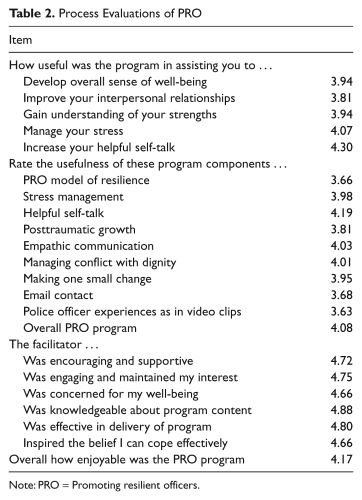
Note: PRO = Promoting resilient officers.
There were very few negative comments. The following are some examples of negative comments that need to be addressed: “Too much content, too much to remember”; “Too much nice touchy feeling communicating.” Process evaluations also encouraged participants to provide suggestions for improvement; responses included “More ‘war stories’ and stories relating to what I’m about to face on the job” and “Perhaps more one-on-one time with the facilitator.”
As mentioned, one of the innovations of PRO was the delivery of online refreshers and the development of a product that can effectively be described as a hybrid between face-to-face and online interventions. In that context the uptake and response to the online components was examined. While there is good literature on the potential effects of online interventions, uptake and completion rates can be very poor even in the context of treatment (Christensen, Griffiths, Groves, & Korten, 2006; Christensen, Griffiths, & Jorm, 2004). Within a universal approach, this could be even more problematic as engagement and reach is a ubiquitous problem in universal interventions. Completion rates for the online components of the PRO intervention to date are contrary to those negative trends. To date, data indicates 88.2% of participants have accessed and logged onto the online refresher and a completion rate of the entire session was recorded for 73.8% of participants in the PRO groups. The high completion rate strongly endorses the potential value of such hybrid programs in terms of access and reach. A random sample of participants was contacted by phone to provide qualitative feedback on the online refreshers. Responses suggested that the online components were well received and not considered intrusive or onerous, for example,
“It was good for me to remember self-talk, of reminding me of things that worked for ME”;
With positive self-talk, I have to keep remembering, at stressful times, you’ve got this far, you’ve felt like this before and you got through it, just keep going. You can forget it with the magnitude of some of the stuff you are going through, but you need to stop and think about it and some of the stuff comes to mind;
and, “Better than normal surveys where you just tick and flick, it held my attention more than they usually do. Yep, (because of) the interactive nature of it.”
Conclusion
The community-based participatory approach helped to ensure that implementation of the research and the program was not anathema to the system and caused minimal disruption. Instead this has become a jointly owned project between university researchers and the Queensland Police Service that is highly valued and in keeping with the direction and strategic initiatives of the police service. The use of endogenous resources for program facilitation is particularly important in terms of credibility and program sustainability.
The strength-focused resilience orientation is in keeping with the current push in the area of mental health promotion and is also in keeping with a growing salutogenic focus in the psychological trauma arena. In addition, this strength-focused narrative was well received within the organizational context and they were thus eager to locate a program of this positive nature as an integral part of the police training process. The location of the intervention as part of recruit training provided an important pragmatic solution to program delivery as well as sending the message (sanctioned from above) of the importance of mental health self-care when working in such high risk occupations.
The outcome of the RCT of the PRO program on mental health and well-being is obviously of key interest. This is still to be determined. The fact that we can deliver a program with high engagement and integrity is of little meaning if it does not result in positive and enduring outcomes. The burden of mental health problems (particularly trauma) on employees and the family and community are of vital concern. For now, however, early indicators are that the PRO program is able to effectively deliver a promising and sustainable intervention to promote and maintain positive mental health that has been largely embraced by the organization and the participants.
Footnotes
The authors declared no potential conflicts of interest with respect to the research, authorship, and/or publication of this article.
The authors disclosed receipt of the following financial support for the research, authorship, and/or publication of this article: This research was supported by a grant from the Australian Research Council in Partnership with the Queensland Police Service.