







Abstract
The purpose of this study was to develop a set of profiles on incarcerated older adults, which map the association between world assumptions, trauma, and indicators of mental health, including stress, depression, anxiety, hostility, and paranoia. A sample of 667 incarcerated older adults in prison completed a self-administered survey that included the World Assumptions Scale, Brief Symptom Inventory, and an index of subjective trauma experiences. Latent class analysis was used to model the heterogeneity in the sample. The authors identified three distinct classes of world assumption profiles among the study participants: a highly resilient group, a group who liked themselves, but no one else, and a group with elevated mental health indicators. The findings have theoretical implications for understanding cognitive schemas and life-course traumatic experiences as well as suggestions for identifying incarcerated individuals most at risk of psychological problems.
The concept of assumptive worlds has captured the imagination and interest of trauma researchers and practitioners for over two decades. In the early 1990s, Janoff-Bulman (1992) advanced world assumptions theory to describe how the experience of trauma survivors jades their positive world outlook and instead shifts their schema to a negative worldview (Janoff-Bulman, 1989). The theory is based on the idea that we live in socially organized groups; therefore, everyone is born with a propensity for positive core beliefs about the goodness of people in a caring and just world (Janoff-Bulman & Frieze, 1983). However, these tendencies are often challenged by traumatic experiences, such as childhood physical or sexual assault. Traumatic experiences run counter to a positive worldview and challenge the expectation of a caring and just world among trauma victims (Forest, 1995; Janoff-Bulman & Morgan, 1994). Thus, exposure to traumatic experiences is postulated to have the capacity to alter a person’s worldview, as well as his or her view of self, and view of others. These views are further postulated to shape the individuals’ behavioral repertoire (Janoff-Bulman, 1989). Given the high rates of trauma found among criminal justice populations, gaining a better understanding of how exposure to traumatic experiences influences and is influenced by cognitions and behaviors is an important research area to pursue.
A key premise of world assumptive theory is that exposure to traumatic experiences has the capacity to shift core beliefs. However, empirical studies using the World Assumptions Scale (WAS; Janoff-Bulman, 1992) have shown mixed results. A review of the empirical literature on trauma and world assumptions yielded 13 peer-reviewed journal articles published between 1979 and 2009 (e.g., Currier, Holland, & Neimeyer, 2009; Foster, Sloto, & Ruby, 2006; Janoff-Bulman, 1979; Harris & Valentiner, 2002). Twelve of the 13 studies examining trauma and world assumptions were conducted with community samples of university students or adults (e.g., Calhoun & Cann, 1994; Calhoun, Cann, Tedeschi, & McMillan, 1998; Engelkemeyer & Marwit, 2008). Most examined different types of trauma and life-event stressors linked to world assumptions, including interpersonal violence, natural and man-made disasters, and traumatic loss, particularly the death of a family member (Currier et al., 2009; Goldenberg & Matheson, 2005; Janoff-Bulman, 1982; Prince-Embury & Rooney, 1995).
To date, there are only two identified studies that have used this measure with a sample of offender populations (Avants, Marcotte, Arnold, & Margolin, 2003; Maschi & Gibson, 2011). Only one study examined world assumptions among individuals who engaged in illegal drug use (Avants et al., 2003), while the other study examined the world assumptions of young and older prisoners (Maschi & Gibson, 2011). Research on the world assumptions of prisoners is particularly important given that studies have found consistently high levels of traumatic experiences among criminal offenders. Upwards of 93% of juvenile or adult offenders report a history of being a victim or witness to violence, including physical or sexual assault occurring during childhood and/or adulthood (e.g., Abram et al., 2007; Hochstetler, Murphy, & Simons, 2004). In addition, maladaptive coping skills, such as low self-esteem or self-blame, are associated with illegal drug use and violence (Avants et al., 2003; Piquero & Sealock, 2000).
The equivocal nature of the research findings supports the need for further investigation. In addition, there is currently a significant gap in our knowledge about how relevant world assumptions are to the psychological functioning of criminal offenders with histories of trauma. Moreover, no published studies have examined the heterogeneity within the samples. It is clear that when data are analyzed at the variable level, the heterogeneity within the sample often left unexamined, masks important inter- and intra-individual differences.
Purpose of Study
The purpose of this study was to contribute to the extant literature by examining the patterns of difference on world assumptions using the WAS (Janoff-Bulman, 1992) with a sample of prisoners with histories of traumatic experiences. The focal aim was to develop a set of profiles, which map the association between world assumptions and indicators of mental health such as stress, depression, anxiety, hostility, and paranoia along with historical traumatic stressors.
Method
Research Design
This study, which used a cross-sectional correlation design, was conducted in September 2010 in the New Jersey Department of Corrections (NJ DOC) and consisted of 667 English-speaking prisoners (aged 50 and older). Of approximately 25,000 prisoners housed in the NJ DOC in January 2010, approximately 7% ( = 1750) were aged 55 and older. Information to create the sampling frame included the NJ DOC administrative records data for State Bureau of Identification (SBI) number and age. The NJ DOC generated the sampling frame for the study with a list of names, so that invitations and anonymous surveys could be mailed to potential participants and return correspondence could be received.
A response rate of about 40% was achieved. This estimate falls within the higher range of expected mail response rates, which are 20% to 40% for prison populations (Hochstetler et al., 2004). Seven cases were eventually dropped due to problems in response coding resulting in a sample of 667. The project was part of the Hartford Social Work Faculty Scholars Program Award, which is funded by the John A. Hartford Foundation and the Gerontological Society of America. The study was approved by the ‘Fordham University’ Institutional Review Board (IRB) and met the standards for conducting research with a special population of older prisoners and on sensitive topics.
Data Collection
The Dillman et al. (Dillman, Smyth, & Christian, 2009) method for mailed surveys was used to maximize response rates. Specifically, potential participants received (a) a letter of invitation; (b) a packet with a cover letter, consent form, survey, and a self-addressed electronically stamped envelope (SASE) 7 days later; (c) two thank you cards and reminders sent 7 days apart that included an enclosed self-addressed envelope for participants to request a survey replacement.
Constructs and Study Measures
Traumatic and life-event stressors
Traumatic and life-event stressors were measured using the 31-tem Life Stressors Checklist (LSC-R; McHugo et al., 2005). The LSC-R estimates the frequency of lifetime and current traumatic events (being a victim of and/or witness to violence), which is consistent with DSM IV-TR Criterion A for posttrauma stress symptoms (American Psychiatric Association [APA], 2000). It also accounts for life-event stressors, such as losing a loved one, physical health problems, divorce, and financial problems.
Subjective impressions of traumatic and stressful life experiences
More specifically, the LSC-R also includes a subscale for participants’ “subjective” impressions of traumatic and stressful life experiences. For each of the individual traumatic and stressful life events experienced, participants were asked their current subjective impression of these events by rating each type of traumatic and stressful life events on the degree to which it was bothersome within this past year. Each item was measured using a 5-point Likert-type scale from 1 = not at all to 5 = extremely. A total score was calculated by adding participants’ past year subjective ratings related to each of the 31 possible objective traumatic and stressful life events that were experienced during the life course. Researchers have reported that the LSC-R has demonstrated good criterion-related validity for detecting traumatic and stressful life events among prisoners (McHugo et al., 2005). For example, one study of 2,729 women in which a test–retest sample was completed on a subset of 186 women who completed the measure on average 7 days later. Kappa’s range averaged .70 for different items (McHugo et al., 2005).
World assumptions
To measure world assumptions, we used the WAS (Janoff-Bulman, 1989). The WAS is a 32-item instrument that assesses an individual’s basic assumptions about the world, on a 6-point Likert-type scale that ranges from 1 (strongly disagree) to 6 (strongly agree). The WAS has an overall total score and three subscale scores of benevolence of the world, meaningfulness of the world, and worthiness of self.
The first subscale, benevolence of the world, consists of items that pertain to (a) the benevolence of people (e.g., human nature is basically good), and (b) the benevolence of the impersonal world (e.g., the world is full of goodness). The meaningfulness of the world subscale has items that pertain to (a) the justness of the world (e.g., misfortune is least likely to strike worthy, decent people), (b) the degree to which control is possible (e.g., we can prevent bad things from happening to us), and (c) the randomness of events (e.g., the course of our lives is largely determined by chance). The worthiness of the self-subscale consists of items related to (a) self-worth (e.g., I have a low opinion of myself), (b) the degree to which personal control is possible (e.g., I behave in ways that maximize good results for me), and (c) luck (e.g., I make an effort to prevent bad things from happening to me; Janoff-Bulman, 1989). A summative score was calculated for the total WAS score and each of the three subscales.
A brief summary of prior studies using community samples have found reliability coefficients that ranged from .67 to .78 (Avants et al., 2003; Calhoun & Cann, 2001; Janoff-Bulman, 1989). The WAS also has been used with at-risk populations, such as substance abusers, and these three subscales maintained good internal reliability (α = .75, .82, and .79, respectively; Avants et al., 2003).
Psychological or mental health symptoms
The Brief Symptom Inventory (BSI) was used to measure range of psychological or mental health symptoms (Derogatis, 1975, 1993). The BSI is a standardized scale that measures psychological symptoms and has been used with adults and older adults in community and/or institutional settings (Asner-Self, Schreiber, & Marotta, 2006; Bachman & Chase-Lansdale, 2005; Liu, Rochlen, & Mohr, 2005). It consists of 53 items covering nine symptom dimensions and three global indices. The nine symptom dimensions consist of (1) somatization, (2) obsession-compulsion, (3) interpersonal sensitivity, (4) depression, (5) anxiety, (6) hostility, (7) phobic anxiety, (8) paranoid ideation, and (9) psychoticism.
There are three global indices of distress: (1) Global Severity Index (i.e., current or past level of symptomatology), (2) Positive Symptom Distress Index (i.e., intensity of symptoms), and (3) Positive Symptom Total (i.e., number of reported symptoms). Studies have shown that the BSI has good internal consistency reliability for the nine dimensions, ranging from .71 (i.e., psychoticism) to .85 (i.e., depression). Test–retest reliability for the nine symptom dimensions ranges from .68 (i.e., somatization) to .91 (i.e., phobic anxiety), and for the three Global Severity Indices ranging from .87 (i.e., PSDI) to .90 (i.e., GSI; Derogatis, 1993). This study focused on more common mental health symptoms, including in correctional settings, of depression, anxiety, hostility, and paranoia.
Sociodemographic background
The Culturally Competent Sociodemographic Questionnaire-Prison (Maschi, 2010) was used to gather self-report information on the sociodemographic background of participants. This information included respondents’ age, race/ethnicity, gender, marital status, educational status, number of children, income before incarceration, length of sentence, amount of time served, and expected release date and other relevant criminal justice information. For example, age was determined by the following question, “What is your current age in years?
Analytic Method
Descriptive analyses
The analyses were conducted in two steps. In Step 1, descriptive statistics were used to examine the sociodemographic characteristics of the participants. Step 2 consisted of Latent Class Analysis (LCA), which was conducted using Mplus (5.1) software. LCA is a method for modeling heterogeneity in samples by assigning respondents to groups or classes based on the patterning of their responses in survey instruments. More important, LCA analyses are at the person level rather than at the variable level. Thus, researchers are able to model and identify important intra- and inter-individual differences that yield distinct configurations of the heterogeneity within the sample. The procedure takes into account both the clustering of cases and the items most descriptive of a particular category or latent class. The analysis consists of finite mixture modeling, which captures the unobserved heterogeneity yielding results that are a mixture distribution, which is heterogeneous across the sample but homogeneous within subsamples.
Findings
Descriptive Analyses
Sample description
The final sample consisted of 667 older adult males (aged 50+) serving prison sentences in September 2010 in a Northeast U.S. state prison system. The mean age of participants was 60.83 (SD = 5.43) and their race/ethnicity consisted of White (43%), African American (41%), Hispanic/Latino (9%), and Other (7%). Only 10% reported having no high school diploma and 72% reported having a high school diploma, in which 18% earned a college degree or higher. About one third reported serving in the military.
About 27% of participants reported having a mental health diagnosis and 36% reported a drug problem and being under the influence of a substance (alcohol or drugs) at the time of their current offense. The majority had serious offenses, including violent (62%) and sex offenses (29%). The average time served was 156 months (or 13 years) with a range from 4 months to 42 years served. About 8% were sentenced to life in prison and more than half were scheduled to be released from prison within 1 year (38%) or 2 to 5 years (26%). As for family, about 21% of participants reported currently being married or partnered (21%). Most participants reported having children (80%), including under the age of 18 (17%) and grandchildren (58%). One fifth of participants reported having at least one incarcerated family member.
Latent Class Analyses
In the LCA analyses we used items from the WAS (Janoff-Bulman, 1989) to define the classes. Moreover, we investigated the psychological distress of people in each of the classes by including items from the Brief Symptom Inventory (BSI) as well as the respondents’ reports of the overall number of historical trauma and life-event stressors.
Three classes
As shown in Figure 1, the analysis resulted in a three-class solution that was supported by several fit indices. AVuong-Lo-Mendell-Rubin likelihood ratio test of model fit was performed that compared the estimated three-class model with a model with one less class (Lo, Mendell, & Rubin, 2001). The results yielded a value of 1064.030, p < .012. Given that there have been problems with the Vuong-Lo-Mendell-Rubin test, we performed a Parametric Bootstrapped Likelihood Ratio Test for three versus two classes, which confirmed the three-class solution. Results were an H0 log likelihood value of −20387.632, 2 times the log likelihood difference was 1070.090, and difference in parameters was 27, p <.0000. Other fit indices included Entropy, which was .89 (values close to 1 are considered optimal) and the average latent class probabilities for most likely class membership that were above the .90 recommended range (Class 1 = .956, Class 2 =.931, Class 3 = .957, respectively).
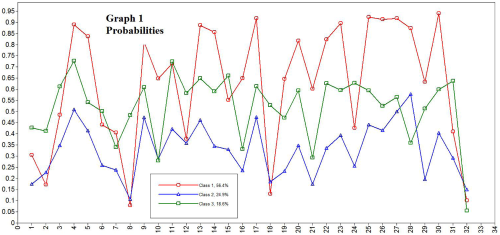
Latent class analysis results.
Class membership was arrived at by taking the posterior probability of membership in each class and then assigning respondents to the class in which they had the highest probability of falling into a cluster.
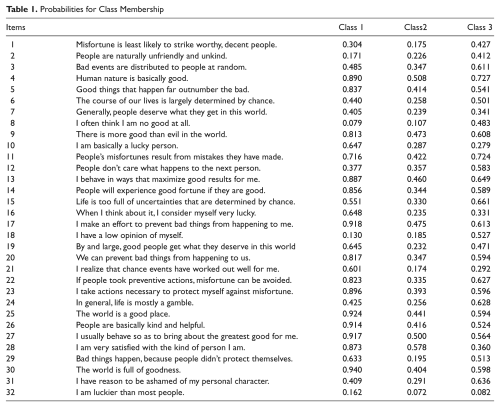
As is illustrated on Table 1, Class 1, which was 56% of the respondents (sample n = 667), had the highest probability of answering agree or disagree on 18 out of the 32 items (the highest probabilities are highlighted in bold). Thus, Class 1 had the highest scores on items related to benevolence of people (see Items 1, 26) and benevolence of the impersonal world (see Items 5, 9, 25, 30) as well as items related to meaningfulness of the world, especially related to a sense of personal control (see Items 17, 19, 20,21, 22, 23, 27).
Probabilities for Class Membership
Class probabilities by item are also displayed in Figure 1. As illustrated, Class 1 graphed using circles is far closer to a probability of 1 on Items 4, 5, 9, 13, 14, 17, 22, 23, 25, 26, and 30 than either of the other two classes. Class 2, represents 25% of the sample (graphed using triangles). The respondents had a response pattern that was notable for the lowest probabilities of answering agree or disagree to any of the items. Only Item 28, “I am very satisfied with the kind of person I am,” spiked above Class 3 and broke the low-probability pattern of endorsing any of the world assumptions. Class 3 (graphed using squares) represents 19% of the respondents. This group had a response pattern that was characterized by items endorsing unjustness in the world (see Item 1), low self-esteem (see Items 8, 18, and 31), and a lack of world meaning, especially perceived a lack of personal control (see Items 3, 6, 15, and 24) and the untrustworthiness of people (see Items 2, and 12).
Clinical profiles based on classes
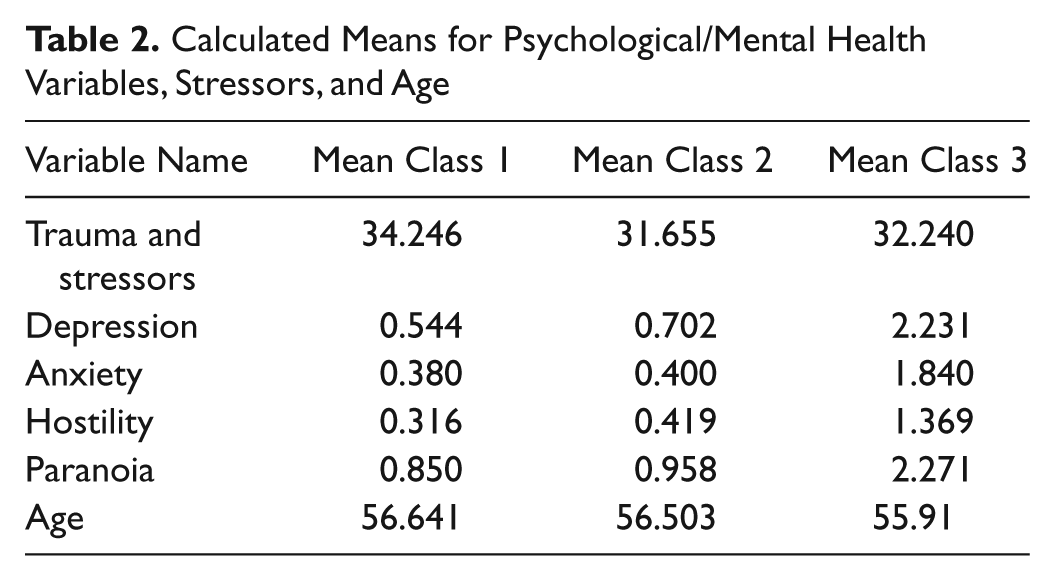
Table 2 shows the calculated means for the psychological/mental health symptoms of depression, anxiety, hostility, paranoia, as well as the mean number of the subjective impressions of trauma/stressors and the mean age by class. There were no significant differences in either the number of trauma/stressors or the age of respondents in any of the three classes. However, it is clear to see that Class 3 had the most significant clinical profile with the highest means on all of the psychological distress items. The elevations are notable especially for depression and paranoia, items that are strongly related to feeling bad about ones’ self, not trusting people, and feeling that life circumstances were out of control.
Calculated Means for Psychological/Mental Health Variables, Stressors, and Age
Discussion
The purpose of this study was to develop mental health profiles on a sample of older adults who are imprisoned. The study examined older prisoners’ assumptions about the world and the association of these assumptions with mental health correlates including: depression, anxiety, hostility, paranoia, subjective experiences of historical trauma, and stressors and the prisoners’ age. World assumptions theory postulates that traumatic and stressful life experiences have the capacity to shift core beliefs. As reported earlier empirical studies using the WAS to examine this postulate have shown mixed results. We found mixed results also. We identified three distinct classes of world assumption profiles among the study participants. Two out of three participants fell within Class 1, (56%) the benevolent world group. This group was differentiated from the other two groups by their endorsement of items which represented intact “self-other-world” assumptions. In general, Class 1 reported a positive sense of self-worth and self-control replete with a sense of agency to act on the world. They perceived others and the world for the most part as good. They also endorsed a sense of justice and fairness and a realistic view of the degree to which control is possible. While there was no significant difference in age or degree of subjective impressions of past trauma and stressors across the three classes, Class 1 had the lowest degree of psychological and mental health symptoms compared to other two classes.
One out of four participants fell within Class 2 (25%). This class endorsed items representative of an intact self but had a pattern of negativity toward others and a shattered sense of goodness in others. They reported feeling relatively satisfied with the kind of person they were but indicated a disagreeable view about the others. Overall the pattern of Class 2 suggested that the world was unjust and out of their control. Class 2 members reported slightly higher levels of psychological symptoms, especially related to depression, anxiety, and paranoia, compared to Class 1 members.
One out of five participants fell within Class 3 (19%). This group had a pattern of responses that could be characterized as shattered assumptions of self, others, and the world. On average, Class 3 was more likely to endorse beliefs about low self-worth and personal control, self-blaming, and an uncaring and unjust world. Notably, Class 3 members reported the highest degree of psychological-mental health symptoms related to depression, anxiety, hostility, and paranoia compared to Class 1 and 2 members.
The pattern of responses of Class 3 members provides the most empirical support for the major tenets of world assumptions theory. Overall, these findings suggest that among older adults in prison, perceptions of self and others influenced their psychological symptoms. The more one’s perceptions of self-worth, benevolence of people and the world, and meaningful of their world were compromised, the higher their levels of adverse psychological symptoms.
Overall, these findings contribute to the extant literature by examining the world assumptions of an older adult prison population. The prior literature using mostly community samples of college students has reported mixed results about the impact of exposure to trauma and world assumptions. The current study extends this literature by examining a cumulative index that consists of the subjective impressions of prior trauma and life-events stressors to determine how different expressions of world assumptions influence psychological mental health symptoms. Overall, these findings suggest that individuals whose three domains of world assumptions (benevolence of the world, worthiness of self, meaningfulness of the world) have a cognitive makeup that is associated with high levels of psychological distress.
Limitations
This study has methodological limitations that specifically warrant discussion. First, the study used a cross-sectional correlational design and this limits causal inferences. Second, the data are a regional sample of older adults in prison in the Northeastern United States. The response rate is not necessarily representative since it was only 40%. Therefore, the findings cannot be confidently generalized from the population from which it was drawn.
In addition, this is one of the first studies to use the WAS with mostly older imprisoned adults. Therefore, this measure that was originally developed for female rape survivors may not accurately capture the dimensions of world assumptions or its variations that might be influenced by factors, such as age, gender, and offender status. For example, the meaningfulness scale attempts to capture the esoteric and idiosyncratic construct of meaning in life. The self-worth scale examines how much the prisoner values and respects oneself. Consequently, these scales may not effectively work with prisoners, who are serving long sentences with perhaps little optimism or spiritual perspective for finding a positive meaning in their current incarcerated existence. Controlling for these factors in future analysis is warranted. In addition, prescreening for those who endorse embracing spirituality may assist in the future analysis of this scale. Future studies should take into account how the measure can be revised if at all for special populations, such as aging prisoners.
Implications
These findings have significant theoretical implications for understanding cognitive schemas and life-course traumatic experiences, especially as it relates to older adults in the criminal justice system. World assumptions theory offers a perspective of the internal worldviews commonly used by trauma survivors, of which a sizeable number are involved in the criminal justice system for committing criminal offenses (Baer & Maschi, 2003; Maschi & Gibson, 2011). These findings suggest that some trauma survivors’ sense of meaning about the world being a fair and just place is challenged. Whereas the theory mostly describes the impact of traumatic stressors on world assumptions, there has been literally no empirical testing to classify subgroups of individuals whose world assumptions have remained intact or positive about self, others, and meaning and control.
For assessment and intervention purposes, the current study discerns three distinct groups that demonstrated varying levels of resilience about perceptions of oneself, others, and the world among older adults in a correctional setting. These perceptions were inversely related to common presenting mental health symptoms (i.e., depression, anxiety, hostility, and paranoia), including among older adults in prison. This suggests that even among high-risk populations, the presence of positive cognitive coping strategies can have a resilient effect, especially for maintaining mental well-being in stressful prison environments. For those individuals that at least present with their self-agency intact, as found in Class 2, fostering their sense of self-agency and self-determination, even within a prison setting, can continue to maintain or improve mental well-being in prison settings and/or preparing them for reentry into society.
In addition, conduct thorough assessment of maladaptive world assumptions appears to be critical for identifying individuals most at risk of psychological problems. Assessment can include use of the WAS (Janoff-Bulman, 1989) for intake and monitoring of progress. Therefore, developing interventions that foster positive world assumptions and behaviors self-agency and self-determination as well as challenging black and white thinking about matters of personal and external locus of control is warranted. There is growing evidence that unresolved trauma and grief are related to mental health and substance abuse problems and recidivism (e.g., Leach, Burgess, & Holmwood, 2008). Therefore, targeting world assumptions as an assessment and intervention strategy can help to rebuild positive world assumptions, which in turn can help to reduce the risk of these potential adverse mental health and criminal justice consequences.
Based on the current findings, perhaps world assumptions theory sheds light on how a collective of self-other-world assumptions are related to adverse psychological symptoms. It is quite plausible that this type of negative “mindset” instigates or exacerbates mental health problems or high-risk behavior. For example, individuals who perceive the world as unjust and unfair may respond by taking justice “into their own hands.” If offenders blame others for their “misfortune,” they may not take personal accountability and continue a trajectory of offending behavior.
Therefore, assessing and treating not only unresolved trauma but also maladaptive worldviews among offenders may not only reduce adverse psychological consequences but also high-risk behaviors. Intervention efforts in criminal justice settings, especially in prison and reentry programs, would benefit by actively incorporating trauma and stress management programming to address possible adverse psychological reactions, such as impaired world assumptions and possible PTSD symptoms. In particular, more actively exploring cognitive therapies within correctional programming that would address maladaptive thinking among criminal offenders is recommended.
In fact, here is a precedent for this as cognitive therapies have been shown to reduce recidivism among adult and juvenile offenders (e.g., Landenberger & Lipsey, 2005). In particular, innovations in the form of cognitive restructuring group work that involves the use of dreams and imagery has shown to be a promising avenue for processing both trauma and criminal offense histories among incarcerated offenders (DeHart, 2010). Following the lead of the juvenile justice and child welfare systems for adaptive trauma informed practices, the criminal justice system would benefit by following suit (Ko et al., 2008).
In conclusion, perhaps most important about this study is that what people think can have an effect on overall mental well-being. If left unidentified and untreated, life-course mental health can be adversely affected. Therefore, the adaption of trauma-informed care in the criminal justice system that targets offenders’ cognitive schemas has the potential to result in better mental health and behavior among offender populations, especially among older adults.
Footnotes
Declaration of Conflicting Interests
The authors declared no potential conflicts of interest with respect to the research, authorship, and/or publication of this article.
Funding
The authors received no financial support for the research, authorship, and/or publication of this article.