







Abstract
Oral phage therapy is a promising strategy for reducing harmful bacteria in broilers. However, it may lead to the spread of therapeutic phages in the farm environment, potentially increasing bacterial host tolerance. To determine the stability of novel Salmonella bacteriophages in chlorinated drinking water and their response to farm disinfectants, we evaluated virucidal activity using a quantitative suspension test in the presence of organic matter. A >4-log-reduction was achieved using oxidizing agents, organic acid- and surfactant-based (1:350, 2 min), as well as glutaraldehyde and benzalkonium chloride-based (1:1000, 15 min) disinfectants. A hydrogen peroxide and peracetic acid-based disinfectant required a higher concentration (1:100, 10 min) to achieve an equivalent reduction. Results support the selection of disinfectants to mitigate residual therapeutic phages on farm premises. Chlorine (3-ppm, 24 h) did not reduce phage titer compared with the control, demonstrating the flexibility to administer bacteriophages in chlorinated drinking water for broilers.
Introduction
Lytic bacteriophages have emerged as a promising approach to reduce harmful bacteria in intensively reared food-producing animals. Drinking water offers an ideal route for mass administration of phage therapy to broilers. However, the instability of phages in the presence of chlorine, commonly used for water sanitization, may require its removal prior to administration (Pino et al., 2025). Routine use of phage therapy in broiler flocks may lead to their spread within the farm environment. Prolonged exposure to target bacteria could promote natural bacterial adaptations, potentially reducing the effectiveness of the phages over time (Sommer et al., 2019; Raza et al., 2021).
Cleaning and disinfection are key strategies for reducing microorganisms in broiler farms (Collett and Smith, 2020). Disinfectants must deliver consistent antimicrobial activity; however, commercial products are typically tested on bacterial and/or viral models, which may not effectively target all microorganisms (Karczewska et al., 2023). We previously tested lytic, tailed bacteriophages with dsDNA genomes to reduce Salmonella in broilers through administration in chlorine-free drinking water (Vaz et al., 2024). In this study, we evaluated the response of these phages to commercial disinfectants to identify effective biocides against residual therapeutic phages on farms. Chlorine was also tested to assess the feasibility of administering phages via chlorinated drinking water.
Material and Methods
Phages (BRM 13312, BRM 13313, and BRM 13314) titers in the stock solution (sodium magnesium [SM] buffer) were determined by the standard double-layer agar assay. Briefly, each phage stock was serially diluted with SM buffer, and 10 µL of each dilution was mixed in 108 CFU/mL (250 µL) of a host strain (Salmonella Enteritidis BRM 13425), adsorbed at 37°C for 15 min, and transferred to 7 mL of nutrient broth (Oxoid, UK) supplemented with 5 mM MgSO4, and 0.7% agarose (Invitrogen, USA). The soft agar was gently mixed before pouring, in duplicate, onto a nutrient agar plate and distributed by gentle rotation. The soft agar was allowed to solidify at room temperature. After overnight incubation at 37°C, the plates were examined for plaque enumeration, and the titer was considered as the average of the duplicates, corrected by the dilution factor.
Table 1 describes the commercial disinfectants used (A, B, and C) and their respective exposure times. Chlorinated water at 3-ppm, the level required for drinking water on Brazilian poultry farms (Brasil, 2007), was prepared using sodium hypochlorite and tested after 24 h of exposure. Hard water (1.26 mM MgCl2, 2.52 mM CaCl2, and 3.36 mM NaHCO3; pH 6.8) was used to dilute the disinfectants. Acidified whey served as the source of organic matter.
Effect of Commercial Disinfectants and Chlorine on Bacteriophages Titers (BRM 13312, BRM 13313, and BRM 13314; log10 PFU/mL) Under Specific Test Conditions
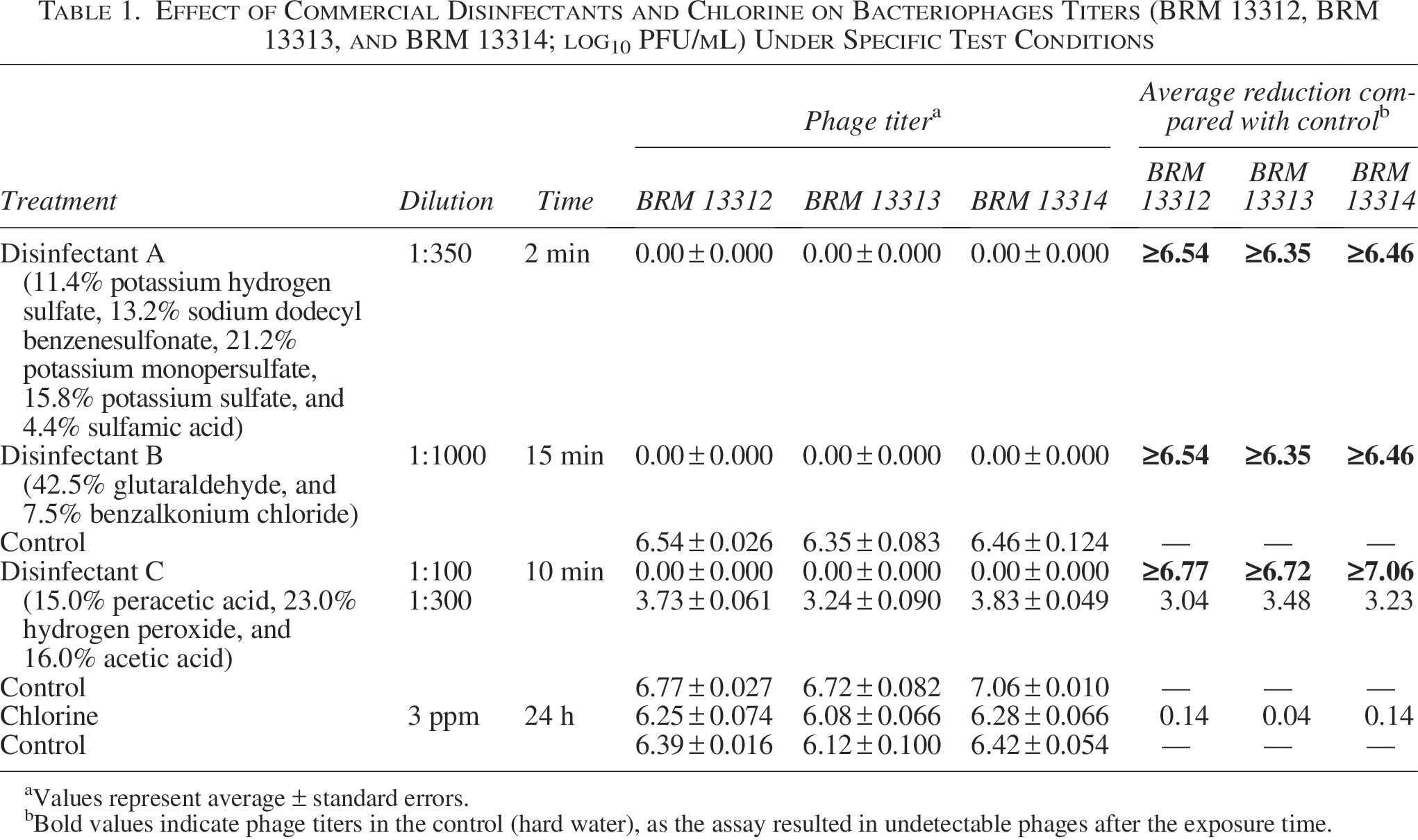
Values represent average ± standard errors.
Bold values indicate phage titers in the control (hard water), as the assay resulted in undetectable phages after the exposure time.
The quantitative suspension test was adapted from Morin et al. (2015). First, the assay was validated to confirm the absence of lethal effects due to test conditions, the nontoxicity of the neutralizing solution (nutrient broth [Oxoid] supplemented with 3% Tween 80 [Vetec, Brazil], 0.3% L-histidine [Sigma, USA], and 0.3% sodium thiosulfate [Sigma]), and the efficacy of this solution in neutralizing the tested chemicals. One milliliter of each phage suspension (109 PFU/mL) was then mixed with 1 mL of 10% organic matter for 2 min. Next, 8 mL of each disinfectant, prediluted in hard water (1.25×), were added, vortexed, and left in contact at room temperature (approximately 24°C). Chlorine was tested as described above, with distilled water used in place of organic matter. For the control, the chemicals were replaced with hard water at the same volume. At the end of exposure, both test and control were immediately diluted 1:50 (v/v) in the neutralizing solution for 5 min. A tenfold serial dilution was prepared in SM buffer for each treatment and control to enumerate infectious phages using the double-layer agar technique, as described previously, in duplicate. Each treatment was performed in triplicate.
The plaque-forming unit (PFU)/mL values were log-transformed before analysis. A virucidal effect was defined as a reduction of ≥4 log10 units compared with the control under the same conditions (Morin et al., 2015). Confidence intervals (95%) for the average phage titers were estimated using the standard error and Student’s t-distribution in SAS (v. 9.4, SAS Institute, USA) to assess the effect of the tested chemicals. Nonoverlapping intervals indicated a significant difference (p ≤ 0.05) between a given chemical and its respective control.
Results
Disinfectants A and B demonstrated a virucidal effect against the bacteriophages, as indicated by the absence of detectable PFUs after the exposure time. In contrast, the respective controls recorded average titers of 6.54, 6.35, and 6.46-log units for phages BRM 13312, BRM 13313, and BRM 13314, respectively (Fig. 1a). Disinfectant C was less effective, requiring a higher concentration (1:100) to achieve a comparable titer reduction (Fig. 1b). At least one tested dilution of each disinfectant significantly (p ≤ 0.05) reduced phage titers compared with the control. Chlorinated water at 3-ppm showed no significant (p ≥ 0.05) reduction in phage titer after 24 h of exposure, relative to the control (Fig. 1c). Table 1 provides details on the variances in phage titers following exposure to each chemical and control.
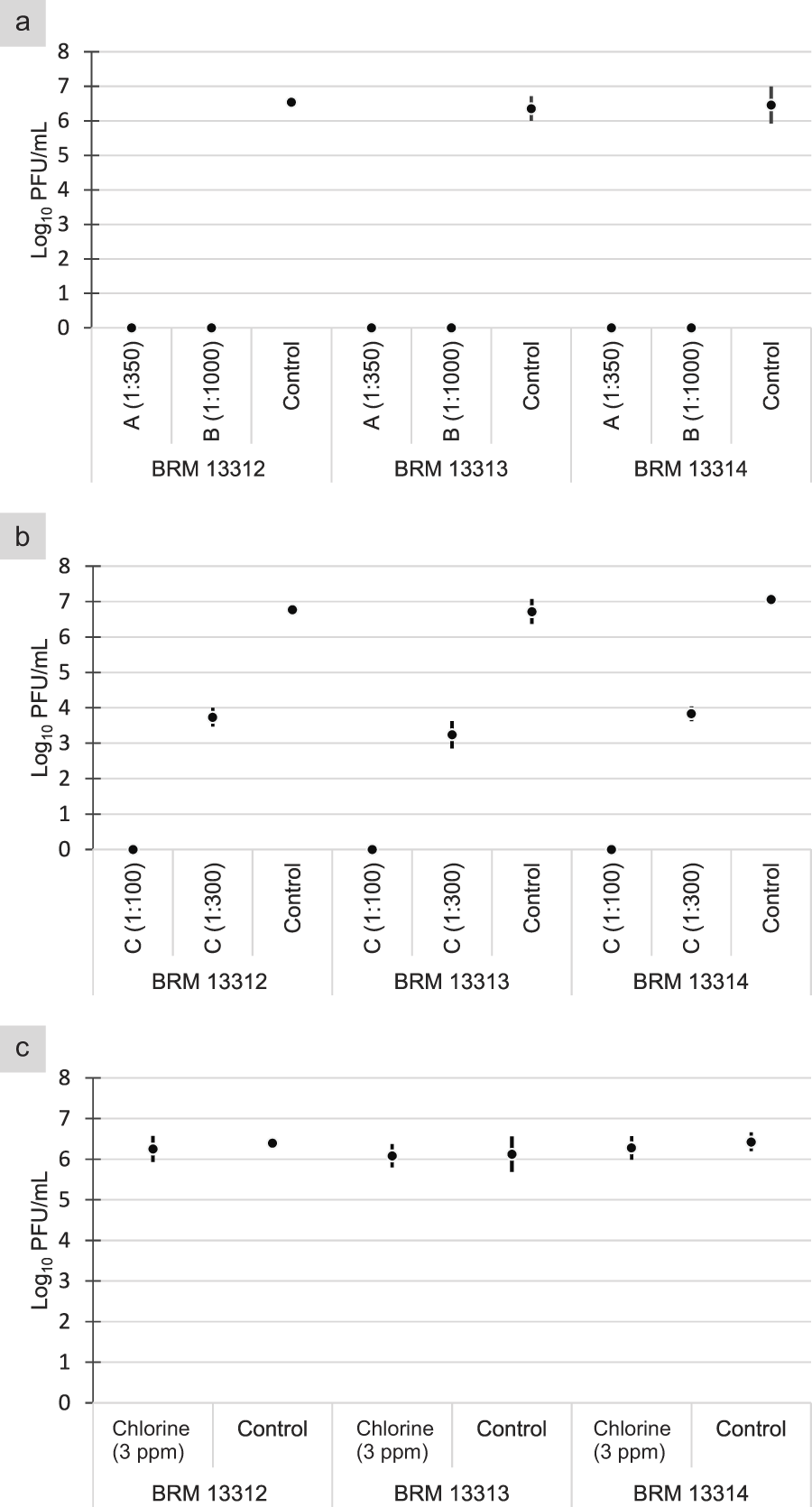
Average bacteriophage titers (BRM 13312, BRM 13313, and BRM 13314; log10 PFU/mL) after exposure to
Discussion
In general, tailed phages with dsDNA genomes lack a lipid envelope, making them more resistant to the inactivating effects of several biocides (Sommer et al., 2019). Table 1 details the bacteriophage titer reduction for each tested disinfectant. It can be observed that disinfectants A and B consistently showed a >4-log-reduction for all phages, indicating virucidal efficacy. Disinfectant C, in contrast, showed greater variability in titer reduction, reinforcing the importance of specific disinfectant concentration for effective bacteriophage inactivation. As previously reported, while peracetic acid- and hydrogen peroxide-based disinfectants can be virucidal, higher concentrations are needed to achieve similar efficiency in the presence of organic matter (Lin et al., 2020). For benzalkonium chloride, generally effective against phages in food industry settings (Sommer et al., 2019), virucidal activity also varies depending on the concentration used (Karczewska et al., 2023). Therefore, it is crucial to establish effective disinfectants specifically targeting the phage strain in question.
The difference in efficacy between disinfectants may be related to the specific chemical composition of each product. Glutaraldehyde (within disinfectant B) is a broad-spectrum agent that interferes with DNA, RNA, and protein synthesis (Karczewska et al., 2023). It is highly effective against many viruses after short exposure times (Lin et al., 2020). Likewise, the phagecidal activity of potassium monopersulfate (within disinfectant A) has been previously reported (Morin et al., 2015), supporting its utility for premises disinfection due to its rapid effect.
Sodium hypochlorite contains 5% to 12% available chlorine. In water, hypochlorite partially dissociates into hypochlorite ions, while the remainder stays as hypochlorous acid, both of which have strong oxidizing activity (Jones and Joshi, 2021). Higher concentrations of sodium hypochlorite (e.g., 10-ppm available chlorine) may inactivate bacteriophages (Lin et al., 2020). Nevertheless, water sanitization with chlorine-releasing agents easily monitored within closed drinker systems on farms remains essential to prevent the introduction of poultry pathogens through drinking water (Collett and Smith, 2020).
Conclusion
A >4-log-reduction in phage titer was achieved with all tested disinfectants at one of the tested dilutions. Exposure to chlorine did not reduce the titer of infective phages. Therefore, chlorinated drinking water at 3-ppm does not require neutralization prior to administering phages to broilers, representing a labor-saving practice on the farm. These results provide a foundation for further studies to establish the use of these phages in broilers.
Footnotes
Acknowledgments
The authors are grateful to Dr. Nelva Grando (independent poultry consultant), who kindly suggested the tested disinfectants.
Funding Information
This work was financially supported by the Brazilian Agricultural Research Corporation (Embrapa, grant number 20180300800).
Author’ Contributions
C.S.L.V. and D.V.R. obtained research funding and conceived the study. D.V.R. carried out the material preparation, laboratory assays, and data collection. C.S.L.V., D.V.R., F.N.F., and A.C. analyzed the data. C.S.L.V. wrote the original draft and edited the article. D.V.R., F.N.F., and A.C. revised the article. All authors read and approved the final article.
Data Availability
The data are available upon reasonable request to the corresponding author.
Disclosure Statement
No competing financial interests exist.