







Abstract
An investigation into an outbreak of Salmonella enterica serovar Enteritidis (S. Enteritidis) infections in Canada was initiated in October 2021 after a cluster of cases was identified through whole-genome sequencing. A total of 118 cases were identified in five provinces, related by 0–4 whole-genome multilocus sequence typing allele differences. Cases became ill between September 6, 2021 (symptom onset date) and January 27, 2022 (specimen isolation date). The median age of cases was 30 years (range: 1–89 years), and 64% were female. Five hospitalizations and two deaths were reported. Early in the investigation, a cluster of illnesses was identified that ate at different locations of the same restaurant chain (Restaurant Chain A). Several hypothesis-generating methods were conducted to identify the source, including: case re-interviews, menu review, ingredient analysis, traceback investigations, and sampling of food items. These methods identified multiple fresh produce items as possible hypotheses, but the source of the outbreak was identified when a sample of Brand X Individually Quick Frozen (IQF) Corn from Restaurant Chain A tested positive for the outbreak strain of S. Enteritidis. In total, 87% (75/86) of cases reported exposure to, or potential exposure to, corn. Based on the distribution records, 91% (68/75) of these cases could be linked to the recalled Brand X IQF Corn, and of those, 88% (60/68) consumed food from Restaurant Chain A. This article summarizes the first known outbreak investigation of Salmonella associated with frozen corn in Canada and adds evidence to the potential food safety risks associated with frozen vegetables.
Introduction
Salmonellosis is a nationally notifiable disease in Canada (Government of Canada, 2022a), and in 2021, Salmonella enterica serovar Enteritidis (S. Enteritidis) was the most common serotype reported in Canada, accounting for 35% of all human salmonellosis, with an average of 3.07 per 100,000 cases (Government of Canada, 2022b). The consumption and/or improper handling of poultry has been previously identified as an important risk factor for the development of S. Enteritidis (Kimura et al., 2004; Middleton et al., 2014; Voetsch et al., 2009). Outbreaks of Salmonella associated with fresh fruits and vegetables have been documented (Denich et al., 2024; Kozak et al., 2013; Lynch et al., 2009), but the only reported Salmonella outbreak associated with frozen fruit or vegetables was a 2021 outbreak associated with frozen tomatoes in Finland (Kääriäinen et al., 2022).
In early October 2021, Canada’s National Microbiology Laboratory (NML) detected a cluster of five S. Enteritidis cases in two provinces through whole-genome sequencing (WGS) based surveillance as a part of national foodborne disease monitoring. Within two weeks, the case count had tripled to 18 cases in four provinces, and a collaborative investigation into the source of these illnesses began on October 20, 2021. Within the first two days of the investigation, a signal emerged for a cluster of illnesses that ate at different Restaurant Chain A locations. This restaurant chain served foods such as burritos, wraps, soups, and salads, with a variety of fresh toppings and customization options available. The objective of this article is to describe the outbreak investigation, which is the first known outbreak of Salmonella associated with frozen corn to occur in Canada, and add evidence to the potential food safety risks associated with frozen vegetables.
Methods
Case definition
A confirmed case was defined as a resident of or a visitor to Canada with laboratory confirmation of S. Enteritidis, with isolates matching the PulseNet Canada (PNC) cluster 2110SENWGS-1MP by WGS and symptom onset, or a collection date between September 1, 2021, and March 10, 2022, inclusive.
Laboratory analysis
In Canada, all clinical Salmonella isolates are received and sequenced by provincial public health laboratories and the NML for the purpose of WGS-based subtyping. Genomic DNA was obtained from a single colony incubated at 37°C overnight on nutrient agar. DNA was extracted using the DNeasy blood and tissue kit (Qiagen, Valencia, CA, USA). Libraries were generated using the Nextera XT DNA library prep kit (Illumina, San Diego, CA, USA), and sequencing was performed on the Illumina MiSeq platform with the MiSeq Reagent kit V2 or V3 (Illumina) according to the manufacturer’s directions. FASTQ files were deposited into the Integrated Rapid Infectious Disease Analysis platform (www.irida.ca) for storage and analysis. WGS data quality was initially evaluated using FASTQC (Babraham Bioinformatics), and reads with an estimated genome coverage ≥40× and average quality of ≥30 went on to be assembled in BioNumerics v7.6.1 (BioMeriuex, Lyon, France) using SPAdes v3.7.1. Assemblies with a genome length between 4.4 and 6 Mbp and ≤200 contigs were considered good quality. WGS data were analyzed locally in provincial public health laboratories and then uploaded to a centralized BioNumerics database, where they were analyzed by the PNC national database team using whole-genome multilocus sequence typing (wgMLST). Multi-jurisdictional S. Enteritidis clusters are identified using a threshold of 3 or more isolates genetically related by ≤10 wgMLST allele differences, where 2 of the 3 isolates are within ≤5 wgMLST allele differences of each other and at least 1 isolate is clinical. To visualize isolate relatedness, the unweighted pair group method with arithmetic mean dendrograms are constructed within BioNumerics v7.6 using a categorical similarity coefficient.
Canada and the United States have a bilateral information-sharing agreement that allows the routine exchange of molecular and genomic data. Under this agreement, WGS data were exchanged with PulseNet USA to facilitate the query of PulseNet USA databases for potential matches in the United States. A representative isolate was uploaded to BioProject PRJNA543337 on the National Center for Biotechnology Information, and the Pathogen Detection Pipeline was queried for genetically related isolates (The NCBI Pathogen Detection Project, 2016).
Epidemiological hypothesis generation
Case interviewing
Cases were initially interviewed by local public health investigators using routine provincial Salmonella questionnaires. The exposures included in routine questionnaires differ by province and the level of detail collected. Once confirmed as a part of the outbreak, cases were centrally re-interviewed by one of two interviewers at the Public Health Agency of Canada (PHAC) using the national Salmonella hypothesis-generating questionnaire combined with open-ended prompts. As the investigation progressed, various iterations of a focused questionnaire were used. Initially, the focus was on fresh produce, nuts, and seeds, as well as on foods eaten outside the home (i.e., restaurants and fast-food dining locations). A revised version focused on fresh tomatoes, onions, avocado, and cilantro while continuing to ask about foods eaten outside the home, including specifically prompting for exposure at Restaurant Chain A. For cases that reported an exposure outside the home, they were asked what meal they consumed, including the ingredients, substitutions, additions, or removal of items. Location-specific menus were used during case interviews to assist with recall. Once corn was identified as the source of the outbreak, the questionnaire focused on corn exposures both inside and outside the home, as well as any additional food outside the home exposures to account for potential recall issues with consuming corn in a restaurant or fast-food meal.
Menu review and ingredient analysis
Given the large number of cases reporting exposure to Restaurant Chain A, investigators focused on these illnesses. Using information obtained from the case interviews, investigators reviewed the menus to identify the ingredients in each meal reported at Restaurant Chain A, which were analyzed for commonalities to help generate hypotheses. Further specificity on meal ingredients, along with cooking practices, were obtained from the Restaurant Chain A Head Office by the Canadian Food Inspection Agency (CFIA).
Food safety investigation
Food sample collection
Throughout the investigation, various food items were collected by local, provincial, and federal investigators from Restaurant Chain A locations, a retirement home one case lived in, and avocado distributors to support hypothesis generation. The food samples collected and tested depended on the stage of the investigation and the foods of interest at that time. CFIA tested the samples using the MFHPB-20, MFLP-29, and MFLP-40 methods published in Health Canada’s Compendium of Analytical Methods (Health Canada Bureau of Microbial Hazards, Evaluation Division, Food Directorate, 2011). Once a positive finding of S. Enteritidis was identified in a sample of Brand X Individually Quick Frozen (IQF) Corn from one Restaurant Chain A location, CFIA collected additional samples of five different lots of Brand X IQF Corn from the Canadian importer (n = 2) and two distributor locations (n = 3), representing three different fields where the product was harvested. WGS was performed on recovered Salmonella isolates and compared to the clinical isolates.
Traceback analysis
The CFIA completed traceback on frequently reported raw ingredients at Restaurant Chain A: avocado, red onion, and cilantro, to look for commonalities among suppliers, importers, distributors, and/or growing regions, comparing data with other reported establishments to help confirm or eliminate hypotheses. After the identification of the positive S. Enteritidis Brand X IQF Corn sample, traceback and trace forward activities on Brand X IQF Corn were completed to identify the manufacturer, details about the manufacturing process, and the distribution of the product.
Post-investigation inspection activities
In January 2022, local public health investigators conducted post-investigation site inspections at three Restaurant Chain A locations reported by the highest number of cases. These inspections focused on frozen corn practices in order to identify the potential contributing factors to the illnesses.
Results
Case characteristics
A total of 118 cases were identified in British Columbia (44), Alberta (55), Saskatchewan (4), Manitoba (13), and Ontario (2) as a part of this outbreak investigation (Fig. 1). The illnesses reported in Ontario were related to travel to Alberta and British Columbia. Cases became ill between September 6, 2021 (symptom onset date) and January 27, 2022 (specimen isolation date). The median age of cases was 30 years (range: 1–89 years), and 64% were female. There were five hospitalizations (4.67%; 5/107), and two deaths reported, but Salmonella was not the cause of either death.
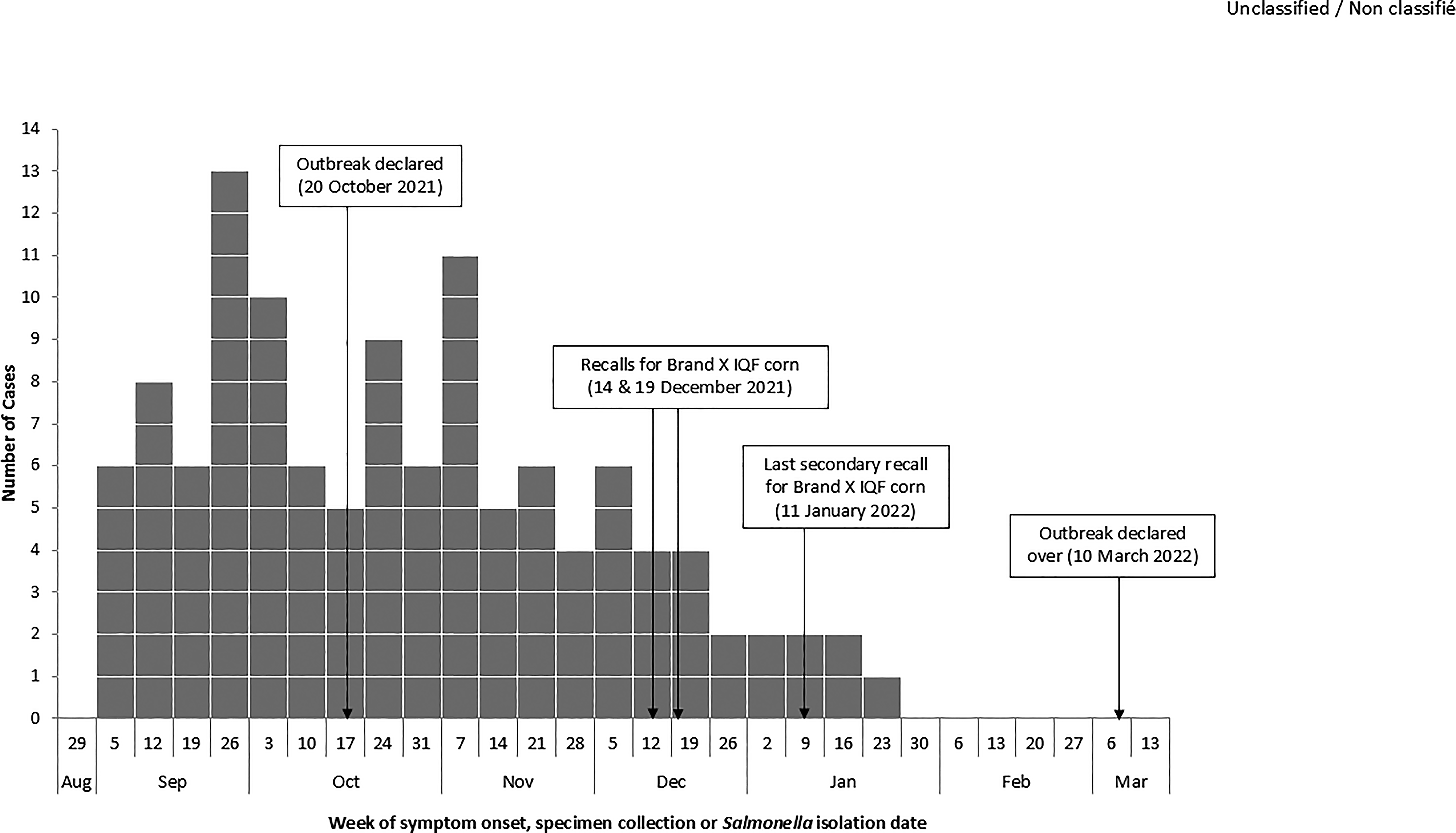
Distribution of Canadian Salmonella Enteritidis outbreak cases (n = 118) by symptom onset; specimen collection or Salmonella isolation date from September 6, 2021, to January 27, 2022. Each box denotes a case.
Laboratory analysis
The 118 clinical isolates and 8 nonclinical isolates (from three samples: 4, 2, and 2 isolates, respectively) recovered from Brand X IQF Corn were considered highly related to each other based on WGS and grouped together by 0–4 wgMLST allele differences (Supplementary Data S1). The wgMLST profile was unique in the Canadian database, and no United States or international matches were identified.
Epidemiological hypothesis generation
Case interviewing
Exposure information was collected from the initial interviews for 92% (108/118) of cases. To gather more specificity on case exposures, PHAC conducted 78 centralized re-interviews. In total, 7 cases were re-interviewed using the national Salmonella hypothesis-generating questionnaire combined with open-ended prompts, and 71 cases were re-interviewed using a focused questionnaire. A total of 65% (60/92) of cases reported exposure to at least one meal at a Restaurant Chain A location before their illness onset. Thirty-three Restaurant Chain A locations were reported across Western Canada, with 13 locations reported more than once (range: 1–8 cases). Most cases reported a meal at Restaurant Chain A within the 7 days prior to their illness onset (median: 4 days). However, eight cases reported their meal date between 8 and 13 days prior to their illness onset. Of the 86 cases that were asked about corn exposure, 87% (75) reported exposure to, or potential exposure to corn (i.e., they did not report corn but reported a restaurant/institution where corn may have been served). Based on the distribution records, 91% (68) of cases that reported exposure to, or potential exposure to corn could be linked to Brand X IQF Corn. Of the 68 cases where a link to Brand X IQF Corn was identified, 88% (60) consumed food from Restaurant Chain A, 3% (2) were unsure if they consumed food from Restaurant Chain A during their exposure period, 7% (5) consumed food from different food establishments, and 2% (1) resided at a retirement home.
Menu review and ingredient analysis
The most commonly reported ingredients in cases’ Restaurant Chain A meals were as follows: avocado, red onion, cilantro, tomato, brown rice, frozen corn, and black beans. Brown rice, frozen corn, and black beans all had at least one heat treatment step associated with them and were therefore deemed less likely to be sources of illness than the other ingredients that were served raw. Frozen corn specifically was reported to be heated for 4–5 minutes in boiling water prior to serving. This practice was verbally confirmed by two of the locations during the investigation; however, it was not directly observed. Tomatoes were ruled out as a likely source, as multiple different varieties of tomatoes were reported by cases.
Food safety investigation
Food sample collection
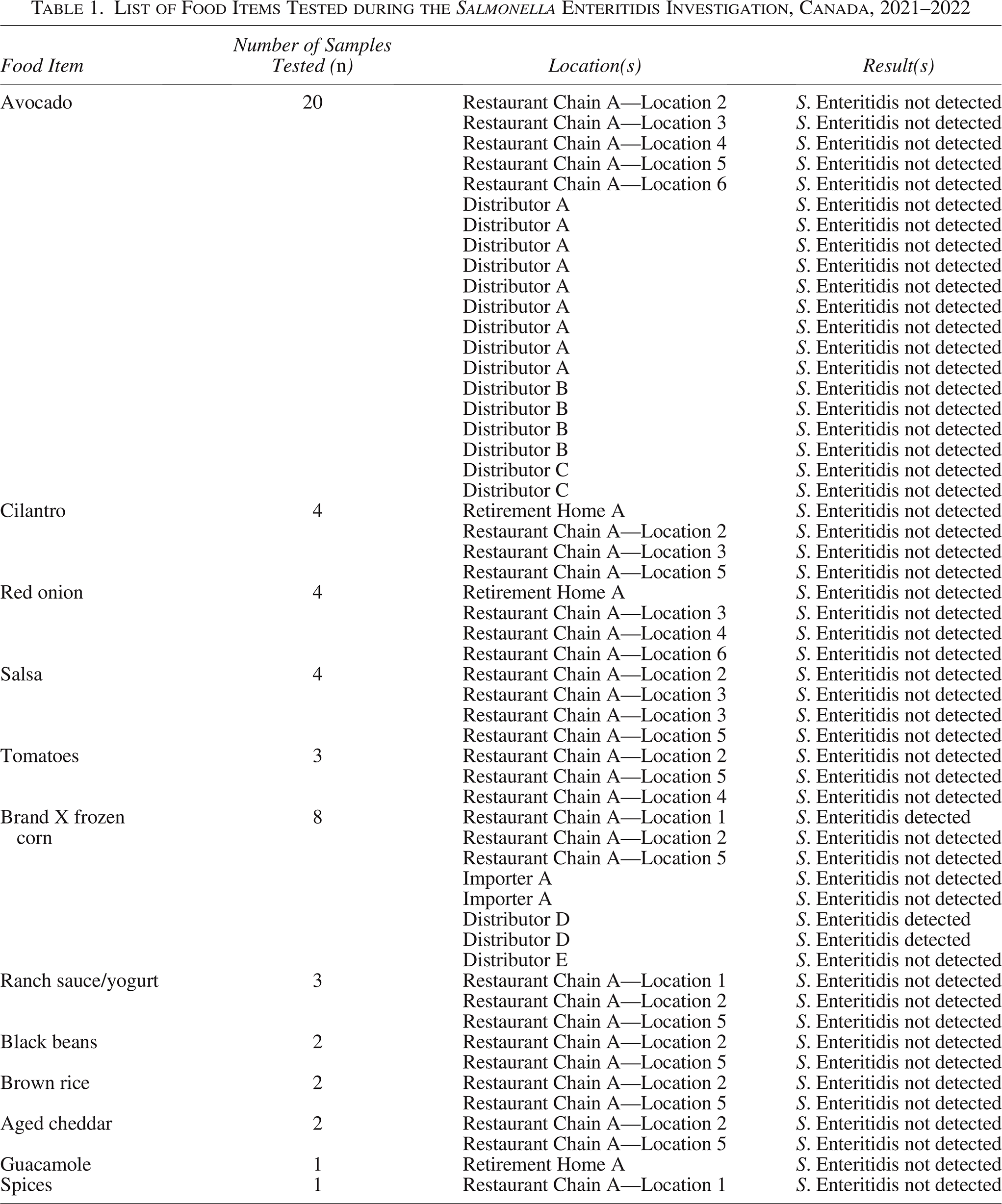
Fifty-four food items from six Restaurant Chain A locations, one retirement home, five distributors, and one importer were collected throughout the investigation, including avocado (n = 20), red onion (n = 4), cilantro (n = 4), salsa (n = 4), tomatoes (n = 3), ranch sauce/yogurt (n = 3), frozen corn (n = 8), brown rice (n = 2), black beans (n = 2), aged cheddar (n = 2) guacamole (n = 1), and spices (n = 1) (Table 1). On December 13, 2021, a closed sample of Brand X IQF Corn taken from one location of Restaurant Chain A tested positive for Salmonella and was confirmed as the outbreak strain by WGS on December 17, 2021. The outbreak strain of Salmonella was also detected in three of the five additional samples CFIA collected, which corresponded to the product lots originating from the same harvest field as the initial positive result and had pack dates ranging from late April to late May 2021. In contrast, Salmonella was not detected in the remaining two samples, which represented product from two different harvest fields than those linked to the positive samples.
List of Food Items Tested during the Salmonella Enteritidis Investigation, Canada, 2021–2022
Traceback analysis
There were no commonalities identified in suppliers, importers, distributors, and/or growing regions for either red onions or cilantro, and avocado became the leading hypothesis in early December. Investigators were actively working to identify if there was an upstream linkage among avocado exposures when Salmonella was identified in a sample of Brand X IQF Corn.
At the manufacturer level, Brand X IQF Corn was produced by Manufacturer A outside of North America and was first exported to Canada on January 1, 2020. The earliest lot of Brand X IQF Corn that could explain the illnesses was imported into Canada on August 20, 2021. The product was reported to be blanched at the manufacturer prior to packaging. The packaging instructed users to cook the product prior to use, but specific cooking instructions were not included. The Canadian importer did not repackage Brand X IQF Corn, and it was supplied to distributors and manufacturers primarily for use by Hotels, Restaurants, and Institutions (HRI).
Brand X IQF Corn was used by Restaurant Chain A locations across Canada. The Canadian importer had two storage facilities in Canada that distributed the product to Western and Eastern Canadian Restaurant Chain A locations from those respective warehouses. The initial sample of Brand X IQF Corn that tested positive was sourced from a lot imported into Canada on October 22, 2021, and subsequently distributed to distributors and manufacturers across two provinces in Western Canada on November 4, 2021, which were then further distributed to the other two Western Canadian provinces. There was limited distribution of the other recalled lots in Eastern Canada, and no illnesses were reported that could be linked to the consumption of Brand X IQF Corn distributed in Eastern Canada.
Post-investigation inspection activities
Variable cooking procedures were reported among the three Restaurant Chain A locations visited. One location reported heating the frozen corn in boiling water for 5 minutes, one location reported not having a specific amount of time they heated the corn for each time, and the other location reported adding boiled water to the frozen corn and letting it sit for 5 minutes. Two of the three locations did not have a freezer on-site and stored the frozen corn in walk-in coolers.
Public health control measures
Two food recall warnings were issued for four lot codes of Brand X IQF Corn on December 14 and 18, 2021. Five additional secondary recalls were issued between December 19, 2021, and January 11, 2022, for products containing Brand X IQF Corn. A Public Health Notice was posted to inform people in Canada about the outbreak and to identify Brand X IQF Corn as the source of the outbreak.
Discussion
This investigation employed a combination of epidemiological, microbiological, and food safety strategies to identify Brand X IQF Corn as the likely source of this S. Enteritidis outbreak, which resulted in 118 cases. While outbreaks of Listeria monocytogenes associated with frozen vegetables, including frozen sweet corn, have previously been reported (Rumore et al., 2018; European Food Safety Authority, European Centre for Disease Prevention and Control, 2018; Madad et al., 2023), this was the first Salmonella outbreak linked to frozen vegetables to be reported in Canada and further highlights the potential food safety risks associated with frozen vegetables.
As outbreaks of Salmonella in frozen vegetables have not been commonly reported, consumers may not be aware of the potential risks and need for proper storage and adequate cooking (Ceylan et al., 2017). A recent study conducted in the United States found that only one-third of consumers thought that frozen vegetables could contain Salmonella, Escherichia coli, and Listeria, and 40% of consumers who reported eating frozen vegetables did not report following the instructions on the package (Canning et al., 2025). An outcome of this investigation included adding messaging around the importance of the proper handling of frozen vegetables to reduce the risk of foodborne illness to the Government of Canada Healthy Canadians website (Government of Canada, 2024c).
Although a source was identified, the root cause of contamination at Manufacturer A was not able to be determined. Samples of corn originating from three harvest fields were tested, but positive results were only detected in frozen corn originating from one of the three fields. It is possible that contamination occurred during growing and harvesting in this field, combined with an inadequate blanching process at the manufacturer. As the product was imported, manufacturing processes were not able to be validated in-person. Potential contributing factors identified at the restaurant level may have also contributed to illnesses. Although Brand X IQF Corn was distributed to all Restaurant Chain A locations in Western Canada, cases were only identified at approximately one-quarter of these locations. Based on the post-investigation site inspections, it is possible that the absence of frozen storage and standardized cooking processes among some locations may have contributed to the growth of Salmonella, or the lack of elimination, in Brand X IQF Corn. A recent study that looked at the microbiological characteristics of contaminated Brand X IQF Corn found that 8 minutes of cooking in a 90°C water bath was required to achieve a 5-log reduction, suggesting that the cooking procedures reported by Restaurant Chain A locations may have been insufficient to ensure microbial safety (Rao and Tamber, 2025).
Not all cases reported exposure to corn, and among those that did, not all cases could be linked back to Brand X IQF Corn. There are several possible explanations for this. First, corn is not an exposure asked about during routine Salmonella case follow-up in Canada, and not all cases were able to be re-interviewed to collect a detailed 7-day food history, including foods eaten outside the home. Notably, only 52% (31/60) of cases that reported exposure to a meal from Restaurant Chain A, did so on the initial interview. At the time of the investigation, two provinces were using a 3-day rather than a 7-day food history. Given that the median interval between the Restaurant Chain A meal date and symptom onset was 4 days, this may also have contributed to the low number of cases reporting the exposure at the initial interview. For cases that were re-interviewed, frozen corn exposure could have been missed due to challenges with case recall. The recalled frozen corn was primarily distributed to HRI’s; therefore, cases may not have recalled corn as an ingredient in their meal. Second, some cases may have had a longer incubation period than the 7-day exposure period used for national Salmonella investigations. During the investigation, 7% (8/118) of cases reported a meal at Restaurant Chain A outside this period. Longer exposure periods for Salmonella have been previously documented and should be considered during outbreak investigations (Eikmeier et al., 2018). Third, there may have been cross-contamination at the HRI level. It is possible that contaminated frozen corn was used at an establishment, but was not specifically an ingredient in the meals reported by some cases. Lastly, not all distribution lists of the recalled corn were available to cross-reference with the restaurants where cases reported, or could potentially have had exposure, to frozen corn.
This was the first reported outbreak of Salmonella linked to frozen corn in Canada, or to frozen vegetables more broadly. Initially, frozen corn was not considered a likely source of illness in the investigation because the corn was reported to be blanched at Manufacturer A and underwent additional heat treatment steps at Restaurant Chain A locations. While case interviewing, menu review, ingredient analysis, and traceback were all useful hypothesis-generation strategies during this investigation, continuing to consider alternative hypotheses, and the sampling of less likely foods that included a heat step were critical to the identification of the source of illnesses.
Authors’ Contributions
L.D.: Conceptualization, data curation, formal analysis, investigation, methodology, validation, visualization, writing—original draft, writing—review and editing. T.K.: Conceptualization, data curation, formal analysis, investigation, methodology, project administration, supervision, validation, visualization, writing—original draft, writing—review and editing. H.B.: Conceptualization, data curation, formal analysis, investigation, methodology, validation, writing—original draft, writing—review and editing. M.T.: Conceptualization, data curation, investigation, methodology, validation, writing—review and editing. M.E.: Data curation, investigation, validation, writing—review and editing. A.K.: Data curation, formal analysis, investigation, project administration, supervision, validation, writing—review and editing. L.H.: Conceptualization, formal analysis, investigation, methodology, validation, writing—review and editing. B.A.: Investigation, methodology, validation, writing—review and editing. V.M.: Investigation, methodology, validation, writing—review and editing. R.M.: Investigation, resources, supervision, validation, writing—review and editing. C.M.: Investigation, resources, validation, writing—review and editing.
Footnotes
Acknowledgments
The authors would like to thank the following organizations for their contributions to the outbreak investigation: local public health colleagues and public health laboratories in British Columbia, Alberta, Saskatchewan, Manitoba, and Ontario; British Columbia Center for Disease Control; Alberta Health; Alberta Health Services; Saskatchewan Ministry of Health; Manitoba Health; Public Health Ontario; Ontario Ministry of Health; Canadian Food Inspection Agency; the National Microbiology Laboratory; Health Canada; and the Public Health Agency of Canada.
Funding Information
No funding was received for this article
Disclosure Statement
No competing financial interests exist.
Data Availability Statement
The data from this article are not publicly available due to privacy concerns and legislative requirements.
Supplemental Material
References
Supplementary Material
Please find the following supplemental material available below.
For Open Access articles published under a Creative Commons License, all supplemental material carries the same license as the article it is associated with.
For non-Open Access articles published, all supplemental material carries a non-exclusive license, and permission requests for re-use of supplemental material or any part of supplemental material shall be sent directly to the copyright owner as specified in the copyright notice associated with the article.
