







Abstract
Brazilian artisanal cheeses are widely valued for their sensory quality and cultural relevance; however, their production frequently involves raw milk and extensive handling, conditions that may favor contamination by Staphylococcus aureus. This retrospective baseline study analyzed artisanal raw-milk cheeses collected between 2014 and 2016 in Southern and Southeastern Brazil and characterized the isolates regarding antimicrobial resistance, biofilm-forming ability, and the presence of virulence and resistance genes. A total of 147 cheese samples were collected from street vendors and markets in five Brazilian states; notably, 93% of the sampling and all S. aureus-positive samples were concentrated in Paraná, São Paulo, and Minas Gerais, Brazil. S. aureus was isolated using selective media and biochemical identification, followed by antimicrobial susceptibility testing according to CLSI guidelines. Molecular analyses were performed to detect enterotoxin genes, the tst gene, the mecA gene, and SCCmec types. Biofilm production was assessed using a microtiter plate assay. Thirteen samples (8.84%) were positive for S. aureus, yielding 25 isolates. Resistance to cefoxitin (FOX) was the most frequent phenotype (20%), followed by resistance to ampicillin, ciprofloxacin, chloramphenicol, and streptomycin (8% each). Two isolates were classified as multidrug-resistant (MDR). Genotypic analysis revealed one mecA-positive isolate (methicillin-resistant S. aureus [MRSA]; SCCmec nontypable), while four FOX-resistant mecA-negative isolates (including three SCCmec type II carriers) were classified as borderline-oxacillin-resistant S. aureus. Biofilm formation was observed among resistant isolates. Among the virulence genes investigated, only one isolate carried the sea gene, and none were positive for tstH. Although the prevalence of mecA-positive MRSA and enterotoxigenic strains was low, the detection of MDR, biofilm-producing S. aureus highlights potential risks to food safety and public health. These findings reinforce the importance of continuous surveillance, molecular monitoring of resistance determinants, and strict hygienic practices in artisanal cheese production.
Introduction
In recent years, Brazilian artisanal cheeses have gained prominence for their quality, receiving recognition in various awards at both national and international levels (Prêmio Queijo Brasil, 2021; Mondial du Fromage, 2021; Hosken et al., 2023). With a rich historical, socioeconomic, and cultural tradition, artisanal cheese production in Brazil takes place mainly on small farms, where practices passed down through generations preserve traditional methods and the use of raw milk (Monteiro and Matta, 2018; Róldan and Revillion, 2019).
However, due to their high moisture content, often combined with poor hygiene conditions during production, the use of raw milk, the maturation environment, and frequent handling throughout the production process, artisanal cheeses become susceptible to contamination by foodborne pathogens, particularly Staphylococcus aureus (Cunha et al., 2006; Baran et al., 2017; Campos et al., 2021; Pineda et al., 2021).
S. aureus is a major foodborne pathogen associated with dairy-related outbreaks, primarily through the ingestion of preformed staphylococcal enterotoxins (Le Loir et al., 2003; Kadariya et al., 2014). In addition to toxigenic potential and biofilm formation, antimicrobial resistance (particularly methicillin resistance mediated by mecA carried on SCCmec) complicates control and surveillance in artisanal dairy production (Fox et al., 2022; Huang et al., 2023).
Cheeses and other contaminated dairy products are frequently associated with food poisoning outbreaks caused by S. aureus in Brazil and other countries (Kadariya et al., 2014; Ferreira et al., 2016; das Dores et al., 2013; Johler et al., 2015; Cândido et al., 2020). Between 2012 and 2021, the Brazilian Epidemiological Surveillance reported 6347 foodborne disease outbreaks, in which S. aureus was identified in 12.9% of cases, with 7.1% linked to dairy products (Brasil Ministério da Saúde, 2022). Due to these risks, government agencies have begun to require the detection and enumeration of coagulase-positive Staphylococci and their toxins as part of sanitary inspections (Brasil Ministério da Saúde, 2022).
Thus, this study aimed to retrospectively evaluate the presence of S. aureus in artisanal cheeses collected in 2014–2016 from Southern and Southeastern Brazil and to characterize isolates by antimicrobial susceptibility testing, biofilm formation, virulence gene detection (staphylococcal enterotoxins and TSST-1), and molecular screening of cefoxitin (FOX)-resistant isolates for mecA and SCCmec types, enabling classification of mecA-negative FOX-resistant isolates as BORSA (borderline-oxacillin [OXA]-resistant S. aureus) when applicable.
Material and Methods
Samples and bacterial strains
This retrospective baseline study analyzed artisanal raw-milk cheese samples collected between July 2014 and January 2016 from street vendors and markets in five Brazilian states, with sampling concentrated in Southern and Southeastern regions: Paraná (64), São Paulo (49), Minas Gerais (24), Mato Grosso do Sul (8), and Bahia (2). Samples were produced from raw milk under small-scale artisanal practices. Twenty-five grams of cheese were diluted in 225 mL buffered peptone water; then 0.1 mL was streaked onto Baird-Parker agar supplemented with egg yolk tellurite emulsion (Difco, Sparks, MD, USA) and incubated at 37°C for 24 h. Two presumptive colonies from each positive sample were selected and tested by using biochemical assays (catalase, coagulase, and DNAse) to identify S. aureus. All strains of S. aureus were stored in brain heart infusion (Difco) plus 25% glycerol (Sigma, St. Louis, MO) at −80°C. Positive and negative controls used in this work are from the Bacterial Collection of the Laboratory of Basic and Applied Bacteriology, Universidade Estadual de Londrina.
Antimicrobial resistance testing
The following antimicrobial agents (Oxoid, Thermo Fisher Scientific, Waltham, MA, USA) were used on S. aureus isolates: ampicillin (AMP, 10 μg), cephalothin (30 μg), ciprofloxacin (CIP, 5 μg), erythromycin (ERI, 30 μg), sulfamethoxazole-trimethoprim (25 μg), clindamycin (CLI, 10 μg), gentamicin (10 μg), tetracycline (TET, 30 mg), chloramphenicol (CHL, 30 μg), streptomycin (STR, 30 μg), penicillin G (PEN, 30 μg), and linezolid (10 μg). FOX (30 μg) and OXA (1 µg) disks (Cefar, São Paulo, Brazil) were used as phenotypic screening markers for reduced susceptibility to OXA; methicillin-resistant S. aureus (MRSA) was confirmed by mecA polymerase chain reaction (PCR), and FOX-resistant mecA-negative isolates were interpreted as BORSA when applicable. These tests were performed according to the criteria established by CLSI (2021). S. aureus ATCC 29213 and Enterococcus faecalis ATCC 51299 were used as quality control.
PCR for detection of virulence and resistance genes in S. aureus isolates
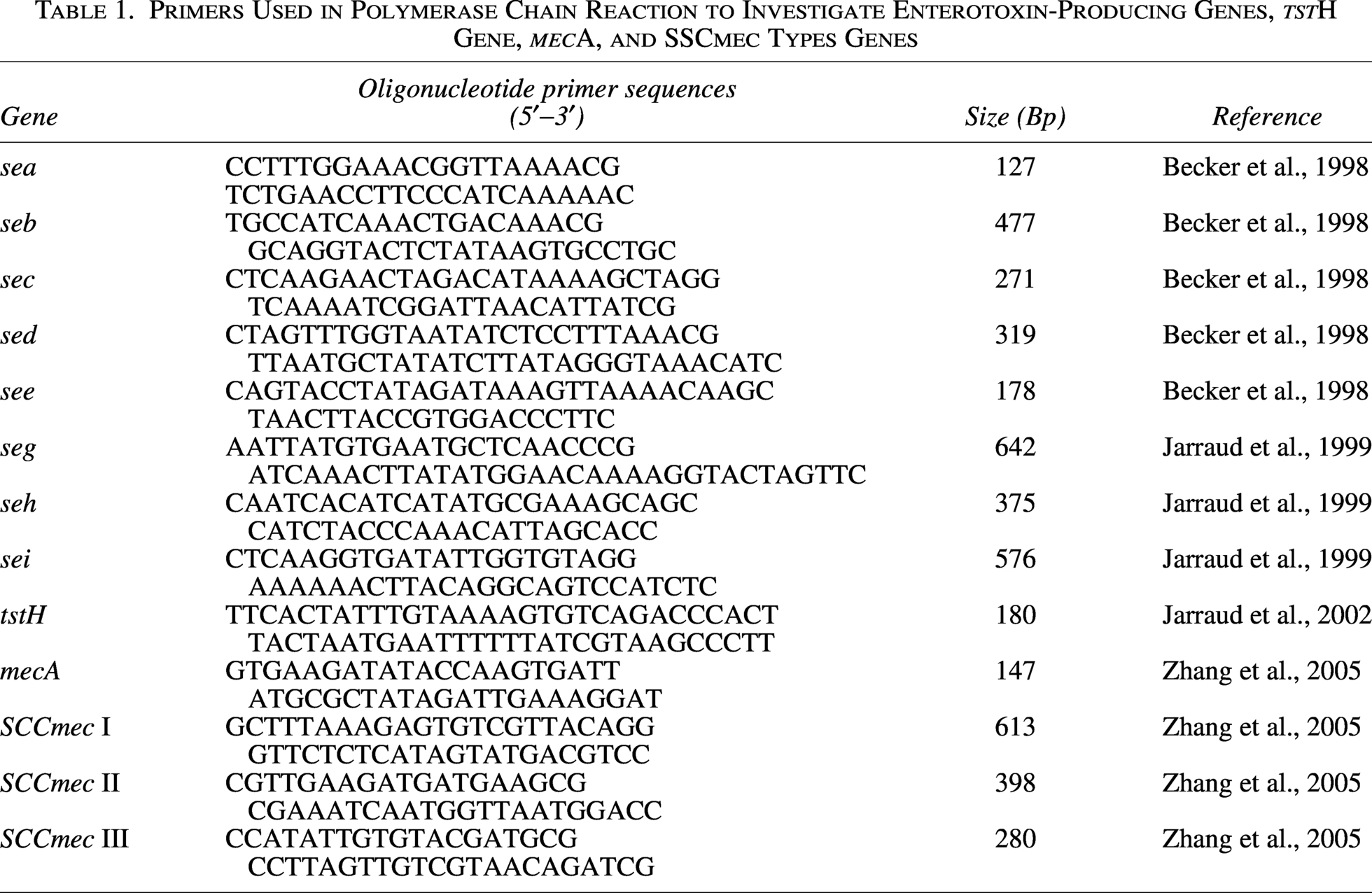
Genomic DNA was extracted from overnight cultures by alkaline lysis followed by CTAB/phenol–chloroform purification, as described by Sambrook and Russell (2001). The tstH gene was investigated according to Jarraud et al. (2002). Classical staphylococcal enterotoxin genes (sea, seb, sec, sed, and see) were screened by multiplex PCR using primers described by (Becker et al., 1998). In addition, sec, seh, and sei were investigated using primers described by (Jarraud et al., 1999). All FOX-resistant isolates were subjected to multiplex PCR for detection of mecA and SCCmec types associated with reduced susceptibility to β-lactams, as described by Zhang et al. (2005). PCR products were resolved by 2% agarose gel electrophoresis, stained with an intercalating dye, and visualized under UV illumination; a 1-kb DNA ladder was included in each run. Each PCR assay included appropriate positive controls. SCCmec profiles were reported as typable when amplification patterns were consistent with the SCCmec typing scheme (Zhang et al., 2005) and as nontypable (NT) when no SCCmec type was assigned using the primer sets employed (Gómez-Sanz et al., 2019). The primers used are listed in Table 1.
Primers Used in Polymerase Chain Reaction to Investigate Enterotoxin-Producing Genes, tstH Gene, mecA, and SSCmec Types Genes
Biofilm formation
Biofilm formation was assessed in polystyrene microplates by crystal violet staining (Stepanović et al., 2007). OD was read at 570 nm; isolates were classified as nonproducers when ODi ≤ ODc and producers when ODi > ODc. MRSA BEC 9393 and broth-only wells served as positive and negative controls.
Results
Out of 147 unpasteurized cheese samples analyzed, 13 tested positive for S. aureus, resulting in 25 isolates subjected to antimicrobial susceptibility testing. Among these, five isolates exhibited resistance to FOX (20.0%), the highest resistance rate observed, followed by resistance to AMP, CIP, CHL, and STR (8% each). Two of the five FOX-resistant strains were classified as multidrug-resistant (MDR), showing resistance to more than three antimicrobial classes.
Genotypic characterization of the five FOX-resistant isolates revealed that one carried the mecA gene, although it could not be SCCmec-typed (SCCmec NT), and was therefore classified as MRSA. The remaining four FOX-resistant isolates were mecA-negative (three carrying SCCmec type II and one negative for SCCmec by the primer set used) and were classified as BORSA. Biofilm production was detected among resistant isolates, highlighting their potential for environmental persistence and pathogenicity.
The genotypic and phenotypic profiles of these strains are detailed in Table 2. Isolate SC-1, from Minas Gerais, was mecA-positive (SCCmec NT), demonstrated resistance to STR and FOX, and did not produce biofilms or enterotoxins. SC-2, also from Minas Gerais, exhibited resistance to CIP and FOX but lacked mecA and SCCmec markers; this BORSA isolate formed biofilms but did not carry enterotoxin genes.
Genotypic and Phenotypic Characteristics of Staphylococcus aureus Isolated from Artisanal Cheeses in Southern and Southeastern Brazil
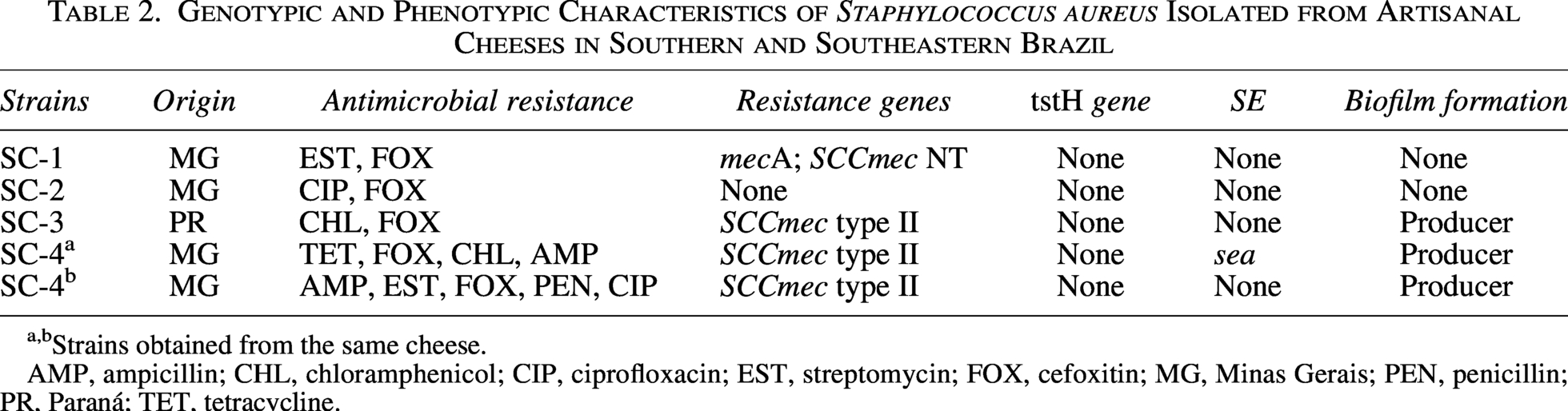
a,bStrains obtained from the same cheese.
AMP, ampicillin; CHL, chloramphenicol; CIP, ciprofloxacin; EST, streptomycin; FOX, cefoxitin; MG, Minas Gerais; PEN, penicillin; PR, Paraná; TET, tetracycline.
Isolate SC-3, from Paraná, carried SCCmec type II, was resistant to CHL and FOX, and demonstrated biofilm production without enterotoxin genes; this isolate was classified as BORSA due to the absence of mecA. SC-4a and SC-4b, both from Minas Gerais, exhibited extensive multidrug resistance to TET, FOX, CHL, AMP, STR, PEN, and CIP, with SCCmec type II; both were classified as BORSA. SC-4a carried the sea gene, whereas SC-4b did not carry enterotoxin genes; both were biofilm producers.
Discussion
The results obtained in this study provided an analysis of the genotypic and phenotypic characteristics of S. aureus isolates from raw milk cheeses, highlighting the potential public health impact due to antimicrobial resistance and biofilm formation. This scenario is concerning, as artisanal cheeses are widely consumed in Brazil and may act as vehicles for resistant pathogens, capable of causing severe and difficult-to-treat foodborne infections. The presence of MDR and biofilm-producing isolates reinforces the importance of strict sanitary control, as biofilm formation facilitates persistence in processing environments, while antimicrobial resistance limits therapeutic options (Fox et al., 2022; Huang et al., 2023).
In the present study, S. aureus strains were isolated in approximately 8.84% of the analyzed cheeses, a relatively lower rate compared to studies conducted in different regions of Brazil, where contamination by S. aureus in artisanal Minas cheeses ranged from 10.7% to 45% (Queiroz et al., 2017; Pinto et al., 2011; Passos et al., 2009; Zocche et al., 2012). This difference may reflect variations in production and hygiene practices between the regions studied. The prevalence of S. aureus is concerning, especially considering that this pathogen was the most frequent microorganism (66.28%) identified in studies by Aguiar et al. (2024) and Camargo et al., (2021), and international studies also report substantial contamination in unpasteurized cheeses, underscoring the need for corrective actions and good manufacturing practices (Adame-Gómez et al., 2018; Prabakusuma et al., 2022).
Regarding antimicrobial resistance, 5 of the 25 S. aureus isolates were resistant to at least 2 antimicrobials, including FOX (20%), a surrogate marker for reduced OXA susceptibility. Molecular testing showed that only one isolate was mecA-positive (MRSA), whereas the remaining FOX-resistant isolates were mecA-negative and classified as BORSA. Resistance to CHL, STR, AMP, and CIP occurred in 8% of isolates. These findings align with reports of FOX resistance in dairy-associated S. aureus in Brazil and elsewhere and emphasize that phenotypic screening should be combined with genotypic confirmation to avoid overestimating MRSA based solely on disk diffusion.
In contrast, Aguiar et al. (2024) found high resistance to PEN (33.33%), TET (22.80%), ERI (26.31%), and CLI (28.07%), but no FOX resistance. This differs from the present retrospective baseline, in which 20% of isolates were FOX-resistant (one mecA-positive MRSA and four BORSA). Similar variability across producers and regions has been reported (Castro et al., 2020; Kuhnen et al., 2021), reinforcing heterogeneity and the need for continuous monitoring.
The presence of MDR isolates is particularly concerning. Aguiar et al. (2024) reported that 42.85% of resistant isolates showed resistance to five classes of antibiotics, while 23.80% were resistant to three classes. These findings are consistent with previous studies highlighting the spread of S. aureus strains resistant to multiple antimicrobials in various contexts, including artisanal cheese production (Silveira-Filho et al., 2014; Prabakusuma et al., 2022; Normanno et al., 2007; Basanisi et al., 2017). The presence of MDR in S. aureus is alarming, as it limits therapeutic options and increases the risk of treatment failures (Aguiar et al., 2024).
The detection of MRSA in food, particularly in dairy products, is a challenge due to the heterogeneous expression of resistance and the limited sensitivity of traditional methods, such as the use of FOX and OXA discs. CLSI (2014) recommends the detection of the mecA gene as the gold standard for MRSA identification, precisely because phenotypic methods may fail to detect resistant strains that do not clearly express resistance in vitro. This may explain why, in this study, only one sample was positive for the mecA gene, even though other samples might contain S. aureus strains with resistance mediated by other mechanisms or with heterogeneous resistance expression.
The low prevalence of MRSA observed in this study is consistent with some previous works, such as Silveira-Filho et al. (2014), who did not find MRSA strains in milk and dairy products in Brazil. On the other hand, studies like those by Normanno et al. (2007) and Basanisi et al. (2017) reported MRSA detection rates in dairy products ranging from 1.3% to 8.3%, indicating that the presence of MRSA can vary significantly depending on the region, type of sample, and detection methods used.
The detection of MRSA in only one sample in this study may reflect low contamination of the analyzed products or the effectiveness of hygiene and processing practices that reduce the presence of resistant S. aureus. However, it also highlights the importance of molecular methods, such as mecA gene detection, to ensure accurate identification of MRSA, especially in foods where the phenotypic expression of resistance may be inconsistent.
SCCmec typing remains a key molecular tool for tracking the epidemiology and clonal relationships of MRSA, especially in community-acquired (CA) lineages (Zhang et al., 2005). In this study, one mecA-positive isolate carried an NT SCCmec, which may reflect structural variability of SCCmec elements and limits of primer-based typing, as previously discussed for diverse staphylococcal populations (Salgueiro et al., 2017). Importantly, several FOX-resistant isolates were mecA-negative yet yielded SCCmec type II by PCR; rather than being labeled as MRSA, these isolates were classified as BORSA. This distinction suggests that the observed phenotype may arise from alternative mechanisms (e.g., hyperproduction of beta-lactamase or other modifications affecting beta-lactam susceptibility) and underscores the need for expanded molecular screening (e.g., mecC and other homologues) when interpreting FOX resistance in food-associated isolates.
In a recent study, Dehkordi et al., (2024) identified SCCmec types IVa, IVb, IVc, IVd, and V in 75.43% of the strains, which are typical of CA-MRSA, while 50.87% of the strains presented SCCmec type III, characteristic of health care-associated MRSA. These results reinforce the global spread of MRSA strains with distinct genetic profiles, adapted to different ecological niches. In addition, the detection of SCCmec types II and III in studies conducted in Japan (Hata et al., 2010) and Turkey (Türkyilmaz et al., 2010), where 87.5% of the MRSA strains isolated from bovine milk presented SCCmec type III, suggests that these genetic cassettes are widely distributed across various contexts, including food and animal production environments.
Because samples were collected in 2014–2016, the present findings should be interpreted as a retrospective baseline describing the historical toxigenic and resistance profiles of S. aureus in artisanal dairy products from Southern and Southeastern Brazil. At that time, staphylococcal enterotoxins were not routinely investigated as a mandatory food-safety parameter in Brazil; regulatory scrutiny over enterotoxin-related hazards was strengthened later, first with updated sanitary metrics in 2019 (IN 60/2019) and further reinforced in 2022 (IN 161/2022). Accordingly, we discuss enterotoxin-related risk as a contemporary benchmark for surveillance, not as a claim of noncompliance at the time of collection. Under current criteria, the detection of the enterotoxin-encoding gene sea in isolate SC-4a would not meet current sanitary criteria for dairy matrices, supporting the public-health relevance of maintaining and monitoring archived isolate banks. Such baselines help contextualize changes in microbiological safety following regulatory modernization.
However, Brazilian studies after 2019 have reported enterotoxin-coding genes among cheese-associated S. aureus. Cândido et al. (2020) detected classical (seb) and nonclassical (seg, seh, sei, and sej) enterotoxin genes in Minas fresh cheese isolates. Ribeiro-Júnior et al. (2024) found 33.33% positive for sea and 48.1% for tstH among 177 strains. Margalho et al. (2024) reported high MDR frequency (80.5%) and enterotoxin genes in 92.6% of strains, screening sea, seb, sec, sed, see, seg, sei, sej, and ser. Allaion et al. (2022) reported high prevalence of enterotoxin genes, particularly seh (92.2%) and seg (75.2%), showing the risk profile remains relevant because more recent studies continue to evidence enterotoxigenic S. aureus.
The discrepancy between the results of this study and those of previous research may be related to differences in the practices of cheese production, handling, and storage, as well as regional variation in the prevalence of toxigenic S. aureus strains. The absence of enterotoxin genes and TSST-1 toxin in the analyzed samples suggests that the dairies evaluated adopt good manufacturing practices, minimizing contamination by toxigenic strains. However, the detection of one sample positive for the sea gene highlights the need for continuous monitoring, as staphylococcal enterotoxins in food pose a significant risk to public health.
The ability of pathogenic bacteria to form biofilms represents a significant challenge not only in healthcare environments but also in the food industry. Biofilm formation on processing equipment can lead to food contamination, resulting in spoilage and health risks for consumers (Galié et al., 2018). For Staphylococcus spp., biofilm formation is an evolutionary advantage as it provides resistance to adverse conditions, such as the action of antimicrobial agents, sanitizers, desiccation, and ultraviolet radiation (Castro et al., 2020).
In this study, three strains demonstrated the ability to form biofilms, two of which exhibited phenotypic characteristics of multidrug resistance, and one carried the sea gene, which encodes staphylococcal enterotoxin A. These findings highlight the potential risk associated with Staphylococcus strains capable of forming biofilms, as antimicrobial resistance and toxin production can exacerbate impacts on food safety and public health.
Similar results were observed by Gajewska et al. (2022), who reported that 63.4% (59/93) of the Staphylococcus isolates analyzed were capable of forming biofilms. Similarly, Castro et al. (2020) found that 69.7% of the isolates studied exhibited this capability. These data reinforce the prevalence of biofilm-forming strains in different contexts, indicating that this phenomenon is widely disseminated among Staphylococcus spp.
The main factor associated with biofilm formation in S. aureus is the polysaccharide intercellular adhesin, which, along with other components such as teichoic acids, proteins, and extracellular DNA, forms the extracellular matrix of the biofilm. This matrix protects bacterial cells from external agents, making it difficult to eradicate these microorganisms in industrial and food processing environments (Sugimoto et al., 2018).
The presence of biofilm-forming strains, especially those with profiles of multidrug resistance and the ability to produce toxins, poses a significant challenge to food safety. The persistence of these bacteria on surfaces and equipment can lead to cross-contamination and the spread of resistant and toxigenic strains. Therefore, it is essential to implement strict hygiene and monitoring measures in food processing facilities, as well as to invest in research that explores effective strategies for preventing and controlling biofilm formation.
Conclusion
This study documented the presence of S. aureus in artisanal cheeses from Southern and Southeastern Brazil, with an emphasis on antimicrobial resistance, biofilm formation, and virulence markers. Although mecA-positive MRSA was detected in only one isolate, FOX-resistant mecA-negative isolates classified as BORSA, including MDR and biofilm-producing strains, were also identified. The detection of a sea-positive isolate (SC-4a) further reinforces the need for strict hygienic practices and continuous surveillance, particularly in light of the more stringent sanitary metrics adopted in 2019 and reinforced in 2022 (IN 161/2022). Collectively, these findings support the maintenance of strain repositories and molecular monitoring of resistance determinants as part of ongoing risk assessment for artisanal cheese production.
Authors’ Contributions
A.C.L.P.d.C.: Investigation, methodology, resources, writing—original draft, and writing—review and editing. J.J.P.-S., F.C.D., L.P.M., and M.D.: Methodology, resources, and writing—original draft. B.C.G. and L.B.B.C.: Resources and writing—review and editing. E.P.F., R.K.T.K., and G.N.: Conceptualization, data curation, formal analysis, methodology, resources, project administration, supervision, and writing—original draft.
Footnotes
Disclosure Statement
No interests to disclose.
Funding Information
This study was financed in part by the Coordenação de Aperfeiçoamento de Pessoal de 245 Nível Superior—Brazil (CAPES).