







Abstract
The management of transthyretin amyloid cardiomyopathy (ATTR-CM) has revolved around the scintigraphic diagnosis since the introduction of a specific treatment; however, the equivalency of the bone radiotracers remains unclear. This retrospective monocentric observational study compared [99mTc]Tc-3,3-diphosphono-1,2-propanodicarboxylic acid ([99mTc]Tc-DPD) and [99mTc]Tc-hydroxy-methylene diphosphonate ([99mTc]Tc-HMDP) intensity of myocardial uptake compared with background noise for ATTR-CM suspicion. Two hundred and seventy-four patients who underwent planar scintigraphy after intravenous injection of [99mTc]Tc-DPD or [99mTc]Tc-HMDP for ATTR-CM were included. The patients’ current visual Perugini grades were retrieved. Regions of interest were measured on the heart (H) and on the contralateral mediastinum (CM), and H/CM ratios were calculated. Although the distribution of quantitative assessments of heart to contralateral mediastinum ratios is wider with [99mTc]Tc-DPD, no difference in Perugini grades was found between [99mTc]Tc-DPD and [99mTc]Tc-HMDP for the diagnosis of ATTR-CM in evocative/non-evocative conditions. There was no difference in ATTR-CM diagnosis between the 2 tracers with a threshold of 1.5 (p-value <0.001 for [99mTc]Tc-HMDP and for [99mTc]Tc-DPD). We show in our local cohort that [99mTc]Tc-DPD and [99mTc]Tc-HMDP for amyloidosis diagnosis are equivalent for ATTR-CM diagnosis based on the Perugini grading scale.
Letter to the Editor
Transthyretin amyloid cardiomyopathy (ATTR-CM) is increasingly diagnosed using noninvasive imaging, particularly bone tracer scintigraphy. While [99mTc]Tc-3,3-diphosphono-1,2-propanodicarboxylic acid ([99mTc]Tc-DPD), [99mTc]Tc-hydroxy-methylene diphosphonate ([99mTc]Tc-HMDP), and [99mTc]Tc-pyrophosphate ([99mTc]Tc-PYP) are approved tracers, their comparative diagnostic performance remains debated.1–5
A single-center retrospective observational study was conducted at Montpellier University Hospital between June 2019 and September 2024 to investigate whether [99mTc]Tc-DPD and [99mTc]Tc-HMDP are equivalent in diagnosing ATTR-CM using Perugini grading and H/CM ratio analysis. Two hundred and seventy-four patients with suspected ATTR-CM underwent late-phase bone scintigraphy using either [99mTc]Tc-DPD or [99mTc]Tc-HMDP. Whole-body planar scans were acquired 3 h post injection. Perugini grades were assigned by nuclear medicine specialists. Heart to contralateral mediastinum (H/CM) ratios were calculated using geometric mean activity in defined regions of interest. Wilcoxon and Fisher's exact tests were used. Statistical significance was defined as p-value ≤0.05.
Our results are presented in Figure 1. There were no statistically significant differences between the two groups in terms of age, gender, or injected dose. The distribution of Perugini scores was similar across both tracers. The mean H/CM ratio was 1.21 for [99mTc]Tc-HMDP and 1.31 for [99mTc]Tc-DPD, with a p-value of 0.5, indicating no significant difference. When applying a diagnostic threshold of H/CM > 1.5 and considering the pooled Perugini groups as reference, [99mTc]Tc-HMDP demonstrated a sensitivity of 91.7% and specificity of 96.7%, while [99mTc]Tc-DPD showed a sensitivity of 96.8% and specificity of 100%.
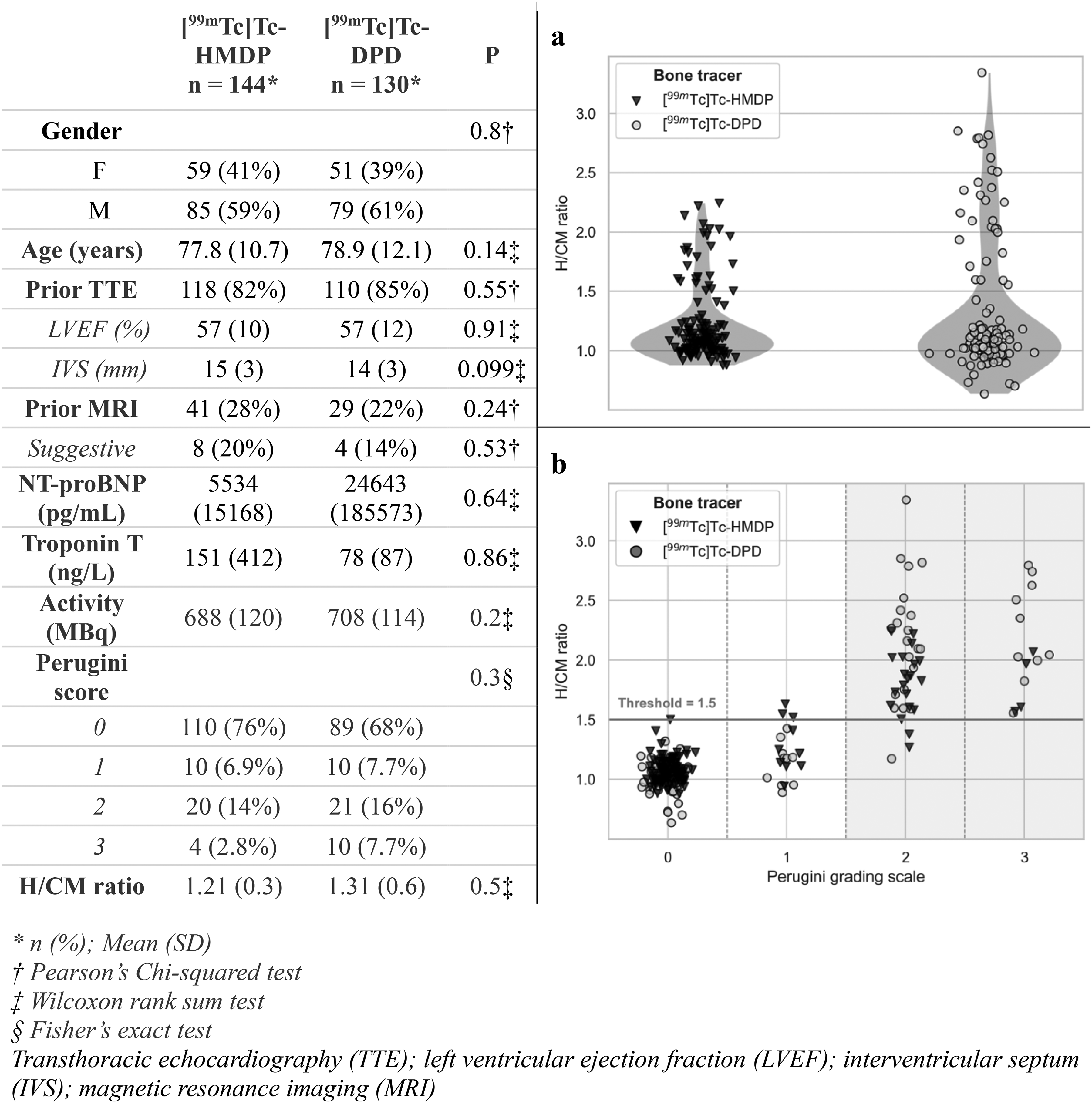
Summary of patient demographics and imaging metrics: (a) heart/contralateral mediastinum (H/CM) ratios’ distribution between [99mTc]Tc-HMDP and [99mTc]Tc-DPD; and (b) according to the attributed Perugini grading score for each patient.
These findings suggest that both tracers perform similarly in identifying ATTR-CM and support the interchangeable use of both tracers in clinical practice. [99mTc]Tc-DPD showed greater variability in H/CM ratios, which may reflect differences in tracer affinity or disease severity. The H/CM ratio threshold of 1.5 may be a reliable diagnostic marker for late-phase bone scintigraphy with these two tracers for our patient cohort. While Perugini grading remains subjective, quantitative H/CM ratios offer a promising complementary metric for diagnostic precision and support treatment follow-up. Prospective studies are needed to validate tracer selection for treatment monitoring and subtype differentiation.
Supplemental Material
sj-doc-1-mix-10.1177_15353508261430506 - Supplemental material for Bone Tracers for Transthyretin Amyloid Cardiomyopathy: Are [99mTc]Tc-DPD and [99mTc]Tc-HMDP Equivalent?
Supplemental material, sj-doc-1-mix-10.1177_15353508261430506 for Bone Tracers for Transthyretin Amyloid Cardiomyopathy: Are [99mTc]Tc-DPD and [99mTc]Tc-HMDP Equivalent? by Julien Dubois, Florentin Kucharczak, Denis Mariano-Goulart and Tom Paunet in Molecular Imaging
Footnotes
Acknowledgments
Not applicable.

Ethical Considerations
This study was conducted in accordance with the Helsinki Declaration and was approved by the French nuclear medicine committee for the protection of individuals (CEMEN) on 5 December 2023 and registered under the institutional review board number CEMEN-2023-04.
Consent to Participate
Written informed consent was obtained from all the patients for participation.
Consent for Publication
Written informed consent was obtained from all the patients for publication and accompanying images.
Author Contributions
All authors contributed to the study conception and design. Material preparation, data collection, and analysis were performed by Julien Dubois, Florentin Kucharczak, and Tom Paunet. The first draft of the manuscript was written by Julien Dubois, and all authors commented on the successive versions of the manuscript. All authors read and approved the final manuscript.
Funding
The authors received no financial support for the research, authorship, and/or publication of this article.
Declaration of Conflicting Interests
The authors declared no potential conflicts of interest with respect to the research, authorship, and/or publication of this article.
Data Availability
The datasets used and/or analyzed during the current study are available from the corresponding author upon reasonable request.
Supplemental Material
Supplemental material for this article is available online.
References
Supplementary Material
Please find the following supplemental material available below.
For Open Access articles published under a Creative Commons License, all supplemental material carries the same license as the article it is associated with.
For non-Open Access articles published, all supplemental material carries a non-exclusive license, and permission requests for re-use of supplemental material or any part of supplemental material shall be sent directly to the copyright owner as specified in the copyright notice associated with the article.
