







Abstract
Our study was designed to investigate the relationship of the POAG (primary open angle glaucoma) risk with the XRCC1 SNPs (single nucleotide polymorphisms) and other gene–diabetes interactions and haplotype combinations. HWE (Hardy–Weinberg equilibrium) test and GMDR for the best haplotype interaction of four SNPs in XRCC1 gene and diabetes were assessed. Logistic regression analysis revealed that rs25487-A and rs861539-C allele, with adjusted ORs (95% CI) of 1.60 (1.19–2.02) and 1.62 (1.20–2.08), respectively, were the associated risk factors with increased POAG. GMDR test indicated that testing accuracy of two-locus model (including rs25487 and T2DM) was 62.11% (P < 0.01). Therefore, regardless of how the data are partitioned, the highest cross-validation consistency across the multidimensional model is showed by this best model. The analysis indicated that T2DM influenced the POAG risk depending on the genotypes at rs25487. Pairwise LD analysis suggested that the haplotype G-G was the most common in the POAG patients (49.45%) and in the controls (55.78%), respectively. The results showed that haplotype A-A significantly correlated with a higher POAG risk. The re25487-A and rs861539-c and the interaction of between rs25487 and T2DM and the haplotype A-A were all associated with higher POAG risk.
Impact statement
Some studies have suggested that diabetes and XRCC gene may be risk factors for glaucoma; however, no studies have focused on the interaction between the XRCC gene and T2DM with respect to POAG risk. Therefore, the present study evaluated the initiative gene–environment interactions in POAG.
Keywords
Introduction
Glaucoma-caused irreversible blindness represents a major public health problem worldwide, 1 in which POAG (primary open-angle glaucoma) is one type of the most common form. 2 Some risk factors including ocular hypertension,3,4 age, a first-degree relative with glaucoma, pigment dispersion, pseudoexfoliation, myopia, and genetic factors5–7 have been previously reported.
NER (nucleotide excision repair) and BER (base excision repair) can repair the oxidative DNA damage.8,9 BER is the critical pathway for repair of oxidative DNA damage. 10 Several SNPs belong to DNA repair genes were reported, among which polymorphisms of XRCC (X-ray cross-complementing group) genes may have phenotypic significance.11,12 To date, the molecular mechanism underlying POAG remains largely unknown. Generally, the pathologic mechanism underlying POAG is considered to be a complex process that is mainly caused by the combined action of environmental and genetic factors. 13 Some studies have suggested that one of the potential risk factors for glaucoma is diabetes;14,15 however, no studies have focused on the XRCC–T2DM interaction with respect to POAG risk. Therefore, the present study evaluated the interactions between the XRCC SNPs (single nucleotide polymorphisms) and environment in POAG.
Materials and methods
Subjects
This study collected 1233 participants, including 410 with POAG and 823 controls, who were hospitalized in the Second Hospital of Jilin University. The diagnosis of POAG was determined by a gynecologist based on the following: (1) no other causes; (2) gonioscopic grading III or IV of open iridocorneal angle; and (3) glaucoma hemi-field test showing glaucomatous visual field change detected by the Humphrey automated perimeter. The IOP measured by applanation tonometry before management was > 21 mmHg. Age-matched (±3 years) control subjects, in 1:2 ratio to patients, did not have glaucoma, the family history of glaucoma, other major eye diseases (except mild cataracts and refractive errors), tumors, diabetes, cardiovascular diseases and neurologic diseases. All of the recruited subjects were Han Chinese with no genetic relationships to one other. At recruitment, all subjects signed the written informed consent.
SNPs selection and genotyping
NCBI SNPs-database was used for SNPs selection: (1) the minor allele frequency reported in HapMap was > 5%; (2) reported associations existed with glaucoma or related risk factors, but were not well known; and (3) not included in a published genome-wide association study; 3 mL EDTA-treated blood samples were obtained from all of the participants for genomic DNA extraction according to the instructions of DNA Blood Mini Kit (Qiagen, Hilden, Germany) and the gDNA was kept at −20°C until use. The genotyping for the selected four SNPs was conducted using PCR-based restriction fragment length polymorphism. The primers used in this study are shown in Table 1. The amplification conditions were: initial denaturation step at 95°C for 5 min, followed by 30 cycles at 94°C for 0.5 min, 60°C for 0.5 min, 72°C for 1 min, and 10 min final extension at 72°C.
Description and primer sequences designed for sequencing four SNPs.
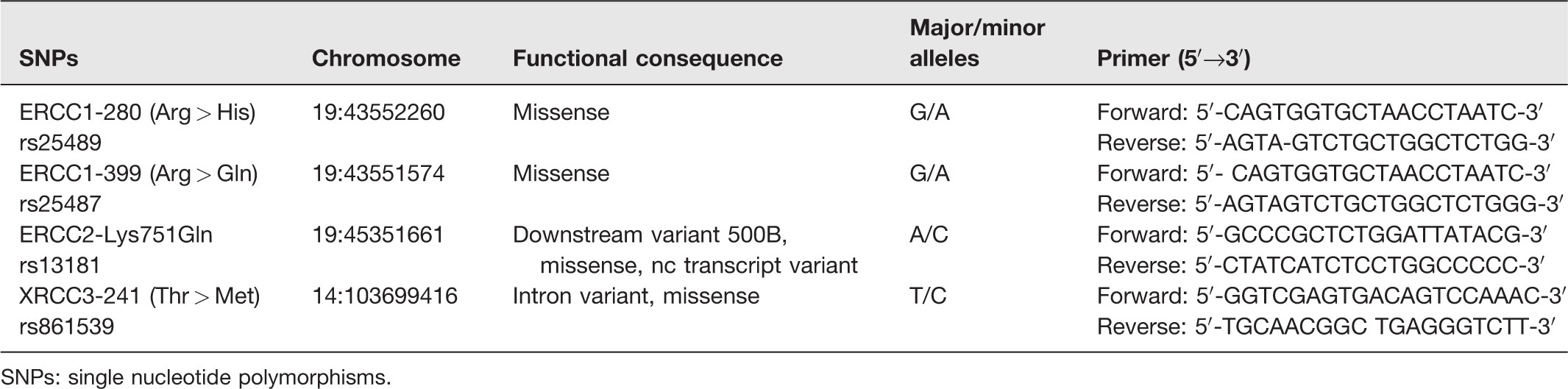
SNPs: single nucleotide polymorphisms.
Statistical analysis
A Chi-squared test was performed for difference analysis between groups on percentages calculated for categorical variables, and the t-test was used for the continuous variables with normal distribution (means ± standard deviations). HWE (Hardy–Weinberg equilibrium) for SNPs in controls was analyzed by SNPstats. Logistic regression calculated the ORs (95% CI) for associations between the four XCRR SNPs and POAG risk. The ORs were adjusted for age, gender, BMI, smoking, and alcohol consumption. The best combination of SNP–T2DM interactions was assessed by GMDR (generalized multifactor dimensionality reduction). Haplotype analysis was performed using PHASE 2.0 (University of Manchester, Manchester, UK). All P values reported in the results section were two-tailed, and the P values obtained from logistic regression were corrected for multiple testing.
Results
A comparison of case and control groups with respect to demographic characteristics is shown in Table 2. There were total of 1233 participants including 410 patients with POAG and 823 control participants. Their average age was 65.9 ± 13.8 years. No significant change existed in the parameters of interest, including gender, age, BMI, and hypertension between the two groups (both P > 0.05). In contrast, the percentage of participants who smoked cigarettes, consumed alcohol, T2DM and intraocular pressure in the POAG was higher than in controls.
Comparison for different demographic characteristics in case and control groups.
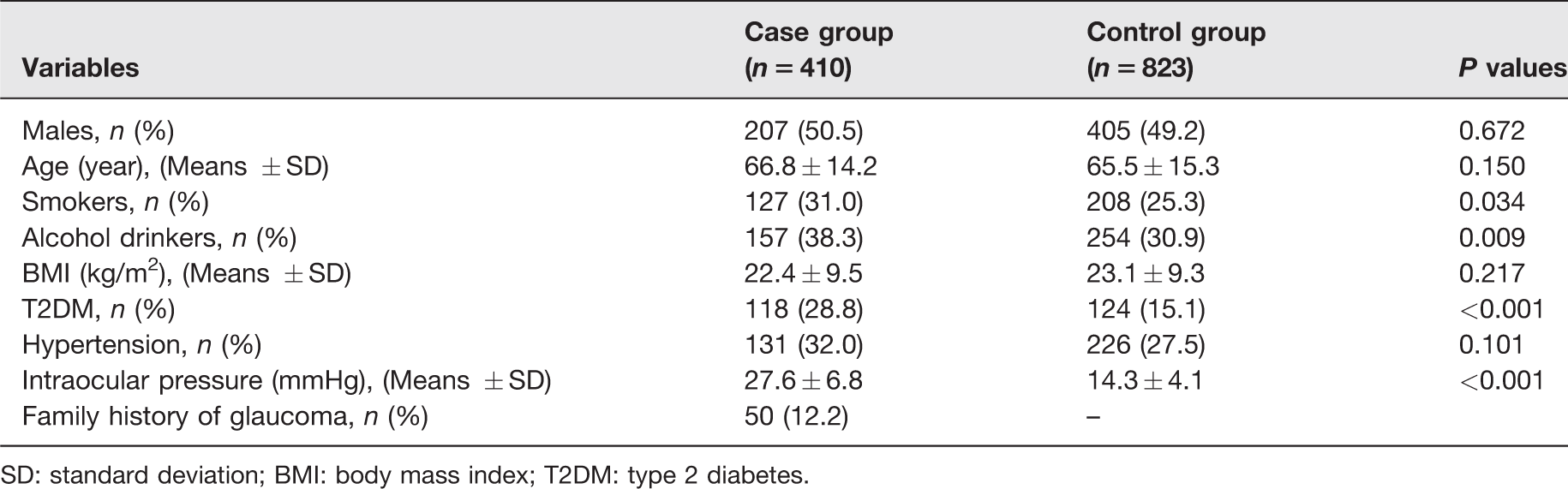
SD: standard deviation; BMI: body mass index; T2DM: type 2 diabetes.
In the current study, the genotype frequencies in the control were distributed accordingly to HWE. The frequency of the rs25487-A allele was 30.1% in cases and 19.9% in controls. The frequency of the rs861539-C allele was 31.7% in cases and 20.8% in controls, which was also a statistically significant difference. The rs25487-A and rs861539-C were associated with a higher POAG risk (adjusted ORs [95% CI], 1.60 [1.19–2.02] and 1.62 [1.20–2.08], respectively; Table 3).
Association analysis for four target SNPs within XRCC gene and POAG risk.
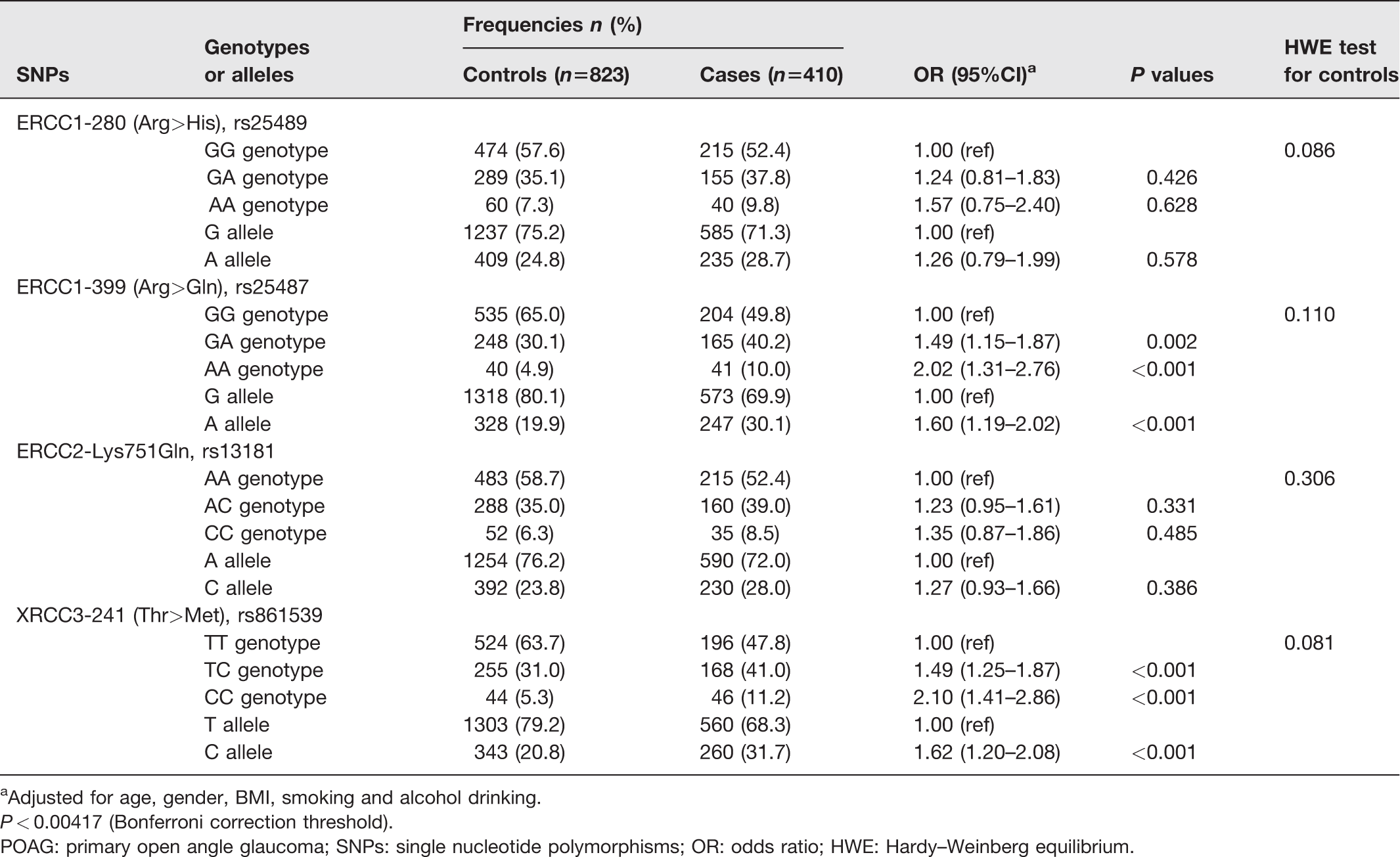
Adjusted for age, gender, BMI, smoking and alcohol drinking.
P < 0.00417 (Bonferroni correction threshold).
POAG: primary open angle glaucoma; SNPs: single nucleotide polymorphisms; OR: odds ratio; HWE: Hardy–Weinberg equilibrium.
The comparison of CVC (cross-validation consistency) and the TA (test accuracy) between gene–gene and gene–T2DM model was determined by GMDR analysis (Table 4). The TA for two-locus model rs25487 and T2DM was 62.11% at the P < 0.01 level indicating rs25487 and T2DM model had the highest CVC independent of how the data were divided, thus providing evidence of rs25487 gene–T2DM interaction. The T2DM related to POAG risk was affected by the rs25487 function.
GMDR analysis for the best interaction combination models.
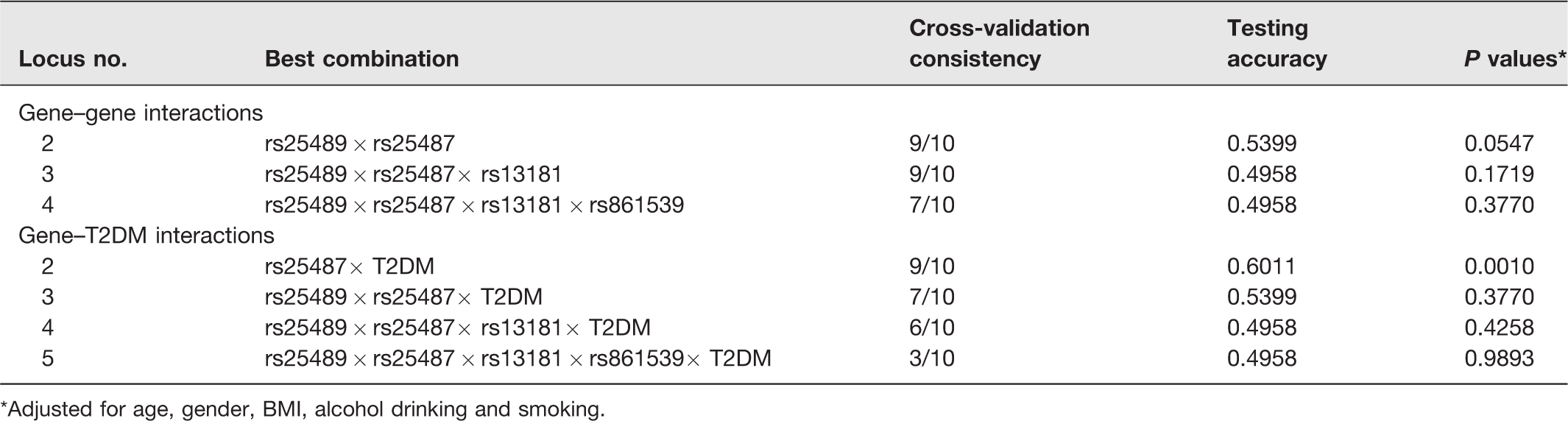
*Adjusted for age, gender, BMI, alcohol drinking and smoking.
Pairwise LD value between rs25489 and rs25487 within the ERCC1 gene was > 0.75. Therefore, SHEsis software was used for haplotype analysis for rs25489 and rs25487. Among all samples, the G-G haplotype was 49.45% in the POAG patients and 55.78% in the controls, respectively. The A-A haplotype was also significantly related to the increased risk of POAG (Table 5).
Haplotype analysis on association of XRCC1 gene and POAG risk.
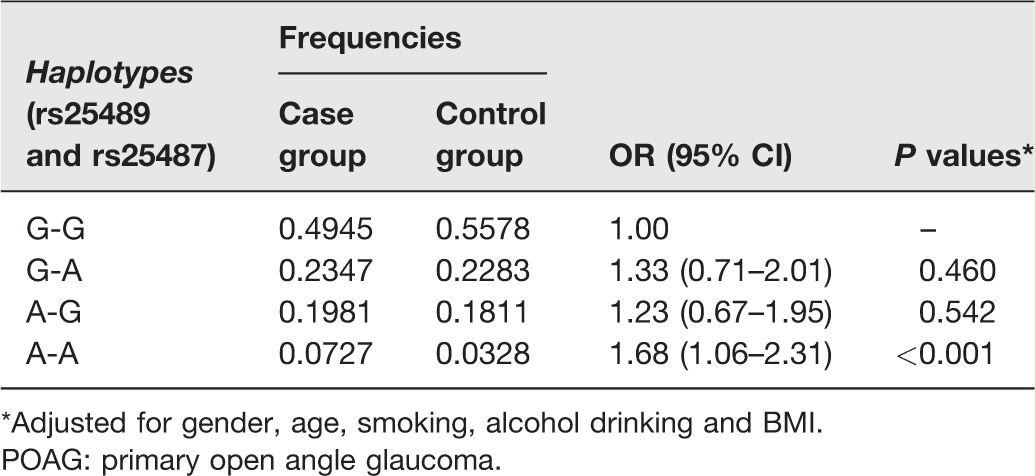
*Adjusted for gender, age, smoking, alcohol drinking and BMI.
POAG: primary open angle glaucoma.
Discussion
In the current study, we have shown that the rs25487-A and rs861539-C alleles are associated with an increased risk of POAG and could be a risk factor for developing POAG; however, there was no relationship between rs25489 and rs13181 and POAG. It is well known that some gene polymorphisms were related to a lower DNA repair capacity and oxidative stress in the eye has been thought as a risk factor in the pathogenesis of cataracts, 16 age-related macular degeneration, 17 glaucoma, 18 and POAG. 19 Reports involving the association between XRCC gene polymorphisms and POAG risk are limited and the results are inconsistent. It has been suggested that XPD codon 751 and XRCC1 codon 399 polymorphisms are not related to POAG risk; 20 however, the sample sizes of the cases and controls were not large enough to detect any true differences between the groups. An association has been reported polymorphisms between rs25487 (XRCC1) and rs13181 (XPD). Szaflik et al. 21 concluded that the XRCC1-399Arg/Gln its 399Gln allele is the potential risk factors for development of POAG. Moreover, Szaflik et al. 21 suggested that XRCC1-399 Arg/Gln may be associated with progression of POAG. Based on a study 22 involving a Polish population, it was suggested that the XRCC1-399Arg/Gln mutation may act as a predictive risk factor of POAG. The difference between these studies and the study conducted by Güven et al. 20 may reflect population group differences. In addition, the sample size in the Güven et al. 20 study was relatively smaller than the previous studies and the current study.
Generally, the pathologic mechanism underlying POAG is a complex process that is caused mainly by the interaction between genetic and environmental factors. 13 Some studies have showed that diabetes may be a risk factor for glaucoma;14,15 however, there are few reports on the interaction between T2DM and the XRCC gene. In the study, we found that the rate for T2DM was higher in cases than in controls, our interaction analysis between the XRCC gene and T2DM indicated significant interaction between rs25487 and T2DM, which provided evidence of XRCC 1 gene–T2DM interaction effects. The analysis indicated that T2DM influenced the risk for POAG depending on the genotypes at rs25487. The present study is the first report attempting to elucidate the possible impact of an XRCC gene–T2DM interaction on POAG risk. Our haplotype analysis for rs1799782 and rs13181 showed the D′ value was > 0.75, indicating that the T-C haplotype was significantly associated with increased POAG risk. Pairwise LD analysis was also conducted for SNPs within substantial LD. We showed that the G-G haplotype existed most frequently in the two groups: the G-G was 49.45% in the POAG patients and 55.78% in the controls, respectively. As well, the results indicated that the haplotype A-A was significantly related to an increased risk for POAG.
The limitations of this study were: First, we studied a relatively smaller sample size, although statistical analysis requirements were met. Second, the cases were all POAG patients; other types of glaucoma patients should be studied in the future to explore the impact of this gene on different subtypes of glaucoma.
In conclusion, we showed that the rs25487-A and rs861539-C alleles, as well as the interaction between rs25487 and T2DM and haplotype A-A are accompanied by a significantly increased risk of POAG.
Footnotes
Authors’ contributions
Yanyan Wang: wrote the manuscript, conceived and designed the experiments. Chenguang Wang, and Shounan Qi: cellular experiment operation. Zaoxia Liu: data processing and statistical analysis. Guanfang Su and Yajuan Zheng: experimental guidance and data verification.
ACKNOWLEDGEMENTS
We appreciate the cooperation of the families and individuals who cooperated in this study.
DECLARATION OF CONFLICTING INTERESTS
The author(s) declared no potential conflicts of interest with respect to the research, authorship, and/or publication of this article.
FUNDING
The author(s) received no financial support for the research, authorship, and/or publication of this article.