







Abstract
Lung grafts may experience multiple injuries during lung transplantation, such as warm ischaemia, cold ischaemia, and reperfusion injury. These injuries all contribute to primary graft dysfunction, which is a major cause of morbidity and mortality after lung transplantation. As a potential selective antioxidant, hydrogen molecule (H2) protects against post-transplant complications in animal models of multiple organ transplantation. Herein, the authors review the current literature regarding the effects of H2 on lung injury from lung transplantation. The reviewed studies showed that H2 improved the outcomes of lung transplantation by decreasing oxidative stress and inflammation at the donor and recipient phases. H2 is primarily administered via inhalation, drinking hydrogen-rich water, hydrogen-rich saline injection, or a hydrogen-rich water bath. H2 favorably modulates signal transduction and gene expression, resulting in the suppression of pro-inflammatory cytokines and excess reactive oxygen species production. Although H2 appears to be a physiological regulatory molecule with antioxidant, anti-inflammatory and anti-apoptotic properties, its exact mechanisms of action remain elusive. Taken together, accumulating experimental evidence indicates that H2 can significantly alleviate transplantation-related lung injury, mainly via inhibition of inflammatory cytokine secretion and reduction in oxidative stress through several underlying mechanisms. Further animal experiments and preliminary human clinical trials will lay the foundation for the use of H2 as a treatment in the clinic.
Keywords
Impact statement
This review summarizes currently available data regarding the protective role of hydrogen in lung injuries caused by lung transplantation, provides an outline of recent advances in the use of hydrogen as a therapeutic medical gas for lung transplantation, and elucidates possible mechanisms underlying the protective effect of hydrogen on lung grafts. This review of experiments on animals will lay the foundation for the application prospects and clinical value of hydrogen during lung transplantation.
Introduction
Lung transplantation (LTx) is the final approach to promote survival for patients with end-stage pulmonary disease. However, the outcomes of LTx are inferior to those of other solid organ transplantations. 1 Primary graft dysfunction (PGD) is a major cause of morbidity and mortality after LTx. 2 PGD can increase the length of mechanical ventilation, prolong hospital stays, and induce bronchiolitis obliterans syndrome. 3 Multiple mechanisms contribute to the pathogenesis of PGD, including ischaemia–reperfusion (I/R) injury, epithelial cell death, endothelial cell dysfunction, innate immune activation, oxidative stress, and inflammatory cytokine and chemokine release. 2 I/R injury is generally considered the major contributor to PGD and may also aggravate rejection. Both I/R injury and PGD are associated with the development and progression of chronic lung allograft dysfunction. 4 In addition to I/R injury, complex interactions of donor injury before transplantation, such as preceding brain death, cardiocirculatory death, and pre-engraftment lung management, also impair the status of donor lungs. 5
In 2007, Ohsawa et al. discovered that hydrogen molecule (H2) has antioxidative and anti-apoptotic properties, which protect the brain against I/R injury and stroke by selectively neutralizing hydroxyl radicals. 6 Since then, hydrogen gas has emerged at the forefront of therapeutic medical gas research. Accumulating evidence has proved that molecular hydrogen exerts cytoprotective effect by its antioxidative, anti-inflammatory and anti-apoptotic properties. In recent years, growing experimental evidence showed that hydrogen can remarkably ameliorate transplantation-related lung I/R injury. Hydrogen inhalation for donors or recipients has been shown to mitigate lung injury and ameliorated lung dysfunction after LTx. Preconditioning lung donors with hydrogen during preservation could also decrease post-transplant lung injury.
Due to its reductive properties, hydrogen can be applied as an antioxidant to selectively eliminate toxic reactive oxygen species (ROS) without affecting the normal physiological function of ROS. 6 Due to its ability to rapidly diffuse across the membranes of cells and organelles, hydrogen can react with cytotoxic ROS in subcellular structures and thus protect against oxidative damage. At present, the main routes of hydrogen administration include inhalation, drinking or injection of hydrogen-dissolved solution, and hydrogen bath. With unique structural characteristics, the lung allows hydrogen to exchange gas without entering the blood circulation and thus enables hydrogen to exert protective effects during the donor preservation period.
The protective effect of hydrogen on donor lung injury
Donor lungs may experience numerous injurious events prior to LTx, including injury before organ procurement, such as donor mechanical ventilation, warm ischaemia phase (WIP) injury from cardiocirculatory death, brain death, and cold ischaemia injury during organ preservation.7–9
Application of hydrogen during WIP protects lung grafts from I/R injury
The donation of lungs following brain death and cardiocirculatory death is the main source to expand the lung donor pool. However, the inevitable occurrence of WIP can activate the immune system in donors and aggravate I/R injury, which increases the risk of PGD. 10 In a rat model of LTx, we showed that 3% hydrogen gas ventilation during WIP improved post-transplantation lung function, as determined by improved partial pressure of arterial oxygen (PaO2)/fraction of inspired oxygen (FiO2) ratio and static compliance of the lung grafts. Hydrogen preconditioning alleviated cardiac death lung graft I/R injury by reducing inflammatory mediator upregulation, demonstrated by decreased myeloperoxidase (MPO) activity, lower serum interleukin (IL)-6 and tumor necrosis factor (TNF)-α levels, and elevated IL-10 level. Hydrogen was also shown to attenuate oxidative stress evidenced by increased superoxide dismutase (SOD) activity and a decreased malondialdehyde (MDA) level, and to decrease the alveolar epithelia cell apoptosis in lung grafts. 11 Brain death initiates a cascade of events such as hemodynamic, hormonal, metabolic, and inflammatory changes, all of which can impact the quality and immune activation of potential donor organs. Previous studies on I/R injury showed a confounding issue: the function of otherwise healthy donor lungs from brain dead donors is impaired. 12 In a rat model of LTx wherein both brain dead donors and recipients received 2% hydrogen ventilation, we found that hydrogen treatment could decrease the IL-8, TNF-α and intracellular adhesion molecule (ICAM)-1 levels, increase SOD activity and reduce MDA levels, and mitigate apoptosis in lung grafts, leading to improved PaO2/FiO2 ratio, static compliance, and graft histology. 13
In 2011, Kawamura et al. discovered in a rat model of LTx that the ventilation of the donor with 2% hydrogen gas prior to procurement can attenuate the upregulation of the mRNA of pro-inflammatory cytokines TNF-α, IL-1β, and ICAM-1, increase the levels of the anti-apoptotic protein B-cell lymphoma-2 (Bcl-2), and decrease the levels of the proapoptotic molecules Bcl-2-associated X (Bax)-protein significantly. Lower lung injury scores and increased PaO2 in lung allografts after reperfusion demonstrated that hydrogen exposure protected lung grafts from I/R injury and mitigated lung dysfunction resulting from LTx. 14 In 2012, Tanaka et al. found that ventilation with 2% hydrogen in donor rats could significantly upregulate 182 target gene expressions, and downregulate 47 target gene expressions by gene array analysis. Further investigation found that preloading hydrogen into the lung significantly upregulated four lung surfactant-related mRNAs, especially Clara cell protein (CCP) 16, a protein major produced by the non-ciliated cells of the tracheobronchial epithelial tree with anti-inflammatory and antioxidant properties, the mRNA levels of four kinds of adenosine triphosphate (ATP) synthase genes, and stress-response gene heat shock protein (HSP) A5, which encodes a member of the HSP70 protein family in the lung grafts, as detected by real-time RT-PCR. The protein levels of CCP16 and HSP70, and the ATP levels in the lung graft tissue were also increased in the presence of hydrogen. The changes in these molecules may underlie the protective effects of hydrogen against I/R injury during LTx. 15
Preloading hydrogen during organ preservation ameliorates I/R injury of lung grafts
In a rat model of LTx, we found that donor lung inflation with 3% hydrogen during the cold ischaemic period could reduce graft MPO activity and serum IL-8 and TNF-α levels, increase PaO2/FiO2 and pulmonary venous oxygen tension (PvO2)/FiO2, resulting in alleviated lung graft injury and improved function. 16 In 2016, we demonstrated that inflation with CO or H2 protected against I/R injury in a rat lung transplantation model, and this effect was enhanced by combined CO and H2 treatment. 17 According to the results of our recent study, the application of hydrogen gas during cold storage attenuated the inflammatory response in an LTx model in pulmonary microvascular endothelial cells, and this effect may be achieved by inhibition of the p38 mitogen-activated protein kinase (MAPK) and nuclear factor-kappa B (NF-κB) pathways. 18 Kayawake et al. discovered that hydrogen-rich preservation solution increased PaO2 and the pulmonary dynamic compliance, decreased wet-to-dry lung weight ratio, reduced neutrophil infiltration and the expression of IL-1β mRNA in lung grafts in a canine left LTx model. 19 Another study by Saito et al. showed the similar results in a rat LTx model that hydrogen-rich preservation solution could decrease leukocytes adhering to the endothelium and the expression of IL-1β mRNA, reduced the level of 8-hydroxydeoxyguanosine, an oxidation marker of DNA. 20 Immersing the lungs in hydrogen-rich saline (HRS) could decrease pro-inflammatory cytokine levels (IL-1β and IL-6) and high mobility group box-1 expression in a rat model of lung I/R injury. 21 These evidence suggested that a hydrogen-rich preservation solution might exert protective effects through antioxidant and anti-inflammatory effects. Donor preservation using a hydrogen-rich solution appears to be a promising approach to managing lung I/R injury.
Hydrogen gas inhalation during EVLP exerts beneficial effects on lung grafts
Normothermic ex vivo lung perfusion (EVLP) is a system that can perfuse and ventilate a retrieved donor lung through an ex vivo circuit. EVLP could provide an opportunity to reassess the viability of the injured donor lung before LTx. Noda et al. found that administering 2% hydrogen through the EVLP circuit attenuated pro-inflammatory responses, decreased lactic production caused by EVLP, downregulated hypoxia inducible factor-1 expression, and promoted mitochondrial biogenesis. Additionally, hydrogen increased the expression of heme oxygenase-1 (HO-1), a well-known key antioxidant enzyme, in the lung grafts. 22 These effects suggested that hydrogen-supplemented preconditioning contributed to better post-transplant outcomes in the recipients. Haam et al. found that hydrogen gas inhalation during EVLP could improve the lung compliance, peak airway pressure, and oxygen capacity (left atrium perfusate PO2—pulmonary artery perfusate PO2/FiO2 ratio) of lung grafts in a pig LTx model. Hydrogen gas exerted antioxidant effect in I/R injured lung grafts, as demonstrated by elevated protein expression of SOD and HO-1. The lower expression of IL-6 and NOD-like receptor protein 3 (NLRP3), a component of inflammasome, higher expression level of anti-inflammatory cytokine IL-10, as well as the decreased number of apoptosis cells after the hydrogen treatment indicated that the mechanisms underlying the beneficial effects of hydrogen involve the action of anti-inflammation and anti-apoptosis.23,24
Administrating hydrogen to recipients after LTx mitigates the I/R injury in lung grafts
In a rat left orthotopic LTx model, Kawamura et al. found that ventilation with 2% hydrogen during surgery and for 1 h after reperfusion alleviated graft dysfunction. The reduced upregulation of mRNAs for ICAM-1, TNF-α, IL-1β, and IL-6 after hydrogen treatment showed that hydrogen ameliorated inflammatory responses associated with I/R injury. Hydrogen mitigated I/R-induced graft apoptosis, as determined by upregulation of Bcl-2 and B-cell lymphoma-extra large (Bcl-xL) mRNAs and protein as well as reduced activated caspase-8 levels. 25 In a rabbit I/R injury model, HRS applied intraperitoneally before reperfusion decreased neutrophil infiltration, reduced the elevation of TNF-a and IL-8. Besides, HRS treatment reduced MDA contents and increased SOD activities at the end of reperfusion. Based on these findings, they demonstrated that the protective effects of HRS in attenuating lung I/R injury seemed to be associated with mitigating inflammation and oxidative damage. 26
Hydrogen had an active effect on immunity. Ozeki et al. recently discovered that hydrogen-saturated water administration after transplantation suppressed the development of mid-term obliterative airway disease via antioxidant and anti-inflammatory mechanisms in a mouse heterotopically tracheal allograft model, and hydrogen could activate regulatory T-cells. Hydrogen water reduced the level of IL-6 and increased that of forkhead box P3 transcription factor and CD4/CD3, suggesting that hydrogen enhanced regulatory T cell activity. 27 Noda et al. found that drinking a hydrogen-rich solution inhibited the proliferation of T cells and the production of IFN-γ and IL-2, and hydrogen was remarkably effective in prolonging graft survival and reducing the proliferation of intimal mast cells. 28
Different ways of molecular hydrogen administration and their effects on lung grafts after LTx are summarized in Table 1.
Different ways of molecular hydrogen administration and their effects in lung transplantation.
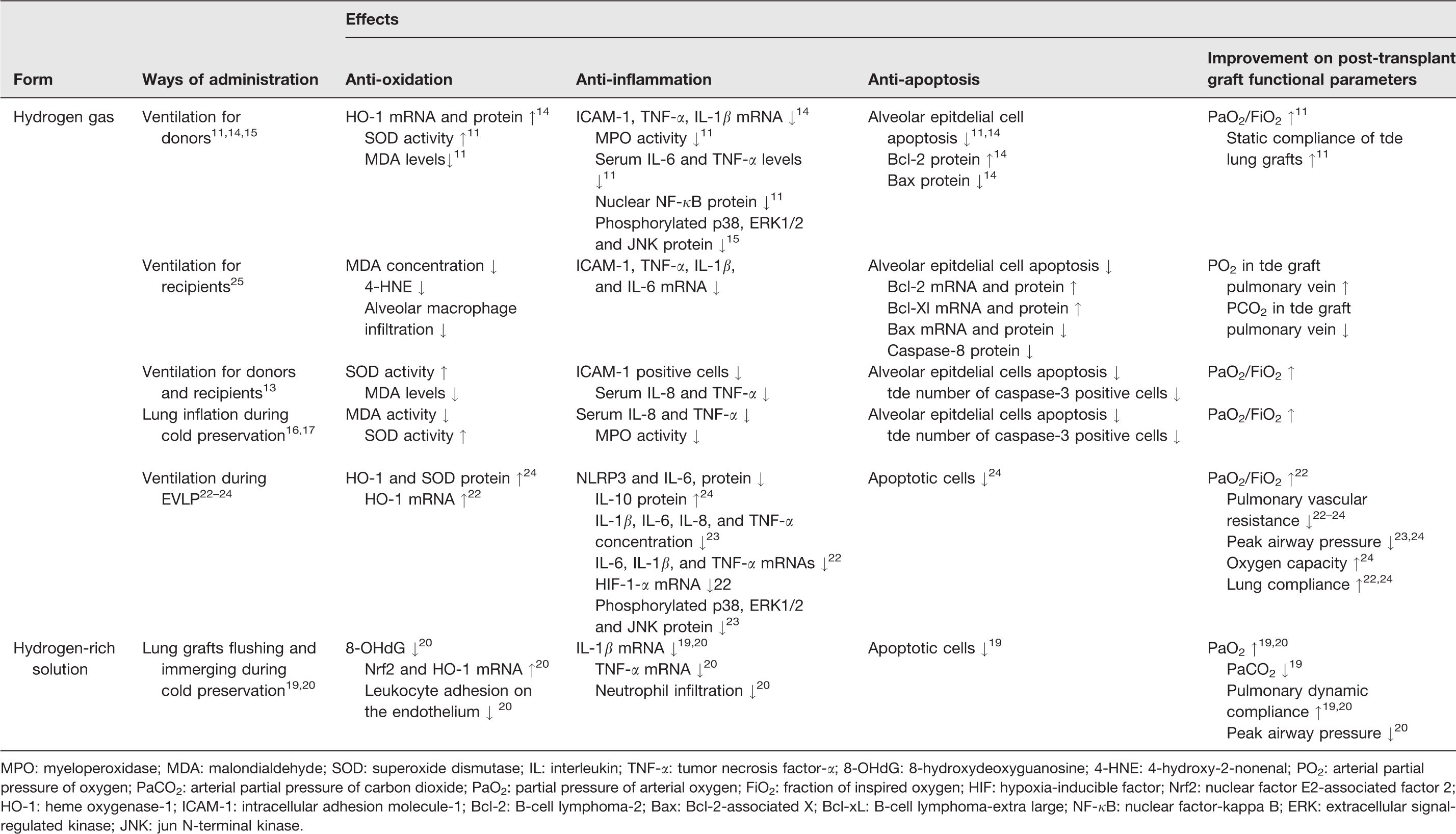
MPO: myeloperoxidase; MDA: malondialdehyde; SOD: superoxide dismutase; IL: interleukin; TNF-α: tumor necrosis factor-α; 8-OHdG: 8-hydroxydeoxyguanosine; 4-HNE: 4-hydroxy-2-nonenal; PO2: arterial partial pressure of oxygen; PaCO2: arterial partial pressure of carbon dioxide; PaO2: partial pressure of arterial oxygen; FiO2: fraction of inspired oxygen; HIF: hypoxia-inducible factor; Nrf2: nuclear factor E2-associated factor 2; HO-1: heme oxygenase-1; ICAM-1: intracellular adhesion molecule-1; Bcl-2: B-cell lymphoma-2; Bax: Bcl-2-associated X; Bcl-xL: B-cell lymphoma-extra large; NF-κB: nuclear factor-kappa B; ERK: extracellular signal-regulated kinase; JNK: jun N-terminal kinase.
Possible mechanisms of the protection effect of hydrogen
Antioxidant effects of molecular hydrogen
Hydrogen may protect against transplant-induced oxidative stress injury both by hydrogen's free radical scavenging activities, and by inducing nuclear factor E2-related factor 2 (Nrf2)-dependent protective signaling pathways.
Free radicals are produced primarily in the respiratory chain, phagocytosis, prostaglandin synthesis, and the cytochrome P450 system. 29 Excessive ROS can react with multiple macromolecules, causing deleterious consequences. Hydroxyl radicals are the most toxic and reactive radicals and are biologically formed by the reaction of O2− with H2O2 through the Fenton reaction. 30 Ohsawa et al. demonstrated that hydrogen directly reacts with hydroxyl radicals in a cell-free system and reduces hydroxyl radicals in cell culture using the method of spin-trapping by 5,5-dimethyl-1-pyrroline N-oxide, selectively scavenging oxygen hydroxyl radicals. 6 A large amount of evidence has demonstrated the radical scavenging capacity of molecular hydrogen. 31 Fang et al. showed that hydrogen treatment significantly reduced the intracellular levels of ROS and MDA in both vitiligo specimens and hydrogen peroxide-treated melanocytes in vitro. 32 Subsequent studies showed that hydrogen mitigates oxidative stress in animal I/R injury models, which was supported by decreased lipid peroxidation and MDA production.11,33,34
The Nrf2-antioxidant response element pathway is considered an essential pathway for protection against oxidative stress for its transcriptionally regulating numerous antioxidative and cytoprotective proteins. Hydrogen gas can ameliorate oxidative stress through induction of Nrf2-dependent genes, such as HO-1 and SOD. The potential mechanism of molecular hydrogen activation of Nrf2 will be discussed in more detail later.
Hydrogen reduces inflammation
TNF-α, IL-1β and IL-6 are the most important inflammatory factors that mediate the inflammatory response and play an important role in the cascade of inflammation. Hydrogen can directly reduce the mRNA expression of inflammatory factors such as TNF-α, IL-1β, IL-6, and ICAM-1, inhibit the mRNA production of chemokines, such as C-C motif ligand 2, and reduce leukocyte accumulation. 21 , 35 Hydrogen can also reduce the activity of MPO, indicating a decrease in the accumulation of neutrophils. 13 , 36 Zhai et al. found that HRS could reduce neutrophil accumulation as evidenced by reduced MPO activity in rat cecal ligation and puncture-induced sepsis-associated acute lung injury models. In addition, the decrease in the levels of pro-inflammatory cytokines, such as TNF-α, IL-1β, and IL-6, in the lung also suggested that HRS could ameliorate pulmonary inflammatory responses. 35
Hydrogen inhibits apoptotic cascades
Number of animal experiments have showed that hydrogen can decrease apoptosis of alveolar epithelial cells and pulmonary microvascular endothelial cells in lung grafts.11,16,18 The anti-apoptotic abilities of hydrogen were at least partially attributed to the regulation of the apoptosis-related genes such as Bcl-2, Bcl-xL, and Bax. Sequential activation of caspases, which plays a central role in the process of cellular apoptosis, can also be inhibited by hydrogen molecular. The number of apoptotic pulmonary epithelial cells was reduced after hydrogen treatment. Accordingly, hydrogen treatment was found to increase the levels of the anti-apoptotic protein Bcl-2 and decrease the levels of the proapoptotic Bax protein significantly in the lung graft of rats. 14 Hydrogen gas inhalation was shown to upregulate Bcl-2 and Bcl-xL mRNAs and protein and inhibit the upregulation of Bax mRNA and protein in lung grafts of rats. Moreover, hydrogen treatment was observed to reduce activated caspase-8 levels. 25 Zhang et al. showed that hydrogen can significantly upregulate the expression levels of Bcl-2 and Bcl-xl in a rat model of endotoxin-induced lung injury, while downregulate the expression of the apoptotic genes caspase-3, caspase-8, and Bax in the lung grafts. 37 Hydrogen inhalation was also reported to increase the expression of Bcl-2 and reduce ventilator-induced lung injury (VILI)-induced expression of the Bax protein in lungs. 38 Qiu et al. showed that lipopolysaccharide (LPS) resulted in an upregulation of Bax protein and hydrogen inhalation inhibited over-activity of Bax protein. 39 These influences of hydrogen on apoptosis-related genes can reduce the secretion of proteases, protect the integrity of cells from damage, and inhibit the initiation of apoptosis programs. 13
Hydrogen protects mitochondrial structure and function in I/R injury
Mitochondria is the major site of generation of intracellular ROS as well as the target of ROS. I/R results in the production of mitochondrial-derived ROS, collapse of the mitochondrial membrane potential, opening of the mitochondrial permeability transition pore (mPTP), an influx of calcium into the mitochondria and release of cytochrome c. 40 Hydrogen molecules can reach subcellular structures, such as the nucleus and mitochondria. Ordinary antioxidants do not effectively target mitochondrial ROS, but hydrogen molecules can selectively scavenge −OH and peroxynitrite anions as detected by fluorescent probes and electron paramagnetic resonance spectroscopy. 41 As a selective antioxidant, hydrogen molecules have the capacity to reduce mitochondrial oxidative stress, and thus protect against mitochondrial dysfunction and inhibit mitochondria-mediated apoptosis.
Iuchi et al. found that molecular hydrogen restored the decline of oxidoreductase activity and mitigate the loss of mitochondrial membrane potential induced by tert-butyl hydroperoxide (a free radical inducer) in a human acute monocytic leukaemia cell line, indicating that hydrogen suppressed oxidative stress-induced mitochondrial injury. 42 Increasing of the coenzyme Q9 concentration by hydrogen-rich water administration can stimulate the transfer of electrons from complex I and complex II to complex III, and increase the level of ATP production through mitochondrial oxidative phosphorylation in rat heart mitochondria. 43 Hydrogen treatment was also associated with increased graft ATP levels and increased activity of the enzymes in the mitochondrial respiratory chain. 28 Sobue et al. found that hydrogen molecules activated the expression of sets of genes regulated by histone H3K27 methylation status through H3K27 demethylase, which significantly increased the expression of mitochondrial HSP and then played a role in mitochondrial repair. 44 Cui et al. showed that after HRS treatment, the mitochondria were less swollen and exhibited membranes integrity with higher mitochondrial membrane potential in cerebral I/R rats during reperfusion. HRS was also shown to significantly attenuate mPTP and reduce the release of pro-apoptotic factor cytochrome c from mitochondria following cerebral I/R. 45 HRS improves the bile duct ligation-induced decline in mitochondrial respiratory function and the integrity of the respiratory chain as assessed by the adenosine diphosphate (ADP) to oxygen ratio and the mitochondrial respiratory control ratio (respiration rate after the addition of 1 mM ADP/oxygen consumption rate after the complete phosphorylation of ADP). HRS can also inhibit the depletion of ATP levels and mitochondrial cytochrome c release in hepatocytes of mice with obstructive jaundice. 46
Hydrogen attenuates I/R injury by suppressing endoplasmic reticulum stress
Oxidative stress, calcium overload, and inflammation in the process of I/R injury can activate endoplasmic reticulum stress (ERS), and in turn, the cell dysfunction and apoptosis induced by excessive ERS aggravate I/R injury. 47 ERS activates signaling pathways, such as the unfolded protein response, ER overload response, and caspase-12-mediated apoptotic pathways. The activation of ERS caused caspase-12 to translocate from the ER to the cytoplasm, cleaved caspase-9, activated caspase-3, and finally led to apoptosis. HRS has been reported to mitigate ERS and ERS induced apoptosis resulting from I/R in multiple organs including myocardium, 48 intestinal, 49 liver,50,51 and brain, 52 as revealed by down-regulated mRNA and protein levels of the pivotal proteins involved in ERS, such as glucose-regulated protein 78 (GRP78) and C/EBP homologous protein (CHOP). According to the results of research by Sun et al., HRS treatment could alleviate the elevated GRP78, CHOP and X-box binding protein-1mRNA expression induced by hyperoxia exposure, hinting that hydrogen could significantly reduce hyperoxic acute lung injury in rats by inhibiting the elevation in ERS. 53 The mechanisms mediate the reduction in ERS by hydrogen might related to cross-talk between autophagy and ERS. Hydrogen significantly reduced the expression of ERS-related protein and increased the autophagy-related protein expression in septic mice. Moreover, treatment with the inducer of ERS or the inhibitor of autophagy abrogated these effects of hydrogen. These results suggested that hydrogen alleviated ER stress via the autophagy pathway in sepsis. 54 However, Gao et al. reported that hydrogen exerted protective effect on myocardial I/R injury in rats by attenuating ERS and down-regulating autophagy. 48
Hydrogen modulates intracellular signaling pathways
Nrf2/HO-1
Nuclear factor E2-associated factor 2 (Nrf2) is considered a key regulator for maintaining the redox balance and controlling the initiation of the transcriptional expression of downstream antioxidant enzymes. The activation of the Nrf2 pathway initiates antioxidant defense through a variety of mechanisms, including SOD-induced catabolism of superoxide and peroxide, regeneration of antioxidant cofactors and proteins, and increase in redox transport. 55
The mechanism of antioxidant effects of molecular hydrogen was shown to involve in the activation of Nrf2 signaling pathway in lung injury induced by hyperoxia, 36 seawater instillation, 56 sepsis, 57 and paraquat-induced lung fibroblast injury in vitro. 58 Hydrogen was shown to increase pulmonary HO-1 protein and mRNA expression, as well as HO-1 activity in the lungs of rats exposed to hyperoxia. Moreover, Nrf2 knockout mice showed little improvement with hydrogen treatment, suggesting that the beneficial effect of molecular hydrogen is Nrf2-dependent. 36 Hydrogen was reported to upregulate the HO-1 mRNA expression and protein level in the allografts, which might contribute to the protective effects of hydrogen. 14 Kelch-like ECH-associated protein 1 (Keap1) located in cytoplasm negatively regulated Nrf2 by binding the N‐terminal Neh2 domain of Nrf2. Upon exposure to ROS, Nrf2 dissociates from Keap1 and is translocated into the nucleus, resulting in an increased expression of antioxidant genes. Lu et al. showed in a rat model of cyclosporine A‐induced nephrotoxicity that HRS administration decreased the mRNA and protein expression of Keap1 without affecting the levels of Nrf2 mRNA. Meanwhile, HRS significantly decreased the protein expression of cytosolic Nrf2, while increased in the expression of nuclear Nrf2, but the total expression of Nrf2 did not increase in rats treated with. 59 These results indicated that hydrogen protects against oxidative stress injuries via the activation of the Keap1/Nrf2 signaling pathway.
NF-κB
NF-κB is a pleiotropic oxidant-sensitive transcription factor that exists in the cytosol in an inactive form complexed to an inhibitory kappa B (I-κB) monomer. Various stimuli, including ischaemia, hypoxia, free radicals, cytokines, and LPS, activate NF-κB by inducing the phosphorylation of I-κB. Zhang et al. found that hydrogen treatment obviously reduced nuclear NF-κB protein expression in the lung graft of rats, indicating hydrogen may exerted anti-inflammatory and anti-oxidative effects against lung I/R injury via the NF-κB signaling pathway. 11 Kohama et al. showed that hydrogen inhalation could inhibit inflammation in hemorrhagic shock and resuscitation-induced acute lung injury rats by inhibiting the NF-κB pathway. 60 Xie et al. found that lung inflammation and apoptosis were decreased by hydrogen treatment via inhibiting the NF-κB activity in a rat model of LPS-induced lung injury. 61 In contrast, Huang et al. reported that hydrogen inhalation resulted in early NF-κB activation in the lungs of mice during VILI as determined by the DNA binding activity of NF-κB, and inhibition of NF-κB reversed the protective effects of hydrogen. These results suggested that the cytoprotective effects of hydrogen against apoptotic and inflammatory may in part depend on the activation of NF-κB during VILI. 38
MAPK
MAPK primarily regulates transcription factors through phosphorylation, including p38, extracellular signal-regulated kinase (ERK), and jun N-terminal kinase (JNK). The activation of p38MAPK is the trigger of inflammation-induced lung injury. The mRNA of dual specificity phosphatase1, a dual specificity phosphatase that decreases MAPK phosphorylation/activation in the lung grafts, were upregulated by hydrogen, which resulted in reduced protein levels of p38 MAPK, ERK1/2, and JNK in the allografts. 15 We found that the anti-inflammatory effect of hydrogen may be due to a decrease in secretion of pro-inflammatory cytokines by inhibiting the activation of the p38 MAPK pathway in pulmonary microvascular endothelial cells. 18 Zhai et al. showed that HRS peritoneal injection inhibited the activation and phosphorylation of p38MAPK and NF-κB. 35 As reported by Zhang et al., saturated hydrogen saline may attenuate LPS-induced acute lung dysfunction in rats by reducing inflammation, autophagy, and apoptosis in a mechanism involving the p38 MAPK signalling pathway. 37 Qiu et al. found that hydrogen can inhibit the production of ROS in lung tissue caused by endotoxins and inhibit the activation of p-JNK. 39 Bai et al. proved that saturated hydrogen water could reduce the occurrence of the inflammatory cascade and organ dysfunction by inhibiting the ERK1/2 pathway. 52 Intraperitoneal injection of HRS inhibited LPS-induced activation of p38 MAPK and JNK, which is associated with LPS-induced downregulation of aquaporin-1 (AQP-1) andaquaporin-5 (AQP-5). 62
AQP-1 and AQP-5
The aquaporins (AQPs) are plasma membrane water-transporting proteins. AQP has an important role in transporting water across the lung microvascular endothelium as well as across the lung epithelia. 63 In mice, lung AQP expression seems to be related to the agent applied to induce lung injury. I/R of lung tissue increased AQP-1 expression 64 and reduced AQP-5 expression, 65 while LPS reduced the expression of AQP-5 and AQP-1. 66 In a rat model of LPS-induced lung injury, hydrogen improved the alveolar-arterial oxygen partial pressure difference (A-aDO2) and protected pulmonary epithelial barrier function by increasing AQP-1 expression and decreasing extravascular lung water (EVLW). A significant negative correlation between AQP-1 expression and EVLW was observed. 67 Tao et al. revealed that HRS can export fluid in alveoli, lung tissue spaces, and pulmonary vessels by upregulating AQP-1 and AQP-5 and thus attenuate LPS-induced pulmonary edema. 62
Conclusions
Taken together, accumulating evidence from animal studies suggests that the use of hydrogen can mitigate the injury of lung graft resulting from LTx and improve the lung graft function. Hydrogen exerts many biological effects, including anti-oxidative stress, anti-inflammation, anti-apoptosis on lung grafts by indirectly regulating signal transduction and gene expression, each of which involve multiple several cytoprotective signaling pathways and crosstalk. As a small molecule gas, hydrogen can penetrate biological membranes to exert these protective effects on cells and organelles. Due to its characteristics of safety, low price, easy accessibility, and lack of accumulation, hydrogen has promising prospects for clinical application. Research on hydrogen treatment for transplantation-induced lung injury is still in the preclinical stage in small animal models, such as rats and rabbits, and the mechanism of the protective effect of hydrogen on lung injury after LTx is still unclear. The preliminary clinical application of hydrogen for human requires a long-term exploration process.
Footnotes
AUTHORS’ CONTRIBUTIONS
QL conceived and designed the research, acquired the data, and drafted the manuscript; ZB participated in data collection, figure assessment, and analysis of the manuscript; ZH conceived and designed the research, handled funding, supervision and correspondence, and made critical revisions of the manuscript for important intellectual content.
DECLARATION OF CONFLICTING INTERESTS
The author(s) declared no potential conflicts of interest with respect to the research, authorship, and/or publication of this article.
FUNDING
The author(s) disclosed receipt of the following financial support for the research, authorship, and/or publication of this article: This study was supported by National Natural Science Foundation of China (Grant No. 81570088).
