






Abstract
This study illuminates an understudied pathway through which disadvantage is reproduced in the rental housing market: the housing search, application, and tenant screening process. Using in-depth interviews with 25 housing-seekers with criminal conviction records, past evictions, and damaged credit histories, this article examines the direct role of the rental housing search and application process in reproducing economic precarity and social disadvantage among renters with discrediting background records, beyond delimiting their housing options. Its findings suggest that navigating the housing search from a position of acute market disadvantage comes with significant costs for this population, including the financial burden of repeated application fees and the psychological strains associated with the specter of indefinite housing insecurity. The findings also demonstrate how the housing search process may undermine the willingness of stigmatized renters to contest exploitative or unlawful rental practices by reinforcing awareness of their degraded status in the rental market.
Introduction
Much of the sociological interest in the housing search and application experiences of disadvantaged renters has been motivated by efforts to understand patterns of downward residential mobility, particularly among voucher recipients (Galvez 2010b). Research in this area has demonstrated how the housing search process acts as an indirect channel for the reproduction of poverty and inequality by relegating low-income renters to substandard housing in disadvantaged neighborhoods (Carrillo et al. 2016; DeLuca, Garboden, and Rosenblatt 2013; DeLuca, Wood, and Rosenblatt 2019; Galvez 2010a). However, the rental housing industry’s shift toward more information-intense and stringent procedures for screening and selecting tenants raises questions about whether the housing search and application process has more direct impacts on disadvantaged renters beyond channeling them toward adverse housing outcomes. Landlords are increasingly likely to use commercial background check tools to investigate applicants’ criminal, credit, and eviction histories, and to structure rental criteria around such information. These dynamics pose special challenges for large numbers of renters with tarnished background records at a time when competition is already intense for what remains of the nation’s affordable housing stock (Aurand et al. 2020), such as approximately one in three adults in the United States with a criminal conviction record (Vallas and Dietrich 2014).
This article examines how renters with discrediting background records navigate the rental housing search, application, and tenant screening process, 1 and the immediate consequences of that process for their economic, social, and emotional well-being. It uses a case study of the housing search experiences of prospective tenants with stigmatizing background records in Seattle, WA, to illuminate the rental market dynamics and features of ground-level landlord-tenant interactions that put renters “marked” with negative background credentials (Pager 2003) at a stark disadvantage in the search for decent and affordable rental housing. The data come from in-depth interviews with 25 renters with criminal conviction records, past evictions, and/or severely damaged or nonexistent credit histories who had recently searched and applied for rental housing. Comporting with research on the housing outcomes of renters with eviction and criminal conviction records (Desmond, Gershenson, and Kiviat 2015; Ispa-Landa and Loeffler 2016), the housing search process relegated many of this study’s respondents to substandard and, in some cases, unsafe housing as well as chronic housing insecurity. However, the central findings of the study document the significant material and psychic costs that negatively credentialed renters can incur merely as a result of attempting to secure rental housing, regardless of the outcomes of their housing searches.
This study reveals the economic, mental health–related, and political costs associated with the housing search process for renters with discrediting background records. These include both direct and indirect financial costs (i.e., repeated assessment of application fees and expenses related to temporary living situations) and the psychological strains associated with what were prolonged and arduous housing searches for many of this study’s respondents. The findings also demonstrate how experiencing a grueling and costly housing search, coupled with stigmatized renters’ acute awareness of their own “deficits” as prospective tenants, may undermine the willingness of disadvantaged renters to mobilize the law or other resources to contest unfair or illegal rental practices.
This study illuminates an understudied empirical pathway through which disadvantage is reproduced in the rental housing market and reconceptualizes the housing search process as a direct source of economic and social precarity, rather than solely as a vehicle for downward residential mobility. At a moment when various U.S. municipalities are debating and enacting new laws regulating how landlords screen and select tenants, this study’s findings have timely implications for both tenant screening regulations and the broader housing policy regime that largely entrusts the housing security of marginalized renters to private landlords. Before turning to the current study, I review the reemergence of sociological research on landlords and the rental industry that has established the central role of the private rental housing market in generating contemporary patterns of poverty and inequality. I also review the work of economic sociologists on the social effects of consumer scoring technologies to raise question about the economic and noneconomic consequences of modern tenant screening practices for disadvantaged renters.
Background
The Private Rental Housing Market as a Central Site of Contemporary Stratification
While housing has never been far from sociological work on poverty and inequality, until recently the experience of renters in the private market has occupied a peripheral place within that scholarship (Pattillo 2013). The rich literatures on place-based stratification—including neighborhood effects and residential mobility studies—are largely concerned with rental markets insofar as they trap disadvantaged residents in neighborhoods associated with a host of adverse social, economic, and health outcomes (Warner 2016). By contrast, recent research on landlord practices and the housing trajectories of low-income renters has helped shift sociologists’ conceptualization of housing as merely an outcome of social disadvantage to understanding housing, and the private rental market in particular, as an institution that reproduces poverty and inequality.
Scholars in this field have demonstrated how a variety of rental industry practices reinforce or exacerbate economic and social precarity among tenants, including eviction (Desmond 2016; Purser 2016), the threat of eviction (Garboden and Rosen 2019), exploitation of the housing choice voucher program (Desmond and Perkins 2016; Rosen 2014), passing the costs of regulations on to tenants (Bartram 2019; Greif 2018), and coercive displacement of low-income tenants (Fields 2015; Huq and Harwood 2019). Research in this field has also illuminated the far-reaching consequences of rental housing unaffordability and insecurity for a variety of economic and noneconomic indicators of tenant well-being, including employment (Desmond and Gershenson 2016), children’s educational attainment (Harkness and Newman 2005; Ziol-Guest and McKenna 2014), and health (Desmond and Kimbro 2015; Pollack, Griffin, and Lynch 2010).
In addition to helping illuminate the “black box” (Garboden et al. 2018; Pattillo 2013) of invisible but consequential landlord practices, the revival of sociological research on rental housing also offers a political-economic account of the structural dynamics that pattern landlord-tenant relations on the ground. Scholarship in this area is often situated against the broader features of the national housing policy regime that fail to protect low-income households from the economic volatility of the private rental market: the public sector does little to control rising rental costs, 2 federal rental subsidy programs leave three out of four low-income households who are eligible for housing aid unassisted (Joint Center for Housing Studies of Harvard University 2017), and the majority of those who do receive rental assistance must secure their own housing in the private market (Goetz 2003, 2013). These dynamics have skewed the power imbalance that is characteristic of landlord-tenant relations by increasing the extent to which the housing security of disadvantaged renters is contingent on the practices of private landlords.
The emergence of more information-intense screening standards in the rental industry poses serious challenges for renters with tarnished background records. Yet the unprecedented level of scrutiny with which landlords evaluate applicants has been relatively overlooked in scholarly accounts of the structural forces that undermine economic security and well-being for renters and increase the power of landlords relative to housing-seekers. Although some recent studies have demonstrated how possession of an eviction or criminal record degrades housing outcomes for “marked” renters (Desmond et al. 2015; Evans and Porter 2015; Ispa-Landa and Loeffler 2016), little if any scholarship has examined the more immediate effects of tenant screening practices on the economic and social well-being of tenants. Meanwhile residential mobility scholars have paid closer attention in recent years to the costs and constraints that structure the housing search process for disadvantaged renters (Barnes 2021; Bruch and Swait 2019; DeLuca et al. 2013; DeLuca et al. 2019; Krysan and Crowder 2017), including costs related to tenant screening such as credit check and application fees (Galvez 2010a). However, these studies are also chiefly concerned with the downstream consequences of costly and fraught housing searches (i.e., racial and economic segregation and spatial concentration of voucher holders), rather than the potential direct consequences of the housing search for disadvantage and inequality among renters.
In the proceeding section, I describe a set of historical shifts that have compounded housing challenges for negatively credentialed renters by making personal background records more visible and consequential for housing and other social and economic outcomes. Drawing on the work of economic sociologists who study the social effects of market-oriented scoring technologies, I raise questions about how modern tenant screening practices directly affect disadvantaged housing-seekers before a lease is ever signed, above and beyond their consequences for housing outcomes.
Tenant Screening in the Information Age and its Implications for the “Screened”
Whereas tenant screening prior to the 1990s often amounted to a few phone calls to verify applicants’ rental history and employment status (Thatcher 2008), today the majority of landlords evaluate applicants using commercial tenant screening services that collect information from criminal justice and credit databases, and civil court records that reveal evictions, landlord-tenant disputes, and various forms of outstanding debt (Dunn and Grabchuk 2010). These shifting practices, particularly when accompanied by a tight rental market, have enabled landlords to adopt more exclusionary rental criteria relating to applicants’ criminal, eviction, and credit histories (Clark 2007; Dickson-Gomez et al. 2009; Helfgott 1997). Housing advocates contend that modern tenant screening practices jeopardize the traditional status of the rental market as relatively accessible compared to the homeowner market and erect barriers to housing for a significant proportion of U.S. renters who have stigmatizing background records (Belsky and Drew 2007). Fair housing scholars have called attention to the foreseeable racially discriminatory impacts of exclusionary background screening criteria, such as policies barring all applicants with felonies (Flagg 2011; Lipsitz 2012; Oyama 2009), and the extent to which tenant screening criteria are implicated in, or provide cover for, discriminatory differential treatment (Harwin 2012; Paul-Emile 2014). Such concerns have resulted in new legal guidance on federal standards for fair housing liability, 3 and have motivated policymakers in a growing number of urban jurisdictions to regulate landlords’ background screening practices, particularly with respect to criminal records. 4
Economic sociologists have also recognized that the widespread commercial use of administrative behavioral records like criminal and eviction histories has “a deep effect in structuring life trajectories” (Fourcade and Healy 2013:569). Scholars in this area have illuminated how the diffusion of market-oriented scoring technologies that classify and rate consumers on the basis of personal background information, such as credit scoring and tenant screening reports, deepens and reinforces inequality by constructing classes of individuals who are ineligible for many essential goods, services, and employment opportunities (Fourcade and Healy 2013; Krippner 2017). The stratifying effects of economic classification schemes built on scoring technologies can be self-reinforcing. For instance, a low credit score increases the likelihood that an individual will purchase risky mortgage products (e.g., subprime loans), which in turn increases the risk of having their creditworthiness further degraded by defaulting on their mortgage payments. Eviction records can operate in a similar manner by foreclosing housing opportunities outside of the bottom of the rental market where rents are inflated (Desmond et al. 2015; Desmond and Wilmers 2019), which subsequently increases the risk of eviction for missed rent payments.
In addition to systematizing the exclusion of disadvantaged consumers from many goods and services, another way in which market-oriented scoring technologies are said to reproduce inequality is by disciplining consumers and blunting political or normative challenges to the legitimacy of such tools (Fourcade and Healy 2017; Krippner 2017; Marron 2009). The use of scoring and classification technologies can obscure the bases on which market decisions are made and teach consumers to accept and understand the unequal material outcomes produced by those technologies in hyperindividualized terms. Repeated experiences with scoring technologies encourage the “scored” to attribute their inability to secure better jobs, housing, or credit terms to their own poor past choices—the administrative artifacts of which are cataloged with increasing permanence in digital records repositories—rather than structural forces that pattern the distribution of discrediting background records or the legal environment that fails to effectively regulate their dissemination and use. 5
The theorized disciplinary functions of scoring technologies have implications for our understanding of how disadvantaged renters navigate the housing search process and particularly how they understand the bases on which they are deemed eligible or unfit for housing. Though the technological sophistication with which landlords screen applicants varies considerably, tenant screening practices are increasingly centered around some form of data from commercial background check reports (Dunn and Grabchuk 2010; Kleysteuber 2006; Pasley, Oostrom-Shah, and Sirota 2021). 6 Like other types of market-oriented scoring technologies, an ostensibly “data-driven” approach to vetting rental applicants may help landlords deflect critical questions about the outcomes of tenant screening and selection practices by signaling that their decisions are made on the basis of neutral indicators of market fitness and risk rather than subjective judgments or stereotypes. That hypothesis is partially supported by recent research demonstrating that some landlords believe that deferring to the judgments of commercial tenant screening companies, particularly those that offer unambiguous tenant selection recommendations on the basis of numerical scores, insulates them from liability under antidiscrimination law (Reosti 2020).
While policymakers are increasingly aware of the housing access and equity problems linked to modern tenant screening practices, 7 housing scholars have been slower to examine how the shift toward tougher background screening methods has transformed ground-level relations between landlords and prospective tenants or impacted tenants beyond delimiting their housing options. Scholarship on market-oriented scoring and classification technologies, however, points to a number of salient research questions regarding the social effects of tenant screening: What are the consequences of modern tenant screening practices for the economic, social, and emotional well-being of “the screened”? What lessons do disadvantaged renters learn from the housing search, application, and tenant screening processes? How does that learning process shape their strategies for securing housing, or their understandings of the fairness or legitimacy of the bases on which rental housing access is determined?
To interrogate these questions, this article draws on a descriptive, ground-level case study of how renters with discrediting background records navigate the rental housing market and are directly affected by the housing search and application process.
Data and methods
I construct a descriptive picture of the housing search experiences of negatively credentialed renters using in-depth interviews with 25 individuals with criminal conviction records, prior evictions, damaged credit, and/or rental histories who had searched and applied for private rental housing in the last year. Respondents were recruited using flyers distributed through several local organizations that provide relevant resources and legal services for the population under study, such as credit counseling, legal aid for tenants, and criminal conviction expungement services. 8 The flyers solicited participants for a study of “the experiences of people who have recently searched and applied for rental housing, particularly their experiences undergoing background checks” and offered $25 in compensation. Prior to scheduling interviews, potential participants were prescreened by phone or e-mail to ensure they met the study’s eligibility criteria: adult renters who had searched for housing in the last year and possessed one or more of the three negative rental credentials under study. The interviews lasted between one and two hours, took place at a location of the respondent’s choosing, and were guided by a protocol designed to elicit detailed descriptions of each step in the respondent’s most recent search for rental housing. Self-reported demographic and rental history characteristics of respondents are detailed in Table 1.
Renter Respondent Characteristics.
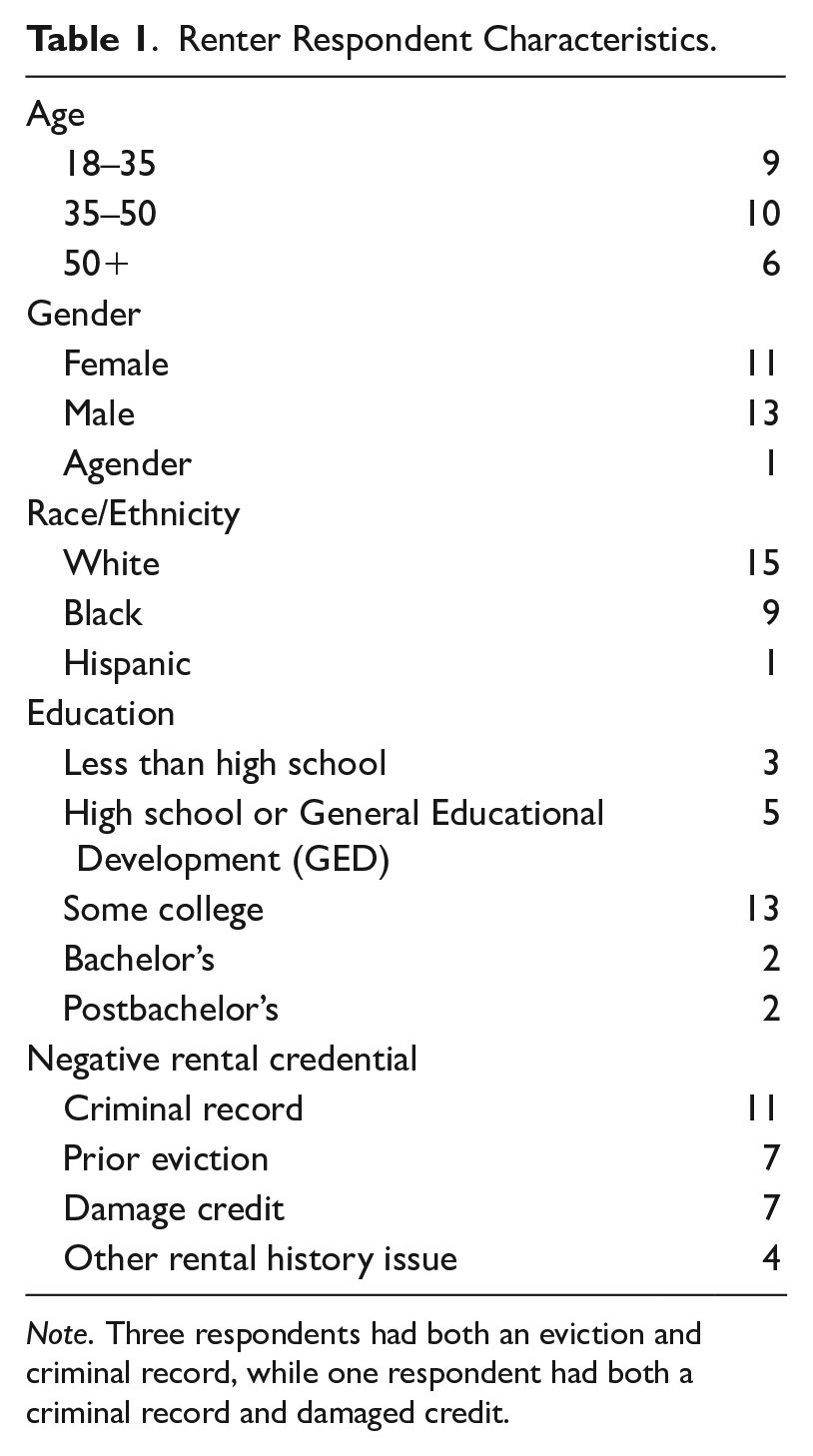
Note. Three respondents had both an eviction and criminal record, while one respondent had both a criminal record and damaged credit.
Transcriptions of the audio recorded interviews were coded using NVivo content analysis software. To systematically identify patterns of variation within the interview data, an index of coding themes and categories was developed prior to initiating data analysis and refined iteratively throughout the coding and analysis. These included broader theoretical themes emerging from existing literatures on the reproduction of poverty and inequality in the rental housing market and the social effects of modern market-oriented scoring technologies (e.g., high costs of poverty, power and information asymmetries, mobilization of rights and resources) and more descriptive categories capturing various dimensions of the housing search experience (e.g., search methods, interactions with landlords, duration and outcome of search).
Study Site
Data collection for the study was undertaken between 2016 and 2017, during an acute (and ongoing) rental unaffordability crisis in Seattle. Seattle saw some of the nation’s largest increases in rental prices in the decade following the 2008 foreclosure crisis (Balk 2014; Rosenberg 2016). In 2017, the Seattle metro area had the third-lowest rental vacancy rate among the nation’s 75 largest metropolitan statistical areas (U.S. Census Bureau 2020), and the fair-market rent for a two-bedroom apartment in the Seattle metro area, $1,544, was significantly higher than the national average of $1,103 (Aurand et al. 2017). As such, this study’s respondents likely encountered unique constraints related to Seattle’s tight rental market relative to rental housing-seekers in slacker markets. The shortfall of available affordable rental housing for low-income Seattleites, however, is similar to the persistent gap faced by low-income renters throughout the country, where in no state can a person working full-time at the federal minimum wage afford a market-rate two-bedroom apartment (Aurand et al. 2020). Another feature of Seattle’s rental market and policy environment that is characteristic of national trends is the scarcity of both project and voucher-based housing assistance, which means that the majority of low-income households must secure housing in the unsubsidized private rental market (Joint Center for Housing Studies of Harvard University 2017; Patrick 2020).
The experiences of this study’s respondents are characteristic of the challenges encountered by all low-income renters in such an environment. Though every respondent struggled to find housing affordable at their income level, only four respondents had received housing assistance (rental vouchers) at the time of the interview. Another eight respondents had applied and/or were waitlisted for housing with city or county public housing authorities or nonprofit low-income housing agencies but had directed their searches to the private rental market on the assumption (and in some cases, acknowledgment by case workers) that they would not access public or nonprofit housing assistance anytime in the near future.
In what follows, I use interview excerpts to provide a descriptive overview of how respondents varied with respect to the basic features of their housing search experiences: the duration and outcomes of their searches and the strategies they employed to look for housing and find landlords with more flexible rental criteria. I then present interview data to illustrate the study’s central findings regarding the economic, emotional, and political costs of the housing search and application processes for this population.
Findings: Overview Of Housing Search Experiences
Before illustrating three distinct types of costs that this group incurred during their housing searches, I provide a descriptive overview of the variation in respondents’ search experiences, including the duration and outcomes of their searches, as well as the strategies they employed and the constraints they encountered during their searches. This study is not intended to systematically evaluate how different types of tenant background credentials impact housing searches or outcomes, which would require isolating the effects of those credentials from the multitude of individual factors that shape disadvantaged renters’ housing trajectories. Though respondents expressed frustration in response to a similar set of constraints that made their housing searches more difficult, the diversity of this study’s respondents with respect to their backgrounds, identities, preferences, and housing histories means that some respondents were probably much less likely than others to be viewed as fit prospective tenants by landlords (whether on lawful or discriminatory grounds). 9 Nevertheless, this study’s respondents expressed similar accounts of their housing search experience on three fronts: the manner in which they learned to tailor their housing searches, the strategies they used to mitigate the stigma of their background records, and the information asymmetry that characterized their interactions with prospective landlords. The commonalities in respondents’ search experiences help illuminate the broader features of the rental market and landlord-tenant relational dynamics that expose negatively credentialed renters to significant and varied costs during their housing searches.
Duration and Outcomes of Searches
Respondents varied considerably with respect to the duration and outcomes of their searches, indicators which are suggestive of the relative ease or difficulty with which they navigated the rental market and the relative success or failure of their searches. At the time of the interview, twelve respondents were still searching for housing, seven had secured adequate rental housing, and three had found rental housing with serious habitability problems (i.e., rodent and mold infestations). Another three respondents had put their fruitless housing searches on hold after moving into some form of temporary living situation with family or friends. While respondents’ searches lasted from anywhere from two weeks to over a year, the respondents who found satisfactory rental housing all managed to do so in less than four months. By contrast, the ten respondents who had searched for over four months were all either still searching for housing at the time of the interview or had secured housing in hazardous conditions. Respondents reporting longer searches were more likely to have multiple types of stigmatizing background records, particularly both criminal and eviction histories, and histories of homelessness.
Search Strategies: Attempting to Target Flexible Landlords
Respondents also varied with respect to the geographic scope of their housing search and the resources they used to find rental listings.
10
Nevertheless, respondents unanimously reported taking up the same strategy to focus their housing searches within one segment of the private rental market: smaller, independent landlords who they hoped would be able to exercise greater discretion and use more subjective approaches to screening, rather than automatically rejecting them on the basis of clearly defined rental policies. Many respondents described a strikingly similar process by which they learned to target smaller, “mom and pop” rental housing providers. While some reported being coached to take up such an approach by friends or social workers, others learned through trial and error that large swaths of that market—particularly the newer corporate apartment complexes that are rapidly transforming the composition of Seattle’ rental housing stock—were out of reach on account of their insurmountable and inflexible eligibility criteria. Annie,
11
who had been previously evicted and had multiple older criminal convictions, described the process by which she learned to tailor her searches: I learned really early on that if you targeted like a small private landlord—just like a guy that answered the phone not like “Hello, thank you for calling Capital management” or something—I knew that they would have more discretion to let you in. And I knew that a lot of those places were just mostly interested in could you pay rent. I just learned early on that management companies have rules and . . . no matter how nice I was and personable and I cover up my tattoos and spoke really properly—I just knew that wasn’t going to work for me.
Another respondent with a criminal conviction record, Viola, described a similar learning process and emphasized the better prospects for one-on-one, personal interactions that come with smaller, independent rental providers: I kind of lost hope for anything corporate really quickly. I was giving it chances for maybe a month. Then I felt like that avenue was hopeless so I started looking for private owned places . . . so I could get a personal connection and agreement so I can get a fighting chance.
In addition to more flexible rental criteria, other respondents also reported targeting “mom and pop” landlords in the hopes that they would have greater opportunities for an in-person conversation in which they could tell their “side of the story” regarding their background records. Deborah recalled an instance in which an independent landlord offered her a lease after she contextualized her criminal conviction record with biographical details related to her status as a recovering alcoholic: “[The landlord] really appreciated me being up front from the beginning saying I’m a recovering alcoholic and I’d been sober for X amount of years and I have a history.” Unlike Deborah, however, many of this study’s respondents were less successful in their efforts to strategically target their searches to amenable landlords and use in-person conversations to mitigate the stigma associated with their background records. The next section describes a common set of obstacles that frustrated respondents’ searches.
Constraints on the Search Strategies of Negatively Credentialed Renters
An important dynamic that undermined the efficacy of respondents’ search and application strategies was the information asymmetry that characterized their communications with landlords. Respondents rarely encountered specific screening standards in rental advertisements or received unambiguous responses, if any, when they contacted landlords to inquire about their eligibility criteria before applying or the status of their submitted applications. Such circumstances pose distinct challenges for renters who would like to optimize their searches and minimize spending on application and screening fees but are unable to determine with any certainty whether they meet a particular landlord’s screening criteria or stand a reasonable chance of being selected among other qualified applicants. Phil recounted how he and his wife were often left with few clues about the specific bases on which their rental applications were repeatedly rejected since they both had older criminal convictions and damaged credit: Author: Have any of them ever been explicit about what the [criminal history] policy was? Respondent: No, absolutely not. They’ve never said this specifically raises a red flag, no . . . for sure they never said that. Because we were always just kind of thinking, “Was it our credit? Was it you? Was it me?” And that’s how I can remember that no one ever addressed a specific problem.
Annie similarly described the difficulties she encountered when she sought information about the status of her rental applications, and speculated that housing providers were reluctant to respond to her inquiries because of the social awkwardness involved in discussing criminal history: So I filled out the application fee and sometimes they would call me back or they would just avoid my call. And then I would finally have to go up there again and be like, “Hey, could you just tell me what’s going on with my application?” And they’d be like, “You were denied.” And sometimes you would get like a cool person that would be like “Well, you’ve got a lot of stuff in your record.” And sometimes they’d be like “We don’t know why. It goes through the company.” I think they felt uncomfortable talking to me about it.
The competitiveness of Seattle’s affordable and quasi-affordable rental sector also undermined respondents’ efforts to search strategically in two ways. First, multiple respondents drew a causal connection between the tight market and the unresponsiveness of landlords. That connection was corroborated in stark terms for one respondent, Viola, who devised an experiment to investigate why so few landlords were responding to her e-mail or phone inquiries about rental advertisements: I was like, how am I not getting any responses from any of these rentals? I hit up like hundreds it seemed like. So I posted my own fake rental ad just to see how many people responded and I was inundated. I had like 500, 600 e-mails in my inbox that night. I was like, “No wonder I am not getting any calls back.”
Second, many respondents assumed that the tight market diminished their chances of being selected among large pools of more qualified applicants. One respondent with damaged credit, Denise, speculated that competition was particularly intense for what remains of Seattle’s older, more affordable, independently owned rental stock (Bhatt 2015). Consequently, as she explained, landlords in that sector are disincentivized from opening their doors to applicants with tarnished background records: The problem with private owners is there’s so many people that are looking at the same apartment. If you would not be 100% what they’re looking for you don’t have a chance . . . There’s a lot of competition. If you don’t have everything in a really positive way it’s really hard to get your foot in . . . If you’re low income or middle income and if you have any blemishes on your credit report it’s almost impossible.
Although each of this study’s respondents brought unique resources and vulnerabilities to the housing search, they encountered a similar set of constraints on their ability to find landlords willing to overlook their discrediting background records in a competitive rental market. Even for respondents who successfully secured conventional rental housing that met their needs, these constraints help explain the significant costs they encountered along the way. In the proceeding sections, I draw on illustrative testimony to highlight the three types of costs that respondents incurred as they confronted the uphill battle of finding private market housing with one or more discrediting background credentials: economic, psychological, and political.
Costs of the Housing Search Process
Economic Costs: Increasing Financial Insecurity
Nearly every respondent lamented the funds, time, and energy they were forced to devote to the formidable enterprise of securing housing from a position of marked competitive disadvantage in a very tight rental market. Without an effective means to determine which landlords exercised more forgiving eligibility criteria before applying, some respondents reported searching for housing for months and submitting dozens of unsuccessful applications. The most frequently identified costs associated with such housing searches were economic, particularly those related to the repeated assessment of application and screening fees.
Respondents varied considerably in their self-reported search expenses related to application and screening fees: twelve respondents spent under $100, eleven spent between $100 and $300, and two spent over $1,000. Nevertheless, application and/or screening fees loomed large in most respondent’s accounts of their housing search challenges. Fees adversely affected respondents in two ways. First, repeated fee assessment deepened the economic insecurity of respondents who felt forced to apply broadly to secure housing within a limited time window (such as voucher recipients and those at immediate risk of homelessness). Second, the specter of application fees prolonged the searches of respondents without the means to submit multiple applications at a time and thus indirectly compounded their expenses associated with temporary living situations, such as hotel stays and storage units.
At the time of our interview, Sandra was two months away from the expiration of the transitional housing program where she had been living following an eviction. She had already spent $1,030 on nonrefundable application and screening fees during her search and was growing increasingly anxious about how to allocate what remained of her financial resources to find housing: And you’re like, “I’m almost there. OK, they may work with me,” and they know everything [about her background], and they’ll take all your information, all your application fees, and then it’s like, “I’m sorry. I can’t approve you.” . . . One week, I spent $480 in application fees . . . I work home health and hospice, but sometimes I work labor ready or different jobs like that, and it’s all to go towards application fees.
The same respondent illustrated how a costly rental search process can exacerbate financial precarity. At the time of our interview, her ability to cover her regular expenses was contingent on the timeliness of a refunded deposit from a landlord who rejected her application: I just wrote a check, and if I don’t get this money in there, it’s probably going to bounce . . . I’m waiting on the guy to actually send part of my deposit back. I had to put up like seven or eight hundred dollars down. And the last time I did that, it took three weeks, so it leaves you financially in a bind.
A similar dilemma was described by Denise, whose credit was severely damaged by the medical debt she incurred undergoing experimental cancer treatment without insurance. Though she would try to explain the circumstances surrounding her debt to potential landlords, few housing providers were willing to give her definitive answers regarding whether her credit issues would disqualify her prior to undergoing a formal screening. Desperate to secure housing but without an effective means to shrewdly allocate her resources, she estimated that she spent at least $4,500 over the course of her five-month search for housing: Respondent: Every time that you try to go to look at a place, they want you to fill out an application and it costs money. So when you’re thinking about $50 per application, any money that you have saved up, it depletes really fast. I was like this is crazy. Every time you go to apply for some place they’re like you have to go through this whole thing then they’ll come back and said, “Well, you have issues.” I told them I had issues. I would tell them I’m a cancer survivor and that I was in treatment for a year and a half. I only have so much money because of not being able to work because I was so sick. I had good rental history. I’ve never been late. Author: How long were you looking before you found the place that you found? Respondent: About five months. Author: Do you have a ballpark estimate of how many places you applied to? Respondent: I would say I must’ve applied to 20, 25 because when I add it up I’ve spent over $4,500.”
12
Many respondents expressed frustration at what they suspected were unfair and extractive practices around charging screening and/or background check fees, such as overcharging applicants for commercial background reports or collecting fees from large pools of prospective tenants whose applications are never processed, in contradiction of Washington state law.
13
One respondent with a criminal record, Chelsea, voiced her frustration at rental companies that would collect application fees without ever informing her about the status of her application: I don’t bother with an apartment complex. I don’t bother with them, because it’s a scam. I know it. You’re just never going to hear back. You can pay hundreds and hundreds [in fees], and you’re still going to end up somewhere way down in Des Moines in some shitty apartment complex that takes felons.
Multiple respondents expressed a sense of futility in characterizing application fees as a burdensome but ultimately inescapable feature of the search for housing. Sandra conveyed her resignation about wasting money on fees in circumstances in which her application may not have been seriously considered. She recounted the sort of explanation she frequently heard from landlords: “‘Well, it was someone else that applied at the same time you did, and I decided to go with them instead of you,’ and so, that’s my $45 just out the window.” Given their status as imperfect rental candidates in a competitive, low-vacancy landlord’s market, few respondents felt they were in a position to negotiate such costs or challenge landlords’ tenant selection decisions.
The housing search also came with indirect financial costs associated with expensive, temporary living arrangements for respondents who were unstably housed during their prolonged searches. Sandra recounted the steep costs she incurred from staying in hotels while she searched for rental housing before entering transitional housing: “And I spent like $3,000, $4,000, in my IRA savings, so I’ve pretty much—I’ve just depleted my funds, just staying in hotels . . . And it goes really fast.”
Viola similarly described the economic costs and related stresses associated with living in hotels during her housing search, particularly since she could not predict how long the search would last: Like we tried everything—apartments, low income, community housing programs and I just couldn’t get it anywhere. So we almost got stuck in the hotel trap you know? Being in that every day and not having money to even save up for a deposit or moving costs or anything.
For Viola and other respondents, the inability to discern their eligibility before paying applications fees inhibited and potentially prolonged their housing searches since they could not afford to submit multiple rental applications at a time in a fast-moving market. As Viola explained, “Another factor that made me hesitant to apply to places was the fee and knowing that what if I pay it and get declined. What’s the point? I don’t have money to just throw around—$40, $50 at a time.”
Though we know little about the typical financial costs incurred by renters during their housing search, a tight housing market likely raises search costs for all types of renters by forcing them to submit more applications as they compete with large pools of housing-seekers for a diminished supply of affordable units. The experiences of this study’s respondents illuminate why those market dynamics may have outsized impacts on renters with stigmatizing background records. Their degraded status in the marketplace, in tandem with the opaque quality of many landlords’ screening criteria and tenant selection procedures, means that negatively credentialed renters may be forced to cast a particularly wide but inefficient net to find housing, which compounds the financial costs of the search and application process.
Psychological Costs: Undermining Emotional Well-Being
The housing search and application process also took a considerable toll on the psychological or emotional well-being of some respondents. Respondents identified at least three ways in which their challenging housing searches adversely impacted their emotional well-being: the anxiety triggered by uncertainty about their prospects for ever securing housing, the degradation of being routinely assessed on the basis of stigmatizing personal background information, and feelings of disempowerment or futility that arose from being denied housing on the basis of factors outside their control, namely, immutable background records.
Multiple respondents reported the psychological consequences of what they described as time-intensive or all-consuming searches for housing. As Deborah reflected, “I was a pretty nervous wreck through the whole thing. You get exhausted running around and thinking, ‘What if I don’t find a place?’” Another respondent with a damaged credit record, Max, explained why they had decided to scale back their housing search, despite being homeless at the time of the interview: I’m kind of putting my search on hold, because just the search itself is so stressful, because of the scarcity of housing right now. And I just wanted a few months to not have crippling anxiety when I wake up every morning around housing.
Finally, Chelsea described the recurring anxieties she confronts each time she is tasked with finding housing, despite fifteen years having elapsed since her most recent criminal conviction: And it’s so stressful . . . it’s the same gut-wrenching thing of, “Am I going to be able to pull this off one more time? Am I going to be homeless? Am I going to have to put everything in storage and figure it out?” I don’t know, and it super freaks me out.
In addition to being an acute source of stress, for some respondents the housing search process was also detrimental to their self-worth. Sandra recounted her experience working with a case worker at a transitional housing program and described her shame around not being able to secure housing without the intervention of a social worker: The lady that’s working with me, “Let me know who has disapproved you, so I can do a follow-up call and see if we can turn things around.” And it’s so embarrassing, you know? It’s just like . . . it’s so degrading to have to try to beg somebody for housing.
Another respondent, Annie, expressed her frustration at being forced to repeatedly open her past to scrutiny to be considered for rental housing: “There was nothing to belittle you more than asking you about . . . your state of mind when you did something when you were 17 and now you are in your 30s.”
Being repeatedly deemed ineligible or undesirable by housing providers left some respondents pessimistic about their prospects for ever securing rental housing. As Sandra remarked upon realizing that a rental unit she had applied for was still vacant months after her application was rejected while she remained insecurely housed, “You feel hopeless . . . and optimism kind of goes out the window.” The capacity for tenant screening to reduce applicants to unflattering artifacts of their personal histories they had little control over made the housing search a particularly disempowering experience for some respondents. Expressions of futility and helplessness were particularly common among respondents with criminal conviction records. Given the legal and practical barriers to expungement procedures (Prescott and Starr 2020), some respondents lamented that they had no recourse for modifying records that constituted an out-of-date and inaccurate depiction of themselves. Annie spoke to what she maintained was a criminal record’s unique capacity to foreclose opportunities in virtual perpetuity: The thing about criminal conviction that is different even than eviction is that there’s no timeline in which it’s going to become irrelevant. So you know if you get the eviction—you know if you jack up all your credit—you file bankruptcy or you can sit on it for seven years. Eventually it’s going to pepper your outcomes but it’s not going to be a total factor. A criminal conviction is one of the only things that, no matter how young you were when you did it, if you don’t seal your record, that is going to literally follow you until you are 100 years old if you live that long.
This situation was discouraging for respondents who felt that their damning background records would always overshadow whatever mitigating evidence of their rental qualifications they could muster. Phil, who had made considerable career strides after spending much of his twenties in and out of jail, reflected on the relative ease of using positive credentials to compensate for a criminal record in the employment setting versus housing: For getting employment, you can say, “I know I screwed up when I was young, but I have college education.” But you know, housing, you really have nothing to back it up with. I mean, except, “I have a job.” But everyone else does too.
Chelsea similarly expressed frustration that her professional status and years of strong rental history seemed to carry little weight with landlords against her 15-year-old criminal conviction history: “I always pay my rent on time. I am a good tenant. None of that seems to matter . . . I’m too old for this, and I’ve done a lot of work . . . how big is my pound of flesh?”
Another respondent, Eric, with a history of incarceration lamented that the progress he had made in stabilizing other aspects of his life seemed to matter little when his fitness as a potential tenant was evaluated: What I’m looking for is someone to say, “Hey, today there is a man that is trying to raise his kids, hold his job down, house his family.” The backgrounds are yours, so you’ve got to own it. But I’m looking for someone to look at me today and give me a chance today. I’m not asking for a chance from yesterday. The reason why you’re saying no is based on something that I can’t change. I mean, I just want them to think of that.
For some respondents, the stress, damage to self-worth, and powerlessness associated with a difficult housing search or the housing insecurity that accompanied it had the potential to derail their ability to successfully manage addiction or mental health issues. One formerly incarcerated respondent, Nancy, was employed at a reentry housing agency for formerly incarcerated women and drew parallels between her own housing search and those of her clients. She described the costs of having to rely on family and significant others for housing, speaking from both her own and her clients’ experiences: It’s very stressful for me and probably them [clients], too. They found jobs. You can get anything else but housing, and that is a major stressor in their lives, especially knowing that you’re staying in a temporary living situation, and you don’t know if your next place is going to be temporary. And it’s concerning when it comes to sobriety. Sometimes people relapse because they’re not—you know Maslow’s hierarchy of needs. You don’t have a safe, stable living environment . . . And staying with my family right now is not necessarily the best mental health option for me.
Dennis highlighted how the experience of facing repeated nonresponse or rejection from landlords and the unstable housing circumstances he endured while he struggled to find housing jeopardized his ability to manage his mental health: I’m one of those people out of a million who’s trying to turn their life around. I’m trying to stay on the right side of the fence and deal with my mental illness also, so it’s very hard to apply for apartment and you never hear back from these landlords . . . So I’m out downtown [at the shelter] where it’s not a good environment. I’m really struggling down there.
The housing search and relocation process ranks among universally stressful life events (Kershaw 2010). However, the experiences of these respondents suggest that navigating the private rental market comes with unique emotional costs for renters whose stigmatizing background credentials put them at a steep competitive disadvantage in that marketplace. Those costs may be particularly acute for respondents who already struggle to maintain their sobriety and/or mental health.
Political Costs: Chilling Effects on Personal Agency and Legal Mobilization
A difficult, costly, and disempowering housing search experience may also undermine the willingness of negatively credentialed renters to mobilize the law or other resources to contest unfair or unlawful rental practices, even though their disfavored position in the marketplace may make them uniquely vulnerable to illegal treatment. Beyond its consequences for individual renters, this dynamic has broader political ramifications for the efficacy of tenant protection or antidiscrimination laws that largely depend on victim complaints for enforcement. Thus, a third cost associated with the housing search process is the chilling effect that reinforcing negatively credentialed renters’ awareness of their degraded status in the rental market has on their willingness to advocate for themselves or assert their legal rights as tenants.
Deborah remarked that while she wanted to challenge landlords who reject housing voucher recipients in violation of Seattle law, the difficulty of finding housing with both a voucher and a criminal record discouraged her from doing so: They’re supposed to I think but I’ve seen it on Craigslist, “We don’t accept Section 8.” I almost feel like writing them and saying, “You should keep that to yourself.” I would just call them and ask them and it was just no. I had enough going against me that I wasn’t going to say “Equal housing!”
Negatively credentialed renters’ acute awareness of their own perceived deficits as potential tenants may exacerbate the existing challenges associated with detecting discrimination and mobilizing fair housing laws (Johnson 2011). Though some respondents strongly suspected that racial discrimination was contributing to the repeated rejections they experienced during their housing searches, they could not identify specific evidence of illegal discrimination, given the vague explanations landlords offered for rejecting them in favor of other applicants. Sandra described her long and unsuccessful search for rental housing with an eviction on her record and her struggles to distinguish lawful tenant selection practices based on ostensibly race-neutral rental criteria from illegal discrimination on the basis of race: There’s got to be one person out there that would bend or break, but there’s really not. I feel like a lot of it is discrimination. I asked the guy, “What disqualified me?” And he said, “Oh, everything looked good. Your salary looked good . . . I can’t remember if they applied along with you.” And so, I just asked him, “Is it the color of my skin?” And he got quiet, and, “Well, I’ll tell you what. I’ll have another unit available in June.” And I’m like, “June? Are you serious?” C’mon don’t pull my leg, I’m homeless, you know?
The affordable housing crisis creates conditions that compound the difficulty of detecting discrimination in tenant screening and selection, since the large demand for housing allows landlords to explain their rejection of marginalized renters in reference to other, better-qualified applicants (Reosti 2020). Such explanations are especially plausible and difficult to protest from the perspective of negatively credentialed renters, posing serious challenges for such renters to mobilize fair housing laws in response to suspected discrimination.
Enduring an arduous and expensive housing search may also undermine renters’ ability or willingness to extricate themselves from dangerous housing situations or make demands on landlords that could put them at risk of eviction. Upon finally securing housing following a five-month search that she estimated cost her $4,500, Denise realized that her new apartment was infested with mold and that the building’s absentee owners were unwilling to offer anything more than cosmetic remedies. Though the problem posed a serious threat to her health, given her recent treatment for respiratory cancer, she explained that her housing search had left her without the means to break her lease or the confidence that she would be able to find another landlord to open their doors to her: At this point I don’t have a choice. I feel like I’m a victim in the situation because if I want to move I have to pay $1,200 [to break the lease] . . . The other thing is how hard it is going to find another place. After what I’ve been through it’s not like I want to go through that again.
Another respondent, Kelly, similarly described how the difficulty of finding rental housing with damaged credit in Seattle left her resigned to staying put in an undesirable neighborhood: “I feel like my decision has already been made for me . . . So I feel like I don’t really have a choice . . . I’m so psyched out by what I know housing searches are already like.”
Though many respondents voiced frustration in response to various aspects of tenant screening and selection practices in the private rental market, the search experience seemed to reinforce the perception that they were powerless to challenge those practices. Expressions of futility in this regard were often accompanied by begrudging assertions that rental property owners have unassailable rights to screen and select tenants however they like. A respondent with damaged credit, Brad, affirmed the primacy of landlords’ property rights in passing when he remarked, “But, you know, you own a building you can do whatever you want I guess.”
Leslie reflected on her surprise upon realizing the degree of access that landlords and property managers have to applicants’ personal background records. She also expressed a mix of frustration at and resignation to the notion that she was largely powerless to change the way she was evaluated on the basis of information from background screening reports: See I’ve learned that managers . . . can look up stuff that I didn’t even imagine that they would even have access to. It’s up to the landlord to use the discretion or whether they want to accept that or not [damaged credit record] . . . So you work hard, then life knocks you down and then you get back up and life keeps knocking you down.
Dennis also illustrated that prerogative as he bemoaned the unfairness of excluding people with criminal records from housing while affirming landlords’ rights to do so and his inability to change the system by which housing is allocated: It’s their property. They can do what the hell what they want to do, but it’s still discriminating against people . . . We’ve got to live somewhere, you know? . . . So I can’t do nothing—accept the answers and go on and go on to the next one. I can’t change them by being mad.
Summary and Discussion
This study’s findings document the immediate material and psychic costs associated with efforts to secure housing in the private rental market for housing-seekers with discrediting background records. This study builds on recent research on the housing search experiences of disadvantaged renters (Barnes 2021; Bruch and Swait 2019; DeLuca et al. 2013; DeLuca et al. 2019; Galvez 2010a; Krysan and Crowder 2017) by broadening our understanding of the mechanisms by which housing searches can reinforce inequality. Its findings point to the direct role that the rental housing search and application process plays in reproducing economic precarity and social disadvantage among renters, beyond sorting them into unequal neighborhoods and housing units. The experiences of this study’s respondents suggest that for renters with stigmatizing background records in a competitive urban rental market, the pedestrian task of finding a place to rent is rife with risk and has the potential to undermine their economic security, mental health, and/or capacity for self-advocacy. In the following sections, I summarize my findings regarding the three types of search costs identified in this study (economic, emotional, and political) and discuss how these findings advance scholarship related to the high costs of poverty, the connection between housing and mental health, and the disciplinary functions of market institutions.
First, the findings suggest that the routine assessment of application and background check fees in the rental market has unique adverse consequences for renters who are frequently deemed ineligible on the basis of landlords’ varied and often unpredictable admissions standards and are thus forced to cast a wide, inefficient, and costly net in their search for housing. Caplovitz’s (1967) pioneering insight that “the poor pay more” for comparable goods and services drew on both quantitative surveys of the spending habits of low-income consumers and qualitative research that illuminated how and why disadvantaged consumers navigate ostensibly neutral markets under distinct and less favorable conditions. This study falls into the latter category; it is not designed to systematically compare the average financial expenses associated with the housing searches of “marked” and “unmarked” renters, but instead advances sociological scholarship on the high costs of poverty (Desmond and Wilmers 2019; Faber 2019; Squires 2004) by examining the features of the private rental market and ground-level interactions between landlords and applicants that financially penalize negatively credentialed renters during their searches. Many of this study’s respondents strategically targeted their searches to sectors of the rental market where they anticipated that landlords would exercise more forgiving screening standards and tried to ascertain whether they met landlords’ eligibility criteria prior to applying. However, wide variation exists in the criteria landlords use to screen and select tenants in what remains a decentralized and heterogeneous industry (U.S. Census Bureau 2018), and tight market conditions disincentivize landlords from opening their doors to applicants with imperfect background records (Reosti 2020; Clark 2007; Dickson-Gomez et al. 2009). 14 While nonuniformity in tenant screening standards and a competitive rental market can create adverse search conditions for any housing-seeker, these dynamics put renters with discrediting background records at a distinct disadvantage. This study’s respondents were often unable to determine their eligibility before submitting an application, encountered repeated rejections, and were offered few insights into what was “wrong” with their applications. Such constraints undermined respondents’ strategic efforts to minimize search costs, contributed to significant out-of-pocket expenses for those who were under pressure to quickly secure housing, and compounded the costs associated with temporary living situations (i.e., hotels, storage units) for respondents whose searches were prolonged because they lacked the means to apply broadly.
Second, the fraught nature of the housing search process took a psychological or emotional toll on many of this study’s respondents. Existing research on the connection between housing and mental health has largely focused on the mental health consequences of residential displacement and housing cost burdens (Desmond and Kimbro 2015; Downing 2016; Libman, Fields, and Saegert 2012; Mason et al. 2013). This study offers new insights into that connection by illuminating how the experience of navigating the housing market from a position of acute disadvantage can trigger or exacerbate mental health issues before a lease or mortgage contract is ever signed, particularly anxiety around the prospect of protracted housing insecurity. Respondents also recounted experiencing feelings of futility, powerlessness, and shame in response to repeated rejections and background screening practices that flattened their biographies to decontextualized and stigmatizing data points from administrative records they had limited ability to alter. Thus, this study also expands housing scholars’ understanding of how “ontological security,” or the “sense of continuity and order in events” (Giddens 1991:243), is undermined in the housing setting not only by the threat of losing one’s home via eviction or foreclosure (Garboden and Rosen 2019; Libman et al. 2012) but also by the prospect of indefinite housing precarity stemming from factors outside one’s control (i.e., immutable stigmatizing background records).
Third, these findings suggest that enduring a difficult and disempowering housing search can weaken the capacity or willingness of disadvantaged renters to mobilize the law or other resources in response to unlawful or exploitative treatment. In reflecting on their reluctance to challenge illegal rental practices (i.e., racial or source-of-income discrimination) or extricate themselves from dangerous housing situations, respondents referred to their acute awareness of their own deficiencies as prospective tenants, which had been reinforced during the tenant screening process. This study offers new insights into the learning process that discredited renters undergo during the housing search, with important implications for the sociological understanding of how market institutions discipline the poor. Economic sociologists have argued that an important disciplinary function of market-oriented scoring technologies and classification systems is to compel low-income consumers to acquiesce to systems from which they derive marginal, if any, material benefits by emphasizing individual responsibility for economic outcomes (Fourcade and Healy 2013, 2017; Krippner 2017). Poverty governance scholars have characterized the disciplinary functions of neoliberal-era welfare programs in very similar terms (Schram et al. 2010, Soss, Fording, and Schram 2011).
However, scholars in both areas also note that the targets of poverty governance (i.e., consumers and welfare recipients) do not, by and large, uncritically accept the individualistic narratives around economic inequality promoted by market and state institutions (Fourcade and Healy 2013, 2017; Schram et al. 2010; Soss et al. 2011). Instead, as Schram and colleagues explain with respect to the welfare context, modern welfare programs effectively impose market discipline on recipients by “restructuring the terrain that these actors must negotiate in order to be successful under prevailing systems” (Schram et al. 2010:751). This study’s findings suggest that the rental housing market may similarly discipline disadvantaged renters by reinforcing the notion that they are powerless to change the terrain they must navigate to secure housing. Many respondents criticized both landlords’ screening practices and policymakers’ failure to regulate public access to personal background information. Respondents who had been denied housing because of outdated background records were especially skeptical of the notion that tenant screening and selections decisions are made on the basis of neutral, legitimate metrics of tenant-risk or fitness. Nevertheless, many respondents viewed the prospect of changing a system in which their housing security was tied to the discretionary decision making of rental property owners as a futile one (“But, you know, you own a building you can do whatever you want I guess”), and felt that their discredited renter-status made them particularly powerless to do so (“I had enough going against me that I wasn’t going to say ‘Equal housing!’”).
Implications for Policy and Future Research
This study has multiple timely implications for policies regulating tenant background screening, the dissemination of personal background information, and affordable housing provision. Local policies restricting landlords’ use of criminal conviction and in some cases, eviction, and credit records to screen rental applicants have been enacted in fourteen jurisdictions in the last decade, 15 including Seattle, where two new laws governing tenant screening went into effect shortly after data collection for this study was completed. 16 The COVID-19 pandemic has also increased calls to regulate landlords’ access to, and use of, eviction records (Kirchner 2021; Kiviat and Greene 2021).
First, the study’s findings underscore the imperative for new tenant screening regulations to include proactive (i.e., testing-based) enforcement mechanisms that shift the burden of enforcement away from tenants. To the extent that the housing search process discourages negatively credentialed renters from mobilizing the law, new policies designed to reduce screening related barriers to rental housing may have limited impact on landlord behavior if they rely on victims of unlawful screening practices to detect wrongdoing and file complaints. These findings comport with sociolegal accounts of the weaknesses of workplace and housing antidiscrimination laws, which largely rely on the victims of discrimination to enforce the law in settings characterized by stark power and resource differentials between the law’s targets and beneficiaries (Berrey, Nelson, and Nielsen 2017; Johnson 2011; Selmi 1997).
Second, this study’s findings point to the need for additional policies that do not hinge on transforming the way landlords use background records but instead intervene in the earlier processes by which administrative records are created, archived, and sold to third-party data brokers. At a time when criminal records sealing and expungement procedures have been undermined by the widespread dissemination of personal background records by nonstate actors (Corda and Lageson 2020; Wayne 2012), recent innovations in eviction record-keeping procedures offer a promising model for minimizing the collateral consequences of stigmatizing background records. For example, Lawmakers in California and Washington have directed housing courts to automatically seal eviction cases under certain circumstances before they are ever digitally archived and disseminated by third-party screening companies. 17 Policymakers should also take steps to reduce the financial burden of the housing search by promoting the use of portable screening reports, which allow housing applicants to pay a one-time fee for a verified tenant screening report that can be reused for 30 days. 18 In addition to reducing the out-of-pocket costs associated with repeated fee assessment, portable screening reports would help right information asymmetries in tenant screening by allowing tenants immediate access to the background screening information that landlords are using to evaluate them.
Finally, this study’s findings point to the need for broader housing policy shifts that make the housing security of disadvantaged renters less contingent on meeting the screening standards of private landlords by expanding the supply of permanently affordable, nonmarket housing. Improving our understanding of how renters with discrediting background credentials fare as consumers in the private rental housing market offers new insights into the costs of a national housing policy regime in which the state has largely delegated responsibility for housing disadvantaged renters to the private sector. The late twentieth century shifts in federal policy from state provision of low-income housing to vouchers and tax-credits were officially intended to deconcentrate poverty and racial segregation associated with public housing and improve residential mobility by expanding the consumer choices of poor renters (Goetz 2013; Harvard Law Review Symposium: Public Values in an Era of Privatization 2003). However, the experiences of this study’s respondents suggest that renters with tarnished background records, including voucher recipients, are far from empowered consumers and instead navigate the housing search from a position of profound market disadvantage and at significant potential costs to their economic security and emotional well-being.
This study was conducted in one of the country’s most competitive rental markets and the study’s recruitment methods may have attracted participants with particularly stigmatizing background records. 19 As such, the housing searches of negatively credentialed renters in other circumstances may be less arduous or costly than the searches described by this study’s respondents, although existing research suggests that rental market tightness has complex implications for housing-seekers with discrediting background records. 20 Future comparative research into how renters with stigmatizing records fare under different housing market conditions and/or regulatory regimes could make important contributions to the burgeoning political-economic approach to the study of housing in sociology. The findings from this small-scale, single-site case study also point to the need for more systematic data collection on the fees incurred by rental applicants. Though some tenant advocates and local policymakers have expressed concerns about the proliferation of application and move-in fees in the rental industry and the challenges that repeated fee assessment pose for disadvantaged housing-seekers (Bryson 2019; Ferré-Sadurní 2019; Terry 2019), we know little about the typical financial costs incurred by renters during their housing search. In addition to informing regulatory policy and expanding discussions around housing cost burdens beyond rent and utilities, more research into fee assessment practices in the rental industry would advance housing scholars’ understandings of the mechanisms by which the private housing market exacerbates economic and social precarity among renters before they sign a lease.
Footnotes
Acknowledgements
The author would like to thank Katherine Beckett, Kyle Crowder, members of the UIC-NHUS reading group, and two anonymous City and Community reviewers for their generous and constructive feedback on various iterations of this manuscript.
Funding
The author(s) disclosed receipt of the following financial support for research, authorship, and/or publication of this article: The research was supported by National Science Foundation (NSF) Doctoral Dissertation Research Improvement Award #1636961.