







Abstract
Scholars have questioned the analytic utility of gentrification theories when applied to declining Rust Belt cities. In these contexts, scholars suggest the state may play a more significant role in instigating gentrification. This article builds on recent scholarship at the intersection of colonialism, race, and urban studies to examine eight regulatory changes aimed at quelling decline and promoting revitalization in Detroit, Michigan that were rolled out during a pivotal period in the city’s recent history. We argue that these state interventions reflect and reproduce a settler colonial replacement logic: they threaten marginalized, primarily Black residents’ informal and legal relations to the city and its resources, while simultaneously striving to attract newcomers and expand their legal ownership of city land and property. These findings illustrate another way settler colonialism continues to shape contemporary dynamics in the United States and implicates city and state regulations as key instigators of urban revitalization in declining cities struggling with segregation and hypervacancy.
Scholars have questioned the analytic utility of gentrification theories in the context of declining Rust Belt cities due to conditions such as racial segregation and hypervacancy (Hackworth 2021; Safransky 2014; Tighe and Ganning 2016). In these contexts, research suggests the state may play a more significant role in creating conditions for market and cultural forces that instigate gentrification to take root (Hackworth 2019). This article builds on recent empirical and theoretical developments in colonialism, race, and urban studies to show how state efforts to promote revitalization in the context of urban decline reflect and reproduce settler colonial logics of removal and resettlement. Settler colonialism is a complex, relational process of racial domination, wherein the state has and continues to promote land control, Indigenous erasure, and resettlement in the interest of spatial, socio-cultural, and capital expansion (Coulthard 2014; Herbert and Brown 2023; Petersen 2022). While Indigenous scholars have long argued that colonial structures are ongoing in settler societies, Blatman-Thomas and Porter (2019) argue that within existing urban scholarship “unless the central subject of study is colonialism itself, the colonial structure invariably fades from view” (p. 31). This article foregrounds this structure by focusing on the racialized logic of property and population control in contemporary state efforts to promote urban revitalization.
Many settler colonial societies, including the United States, are shaped by evolving forms of domestic colonization in the assimilation of formerly enslaved populations and their descendants. In previous work, we theoretically integrate these histories and structures to form a “binocular colonial lens” (Herbert and Brown 2023). Using this lens, this article uses qualitative methods to analyze eight regulatory changes in Detroit, Michigan implemented between 1999 and 2014 that were all deployed to remedy effects of urban decline. During this time, Detroit was colloquially said to have “hit rock bottom” and then subsequently experienced a “rebirth,” reflected in several indicators of gentrification. We show how these eight regulatory changes reproduce the replacement logic of a settler colonial state. That is, historically, some U.S. government regulations have weakened, disregarded, or eliminated the socio-cultural, economic, and land/place relations of racialized communities, especially Indigenous Americans, to promote the expansion of capital and settler society. In contemporary Detroit, where 88 percent of the population is non-White (U.S. Census 2020), these revitalization-regulations threaten vulnerable residents’ informal and legal relations to the city and its resources, while simultaneously attracting newcomers and expanding their opportunities for legal access to and control over urban land.
Literature on state-led gentrification (SLG) has highlighted how government acts through policy and programming to shape urban conditions, with particular impacts at the intersections of race and class (Goetz 2011; Hyra 2012) but has focused almost exclusively on select development efforts like public housing demolition, HOPE VI, Empowerment Zones, and public–private partnerships. While much scholarship has debated connections between settler colonialism and gentrification, these works have yet to investigate the way colonial legacies and logics continue to shape urban policy. But a key feature of settler colonization has been government efforts to control access to land, access to resources, and population movement (Coulthard 2014). In this article we connect colonialism—as a theoretical and historical phenomenon—with contemporary debates on segregation, racial capitalism, and gentrification in the urban context. Doing so advances our understanding of the government’s role in gentrification efforts, especially in the context of urban decline, and highlights another way colonialism continues to shape the contemporary U.S. Pragmatically, this article draws attention to legal and regulatory changes that may have harmful impacts for vulnerable residents, such as ways in which government-led racialized dispossession and displacement might precede typical signs of gentrification, implicating government policy as an important point of possible intervention.
Literature
This literature section first reviews urban scholarship on the role of government in gentrification and challenges mounted by the context of urban decline. In this literature, “the state” is often operationalized as federal government policies, programming, or funding that are implemented at the city-level, or local public-private development partnerships using tax monies. To these common foci, we add the role of policing (the enforcement arm of the state) and, in declining cities, the state’s role in regulating private property. Together, these sections scaffold the need to re-examine how the state is involved in gentrification in the context of urban decline. This article will demonstrate how in these contexts, the state’s role in gentrification reproduces settler colonialism’s “replacement logic.” As such, we conclude this literature section by offering a more detailed introduction to settler colonialism, illustrating how this logic is evident in historical examples of the state’s (as federal government) power to control land and population. We suggest that this replacement logic undergirds many scholarly attempts to connect gentrification and settler colonialism and discuss how focusing on state-action advances scholarly understanding of racialized processes of capital and spatial expansion. While research and theorizing on the state is extensive and beyond the scope, we focus on state power operating at different levels of government in creating city and state laws, regulations, and policies, and decisions about deploying federal funding. These actions reverberate, influencing powerful actors and residents’ opportunities and practices and are entangled with cultural and ideological features of colonialism.
Gentrification and the State
Scholarship has identified the role government plays in promoting revitalization and gentrification, often through neighborhood-scale interventions such as urban renewal and slum razing, public housing developments, Empowerment Zones, or Hope VI and poverty deconcentration (Davidson 2008; Fraser et al. 2013; Hyra 2012). Governments also often aim to stimulate private investment and attract affluent residents with tax incentives; public–private partnerships; massive entertainment projects like stadiums or casinos; or infrastructure projects (Elliott-Cooper, Hubbard, and Lees 2020; Zuk et al. 2018). Other studies focus on government’s role in preparing spaces for gentrification (Billingham 2017); meaning interventions that pave the way for the economic and cultural instigators of gentrification to take root (Zukin 1987).
A key thread across this scholarship is the relationship between SLG and displacement. Notably, Goetz (2011) and Hyra (2012) both find that displacement due to public housing demolition, HOPE VI, and Empowerment Zone investment often depends on the intersection of race and class, with some middle-income Black communities benefiting and poorer Black residents often displaced. Other scholars challenge the focus on direct-economic displacement in SLG gentrification scholarship. For example, Davidson (2008) argues that social mixing efforts (such as HOPE VI in the United States) might lead to displacement via more indirect means, such as by making an area attractive to investors or upper-income residents which subjects poorer residents to market pressures, or by changing the culture or political power of a neighborhood to the extent that communities no longer feel at home. Elliott-Cooper et al. (2020) make a broader argument that the violence of displacement may abide varied temporalities. Displacement due to SLG might unfold slowly, for example, when development projects lead to higher rents over time and eventually displacement, or quickly, for example, when the state removes communities to make way for massive sports, entertainment, or transit development (Elliott-Cooper et al. 2020; Zuk et al. 2018).
Other recent research shows that more dispersed efforts by different levels of government to institute “order” may be a precursor to gentrification and occur before there is evidence of displacement. Research suggests that low-level “order maintenance” policing increases in gentrifying neighborhoods to make spaces more conducive to market expansion and elite consumption practices, while at the same time quelling “disorderly” people and practices (Collins, Stuart, and Janulis 2022; Laniyonu 2018; Vitale 2008). Some scholars have argued that the increase in policing comes in response to gentrifiers’ complaints and calls for service (Vitale 2008). More recently, however, there is evidence of order-maintenance policing being dictated at the organizational level—policy officials, administrators, municipal elites—rather than solely initiated by gentrifiers (Collins et al. 2022; Laniyonu 2018).
Collectively, this scholarship suggests that further examining the role of the state in gentrification requires: (1) linking multiple levels of urban public investment and government regulation (e.g. city, county, state, federal), (2) looking for harms beyond direct-economic displacement highlighted in much of the gentrification research, and (3) carefully attending to the dynamics of race and class to assess impacts. This may be particularly important in places characterized by racial segregation and concentrated poverty, like many declining Rust Belt cities.
Gentrification in the Context of Urban Decline
Some scholars challenge gentrification theories’ analytic utility in declining U.S. cities (Hackworth 2021; Safransky 2014; Tighe and Ganning 2016): the concentration of Black poverty and its strong correlation with vacancy and housing loss have intensified (Hackworth 2018; Mallach 2018) since gentrification scholars in the late twentieth century conceptualized disinvested neighborhoods as the frontier of profitable investment (e.g. Smith 1996). That is, while cities like New York and Boston experienced decline, they more quickly “rebounded” and have been the subject of intense debates over gentrification and its pathways. But Detroit and other Rust Belt cities have continued to decline for several decades, creating conditions more severe than gentrification theories originally considered. Now, many of these cities struggle with vacancy rates of 20 percent or more—“hypervacancy”—which, Mallach (2018) explains, “indicate that market conditions have deteriorated to the point where properties that have become vacant are as likely or more likely to remain so and ultimately be abandoned rather than reused” (p. 11).
Critics emphasize that existing theories of gentrification do not sufficiently account for the “obstacle” that majority-Black populations pose to the influx of gentrifiers and capital to disinvested neighborhoods (Hackworth 2021; Herbert and Brown 2023). Scholarship linking racial capitalism and the valuation of space (e.g. Dantzler 2021; Rucks-Ahidiana 2022) suggests that the spaces of poor Black cities are devalued because of how they are racialized, which has been empirically verified by scholarship demonstrating that race is integral to risk-assessment and how neighborhoods are perceived and valued by outsiders (Charles 2000; Hwang and Sampson 2014). Majority Black populations, lack of reliable law enforcement, and deteriorated/vacant built-environments coalesce to fuel racist fantasies, undermine confidence in the investment-potential of urban property, and deter potential newcomers, who may view such socio-spatial landscapes as risky and undesirable (Hwang and Sampson 2014). Amid conditions like these, wherein spaces were viewed as risky bets for development and “it was not initially clear that you could convince the gentry to live in them,” (Hackworth 2019:51) scholarship suggests that the state might play a more active role in promoting gentrification (Hackworth and Smith 2001).
Ghertner’s (2015) critique of gentrification as a global phenomenon offers other important insights into the state’s role in gentrification in the context of decline. Ghertner (2015) argues that most scholarship treats gentrification as a process of rising rents and market-induced displacement which “renders unthinkable and invisible the regulatory and legal changes that underpin the most violent forms of displacement” (p. 552) in places around the world where informality, common property, or public land tenure endure. That is, he highlights problems with gentrification’s applicability in places where the private property regime is not all-encompassing and where other forms of land tenure pose obstacles to market-led redevelopment. In declining Rust Belt cities (and even neighborhoods in some growing cities like Philadelphia and Chicago), informal (de jure illegal) uses of property are commonplace: residents squat houses for shelter, take over vacant land for all sorts of uses, and tear down/take from unsurveilled property (Becher 2014; Herbert 2021; Kinder 2016; Roy 2017; Safransky 2014).
In sum, gentrification lacks explanatory power in the context of urban decline because the conditions of vacancy, concentration of Black poverty, and prevalence of informality pose obstacles to the market and cultural forces that often instigate this process of urban change. Instead, legal and regulatory changes that enforce private property and aim to reduce racialized signs of risk and disorder may be integral to how Rust Belt cities revitalize and gentrify. In the United States, past and current efforts to (re)create private property from land as a technique for severing land relations for people “in the way” of territorial and capital expansion cannot be divorced from our ontology as a settler colonial society.
The Continuation of Settler Colonialism’s Replacement Logic
Settler colonialism refers to the structures and processes through which settler societies were founded, wherein land was forcibly seized from Indigenous peoples and made available (via various government policies and programs) to settlers. In contrast to “metropole” colonialism, where the logic of extraction guides the “mass transfer” of human and material resources from the colonized world to the metropole, settler colonialism reflects a replacement logic that guides the “mass transfer” of a settler population onto land where they intend to stay and create a new society (Hugill 2017:5). While much pop discourse connecting gentrification and settler colonialism is reductively offensive (see Quizar 2019 for discussion), implicit identification of this replacement logic may explain recent scholarly attempts to analyze connections between gentrification and settler colonialism, while other earlier work can be interpreted as evidence of the ubiquity of settler ideology and related cultural norms in the United States today.
Numerous historical examples illustrate the way settler state maneuvers enact this replacement logic, violently erasing Indigenous peoples whose presence poses obstacles to land control and settlement. In addition to genocide and war, historical examples of erasure include practices of sequestration, reservation, and ghettoization; disrupting the generational transmission of culture and language (boarding schools for/White adoption of Native children); and severing Indigenous relations to land (through various mechanisms of displacement and the creation of private property) (Fenelon and Trafzer 2014; Glenn 2015; Madley 2016; Wolfe 2006). In the United States and other countries shaped by the principles of western liberalism, one primary role of the state is to regulate, protect, and enforce private, contractual, and exclusionary rights to property.
The global history of settler colonization shows the entanglement of racialized dispossession and the persistence of a replacement-logic, especially undergirding state policies and programs that deploy private property as a tool and technique for accessing and controlling land (Bhandar 2018). For example, the U.S. federal government used treaties to provide a legal framework for taking land, establishing reservations, and spatially sequestering Native Americans. These treaties situated Native Tribes as owners of land-as-property, and thus agents who could sell their land and be compensated for it by the federal government (Nichols 2020; Tsosie 2001). The Dawes Act (1887) broke up reservation land into allotments, some of which were then parceled out to individual Tribal members (Tsosie 2001). For various reasons, tax foreclosure on individual parcels was rampant, and White speculators often purchased the land for far below market value (Bradford 2002). The Homestead Act (1862) enabled transferring these allotments (and land taken via treaty) to individual settlers.
These state actions also reflected and promoted cultural norms and functioned as disciplinary mechanisms. Indigenous people were considered savage and heathen in part because they were “not making productive use of the land or its resources” (Bhandar 2018; Glenn 2015:67). Therefore, the allotment process largely aimed to “civilize” Native Americans by promoting individual self-interests through private property ownership and the adoption of a farming lifestyle (Bradford 2002; Merijan 2011). Reflecting the idea that property ownership is legitimated via specific norms of productive use and tenure (Bhandar 2018), settlers—primarily White males—could gain legal title to 160 acres if it was used for “the purpose of actual settlement and cultivation” (Homestead Act 1862: Sec. 2). Between 1887 and 1934, Native Americans lost 90 million acres—roughly the size of Montana—accounting for about 65 percent of their land (Merijan 2011:618).
These historical examples illustrate the replacement-logic of settler colonialism. Implicit or explicit recognition of this logic may be partially driving scholarly explorations of the relationship between gentrification and settler colonialism. For decades, gentrification scholarship has borrowed the language and concepts of settler colonialism in myriad ways, such as to frame the space of gentrifying neighborhoods, to label different actors, and to describe interactions between longtime and new residents (e.g. Brown-Saracino 2009; Lees 2003; Smith 1996; Spain 1993; Zukin 1982). Some of these works have been criticized for using “abstracted” notions of colonialism and Indigeneity, which risks perpetuating Indigenous erasure (see Ellis-Young 2022; Quizar 2019). This is cause for concern, however in some examples this critique may also fail to sufficiently foreground the very real continuation of the settler state and White settler ideology. For example, in A Neighborhood that Never Changes, Brown-Saracino (2009) recounts how newcomers use colonial language to describe their interaction with longtime residents, illustrating how settler ideology is not dependent on an immediate confrontation with Indigeneity to persist. Rather, it is ubiquitous: in the name of “development” and “progress,” populations in the way of capital and spatial expansion are conceptually erased and urban space is treated as “empty” and available for remaking as one sees fit (Barry and Agyeman 2020; Herbert 2021; Petersen 2022).
Recent urban scholarship has been examining how settler colonization continues to impact Indigenous Americans and other racially minoritized groups (Barry and Agyeman 2020; Blomley 2004; Dorries, Hugill, and Tomiak 2022; Herbert and Brown 2023; Hugill 2017, 2021; Keeler 2023; Launius and Boyce 2021; Petersen 2022; Safransky 2014). Some scholars, rightfully wary about the metaphoricalization of Indigeneity, have critiqued or cautioned the use of settler colonial frameworks to analyze the impacts of urban changes for non-Indigenous racial minorities (e.g. Ellis-Young 2022; Quizar 2019). However, scholars from history, race, and ethnic studies urge foregrounding chattel slavery, racial capitalism, and domestic colonialism as inextricably linked to the history and continuation of settler colonization in the United States (e.g. Kelley 2017; King 2019; Mays 2021). These scholars remind us that, while they cannot be conflated, the histories and experiences of subordination, domination, and dehumanization of Indigenous and other racially minoritized people in the United States unfold at the behest of the same state, hinge on the creation of property (in land and bodies), and toward entangled goals of capital and territorial expansion (see King 2019; Mays 2021). Scholars also reiterate that historical and contemporary socio-structural relations of settlement and erasure deploy multiple, complex racial dynamics (Glenn 2015; Launius and Boyce 2021; Pulido 2018): at certain historical moments, in specific spaces, racially subordinated groups participate in various ways that may function to uphold White supremacist structures. 1 Instead of claiming that the structural continuities across gentrification and settler colonialism are only applicable when Indigenous people are the direct target of gentrifying forces, recent works (e.g. Dantzler 2021; Herbert and Brown 2023; Kent-Stoll 2020; Launius and Boyce 2021; Mays 2021, 2022) foreground shared experiences of conquest and domination for racially subordinated people (Indigenous and arrivants, per Byrd 2011; see also King 2019) in the United States that are shaped by the continual drive for racialized capital expansion, territorial control, and promotion of settler society.
This article builds on these developments in settler colonial and gentrification scholarship and refocuses our binocular colonial lens (Herbert and Brown 2023) on the state’s role in the context of urban decline. By analytically foregrounding maneuvers such as sequestration and erasure operative in domestic and settler colonialisms, this approach “brings into focus the field of racialized colonial violence operative in gentrification and urban change” (Herbert and Brown 2023:14). Our approach draws on the robust tradition of domestic colonialism and recent work in race, ethnic, and Indigenous studies which articulates structural commonalities in the way the settler state treats racially subjugated, colonized populations on U.S. soil (Kelley 2017; King 2019; Mays 2021). Writing about Detroit, Mays (2022) argues “By exploring Black and Indigenous urban histories together, we can better understand that dispossession as an analytic can explain the connections between racial capitalism and settler colonialism, as well as indigeneity and racialization in urban spaces” (p. 23).
In the United States, gentrification is a process of racialized capital accumulation (Rucks-Ahidiana 2022) and as such is inextricable from settler and domestic colonialisms. The ways in which the state has and continues to facilitate the project of racial capitalism through territorial control and erasure of Indigenous people are central to creating land available for capital investment and extraction (Kelley 2017). Rust Belt cities have been criticized for trying to tackle decline by shifting the process in reverse and stimulating population and economic growth (Akers 2013; Hackworth 2014). Due to high rates of concentrated poverty in declining cities with majority Black populations, widespread vacancy, and lack of markets for property, this growth goal requires state-involvement to “prepare” urban space for gentrification—curbing signs of disorder, making markets for property, ensuring safe investments, and branding the city to appeal to outsiders. Branding a declining city requires appealing to different cultural values than the quintessential urban lifestyle characterized by density and walkability that attracts gentrifiers (Zukin 1987), because many of these cities have sprawling, car-centric designs, single-family housing, and widespread vacancy/abandonment (features that make these cities hard to gentrify; Hackworth 2021). Instead, such cities are framed as empty—the urbs nullius (Coulthard 2014) where deeply engrained settler ideology finds new opportunity for urban homesteader lifestyles (Herbert 2021; Safransky 2014). Safransky (2023) describes this empty city narrative as a “legal fiction and ex post facto justification” (p. 127) used by colonists to legitimate terrorizing Indigenous people which persists in declining cities today.
Data and Analysis
This article analyzes the text and aims of eight regulations impacting the city of Detroit that were implemented between 1999 and 2014. These regulations were identified and selected during data collection for a larger project wherein the first author conducted 65 interviews with residents and city officials, and participant observation from 2011 to 2016 while both authors were living in Detroit (see Herbert 2021). This article primarily draws from the regulations on-the-books as well as related news and other media coverage to aid interpretation and contextualization, though in a few instances we integrated data from informative interviews.
These regulations were selected for three primary reasons. First, they all variously target access to and control over urban property which was a central focus of the larger study (Herbert 2021). Second, during fieldwork, these regulations were often brought up by residents and officials; some of the latter were involved in their design and implementation. Third, these regulations were conceptualized and rolled out during a phase of Detroit’s history wherein the city was colloquially said to have “hit rock bottom” due to the dramatic 25 percent population decline from 2000 to 2010, the acute impacts of the Great Recession, and myriad financial problems resulting in bankruptcy and emergency management in 2013. Shortly after, the city experienced two common indicators of gentrification: in 2014 the White population in Detroit increased for the first time since 1950 (Aguilar and MacDonald 2015) and in 2018 property values increased for the first time in over 17 years (Stafford 2018).
Our thematic analysis of these regulations was initially motivated by findings during field work and our collective community-engagements in Detroit. Longtime residents were concerned these new regulations would negatively impact or even harm their survival. But newcomers often noted how they had variously leveraged these regulations to bolster their access to the city. Our analysis explored: (1) how these regulations might impact different residents, (2) how these regulations might interact with each other in ways not explicitly articulated as aims, and (3) how the regulations interacted with broader changes across the city. To interpret and make sense of these regulatory changes, we build on our previous work constructing a binocular colonial lens as an analytic tool (Herbert and Brown 2023).
Detroit: A Case of Urban Decline
In the United States, many cities have experienced decline associated with deindustrialization, suburbanization/White flight, and institutional/interpersonal racism. Concentrated in the Midwestern and Northeastern Rust Belt, population losses in these cities are often upward of 20 to 30 percent: cities such as Buffalo, Cleveland, Pittsburgh, and St. Louis lost more than half their populations (Hollander et al. 2009). This process of urban change created racially segregated, disinvested cities of concentrated disadvantage (Krivo et al. 1998; Sugrue 1996) where hypervacancy (more than 20 percent) has been steadily growing since the 1990s (Mallach 2018:30). Detroit is an illustrative case of decline.
As of 2015, Detroit had lost nearly two-thirds of its population, down to about 679 thousand from its peak of nearly 1.9 million in 1950 (U.S. Census 2020). This population decrease resulted in over 78 thousand deteriorated, vacant properties and over 20 square miles of occupiable city-owned vacant land (Detroit Future City 2012:11). As with many declining U.S. cities, the racial dot map (Figure 1) visualizes the stark racial segregation between city and suburbs. Detroit is 78.6 percent Black while the counties in the surrounding metro area are all at least 75 percent White. The horizontal boundary between blue and pink demarcates 8 Mile Road, which separates Detroit (outlined) from its northern suburbs.
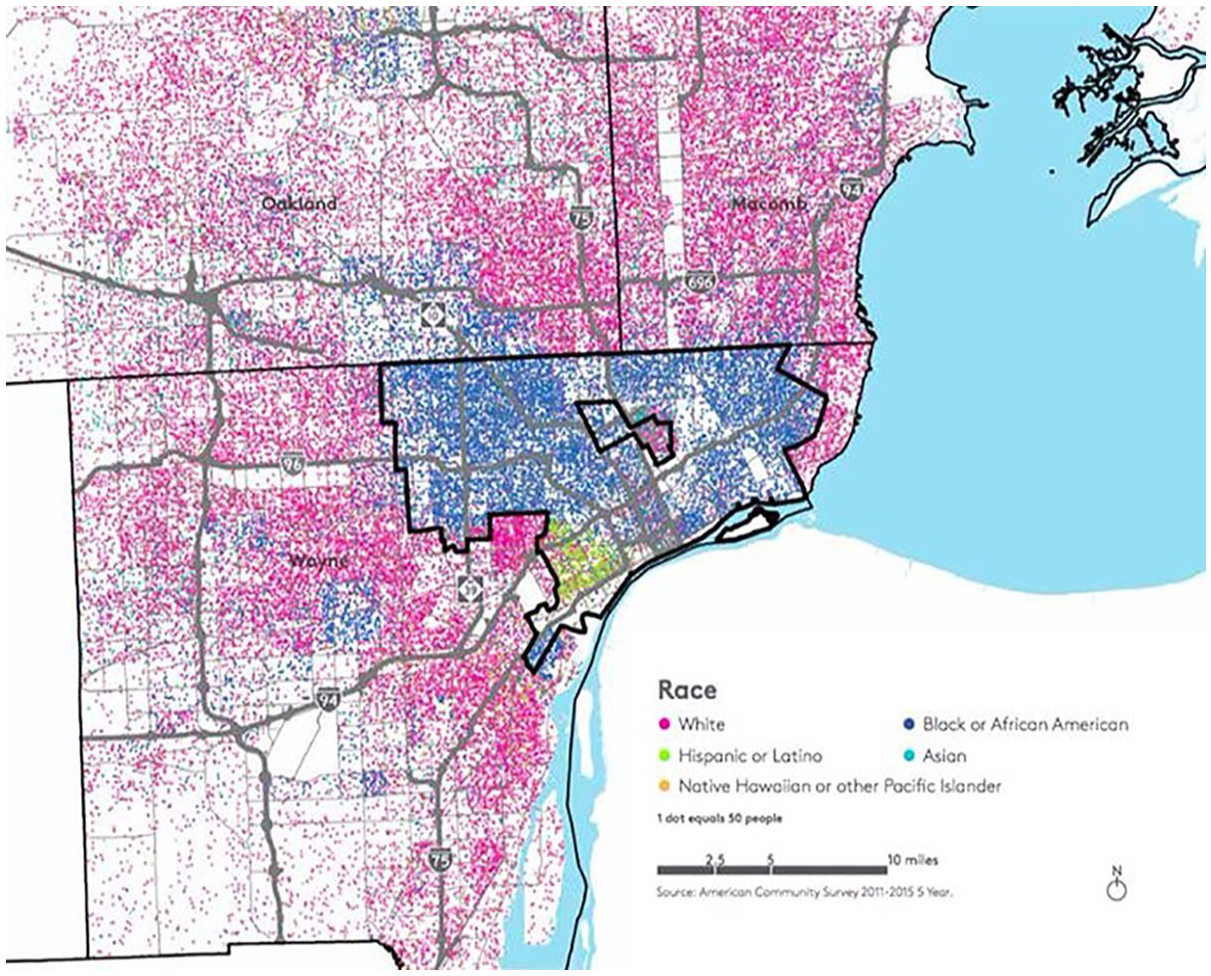
Racial dot map of Detroit and suburbs.
Detroit’s severe fiscal crisis, bankruptcy, and restructuring have been discussed at length (e.g. Kinder 2016; Peck 2012). Importantly, these conditions have profoundly exacerbated racial inequality in the city, constrained authorities’ options for remedies, and contributed to widespread reliance on austerity measures that “concentrate both costs and burdens on those at the bottom of the social hierarchy, compounding economic marginalization with state abandonment” (Peck 2012:651). By 2013, property values in Detroit had dropped 78.76 percent since their peak in 1958 (adjusted for inflation; Bomey and Gallagher 2013:6). Despite a median home price of only $19,070 in 2015, high poverty and unemployment rates (38 and 27 percent respectively in 2010; U.S. Census 2020) in Detroit also meant that nearly 50 percent of renters at that time were rent-burdened (Pitingolo 2015). High need for economic resources and shelter, combined with lax regulatory enforcement has led to an abundance of informal property use, as residents squat houses for shelter, garden vacant lots, and scrap metal from buildings to sell for income (Herbert 2021).
Detroit occupies the native land of Anishinaabe people, yet the racial dot map (Figure 1) fails to show that Southeastern Michigan has the 10th largest urban Native American population in the country, with 2,931 Native-only residents in Detroit (U.S. Census 2020). This population experiences many of the same obstacles as Black Detroiters (Quizar 2019). However, Indigenous communities in Detroit are continually resisting erasure, and their survivance is intertwined with the contemporary dynamics of the city (Mays 2019).
While Detroit is an illustrative case of urban decline, it also represents conditions relevant for analyzing how the violent colonization and erasure of Indigenous Americans is formative for contemporary land relations and colonial structures (Mays 2021, 2022; Quizar 2019; Safransky 2023). Importantly, the racial dot map of Detroit (Figure 1) and other cities like it visualizes what Pinderhughes (2011) calls the era of “the neo-internal colonial ghetto”: the spatial sequestration of poor, primarily Black and Latine residents who are economically, socially, and politically oppressed. In this context, Quizar (2019) argues that a settler colonial logic is operative insofar as Detroit’s land is now more valuable than the labor-potential of the city’s majority Black population: they are in the way of revitalization efforts. Here, Mays (2019) explains, “Black displacement is based upon the same logic of settlement and elimination” (p. 467). The history of racial segregation and disinvestment are inseparable from current conditions of hypervacancy and poverty in many Rust Belt cities.
In Detroit, anything resembling gentrification was (and still is) confined to very select neighborhoods. Gentrification scholarship treats devalorized neighborhoods as awash in affordable housing, enabling residents to stay in place. But in Detroit, research shows the greatest displacement pressures and number of forced moves are in neighborhoods not yet “gentrifying” (Seymour and Akers 2022). Understanding how gentrification takes hold in such cities requires reckoning with the conditions of decline and foregrounding the continued influence of racialized colonial structures, which the binocular colonial lens directs us to see in this article’s analysis.
Revitalization Regulations
This section describes and analyzes eight legal and policy (“regulatory”) changes impacting Detroit that were rolled out between 1999 and 2014 that target the use, access, and control over urban land, houses, and other buildings. New regulations expedited the timeline for tax foreclosure; federal funding was redirected away from foreclosure assistance to demolition; survival strategies involving vacant property—like squatting and scrapping—were criminalized; and new avenues for legal property ownership were created. Each description first highlights the generalizability of these regulations as common strategies for addressing the very real problems facing many Rust Belt cities that residents and authorities are often desperate to fix.
After describing each regulatory change, we then analyze their interconnections and how they reflect the two dimensions of settler colonialism’s replacement logic: elimination and (re)settlement. The eliminatory impulse removes people and practices that are in the way of, or pose obstacles for, settlement and the expansion of sources for capital generation. Taking an integrated view of these multiscalar regulations, they reproduce a settler colonial replacement logic by making it harder for vulnerable, longtime residents to remain connected to land (property) in the city and in doing so threaten survival, while at the same time increasing access to legal property ownership for newcomers or investors. These regulations aim to temper features of the city that may be viewed as risky, disorderly, or undesirable, and bolster the city’s appeal to newcomers. These interconnections are summarized in Table 1.
Settler Colonial Replacement Logic in Revitalization Regulations.

In our contemporary era, racial motives must be surreptitiously encoded: there was no utilization of racial language nor evidence of racialized intent in the regulations themselves. And, because social structures like colonialism reproduce and persist even in the absence of explicit aims (e.g. Bourdieu 1977), this analysis does not seek to identify nefarious intent by state actors. However, the racial conflicts shaping spaces like Detroit since colonization should not be overlooked, and still influence city-suburb relations, infusing authorities’ treatment of the city and its residents (Bates 2010; Hackworth 2018; Jay and Conklin 2020; Kornberg 2016).
Tax Foreclosures and Water Bills
Declining cities’ tax bases decrease as residents leave and property values plummet, making it harder to address rising vacancy and aging infrastructure. In response, many cities raise property taxes and utility rates to offset lost revenue and use tax foreclosure to gain control of abandoned properties. The latter enables authorities to avoid the arduous process of eminent domain, and then sell or demolish properties (Dewar, Seymour, and Druța 2015). By selling properties to private owners, cities also seek to make up some of their lost tax revenue and decrease ongoing maintenance costs.
Detroit has adopted these strategies, with harmful effects that coalesce with two regulatory changes. In 1999, Michigan property tax law was amended. Ending the sale of liens to debt collectors for tax delinquency, the city now sells tax delinquent properties via the county’s property auction. This amendment shortened the foreclosure timeline from at least six years to three years. At the time of enactment, the state legislature stated the need “to strengthen and revitalize the economy. . . by encouraging the efficient and expeditious return to productive use of property returned for delinquent taxes” and to bundle and channel properties for redevelopment (Michigan Act 123 1999). In 2006, the Detroit Water and Sewerage Department “began exercising its legal right to defer delinquent balances to the property taxes” (Detroit Water and Sewerage Department N.d.:1) to fund infrastructure repairs. This is a common practice nationwide, used to get payment for delinquent balances (Kurth 2014), but in Detroit it was also a political move reflecting city/suburb tensions over regional infrastructure (Kornberg 2016).
Because of high water and tax rates, these new regulations have severed some Detroiters’ access to a vital resource for survival and their homes. With depopulation, fewer residents shoulder the fixed-costs of aging infrastructure, which accounted for 80 percent of water rates in Detroit (Butts and Gasteyer 2011). Rate hikes of 8.7 percent meant that Detroit residents pay more for water provision than residents in the metro suburbs (Kornberg 2016). In 2014, the city shut-off water for 27,000 residents with delinquent water bills, garnering the attention of the ACLU, NAACP, and United Nations due to the impact for poor Black households, elderly and disabled people, and children (Associated Press 2014a): residents resorted to filling buckets with water from neighbors’ hoses in the middle of the summer.
These delinquent water bills are now rolled into property taxes in Detroit and contributing to foreclosures. Detroit mayors have raised property tax rates over the years so much that rates are typically double the U.S. average (Lincoln Institute of Land Policy and Minnesota Taxpayers Association 2012). Compounding this, a review of 173,000 Detroit homes found that, from 2010 to 2016, over 92 percent were illegally over-assessed and overtaxed by an average of $3,800 (MacDonald and Betancourt 2020). In at least one of those years, 96,000 were taxed twice what they should have been, violating the Michigan Constitution (Atuahene and Hodge 2018). The impacts of these two regulations have been enumerated. In 2014, 11,979 of the approximately 23,000 homes sold at the Wayne County Tax Auction had unpaid water debts included in the delinquent taxes (Cwiek 2015). By 2015, approximately 92,000 residential structures had been foreclosed for tax delinquency in Detroit since 2002 (Seymour and Akers 2022).
Property Auctions
Land banks are government (or nonprofit) entities designed to help manage the rise in “problem properties” in declining cities—for example, vacant, deteriorated, or abandoned properties often tax delinquent or with encumbered titles. Land banks have special powers to acquire property titles, and can clear any liens, clouds, or encumbrances. They often strategically hold properties to amass for redevelopment, try to sell them (often via auction) to private owners, or hold them in queue for demolition (Center for Community Progress N.d.). Elected in 2013, Mayor Duggan’s administration took over and revamped the Detroit Land Bank Authority (DLBA), creating a second property auction that streamlines moving tax delinquent properties into the hands of new residents. The DLBA’s slogan is “Neighbors Wanted”—referring to their goal of attracting new “responsible” home-owning residents to Detroit’s neighborhoods.
Previously, the only auction for Detroit properties was the yearly Wayne County Treasurer’s tax auction. In the first round, bidding starts at the amount of taxes owed; those left in the second round start at $500. The Wayne County Treasurer’s website only lists the address and taxes owed. Owners who lost their properties to tax foreclosure are prohibited from purchasing properties (or having a third-party do it for them) at the auction for three years (Michigan Public Act 501 2014), making this pathway to homeownership inaccessible for the tens of thousands of Detroiters who lost their homes to tax foreclosure.
In contrast, the DLBA’s auction is on-going, with bidding starting around $1,000. The DLBA shares photos and details about potential improvements needed, and sometimes holds open houses before bidding starts. The DLBA property auction stipulates that new owners bring properties up to code within six months and thus those able to participate must possess the time, knowledge, and/or money to do so. More recently, the DLBA began selling “Rehabbed and Ready” properties for those with the capital and desire to move right into a remodeled home.
Rather than be a potential source of inexpensive housing for those in need, many poor residents express being deterred by the substantial work and associated liabilities of these auction-properties. However, these properties do appeal to new, predominately White “urban homesteaders” who want to productively mix their labor with property to legitimate their new ownership and/or build equity (Herbert 2021). And, these conditions do not deter speculators who hold property vacant hoping values will rise: between 2005-2015, 88 percent of tax auction sales of one-to-four-unit buildings were purchased by investors, mostly in bundles of 10 or more (Seymour and Akers 2022).
Hardest Hit Funds and Demolition
Deteriorated buildings are a significant problem for declining cities like Detroit. Due to population decline, scores of abandoned properties scatter these cities, and strained budgets prevent authorities from maintaining them or enforcing legal owners’ obligations. Popularly conceived, these properties are “broken windows” which signal apathy and lack of social cohesiveness among residents, contribute to the further deterioration of social relationships and the built environment, and increase crime (Sampson and Raudenbush 2004). Cleaning up the material signs of disorder, like “blighted” housing, is then imperative for improving social conditions and attracting new residents to these cities.
In 2014, a Detroit property survey identified 78,506 properties as blighted or having indicators of future blight (Detroit Blight Removal Task Force 2014:14). Mayor Duggan’s administration has touted the importance of blight removal in the city and unveiled a massive blight demolition plan. This plan targets the most stable neighborhoods with the lowest vacancy rates for demolition first, aiming to prevent further decline and benefit the most residents (Detroit Blight Removal Task Force 2014). Residents face a host of social and environmental ills from living near structurally unsound houses and buildings: they are attractive nuisances and commonly used for illegal activities. 2 This plan defined property as “blighted” if it meets any of a long list of conditions, including: being a fire hazard, having had the utilities disconnected or rendered ineffective, being tax-reverted, being owned or controlled by a land bank, having been vacant for five years and not maintained to code, or being on the demolition list (Detroit Blight Removal Task Force 2014:13). According to this definition, even many owner-occupied homes are “blight.”
Demolition is expensive, and so the city redirected federal funds from foreclosure assistance to blight demolition. In 2010, amidst the aftermath of the recession, the U.S. federal government created the Hardest Hit Fund to “help struggling homeowners” (U.S. Department of the Treasury 2018) and, in 2013, allocated 52.3 million dollars for Detroit (Detroit Blight Removal Task Force 2014:240-01). Local activists argue these funds were supposed to help the thousands of households facing mortgage or tax foreclosure. 3 As of September 2017, Detroit had demolished 12,341 buildings, and 2,151 were in queue (City of Detroit 2017).
Most immediately, this change harmed vulnerable residents by failing to help quell extensive foreclosures. However, demolition gets rid of the vacant properties that poor residents in declining cities often rely on for shelter and income (Herbert 2021; see next section). Only city-owned properties are eligible for demolition using Hardest Hit Funds, but these are also the properties squatters most often seek out for housing and from which scrappers take material to sell for income (Herbert 2021). In 2015, one of the three major demolition companies in Detroit estimated that squatters occupy 10 percent of the houses they are slated to demolish (Williams 2015). If that estimate held true for all three companies, 60 of the approximately 200 houses demolished every week in Detroit would likely be occupied (Gallagher 2014). While demolition can be an important safety, health, and aesthetic intervention, getting rid of these properties also removes the informal ways of using property that aides the survival of the poorest Detroiters.
Criminalization of Squatting and Scrapping
In declining cities like Detroit, the combination of spatial opportunity (abandoned property), lax municipal oversight, and high economic need among residents contributes to the rise of informal ways of using and relating to property that don’t fit the private ownership model, like squatting and scrapping (Herbert 2018). However, squatting and scrapping can interfere with revitalization goals. Scrapping contributes to a deteriorated built environment and squatters can impede the transfer of vacant properties to new legal owners. Both practices signal a lack of reliable property-law enforcement, posing risks for potential investors. In 2014, the state of Michigan implemented two new laws which, by reinforcing state commitments to private property, harm Detroit’s most vulnerable residents.
Then State Representative Rashida Tlaib spear-headed the new “anti-scrapping” law, aiming to curb illegal metal scrapping. 4 A local authority explained that in Detroit the law’s primary motivation was to curb the destruction of buildings that often makes it cost-prohibitive to renovate them. 5 This new law aimed to disincentivize scrapping by: making it harder for “thieves” to sell illegally acquired materials at scrap yards for quick cash; making it easier for law enforcement to trace stolen material and prosecute scrappers; and increasing the severity of punishment (Associated Press 2014b). The impact for poor Detroiters is that it becomes harder and riskier to exchange scrapped materials for income (even scrapping that residents view as acceptable, see Herbert 2021).
Just a few months later a new statewide law criminalized squatting and increased the power of property owners. A similar ordinance was initially under consideration by Detroit’s city council, but the state law superseded the need for it (AlHajal 2014). As is the case in most places, squatters violate property laws when they trespass in Detroit. Authorities can arrest or cite a squatter if trespass can be verified. But (prior to this new law) without proof that trespass occurred, the only legal recourse was for the property owner to pursue eviction through civil court, or file trespass or vandalism charges (Michigan Public Act 223-225 2014). With this new law, squatting in Michigan is now a misdemeanor for a first offense, and a felony for the second. It allows property owners to take more direct action to reassert control over their property. Owners are now allowed to “use force to regain possession of premises occupied by a squatter” (Michigan Public Act 223-225 2014) by, for example, physically removing squatters’ belongings or changing the locks. Squatters have been an obstacle for new owners of tax auction houses, who arrive to find squatters had moved in or the former owners remained (Cox 2014). The anti-squatting law makes it easier for new owners to take possession of these properties without the costly and time-consuming process of legal eviction. Both laws threaten the survival practices of very poor Detroiters while reinforcing the power of legal owners.
Urban Agriculture Ordinance
Urban agriculture has become more popular in declining cities and attracts newcomers (Pothukuchi 2017; Safransky 2014). Local governments have increasingly embraced urban greening projects because they improve the urban landscape, economic opportunities, and access to food for impoverished communities (Detroit Future City 2012). In 2013, with widespread support, Detroit’s City Council adopted a new ordinance that recognizes agriculture as a legitimate land use in the city and sets standards for urban agriculture activities.
This new ordinance formally regulates practices that have persisted informally in Detroit since the late nineteenth century. 6 The ordinance delineates site requirements, acceptable crops and forms of agriculture, and regulates agricultural commerce such as farmer’s markets. Some residents even subsist on these ventures alone (Herbert 2021). It also permits pre-existing operations to continue as a “legal noncomforming use” (Busdicker 2013). This incentivizes legalization (i.e. for residents to purchase the land they use) by excusing them from significant costs to comply (like moving a greenhouse further from the sidewalk).
Prior to this new ordinance, residents could not purchase vacant property that was not adjacent to their legally owned residence unless they planned to build on it. Now an individual—resident or not—can purchase vacant lots across the city to start a farm because agriculture is a legally accepted land use. Lots can be purchased through the city for as little as $200 for a side-lot and for “fair market value” for non-residence-adjacent-land (Busdicker 2013:3). The urban agricultural ordinance formalizes informal practices, creates an avenue for residents and outsiders to gain legal control over the city’s land, and promotes various manifestations of “urban homesteading” lifestyles (Herbert 2021).
The Replacement Logic of Revitalization Regulations
These regulatory changes are all aimed at quelling the injurious conditions of decline and stimulating revitalization. Research has long noted the role government plays in bolstering gentrification and forms of displacement. Here, settler colonialism’s replacement logic is evident insofar as government efforts to promote urban agriculture, facilitate property re-allocation, and make the city more enticing to newcomers are entangled with regulations that threaten marginalized residents with eliminative forces; and indeed, the former requires the latter (see Table 1).
Tax foreclosure is touted as a tool for neighborhood improvement that takes control of deteriorated, abandoned properties. But, read through the lens of settler colonial spoliation, tax foreclosure operates as a “civilizing mechanism” aimed at making urban property productive via legitimate private ownership, using tax status as a de facto (but highly unreliable, Herbert 2021) measure of productivity. Foreclosures in Detroit, one of America’s poorest cities, have manifested as a massive wealth reduction, primarily impacting Black residents. The property auctions streamline investors’ and new residents’ ability to inexpensively purchase Detroit’s land and buildings, and legally claim a piece of the city. These investors are “notorious slumlords” who frequently hold properties for speculative future redevelopment, rent them in substandard condition, re-sell them in “flipping schemes targeting naïve out-of-town buyers” (Seymour and Akers 2022:15) or sell them under predatory conditions to residents without access to conventional lending (Akers 2013).
Redirecting Hardest Hit Funds from foreclosure assistance to demolition allows property-takings to continue unabated, removing residents’ legal right to the city. Blight removal aims to stabilize some neighborhoods, makes them more appealing to newcomers who might otherwise be deterred by these “signs of disorder,” but also demolishes properties that many poor residents rely on to procure shelter and income. New laws criminalizing squatting and scrapping make the city more hostile for residents who survive via informal uses of urban land and buildings. These laws also make private ownership a safer investment for newcomers or speculators who may want to purchase property, bolstering their legal claims to the city.
The new agriculture ordinance may benefit existing residents who farm or garden. But contextualized in Detroit’s racial, fiscal, and spatial crises, research also finds that the ordinance has been wielded as a tool of eviction (Montgomery 2020), is experienced as opaque and exclusionary by resident gardeners, and viewed as facilitating elite access to city land (Pothukuchi 2017). In addition, the ordinance bolsters the practices of newcomers drawn by problematic representations of Detroit as a vacant urban frontier (Herbert 2021; Safransky 2014). Despite supporting greening efforts, the new ordinance also sits at the nexus of this replacement logic: many of these lots are the same spaces wherein residents previously lost their homes to foreclosure, which then sat vacant for years and deteriorated until they had to be torn down using diverted federal Hardest Hit Funds, and are now being resold to new “urban homesteaders” for $200 or in bundles to speculators (see Table 1).
A Decade Later
In the decade since the latest of these regulations was rolled out, urban scholars and popular media have debated the form and extent of Detroit’s changes. A recent study by economists finds few census tracts in Detroit qualify as “gentrifying” according to their metrics (Brummet and Reed 2019). Yet popular media and scholarly accounts highlight fears of gentrification among longtime residents, who feel like the city’s changes are not for them. Despite these different views about whether Detroit is gentrifying, 7 scholars confirm that recent changes have continued to exacerbate racial inequality—now as much within the city as between city and suburbs. Of common concern are the multi-billion-dollar investments (subsidized greatly with public funds) in the 7.2 square mile Greater Downtown and lack of meaningful investment in the 134.8 square mile “neighborhoods,” as the divide is often referred to in Detroit (Gillette 2022; Jay and Conklin 2020; McGahey 2023; Moscowitz 2017). Findings from a 2018 University of Michigan Population Studies Center survey are particularly revealing about Detroiters’ attitudes toward city changes: “Asked about who benefits most from downtown and Midtown investments, more believed it was non-residents (38 percent) than city residents (20 percent); white people (47 percent) as opposed to black people (2 percent); and wealthier people (70 percent) over poorer people (2 percent). ‘The negativism is a little starker than we thought,’ concluded Jeffrey Morenoff, the director of the Center,” (Kurth and Wilkinson 2018).
These concerns map onto the reality of demographic changes in the Greater Downtown area and the city overall, revealing ever-more-glaring racial and economic inequality. The city’s White population has increased more than 25 percent since 2010, with the majority of newcomers settling in the Greater Downtown area. Here, between 2011 and 2016 the population of White residents increased by 66 percent while the Black population decreased by 5 percent (Jay and Conklin 2020:36). In 2019, Detroit had the 2nd highest poverty rate for cities its size (McGahey 2023:115) and in 2020, 62 percent of renters were housing cost burdened (Lynch et al. 2021:14). From 2010 to 2019, the median income increased 60 percent for White Detroiters in comparison to 8 percent for Black Detroiters (Lynch et al. 2021:33). As of 2019, the unemployment rate for Black Detroiters was 1.5 percent that of White residents (Lynch et al. 2021:13) while the average home value for White Detroiters was $122,180 but only $76,090 for Black Detroiters (Lynch et al. 2021:40). Unfortunately, in the last decade after Detroit’s “turning point” post-bankruptcy, these state-led efforts to promote revitalization, alongside various forms of public and private investment, are correlated with sharpening racial and economic inequalities across the city.
By refocusing the binocular colonial lens on state-led efforts to promote gentrification, we can better anticipate where Detroit is headed and “see” more clearly what traditional gentrification theories cannot account for or leave out of their analytic purviews. These revitalization regulations help to dispossess and remove residents, clear “disorderly” spaces and people, amass and repurpose land, reinstate private property rights and the “rule of law,” while enticing new residents and investors and expanding access to property ownership. These regulations also interact with more commonly recognized SLG efforts like large-scale public-private developments, such as the new Detroit Red Wings Stadium, which was aided by many of the regulatory changes analyzed here, and built with 58 percent public funds despite widespread opposition (Herbert and Orne 2021). In the last decade, the city has seen the rise of what activists have called “white islands” (Feloni 2018) in a historically Black city: neighborhoods like Greater Downtown, Corktown, the Villages, or the North End where longtime residents have used the term “colonizer” to talk about the entitled orientation of White newcomers and their urban agricultural endeavors (Perkins 2017). Longtime residents assert that these “new white development areas” are built on the exclusion and exploitation of Black residents (Doucet 2020:646). In the militarized process of frontier control, “isolated settler/forts are . . . located so as to be able to act as bridgeheads from which larger concentrated action into ‘barbarian’ territory could be assembled” (Weizman 2004:2). Read through a binocular colonial lens, White islands may be the solution to the obstacle that existing research suggests a majority Black population poses for gentrification. Rather than “braving” a majority Black city, newcomers can move to the edges of these White islands, allowing gentrification to “spillover” in a more legible process whereby the urban edge of profitability (Smith 1996) is advanced slowly from these fortified, White spaces to surrounding disinvested Black spaces.
Conclusion
In this article, we have picked up a thread of scholarship which has been uncovering the way settler colonialism, as an adaptive and ongoing structure, shapes contemporary socio-cultural, political, spatial, and economic relations. By identifying the settler colonial replacement logic in government urban revitalization efforts, we can cohere processes of racialized removal and resettlement as entangled, rather than simplistically viewing displacement as an unfortunate outcome of gentrification. This article advances scholarly understanding of (1) how colonialisms structure urban dynamics, (2) how gentrification unfolds in the context of urban decline, and (3) the state’s role in these efforts.
First, we have shown that the settler colonial state is operative in revitalization processes. Existing studies of gentrification that utilize the language and ideology of settler colonialism to simply frame, name, or describe newcomer/longtimer dynamics fail to unearth the complexities of how this process continues, and can perpetuate Indigenous erasure. In places like Detroit, deterioration, vacancy, informal property relations, and poor non-White residents are obstacles to resettlement and the realization of settler futurities (Barry and Agyeman 2020). But when government efforts to tackle decline prioritize growth (Akers 2013), enticing new residents and capital investment requires creating a landscape that is not perceived as risky. The valuation of space is highly racialized (Rucks-Ahidiana 2022), and so government efforts to clean up signs of “disorder” and promote “legitimate” uses of property are entangled with and target the obstacle that the majority poor, Black residents pose to gentrification (Charles 2000; Hackworth 2021; Hwang and Sampson 2014). Here, revitalization regulations coalesce to reflect and perpetuate the logic of removal and resettlement. Building on this, a second key takeaway is that “gentrification” in the context of urban decline may be instigated by government regulations that leverage racialized forms of dispossession to clear space and control property, enabling developers and newcomers to move into these spaces unencumbered. For future race and urban scholarship, this analysis highlights the utility of foregrounding the interconnected histories of and ongoing structures shaping Black and Indigenous Americans’ lives, particularly how these legacies overlap and continue to be intertwined with processes of racial capitalism.
Third, this article shows the utility of rethinking two key facets of SLG scholarship. Research should be explicit in examining how government regulations cohere across levels to influence local dynamics. The regulations in this article intersect in Detroit, but are deployed at the city, county, and state levels, and (in the case of Hardest Hit Funds) draw on federal resources. In addition, our analysis identifies other kinds of government interventions that might be instigators of gentrification, especially across Rust Belt cities. Most SLG research has focused on government programs that are explicit in their efforts to promote various forms of urban development. But, like quality-of-life policing, Rust Belt regulations may not have urban development as their aims even though the consequences may be impactful for gentrification.
As attention to what-looks-like-gentrification increases in Rust Belt cities, government regulations aimed at addressing vacancy, reinforcing private property, or removing signs of “disorder” should be critically interrogated for their potential contributions to racialized patterns of elimination and resettlement. We have shared the evidence that exists, but future research is needed to more comprehensively measure the impacts of these regulations. To what extent do demolition efforts make a neighborhood more appealing to newcomers? (There is conflicting evidence on the benefits for existing residents, Hackworth 2016). How many newcomers are drawn to the urban pioneering lifestyle some declining cities promote? What happens to squatters evicted from housing and scrappers who no longer have this income to rely on? Cities like Detroit are rock-bottom for housing prices and enable survival practices that are not possible in other contexts, so if residents are forced out of their housing their survival is likely threatened in a way that has not been considered in other gentrification research, because there may not be cheaper housing or other buildings to squat. As we previously argued, it may be more appropriate to consider such effects as “eliminatory” versus just displacement (Herbert and Brown 2023). Amid an acute housing crisis, many Rust Belt cities are being lauded for their relative abundance of affordable housing (Prakash 2024) and as possible “havens” from climate change (Maniere 2023), which may intensify both the influx of newcomers but also government efforts to attract and accommodate them and their resources.
Researchers, thus, should attend to the impacts of government revitalization efforts in the context of urban decline in the United States. Integrating colonial theories to analyze urban changes enables us to identify and better anticipate these harmful impacts. This is not to say that the regulations analyzed here may not be beneficial for some longtime Detroiters, nor that many of the conditions of urban decline they seek to remedy are not real problems. Instead, along with gentrification scholars and activists who have sought ways to promote neighborhood improvement that does not result in displacement, we advocate finding ways to tackle the problems of decline and disinvestment that do not reproduce the harms of elimination-resettlement that the settler colonial state continues to deploy in the interest of racialized capital and territorial expansion.
