







Abstract
Placemaking is a vaguely defined yet ubiquitous activity of urban development. It comprises a professional field encompassing experts, technical discourses, canonical texts, and even academic programs. This article suggests that placemaking’s popularity signals the growing complexity of the community development field and the political coalitions required for housing and neighborhood development in U.S. cities. Using Detroit as a case study, I examine how two distinct development coalitions downtown and in a residential neighborhood coalesced around different placemaking approaches, conceptualized as an economic development versus community development frame. The result of both efforts is similar: a narrow view of development prevailed, channeling placemaking processes into well-known urban development strategies. The urge to involve the community in decision-making comes at a time when issues of urban inequality have gained prominence in public discourse. Yet, city officials, non- and for-profit developers, community advocates, and “engagement professionals” operate within a state and federal competitive grant system that prioritizes lower-income neighborhoods located near stronger housing and land markets, raising concerns around displacement. Placemaking effectively minimizes this tension by symbolically elevating the local histories and affective ties of longtime residents while promoting market-aligned development.
Introduction
In 2010, the National Endowment for the Arts (NEA) did something revealing. Jettisoning its historic commitment to the arts qua arts, it elevated the role of arts organizations in creating better places, a practice it referred to as creative placemaking. The NEA drafted reports, engaged experts, and attempted to define best practices in this burgeoning field. Soon, other federal agencies such as Housing and Urban Development (HUD) took notice. HUD’s Choice Neighborhoods (one of the largest federal housing grants competitively awarded to cities) included creative placemaking priorities in its selection criteria. HUD then organized its own placemaking conferences, to which it invited grantees and project implementation professionals from across the country.
Placemaking is not a new concept. It has existed as a term since at least the 1970s. In urban planning and design, placemaking emphasizes community participation, diversity, and everyday residents’ role in producing place, often through artistic interventions in public spaces. Placemaking is at once a concept, a toolkit, and a methodology (Keidar et al. 2024), spanning specific practices such as asset mapping, normative ideals such as community participation, and emblematic interventions such as mural arts that memorialize local history. Perhaps due to its inherent “fuzziness” (Nicodemus 2013)—imbued with different meanings by distinct practitioners or community members—placemaking has remained influential in professional planning for nearly 30 years. Organizations such as the Project for Public Spaces (PPS) have championed the placemaking approach since the 1970s, although PPS first used the term in 1995. Today, placemaking is a routine and ubiquitous activity in community development across the United States and, increasingly, around the globe (Arefi 2014; Lederman 2020).
Why have local officials, community organizations, developers, and academic theories converged on placemaking’s importance in community development? What are the consequences for neighborhood change and politics? I argue that placemaking’s flexibility provides a shared frame around which growth-oriented coalitions can coalesce. I show how placemaking was employed in Detroit in two contexts and through two distinct framings. An economic development frame accompanied downtown placemaking, while a community development frame characterized placemaking efforts in a residential neighborhood. These divergent framings demonstrate the coalitional tensions that arise in different development contexts and highlight the importance of placemaking in each. Despite divergent contexts, the results of both efforts were similar: a narrow conception of development predominated and constrained thinking about alternative forms of community-led growth.
But how do such projects align with an ethos of community participation during a period in which urban inequality has gained prominence in public discourse? How does a placemaking toolkit bring together diverse coalitions necessary for development? I show how placemaking processes allowed developers, non-profits, city officials, and philanthropy to paper over contradictory goals and outcomes. Placemaking’s language of people-centricity and community engagement bridged the efforts of city officials and developers, who aimed to promote market-aligned development, with non-profit and philanthropic attempts to engage residents in decision-making and create a more vibrant or livable city.
Detroit’s precarious position prior to, during, and following its 2013 bankruptcy required city officials to signal adherence to urban planning frameworks with high levels of acceptance among resource-rich actors in the community development field, such as state and federal government and local philanthropies. Downtown, a coalition of philanthropy, city government, and business interests invoked placemaking through an economic development frame. Several years later, however, placemaking practices were likewise able to bring together a coalition necessary for development in North Corktown, a residential neighborhood outside downtown. In an area characterized by high levels of vacancy and disinvestment, placemaking’s flexibility allowed city officials, advocates, community groups, and non- and for-profit developers to invoke a community, rather than economic development, frame. This community development frame partially reconciled a dilemma between the city’s prioritization of new investment, on the one hand, with its stated concern (shared by stakeholders such as community organizations) for resident participation and equity on the other. Placemaking processes provided opportunities for community engagement in ways that appealed to residents and advocates, but also developers and city officials. Including placemaking in the development process served to mitigate critique of new development without substantively changing its objectives.
The implementation of placemaking projects shows a preference for highly symbolic physical investments such as artistic interventions that highlight local character (such as murals), livability improvements (such as bike lanes and pocket parks), and consumption activities (such as locally-themed small businesses), that integrate with—or at least do not discourage—developers’ plans to build market-rate housing. The community development frame may be distinct from the economic development emphasis downtown, but placemaking offers a flexible rhetoric that can integrate diverse coalitions. As a result, both downtown and neighborhood projects appear congruent with future market-aligned investment.
Drawing on expert interviews, participant observation, and archival research, this research suggests that placemaking proliferates in part because of its ability to incorporate diverse actors necessary for new development. The importance of community participation and legitimacy (Lee 2014b) in urban development renders placemaking a useful tool for acknowledging and celebrating the everyday residents, historic traditions, or working-class character of Detroit neighborhoods undergoing redevelopment (Montgomery 2016, 2020). As a malleable suite of planning tools, placemaking helps resolve a tension between the priority of community engagement and efforts to grow the urban tax base (e.g., DeFilippis 2004). Placemaking provides a shared frame to promote a participatory vision of community development while spurring new investment in neighborhoods ripe for growth.
Coalitions and Community Development
From bikeshares and bike lanes to Bus Rapid Transit to mixed use developments anchored by creative placemaking, local officials integrate well-known best practices into city planning policies (Peck and Theodore 2015). Adoption of these policies may be shaped by a desire to position cities to secure federal grants, win professional awards, or generate image-making opportunities that position cities for new investment, tourism, or a vaunted creative class of highly educated knowledge economy workers (Florida 2004; Peck 2005). From the perspective of scholarship on organizations going back as far as Max Weber (2009), best practice uptake may reflect a functional world of converging institutional practices. The priorities of modernization, technical-scientific efficiency, or the pursuit of economistic rationality converge upon standardized forms of bureaucratic organization.
But institutional practices exist within political-economic constraints in which local officials seek to secure legitimacy within organizational fields shaped by political, rather than merely rational, objectives. DiMaggio and Powell (1983) famously described the creep of standardization as “institutional isomorphism.” The pursuit of certain objectives over others, the appeal to legitimizing scripts or well-known policy idioms, and the strategic selection of metrics to measure success reflect an institutional recompense for the adoption of influential policies.
As McQuarrie and Marwell (2009:259) point out in the context of community development, the structures and forms that organizations take are “designed to resolve competing environmental demands,” rather than simply aimed at doing the work of organizations’ stated goals or mission. Organizations adapt to the norms and constraints of their professional fields (i.e., “environments”). Unlike the “old” institutionalism, which suggested that organizations’ strategic objectives and goal-oriented action might be redirected through values, organizational cultures, and entrenched political interests (Powell and DiMaggio 2012: Ch. 1), the “new” institutionalists examined how influential actors within the broader field shape organizational priorities (McQuarrie and Marwell 2009; Scott 2004). Community development organizations adapt to interorganizational imperatives within an increasingly complex professional ecosystem (e.g., competitive grantmaking in urban development), while aiming to preserve their legitimacy, often through community engagement practices such as placemaking.
The importance of organizational legitimacy and the role of public participation in generating this legitimacy (e.g., Lee 2015) connects the study of organizations to the priorities of urban coalitions. Sociologists and political scientists have debated how these coalitions come together, what motivates their action, and how their actions correspond to theories of democratic participation (Dahl 1964; Logan and Molotch, 2007; Stone, 1989, 2006). Dahl’s (1964) classic pluralist analysis of New Haven suggested that distinct groups of elites, residents, and elected officials shaped decision-making. Formal mechanisms of democratic politics—that is, elections—checked the power of elites. Community groups or real estate developers fit comfortably into categories of pluralist action, which inevitably cast development or land use decisions as empirical evidence of power. Discrete decisions such as approvals for development constituted a testable basis for pluralist theories. The occasional triumph of everyday citizens or the decisive influence of canny elected officials was proof of messy but ultimately democratic outcomes.
This view clashed with political-economic analyses of elite decision-making (Peterson 1981) and the emerging sociological concept of the growth machine (Logan and Molotch 2007), which cast local development elites as a dominant influence in urban politics. Rather than highlighting the cleavages among elites and elected officials, the topic of growth—that is, decisions about land use and the prioritization of exchange values—appeared to “consistently generate consensus among elite groups (Logan and Molotch 2007:50). Place entrepreneurs relentlessly pushed for growth by dominating local politics and “exerting ideological leadership on matters of land use and production” (p. 200).
Subsequent work on urban regimes (Stone 1989, 2006) suggested a more nuanced view of how coalitions are situated within governing institutions. Urban regime theory reconceived the public and private sectors; not as strictly separate realms but embedded in institutional arrangements that government and economic actors collectively produced (Stone 1989:4; Ch. 7). Regime theory suggested that elites were able to “shape governing arrangements, as opposed to [exercise their] influence on discrete decisions” (Stone, quoted in Hochschild (2008:326)). Growth-oriented elites made concessions to democratic politics but also meaningfully shaped local institutions (e.g., Stone 1989:96–98). Although urban politics entailed a push and pull of elite influence versus residents’ desire for equity and access, elites’ command of resources provided “an extraordinary opportunity to promote civic cooperation” in ways that “protect[ed] a privileged position” (242). Put another way, growth coalitions worked through public institutions to maintain their influence in the face of “popular control of the formal machinery of government” (Stone 1989:6) and in so doing development typically cohered with a definition of cooperation that the powerful shaped to their benefit.
The emergence of the community development field in the 1970s reflected a shift in the coalitions that have come to define contemporary urban governance (Ford Foundation 1973). As the community development model spread throughout the country in the 1980s and 1990s, its focus on engaging local communities reflected a hardnosed reality in addition to signaling an idealistic commitment to public participation: Private non-profits dedicated to economic uplift in their communities needed to credibly assert that they represented the community (Levine 2021:Ch. 1; McQuarrie 2013).
As Lee (2015:274) notes, public participation has become “central to organizational legitimacy” across a range of professional fields. As community development became more professionalized and technical (e.g., through complex partnerships to develop affordable housing, or through tools such as tax increment financing [Elwood 2004; Pacewicz 2015]), these fields came to rely upon a growing cadre of non-profit community and economic development professionals. The need to ground this expertise in community legitimacy increased (e.g., McQuarrie 2013). The result has been a tension between community development organizations’ grassroots legitimacy and the professionalization needed to win government grants or utilize complex financial instruments necessary for urban development. As Walker and McCarthy (2010) show, community-based organizations struggle with the need for community legitimacy and the professionalization that allows them to access external resources. Some organizations now prioritize the appearance of grassroots authenticity to win new business in the context of funding agencies’ prioritization of projects with robust community engagement (Robinson 2020). As a result, local officials may support participatory processes and community engagement “in support of governance and authority, underpinning the rule and legitimacy of elites rather than simply challenging them” (Walker et al. 2015:14). City officials and non- and for-profit developers partially secure this legitimacy through participatory practices such as those that placemaking affirms. This participation may ensure that “developers’ essential needs are met, and their projects are legitimated by the buy-in of disadvantaged groups” (Purcell 2009:157). In this way, placemaking frameworks help elicit consensus and build governing coalitions rather than simply articulate the needs of constituents.
Professionals tasked with seeking, analyzing, and choreographing neighborhood participatory processes such as placemaking constitute what Caroline Lee (2014a) calls the “engagement industry.” Real estate developers and other members of a local growth coalition may seek to squeeze economic value out of neighborhoods with depressed land or housing markets, but city officials, engagement consultants, and non-profit community development organizations aim to engage residents, often cast as the adjudicator of the neighborhood’s authentic history. Placemaking helps resolve a tension between the need for legitimacy, on the one hand, and city official’s desire to promote new growth on the other. During a period of rising inequality and increased public discourse around gentrification and displacement, city officials may advocate quality-of-life improvements such as parklets or mural arts through engagement processes such as placemaking. Key placemaking practices such as murals that commemorate local figures, or indeed participatory methods that ask, “what does the community want to see?,” help paper over the distinct interests of community members, city officials, and for-profit developers. These placemaking interventions elevate the role of longtime residents and local quality-of-life concerns. But they are hardly antithetical to new, market-aligned development or the interests of growth-oriented stakeholders. In fact, new development may benefit from community displays that are suggestive of an authentic past or provide uncontroversial amenities such as green spaces or public art.
Placemaking in Its Place
Placemaking elevates the role of culture and identity in fostering a sense of place; however, it also exists within a constellation of practices that comprise the political economy of community development, housing, and public space management. The field spans urban design and consulting firms looking to drum up new business, city officials seeking to promote neighborhood redevelopment vested with the seal of community involvement, as well as non- and for-profit developers concerned with highlighting the role of place in fostering neighborhood character in areas being redeveloped.
PPS was central to the diffusion of placemaking as a concept. Fred Kent, the founder of PPS, was a research assistant to William H. Whyte, the journalist and public sociologist who advocated a social scientific approach to studying how people used public spaces (Whyte 2012). In the 1980s, PPS’ contributions to New York City’s Bryant Park redevelopment raised the non-profit’s profile (Madden 2010). Over time, PPS’ organizational focus evolved in line with external trends in urban design and politics, emphasizing concepts such as social capital (PPS 2012) in the aughts to a more equity-oriented discourse in recent years (Kahne 2017).
Although PPS’ rhetoric has changed, its relationship to funders such as philanthropies and downtown development authorities has consistently resulted in more instrumental approaches to developing public spaces, as opposed to more freewheeling forms of bottom up placemaking, such as Occupy Wall Street (Kohn 2013), the Movement for Black Lives (Villanueva 2024), or unauthorized DIY improvements that everyday residents undertake (Douglas 2018). Although placemaking may be mobilized by everyday community members, most of what gets categorized as placemaking is in fact expert-led, prompted by organizational and institutional actors who label activities placemaking in service to a broader economic or community development goal. In many cases, city officials resist or remove placemaking displays that do not cohere to such goals (Douglas 2018; Nassauer 2021). In far-flung Detroit neighborhoods, residents’ DIY strategies to supplement threadbare city services (Herbert 2021; Kinder 2016) were typically jettisoned in service to top-down frameworks for vacant land (Safransky 2014).
NEA’s adoption of the creative placemaking moniker during the Obama administration raised the profile of placemaking in agencies such as HUD. Creative placemaking, a term first used by NEA in 2009, shifted placemaking from a set of ideas largely confined to the realm of public space into the ambit of community and economic development. In 2010, a landmark NEA white paper on placemaking articulated its economic potential in the following manner: “Resident artists, often traversing the neighborhood at all hours, make the streets livelier and safer, as do patrons of cultural venues and well-designed streetscapes” (Markusen and Gadwa 2010). Then, in 2011, NEA began the “Our Town” grants program, which sought to revitalize communities through placemaking. Soon after, HUD took up the placemaking credo. The HUD Choice Neighborhoods Director emphasized this economic development role for the arts at a 2013 conference in which HUD officially shared the creative placemaking idea with community development professionals from across the country: “I have taken a personal interest in dragging the NEA into this . . . Because I have a personal passion in the arts as a way to revitalize neighborhoods . . . and we are all trying to bring the arts into the neighborhood revitalization arena” (HUD 2013).
This shift followed the growing popularity of Richard Florida’s (2004) creative class thesis, which resonated during a period of deindustrialization (Florida was a speaker during a 2010 NEA conference that kicked off its creative placemaking initiatives). During this period, scholarly attention increasingly centered neighborhoods as sources of social connection and economic networks that could benefit low-income residents (Carriere and Schalliol 2021:6; Peck 2005). As Frenette (2017) notes, placemaking gained adherents following the popularity of the creative city thesis. And it did so by embracing artistic residents as agents of economic development, but also by highlighting the everyday practices of community members as central to successful spaces. Departing from PPS’ early placemaking work, which centered public space as a tool for economic development, placemaking initiatives increasingly prioritized community development and meaning-making, moving beyond its role in economic development. Today, practitioners typically suggest that placemaking is brought forth from the font of community tradition (Ellery and Ellery 2019). Although city officials’ occasional embrace of tactical or DIY urbanism may conjure images of civic participation, as Douglas (2018:Ch. 7) notes, these trends are often tied to forms of reinvestment and inequality in terms of who is celebrated for their contributions to neighborhood culture.
In downtown Detroit, years of consultant-led, economic development-centric, and openly business oriented projects have explicitly invoked placemaking to attract knowledge economy residents, culture-led investments, and new firms through the discourse of public space activation, and by fostering entertainment-leisure activities (e.g. Berglund and Butler 2021; Montgomery 2016). But new investment outside of downtown revealed a shift in placemaking rhetoric in Detroit and nationally, from one that celebrated public space, creative residents, and economic development to one that rhetorically elevated the existing community and its history and tied into community development initiatives such as housing and neighborhood reinvestment.
“In the neighborhoods,” a term at once racialized as home to longtime Black residents, but also deployed to reflect government inaction outside of downtown Detroit (Eisinger 2015), community engagement professionals and city officials are tasked with building support for new development projects, often through placemaking discourses that stress the neighborhood’s authentic residents and traditions. Race remains a potent lens for understanding these dynamics. Building on scholarship on “Black urban regimes” (Johnson 2016; Reed 1999), Montgomery (2020) situates Detroit’s post-bankruptcy reinvestment through the rise and fall of Black political self-determination. She notes that the expansion of economic opportunity to Detroit’s Black majority, which characterized late twentieth-century Detroit, has been rolled back, replaced by a form of gentrification that commodifies the city’s Black history in service to new investment. This investment, driven in part by White suburban stakeholders, results in the displacement of Black residents from neighborhoods experiencing growth (Mah 2021; Montgomery 2020). At the same time, scholarship in Detroit and elsewhere has shown examples of counter placemaking (Montgomery 2020: Ch. 6), centering a uniquely Black or Afrocentric placemaking (Radney 2019), resistance placemaking (Montgomery 2016), and more recently “place-keeping” tactics that forestall cultural displacement.
Why Placemaking Is Productive
In recent decades, the notion that place matters—that is, the economic, symbolic, and network resources that coalesce in neighborhoods—has emerged as a taken-for-granted bedrock of U.S. housing policy (e.g., Galster 2019; Owens 2017; Sampson 2008). Sociological concepts such as neighborhood effects and social capital (Small 2009) suggest that societal inequalities can be overcome by fostering the kinds of benefits that accrue in specific places (DeFilippis 2004, 2017). These benefits include collective efficacy, dense and advantageous social networks, or forms of informal social control.
Federal grants such as Choice Neighborhoods and federal-state financial instruments such as the Low Income Housing Tax Credit (LIHTC) all gesture toward the benefit of locating subsidized housing in stronger housing markets with the physical, social, and network infrastructures that characterize efficacious places. For example, LIHTC credits are allocated at the state level through a competitive process. Although different states vary in their selection criteria, almost all states prize developments located in mixed-income settings rather than, say, neighborhoods of concentrated poverty. In Michigan, the selection criteria also include proximity to labor markets and retail amenities, guidelines that promote development near downtown or other stronger neighborhood real estate markets (Dewar, Deng, and Bloem 2020). Choice Neighborhoods criteria likewise privilege developments sited in neighborhoods with robust transit, near amenities, jobs and higher income neighborhoods, often proximate to the downtown core.
As a result, local housing policy may require activating relatively weak, but promising, housing markets close to more consolidated neighborhoods. These areas meet much of the competitive grant criteria due to their existing infrastructure and likelihood to house some higher income residents, ostensibly creating mixed-income communities. On the other hand, Detroit’s far-flung, rigidly segregated neighborhoods, more likely to be spaces of concentrated poverty, property abandonment (Clement and Kanai 2015; Herbert 2021), and few amenities, typically do not qualify nor receive new state-led investment, despite housing some of the city’s lowest income residents.
The neighborhoods that city officials select for development may be ripe for reinvestment based on their privileged location; however, they also typically contain disinvestment and poverty, unsurprising given these grants’ aim to improve the housing conditions of low-income residents. The practices of placemaking partially resolve this dilemma. Placemaking at once celebrates local histories and neighborhood authenticity even as officials and other actors invoke placemaking in neighborhoods that support future market-aligned development.
Data and Methodological Approach
This research relies upon multiple qualitative methods combining interviews, archival work, and participant observation. I interviewed experts from across various sectors of the placemaking and community development fields, from Detroit city officials to two high-level PPS employees (one current and one former) to a director at a national philanthropy that funded placemaking projects in Detroit. I initially selected respondents based on my knowledge of the case, starting with two personal contacts, and used a snowball approach that resulted in additional interviews. In total, I conducted 15 “expert” interviews and had dozens of semi-formal and informal conversations with residents, community development professionals, and community members before and after in-person observation at community meetings.
Some of this research took place during the height of the COVID-19 pandemic and I watched or attended (online) roughly 125 hours of community meetings in which a neighborhood strategic framework plan and Community Benefits Agreement, including their placemaking components, were developed by city planners, consultants, and everyday residents. I typically watched these meetings on recordings after they took place, so as not to have my presence interfere. I took notes on emergent themes and paid attention to the policy aims of placemaking initiatives—that is, how residents, city officials, and experts appealed to placemaking concepts to further their claims or articulate their demands. I then analyzed how certain themes, such as preserving an authentic history through placemaking, were repeated in subsequent meetings. I also attended in-person community meetings after the COVID-19 public health emergency ended, between 2022 and 2024. I often spoke with residents and planners following such meetings but did not contribute to the formal proceedings.
To situate this case historically, I used an archival approach, drawing from formal archives and online research. I analyzed plans and reports through the University of Michigan-Ann Arbor’s Bentley Historical Collections library, which contains state and local government reports going back more than a century, as well as the Rockefeller Archive Center in Tarrytown, NY, which contains papers from PPS and William Whyte. Through the University of Michigan catalog, I searched terms such as “Campus Martius,” “Michigan Municipal League,” and “Detroit Economic Growth Corporation,” the materials for which were often available for reading at the Bentley library. These archival materials helped contextualize other qualitative materials. For example, in the early 2000s, then Michigan Governor Jennifer Granholm adopted a state-wide “Cool Cities” initiative, which self-consciously drew upon Richard Florida’s Creative Cities thesis (Michigan Department of Labor and Economic Growth 2005).
Detroit hosted the inaugural meeting of the PPS Leadership Council in 2013 and while no official archive of the meeting appears to exist, I used Google search terms such as “PPS,” “Detroit,” and “leadership council” to find documents and videos. PPS uploaded some of the speakers to the video sharing site Vimeo and I transcribed an important speech by the President of the Kresge Foundation, a philanthropy that funds many Detroit placemaking projects. Subsequent searches led me to an archive of the first PPS “Placemaking Week” in 2016, in which an official with the Downtown Detroit Partnership delivered a talk about placemaking. I transcribed this talk along with one from the same conference in which the Executive Director of Community Development Advocates of Detroit spoke. A 2016 University of Southern California (USC) conference “Drawing on Detroit” likewise featured many government and philanthropic actors involved in Detroit placemaking and I analyzed roughly 13 hours of video hosted on the USC Price School’s YouTube Channel.
Two Cases
The following sections analyze two cases of placemaking in downtown Detroit and in North Corktown (see Figure 1), a residential neighborhood near downtown marked by high levels of vacancy (many homes have been demolished over the last few decades) and disinvestment. I selected the downtown case because of its importance among a prominent coalition of city officials, developers, and major philanthropies. Downtown placemaking marked a key turning point when placemaking emerged as a strategic approach among elites and policymakers. The experience downtown was key to these stakeholders’ adoption of placemaking processes elsewhere. North Corktown was selected as a comparative case because it was undergoing a strategic planning and visioning process and the contrast in actors and contexts enabled an analysis of the role of placemaking in forging distinct development coalitions. The North Corktown case highlights variation in terms of how different configurations of local officials, community development professionals, and everyday residents invoked placemaking and shaped its material consequences. City planners and consultants used placemaking to align new development with a rhetoric of economic development downtown, while in North Corktown placemaking was framed around equity and participation. In both cases, placemaking emerged as a flexible rhetorical tool, capable of convening diverse coalitions and papering over tension among actors with distinct interests.
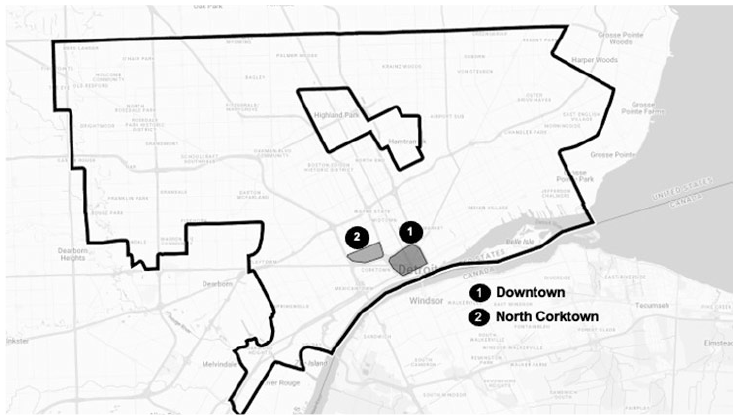
Map of Downtown Detroit and North Corktown within Detroit city boundaries. Base map from www.maps.google.com. KML city boundary data from data.detroitmi.gov.
Downtown Detroit: An Economic Development Frame
In 1999, the City of Detroit and the non-profit Detroit 300 Conservancy selected PPS to help design and program a new park downtown. Detroit’s business community created the Conservancy to commemorate the city’s 300th anniversary and to revive its flagging central business district where a few corporate headquarters remained. Edsel Ford II, Henry Ford’s great grandson and a Ford executive, chaired the committee. The city tasked the conservancy with developing and managing the crown jewel of the anniversary celebrations: the development of Campus Martius Park at the awkward nexus of various sinuous streets, stoplights, and traffic lanes in the symbolic center of downtown. The park would reclaim this space, turning a knot of infrastructure into a central civic square (see Figure 2).
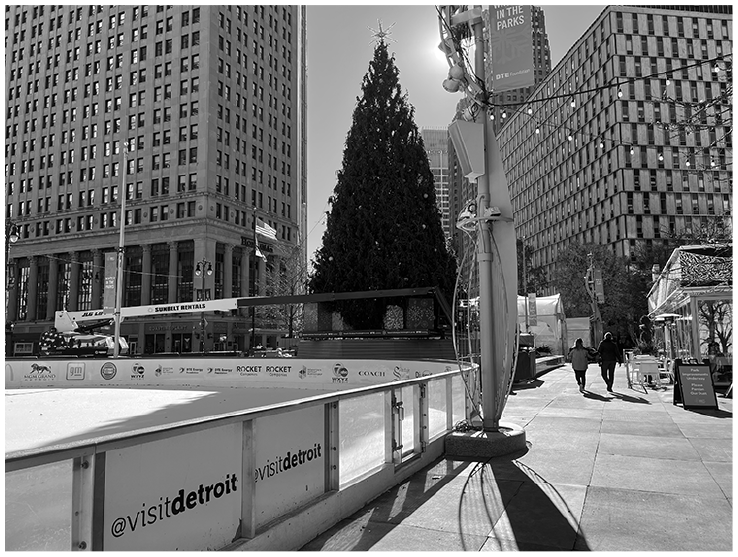
Campus Martius Park. During the winter, the park is outfitted with a Christmas tree and ice-skating rink.
PPS was well known for its conversion of Manhattan’s Bryant Park from a downtrodden space purportedly abdicated to drug dealers, to an upscale park with a high-end restaurant, coffee shops, and movie nights—what Zukin (1996:28) referred to as “pacification by cappuccino.” PPS, however, put it somewhat differently: “In 1981, when PPS began its work there, thousands of people walked along the park’s edges every day . . . but hardly anyone went inside . . . PPS once observed nine separate groups of people dealing drugs in the park and at its entrances . . . Overall it seemed like a very threatening place” (PPS 2004).
PPS touted Campus Martius Park as an unproblematic example of economic development. In a 2009 PPS economic impact study, PPS quoted then President of the 300 Conservancy, Bob Gregory, as saying, “we’ve been surprised by how many people from the suburbs are coming here. The quality of the space attracts everyone from rich to poor” (PPS 2009). In a city that was 83 percent Black in 2010, with a long history of White flight to the suburbs, the straightforward celebration of suburban visitors suggested the primacy of economic development in early Detroit placemaking projects and among a key group of local economic development officials. Over the years, PPS cast Campus Martius as a clear success, suggesting that the park catalyzed 2.24 million square feet of new or renovated office space and nearly $500 million in investment (McGraw 2011).
The reality, however, was significantly more complicated and suggests how early placemaking efforts may have elevated economic development priorities to the exclusion of other forms of urban vitality. As a PPS employee told me during a personal interview in 2021, Even though Campus Martius Park had become an attraction, they had jazz festivals, they had car shows, that was the only way they could get people there, was to do major programming. They weren’t really getting people there on an everyday basis. They weren’t really getting residents there and they weren’t getting suburbanites there [regularly], they were getting a few office workers and then [suburban] people who would come to the big events.
But then something changed. In 2011, billionaire Dan Gilbert relocated his Quicken Loans (Rocket Companies, formerly Rock Ventures) from suburban Livonia, Michigan to downtown Detroit. “That’s when Dan Gilbert comes to the fore,” the PPS employee explained. “[He] brings gradually over 10,000 people into the downtown . . . He and his team started working . . . how do we bring the city back, they started buying buildings. How do we bring retail back, how do we bring restaurants back? Their thought was, how do we activate the ground floor of our buildings. They issued an RFP to find retail consultants . . . Bob Gregory [from the Downtown Detroit Partnership, which had absorbed the Detroit 300 Conservancy], suggested [that they] invite PPS back even though we weren’t retail consultants.”
Gilbert’s Rocket Companies eventually hired PPS to create a master plan entitled “A Placemaking Vision for Downtown Detroit.” According to a personal interview with a PPS employee, PPS won the contract in part because the retail consultants did not understand the dire need to activate streets and public spaces prior to landing major national retail chains. Downtown Detroit was a “ghost town” and the usual retail strategies would not bring higher income residents and shoppers back, the PPS employee said. The PPS plan aimed to: “create a downtown core that rivals any North American city and even European cities. Detroit’s downtown core will be an area that is dense, lively, and attractive for people from the entire region and beyond” (Rocket Companies 2013b:6). PPS was also an appealing consultant because of the organization’s ties to local stakeholders. The Michigan Municipal League (MML), a non-profit advocacy and lobbying group for Michigan cities, had embraced placemaking since the late 2000s as a strategy to stem Michigan’s population decline (MML, 2017). An MML official put it this way in a 2025 personal interview: “When you talk about public policy . . . you talk about taxes and regulations and then the conversation stops. [But] what our research [in the early 2000s] told us was that the thing that attracts and keeps people is the place itself. That was like an ‘ahah’ moment.” MML worked closely with the State of Michigan and, beginning in 2011, state policy elevated placemaking as an economic development strategy for Michigan’s municipalities. In 2011, Republican Governor Rick Snyder’s delivered a “special message” to the legislature, which focused on how placemaking could revive Michigan’s cities and economy.
MML cultivated a relationship with PPS and brought PPS’ founder and President to Michigan as a keynote speaker for its 2011 placemaking summit. As the CEO of the MML wrote in 2012: “Fred Kent, president and CEO of Project for Public Spaces, recently told me that he sees Michigan as a leader in placemaking, and this comes from the guru of placemaking himself!” (Gilmartin 2012:5). These actors also helped seed the placemaking idea among local philanthropies. As the MML noted in its publication, A Decade of Placemaking in Michigan, “The placemaking movement has also increasingly had an impact on shaping foundation funding and private sector support in the state” (MML 2017:17). Gilbert and PPS’ downtown placemaking investments appealed to the state’s economic development officials, who understood placemaking as a tool for talent attraction. Philanthropic interests saw a practice that elevated the arts to make cities economically vibrant and livable for everyday people (e.g., Kresge Foundation 2013a:13).
In 2013, in partnership with the Detroit Economic Growth Corporation and the Downtown Detroit Partnership, Gilbert’s Rocket Companies kicked off a convention of 400 business and civic leaders to celebrate the new vision for placemaking downtown. The founder of PPS, Fred Kent, was a speaker during the event, which preceded what PPS called its inaugural Placemaking Leadership Council Meeting held 10 days later in Detroit: “From the riverfront, gaming, gourmet dining, sports, culture and entertainment to new retail, Detroit has a winning combination of attractions to reclaim its rightful place as a great American city on the international stage,” he said during the conference (Rocket Companies 2013a). Dan Gilmartin, the MML CEO, opened PPS’ subsequent Placemaking Leadership Council Meeting. He sat on stage with the President of the Kresge Foundation, Dan Gilbert (Quicken), Fred Kent of PPS, and the CEO of a national real estate development firm. These routine professional activities became sites of learning in which a diverse group of local elites absorbed a shared economic development frame for downtown placemaking.
PPS’ plan included significant community engagement, logging interactions with thousands of members of what the plan called the “Detroit community.” Although this outreach appears robust, photos of the workshops and focus groups show a mostly White crowd (see also Montgomery 2016). This in part reflected the notion that Campus Martius was an unproblematic civic beacon for the region, including its four million (majority White) suburban residents. But it also reveals how downtown development inhered forms of legitimacy that diverged from those that officials and consultants mobilized in neighborhoods outside downtown. It was not necessary for PPS to invoke a nostalgic vision of community belonging or historic authenticity downtown. PPS did not need to highlight longtime residents to assert the legitimacy of a downtown that catered to commerce. In fact, the plan’s inclusion of downtown’s past typically confirmed the area’s history as a cosmopolitan center of consumer society in the early twentieth century. Beyond a reference to consulting with the “Detroit community,” the plan did not dwell on the community that comprised downtown, past or present.
This occlusion may have reflected the unique attributes of a downtown with few longtime residents (although some residents, especially seniors, had been pushed out by rising prices [see Berglund et al. 2022]). However, it also revealed urban stakeholders’ uncritical uptake of placemaking as an economic development policy in the 2000s and early 2010s. Although critical voices began to emerge around this time (Carriere and Schalliol 2021:113–14), Detroit leaders and boosters seemed unaware of such critiques. PPS’ plan resembled many prior PPS projects (see Figure 3). Recommendations suggested that the city “Add more ‘sub-places’ with food kiosks and seating . . .,” “Add movable seating, planters, and other amenities,” and “Close the streets . . . to create a large, pedestrian-friendly Market Square” (Rocket Companies 2013b).
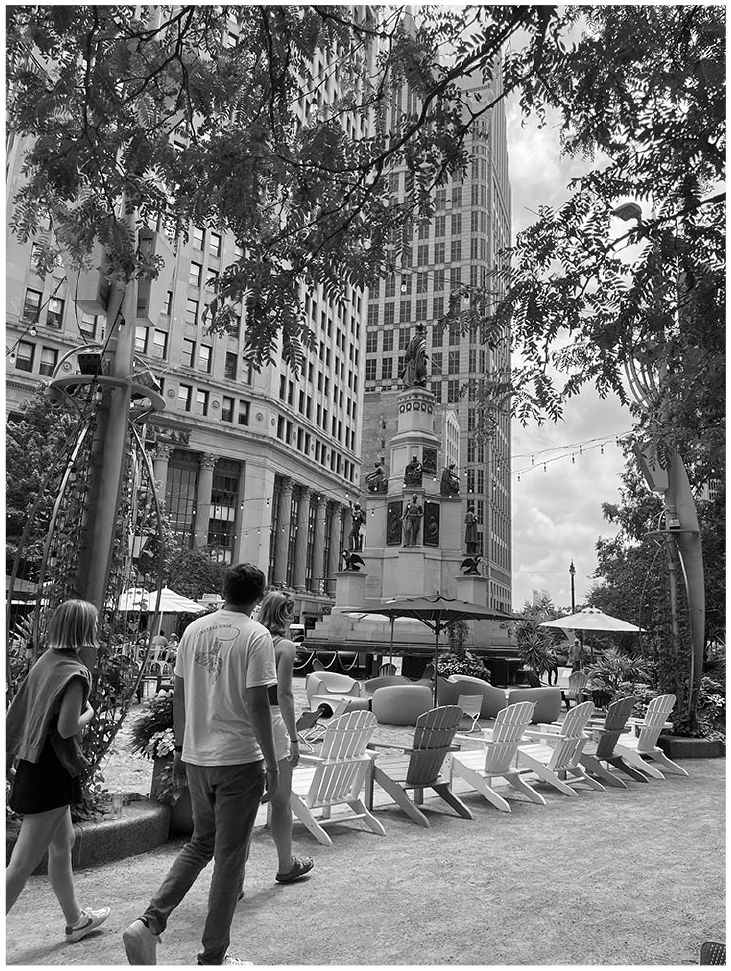
A PPS-inspired “beach” activates Campus Martius in the summer.
Beyond the significance of these technical recommendations, the plan generated a shared frame that a coalition could get behind: city officials, philanthropies, and developers. The Kresge Foundation enthusiastically embraced this vision and began its own placemaking programs. Kresge’s President articulated this support during his talk at the 2013 placemaking conference in Detroit: “The Project for Public Spaces . . . has provided the most meaningful tools we have in our tool kit to transform the places we care about.” He went on to say, “Those resilient cities will, in turn, be those that adopt a people-centered approach and utilize public spaces in ways that build connectivity, sustainability and quality of place” (Kresge Foundation 2013b). In this way, downtown placemaking brought together a coalition of for- and non-profit decision-makers who converged on the term as an uncontroversial economic development goal. Kresge had funded PPS’ Leadership Council meeting, while advocates for municipal government such as MML saw placemaking as a strategy that directed state attention toward cities (Selweski 2017). At the same time, business leaders such as Gilbert clearly understood placemaking as a policy that could spur growth in a diminished central business district.
As one senior former Kresge employee told me in a personal interview in 2021, placemaking was not exactly new in Detroit but its promise to activate the downtown economy raised its profile and brought together a coalition during a period of economic turbulence. “Actually, the Eastern Market Corp [an historic indoor-outdoor market] had brought in PPS in 1992 to develop a placemaking strategy,” this former Kresge employee said, And [PPS] had been really involved with Campus Martius. Then we [Detroit] were going to host the Superbowl in 2006 and a group of corporate leaders came together with the Detroit Economic Growth Corporation and Detroit Renaissance [a business group] to do a plan for downtown Detroit . . . to improve the neighborhoods around Ford Field. That’s the context for the early 2000s, when all these corporate leaders were working on this.
Kresge eventually took the placemaking approach outside of downtown. As the former Kresge employee put it: “Then in 2008 . . . we [Kresge] brought on Cynthia [a Kresge employee focusing on Detroit projects]. She had a really strong connection to all of the guys at PPS . . . They helped us at Kresge develop a farmer’s market strategy for the [whole] city of Detroit outside of Eastern Market. And that’s when the placemaking idea kind of took off [within Kresge].” Kresge felt that PPS developed a non-downtown expertise for neighborhood development as well: “They had a good strategy for getting the community engaged to activate a strategy of their own design. [At first] We were bringing people from outside the community when we started this [neighborhood farmer’s market] program . . . and so what PPS did was able to do draw [community] people together and draw out ideas of what they wanted to do . . . we started backfilling a lot of those efforts with money.”
The PPS informant, however, saw things somewhat differently and noted that outside of downtown, economic development was not a message that could bring a coalition together. The neighborhood markets strategy was outside of the PPS economic development focus at the time, they said. When foundations such as Kresge aimed to use the placemaking frame in the neighborhoods, “they [the community] looked at us and thought, what were a bunch of white people [from PPS] going to do . . . in these Black neighborhoods?” According to the former PPS employee, many of these neighborhood farmers markets did not take off or were not sustainable because they were in such economically struggling neighborhoods and PPS was not equipped to tackle their overlapping social and economic dilemmas.
PPS’ economic development bona fides from Campus Martius and Bryant Park had cross-sector appeal, but their economic development-centric ethos eventually fell out of favor, especially in neighborhood settings. Looking back, even PPS leadership worried about how Bryant Park and Campus Martius may have encouraged gentrification and acknowledged that while Campus Martius was used as an economic success story for many years, more recently (at the time of the interview in 2021), the organization’s embrace of equity priorities caused PPS to rethink this success. As the PPS employee put it in a personal interview reflecting on the work PPS did in downtown Detroit: “Our models are changing, the case studies are changing . . . We’ve really started to focus on how to work in low-income neighborhoods and changing our focus dramatically.” Equity and community engagement began to take center stage as PPS did more placemaking work in residential neighborhoods. “[There’s a] shift in thinking about who we’re serving. We even look now at our community engagement tools that we typically use, our place diagram . . . you start to see all these layers of kind of like bias built into them.”
The coalition fostered by placemaking’s erstwhile economic development frame brought together important stakeholders downtown, but different coalitions were required in lower-income residential neighborhoods. The economic development ethos at the heart of PPS’ model did not translate as easily in neighborhoods in which sources of legitimacy emerged from notions of community control and local history. The practices of placemaking resulted in economic development outcomes in neighborhoods outside of downtown as well. However, as the next section shows, the frame there was one of community development, expressing a skepticism of economic development. Here too, placemaking’s language of vibrant urban design and livability brought together a diverse set of stakeholders. It created value for multiple urban-coalitional actors, by elevating community engagement while appealing to the economic development priorities that city officials, developers, and community development advocates promoted. As city officials and philanthropies moved their placemaking concepts outside of downtown, they aimed to use these tools to build coalitions in neighborhoods with distinct and complex political dynamics.
The Community Development Frame: Placemaking in the Neighborhoods
North Corktown is a quiet neighborhood, sparsely populated mostly by longtime Black residents and relative newcomers of various backgrounds attracted to its abundant land, proximity to downtown, and out-of-the-way atmosphere. The dense neighborhood of wood veneer houses from the late nineteenth and early twentieth century is mostly grassy prairies or well-kept lawns today, having experienced one of the starkest forms of property abandonment and demolition in Detroit. According to 2020 census data, the tract comprising North Corktown has a population density of 2372 per square mile. In 1980, the population of the two census tracts then corresponding to North Corktown (the tracts have changed in the 40-year period) show a population density of 8,137 and 7,671, respectively. In 1980, there were around 5,500 residents, while in 2020 there were 1,382.
During fieldwork, North Corktown community engagement events appeared racially diverse, although White residents and newcomers to the neighborhood were typically over-represented. The current and former board Presidents of the North Corktown Neighborhood Association (NCNA) were both White and during in-person meetings of the NCNA a majority (or plurality) of attendees appeared White, while North Corktown was 74 percent Black according to the 2020 census. Nonetheless, the NCNA was led by a Black Executive Director and its leadership appeared to genuinely encourage and cultivate diverse participation, for example, through outreach to a historically majority Black-owned cooperative housing development in North Corktown. In addition, city officials and consultants who attended community meetings tended to be people of color and often articulated their biography as lifelong Detroiters. Participants rarely framed neighborhood problems around race or racism and residents of all backgrounds tended to emphasize the importance of maintaining their neighborhood’s character and affordability. Although this framing obscured larger structural and racial inequalities associated with neighborhood reinvestment, the section below shows why placemaking processes were productive for creating coalitions and building consensus in ways that may conceal these tensions.
Directly south of North Corktown, Corktown was cleaved from its neighbor by the 1960s construction of I-75, which ripped the two neighborhoods apart with a six-lane highway. Corktown developed as a niche, longtime area of gentrification, with historical accounts of newcomers fixing up Victorian houses as early as the 1970s (Hartigan 2000). Some longtime bars and restaurants, buoyed by the former Tiger’s baseball stadium in the neighborhood, continued to attract White, suburban visitors. In recent years, as downtown Detroit received fresh investment, “historic” Corktown (as opposed to North Corktown) also experienced more development, culminating with Ford Motor Company’s 2018 decision to invest $700 million to restore the abandoned Michigan Central train station and move its autonomous and electric vehicle employees there. Following Ford’s investment announcement, the city launched a broad neighborhood framework plan for Greater Corktown (both “historic” and North Corktown).
Together, Ford’s city-mandated community benefits agreement, along with the city’s Greater Corktown framework plan, generated dozens of workshops, town halls, engagement “charettes,” and other opportunities for resident input. In late 2020, the city completed the framework plan for Greater Corktown. In 2021, Greater Corktown won a $30 million HUD Choice Neighborhoods grant, while North Corktown received an NEA Our Town placemaking grant. The city’s application for a large grant such as Choice Neighborhoods emphasized North Corktown’s poverty but also its proximity to transportation, labor markets, and potential for mixed-income housing.
Ford’s investment in “historic” Corktown (which ballooned to nearly $1 billion) prompted the enforcement of the city’s Community Benefits Ordinance (CBO), reserved for large projects receiving city tax breaks. Members of the community chosen by the planning department, city council, and directly elected by residents negotiated neighborhood improvements with Ford. Although Ford agreed to several investments, the selection of community benefits shed light on how activities associated with placemaking may resolve tensions between the preferences of everyday residents and those of city officials and developers. City officials did not state publicly—or in personal interviews—a desire to “push through” large projects in the interest of new tax revenue or property values, but the totality of their statements and attitudes during public meetings suggested that they saw Ford’s investment as crucial to the city’s tax base.
During the CBO process, the resident-elected Neighborhood Advisory Committee (NAC) requested a $12 million community-controlled fund, to be invested and spent according to community wishes. Ford refused this benefit but agreed to deposit $2.5 million into the city-led “Strategic Neighborhood Fund” (SNF). The SNF helped fund the priorities of the city-led strategic framework process, which began after Ford’s community benefit process ended. Instead of the $12 million, the city agreed to include $750,000 for participatory budgeting. According to the city, following the broader strategic framework process (2019–2020), the $2.5 million fund helped support several activities, many of which aligned with placemaking efforts:
Developing the Ash Street Ecological Corridor with street tree plantings, installation of bike lanes, enhanced pedestrian crossings, and the tactical installation of vegetative planters
Improving the 14th Street Cultural Corridor, Rosa Parks Boulevard, and Bagley Street
Enhancing pedestrian safety along Michigan Avenue
Developing a Community Empowerment Center at the former Owen School site . . .
Unifying Roosevelt Park to create an 8-acre, contiguous public space that will provide needed amenities and serve as a gathering space for residents
Integrating green infrastructure and developing active landscapes within all proposed critical community improvements. 1
The proposed, but rejected, $12 million community fund included measures to keep low-income residents in their homes, such as rent subsidies, and named specific buildings from which residents might be displaced. It also provided resources for renters looking to own: “Residents that currently rent property within the impact area may apply for financial assistance to become property owners within the impact area in the form of low interest loans and support in receiving mortgages from third-party lenders” (City of Detroit 2018: 10). But when these requests were rejected, many CBO resources were channeled into placemaking projects such as those mentioned above; that is, projects that improved green space, public space, and landscapes. Projects such as murals celebrated the community, while pocket parks and traffic calming elements brought quality-of-life improvements that were difficult to contest. The city used other funds, such as the Choice Neighborhoods grant, to develop mixed-income housing and have plans to demolish a HUD-subsidized low-income housing development whose residents are guaranteed spots in the new, mixed-income units.
These projects aimed to add hundreds of new affordable units to the neighborhood. Taken as a whole, however, the placemaking upgrades and new market-rate housing clearly set the stage for more upscale development that benefited from placemaking improvements. While this plan benefited some low-income residents (such as those accessing new-build affordable housing in mixed-income developments), the broader placemaking improvements and Ford investments promoted an increasingly high-end retail and residential sector. And according to HUD’s Choice Neighborhoods data, fewer than half of residents eligible for one-to-one replacement housing following the demolition of older subsidized housing have ended up in replacement units in other Choice Neighborhood sites across the country. 2
Placemaking amenities could nonetheless garner support from neighborhood actors. Planning processes in North Corktown at once prompted and responded to new investment, while aiming to embed this redevelopment in community history and legitimacy. A relentless premise of community engagement activities was that of local control, resident opinions, and community traditions. The Strategic Framework meetings revealed themes of honoring the community’s history, maintaining its ecological character (e.g., open green space such as prairies in North Corktown), and providing benefits to lower-income residents. Rhetorically, these efforts celebrated what was “already there” and aimed to elevate community assets. As the Detroit Design Director said during a July 2020 community meeting, “We’ve heard repeatedly that there is a strong and concerning sentiment . . . that the affordability of this neighborhood will not be attainable for everyone.” He then voiced over a slide with the title “Framework Purpose,” which suggested that the plan would promote “inclusive growth” to “preserve its character and heritage.”
But when community members asked for material benefits, rather than symbolic displays (such as landscapes or street art), the response was less accommodating. For example, neighborhood residents wanted to purchase more “side lots,” empty lots that abutted their properties. The Detroit Land Bank, a quasi-public agency, maintained a side lot program but tended to hold on to property in promising housing markets (Alvarez and Samuel 2018). Residents displayed frustration that while lighting, parks, housing, and streetscapes moved forward, the ability for them to purchase these side lots appeared stalled.
The longtime director of a local cultural organization, Linda, articulated this during an April 2021 Zoom implementation meeting: What I continue to hear from residents is they need a way forward in terms of achieving their projects and achieving their needs. And the overarching message has been for us [residents] to wait . . . A lot of times . . . one partner has to wait until the other partner achieves their objectives. Then the second partner’s objectives might not be met. . . . It’s really important that some of the things that we’re asking for get achieved.
The city’s Design Director responded, “The Land Bank’s had some analysis they’ve began to do on side lot sales,” he said, and this meeting could not address all the activities going on behind the scenes.
Linda’s language of partnership suggested how community development relied upon a coalition and incentivized the uptake of consensual language. Linda’s organization eventually received funding through the city’s Choice Neighborhoods grant, which allowed the non-profit to build a permanent home. The office space would house the non-profit’s activities but also contain retail and community spaces, the programming of which became part of the neighborhood engagement process. During one engagement session in August 2023, residents got to speak with designers and consultants about the retail they wanted to see at this complex. The engagement fair also sought input for several placemaking activities for which the city received feedback on activations such as landscaping and street designs. The new complex would also house a permanent office for the NCNA, which promoted this event and many of the community engagement events at which placemaking tools were used. The NCNA had received placemaking grants from the State of Michigan and Community Foundation of Southeast Michigan for pocket parks, including the one where this community engagement session took place. In short, this event brought together city officials, engagement consultants, and non- and for- profit developers in ways that enhanced their authenticity by allowing residents to provide input on mostly non-binding decisions (such as retail preferences) and aesthetic matters such as landscaping.
Placemaking processes allowed multiple actors to identify convergent interests and it was able to so because it was not rigidly prescriptive or overtly political. However, for this reason, placemaking’s tools of consensus did not work as well when competing interests were articulated. This was the case during a 2020 meeting when the framework plan was first being developed. During that meeting an interesting exchange occurred with the city’s Design Director along with his colleague from the mayor’s office. Melinda, an elected leader of the NCNA and an advocate for green space, got into a rare public spat (over Zoom) with these officials. After they unveiled a plan to include 25 vacant lots into a community open space initiative, which would be managed by the NCNA, Melinda, a highly educated resident who appeared to be White and in her 30s, openly declared that this was insufficient. She argued that the city controlled more than 500 lots in the neighborhood and 25 was not sufficient. The representative for the mayor’s office shot back with surprising stridency given that this was an interaction with a community member. He suggested that this was already a hard sell with the mayor and if residents like Melinda and the NCNA did not show support for this limited amount of community managed space, it might not get pushed through at all. The conversation got heated, with Melinda at one point suggesting that city officials wanted her to “be happy and shut up.” At another point, the city’s design director argued that other residents wanted a Target in the neighborhood, suggesting that this limited greenspace was already a compromise and far more intensive land uses may have been on the table.
The mayor’s office and official planning apparatus required the consent and contributions of groups like the NCNA. But contrary to the purported ethos of these meetings—i.e., officials trying to understand “what the community wants”—this episode revealed how local officials sought to choreograph community engagement to the tune of existing priorities. Appealing to the explicit desires of the mayor was a rare public indication of this dynamic. During a 2023 in-person community meeting it was revealed that eight parcels would become an NCNA-administered community land trust with the idea of converting them into a bird habitat. Another set of parcels would pilot the development of nine modular homes.
This episode shed light on the coalitional politics characterizing community development and the role of placemaking in these processes. Placemaking activities may bolster private development and be useful to city officials aiming to increase neighborhood amenities. Crucially, these activities are also likely to garner support, or at least little opposition, from longtime residents, non-profits, and community development organizations. City officials were happy to let residents make decisions about landscaping and artistic interventions (see Figure 4), even as they rejected local control of financial resources, such as the $12 million proposed fund.
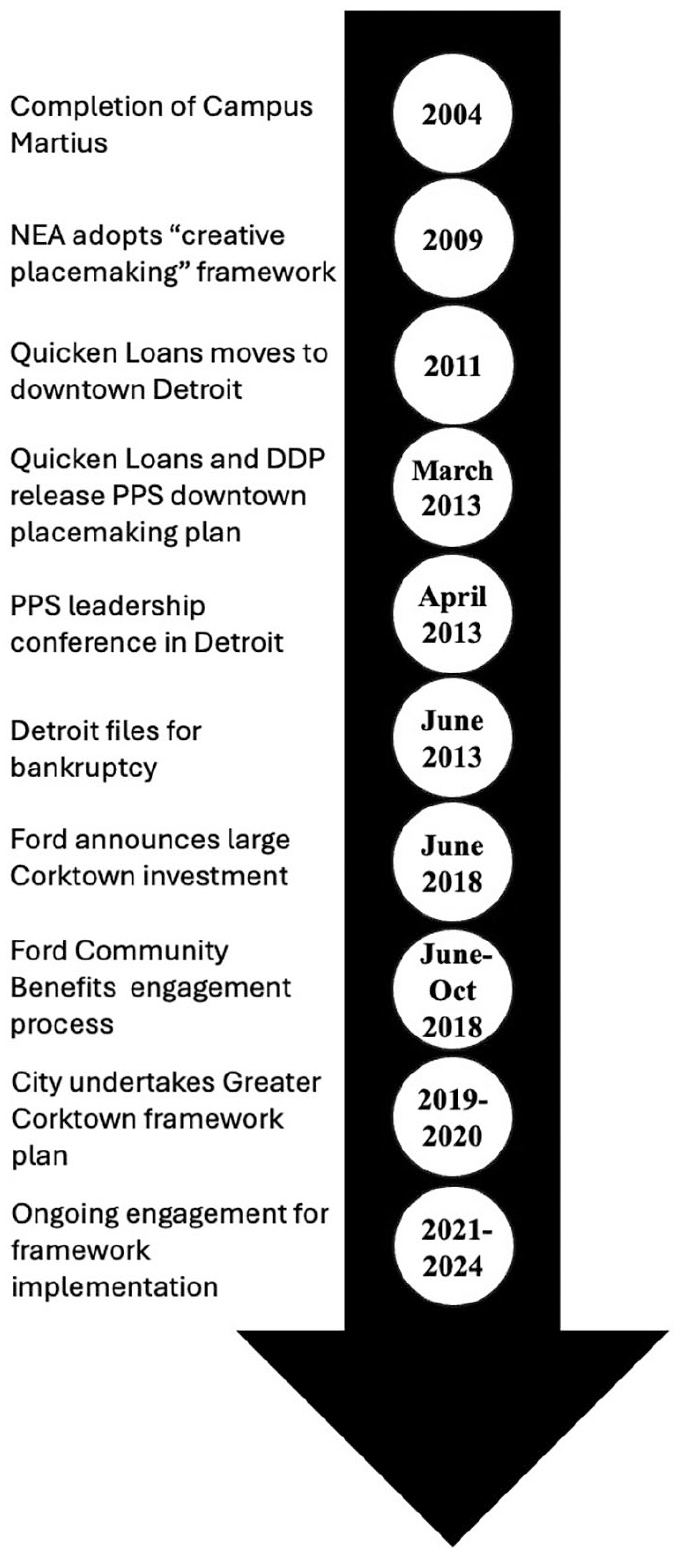
Timeline of major placemaking and engagement processes downtown and in North Corktown.
A concept like placemaking—which the 2019-2020 Greater Corktown Framework explicitly engaged as a key concept—aimed to preserve the neighborhood for residents and their traditions. This resulted in murals and some smaller green interventions in the neighborhood. For example, in 2021, the Michigan Economic Development Corporation (MEDC) provided the NCNA a matching grant to support two pocket parks in the neighborhood through its placemaking grants (see Figure 5; Michigan Economic Development Corporation 2021). These initiatives did not replace other city priorities. New housing and amenities were planned with fewer explicit invocations of placemaking (although the term did come up as a tool to enhance these developments). Yet, placemaking bridged many of these activities and its ethos of community engagement helped make housing and new amenities politically viable by supporting the legitimacy of the broader process. This process brought together divergent interests and connected different actors within the community development field. City officials concerned with the tax base could support participatory initiatives that improved the built environment to attract newcomers and improve the conditions of longtime residents. Community based non-profits saw the history of their communities and members elevated. At the same time, for-profit developers could align murals, greenspaces, bird habitats, or pocket parks with new development. These nods to the history and uses of the neighborhood papered over controversial economic development priorities (such as building market-rate housing) and converting more of the neighborhood from open space to housing and retail.
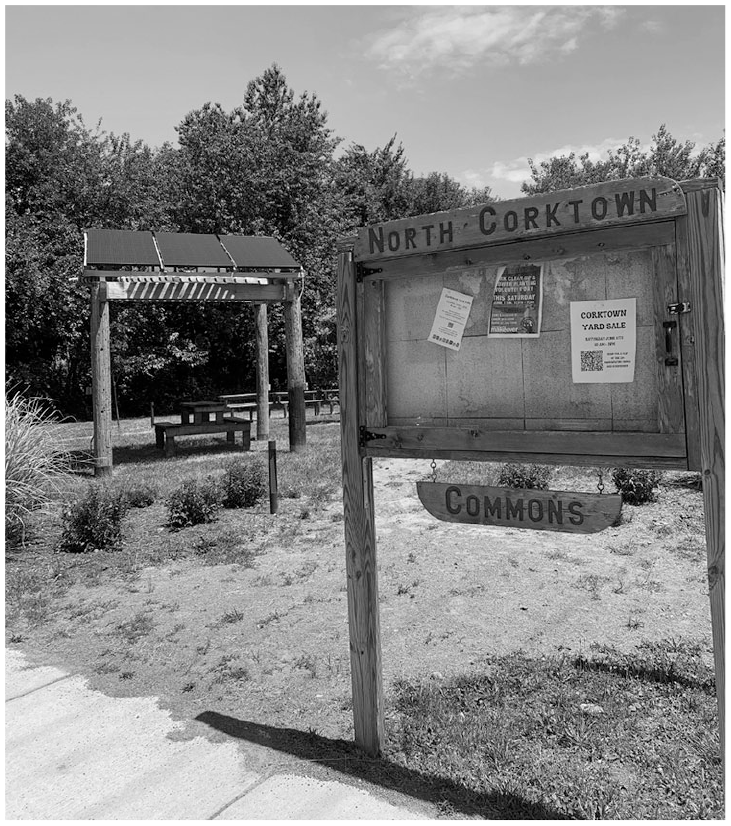
North Corktown Commons, a recipient of placemaking grants. Community members designed and implemented the pocket park with funding from the MEDC.
The public investments these processes portended, and the private investment they spurred, became clear during an in-person, NCNA-organized public meeting in May 2023. Developers proposed an unsubsidized rental building in North Corktown. This was the first new-build, unsubsidized housing built in the neighborhood in the twenty-first century. It was one of the city’s few developments over the last decade not to seek tax abatements. Typically, the city requires community engagement when tax abatements are sought, whereas this building owner had to organize a public meeting because they sought a zoning variance to accommodate a parking deck.
But residents at the meeting had internalized the ethos of community participation. They appeared to believe that the community could and should decide what developments happen in the neighborhood. A few questioned the lack of affordability. Others were concerned with parking. An activist wearing a “Fuck Corporate Corktown” t-shirt promised to “make life hell” for the developer. The developer’s representative stated that they wanted to be “part of the community.” At a separate community meeting the following month, the architect quipped that they were “totally transparent” and encouraged the community to stop by their office. Yet, unlike the placemaking-centric neighborhood framework process, which promised to represent the experiences of the community, the market-rate housing that such processes resulted in left little room for resident control. The developer’s representative not only agreed to bring parking concerns “to the architects” during the May 2023 meeting, but also signaled that they were merely seeking a variance and there was little ability for the community to alter the project.
In the end, the participatory ethos characterizing these processes appeared limited to placemaking interventions such as green space and streetscapes. City officials gained consent and input from residents, while not disrupting the market-aligned development that continued apace. At one point during a June 2023 meeting, a city planner gave an update: “We’re working with you guys on open space and green stormwater infrastructure,” she said. “As new developments come, we need . . . to make sure that the system isn’t overloaded with water because of the runoff . . . and then we’re doing some streetscape improvements . . . and a greenway . . . But we want your community feedback . . . We’re in the planning phase so we really want your input on what you guys want to see there . . .” Although residents could provide feedback on streetscapes and local traffic issues, decisions about the neighborhood’s broader transformation depended on market forces, buoyed by public investments.
During one NCNA engagement fair in the summer of 2023, residents appeared pleased with neighborhood changes such as the parks, landscape, and streetscape upgrades. Amid free food, giveaways (based on accomplishing several engagement tasks), and music, residents placed dots on large boards to note their preferences for the neighborhood. The options consisted of interventions such as more pocket parks, landscaping, and sidewalk improvements. Although the event felt vibrant with roughly 40 people in attendance, nearly half were practitioners from the various architecture, landscaping, developer, and community engagement teams. A non-profit developer mentioned to me during the event that scaling back residents’ demand to meet the available resources was one of the toughest parts of her job. Sometimes, she said, “what the community wanted” cut against the desires and resources of city officials and developers. In the end, the event highlighted residents’ role in placemaking decisions, understood as interventions in the public spaces of the neighborhood, which involved a relatively engaged strata of residents with pre-determined development options open to their input. This use of placemaking mitigated critique of development without significantly changing its goals.
Discussion and Conclusion
This article explores the uses of placemaking in distinct development contexts. Diverse actors and coalitions have come together around shared placemaking frames that are improvised for different settings and respond to the priorities of economic development and community legitimacy. Everyday residents participate in the placemaking process, but placemaking also enables development-friendly coalitions to profit from new growth while highlighting benefits to existing residents. The shifting practices of placemaking reveal the degree to which coalitional politics shape the strategies of local officials, developers, and community organizations. Increased public attention to issues of urban inequality have presaged a shift from placemaking processes that center an economic development objective to one that highlights community decision-making; from placemaking’s traditional implementation in downtown public spaces, to a set of participatory tools increasingly used in neighborhoods outside downtown.
In downtown Detroit, a coalition of developers, philanthropy, and government officials invoked placemaking’s role as an economic development policy in the 2000s and 2010s. A decade later, in a residential neighborhood, an expansive coalition of non- and for-profit developers, community organizations, and local officials deployed an alternative usage, highlighting a community development frame that connected plans for housing, public space, and land use, and made them politically viable in North Corktown. Placemaking processes allowed these actors to identify convergent interests that aligned with dominant players in the field of urban development—from HUD to national philanthropies.
Despite divergent contexts and coalitions, placemaking’s malleability and lack of prescriptive solutions, along with its ethos of community participation, aligned heterogeneous actors within the community development field. Placemaking symbolically elevated the histories and affective ties of residents, even as these practices did little to deter—and may have encouraged—future development that displaces longtime residents. Placemaking processes may bend in the direction of gentrification, but they also establish the legitimacy of the community engagement process. As a result, placemaking signals a tension in U.S. housing and community development policies. When competitive grant processes and dominant community development strategies reward mixed-income neighborhoods in contexts previously characterized by high levels of poverty, officials dutifully aim to generate new amenities and housing that will appeal to higher income newcomers. At the same time, these actors locate sources of community legitimacy through practices that symbolically frame longtime residents as the authentic representatives of these neighborhoods (Levine 2016). Rather than reflecting an ideological commitment to market-centric or neoliberal urban development per se, local officials pursue placemaking approaches that have been structurally incentivized by resource-rich actors in the field of urban and economic development, such as federal and state grantmaking and philanthropy. Placemaking productively aligns these actors into coalitions capable of promoting new growth.
Key placemaking practices such as murals that commemorate local figures or memorialize neighborhood history help paper over these contradictions. Such practices are hardly antithetical to new development, which may benefit from community displays that are suggestive of an authentic past or storied tradition. City officials seek to satisfy the housing needs of lower-income residents, but they aim to do so by building mixed-income housing, often proximate to stronger land and real estate markets.
As both these cases show, placemaking integrates with new development, but more specifically it is a coalition building tool that facilitates the alignment of diverse actors in a field comprised of local officials, for- and non-profit developers, community organizations, and philanthropy. Its focus on livability and participation reflects a shared concern for the legitimacy of the planning processes, while placemaking’s facilitation of market-aligned growth generates support from developers and city officials aiming to grow the tax base. The sources of legitimacy that a placemaking approach enables may be different in distinct contexts such as downtown versus residential neighborhoods. Yet, as an expert discourse with high levels of support among resource-rich actors, placemaking aligns diverse stakeholders to promote new growth. In the end, placemaking processes may channel community participation into debates around smaller-scale physical interventions, while more significant sources of conflict recede from these participatory processes. As this article notes, however, residents who call attention to the importance of material resources over symbolic displays may be capable of interrupting placemaking processes that result in inequitable growth.
