






Abstract
Letta Page speaks with Seth Abrutyn and Amin Ghaziani, outgoing editors of Contexts, about the job of talking about society with society.
To round out our yearlong series of chats with all of the former editors of Contexts, senior managing editor Letta Page spoke with co-editors Seth Abrutyn and Amin Ghaziani (2023-2025) about stewarding the magazine through its last years as a print publication and setting it up for success as it goes online-only for its 25th volume. Noting that their vision took “a little time and a lot of care” to execute, they focused on how diversifying the public face of the discipline, communicating scholarly findings in accessible ways, and working to reach the public urged them, like the best of our contributors, to become ardent ambassadors of sociology. Indeed, their shared enthusiasm and commitment shone throughout their interview—and Abrutyn and Ghaziani’s tenure as editors.
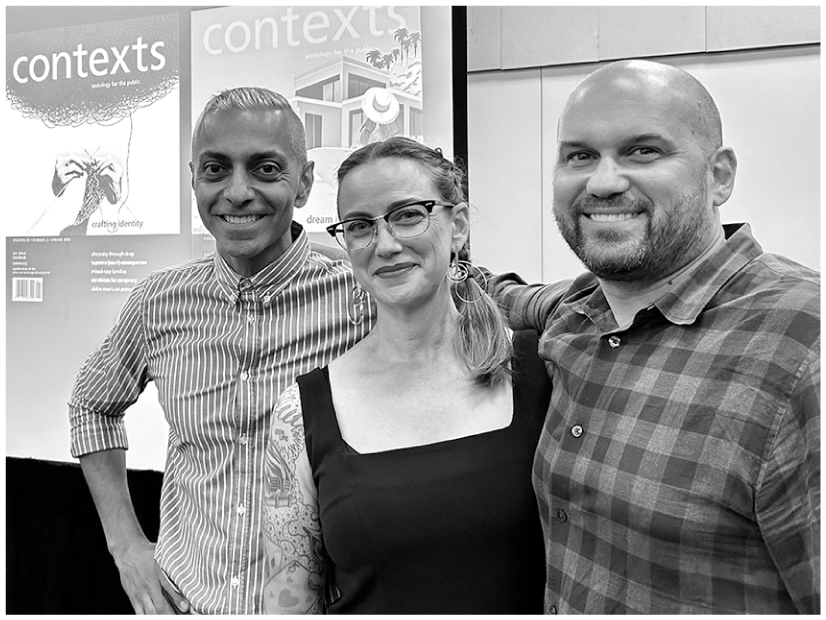
Amin Ghaziani, Letta Page, and Seth Abrutyn
Courtesy Letta Page
I think we definitely accomplished our goal of articulating a global sociological imagination. The biggest surprise, for me, came from navigating the space between our vision for the magazine and the submissions we received. We can’t tell people what to write, nor can we only publish pieces that embrace international perspectives. How then could we realize our editorial vision? That process of finding our footing, of communicating sociological research in accessible ways while remaining steadfast in our desire to diversify the public face of the discipline beyond the United States, took a little time and a lot of care. We needed to get the word out about what we were trying to do, and we needed to be patient for people to hear the message. Ultimately, I think we benefited from some combination of preparation, since something as abstract as a vision doesn’t just manifest by itself, and opportunity, since we can’t control everything, no matter how well-prepared we are.
“I believe that sociology for the public is, and should be, a key part of our professional ethos.” AMIN GHAZIANI
Contexts is the only public-facing periodical that is published by our professional association. This makes the mission of the magazine harder to realize. Personally, I believe that sociology for the public is, and should be, a key part of our professional ethos—but not at the expense of basic research. A diversity of communication channels is a good thing. We should celebrate all expressions of our discipline, and ways of communicating our findings, equally for what each does, rather than rank-ordering them in a hierarchical value system, as if either science or society is singularly more important than the other.
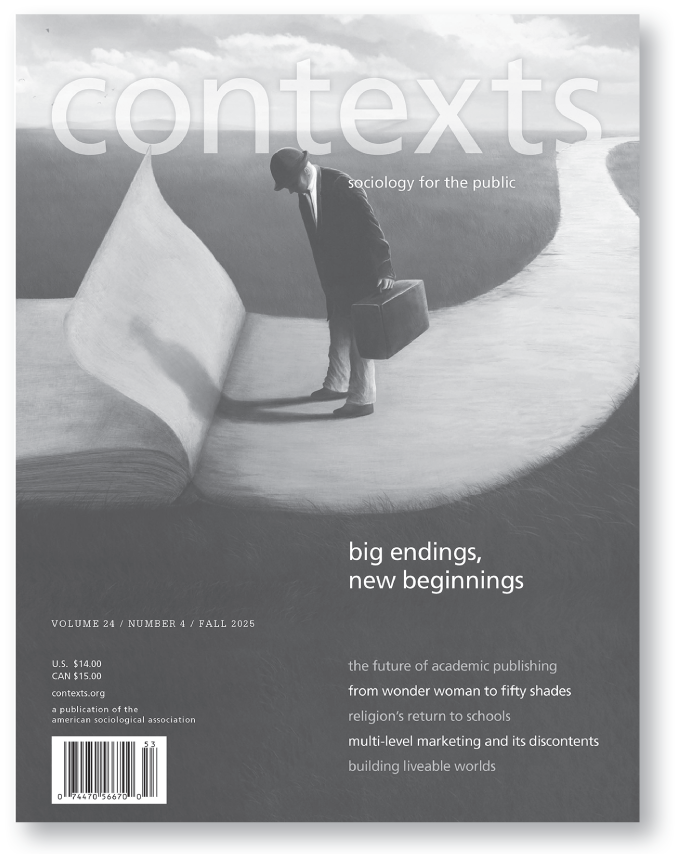
Once we curated all the moving parts for a respective issue, we invited a small number of distinguished researchers to meet the moment by tackling something in the news that had captivated national and international interest. For our first issue, that meant reflecting on the U.S. presidential election. Trump’s out-of-the-gate attacks on diversity, equity, and inclusion, or DEI efforts, inspired the special section of our second issue, where writers examined the business case for DEI, its implications for health care, and how DEI shapes science. For the third issue, we took seriously our location in Canada and created a special section on the increasingly strained relationship between us and the United States. Three Canadian sociologists, including the president of the Canadian Sociological Association, reflected on what it means for us here in the True North to put our “elbows up.” The timely special section in the final issue of our editorial term anticipates the transition of Contexts to an online-only format by asking sociologists, both within the academy and those who work outside of it, like book and developmental editors, to think about the future of academic publishing.
As I reflect on it now, I think the experiment was a great success. These special sections are exhilarating to read as our writers offer real-time analysis and commentary on some of the most pressing and timely social issues of the day. They demonstrate the capacity of sociologists to be at once analytically rigorous and publicly relevant.
With so much excellent social science being produced across so many journals, we have to work hard to reach the public by translating our findings in accessible and narrative-driven ways. Assuming we’re all on board with the public-facing mission of the magazine, how do you do it in a fresh way? On this matter, I’m happy to share something that the three of us—you, Seth, and I— worked together to come up with, and that’s a memorable rhetorical device to guide our authors. As you write, always keep in mind the “4 Rs.” Be rigorous with how you do your research. Ensure that it’s relevant for public audiences. Write it up in a way that’s readable. And finally, never forget that your authorial voice makes your work rad! Contexts grants you a creative power seldom seen in traditional academic journals. Own it!
If you review all the issues in the current calendar year, you’ll see that we used the Q&A section to spotlight all of the former editors of Contexts. We asked each team about their hopes and dreams for the magazine, their sense of where and why they may have fallen short, and their advice for future editors.
These conversations are an extraordinary resource. They contain a treasure trove of ideas, tips, and tricks for what it means to do public sociology and how to do it with style. From my point of view, what’s top-of-mind is so much bigger than only what Seth and I think, although our experiences are important to bear in mind. But in this moment, I want to emphasize our perspectives as part of a throughline that connects insights that have emerged across all prior editors of this incredible magazine that we have curated and loved over the past 25 years.
“ Contexts provides one key path to promoting the science and craft behind sociology, as well as its unique capacity to teach us (humans) about our historical, cultural, political, and economic environments.”
To be vital, we need to be intentional—and intentional about many things, from how to reinvest the economic resources we redirect away from print to how to better market the magazine to increase its visibility in places beyond universities, how to identify the strategic advantages of an exclusively digital platform, and then how to actually exploit those specific advantages relative to the thing we actually create.
In this regard, I think the magazine would benefit by having at least one full-time member of the editorial team who is not a professional academic. The transition requires a diversity of inputs. If everyone who works on the magazine is an academic affiliated with a university, then we are doomed to live and work in a silo or in an echo chamber of what public sociology means, how to do public sociology, and how to improve the scope, scale, and reach of our public efforts.

vectorkhazana.com