






Abstract
With democratic institutions under attack, cities recognize an urgent need to rebuild public trust in government. In New York City, a restorative justice approach is helping to connect civil servants and the public as they navigate everyday conflict in urban settings.
“I’ve made a terrible mistake.” This is the main thought running through my mind as the talking piece makes its way around the circle. It’s a Saturday morning at New York’s Riverside Church, where over 200 restorative justice practitioners have signed up for a day-long meeting on reimagining safety and belonging. I listen as fellow circle members respond to the prompt for this round: reflect on a time when your community acted in a way that didn’t align with your values. It’s been about a week since the 2024 presidential election, and, like the others, I have no shortage of material to draw on. But I’m anxious because I’m not sure what I will say when it’s my turn, and I dread leaving the comfortable role of professional observer. After my turn, I feel an unexpected relief at having had a long-held professional grievance acknowledged by this group of compassionate strangers.
I attended the Restorative Justice Institute’s 6th Annual Citywide Roundtable in November 2024 as part of an ongoing ethnographic study of conflict resolution among NYC civil servants. The event, co-sponsored by the city, brought together community groups that apply restorative approaches to a wide range of issues, including school discipline, neighborhood violence, and gender equity. Restorative justice is rooted in Indigenous practices and aims to address harm by repairing relationships. Within this framework, a circle is a community-building process in which everyone listens while the talking piece, a visual marker of whose turn it is to speak, makes its way around the group of participants. A key element of restorative justice is acknowledging harm, and several panelists at the event recount how they use circles to build community power in response to harms perpetrated by the city.
While restorative practices have been widely applied in criminal justice reform, New York City is unique in the way it seeks to weave the approach into its civil service workforce development. An executive order signed in 2021 expanded the city’s Center for Creative Conflict Resolution at OATH as a resource for bringing restorative practices to bear on the way its employees work with one another and engage the public. Over the past two years, I have talked with the Center’s conflict experts, sat in on training sessions, and observed city workers in their public-facing roles. Through formal in-depth interviews and informal participation in city-sponsored events, I have gotten to know civil servants across many agencies—among them, attorneys tasked with presenting new land use guidelines to the public, foresters who care for the city’s tree canopy, and operations staff who work to maintain public spaces.
Like the welfare case workers that sociologist Celeste Watkins-Hayes profiles in The New Welfare Bureaucrats, New York City’s civil servants bring their occupational and social identities to bear on the way they enact organizationally defined roles, including the way they respond to conflict on the job. Substantive expertise and adherence to procedure are sources of occupational pride for civil servants, as are civic ideals about the way their work contributes to the common good. Yet conflict with the public can be made worse by bureaucratic forms of communication that emphasize expertise and procedure. A restorative lens creates opportunities for mutual understanding and seeds of participatory governance.
On a recent Saturday morning, over 200 restorative justice practitioners signed up for a day-long meeting on reimagining safety and belonging at New York’s Riverside Church.
iStockPhoto // Steve Rosenbach

restorative practices and trust in government
With democratic institutions under attack, there is an urgent need to rebuild the foundations of trust in government. The Pew Research Center estimates that fewer than a quarter of Americans trust the government in Washington to do what is right always or most of the time. State and local governments fare better in the public’s estimation, but still, only about 20% of respondents in a recent poll said they had a great deal of trust in their state or local government to handle problems. While nearly 90% of Americans agree that having a competent and nonpartisan civil service is important for democracy, only about 50% of people who took part in a recent survey agreed that the nation’s civil servants were competent and committed to helping people like them. A March 2025 poll found that 40% of registered voters approved of the way Donald Trump was handling the federal workforce. Lack of trust in the transparency, efficiency, and accountability of government can erode forms of civic engagement that, as Tocqueville famously observed, sustain the democratic skills and values at the heart of the American experiment.
Within the restorative justice framework, a circle is a community-building process in which everyone listens while the talking piece, the visual marker of whose turn it is to speak, makes its way sequentially among the participants.
iStockPhoto // monkeybusinessimages

Building trust is central to the work of New York City’s Center for Creative Conflict Resolution. According to its website, the Center “seeks to transform the harmful potential of conflict into opportunities for improved communication, enhanced relationships, greater public trust and positive change.” While it offers services such as mediation in response to specific instances of conflict, the Center also seeks to build greater capacity for navigating conflict among city workers through professional development trainings. The Center’s Director, the Honorable Raymond E. Kramer, explained that creating “a sense of safety, trust and rapport” is a foundation for mutual understanding that can produce new opportunities for collaborative problem solving.
Engaging conflict by inviting full participation can be beneficial for relationships between government actors and the public.
One of his colleagues added, “Groups need more than just conflict resolution. They need good practices, good habits in order to prevent [conflict] or even help them become more resilient or responsive in the face of conflict.” With those goals in mind, the Center offers trainings on active listening and relationship building, including the use of restorative circles, to equip New York’s civil servants for the relational work of city governance.
defusing conflict in public spaces
There is no shortage of conflict in public sector work. In New York City, employees in resource-strained agencies seek to maintain legal standards for services, promote transparency and public engagement, and enact their personal visions of the common good. For some civil servants, their work also includes responding to public dissatisfaction with the level or type of services they are able to provide. A former maintenance worker who now oversees program operations at an understaffed agency reported, “All of our buildings are breaking regularly, we really have a crisis of capital needs and repairs.” Understandably, this situation causes conflict with the public. The problem, according to a supervisor who started out as a seasonal worker, is the sheer scale of the cleaning and maintenance that his crews have to accomplish during each eight-hour shift: the public doesn’t “understand that math” and instead they “look at it as neglect.” I heard from many research participants that residents routinely yell and occasionally threaten them with violence when their work brings them into the community. Operations workers who maintain the cleanliness and accessibility of public spaces often feel “unprepared or untrained” for that conflict, and encounters with an angry public can escalate because, according to one supervisor, “some staff don’t know how to really accept verbal attacks.”
An operations supervisor told me that a simple technique called “looping,” which she practiced at one of the Center’s half-day training sessions, has improved the way she interacts with the public. As I learned from participating in a similar session with Center staff, looping entails a shift in listening objectives—a shift away from response and toward acknowledgment. With this approach, the listener resists the initial impulse to try to solve a problem and the tendency to become defensive when unable to do so. Looping means repeating back what the listener has said and confirming understanding with language like, “It sounds like you are feeling…” and “Did I get that right?” Looping serves to de-escalate tension through acknowledgment, and it is a critical skill for employees whose work in public spaces is often interrupted with hostility.
engaging conflict in public meetings
Engaging conflict by inviting full participation can be beneficial for relationships between government actors and the public. One supervisor at a small agency reported that the Center’s training “makes you listen differently.” She explained: “Lawyers, we are so trained to listen, to identify what we agree with and what we don’t agree with, and to anticipate how we’re going to respond, and to find holes in what people are saying. That’s important training, and it’s useful in a lot of contexts, but it’s certainly not the only way that people need to learn and listen... Eliminating the expectation that it’s a conversation, that you need to respond to what’s being said, allows you to listen in a very different way.”
Listening to understand, including by acknowledging harm experienced in a resident’s ongoing relationship with the city, can be a building block for more trusting encounters. This same supervisor leaned heavily on her training with the Center when called to facilitate community meetings on land-use policy. Recounting a particular meeting in which she integrated elements of restorative circles, she told me that her goals were to make people feel heard and encourage everyone to participate. Unlike a traditional meeting format in which participants claim a turn to speak by raising their hand, with facilitators holding the tacit authority to respond to each speaker, a restorative circle follows an established sequence in which everyone is offered the opportunity to respond to the same prompt while others focus on listening. At regular community meetings, this supervisor observed, “the lawyers talk over everything.” But at the circle-based meeting she facilitated, the dynamics were different. She recalled, “I got emails from almost every non-lawyer who had been at the meeting afterwards, thanking me. They were grateful not only that I had heard them, but they felt like their own lawyers had heard them back. … I am so proud of that moment.”
Having attended many city-led community meetings in the course of this fieldwork, I can attest that there is a greater breadth of participation and apparent depth of listening in meetings led by facilitators who adopt techniques informed by restorative principles. Yet earning the trust of residents whose communities have historically been excluded from the municipal policy process requires more than active listening and respectful dialogue. A city employee who has trained with the Center and whose job entails building conflict capacity among his agency’s staff gave the following account: “A lot of the work that we do here is us interacting with the public on major projects that affect their lives. …Usually, what happens when [staff] go in the public, they encounter people in the communities who have a lot of racial trauma from the past… ‘Now, you’re coming back into our communities and telling us that we need this store or this building… What do you know?’...A lot of the [staff] don’t know how to handle that.”
The Center is advising this agency on an employee curriculum that draws on restorative principles to acknowledge the harm of past policies that deepened racial and spatial inequalities. Acknowledging the reasonableness of residents’ anger is a start, but what occurs during a meeting on playground reconstruction or transportation equity is ultimately less important for building trust than what comes next in the government’s responsiveness to community input and delivery of services.
Earning the trust of residents whose communities have historically been excluded from the municipal policy process requires more than active listening and respectful dialogue.
iStockPhoto // deberarr
conflict and expertise in policy implementation
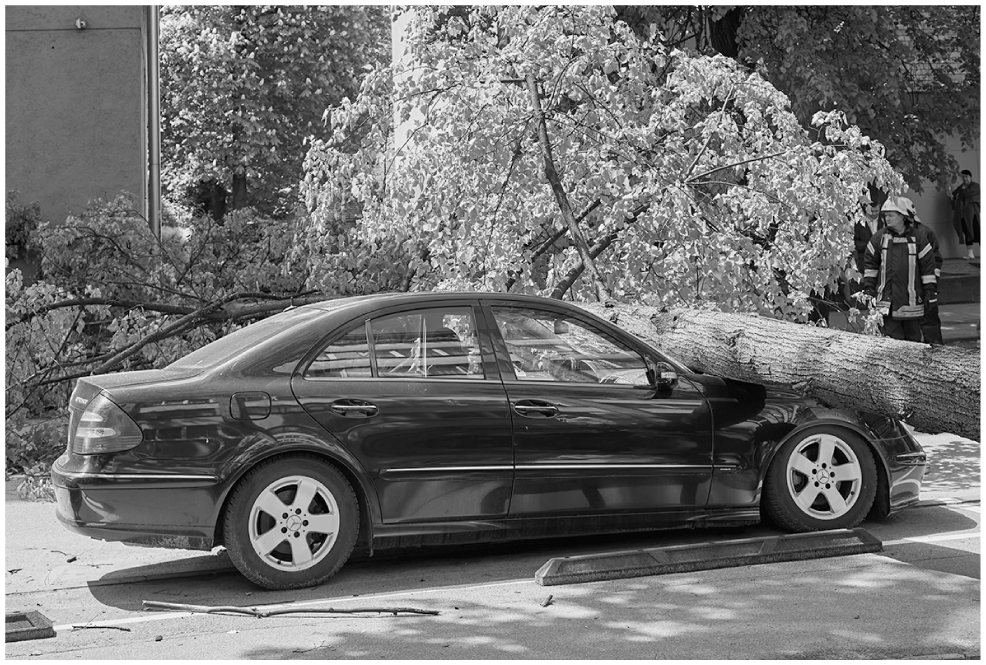
Trees are, perhaps, an unexpected source of conflict in urban governance. However, about 16% of all 311 calls routed to the Parks Department concern trees and tree-related problems, according to my analysis of NYC OpenData. Residents contact the city’s 311 system when they fear tree branches will become a hazard, find that tree leaves are clogging their property’s drainage pipes, or observe sidewalk cracks that they believe are caused by tree roots. Trees can also cause conflict over building permits because residents and developers whose projects may impact existing trees tend to see removal as the preferred way to deal with the problem.
Listening to understand, including by acknowledging harm, can be a building block for more trusting encounters.
When I asked a supervisor who oversees tree maintenance about conflict on the job, he told me that just the previous day, a homeowner got “a little bit violent” and “the police needed to get involved.” Other foresters shared that residents have physically blocked tree beds, screamed at them, and made threats that caused them to feel unsafe. The foresters’ job is to maintain and extend the urban tree canopy, and they take great care to explain to the public why department procedures prioritize preservation of existing trees. One forester shared, “[The trees] are providing more shade. They’re absorbing more groundwater. They’re absorbing more pollution, right? Like, there are so many… benefits of trees, and it only grows as the trees get bigger. They’re providing more habitat for birds and different animals that live within our city. …So we never wanna remove a tree that doesn’t need to be removed.”
Trees are, perhaps, an unexpected source of conflict in urban governance, but about 16% of all 311 calls routed to the New York City Parks Department concern trees and tree-related problems.
iStockPhoto // JTeivans
Foresters bring a wealth of expert knowledge about tree health to their work. They embrace their agency’s understanding of trees as a form of infrastructure that enhances neighborhood equity and promotes climate resilience. Yet they find that sharing their expertise and program aims can be ineffective as a strategy for de-escalating conflict with residents. As one forester explained, “Sometimes I kind of explain to [residents] why is there going to be a tree here and I’m like, ‘Hey, this is a citywide initiative. You know, there’s people who, like, die every summer from, like, heatstroke or some heat-related illness. This isn’t a cure-all thing, but it is definitely something that every city in the United States is, like, utilizing to try to, like, cool down their cities, and so…’” The forester trailed off, shaking his head. “I mean, some people just hear kind of what they want to hear, you know?”
Encounters between civil servants and the public are boundary sites where both parties’ democratic skills are forged and trust in government is earned—or not.
What often does work when tensions run high is the looping technique the Center includes in its conflict training. One forester told me that he likes to “listen to people, … try to hear them out, … and then ask questions, follow-up, you know? Maybe like, ‘Hey, so am I getting this right, that X, Y, and Z?’” It is at that point in the encounter that he turns from de-escalating the conflict to his “talking points” and “ways to help.”
A key question is what happens in the space created by conflict de-escalation. Workplace sociologists are very familiar with the way organizational practices that aim to build connection, like human resources management, can be used to coerce workers and contain collective action. Some observers may wonder if looping and restorative circles are similarly used by the city to secure consent for a non-inclusive process with inequitable results. Yet rather than approaching conflict as a pathology to heal or dampen through the exercise of interactional power, restorative practices take an agonistic view of the possibilities that emerge from engaging difference.
in the public interest: bureaucratic and civic elements of public sector work
Conflict with the public can afford government workers an opportunity to examine the civic identities that inform their bureaucratic roles. Explaining the frustration he sometimes feels with the public over his unit’s work to plant more trees, a forester complained: “I kind of also, like, do have this fundamental belief of government, and like, why we have a government. And that’s maybe a little, like, macro, but… We don’t go around asking each house, ‘Do you want a stop sign at this intersection?’ Right? … ‘Oh, is this a good place for a fire department?’ The trees, yeah, it’s a little bit of an extraction from that, but, like, it’s for the good of everyone.”
To his mind, there is a clear place for expertise in urban governance, and part of that expertise is the ability to zoom outward from the individual to envision and advance a common good. One challenge is communicating that purpose to the public in a way that is responsive to distrust earned by the incumbents of other government roles. Another is balancing formal expertise with the forms of community-based knowledge that emerge in different stages of the policy process.
Conflict between civil servants and the public can shape both parties’ thinking about government services. Following a root assessment in which the homeowner expressed his desire to be present for the subsequent sidewalk repair, a forester described her initial reluctance to have him present on site: “I’m like, ‘Actually, please don’t do that. Like, we don’t really need your input on what’s happening. Like, we are the experts here. You are not.’” The forester chuckled, then continued, “Um, but… he was just really curious about the process, not really like trying to micromanage, which is awesome. And he came out at the end and said, ‘Thank you guys so much. Like, I really appreciate the fact that you guys are out here and doing this. Like, I didn’t think this would ever actually happen.’ And the thing he said that really stuck with me was like, ‘I finally understand why I’m paying taxes,’ which was really cool.”
Only about 20% of respondents to a recent poll said they have a great deal of trust in their state or local government to handle problems.
iStockPhoto // TC Franco

These accounts underscore the potential for conflict-laden encounters to promote greater understanding between government workers and the public. Civil servants steeped in the bureaucratic language of expertise and procedure—and guided by performance metrics that reward efficiency—get to experience first-hand the limits of their expertise. With a restorative lens, the benefits of slowing down to engage the public in their work become more evident.
Sociologists Paul Lichterman and Nina Eliasoph have argued that civic action can occur anywhere people understand themselves to be acting together to improve some aspect of society, including in spaces or roles that were not explicitly intended as such. While civic action is distinct from the work of government officials, encounters between civil servants and the public are boundary sites where both parties’ democratic skills are forged and trust in government is earned—or not.
Municipal workers bring civic aims to their official roles, but they need more than substantive expertise to effectively engage the public. Fiscal austerity and the drive for ever-greater efficiency in the public sector threaten opportunities for this kind of relational civic work: it takes time and training to listen carefully, ask questions, and meaningfully acknowledge harm. Yet the stakes of failing to build understanding between civil servants and the public they serve are high. Absent such solidarities, the coalitions needed to resist privatization and maintain democratic institutions will suffer.
recommended resources
Celeste Watkins-Hayes. 2009. The New Welfare Bureaucrats: Entanglements of Race, Class, and Policy Reform. University of Chicago Press. Unpacks the multiple and overlapping identities that inform civil servants’ exercise of bureaucratic discretion.
John Krinsky and Maud Simonet. 2017. Who Cleans the Park? Public Work and Urban Governance in New York City. University of Chicago Press. Highlights the wide-ranging and unequal effects of privatization in urban governance.
Tim Hallett and Matthew Gougherty. 2024. “Learning to Think Like an Economist without Becoming One: Ambivalent Reproduction and Policy Couplings in a Masters of Public Affairs Program,” American Sociological Review 89(2). Illustrates how students with public service backgrounds develop economic styles of thought through professional socialization.
Francesca Polletta. 2020. Inventing the Ties that Bind: Imagined Relationships in Moral and Political Life. University of Chicago Press. Considers why deliberative forums often fail to generate either policy impact or civic solidarity.
Eric Klinenberg. 2024. 2020: One City, Seven People, and the Year Everything Changed. Knopf. Details the way New Yorkers navigated risk, trust, and connection during the first year of the COVID-19 pandemic.