






Abstract
A moral panic about transgender identities is rapidly growing, driven by widespread misinformation and sensationalist rhetoric. analyzing fox news broadcasts, the authors identify rhetorical strategies broadcasters use to fuel the panic.
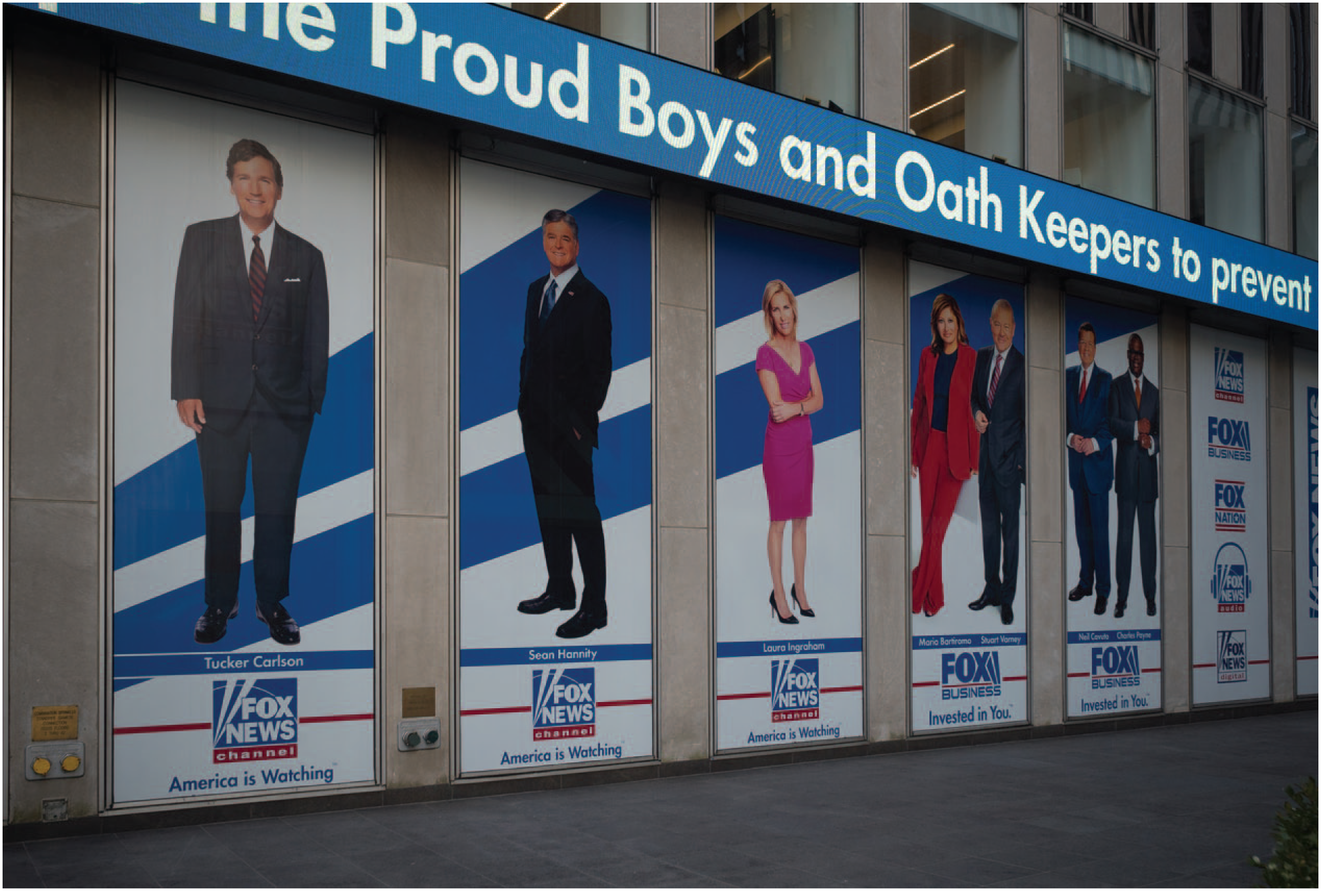
Regularly reaching over two million primetime viewers, Fox News anchors and guests alike describe gender-affirming procedures conducted on children as “harmful and irreversible” decisions that “could alter their lives forever,” and in 2023 Fox host Tucker Carlson declared that “transgenderism is the most dangerous extremist movement in the United States.”
iStock Photo // Massimo Giachetti
In one of his first official acts of his second presidential term, President Donald Trump signed an executive order titled “Defending Women from Gender Ideology Extremism and Restoring Biological Truth to the Federal Government.” This act marked the culmination of a widespread politicization of transgender rights during the 2024 election campaign and was quickly decried by the National Organization for Women, the largest feminist organization in the United States, for being “defined by cruelty, not common sense.” Rather than defending women, the National Organization for Women asserted, the order “puts people in real danger.” Of course, leveraging debates over transgender rights for political gain is hardly new. Over the past decade, influential actors have stoked ongoing moral panics that portray the transgender community as a threat to American society. These narratives infuse the politics of bathroom access, sports, the military, and children’s healthcare, among other issues.
Transgender people have become a convenient focal point in contemporary culture‑war politics for at least two reasons. First, transgender rights challenge longstanding binary assumptions of sex and gender, which, in turn, underpin latent notions of social order, making them a powerful trigger for those who fear the contemporary erosion of traditional Western values. Second, the trans population is numerically small (an estimated 0.8 percent of the U.S. adult population in 2025) and often misunderstood, offering political actors a convenient scapegoat.
Transgender rights challenge longstanding binary assumptions of sex and gender, which, in turn, underpin latent notions of social order, making them a powerful trigger for those who fear the contemporary erosion of traditional Western values.
In this article, we examine the mass-media discourses around transgender issues that fuel these moral panics. Sociologists maintain an abiding interest in how the media industry shapes attitudes and morality in everyday life. There are many ways a story can be told and too many topics to cover entirely, enabling the selective amplification of certain issues to capture audience attention for political or economic gain. Right-wing media networks perform central roles in promoting negative and inaccurate portrayals of the transgender community. For example, former Fox News host Tucker Carlson declared in 2023 that “transgenderism is the most dangerous extremist movement in the United States.” This claim is baldly inaccurate: To take just one example, transgender people have been responsible for less than 0.1 percent of incidents of mass shootings since 2013. (Such incidents are, in fact, disproportionately perpetrated by nontrans men.)
Fox News reaches over two million primetime viewers and, as of October 2025, has more than 25 million followers on X. Given its substantial reach and central role in propagating anti-transgender discourse, we analyzed a sample of over 700 Fox News broadcast transcripts that included on-air discussions about the transgender community between 2012 and 2024. In our analysis, we identified three core narrative strategies that aid in understanding the resonance of anti-trans moral panics: the purity-peril paradox, the mind-body problem, and doomsday rhetoric. Together, these strategies establish rigid boundaries between a virtuous, truthful, and traditional ingroup and a threatening, misleading, and usurping trans “other.”
moral panics and media discourse
Sociologist Stanley Cohen coined the term moral panic to describe periods when cultural authorities and influencers define specific groups as threats to societal values and interests. Researchers have since built upon Cohen’s theory to suggest that moral panics are characterized by several key features. Moral panics typically involve concern about the behavior of a particular group, paired with a rise in hostility toward that group. Moral panics also involve a level of social consensus, such that fear of the group in question becomes a dominant narrative, even though public attention to the issue may ebb and flow. Finally, though moral panics occasionally originate out of genuine and noncynical concerns about potential harm, more typically they misrepresent a group or issue in a way that exaggerates the magnitude of the supposed threat. Typically tied to behavior deemed deviant, the imagined threat generates sustained efforts to regulate the alleged deviance.
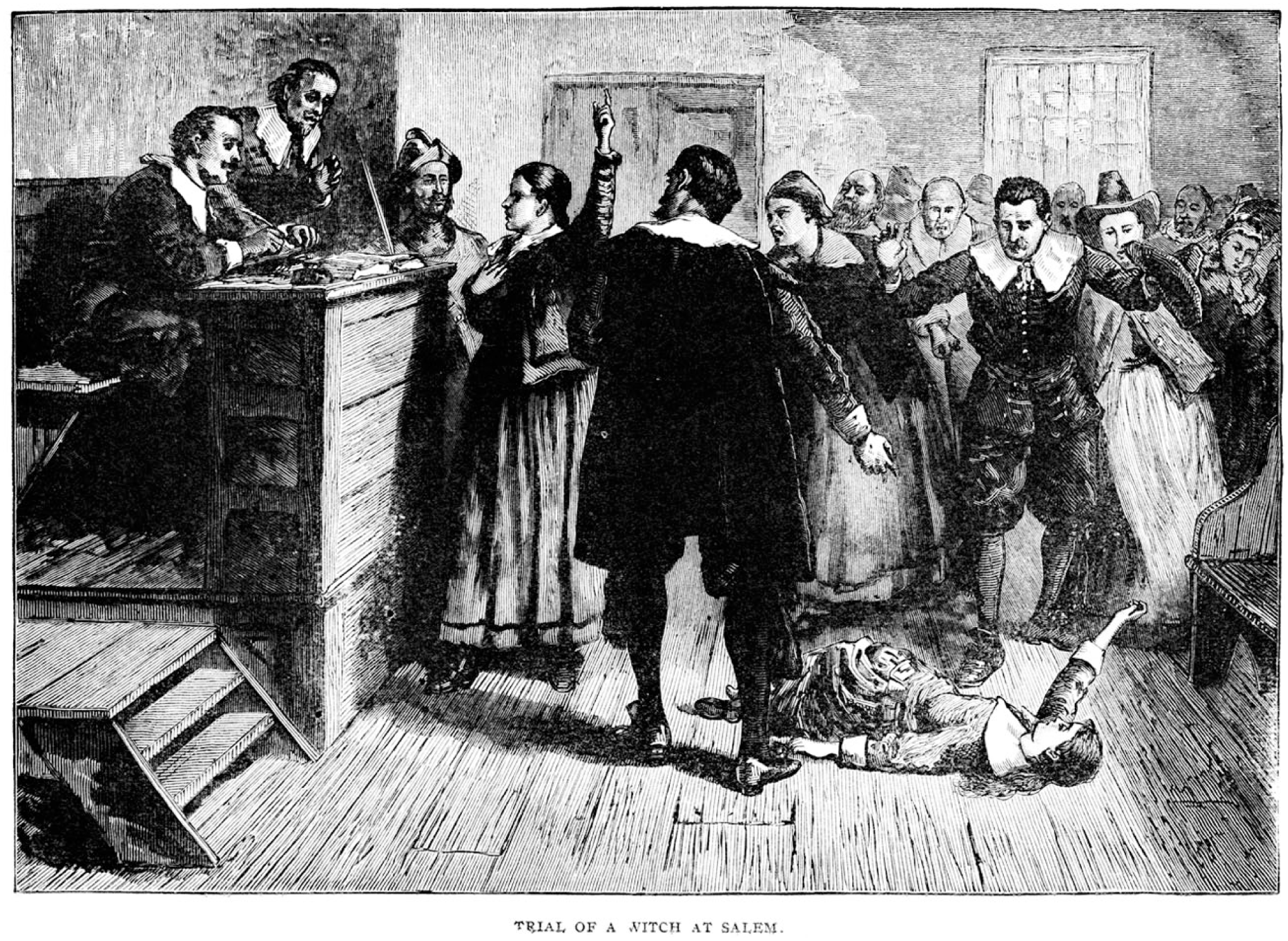
Moral panics have regularly appeared throughout American history. Perhaps one of the best-known examples is the Salem Witch trials, which were a series of prosecutions of individuals accused of witchcraft in colonial Massachusetts during the late seventeenth century. The Puritan colony faced increased pressure from both external sources and internal divisions. Targeting people (mostly women) suspected of witchcraft served to police community norms and create social cohesion among ingroup members. Similar examples can be found throughout U.S. history, ranging from McCarthy-era fears of communist infiltration during the 1950s Red Scare to the current wave of anti-immigrant sentiment driven by the nativism, white supremacy, and right-wing populism of the Trump administration. Each of these moral panics, as well as many others, was created by those with the power to label and define others.
In modern times, moral panics are primarily incited through mass-media channels. According to Cohen, mass media play a vitally important role in moral panics by amplifying threat perceptions, invoking simplistic framings of events that appeal to preexisting prejudices, such as anti-Black racism couched in portrayals of urban crime. These narratives draw on exaggerated stereotypes to portray outgroups as significant threats. Sociologists Erich Goode and Nachman Ben-Yehuda similarly emphasize the media’s role in establishing and promoting “us” vs. “them” boundaries. In sum, when the media frames marginalized groups as existential threats, moral panics spread as dominant cultural narratives.
However, much remains to be explored regarding how the media amplifies moral panics in our contemporary landscape, which differs profoundly from earlier moments in U.S. history. With the rise of social media, we now inhabit an intensified version of what cultural-studies scholars Angela McRobbie and Sarah Thornton term a “multimediated” world in which communication is increasingly participatory, fragmented, and algorithmically curated. Panic narratives emerge not only from top-down outlets but also from decentralized digital networks. Legacy media must race to maintain consumers’ focused awareness in a saturated, high-velocity attention economy. As social media rewards emotional and moral intensity, sensationalist framings become ever more attractive.
As noted, recent portrayals of the transgender community reflect the structure of a classic moral panic, and Fox News plays a key role in amplifying that discourse. Taking this case in point, we examined these broadcasts and asked how they propagate moral panics surrounding the transgender community. Specifically, we identified how Fox News uses three specific rhetorical strategies to (1) create the appearance of a transgender threat, (2) mobilize moral concern, and (3) cement in- and outgroup boundaries. Although our analysis focuses on broadcast content, it should be understood within our broader, networked media ecology that accelerates and synchronizes panic across distinct platforms and publics.
three rhetorical strategies
To identify how Fox News broadcasts portray transgender people, we analyzed a sample of over 700 transcripts. We collected a robust sample of all Fox News broadcasts between 2012 and 2024 that included key terms such as “transgender,” “transsexual,” both “gender” and “identity,” or both “trans” and “gender.” This totaled 2,817 transcripts, and we randomly sampled roughly one-fourth of them to analyze how Fox News on-air personnel framed transgender people and the rhetorical techniques employed by hosts and guests alike. We identified three core strategies used during these broadcasts to propagate moral panics directed toward transgender individuals. Though we do not claim these strategies to be exhaustive, they represent three major ways Fox News promotes moral panics around transgender people. Below, we discuss each in turn.
Allegations of transgender threats to women and girls primarily appear in segments about bathroom access and sports participation.
the purity-peril paradox
We label the first strategy the purity-peril paradox. This category includes rhetoric that simultaneously vilifies transgender individuals as threats to innocent victim groups. Those portrayed as victims by Fox News include women, children, and Christians.
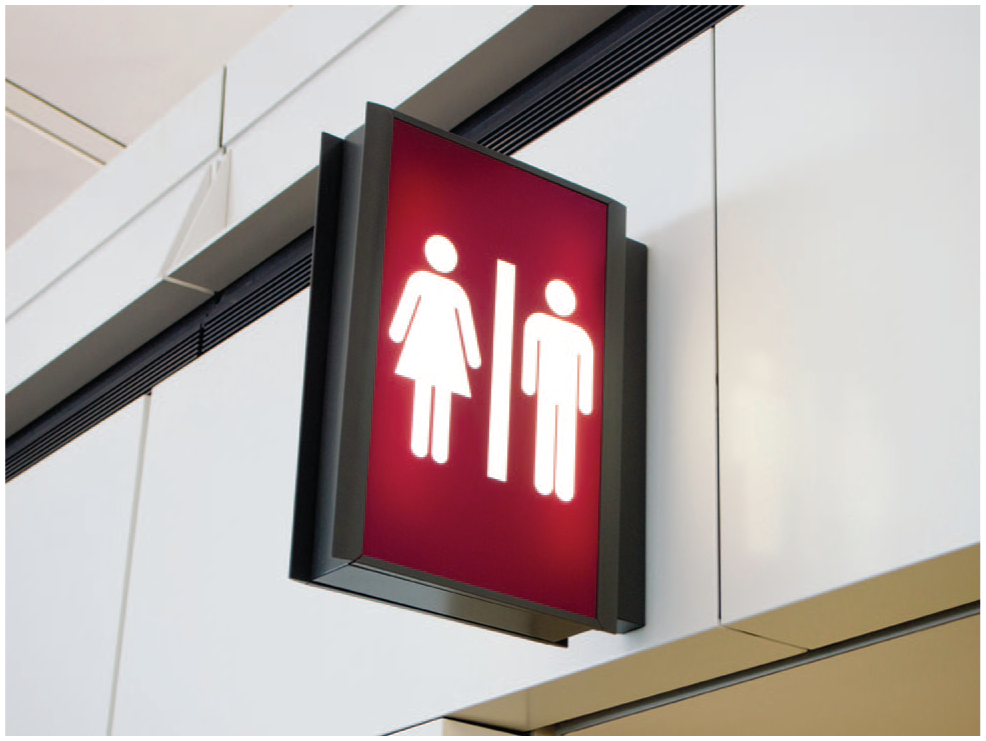
Allegations of transgender threats to women and girls primarily appear in segments about bathroom access and sports participation. For instance, one broadcast claimed, “Around the world we’re seeing radicalized trans activists attack people, and in particular attack women who are defending women’s spaces and women’s sports.” Many of these statements specifically attack trans women for entering women’s bathrooms, sports, or other spaces. This has led to comparisons of trans-women athletes to “rented mules” and accusations that women are regularly “forced” to undress in front of men in bathrooms, putting the “safety of women in jeopardy,” despite the fact that no evidence exists of safety concerns in cases where transgender people are given access to bathrooms aligning with their gender identity. However, transgender people themselves sometimes face harassment or violence when using bathrooms according to their sex assigned at birth.
Fox News broadcasts that portray transgender people as a threat to women and girls manufacture fear about trans women using women’s bathrooms.
iStock Photo // Benimage
Anti-transgender discourse also amplifies children as victims. This framing appears in assertions that trans people are “grooming children,” as well as in portrayals of teachers and schools that characterize transgender identities as “demonic” and encourage “deviant behaviors.” Meanwhile, trans children have been represented as courting danger after embracing a trans identity, with a broadcast stating, “once [children] have that transgender identity and they put, you know, FTM [female to male] on their Instagram account, this is a calling card for pedophiles, for traffickers, for grooming.”
More recently, Christians have been described as victims in some particularly vitriolic rhetoric on Fox. For example, in 2023, host Tucker Carlson depicted the transgender community and support for associated identities as the “mirror image of Christianity, and therefore its natural enemy.” He accused the transgender community of “targeting Christians, including with violence.” Later, Carlson remarked that “Christianity and transgender orthodoxy . . . [are] on a collision course . . . one side is likely to draw blood before the other side.”
We describe this simultaneous vilification of trans people and amplification of victimized groups as a paradox because such groups are not mutually exclusive. In fact, some transgender people are women, children, and Christians. This paradoxical reasoning distinguishes between the morally good and the deviant, normalizing disdain toward those who identify as trans and differentiating them from an implied ingroup, even when shared characteristics exist on either side of this imaginary boundary.
the mind-body problem
The second strategy we identified is what we call the mind-body problem. Here, antagonists paint transgender identity as a mental illness while highlighting the physicality of the alleged “harms” linked to the trans community. This strategy often focuses on gender-affirming care. Here, trans identities are framed as simply a “craze,” as something “most kids grow out of,” with the transgender community labeled a “Cult . . . unlike anything we’ve ever seen.”
Meanwhile, descriptions of alleged harms have focused on physicality, featuring evocative language around doctors using drugs in an “off-label, unauthorized fashion” to “castrate boys and cut off the breast [sic] of little girls,” with such procedures described broadly as a “euphemism for chemical castration, radical plastic surgery.” This emphasis on physicality carries a moral tone, with broadcasts portraying those in support of the transgender community as evil: “Hop on board with every satanic movement . . . transgender your child, mutilate them physically, cut their breasts off, cut their penises off.”
This overall narrative is made even more ominous when augmented by accusations that decisions about gender-affirming care arise as a consequence of deliberate indoctrination into “radical gender ideology” perpetrated by an amorphous group encompassing the political left, pharmaceutical companies, and Hollywood, among others, for political or economic profit. For example, allegations have been raised on Fox News that “Our kids are being experimented on by big pharma to create a revolving door of customers” and that doctors are not “stepping in to protect children” because “it’s just too profitable to destroy the lives of kids.”
Echoing the attention paid to children in narratives that employ the purity-peril paradox, schools and other educational institutions are depicted in mind-body problem narratives as particularly dangerous locations for the spread of “gender ideology,” with classrooms described as “ground zero for gender indoctrination.” These institutions are framed as “pushing boundaries and establishing as normative these deviant sexual behaviors, transgenderism, gender fluidity. . . . This is not normal for American kids.”
The dismissal of transgender identities as mental disorders is paired with an amplification of the so-called harms caused by procedures related to gender-affirming care to describe trans people using the language of morality and sin. In reference to one’s identification with a gender other than that assigned at birth, one Fox News broadcast captured the mind-body framing well: “It's a lie of course, but it's a lie that is only maintained through violence . . . to our bodies.”
The United States has a long history of moral panics, including the Salem witch trials in colonial Massachusetts during the late seventeenth century.
iStock Photo // Christine_Kohler
doomsday rhetoric
Finally, some broadcasts use a strategy we call doomsday rhetoric. This strategy involves depicting American society as moving toward an inevitable demise, should no action be taken to combat a trans-centered “gender ideology” agenda. Doomsday rhetoric promotes a very specific interpretation of Americans as decidedly anti-trans citizens who hold traditional, nationalistic values, and it has been linked to accusations that transgender people “want to create an alternative America.” This strategy equates the recognition of gender fluidity with threats to liberty and the pursuit of happiness for more “ordinary” nontrans Americans. “These are Americans who believe in values, the country, they just want to be left alone. They don’t want trans activism shoved in their face.” Similarly, “wokeism,” loosely defined as the promotion of progressive values (and in this case, the acceptance of gender fluidity), has been framed as “affecting people in every area of life . . . infringing on our ability to live freely.”
Notably, this “threat” trajectory has been presented as the current default course: “America is in a moral freefall. . . . You murder the babies in the womb. . . . If they survive the womb, you try to seduce them into transgender sexual deviation.” This framing includes language depicting trans rights as contagious, with one broadcast referring to equality legislation as “this gay and transexual supremacy act . . . it’s coming from America, and it’s infecting the world.” Another broadcast lamented that without urgent action, “more and more children will become victims of the trans-industrial complex.”
Discussions of “regret,” especially regarding gender-affirming care, are another way Fox broadcasts draw on the speed of social mores concerning sexual diversity. For example, broadcasts urge Americans to “slow down,” alleging that “five years from now, we’re going to look back on [gender-affirming care] . . . in shame and horror.” Fox News anchors and guests alike describe gender-affirming procedures conducted on children as “harmful and irreversible” decisions that “could alter their lives forever.” Broadcasts amplify “harrowing stories” of those who have detransitioned while ignoring accounts of positive transitions, labeling those detransitioning as “survivors.”
A Fox News broadcast described school classrooms as “ground zero for gender indoctrination.”
iStock Photo // TrongNguyen

We view this doomsday rhetoric as establishing a boundary between normalcy and degeneracy, between an idealized if imaginary past versus a sexually fluid and feared future thought to endanger the most sacred of American ideals: “[We] inherited a beautiful document [the U.S. Constitution] . . . it's under constant attack. . . . You need to understand, your children, grandchildren, generations yet unborn are being plundered.”
processes in action: a false “trans terrorism” narrative
Together, the purity-peril paradox, the mind-body problem, and doomsday rhetoric establish rigid cultural and symbolic boundaries that fuel moral panics surrounding gender and sexual fluidity in contemporary American life. Note that these strategies are not deployed uniformly; rather, they are often activated in response to high-profile events that offer political or emotional leverage. Media actors strategically seize on moments of national attention, particularly when the event can be reframed to affirm preexisting narratives of threat. In the first section of this article, we highlighted Tucker Carlson’s declaration that “transgenderism is the most dangerous extremist movement in the United States.” Responses to the event that prompted this statement provide an excellent example of these three rhetorical strategies in action. On March 27, 2023, a mass shooting took place at a Christian school in Nashville, Tennessee. Despite being just one incident in a string of U.S. school shootings, this event sparked a particular set of reactions because the perpetrator was a transgender man. Alt-right influencers took to social media declaring a “trans terrorism” epidemic that blamed “gender ideology” for mass shootings, even though no evidence actually supports this allegation. Yet presenters on Fox News echoed the sentiment of these claims. For example, on her show “The Angle,” host Laura Ingraham griped:
You see where this is going, right, a deranged woman who calls herself a man . . . took the lives of six innocent people. Instead of getting Hale the help that she needed along the way, our social-media culture, Hollywood, even corporate America, affirmed what would ultimately be a lie; that our genetic makeup can somehow be denied. It’s all a vicious lie, and those who refuse to go along with this lie—like the lies told during COVID—they are not anti-science, they are very much pro-science, real science that is. . . . The same people who encourage minors to have life-altering hormones and surgery on their genitalia and even begin transitioning without parental consent, they have done and are doing enormous damage to young people across the country. We have no idea how many are now desperately trying to reverse what has been done to them, but we can tell you from our own experience interviewing them the numbers are growing. . . . We don’t think thoughts and prayers are meaningless here. Our country, all of our country, needs it desperately.
This segment exemplifies the three identified strategies. Ingraham activated the purity-peril paradox by using vilifying language, including “a deranged woman who calls herself a man,” while amplifying generalized victim themes such as “innocence” and “children.” Notably, this framing was not only used in reference to the actual victims of the attack, but rather “all of our country.” Meanwhile, Ingraham introduced the mind-body problem by questioning the legitimacy of the perpetrator’s identity with terms like “deranged,” as well as by labeling transgender identities as “a vicious lie.” Finally, Ingraham invoked doomsday rhetoric by centering both “life-altering hormones” and regret, where transgender people are portrayed as people “desperately trying to reverse what has been done to them.” The timing of the implementation of these rhetorical strategies in this televised coverage underscores how moral panic narratives propagated through these strategies are opportunistically layered onto specific events, allowing actors like Fox News to quickly reframe isolated incidents as evidence of a broader existential crisis, thus cultivating panic.
concluding thoughts
In this essay, we examined mass-media coverage of transgender individuals, focusing on Fox News broadcasts between 2012 and 2024. We identified three rhetorical strategies that broadcasters used to portray transgender people as a deviant, threatening outgroup, contrasted against a virtuous, truth-abiding ingroup. These strategies include the purity-peril paradox, the mind-body problem, and doomsday rhetoric. While not exhaustive, these strategies are prevalent and offer valuable insight into how a major news organization promotes the vilification of an already-marginalized group.
Why might Fox News employ these strategies? In a crowded, multimodal media marketplace, outlets must aggressively compete for attention. Fox News does so by selecting frames that align with its audience’s cultural intuitions and elicit strong emotional responses. These strategies all draw on entrenched conservative beliefs about gender and the erosion of traditional norms, activating outrage, fear, and moral urgency, emotions shown to boost engagement. While a full comparison is beyond the scope of this article, compared to narrower frames like religious or scientific appeals that may only resonate with specific subgroups, the strategies we identified offer an elastic rhetorical toolkit capable of mobilizing heterogeneous conservative publics.
Looking ahead, our analysis allows for some cautious speculation about how this moral-panic rhetoric may evolve. First, we expect these narratives to persist because they appear politically effective and tap into enduring anxieties about moral decline. The result of the 2024 presidential election, in which millions of dollars were spent on anti-trans advertisements, signaled to those within and beyond the media that moral-panic narratives resonate with the public. Second, we anticipate that these strategies will broaden in scope. Anti-transgender narratives may be increasingly bundled with adjacent culture-war issues such as reproductive rights or education, diffusing blame across a wider range of progressive targets. Third, we expect growing interplay between how the media portrays transgender people and how political institutions create legislation concerning transgender issues. As repeated exposure hardens beliefs and transforms narratives into common sense, sensationalist media depictions of transgender people may increasingly shape policy, perhaps to justify exclusionary legislation.
Importantly, however, recognizing these strategies also reveals potential pathways of resistance. Exposing the contradictions of the purity-peril paradox may humanize those targeted. Addressing the mind-body problem may require amplifying the lived experiences of transgender individuals and historicizing gender diversity. Finally, countering doomsday rhetoric could involve contextualizing gender-affirming care and foregrounding its positive impacts for those who seek it.
recommended resources
Stanley Cohen. 1972. Folk Devils and Moral Panics. Routledge. In this foundational work, Cohen developed the concept of a moral panic.
Erich Goode and Nachman Ben-Yehuda. 1994. Moral Panics: The Social Construction of Deviance. Wiley-Blackwell. In another foundational work in the study of moral panics, the authors propose a model of moral panics that includes five defining elements.
Christopher Pepin-Neff and Aaron Cohen. 2022. “President Trump’s Transgender Moral Panic.” In The Trump Administration, edited by Toby S. James. Routledge. This chapter shows how Trump acted as a moral entrepreneur in stoking a moral panic against trans people through his tweets.
Allyn Walker. 2023. “Transphobic Discourse and Moral Panic Convergence: A Content Analysis of My Hate Mail.” Criminology 61(4). In this article, the author (a trans academic) analyzes hate mail sent to them directly, unpacking themes within the growing anti-trans moral panic.
Jack G. R. Wippell. 2025. “The Hate Industry: Mass Media, Moral Panic, and the Mobilization of Anti Transgender Prejudice.” Social Problems. This study examines trends in moral panic discourse within conservative mass media and their association with anti-LGBT+ hate crimes.