






Abstract
Blyss cleveland on the controversy surrounding the endorsement of anti-obesity drugs among Black celebrity women.
The introduction of glucagon-like peptide 1 (GLP-1) drugs like Ozempic has been one of the most monumental pharmaceutical interventions in recent history. Although their development has been decades in the making, their mass-market availability signals a new era in the use of drugs to assist with weight loss, though they were originally developed as antidiabetic treatments. GLP-1s can cost tens of thousands of dollars per year without a prescription, and an estimated 18 percent of U.S. adults have used them despite the high cost.
How are GLP-1s marketed, and by whom? GLP-1 marketing campaigns reveal new norms emerging around legitimate pathways to acquire the ideal body and the blurring boundaries between health and cosmetic interventions in the process. This shift is especially evident in how Black women lend their images to these drugs.
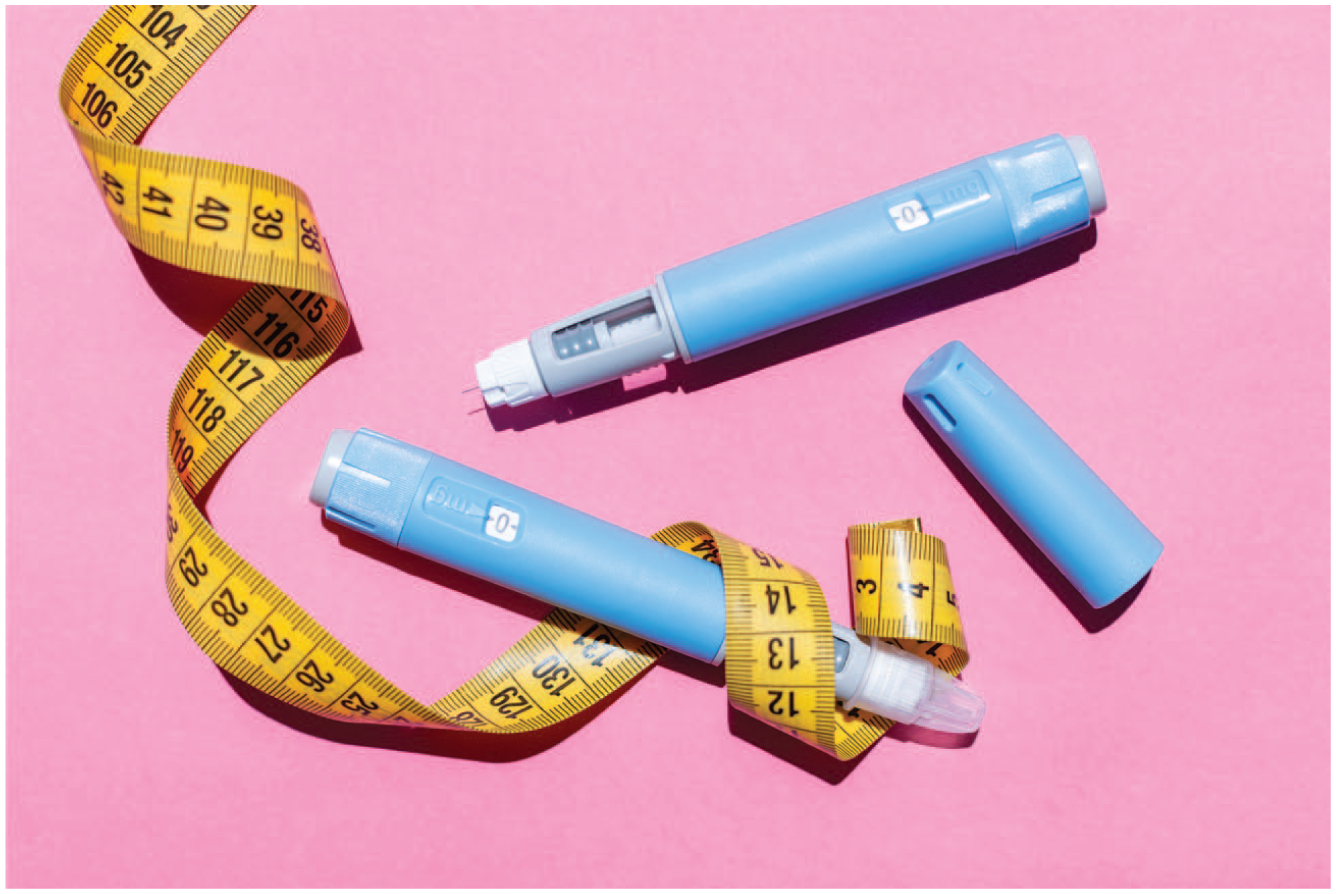
Although their development has been decades in the making, the mass-market availability of glucagon-like peptide 1 (GLP-1) drugs like Ozempic signals a new era in the use of drugs to assist with weight loss.
iStockPhoto // Alones Creative
Several prominent Black celebrities, including TV host Oprah Winfrey and athletes Serena Williams and Simone Biles, have espoused the benefits of these drugs. Winfrey revealed she had begun to use GLP-1s for weight loss in 2023, which she currently promotes alongside messages of body acceptance. Williams, a 23-time Grand Slam champion, has faced scrutiny for her body’s shape and size throughout her career. The tennis player became a brand ambassador for telehealth company Ro in 2025 and credits GLP-1s with helping her lose postpartum weight. As a spokesperson for Mounjaro, the antidiabetic GLP-1 developed by Eli Lilly and Company, gymnast Biles and her mother, who has type 2 diabetes, have starred in advertising campaigns. These ads state that Simone does not have type 2 diabetes, and neither she nor her mom uses Mounjaro.
Winfrey, Williams, and Biles’s choices to lend their images to weight-loss drugs must be considered in light of the politics of fatness. Fears of fatness, historically associated with sociological differences in gender, race, and class, are often laundered under the guise of health and morality. In her 2019 book Fearing the Black Body: The Racial Origins of Fat Phobia, sociologist Sabrina Strings traced the interconnectedness of antifatness and antiblackness. Mid-nineteenth-century women’s magazines were central to promoting the “American Beauty” aesthetic that relied on scientific racism and specious health claims to degrade Black women and discipline white women, lest the latter appear “fat” and hence, nonwhite. As the United States has transformed into a multiethnic and multiracial society, the beauty hierarchy has also diversified. However, the slenderness ideal for women remains durable and anchored by racial and class hierarchies. There is an entrenched colonial logic that equates slenderness with wealth, privilege, and whiteness, while linking fatness to poor and nonwhite bodies.
The contemporary association between fat and race, gender, class, and other types of disadvantage is evident when considering key patterns. In the United States, racial and ethnic minorities, women, low-income individuals, and those with lower levels of education are more likely to be overweight. Black women tend to have the highest obesity rates relative to other sociodemographic groups, a fact shaped by social and environmental determinants. Aside from the few places that have recently passed antidiscrimination legislation, it is legal to discriminate against fat people. Such discrimination is particularly salient in the labor market, where overweight women face a pay gap relative to their slimmer counterparts.
GLP-1s are a boon to individuals managing chronic conditions, but their weight-loss benefits are an individual remedy that falls short of addressing social problems that contribute to disadvantage.
Notably, Oprah Winfrey is one of the wealthiest Black women in the world, but her weight has often been a focus of her public image. In her 2024 television special, “Shame, Blame and the Weight Loss Revolution” Winfrey recalls how she endured years of public shaming from tabloids and commentators for her perceived failure to stay thin. In a 1985 appearance on The Tonight Show, comedian and guest host Joan Rivers even chided Winfrey about her size, asked how she had gained so much weight, and urged her to slim down. Winfrey has spoken about this moment as a time when she felt humiliated.
Tennis star Williams made her professional debut in 1995 and rose to prominence in the early 2000s. Her muscular physique—especially in contrast to her sister Venus Williams’s slender frame—made her the subject of body shaming for her “masculine” appearance. Public scrutiny of women’s bodies was intense during this time, ultimately giving rise to the 2010s body-positivity movement that developed on social media and in online forums, freed from the gatekeepers who control traditional media. While scholars and activists have regarded body positivity as an important development to combat fat phobia, the movement has been critiqued for a lack of inclusivity with respect to women of color, as well as queer and disabled individuals.
Meanwhile, gymnast Biles has not received scrutiny for her weight, but her cultural cachet as the most decorated gymnast of all time is used in Mounjaro advertisements. In one commercial, Biles stands in a gymnasium speaking to the camera between cuts to scenes of paid actors performing exercise routines. Mounjaro’s parent company, Eli Lilly, is an official partner of the United States national team and has contracted with several Olympians to advertise various drugs. Biles’s ambassadorship for Mounjaro suggests using the drug alongside other lifestyle modifications to manage diabetes is an effortful endeavor akin to the rigorous training and competition that made Biles a top athlete.
Serving as a GLP-1 brand ambassador is a natural evolution in how entertainers and athletes utilize their appearance as part of their public image. Celebrities have long served as spokespeople for workout regimens, dietary supplements, and other similarly slimming strategies used to maintain their physiques. Mentions of weight-loss drugs have become more prevalent in this kind of content, with a twist: a common theme in Winfrey, Williams, and Biles’s GLP-1 advocacy is their efforts to remove shame and stigma from using these medications.
If being fat is a disadvantage and the ideal body is slender, why would the use of GLP-1s be a source of shame?
Weight-loss drugs are stigmatized because they are seen as an illegitimate way to acquire “bodily capital.” Building on the work of the late French sociologist and public intellectual Pierre Bourdieu, UC Berkeley sociology professor Loïc Wacquant’s notion of bodily capital refers to the modifications that individuals make to their bodies in pursuit of social rewards. In Wacquant’s study of boxers, athletes trained hard to turn their bodies into capital in the ring. By contrast, weight-loss drugs offer a shortcut to the disciplined body. We learn from a young age that, unless one is genetically gifted, achieving a thin physique requires effort. Reality television shows, such as The Biggest Loser and Fit to Fat to Fit, emphasize that weight loss should be accomplished through hard work and self-discipline. Winfrey disclosed her initial hesitancy to use prescription weight-loss medication because she believed drugs were an insufficient substitute for “willpower.” Indeed, the majority of U.S. adults support the use of weight-loss drugs—but only for adults with weight-related health conditions. Adages such as “Beauty is pain” and “No pain, no gain” underscore the idea that for most people, good looks and slenderness require effort. Drugs are cheating.
The use of prominent Black women as GLP-1 brand ambassadors has been controversial and warrants further reflection. Existing research shows Black girls and women are more likely to report higher satisfaction with their weight and are less likely to report body dysmorphia and disordered eating compared to white women. Ostensibly, exclusion from the culture of thinness has had somewhat of a protective effect for Black women and girls against mainstream standards that associate beauty with slenderness. Although Black women are not exempt from body image issues, Winfrey, Williams, and Biles’s campaigns are an about-face from positioning Black women as a group who exist beyond mainstream beauty standards. However, inaugurating Black women into dominant beauty ideals is an imposition that still uses their bodies to discipline all women.
The proliferation of GLP-1s suggests we have entered an era of body negativity, a time with more reasons for people to feel bad about their bodies and potentially manage these negative feelings through cosmetic changes. Whereas body positivity once promoted visibility and acceptance for bodies that did not meet mainstream standards, body negativity evolves from the neoliberal beauty culture that compels individuals to perform what sociologist and Goldsmiths, University of London professor Rosalind Gill refers to as “aesthetic entrepreneurship.” Since the rise of consumer culture, women—and increasingly, men—have been expected to manage their appearance in accordance with unrealistic ideals—ideals that were, after all, forged in racist regimes that ultimately denigrated and shamed nonwhite bodies. The wider availability of cosmetic interventions indicates rising expectations that all of us will use these technologies. Weight-loss drugs open a pathway to slenderness, but they also confer disadvantage to individuals who cannot afford such drugs or who prefer not to meet the thin ideal. They may also stigmatize their users for “cheating” their way to thinness—unless Winfrey, Williams, Biles, and other spokespersons successfully sell us on the idea of body negativity, as well as GLP-1s, as they urge us to get healthy and beautiful.
The obesity rate in the United States has declined in recent years. Only time will tell how curing fatness will impact fat phobia.
GLP-1s are a boon to individuals managing chronic conditions, but their weight-loss benefits are an individual remedy that falls short of addressing social problems that contribute to disadvantage. The obesity rate in the United States has declined in recent years. Only time will tell how curing fatness will impact fat phobia.