






Abstract
Amanda shigihara on private bodily management and public expectations.
Keywords
“Uh-oh. Here we go again.”
That is what I remember thinking (or even muttering) when my period unexpectedly made an appearance while visiting a friend, Kathleen, in Southern California during college. I wasn’t prepared with pads. She had tampons. I’d never used one, not even once.
It’s not that I had never heard of tampons, but no one in my family talked about them. There was no explanation, no secret stash under the sink. Pads were available. Tampons were not; they were for the “other girls.” Growing up in the California Bay Area in the 1980s and 1990s amid “just say no” messaging and morally conservative frameworks shaped by religion, respectability politics, and immigrant- and working-class values emphasizing upward mobility, adolescent sexuality was handled through silence, at best, and at worst, punishment. This was true even in an otherwise diverse and seemingly progressive setting. The tacit lesson was clear: tampons meant sex, and if you had “it,” you risked sexually-transmitted disease, ill repute, and pregnancy, followed by a sudden disappearance from school, an eventual return months later, and, of course, an eternal afterlife in the fiery depths of hell.
A tampon offers a concrete way to observe how routine, taken-for-granted interactions produce power, silence, and inequality.
iStockPhoto // Liudmila Chernetska
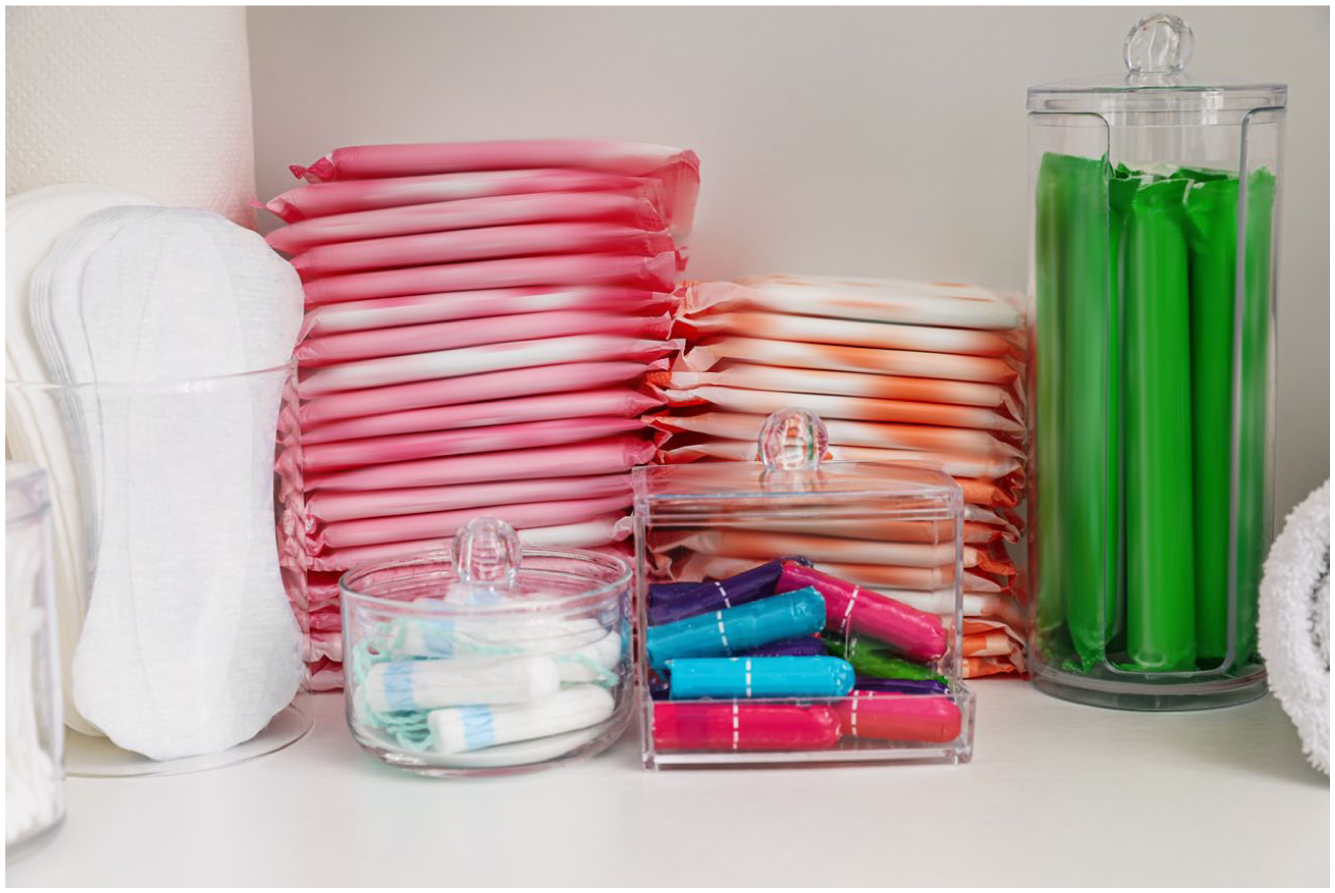
Kathleen stood outside the bathroom door and talked me through the tampon insertion process. Through trial and error—my questions (“If I feel it, is that right?”) and her calm replies (“No, you shouldn’t feel it”)—we got it in. This early-adulthood ordeal stayed with me, not just because of the logistical awkwardness but for what it revealed. A tampon, while seemingly ordinary, could be as profound as an object of liberation (instantaneously freeing me from bulky pads and the constant vigilance they require, since prolonged moisture can invite yeast infections). Or, just as quickly, it was an object marking me deviant, as prematurely sexual.
Access to tampons and the ability to use them comfortably and confidently are not universal.
Over time, it became clear to me that access to tampons and the ability to use them comfortably and confidently are not universal. Tampons come with assumptions. They carry silence and shame. When I began as an assistant professor of sociology in 2014, I returned to that “bloody” bathroom-door moment with sociological curiosity. What might a tampon reveal about culture, power, privilege, exclusion, and resistance? What happens when an object meant to stay hidden becomes visible? These questions eventually led me to develop what I now call tampon pedagogy in my undergraduate- and graduate-level social psychology courses.
Even when menstrual products are technically available, schools, workplaces, and public restrooms stocked with limited options may marginalize those whose cultural, religious, or bodily comfort discourages their use.
iStockPhoto // mirror-images

the activity
“Will someone please hand out the tampons?”
I ask, smiling and listening to giggles, while carrying several handfuls to the front of my spring 2025 undergraduate social psychology class.
Students begin by working in pairs, then triads, to answer a simple prompt projected on the screen: What are the uses of tampons? I encourage them to open the packages, touch and play with the tampons, and discuss freely. Each semester, several students (including both those who do and do not menstruate) admit they have never handled one before. As they talk, I circulate, watching who speaks first, who hesitates, who dominates, and what gets whispered or laughed away. When groups expand, dynamics shift. Comfort grows for some but evaporates for others. What begins as a group-process exercise quickly becomes a lesson in the dynamics of culture, power, and social norms.
Globally there has been a broader reckoning around menstrual dignity: the right to manage menstruation safely, comfortably, and without shame.
meaning-making in real time
“Oh my God, I would never even touch a tampon for my mom. That’s disgusting.”
Tampons unsettle some students. Quoted above, one student’s reaction captured that immediate recoil, because tampons surface beliefs about hygiene, sex, gender, and “the ick” (or disgust). More often, however, students respond with sociological curiosity rather than aversion. As discussion unfolds, attention shifts from what tampons are “for” to broader questions about comfort, familiarity, and access. Who talks, who listens, and who appears most at ease often reflects early lessons shaped by family, ethnic background, cultural expectations, and institutional silence around menstruation. When I show some nonmenstrual uses of tampons (a makeshift straw, a plug for a nosebleed), we begin to see how meanings attached to bodies and bodily processes are social rather than natural.
menstrual dignity and exclusion
“Quietly but unmistakably, the tampons, liners and pads reappeared in many of the men’s bathrooms at Meta’s offices.”
This moment, captured in a January 2025 New York Times article, hints at something larger. Zoom out, and globally there has been a broader reckoning around menstrual dignity: the right to manage menstruation safely, comfortably, and without shame. At Meta, this took a quiet but pointed form. After the company eliminated its diversity initiatives, menstrual products were removed from men’s bathrooms where they had previously been available to transgender and nonbinary employees who menstruate. In response, employees brought their own tampons, liners, and pads back into those restrooms—an act described as “a quiet rebellion.” Employees were not simply redistributing hygiene items; they were challenging institutional practices that normalize whose bodies are anticipated in public space, and whose are rendered invisible.
I have encountered Asian, Chicanx, and Latine students, in particular, who recounted being told that tampons are inappropriate for virgins, result in “loss” of virginity, or are a sign of sexual readiness. Others have described households where menstruation was never discussed, menstrual products appeared without explanation, and menstruants adapted informally, relying on friends or shared products. These accounts echo menstrual myths and norms transmitted early through family socialization, peer networks, and cultural scripts. Shame and silence around bleeding are carried into adulthood, shaping who feels entitled to ask for products, whose bleeding must remain hidden at school or work, and where access is offered symbolically rather than practically.
For migrants, these pressures can be especially pronounced. Research on migrant and refugee women documents how menstruation is governed by culturally specific expectations around modesty, disclosure, and bodily discipline, expectations that do not disappear upon entering the United States. Many encounter U.S. institutions that treat tampon use as the default, without acknowledging alternatives such as pads, cloths, or menstrual cups. Even when menstrual products are technically available, schools, workplaces, and public restrooms stocked with limited options may marginalize those whose cultural, religious, or bodily comfort discourages their use. In these settings, inclusion hinges less on access itself than on whose customs are presumed normal. Thus, menstrual hygiene becomes a quiet test of endurance and resourceful improvisation, documented in research on period product insecurity, alongside discreet management of pollution and bodily disruption and exclusionary institutional practice.
broader implications
Norms surrounding bleeding shape participation in everyday interactions. In any crowded room, someone is quietly doing the math, counting minutes to the next bathroom break, concerned about menstrual supplies, or thinking, “Uh-oh. Here we go again.” If you picture a lecture hall, a movie theater, a packed train, an emergency shelter, or a prison, odds are decent that more than a few people are managing menstruation woes, but social norms dictate that they be asked to endure them quietly and invisibly.
Menstruation has long organized access to school, religious space, family life, and paid labor—sometimes through formal rules but more often through silence, ritual, and expectation.
Across the globe, menstruation has long organized access to school, religious space, family life, and paid labor—sometimes through formal rules but more often through silence, ritual, and expectation. In some societies, this means temporary seclusion or spatial restriction; in others, it takes the form of quiet negotiations (such as deciding whether to disclose menstruation to family members, timing attendance at work or worship, or selectively complying with practices to preserve relationships or autonomy). These arrangements differ across contexts but share common features: menstrual dignity is not a given, is not equally distributed, and does not receive academic or public attention as a global health issue.
In the United States, these dynamics tend to be less explicit but no less consequential. Menstruation is addressed little beyond basic biology in school curricula, and students are expected to manage bleeding independently. Many schools do not provide free menstrual products, and workplaces vary widely in whether products are available at all or confined to select restrooms. Such institutional choices communicate who is permitted to occupy space comfortably and who is expected to manage themselves around it.
The point of tampon pedagogy is not the tampon itself, but about what becomes visible when an ordinary object is taken seriously. A tampon offers a concrete way to observe how routine, taken-for-granted interactions produce power, silence, and inequality. What emerges is not a lesson about menstruation, but insight into how private bodily management is governed by public expectations, revealing how everyday norms quietly sort bodies into ones that belong and ones that do not.