







Abstract
Manuel Schechtl, Nhat An Trinh, Rafael Carranza, and Fabian Pfeffer on economic inequality, informal help, and volunteering.
As wealth concentrates at the top echelons of society, social science researchers have attempted to calculate the increasingly unequal distribution of financial assets across countries around the globe. However, they know much less about what this shift means for everyday interactions among individuals. We take a first step by examining how wealth concentration impacts basic forms of prosocial engagement. Rather than focusing on highly dramatic acts of generosity, we instead consider more commonplace indicators of social obligation: whether people feel a responsibility to help those beyond their immediate family and whether they volunteer.
How might wealth concentration be connected to everyday forms of helping others? As economic distance grows, prosocial engagement could plausibly move in either direction. On the one hand, greater inequality may heighten awareness of need and strengthen norms of obligation, charity, or volunteering, particularly among those with greater resources. In this view, inequality sharpens moral attention to others and increases helping beyond one’s immediate circle.
Alternatively, wealth concentration may weaken habits and gestures of everyday kindness by eroding trust and increasing social distance. As economic advantages become more concentrated, people may view their society as less governed by shared rules, weakening trust and mutual obligation. Greater wealth can also expand access to private spaces and insular social worlds closed off to others. As shared routines and everyday encounters become less common, opportunities for helping others may decline.
study a: willingness to help across countries
We compared 29 countries with different levels of wealth concentration. Using data from the World Inequality Database, we measured how much of a country’s total wealth was owned by the richest 10 percent. We then linked these figures to responses from the International Social Survey Programme (ISSP), which asks whether people believe individuals should focus on taking care of themselves and their families before helping others.
Across countries and within the United States, the same relationship appears: In places of concentrated wealth, individuals’ willingness to help others and engage in volunteerism tends to decrease.
Across countries, a clear pattern emerged (Figure 1 A). Where wealth was more concentrated, people were more likely to embrace a turn inward, prioritizing self-reliance over helping others.
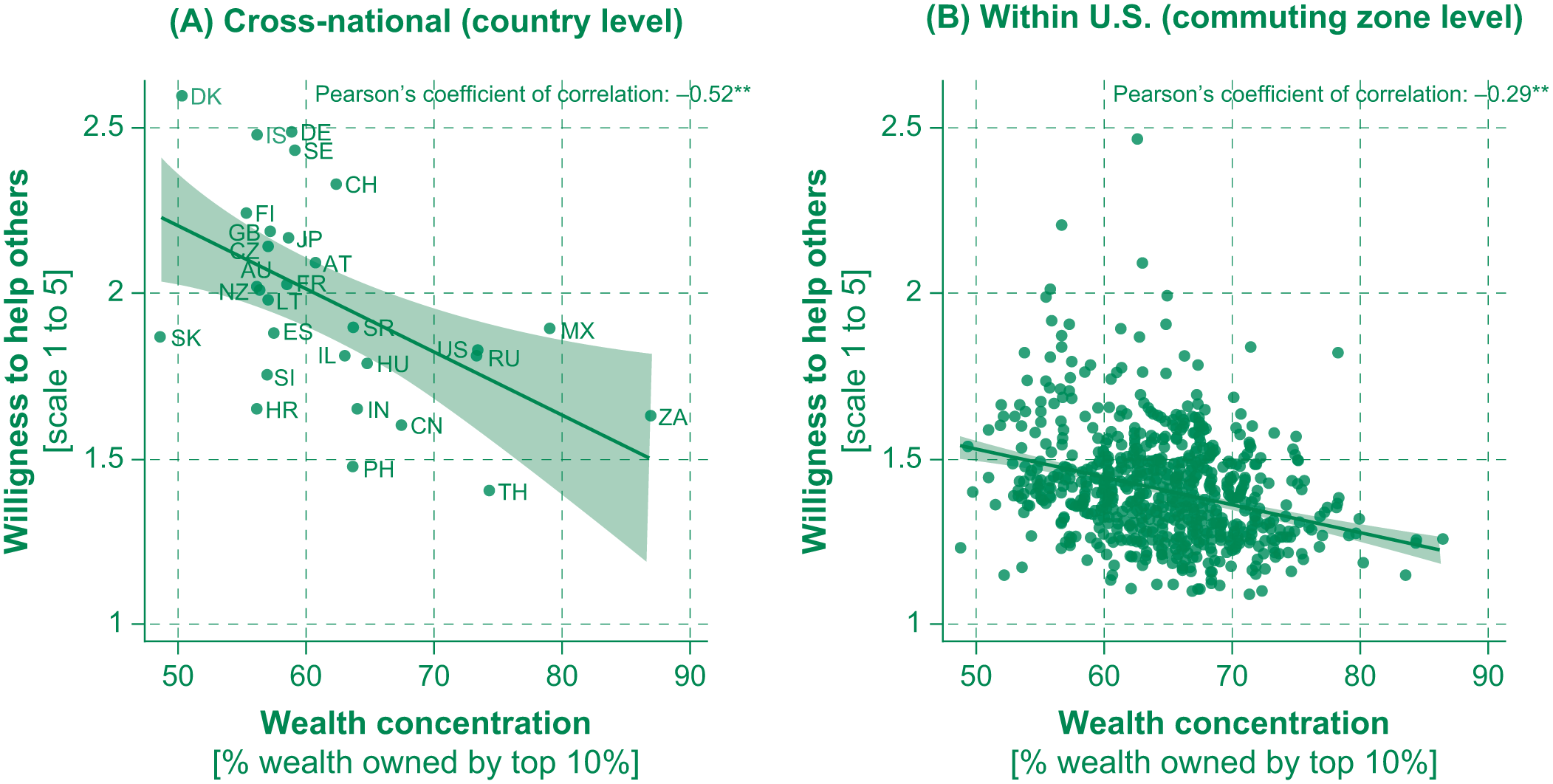
Where wealth is more concentrated, willingness to help others appears less common.
Cooperation holds communities together. When people lose jobs, fall ill, or face collective shocks, communities rely on informal help and voluntary action.
iStockPhoto // SDI Productions

study b: volunteering across u.s. regions
In another study, we turned our focus to the United States, where wealth inequality varies widely across regions. We analyzed 741 commuting zones, or areas that reflect where people tend to live, work, and interact.
Using anonymized social media data on participation in civic and volunteer groups from Opportunity Insights, we analyzed the relationship between local wealth concentration and rates of volunteering. The pattern mirrored the international findings: Regions with more concentrated wealth tended to show lower levels of volunteering, suggesting that economic distance can translate into social withdrawal (Figure 1 B).
the takeaway
Across countries and within the United States, the same relationship appears: In places of concentrated wealth, individuals’ willingness to help others and engage in volunteerism tends to decrease. To be clear, this does not mean that people at the lower end of the wealth distribution grow more united. On the contrary, in highly unequal settings trust tends to erode in all directions. Scarcity and perceived unfairness can foster competition rather than cooperation, making it easier for people to mobilize against one another instead of standing together.
These correlational findings do not necessarily mean that inequality causes indifference or disengagement. After all, many forces shape social life. Still, when the same pattern presents itself across different settings and data sources, it is difficult to ignore. Wealth concentration seems to be linked to people’s willingness to show up for one another in everyday life.
This matters because cooperation holds communities together. When people lose jobs, fall ill, or face collective shocks, communities rely on informal help and voluntary action. If that outreach becomes less common, those with limited resources may find themselves more exposed, unable to rely on adequate social buffers. Seen this way, wealth concentration not only measures inequality at the top, but also suggests implications for what happens below: how everyday ties may loosen, and how a shared social world can slowly give way to parallel lives, long before inequality becomes visible in social or political conflict.
The replication package, including data and code to reproduce Figure 1 is available at https://osf.io/rf42m.