






Abstract
Joya Misra on Katabasis.
Keywords
Katabasis: A Novel, by R.F. Kuang, HarperCollins (Harper Voyager Imprint), 2025
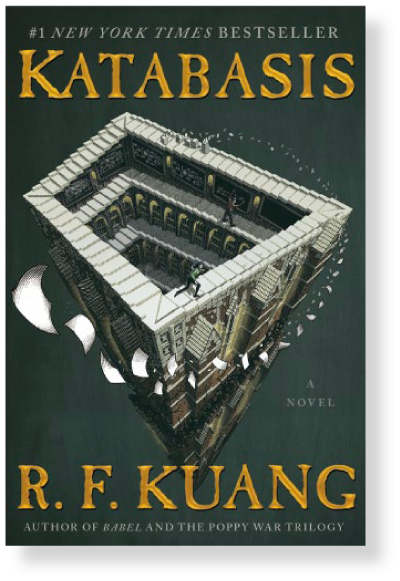
R.F. Kuang’s 2025 Katabasis: A Novel creates a new magical world set in 1980s Cambridge, one in which “magick” is a disciplinary subject alongside geography and history—although unlike those subjects, students use spells and incantations to manipulate reality. The book’s conceit is compelling: Protagonist Alice Law must go to hell to retrieve her dissertation advisor, Nobel Prize winner Jacob Grimes. Otherwise, she won’t get her Cambridge degree, her letter of recommendation, or the tenure-track job for which she has trained.
Grimes died in a gruesome magick accident, for which Alice feels responsible. The trip to hell requires giving up half of her normal lifespan, a cost she considers well worth it, given all she has been through in graduate school. Along for the ride is Alice’s competitor and former friend, Peter Murdoch, another Grimes advisee. Their nourishment is limited to Lembas Bread (peanut protein and sugar) and a Perpetual Flask (an enchanted water bottle)—both common graduate school survival tools at the time.
Katabasis is funny, wry, and, like Kuang’s previous novel, Babel, footnoted. Hell may appear differently to each of us, but to Alice and Peter, it’s a campus, with a library, a student center, and an area the university owns but hasn’t developed, a ghastly no man’s land. Katabasis is also surprisingly sweet. Throughout the journey, Alice meets a series of guides from among the Shades, or the souls of the dead who have not yet moved through the levels of hell. Archimedes, the (living) department cat, appears and disappears (to no one’s surprise, cats can cross boundaries between hell and the everyday world). Some guides are helpful, such as Elspeth Bayes, one of Grimes’ former students who committed suicide a decade before.
Alice’s traveling companion, Peter, also turns out to be a better friend than Alice expected. Born to academic parents, Peter has all the connections Alice desperately wants. He also appears not to care one whit about academic politics and is effortlessly recognized as a genius. (Somewhat stereotypically, Peter is all about math and logic, while Alice is creative and innovative.)
Other characters Alice meets are terrifying. Alice and Peter are pursued by Nick and Magnolia Kripke, a magick couple who committed suicide in the hopes of journeying to hell and back to burnish their academic bona fides. The Kripkes’ scholarship was discounted and their tenure denied because they enjoyed public acclaim.
Since R.F. Kuang is (famously) a graduate student at Yale even as she writes best-selling, award-winning books, the Kripke plotline is an interesting choice. Yet Kuang’s excellent 2023 novel Yellowface eviscerates the publishing industry and its embedded racism. For Kuang, it seems, public recognition does not solve any problems, and tenure denials sow great chaos.
I am in awe of Kuang’s ability to create such complex fantasy worlds while humorously gesturing to the one we live in. For example, in her 2022 novel Babel: Or the Necessity of Violence: An Arcane History of the Oxford Translators’ Revolution, Kuang highlights an economy driven by translators’ ability to harness slight differences in meaning across languages—work that requires the mid-1800s British Empire to recruit a cadre of colonial subjects from across the globe. While she doesn’t fully build out her fictional world in Katabasis (I wish each of the Eight Courts of Hell referenced another facet of college campuses), she creates a compelling alternative universe and a well-paced storyline.
Some may find Kuang’s writing overly academic. Indeed, the book both critiques and seems to reinforce the pretensions of academia. I regularly looked things up while reading, which I enjoyed, as it revealed layers I might have otherwise missed. That might not appeal to everyone.
Throughout the book, Alice reflects on key moments in her relationship with her advisor: his cruelty, exploitation, and violence. Indeed, Grimes is known to everyone in the magick world as an abusive advisor, particularly to women. Yet after committing so much of her life to magick, Alice still thinks she needs his help to achieve a tenure-track job.
I would love for people to read this book widely—and then roll up their sleeves, because we’ve got work to do back here in the real world.
While Alice grows through her journey, I hoped for some structural resistance, perhaps a social movement of graduate student Shades, working against hierarchies (Babel does document revolution). Katabasis illustrates how impostor syndrome weakens the central players, but the book provides few clues for how to challenge the pecking order of higher education or workplaces more generally.
In an ideal universe, exploitation would be punished rather than venerated. So many workers—including graduate students—are trapped in systems that devalue them, shouldering the worst from mentors and bosses and hoping that it will one day pay off. People are expected to work around the clock, as if they did not have bodies, relationships, or lives. Our world needs movements to rebuild schools and workplaces, making them less exploitative, less hierarchical, and more open to new ideas. Universities are supposed to be great generators of mobility and inspiration—yet, as Katabasis illustrates, too frequently they emphasize status and destroy creativity.
The book mercilessly and humorously identifies academic evils. Yet, set in the 1980s, the villains and challenges Kuang focuses on are still largely within the academic bubble. In the twenty-first century, with external attacks on universities, efforts to restrict academic freedom, and neoliberal emphases on academic departments as “profit centers” rather than educational spaces, higher education may indeed be considerably more hellish.
Katabasis is a great read. I would love for people to read this book widely—and then roll up their sleeves, because we’ve got work to do back here in the real world.