






Abstract
The period from 1865 to 1900 proved to be one of tremendous growth for music education in the United States, as well as a time of renewed activity for the temperance movement. Numerous single-volume school songbooks were published, and several sources note the inclusion of temperance songs in these songbooks. By conveying the temperance message to school children, reformers both indoctrinated those children to temperance ideology and used them as intermediaries to convey the message of temperance to their parents and other adults. This study examines temperance songs included in sixty-seven school songbooks from this period, noting common themes and tactics employed by temperance lyricists as well as variations in dominant themes across this thirty-five-year span.
Introduction
Following the turbulent years of the Civil War, the remainder of the nineteenth century proved to be a period of tremendous growth and development for music education in the United States. Baldwin notes that music instruction spread from a few isolated cities to encompass nearly all the cities in “the New England, North Atlantic, Middle West and Coast states” along with some Southern states. Graded music series began to appear in the 1860s, and soon overshadowed sales of other school songbooks; however, single-volume songbooks continued to appear in great number throughout the remainder of the century. 1
These school songbooks were often prepared by music supervisors and designed for use by classroom teachers. Many consisted of carefully planned exercises and songs “designed to impart secularized lessons drawn from Christian morality.” 2 Their contents also conveyed an image or model for future citizens, and conversely, served to “counteract the uncivilized, savagely inspired, social chaos in the crowded and newly industrialized cities.” 3
Several sources note the presence of temperance songs along with other moral themes contained in these songbooks. While this may seem odd to modern readers, many post–Civil War temperance organizations established children’s auxiliaries, and temperance education was compulsory in most states by 1890. 4 By conveying the temperance message to school children, reformers both indoctrinated those children to temperance ideology and used them as intermediaries to convey the message of temperance to their parents and other adults. 5
Temperance song writers utilized a wide variety of tunes and lyrics to convey their message of abstinence. Lyricists often borrowed the tunes of familiar patriotic songs, hymns, or popular songs enabling participants at temperance meetings and other gatherings to sing their new lyrics immediately. Composed songs, including selections by professional composers, George F. Root, Henry C. Work, and Benjamin R. Hanby, were also included. Whether borrowed or composed, the most effective songs were those with simple, strophic melodies and lyrics that conveyed clear temperance messages carefully written to match the character of the tune. 6 This study focuses on temperance songs in school songbooks during the post–Civil War period (1865–1900), exploring the dominant themes and tactics utilized by temperance lyricists.
Brief Summary of the Post–Civil War Temperance Movement
Just as the post–Civil War period was a time of growth and expansion for public school music, the temperance movement experienced renewed activity following a period of decline during the war years. From the founding of the first national temperance organization, the American Society for the Promotion of Temperance, in 1826 to the Civil War, temperance organizations claimed hundreds of thousands in total membership. 7 However, activity declined during the Civil War years. As Branham and Hartnett note, “the Civil War forced activists to make difficult choices regarding their political commitments; one result of these difficult choices was the slackening of grassroots activism, especially for temperance and women’s suffrage.” 8
Following the war, fraternal temperance organizations that had been formed prior to the war experienced a tremendous boost in membership. The Sons of Temperance doubled in membership between 1865 and 1868, and the International Order of Good Templars experienced even greater growth, from 60,000 to 367,000 members, during this same time period with much of that growth from memberships in southern and western states. This revival in temperance activism contributed to the formation of the Prohibition Party in September 1869. 9
For much of the postwar period, women dominated reform efforts. The Woman’s Christian Temperance Union (WCTU) was founded in Cleveland in November of 1874 following a series of successful temperance crusades in 1873, and claimed two hundred thousand members by 1887. Beginning in 1883, the WCTU’s Department of Scientific Temperance Instruction under the leadership of Mary Hunt lobbied for mandatory temperance instruction in the public schools, succeeding in thirty-five of forty-eight states by 1890, and eventually spreading to every state in the Union by 1901. 10
The Prohibition Party with the support of the WCTU achieved its greatest power in the 1880s when total votes in the 1884 presidential election exceeded 150,000 for the Prohibition Party candidate, and again in 1888 when their candidate received more than 250,000 votes. In 1892, the party earned over 270,000 votes, but even at its peak prohibitionists never earned more than 2.2 percent of the total votes cast at the national level. The Prohibition Party produced one of the most radical platforms in history for the 1892 election, including “regulation of corporations, limits on land ownership, an inflationary monetary policy, unrestricted women’s suffrage, equal pay for equal work by women and men, and anti-lynching measures.” 11 Following that election disagreements within the party led to a split into reformist and conservative wings ending the party’s hopes of influencing national politics. Many from the conservative wing joined the Anti-Saloon League, a group that grew out of the Ohio Anti-Saloon League in 1895 when temperance leaders from fourteen other states joined with the Ohio group. Their single-issue, non-partisan approach finally succeeded when the 18th amendment was ratified in 1919 and enacted the following year. 12
Throughout the history of the temperance movement, two types of reform dominated temperance activism. Moral suasion, also known as “assimilative reform,” appealed to the emotion and intellect of the drinker when arguing the case for abstinence. One of the common suasive messages of temperance songs was the admonition to “beware the cup” as shown in the opening verses of Will S. Peterson’s lyrics for “Away with the Wine”:
Verse One
There’s woe in the wine cup, there’s death in the bowl, Tho’ brightly it sparkle and shine. There’s a serpent within that will strike at the soul, Then away, then away the wine. Verse Two There’s death in the wine cup, the tempter may smile, And seem for a while half divine; But there’s nothing on earth half as fiendish and vile, As the serpent that lurks in the wine.
13
Coercion, also known as “coercive reform” and “legal suasion,” focused instead on laws and force to eliminate the alcohol problem. Coercive lyrics often encouraged listeners to join the “temperance army” and vote for prohibition at the polls as shown in the first two verses of Franz Abt’s popular temperance song, “The Temperance Call”:
Verse One
Hear the Temp’rance call, Freemen, one and all! Hear your country’s earnest cry! See your native land, Lift its beck’ning hand, Sons of freedom, come ye night.
Refrain
Chase the monster from our shore, let his cruel reign be o’er; Chase the monster from our shore, let his cruel reign be o’er.
Verse Two
Leave the shop and farm, Leave your bright hearths warm; To the polls! The land to save, Let your leaders be true and noble, free Fearless, temp’rate, good and brave (to refrain).
14
Gusfield makes the argument that the temperance movement progressed from a suasive approach earlier in the nineteenth century to one that was increasingly coercive, culminating in the formation of the Anti-Saloon League and the passage of National Prohibition. In contrast, Blocker maintains that temperance history in the United States consisted of several movements with each movement having periods that were more suasive or coercive in approach. 15
Previous Research on Songbooks and Temperance Songs of the Nineteenth Century
Researchers have analyzed nineteenth-century music textbooks and songbooks for a variety of purposes beginning with Robert John’s extensive work on school vocal instruction books from the early 1700s to the mid-1900s. In a chapter devoted to school songbooks, he comments on the difficulty in identifying school songbooks since the term “school” could possibly be used to denote singing schools or Sunday schools as well as public schools. He also acknowledges that it is seldom possible to know whether particular schools adopted particular songbooks since school board reports rarely mentioned the titles of textbooks in use. Finally, while single-volume school songbooks were numerous following the war, he notes that the use of those books began to decline in the 1880s as a result of the growing importance of graded music series. 16
A few studies analyze the themes conveyed through song lyrics of nineteenth-century songbooks. Haack studied Blackman and Whittemore’s Graded Singers, Book 1, for Primary Schools and Juvenile Classes (1873) and identified six themes—enjoyment, kindness, love, nature, religion, school, and work—that represented values of the time. Later, Volk studied three rote songbooks used in the cities of Buffalo, Rochester, and Baltimore from 1846 to 1850, noting common themes. Each of the songbooks included songs with patriotic themes, songs of the season, and songs about music. Each also included songs with moral themes, and two of the three songbooks included temperance songs. 17
Gustafson, in her study of how vocal instruction from 1830 to 1930 constructed racial boundaries, convincingly argues that the music curriculum and song lyrics created a picture for the child as a future citizen that exemplified “Whiteness” through notions about physical characteristics, morality, and demeanor. She specifically notes the impact of temperance societies and other groups on school songbooks through the frequent inclusion of temperance and other moral songs in the school repertoire. In addition to themes of personal abstinence, many of the temperance songs emphasized rescuing others from alcoholism. 18
Among studies related to music of the temperance movement, Ewing’s extensive work on the lyrics and poetry of the temperance movement echoes Gusfield’s argument regarding the increased use of coercive tactics later in the movement. He further identifies and provides colorful examples of several themes and topics of temperance songs including emphases on the home and family, patriotism, benefits of cold water, pledging to abstain, and voting for prohibition. 19
Peterson examined psalters, hymnals, and gospel songbooks from the early nineteenth century and found that the lyrics demonstrated a shift toward coercion and political activity near the end of the 1830s. Sanders found a similar shift when comparing two temperance songsters compiled by George F. Root in 1867 and 1888 and identified several common themes in song lyrics that seemed indicative of either moral suasion or coercion. Suasive themes were “virtues of water,” “pledge,” and “beware the cup”; coercive themes were “temperance army,” “anti-license,” and “prohibition.” 20
More recently, Sanders examined forty-three school songbooks published between 1840 and 1860 to determine how frequently temperance songs were included, what temperance themes were most common, and whether the shift from moral suasion to coercion reported by temperance historians was supported by contents of school songbooks from this time period. Twenty-three of the forty-three songbooks examined contained at least one temperance song. Several of the dominant temperance themes—“temperance army,” “voting,” “cold water,” “beware the cup,” “pledge,” “home and family,” and “God’s command”—were similar to those reported in his previous study. However, findings of the study did not support the shift from suasive to coercive action reported for this time period because songbooks from the 1850s included more songs with suasive lyrics and fewer songs with coercive lyrics than songbooks of the 1840s. 21
Purpose of the Study
The postwar period was a time of growth and expansion for public school music and renewed activity for the temperance movement. Because of this revival of interest and temperance organizations’ increasing outreach efforts to children, it seems likely that temperance songs would be included in school songbooks with even greater frequency in the postwar period than they had been prior to the war. Previous studies explore the use of coercive and suasive themes in various periods and contexts. This study extends that work to school songbooks published across the thirty-five-year period following the Civil War. Several research questions will be considered:
Were temperance songs commonly included in school songbooks from 1865 to 1899?
If so, what are the dominant themes of those temperance songs, and are there variations in dominant themes across this thirty-five-year span?
Do the themes support Gusfield’s or Blocker’s assertions regarding the evolution of suasive and coercive reform tactics?
Collecting the School Songbooks
To address these questions, it was necessary to assemble a reasonably large sample of songbooks for the thirty-five-year period. I conducted a subject search for the term “school songbook” and examined full-text resources available from three digital library sites, Google Books, Hathitrust, and Internet Archive. 22 Additional school songbooks were examined at the Ohio Historical Society Archives, Oberlin College Libraries, and the Library of Congress, along with several personal copies.
Many songbooks of the postwar period served multiple purposes. Titles and subtitles such as The Singer: A Collection of Music, Designed for the use of Singing Schools, Day Schools, and Social Circles, with Elementary Instructions, and a Condensed Method of Learning to Read Music 23 seem designed to appeal to the broadest possible audience. Because it is often difficult to tell whether songbooks were intended for school use or other purposes in the nineteenth century, I limited the sample to those books that were clearly intended for use in public schools, day schools, and/or high schools. Songbooks for musical conventions, Sabbath schools, singing classes, and singing schools were not included unless they were also intended for one of the school-related categories listed above. School hymnals were also excluded from consideration. After eliminating more than fifty books in these categories, the final sample included 103 school songbooks.
I next examined the songbooks to determine whether they contained temperance songs and, if so, which themes and tactics were employed. This analysis provided the required data to address the research questions posed earlier.
Analysis of the School Songbooks
1. Were temperance songs commonly included in school songbooks from 1865 to 1899?
After reviewing the song content of the 103 school songbooks, I found that 36 books or 35 percent contained no temperance songs. The remaining 67 books (65 percent) each contained one or more temperance songs. In all, 121 different temperance songs were used, but several were included two or more times for a total of 150 temperance songs in the 67 school songbooks, or an average of 2.24 temperance songs per book. 24 Based on this sampling of school songbooks, it seems that temperance songs were commonly featured in school songbooks of the post–Civil War period.
2. If so, what are the dominant themes of those temperance songs, and are there variations in dominant themes across this thirty-five-year span?
Dominant themes were found to be “beware the cup,” “cold water,” “home and family,” “pledge,” “temperance army,” and “voting.” 25 To explore variations in temperance themes and tactics across the period from 1865 through 1899, song characteristics were examined by grouping them based on significant milestones of temperance reform. The first period begins at the close of the Civil War with the renewed activity of fraternal temperance organizations and includes the formation of the Prohibition Party (1865–1873). The second begins with the founding of the Woman’s Christian Temperance Union (1874–1883). The third period encompasses the peak years for the Prohibition Party (1884–1892), and the fourth period marks the split within the Prohibition Party and the rise of the Anti-Saloon League (1893–1899).
Table 1 shows that the most frequently used temperance themes across this thirty-five-year period were “cold water,” “beware the cup,” and “temperance army.” Although “God’s command” was identified as a dominant theme in Sanders’s study of songbooks from 1840 to 1860, it did not emerge as a significant theme in temperance lyrics for this period. For individual time periods, the dominant themes varied; “temperance army” was the most frequent theme in 1865–1873 and again in 1884–1892, “beware the cup” was the dominant theme in 1874–1883, and “cold water” was most common in 1893–1899.
Dominant Temperance Themes by Period.
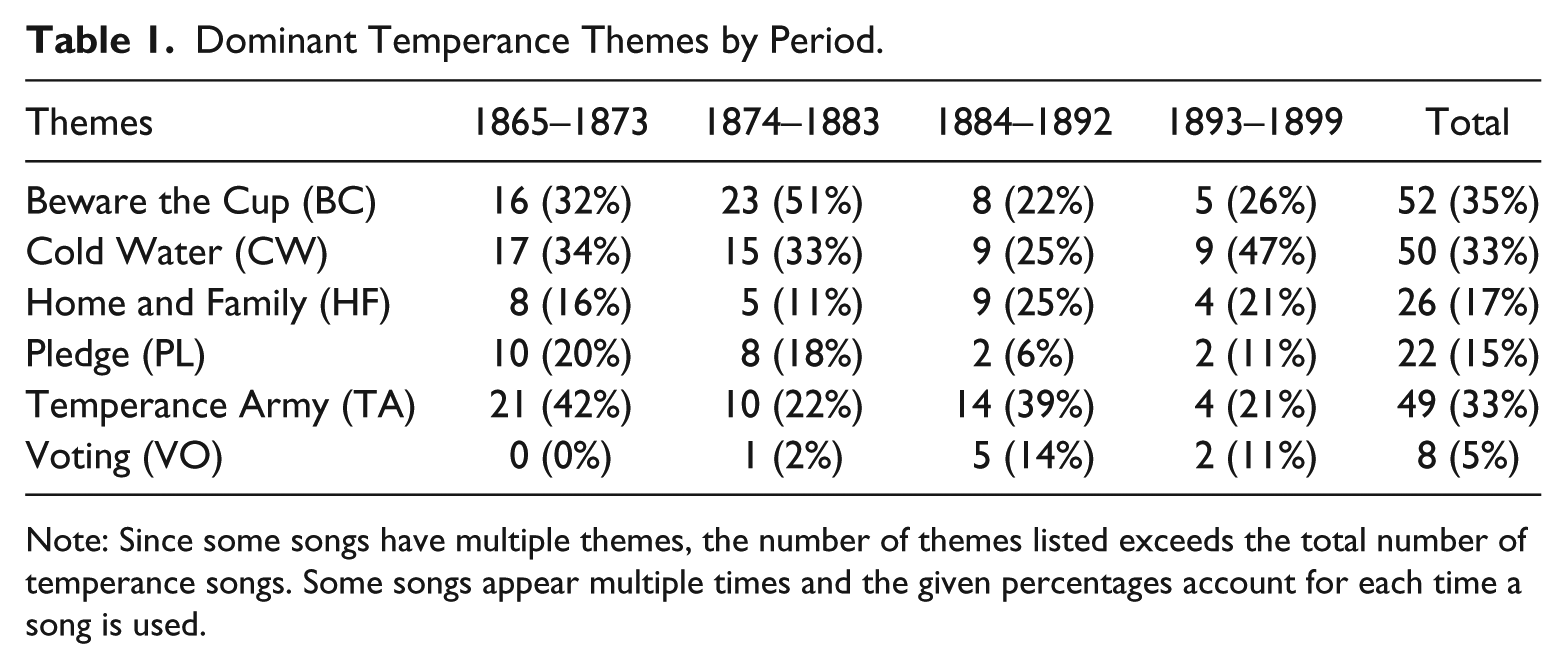
Note: Since some songs have multiple themes, the number of themes listed exceeds the total number of temperance songs. Some songs appear multiple times and the given percentages account for each time a song is used.
3. Do the themes support Gusfield’s or Blocker’s assertions regarding the evolution of suasive and coercive reform tactics?
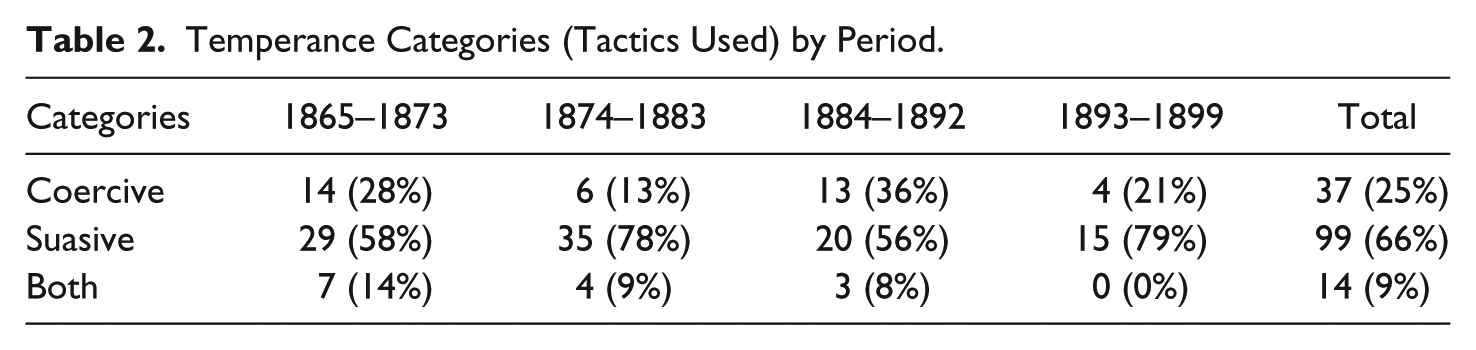
As in previous studies, the “temperance army” theme and “voting” for prohibition were considered coercive tactics since force and/or legal action are implied by these themes. “Beware the cup,” “cold water,” “home and family,” and “pledge” songs were considered suasive because in each case the lyrics primarily focus on persuading the listener to abstain from drinking. Songs are classified as “both” if themes from both categories are utilized.
Table 2 shows the number and percentage of songs for each period that fall into these three categories and the totals across all four periods. While moral suasion was most commonly utilized in each period, there are clearly variations from period to period with regard to the percentage of songs that were suasive or coercive. Since the “both” category also includes coercive themes, it seems appropriate to consider the combined percentages for “both” and “coercive” as a measure of coercive activity. The combined percentage was greater in two periods, 1865–1873 (42 percent) and 1884–1892 (44 percent), and considerably less in 1874–1883 (22 percent) and 1893–1899 (21 percent). This variation across four periods seems to support Blocker’s argument that use of suasive and coercive tactics varied across the span of temperance reform.
Temperance Categories (Tactics Used) by Period.
Discussion
The fact that temperance songs were included in 65 percent of school songbooks analyzed for this study compared to slightly more than half in Sanders’s 1840–1860 study seems to suggest that the influence of the temperance movement in schools grew during the postwar years. In both studies, the three most common themes were “cold water,” “beware the cup,” and “temperance army.” The “home and family” and “pledge” themes were less prominent in both studies, and especially so for the present study.
The “God’s command” theme was also less prominent in the earlier study, found in 15 percent of the songs reviewed. Furthermore, it did not emerge as a dominant theme in this study possibly suggesting that postwar temperance reform efforts were moving toward a more secular and focused approach to control the liquor problem. This is consistent with Blocker’s observation that Party Prohibitionists viewed the liquor traffic as the cause for social problems, ignoring “the scriptural basis for social action asserted by the churches.” 26
The formation of the Prohibition Party in 1869 brought the liquor control issue to the national level. One might reasonably assume that school songbooks of this period would rely more heavily on coercion than moral suasion, but this was not the case. Results suggest that reliance on moral suasion actually increased in the postwar years, with 66 percent of songs identified as suasive compared to 62 percent in Sanders’s 1840–1860 study. Perhaps the strong emphasis on moral suasion was due to the fact that the songs were to be sung by children. Branham and Hartnett note that such messages delivered through school concerts utilized “persuasion through family-based shame,” 27 as a means of reaching parents and other adults in the audience. Suasive songs extolling simple messages about the dangers of alcohol and the benefits of cold water could also more effectively influence the future citizens who were singing them. Coercive songs focused on voting were also far less relevant since voting would not become an option for several years for the boys who sang these songs, and several decades for girls in the classroom since the nineteenth amendment was not ratified until 1920. Understandably, the more common coercive theme employed in these temperance songs encouraged membership in the temperance army through children’s auxiliaries associated with temperance organizations.
A few of the temperance songs in these school songbooks appeared three or more times, and several of these are noted as popular temperance songs by other sources. “Touch Not the Cup” to the tune of “Long, Long Ago” with lyrics by J. H. Aikman appeared in five of the school songbooks and was also included in more than a dozen temperance songsters. Franz Abt’s “The Temperance Call,” also published in five of the school songbooks, reportedly appeared in at least thirty-five hymnals and temperance songsters. Benjamin Russel Hanby’s “Crowding Awfully” appeared in four of the songbooks. It was a favorite selection of the singing Hutchinson Family, published in sheet music format in 1866. Finally, “Rise, O Rise to Nobler Manhood” set to George F. Root’s popular Civil War song, “Tramp, Tramp, Tramp,” was included in three of these songbooks and also appeared in numerous temperance songsters of the postwar period. 28
Recommendations and Final Thoughts
A number of singing school books and other songbooks not specifically designated for school use were intentionally excluded from this study. Yet, in doing so, at least three singing school books used in public schools, The Harp of Judah, Jubilee, and Emerson’s Golden Wreath were not examined. 29 Future researchers may wish to analyze the contents of singing school books to determine whether temperance songs were commonly included and, if so, whether the common themes and tactics differed from those of school songbooks. Since singing schools were generally attended by both children and adults, it seems likely that “voting” and other coercive themes would be used more frequently.
The first graded music series appeared in the 1860s, and by the 1880s they began to overshadow single-volume school songbooks. Given the importance of these new series, Birge, as well as Mark and Gary, devotes his discussion of post–Civil War curriculum materials almost entirely to the graded music series. 30 Yet, in doing so, they give important single-volume songbooks of this period almost no attention. As John mentions, and as is evident from the sample in this study, school songbooks continued to be published for the remainder of the century and beyond. 31 If reports from publishers can be believed, several books sold well even as the graded series began to dominate the market. Emerson’s Golden Wreath sold more than 250,000 copies by 1876. Palmer’s Song King reportedly sold more than 90,000 copies in its first year and nearly 200,000 copies between 1872 and 1876. By 1891 it reportedly had “the greatest sales of any similar work ever published” although it is impossible to know what portion of these sales were for school use. 32
Single-volume books expanded their appeal to the public in a variety of ways. Some, such as Giffe’s Vocal Drill Book (1885), were designed especially for use by classroom teachers. This addressed a specific need since classroom teachers often taught elementary music with guidance from music supervisors. W. S. Tilden’s Common School Song-Reader for Schools of Mixed Grades served an ongoing need in such schools where “no one book of a regularly graded series can be so conveniently and effectively used.” Although W. A. Ogden stated that his Morning Bells for Public Schools (1892) was designed “as a supplemental book in schools where music is regularly taught,” the inclusion of several pages of instructional materials seems to suggest that the book could also stand alone when graded series were not available or appropriate. Still other compilers sought to bring the graded aspect of series books within the covers of a single volume, as was the case with S. G. Smith’s Class and School and Palmer’s Graded Studies. 33 Given the large number of single-volume school songbooks published during this period, future researchers may wish to more fully explore their impact and evaluate changes in instructional content and song materials intended to address the needs of the schools and to compete with the graded series that would soon dominate the school music market.
The temperance movement and its songs were not limited to the United States. Temperance organizations were formed during the nineteenth century in Canada, England, Ireland, Scotland, and Wales. The WCTU established branches in Australia (1882), Canada (1877), and Japan (1886), and the World’s Woman’s Christian Temperance Union (WWCTU) was formed in 1885, eventually drawing large memberships in Australia, Canada, England, New Zealand, Scotland, and South Africa. 34 Charles Edward McGuire provides an interesting discussion of John Curwen, founder of the Tonic Sol-fa movement in Great Britain, and his support for the temperance cause in Music and Victorian Philanthropy. 35 Additional studies of the temperance movement and music education in other countries are needed to more fully understand the role of music within the international temperance movement.
The results of this study show that temperance songs were frequently included in school songbooks in the post–Civil War years of the nineteenth century. Such songs were intended not only for the moral education of children but to convey the message of temperance to other family members and the community through school concerts. No doubt these efforts were encouraged by the WCTU’s Department of Scientific Temperance Instruction and other temperance organizations of the day that recognized the important role of temperance songs in conveying their message. As one publisher notes, Music is loved by all; it is the echo of our nature, and we never speak so forcibly as when we sing. . . no idea ever fairly impresses the world until it is set to music. How triumphantly a thought moves on when it is chanted through the land! Let the Temperance principles, then, be brought out in song, so that they may be sung in the Church, in the Sabbath School, in the Temperance Meetings, in the Bands of Hope, at the forge, in the office, workshop, on the sea, on the farm—everywhere.
36
Findings of this study support Blocker’s assertion that “history reveals no simple progression toward coercion.” 37 Confirming that assertion with evidence from school songbooks of the period not only strengthens his argument but also demonstrates the power of music to both influence and reflect historical trends and events.
Footnotes
Appendix A
Appendix B
Appendix C
Declaration of Conflicting Interests
The author(s) declared no potential conflicts of interest with respect to the research, authorship, and/or publication of this article.
Funding
The author(s) received no financial support for the research, authorship, and/or publication of this article.
1
Ralph L. Baldwin, “The Evolution of Public School Music in the United States from the Civil War to 1900,” Music Supervisors’ Journal 10 (December 1923): 8; and Robert W. John, “A History of School Vocal Instruction Books in the United States” (Ph.D. diss., Indiana University, 1953), 75–76.
2
Michael L. Mark and Charles L. Gary, A History of American Music Education, 2nd ed. (Reston, VA: MENC, 1992), 168.
3
Ruth Iana Gustafson, Race and Curriculum: Music in Childhood Education (New York: Palgrave Macmillan, 2009), 4.
4
Jonathan Zimmerman, “‘The Queen of the Lobby’: Mary Hunt, Scientific Temperance, and the Dilemma of Democratic Education in America, 1879-1906,” History of Education Quarterly 32, no. 1 (Spring 1992): 8.
5
Robert James Branham and Stephen J. Hartnett, Sweet Freedom’s Song (Oxford: Oxford University Press, 2002), 79, 168.
6
Ibid., 164; George W. Ewing, The Well-Tempered Lyre: Songs and Verse of the Temperance Movement (Dallas: Southern Methodist University Press, 1977), 179–82; Paul D. Sanders, Lyrics and Borrowed Tunes of the American Temperance Movement (Columbia: University of Missouri Press, 2006), 259–62.
7
Jed Dannenbaum, Drink and Disorder (Urbana: University of Illinois Press, 1984), 12, 16, 33, 42; and Jack S. Blocker, Jr., American Temperance Movements: Cycles of Reform (Boston: Twayne Publishers, 1989), 73.
8
Branham and Hartnett, Sweet Freedom’s Song, 163.
9
Blocker, American Temperance Movements, 73.
10
Blocker, American Temperance Movements, 74–80; Branham and Hartnett, Sweet Freedom’s Song, 165; Zimmerman, “‘The Queen of the Lobby’”: 8; and Daniel Okrent, Last Call: The Rise and Fall of Prohibition (New York: Scribner, 2010), 21.
11
Jack S. Blocker, Jr., David M. Fahey, and Ian R. Tyrell, eds., Alcohol and Temperance in Modern History: An International Encyclopedia (Santa Barbara: ABC-CLIO, 2003), s.v. “Prohibition Party (United States).”
12
Ibid., s.v. “Anti-Saloon League of America (ASLA).”
13
J. William Suffern, The Normal (Chicago: Brainard’s Sons, 1872), 67.
14
L. O. Emerson, The Encore (Boston, MA: Oliver Ditson and Co., 1876), 55.
15
Joseph R. Gusfield, Symbolic Crusade: Status Politics and the American Temperance Movement (Urbana: University of Illinois Press, 1863), 6–7; and Blocker, American Temperance Movements, xiv–xv.
16
John, “A History of School Vocal Instruction Books,” 52–53, 70, 73–76.
17
Paul A. Haack, “An Analysis of the Values Expressed in the Song Texts of an 1873 Music Education Book,” The Bulletin of Historical Research in Music Education 4 (January 1983): 7–13; and Terese M. Volk, “Rote Songbooks: Materials and Repertoire for the Classroom, 1846-1859,” The Bulletin of Historical Research in Music Education 17 (May 1996): 181–96.
18
Ruth Iana Gustafson, “Merry Throngs and Street Gangs: The Fabrication of Whiteness and the Worthy Citizen in Early Vocal Instruction and Music Appreciation, 1830-1930” (Ph.D. diss., University of Wisconsin-Madison, 2005).
19
Ewing, The Well-Tempered Lyre, 21–22, 41–45, 52–62, 82, 84–103, 152, 165–78.
20
Jane Anne Peterson, “Rum, Ruin and Revival: Protestant Hymns and the Temperance Movement” (M.A. thesis, Southern Illinois University at Edwardsville, 1998); and Paul D. Sanders, “Use of Suasion and Coercion in George F. Root’s Temperance Songbooks,” Bulletin of the International Kodály Society 30, no. 2 (2005): 34–43.
21
Paul D. Sanders, “Temperance Songs in American School Songbooks, 1840-1860,” Journal of Historical Research in Music Education 37, no. 1 (2015): 5–23.
22
Google Books, http://books.google.com/; HathiTrust, http://www.hathitrust.org/; and Internet Archive,  .
.
23
Theodore F. Seward, The Singer (New York: Biglow and Main, 1870).
25
Appendix B contains a complete listing of the temperance songs arranged by date, and songbook title noting tactics (coercive, suasive, or both) and dominant themes. shows examples of each of the dominant themes listed in Table One.
26
Blocker, American Temperance Movements, 87.
27
Branham and Hartnett, Sweet Freedom’s Song, 79.
28
Ewing, Well-Tempered Lyre, 179; and Sanders, Lyrics and Borrowed Tunes, 150–52, 232; “The Temperance Call,”
Hymnary.org
, (accessed May 20, 2015); and Jeanne B. Gross, “Benjamin Russel Hanby, Ohio Composer-Educator, 1833-1867: His Contributions to Early Music Education,” (Ph.D. diss., The Ohio State University, 1987), 192.
29
Baldwin, “Evolution of Public School Music in the United States,” 12; and Edward Bailey Birge, History of Public School Music in the United States, New and Augmented ed. (Washington, DC: MENC, 1966), 80.
30
Birge, History of Public School Music in the United States, 86–162; Mark and Gary, History of American Music Education, 165–201.
31
John, “A History of School Vocal Instruction Books,” 75–76.
32
Sales figures reported on back cover of the following, respectively: L. O. Emerson, The Encore (Boston: Oliver Ditson & Co., 1876); H. R. Palmer, The Song Queen (Cincinnati, OH: John Church & Co., 1872); H. R. Palmer, The Song Herald (Cincinnati, OH: John Church & Co., 1876); and H. R. Palmer, Palmer’s Graded Studies (Cincinnati, OH: John Church & Co., 1891).
33
W. T. Giffe, Giffe’s Vocal Drill Book (Logansport, IN: Home Music Co., 1885), cover; W. S. Tilden, Common School Song-Reader (Boston, MA: Ginn and Co., 1891), preface; W. A. Ogden, Morning Bells for Public Schools (Toledo: W. W. Whitney Co., 1892); S. G. Smith, The Class and School (Cincinnati, OH: John Church Co., 1890); and H. R. Palmer, Palmer’s Graded Studies.
34
Alcohol and Temperance in Modern History, ed. Blocker, Fahey, and Tyrell, s.v. “British Temperance League (BTL),” “Canada Temperance Act,” “Ireland,” “Scottish Temperance League,” “Wales,” “Woman’s Christian Temperance Union (WCTU),” and “World’s Woman’s Christian Temperance Union (WWCTU).”
35
Charles Edward McGuire, “Temperance and Tonic Sol-fa,” in Music and Victorian Philanthropy: The Tonic Sol-fa Movement (New York: Cambridge University Press, 2009), 68–112.
36
[H. Huck], Clear Notes (Chicago: H. Huck, 1879), preface. The term “Band of Hope” originates with Protestant temperance organizations’ branches for children in the United Kingdom beginning in the 1840s, but as the movement spread to other countries Bands of Hope became a generic term for children’s temperance groups. See Jack S. Blocker, Jr., David M. Fahey, and Ian R. Tyrell, eds., Alcohol and Temperance in Modern History: An International Encyclopedia (Santa Barbara: ABC-CLIO, 2003), s.v. “Bands of Hope.”
37
Blocker, American Temperance Movements, xv.