






Abstract
This historical study is an extension of an earlier study “The Origins of Multicultural Music Education in Chinese Secondary Schools’ General Music Classes.” In the earlier study, I examined multicultural music education in middle school music classes in the People’s Republic of China from 1989 to 2010. The present study examines the same topic during an earlier time period, 1978–1988. Primary sources are national syllabi issued by the Chinese Ministry of Education and State Education Commission. The study concludes that during the time period Chinese multicultural music education highlighted the diversity of Chinese music culture, involving music from 56 nationalities in the People’s Republic of China. The findings, along with the findings of the earlier study, reveal trends in multicultural music education in Chinese schools.
Introduction
Names of 56 ethnic groups in the People’s Republic of China.
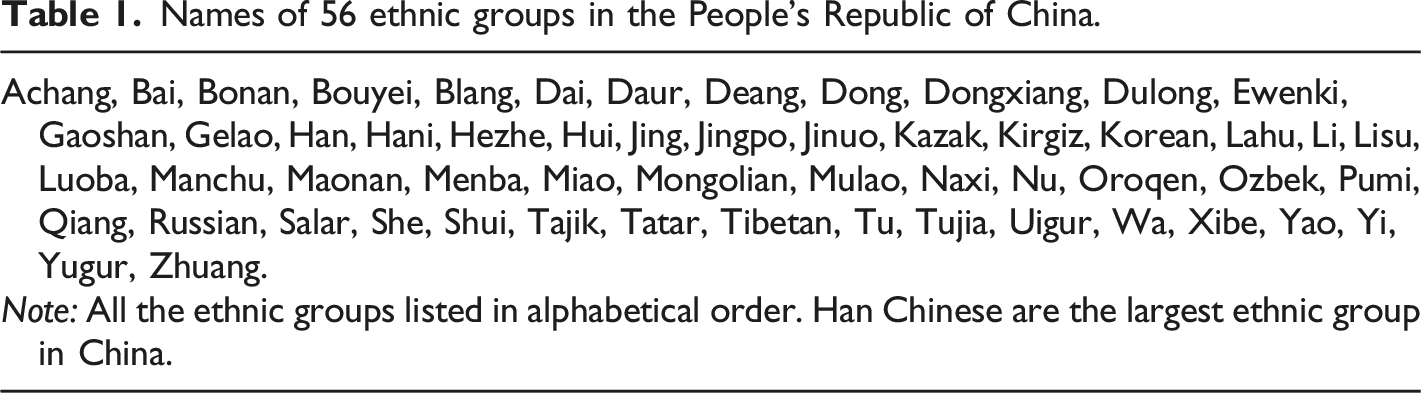
The music from 55 ethnic groups were known as Chinese ethnic minority music. Music from each ethnic group reflects aspects of that group’s culture. Ethnic Han music and ethnic minority music were known collectively as Chinese folk music. Folk music found in China is influenced by the music of other countries. One reason for this diverse music is likely because of the impact of travel along the Silk Road, which promoted commodity and cultural exchange among China and East Asia, Southeast Asia, Central Asia, West Asia, Europe, and North Africa. 4 These cultural exchanges influenced Chinese folk music, creating blends that are highly diversified. Consequently, from the perspective of learning Chinese folk music, studying Chinese multicultural music education is necessary, and learning multicultural music may benefit Chinese cultural development.
Multicultural music education is a vital means to show students’ cultural diversity and teach them about a variety of music genres. Chinese educators believe that school multicultural music education plays an essential role in decreasing ethnic bias and fears. 5 Music could be a way to let students have an increased understanding of other cultures. In this way, multicultural music education benefits students in fostering a broader perspective of a number of the world’s cultures.
The current Chinese music education curricula took shape in 1950. 6 According to the documents issued by the Ministry of Education of the Central People’s Government, including the Middle School Music Teaching Syllabus (Draft) (1956, 1957), there is no evidence to indicate that music education in middle schools originally included multicultural music. 7 From 1958 to 1962, music education in primary and secondary schools was reduced or even discontinued due to the influence of the “Great Leap Forward” movement. 8 The core idea of this movement was to call on the entire Chinese people to devote themselves to industrial and agricultural production, aiming to catch up with or even surpass the United Kingdom in terms of output in 15 years or less. Under this guidance, the Chinese government at that time put forward a series of unrealistic targets. China’s industrial and agricultural production pursued rapid development. The Great Leap Forward also encouraged progress in other aspects of Chinese life, such as transportation, education, and culture. In the education field, the Great Leap Forward was known as the “Education Revolution,” and it emphasized a combination of education and productive labor. The Chinese government encouraged students and teachers to participate in efforts that would assist agricultural and industrial production. 9 This educational movement resulted in chaos in school education.
In 1966, Chairman Mao
10
launched the Cultural Revolution, which lasted 10 years. The Cultural Revolution was a political movement to prevent the restoration of capitalism.
11
From 1966 to 1976, school education was mainly aligned with Mao Zedong Thought
12
and contained many references to Mao Zedong’s Quotes.
13
Likewise, the purpose of school music education was largely restricted to its political function. In February 1967, the Central Committee of the Communist Party of China issued the Notice on the Proletarian Cultural Revolution in Primary Schools (Draft) stipulating that students must learn to sing revolutionary songs.
14
At that time, there was no national document to guide middle school music education. In response to the 1967 official notification, elementary and middle schools in some areas changed music classes into revolutionary art classes.
15
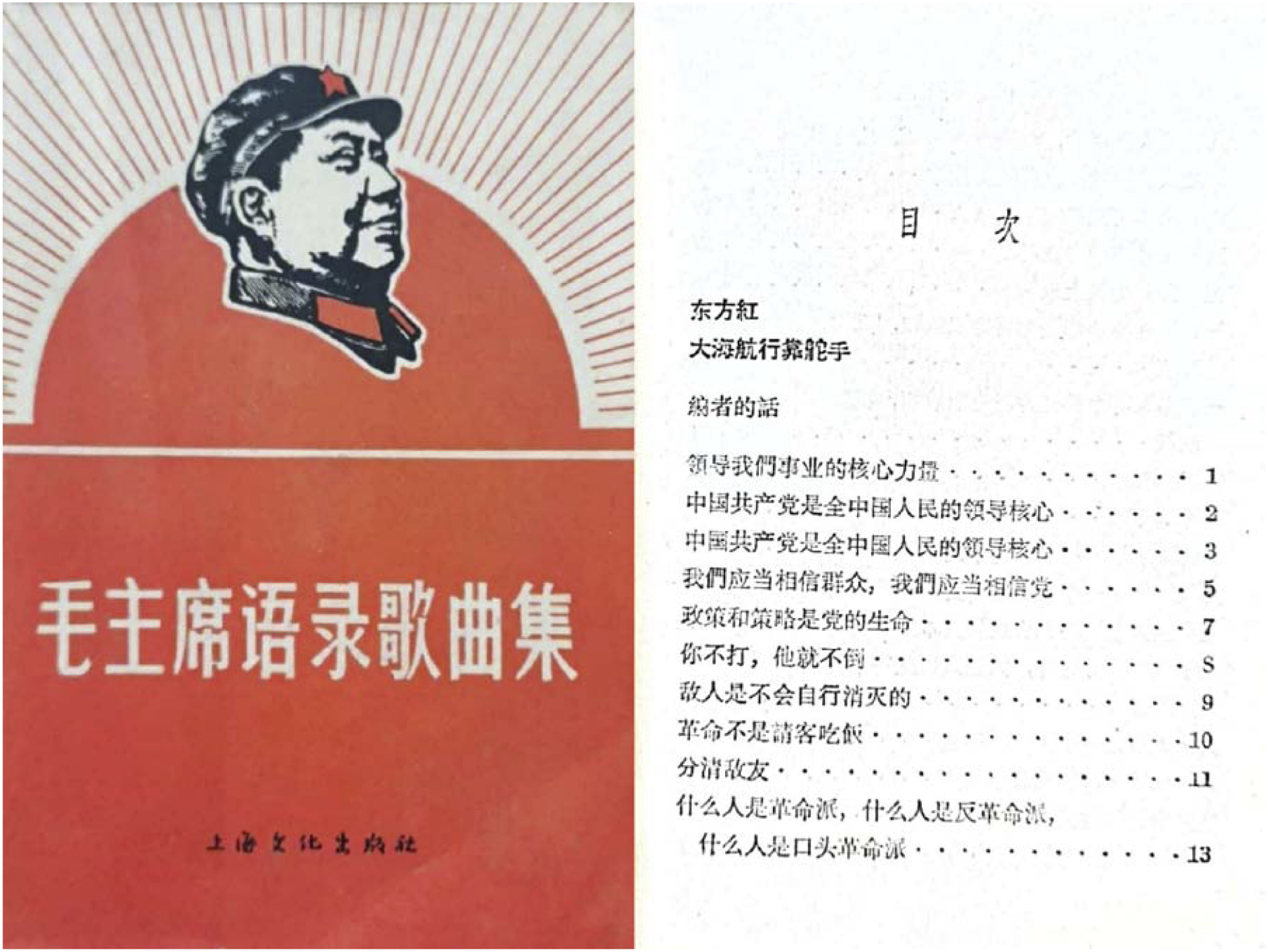
Chinese school music education, thus, became stagnant over the decade of the Cultural Revolution (1966–1976). A series of little songbooks, such as Promote Mao Zedong Thought (《大立毛泽东思想》) (see Figure 1) and Song Collections of Mao Zedong’s Quotations (《毛泽东语录歌曲》) (see Figure 2), provide evidence that revolutionary songs and drama were the only remaining music for music teaching from 1966 to 1976. The cover page and content list of songs of Promote Mao Zedong Thought 《大立毛泽东思想》. The cover page and content list of songs of Song Collections of Mao Zedong's Quotations 《毛泽东语录歌曲》.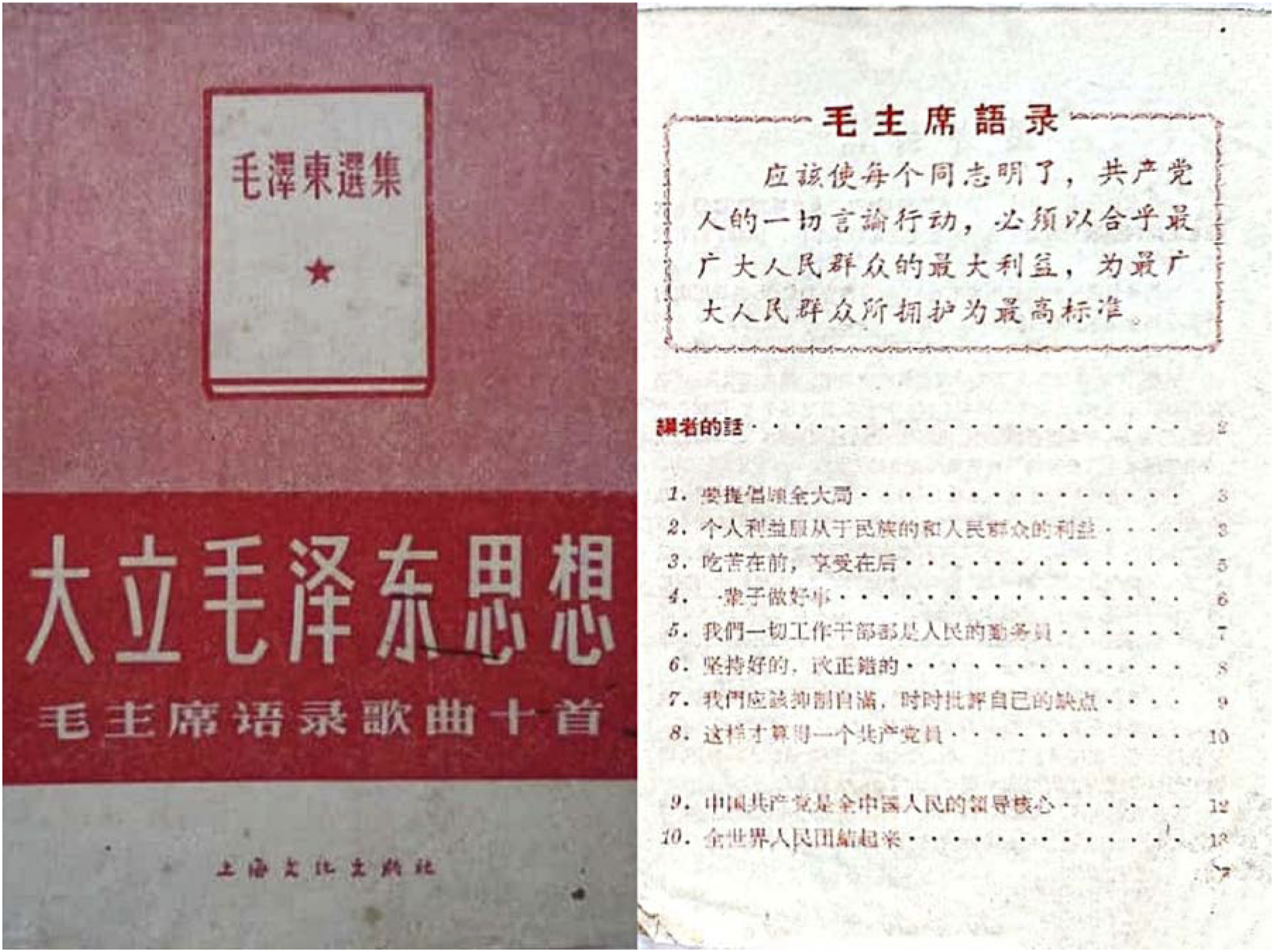
In 1978, Deng Xiaoping, a new leader, came to power in China. 16 The same year, Deng proposed and helped initiate an “open-door” economic policy. This policy opened up China to investment by foreign companies. The policy impacted Chinese education, resulting in a new direction for school music education, including the directive to embrace various musics from all over the world. An earlier study by the author, 17 explored middle school multicultural music education from 1989 to 2010.
The present study continues to examine Chinese middle school multicultural music education in general music classes from 1978 to 1988. This study aims to explore the multicultural portions of the Chinese national syllabi in middle school general music classes from 1978 to 1988. Two questions guided this research: What was the definition of multicultural music in Chinese education from 1978 to 1988? What were the purposes of multicultural music education in Chinese middle school general music classes during this decade?
A Definition of Multicultural Music
In the United States, multicultural studies “highlight racial, ethnic, national, class, gender, religious, and linguistic differences.” 18 However, the definition of “multicultural” may change based on the cultural and historical context. Chinese music educators and scholars provided a different interpretation of multiculturalism. Some of them believe that the core idea of multicultural music is to challenge the concept of “Western Music-centrism” and value music culture of all nationalities in the world. 19 These authors claimed that Chinese folk music, representing some of the 56 Chinese ethnic groups, should be an indispensable part of multicultural music. Therefore, in the current study, multicultural music education consists of “Chinese multicultural music” and “world multicultural music.” Chinese multicultural music includes folk music from 56 ethnic groups in China (Chinese folk music), emphasizing ethnic diversity within China. Based on the perspective of contrasting “Western Music-centrism,” world multicultural music means folk music from ethnic groups in other countries but excludes western classical music.
Primary and Secondary Sources
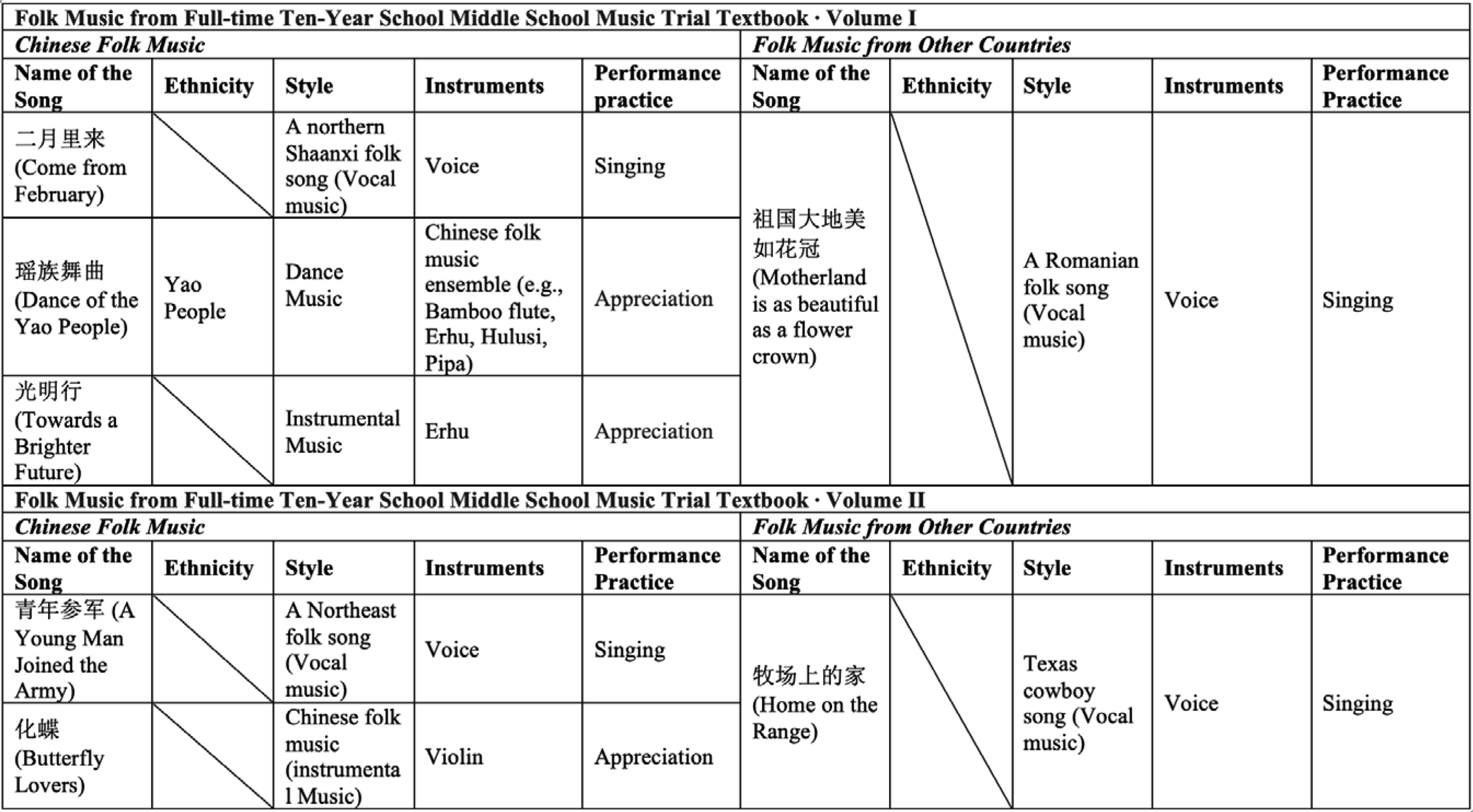
In historical research, researchers collect and interpret historical data to explore past events. Historical data includes primary and secondary sources. The primary sources of the current study heavily relied on documents issued by the Ministry of Education of China. They were Full-Time, Ten-Year Primary and Secondary School Music Teaching Syllabus (Trial Draft) (1979), Full-Time Middle School Music Teaching Syllabus (Trial Draft) (1982), and Nine-Year Compulsory Education Full-Time Middle School Music Teaching Syllabus (Preliminary Draft) (1988). 20 These syllabi primarily include educational purpose, teaching requirements, teaching method suggestions, and assessment suggestions. These documents provide an overview of the Chinese central government’s middle school music education policies. These national syllabi impacted the goals of China’s middle school music education, as well as the teaching materials and instructional strategies that teachers implemented in the classroom. Since these national syllabi did not include suggested repertoire, Full-time Ten-Year School Middle School Music Trial Textbook ∙ Volume I and II were also used to deeply understand findings from the syllabi. These two textbooks were national music textbooks for middle schools, which were published in 1980.
To better understand the historical background of Chinese education as well as school music education from 1979 to 1988, the educational chronicles of this period will also be used as secondary data. The secondary sources examined for this study were Chinese music education history books and other relevant historical research, such as Education Events of the People’s Republic of China, 1949–1982; History of Music Education in Modern China: 1840–2000, and A History of School Music Curriculum in China. 21 The data from the secondary sources were used to corroborate the findings from the primary sources.
Chinese Middle School Music Classes
In Chinese middle schools (grades seven to nine), a general music class was the only form of music that every student was required to take. 22 The curriculum of middle school general music classes was guided by the national educational documents issued by the Ministry of Education of China, such as Full-Time Middle School Music Teaching Syllabus (1982) and Nine-Year Compulsory Education Full-Time Middle School Music Teaching Syllabus (Preliminary Draft) (1988). 23 There were various textbooks that teachers used, all designed according to the National Music Curriculum Standards and national syllabi. These books had slight differences, such as genres of music and songs. Usually, the city-level education committee would choose the music textbook for teachers. Thus, music teachers have less freedom to select songs for classroom teaching. The middle school general music classes typically focused on just singing and listening, although the national syllabi included singing, listening, dancing, composing, playing, and analyzing as equally important standards for the music classroom. 24
Initial Exploration of Multicultural Music in China (1978–1988)
Historical Background
In 1978, the open-door policy ended much of the insularity caused by the Cultural Revolution and opened China to the world. This policy influenced music education by adopting western music, methods, and materials in China’s music teaching and launched musical exchanges between China and other countries. During this period, foreign music included in Chinese curricula expanded from western classical to music from countries and regions of Asia, Africa, Latin America, and Australia.
In 1983, Deng Xiaoping proposed “three-oriented” education guidelines; that is, he believed that teachers should gear education to modernization, the world, and the future of the country. 25 The policy that “education should face the world” promoted the development of multicultural education in China. In the area of school music education, this policy meant understanding more world music cultures and learning from all nationalities and ethnic groups, rather than merely focusing on Western classical music. 26 Understanding the music culture of other ethnic groups not only promoted the musical communication between various ethnic groups and nationalities, but also helped students cultivate greater understanding of different cultures. This new idea resulted in the reform of school multicultural music education. Chinese music educators then started to reexamine the existing educational goals, values, standards, and curricula.
At the same time, many international-recognized music teaching methods have been introduced in China, such as Orff-Schulwerk and the Kodály Method. For example, in September 1984, the first Orff-Schulwerk Research Group was established in China. In December, eight members from the research group presented their classroom teaching using Orff-Schulwerk at the Shanghai Music Education Research Conference for Primary and Middle Schools Teachers. 27 In May 1986, the Education Committee of the Chinese Music Association and the Department of Education of Beijing Normal University invited Mrs. Schnader, a German Orff teacher, to come to China to introduce Orff-Schulwerk. 28 One year later in July, the Chinese Musicians Association established a six-member music education group to visit Hungary to learn the Kodály method. 29 Moreover, during this period, higher education offering included world music courses, such as foreign folk music, Latin American music, and Southeast Asian music, to prepare for teaching world music (multicultural music) in primary and secondary schools. 30
School Music Education, 1978–1980
On January 18, 1978, China’s Ministry of Education promulgated the Trial Draft of the Full-Time, Ten-Year Primary and Secondary School Teaching Proposal. In this document, music education in middle schools did not receive a great deal of attention. The information provided stipulated only that the middle school must offer music lessons to seventh-grade students (those in the first year of middle school). There were no specific requirements for music education in other middle school grades. In the document of the teaching proposal, although the Ministry of Education clearly stated that middle schools must offer music lessons to students in the first year, many schools were unable to meet this requirement. This was because the Cultural Revolution had resulted in a shortage of music teaching materials and teachers. 31
In February 1979, the Ministry of Education held a conference on primary and secondary music and art instruction materials, which gathered scholars from nine provinces. 32 During this conference, the Ministry of Education developed the Full-Time, Ten-Year Primary and Secondary School Music Teaching Syllabus (Trial Draft) based on the music education section in the trial draft of the Full-Time, Ten-Year Primary and Secondary School Teaching Proposal. 33 This document was the first national school music education syllabus after the Cultural Revolution. In June of the same year, the Ministry of Education officially issued the Full-Time, Ten-Year Primary and Secondary School Music Teaching Syllabus (Trial Draft). The section of the document named “School Music Education Purpose” mentioned that music education should enable students to love the music from their motherland and familiarize themselves with the folk music of China, as well as provide students with enough opportunities to learn about “excellent” foreign music. 34 Likewise, in the section “Teaching Content and Method,” the document suggested that the repertoire of singing instructions should include Chinese folk songs and appropriate foreign pieces, which are suitable for the context of Chinese school music education. The music appreciation repertoire needs to include vocal and instrumental music from China and other countries, and folk music from China’s 56 ethnic groups. When selecting the music for appreciation instruction, teachers must consider the diversity of the genre, the form, and the style to expand students’ musical knowledge and meet their different various needs. 35 From the perspective of musical diversity within China, this document did not require proportional representation of music from the 56 ethnic groups in all repertoires. However, the guideline advocated the importance of folk music from the Chinese 56 nationalities in school music education. From the perspective of learning and teaching methods, general music education in middle school mainly relied on singing and listening (music appreciation). 36 Teaching suggestions in the syllabus (1979) also highlighted the importance of singing for middle school students by providing techniques for vocal teachings, such as exercises for breathing, breath control, two-part singing, and legato and staccato. These indicate that singing was a primary way for students to perform music at that time. 37
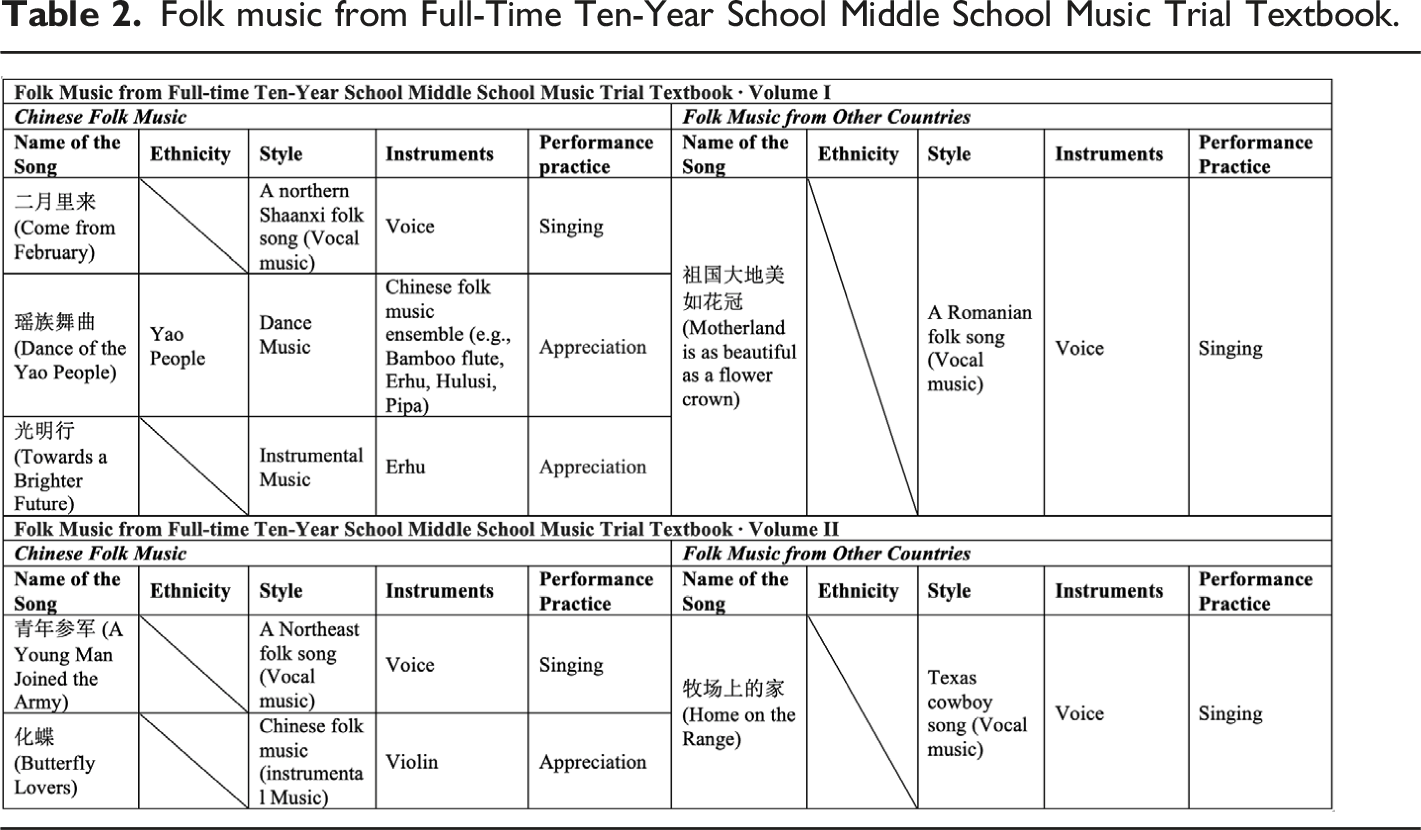
Folk music from Full-Time Ten-Year School Middle School Music Trial Textbook.
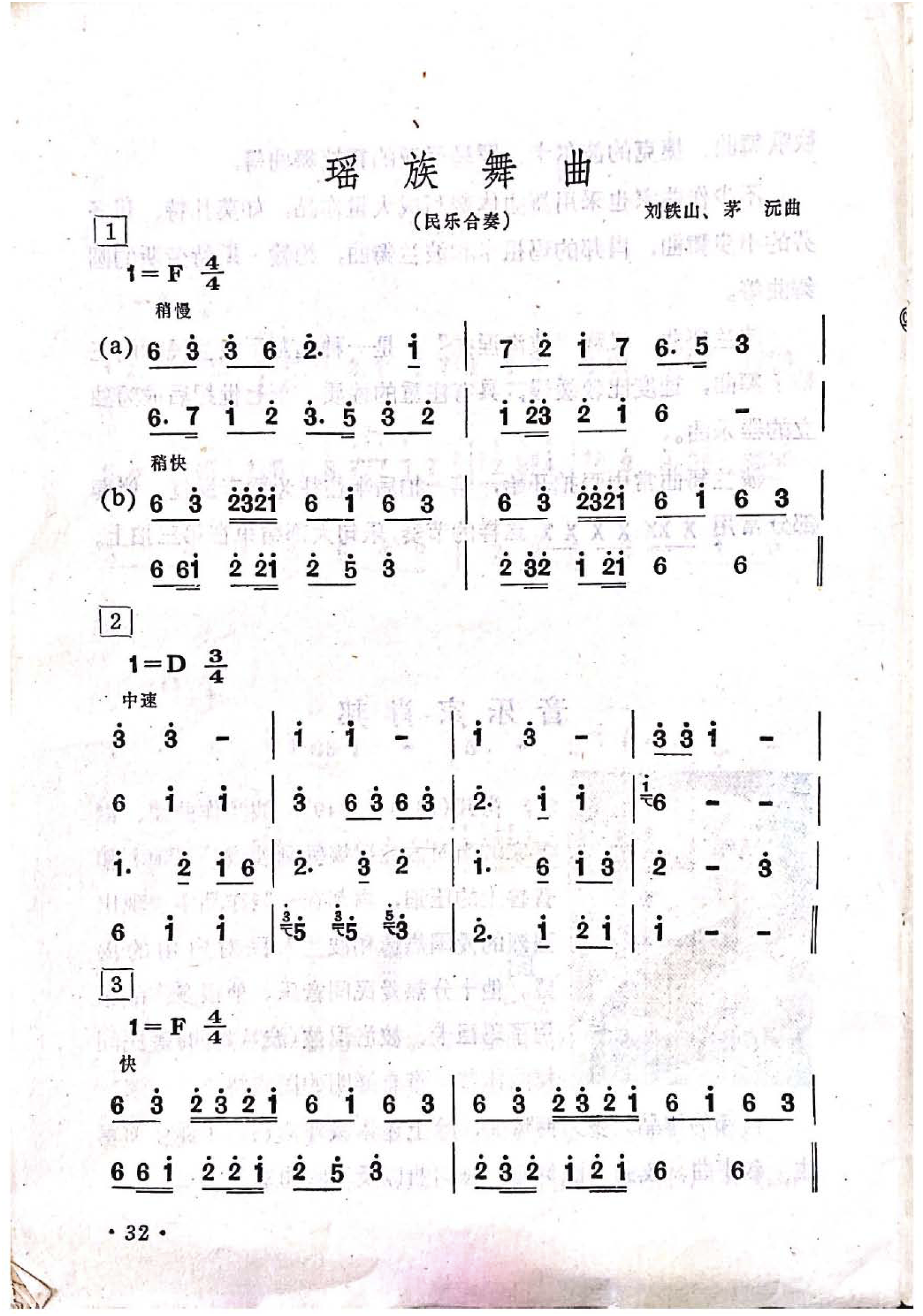
Music score of “dance of yao people” from Full-time Ten-Year School Middle School Music Trial Textbook ∙ Volume I.
The music textbooks published in 1980 included information specific to each ethnic music, composers of each music piece, and theories that needed to be included in each lesson. However, few introductions included specific cultural information. Due to the lack of information about how music teachers taught music from other cultures, it is difficult to decipher whether the concept of “multiculturalism” at that time was limited to singing songs from other ethnic groups.
Generally, the 1979 syllabus provided policies to support the implementation of multiculturalism in China’s school music classes without many specific recommendations. The repertoire of the 1980 textbook did not well reflect the perspective of musical diversity among the 56 ethnic groups in China. Also, two pieces of folk music from other countries in the textbooks indicated that world multicultural music was also limited.
School Music Education, 1981-1988
In April 1981, the Ministry of Education issued a notice about revising the secondary school section found in the document Full-Time, Ten-Year Primary and Secondary School Music Teaching Syllabus (Trial Draft) (1979). 39 Subsequently, the Ministry of Education issued the Full-Time Middle School Music Teaching Syllabus (Trial Draft) in 1982. Regarding teaching content, this revision reproduced the language and main points from the 1979 syllabus. For the multicultural music section, the 1982 syllabus increased the amount of required Chinese folk music from 56 ethnic groups for the music appreciation instruction. Singing and music appreciation were primary methods in middle schools’ general music classes. In music appreciation instruction, students listened to folk music and analyzed specific characteristics of folk music, such as instruments, speed, rhythm, melody, with teachers’ guides.
In the section of “Teaching Requirements by Grades,” the teaching guidelines for the first and second grades of middle school (grades seven and eight) stated that “students need to understand and learn to appreciate the music from various ethnic groups in China. Also, students need to be familiar with the main musical instruments used to perform Chinese folk music (music from the 56 ethnic groups).” 40 This guideline required students to memorize musical instruments played in different genres of Chinese folk music, rather than learn to perform on these instruments.
Additionally, the 1982 syllabus highlighted the role of general music classes in developing students’ respect and understanding of cultural diversity for the peoples and cultures of the 56 ethnic groups. These requirements for world music teaching in the 1982 syllabus were similar to the syllabus issued in 1979. 41 Only the guideline in the 1982 syllabus for third grade (grade nine) appreciation instruction clearly put forward the requirement of introducing some folk songs from other countries. However, specific recommendations for time spent teaching and repertoire of multicultural music were not suggested in the syllabus released in 1982. The big challenge for the researcher to learn about the specific foreign folk songs included in the classroom teaching is that the Ministry of Education of China canceled the proposal of using music textbooks uniformly throughout the country in 1981. 42 Instead, the Ministry of Education encouraged provinces or cities to publish local textbooks based on the specific needs of music teaching in local schools and in the national syllabus. Therefore, although the 1982 syllabus advocated the inclusion of folk songs from other countries in middle school music classes, without investigating the textbooks used in different provinces, it is difficult for the researcher to analyze the practices of multicultural music education in different places in China, such as (1) Whether the middle school music education in each province followed the national syllabus; and (2) What world music was taught in middle school music classes at that time.
In May 1988, the National Educational Committee distributed yet another syllabus, Nine-Year Compulsory Education Full-Time Middle School Music Teaching Syllabus (Preliminary Draft), to guide music education in middle schools. This syllabus contained clear stipulations and set the proportion of time for teaching Chinese folk music and world music (non-Chinese music) at a ratio of six to four, respectively. 43 Therefore, more emphasis was given to teaching Chinese folk music than any other music. As to the proportion of time devoted to various music genres, Chinese folk music from all of China’s ethnicities accounted for a large proportion of what was studied in middle school music classes. This stipulation meant that the diversity of the music culture in China received more attention than before. This requirement for teaching instruction, along with some revised music textbooks, significantly changed and improved the multicultural Chinese folk music used for teaching middle school students about the diversity of Chinese folk music. However, from the suggestions of teaching methods, there was no significant change in Chinese folk music teaching. Due to a lack of a definition in the syllabus, we do not know whether the term world music refers only to western music or folk music from other countries. Drawing conclusions on the specific proportion of multicultural music teaching being implemented in middle schools across China in the late 1980s is unknown.
Conclusion
From 1978 to 1988, with the implementation of Deng Xiaoping’s open-door policy and the national education reform, multicultural music education in Chinese middle school classes entered a germination and exploration stage. In the national music teaching syllabi for middle schools, the Ministry of Education and State Education Commission stated the need for and importance of learning about music from the 56 ethnic groups in China and about music from other countries. However, specific strategies for implementing multicultural music teaching and the definition of multicultural music were vague. According to the guidelines in national documents, the way students experienced folk music from the 56 ethnic was relatively simple, mainly relying on singing and listening.
From 1978 to 1988, although the syllabi emphasized an understanding of the diversity of Chinese national music culture in middle school music classes, based on analysis of national textbooks, school music education did not reflect the proposal of implementing Chinese multiculturalism in national syllabi. For the implementation of world multiculturalism, due to the lack of specific definitions of concepts such as “foreign music,” “world music,” and “music from other countries,” it was difficult to determine whether the folk musics from other countries and other ethnic groups outside of China were included in middle school music classes. The 1980 national textbooks included the most of these so-called “excellent foreign music,” with musicians such as Bach, Beethoven, Mozart. The limited number of folk music selections from other counties in the 1980 national textbooks suggested a further impediment to implementing multiculturalism in school music education. Based on sources used in this study, the amount of multicultural music that students experienced in Chinese middle schools during this decade was unclear and would be an excellent topic for future researchers to investigate. Future researchers could investigate the implementation of multicultural music education in middle schools in the specific province(s) by examining the music textbooks used in these place(s).
According to the national syllabi mentioned here, the purpose of multicultural music education during this decade (1978–1988) was to develop students’ respect, understanding, and tolerance of cultural differences among the 56 Chinese ethnic groups. Obviously, the purpose of multicultural education in Chinese middle schools was different from the goal of multicultural education in the United States as described by American researchers: multicultural education for students from different racial, ethnic, gender, and class backgrounds so that these students could have opportunities for educational equity and success. 44 Therefore, the purpose of multicultural music education and definition of "multiculturalism" can change depending on cultural context and social background.
Based on the findings of my previous study that examined Chinese school multicultural music education from 1989 to 2010, the educational goal of multicultural music in middle school from 1978 to 1988 seems to have been realized. 45 However, during the decade of 1978–1988, a lack of information about Chinese folk music and folk music from other cultures outside of China in national documents issued by the Ministry of Education does not support the existence of a more global approach to multicultural music education at that time.
The findings of the present study and my earlier research show that multicultural music education in Chinese middle schools was developing toward greater globalization. In early 21st century China, both the music of China’s 56 ethnic groups and world multicultural music were essential in Chinese multicultural music education.
I hope that multicultural music education in Chinese school education will continue to evolve by including more music from ethnic and cultural groups outside of China. Moreover, singing and listening might be accessible ways for Chinese teachers to implement in classroom teaching, while they are not always the best ways to experience multicultural music. School educators could consider incorporating other approaches, such as body movements, cultural conversation, and instruments learning, in school multicultural music teaching. Increasing various ways for students to experience music from other cultures would promote the development of multicultural music. The addition of more precise language in national syllabi is recommended to help music teachers implement multicultural music education.
The present study and my previous research examined only the middle school national music teaching syllabi from 1979 to 2010. The Chinese Ministry of Education released two new versions of the national syllabus in 2011 and 2020, respectively. Further research is needed on the evolution of multicultural music education in Chinese school music classes. Future researchers could consider: (1) examining Chinese middle school multicultural music education during the past 10 years (2010–2020), (2) examining multicultural music education in Chinese primary schools and high schools, and (3) investigating how both China’s 56 ethnic groups’ music and world multicultural music both support national music education.
Footnotes
Declaration of Conflicting Interests
The author(s) declared no potential conflicts of interest with respect to the research, authorship, and/or publication of this article.
Funding
The author(s) received no financial support for the research, authorship, and/or publication of this article.
