







Abstract
In this study, I used historical case methodology to analyze the conditions of music education in the Portland (Oregon) Public Schools (PPS) between 1990 and 2017. In 2008, city leaders discovered that only 25% of PPS schools had any arts instruction and developed the Arts Tax to increase staffing for those subjects in the public elementary schools. The primary purpose of this study was to help explain why city leaders felt the Arts Tax was necessary policy. I utilized both primary source archives and interviews of former and current teachers to complete a timeline of events that help explain the conditions city leaders found in 2008 and the remediation process that followed. The analysis includes narratives of the budget cut process, behavior of stakeholders, and exploration of policies that affected PPS music programs. Emergent themes were arranged chronologically according to the timeline and included budget cuts, response to budget cuts, and site-based management. An ad hoc policy analysis provided evidence that site-based management had an indirect but substantial effect on the outcomes for PPS music programs at all grade levels.
The economic and political impact of tax revolts is both immediate and far-reaching, and largely cannot be evaluated until long after the burning embers have turned to ash.
1
Research about music education and education policy is often intertwined with issues of finance and economics. This relationship exists for many reasons, historical and modern, and has been a much-studied topic in music and arts education. Most of the existing literature focuses on how budget reductions are linked to decreased access to arts education. 2 The deprioritized status of music and other arts education since the 1960s has consistently resulted in cuts to these subjects whenever a school budget is under pressure. That is, unless there is a general outcry from the public or special consideration from school leaders. 3 Even in the current era, where music is framed in law as part of a holistic curriculum and a core subject, external pressure on states for accountability in other disciplines prevents music from holding any priority status in the curriculum. 4
The purpose of this study was to incorporate historical case study to investigate budget cuts, tax policy, and their direct and indirect effects on public school music education. The subject of analysis was music education in Portland (Oregon) Public Schools (PPS) between 1990 and 2017. Specifically, I wanted to evaluate two tax measures passed in those years: Measure 5—a property tax limitation passed in 1990—and the Portland Arts Tax, passed in 2012 and upheld by Oregon courts in 2017. An existing study has examined the Arts Tax in detail and outlined the specifics of the policy and the process by which it came to pass. 5 In that previous study, leaders from Portland’s ArtsPAC (political action committee) organization stated that their field research in 2008 revealed only one in four elementary schools in Portland offered any arts instruction at all. The ArtsPAC did not examine the context or events that led to that situation, but instead used their data and public polling to support a campaign for the Arts Tax that now funds public elementary school arts teaching positions. Therefore, the purpose of this investigation was to create the timeline between Measure 5 and the Arts Tax to help explain why civic leaders and the ArtsPAC believed the Arts Tax was a necessary solution. Measure 5 was chosen as the start of the timeline because it was a landmark policy that entirely restructured the way Oregon public schools were funded.
Positionality Statement
Studying the public-school music programs in Portland is personal to me, as I was a high school student in Portland Public Schools (PPS) from 1993 to 1996. During this time, the music program at my high school fell apart due to destaffing and I completed my diploma at a nearby suburban high school. 6 I observed that even at my new high school, the budget cuts from Measure 5 negatively affected the music program. As a result of my experience during these budget cuts, I chose to attend college as a music education major in neighboring Washington State and spent most of the next decade teaching music in Washington school districts.
After the Great Recession of 2007 to 2009, I moved back to Portland with my husband and children. The Arts Tax appeared on the ballot during our residency there, which was the catalyst for this project. I was interested in whether my decision to move to Washington State had been justified or if the music programs in PPS had fared better than I predicted. This question was amplified by my son’s impending enrollment in PPS for kindergarten. Therefore, my positionality to this study exists through the lenses of student, music education professional, parent, and resident of the city, all within the period of 1990 to 2012.
Background and Case Context
Oregon’s Economy Pre-1990
In the 1970s, Oregon had a robust economy based primarily on the industries of logging and related manufacturing. Property taxes, personal income tax, and timber receipts made up a large part of school funding. 7 Timber receipt(s) is still the designation used for funding that comes from companies such as Weyerhaeuser that lease public forests for logging through the federal government. 8 Counties that lease state or national forest land received a large portion of the lease money for use on such expenses as road maintenance, county law enforcement, and schools, balanced through the Payments in Lieu of Taxes Act of 1976. 9 Larger population areas such as Portland, Eugene, and Salem did not need timber receipts, as they were able to raise more funding from higher residential land value and higher personal income tax revenue. 10
The Environmental Protection Act of 1969 led to the discovery of several endangered species in Oregon’s old growth forest habitat during the late ‘70s and early ‘80s, which severely limited timber production and revenue from timber receipts. Logging companies and mills laid off workers and/or closed as production slowed throughout the 1980s, which caused many rural counties to become impoverished through high unemployment and reduced local funding from personal income tax. 11 The industry slowdown coincided with the 1980 to 1982 recession and the national anti-tax movement known at the “Tax Revolt,” popularized by President Ronald Reagan. 12 The Tax Revolt was a national phenomenon that manifested differently among states and developed partially in the wake of the post-war economic boom and the Civil Rights movement. Reasons for the Tax Revolt included housing values, property taxes, and inflation. In some places, voters were angry about desegregation and the use of taxes to fund schools outside their neighborhood. 13
Oregon’s economic struggle during the downturn of the logging industry was combined with the eleventh highest property tax rate in the nation, which made it fertile ground for the Tax Revolt. Local business leaders used these circumstances as an opportunity to sell the public on a property tax reform measure (Measure 5) modeled on California’s Proposition 13. Measure 5 passed in November 1990 with over 60% support.
Measure 5
Oregon is only one of fifteen states that utilizes a voter-initiative or referendum process that can result in constitutional amendments. 14 Measure 5 appeared on the ballot as a citizens’ initiative, though it was written and promoted by business owners and anti-tax activists Don McIntire and Thomas Dennehy. 15 Measure 5 constitutionally limited non-school property taxes to 1% and school property taxes to 0.5% of assessed valuation. The new law also obligated the state to make up the loss of revenue during the phase-in period of 1990 to 1994. In addition, the state was given centralized control of all distribution of school financial resources, similar to California’s Proposition 13. 16 Follow-up measures 47 and 50, passed by the Oregon legislature in 1996 and 1997 respectively, required a double majority to pass new tax revenue sources including local levies (47) and clarifications of procedure (50).
Attributes of Measure 5 that paralleled California’s Proposition 13 included the following:
(1) Proponents used dissatisfaction with the public schools to campaign for the tax cuts, which led to further school budget cuts and increased inequity. 17
(2) The funding design moved responsibility for school finance from local authorities to the state. 18
(3) The measures were promoted as being more financially equitable through centralization of revenue resources. 19
(4) Rather than increase revenues by other means, the state attempted to make up the property tax revenue loss by cutting funding from other state services and by turning to a per-student funding formula. 20
The Portland Arts Tax
In the mid-2000s, a Portland City Council member named Sam Adams was working as the liaison to the Arts and Culture committee. During his work with them, he developed a vision for expanding the arts economy, increasing support of arts organizations, and attracting arts related workers in non-arts industries to Portland. 21 After successfully running for mayor of Portland, he and several other local politicians created the ArtsPAC to fundraise for the election of arts-friendly leaders and to conduct research on the best way to proceed with the arts expansion plan. The ArtsPAC research eventually developed into the Act4Art plan. The ArtsPAC saw that by expanding access to arts and arts education, they could eventually build and attract businesses that rely on artists to design and manufacture their products. Adams’s view was that arts education was a critical piece of a broader arts expansion because an educated audience would be more likely to appreciate, consume, and create art.
The ArtsPAC/Act4Art coalition conducted polls and focus group research between 2008 and 2011, which revealed that many citizens of Portland knew the arts had been previously cut in the schools but were largely unaware of the extent. School district staffing records revealed that only 25% of Portland public elementary schools offered any arts instruction at all. 22 Using careful legal guidance, ArtsPAC developed the Arts Tax to restore K–5 arts education in PPS and to supplement funding for the other five school districts within Portland’s city limits, restoring 1990 levels that required one full-time equivalent (FTE) position for every 500 students. Funding for this policy involved a per-person tax of $35 among all residents over the age of 18. 23 The initiative passed with over 62% of the vote and remains in effect today, having been upheld by Oregon courts in 2017. 24
Method
I used historical case study for this investigation, a method not common in music education literature. The method differs from conventional historical research in several ways. First, the use of case bounding is highly important. Case bounding is used to define the scope or limitations of the subject(s) and/or object(s) of the case. 25 Second, the sequence of events are used to interpret and understand larger themes that emerge from other data. 26 The case in this study was initially bound by location and the events between passage of Measure 5 in 1990 and the Arts Tax in 2012, as well as the position and status of co-curricular music instruction within PPS. However, the case was extended to 2017 when the Oregon Supreme Court upheld the constitutionality of the Arts Tax against a citizen lawsuit.
According to Widdersheim, 27 a historical case study must (a) adopt both a retro view and current view, (b) incorporate existing data sources and develop new ones, and (c) generate both specific and general types of knowledge. The resulting conclusions should be a combination of nomothetic (transferable) and idiographic (individual/unique) knowledge. These two types of knowing are typically considered oppositional, but Salvatore and Valsiner view them as complimentary terms where the data are dynamic and interdependent. 28 In other words, a hybrid of nomothetic and idiographic information can provide validity for conclusions and implications. In using a rigorous framework for data collection and integrating a historical lens for analyzing the case (Figure 1), this method fulfills several of Tracy’s markers of “quality qualitative” research. 29
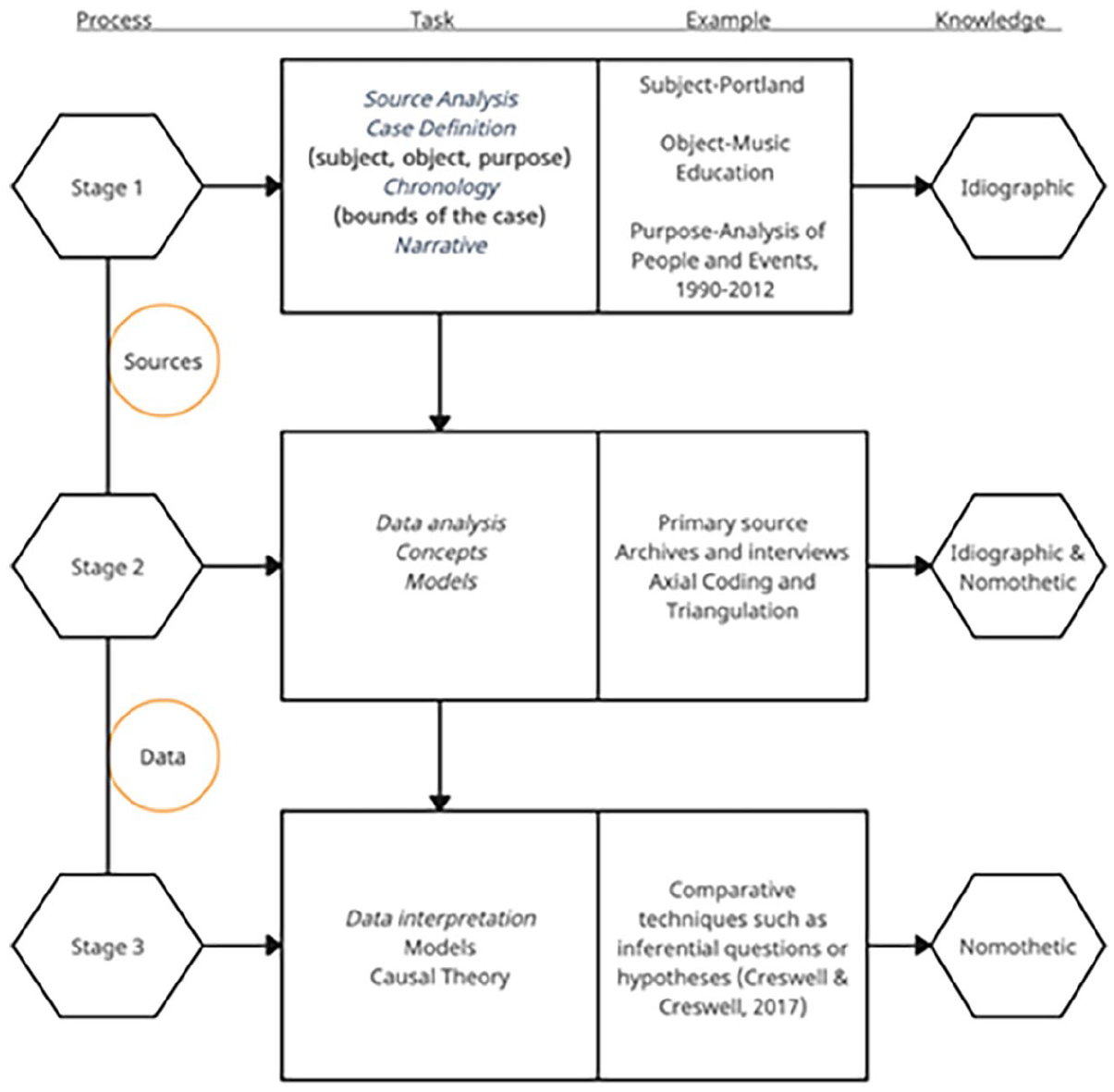
Widdersheim’s (2018) adapted sequence methodology.
The data collection procedures were approved by an institutional review board and took place between April 2021 and April 2022. Data for this study included primary source archival materials and in-depth interviews of ten music educators who worked in Portland Public Schools during the 1990 to 2012 period. To locate interview participants, I used convenience sampling with personal contacts and then snowball sampling. 30
The final group of participants included elementary and secondary teachers who taught general, instrumental, and vocal music and worked in schools from every region of the city, maximizing the variation of individual experiences. I built the initial timeline starting with events I suspected had an effect on music education and of which I was already aware due to my positionality. By starting with this timeline (Figure 2), I was able to refine my interview questions to gain participants’ personal experiences and interpretations of these events. All interview participant names used here are pseudonyms.
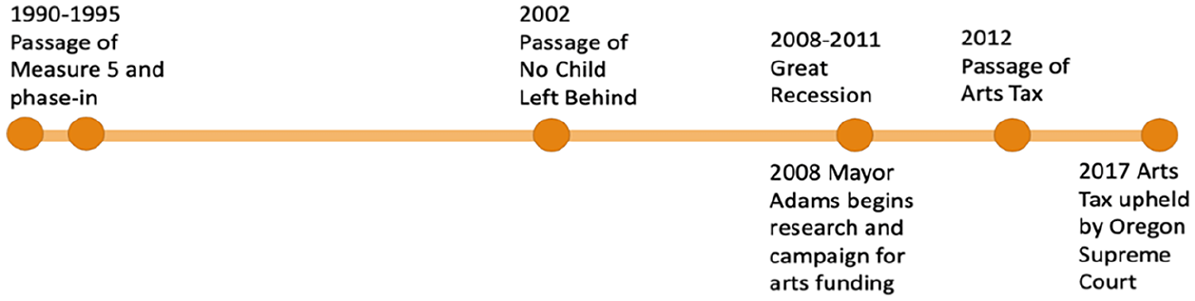
Timeline of historical case.
I conducted hour-long, in-depth interviews and included questions about the tax, curricular, and financial policies of the state and school district, as well as the perceived effects on individual school music programs. I used in vivo inductive coding and axial coding to arrive at emergent themes, then triangulated codes and themes to data from archive materials. I used recursive analysis between the interviews and archive documents to fill gaps in the timeline as participants informed me of events or policies of which I was not previously aware. This process contributed to my search for relevant archive documents. 31 The method of triangulation I used is called data triangulation, which involves the use of time, space, and persons. I implemented this process through a recursive analysis of multiple participant interviews and archival sources. 32 I also conducted member checks of quotes and conclusions to ensure trustworthiness of my data interpretation.
The archive materials were collected from the following sources: Oregon Historical Society, Oregon Department of Education, Oregon Law Library, Oregon State Library, Oregon School Activities Association, University of Oregon, National Center for Education Statistics, and Portland Public Schools. Examples of archive materials include case summaries from lawsuits and legislative sessions, anonymized personnel records, and internal agency documents.
Findings
Effects of Measure 5 on Portland Schools, Pre-1990 to 2000
The primary purpose of Measure 5, according to its authors, was to limit local property taxes and shift responsibility of school funding to the state. Increased state funding was supposed to support school district equalization by stabilizing and increasing spending in poorer districts while making relative cuts in per capita spending in the state’s wealthier areas. 33 The state, fearing voter backlash, tried to meet their obligation by shifting funding from other state services such as parks, libraries, and state police rather than institute a new form of revenue. 34
According to the October 2006 issue of Oregon Business, the first sixteen years of Measure 5 reduced local revenues by $41 billion. The state legislature passed Measures 47 and 50 a few years later to clarify that county and city governments could not make up property tax funding by passing their own revenue measures. As Measure 5 required the state to take control of school finance distribution, the proportion of K–12 operating expenses funded by the state’s Basic School Support Fund (general fund) went from 28.6% in 1990 to 1991 to a high of 70.6% in 1998 to 1999. School district dependency on state general funds remained above 66% until the recession of 2009 brought the number down to 63%. 35
Oregon House Bill 814 was introduced in 1991 to further equalize school funding through a per-student funding formula, which caused additional budget problems. While the formula was weighted for categories such as special needs, poverty, or gifted status, it did not include a calculation for higher salaries necessary in higher cost of living areas, a particular problem for Portland. 36 The timing of per-student formula implementation was also an issue, as Portland’s population decreased throughout the 1990s and early 2000s. The decrease occurred due to multiple reasons including families leaving for suburban districts, aging residents without school age children, and the increasing cost of housing that created difficulty for young families to move into the city.
Related Lawsuits Following Measure 5, 47, and 50
A lawsuit in 1994, Withers v. State of Oregon, challenged the state constitutionality of the per-student funding system. 37 A trial court found that Measure 5 and the resulting funding formula did not violate the Oregon constitution. Withers II (1998) was a separate complaint sent to court after the original plaintiffs’ appeal was consolidated with related lawsuits. The state argued that the students in question were not a “class” of citizens because they theoretically had the ability to move in and out of “privilege” by changing schools or districts, thus arguing that any students suffering from the loss of services could simply choose to go somewhere else. The court upheld this opinion through several appeals to the Oregon Supreme Court in 1999. 38 In Withers II, the court was evaluating inequality of school funding, but their promotion of boundary exceptions as a solution simply supported the movement of students between schools that was already happening in PPS music programs.
Another lawsuit regarding insufficient school funding was filed in 2008 from plaintiffs in Pendleton, Oregon. 39 The plaintiffs argued that the Oregon constitution required appropriation of sufficient funds for public schools. The court confirmed that the Oregon legislature had been insufficiently funding schools but ruled that if they were consistently reporting the insufficiency, the court had no power to impose sanctions, so no mandate was issued to increase funding. Appeals of the Pendleton lawsuit were eventually dismissed in 2009. 40
Effects of Measure 5 on Music Programs, Pre-1990 to 2000
This period of PPS music programs is characterized through the interview codes as a time of instability and uncertainty. The state of the music programs in Portland in the late 1980s varied from school to school. However, participants described it as relatively stable, especially when taking into consideration the challenges of urban districts. Prior to 1990, staffing for arts was allocated at the district level and elementary schools with over 400 students were provided with one full-time equivalent (FTE) contract for both music and physical education. Schools with less than that number had a proportionate FTE allocated for their school size. Some elementary schools even offered instrumental music for 4th and 5th grade, which was cut after Measure 5. Schools were also provided with a small per-student budget specifically for music (Kevin). 41
Some secondary music programs were not entirely full-time prior to the Measure 5 budget cuts in 1990, and several participants described odd or itinerant work assignments to maintain their full-time contract. The passage of Measure 5 and the ensuing cuts exacerbated those existing staffing issues. Jane described initially losing her job due to Measure 5, though the principal was able to fight for a half-time assignment. Mike, Dale, and Sam all had stories from this timeline point as well:
Parents raised money for me twice [to keep the job full time] . . . the principal was like, “You’re the low person on the totem pole, I have to do some cuts, we’re cutting you to half time.” But he was very supportive, and [parents] raised the money to fund my position . . . which is an equity issue (Mike). [my position] was always in danger. That’s why I got more kids in. If I had 300 kids in the program, where would they put all of them if my position was gone (Dale)? I went down there to [feeder middle school] and taught . . . it was for two years. . . . And the first year, I had maybe 15 kids, the second year was 50. And I thought, well, this is cool. But what happened then is all of a sudden, after two years, I was back up to normal over at [high school] (Sam).
As positions became threatened, administrators began recommending that arts teachers get additional endorsements so they could better protect individual jobs, though that advice was met with mixed responses.
When [budget cuts started], [administration] wanted all the music people to go back to school and get our . . . gen ed degree . . . I knew if I was qualified to teach the other things, that’s where they would put me . . . I chose not to. And I was kind of given some flack about it, but I still didn’t do it. So, I stayed in music the whole time (Jerry). Measure 5 had just passed . . . and one of the colleges had a program where you could get your [general elementary endorsement] . . . I didn’t want to lose my job . . . I taught [general ed] for a couple of years until they cut the music teacher back and [I moved back to music] (Ryan).
District and staffing policies were also affected by collective bargaining agreements and union membership. Teachers with seniority were guaranteed positions within the district, even if the music program was cut in their building. Those teachers were sometimes assigned to teach grade levels in which they did not have expertise. The only situation mentioned by participants regarding the union involved protecting seniority without regard for protecting or maintaining curricular programs. Dale described the situation in this way:
They laid off eleven elementary teachers and put them in high school jobs. And the programs just went down. [The teachers] didn’t want to [be there], they knew nothing about high school teaching. . . . It’s a totally different set of skills.
Sam described how the teacher turnover contributed to the decline of musical outcomes in the secondary programs:
The band directors, there was a revolving door of probably seven men. . . . And then there was one more, and he did jazz . . . really a firecracker [and] did great things for jazz. . . . [T]he program kind of, it didn’t die, but it didn’t thrive (Sam).
One of the reasons Portland’s building administrators were able to cut entire programs regardless of their music teacher’s seniority status was the site-based management policy introduced in 1992. Site-based management is a democratic system of school governance based on the theory that local control of schools should be maintained by the stakeholders of each building. Portland implemented site-based management around the same time as Measure 5 and the per-student funding changes, so it is likely district leaders chose that policy to allow school communities more control over decisions as resources became increasingly limited. However, the application of site-based management in PPS appears to have given building administrators greater influence compared to other stakeholders such as parents and teachers.
42
Kevin described the effect in this way:
You lost all equity across the district. And it was up to [administration] and it became more of a popularity contest. As an example, my neighborhood school was [elementary school] . . . both schools fed [middle school]. [Other feeder elementary school] at the time had this awesome PE teacher. And everybody loved him. He was great. But with site-based, they decided that he was going to get full FTE. And they cut the music program. And at my school, the PE teacher was laid off so I could be full-time music (Kevin).
The combined themes of budget cuts, per-student funding, and site-based management created a culture where administrators were incentivized to use any means necessary to recruit students, assisted by a liberal boundary exception policy. A few administrators considered music an asset and started actively poaching students from other areas of the city (Dale, Kelly). Dale’s principal paid for the choir to tour in and outside their boundary area specifically to recruit.
Our principal was very open about allowing other people in like it was the principal’s choice who he could allow in. That first five years I was there, I remember he . . . would go and try to recruit [students] to come to our school. But then that was totally shut down [by the district] because it’s an equity issue (Mike).
The participants also talked about how the incentive to recruit students was the catalyst for starting programs that interfered with and competed with music as electives in students’ schedules: International Baccalaureate, Advancement Via Individual Determination (AVID), Reading Recovery, and the Small Schools Initiative. Competition between schools for student enrollment amplified the student attrition issue that already existed with magnet and alternative programs. What followed was a dwindling of arts programs. Shifting student enrollment resulted in music offered at only a few buildings. Low music enrollment in other schools motivated principals to cut classes and programs entirely.
Other Policy Effects on Portland School Music Programs, 2000 to 2017
This period of PPS music could also be characterized as triage. The loss of music positions through resignations, layoffs, and retirements that went unfilled contributed to a slow and uneven decline of music programs. However, one artifact from the interviews was the perception that conditions were much worse than what the district was reporting on paper. “There were ninety-three of us. Ninety-three music teachers in the district [in the 1980s]” (Kevin). “[In 2008], we [had] 40,000 K–5 students and we only had 19 [arts] FTE for 40,000 students” (Kelly). The ArtsPAC research in 2009 to 2010 also found a disturbingly low number of arts educators, with only one in four elementary schools having an arts specialist. 43 The district staffing report of 2010 showed there had been an increase in the percentage of full-time, non-itinerant positions. The discrepancy is likely due to PPS consolidating many elementary and middle schools to a K–8 model and closing other schools. Consolidation caused a loss of positions but increased the percentage of schools with arts educators, since three consolidated schools would only need one full-time teacher. The discrepancy in data reporting could also explain why teachers felt the magnitude of the problem more strongly than district leaders.
In 2002, the budget situation in Portland became worse with the passing of the No Child Left Behind Act (NCLB). No Child Left Behind was a law that purported to hold schools accountable for student achievement through high-stakes testing. A school or district’s failure to meet certain progress benchmarks could result in loss of federal funding or even school closure. The high-stakes tests were focused solely on math and English, causing a narrowing of curricula across the U.S. 44 Financial resources of schools were affected nationally, and administrators did everything in their power to focus on subjects that would guarantee continued funding. 45 In Oregon, already struggling to recover from the previous decade of funding cuts, the shift of resources to tested subjects was swift.
We started really narrowing the focus on what we valued in schools nationally around this legislation and we started testing for two subject areas. All of the resources started going toward that . . . everybody was chasing that [funding] . . . and [district leaders] started saying we’re going to use any extra money we have to [increase test scores] . . . it eroded everything else (Kelly).
Researchers agree that NCLB resulted in a reduction of resources for the arts including funding, staffing, and instructional time, which exacerbated inequities among student populations already underrepresented in music programs. 46 Portland was clearly no exception to this pattern.
Cuts at the elementary level trickled up to the middle schools and high schools, affecting student musical skills and music enrollment. However, enrollment policies meant parents could request boundary exceptions for students interested in the remaining music programs, which resulted in music students at only a few schools. In addition, the district’s move to the K–8 model sometimes meant that one music teacher had to meet the differing curricular needs of students in many grade levels. As a result, high school teachers felt that the K–8 students with a single music teacher had not progressed much farther than feeder schools with no music instruction at all. The uneven lack of accountability for K–8 music instruction availability and quality also affected student interest in high school classes and the job security of secondary school music teachers, since high school jobs were based on enrollment. Students interested in learning music had to actively choose a school for music. The combined effect of these policies meant that some Portland middle schools and high schools eventually lost their entire music program while other PPS high schools were thriving on par with their suburban counterparts.
In 2006, two sources of revenue for Portland were phased out: A Portland-area local option property tax and the last of the federal desegregation money used for Jefferson High School’s arts magnet program. The budget that PPS adopted for that year had a $57 million dollar shortfall, a 16% decrease from the previous year. 47 The district budget general fund did not recover from this loss until 2015.
Throughout all the budget crises up to the Great Recession, the participants described changes such as losing money for classroom supplies and field trips and watching colleagues laid off and reassigned. However, most of the teachers I interviewed were well established in their buildings and had strong programs. While many acknowledged their experience was not necessarily true across the district, having seniority provided some protection that allowed them to build programs relatively immune from the budgetary fluctuations of the district. Some teachers spent their own money to obtain instruments for students (Jane, Kevin). Others funded their programs entirely through booster clubs, or collecting fees from outside performances, which caused conflict with other school clubs and athletic programs (Dale, Mike, Ryan).
And now the PTA, well, a few years ago, they were like, well, why does choir have all this money? And I’m like, well, you didn’t want to fund us. I don’t ever have to ask for money. Because I’m all self-contained. So don’t be mad at my program (Mike).
Recognizing the Need for New Funding Sources
Following the decisions for both the Withers and Pendleton lawsuits, the courts acknowledged that funding was insufficient but there was nothing they could do to change it without reversing Measure 5 and amending the state constitution. At this point, Adams and the ArtsPAC/Act4Art team discovered the damage that had occurred to Portland’s arts education. The Arts Tax passed in 2012 with over 60% voter support but was immediately challenged, which ended in Oregon courts upholding the tax in 2017. 48 The interview participants did not agree on the topic of the Arts Tax, explaining that they viewed it as a good idea that was poorly executed. “We got not one cent. We got nothing from the Arts Tax. I don’t know where that money went. But it [didn’t go to secondary school programs]” (Jane). Others described how the funds came to the schools, but the principal had discretion to apply those funds to visual art, music, or dance (Mike, Jerry).
Well, the arts tax, we were all really excited about it, but as a [taxpayer] it was just not handled well and so some people paid and some people didn’t . . . there was no requirement . . . and it’s Portland, so everybody had to have [their] say (Dale)!
The effect of the Arts Tax on Portland’s elementary arts staffing was clear. A report given to the school board in 2015 showed that K–5 positions increased from 19 FTE to 66.5 FTE in a span of three years. 49
Analysis and Discussion
I was unable to locate or interview building administrators who worked in PPS during the defined timeline of 1990 to 2017. Although the perceived changes described in this study are limited to the perspectives of the music teachers, almost all of what they shared was verifiable through archival sources and corroboration between participants. One example of this limitation occurred when I was analyzing archived personnel records. The records showed an increase in the percentage of full-time music positions while the actual number of teachers was decreasing. The discrepancy occurred because part-time and itinerant positions were eliminated or consolidated and smaller programs were entirely cut from schools. If I had been able to gain the perspective of a building- or district-level administrator, perhaps the justifications to consolidate schools or eliminate programs could have been better explained. Perhaps the decision was an attempt to save positions in a situation with few good choices. As it stands, the participants viewed the reductions as a devaluation of their subject area and expertise as educators and I have no data to contradict that view.
I was able to fill the a priori timeline with the following events: (1) Passage of per-student funding formula (1992), (2) Implementation of site-based management in PPS (1992–1993), (3) Consolidation of many elementary and middle schools into a K–8 model (2000–2010), and (4) the Withers and Pendleton lawsuits (Figure 3).
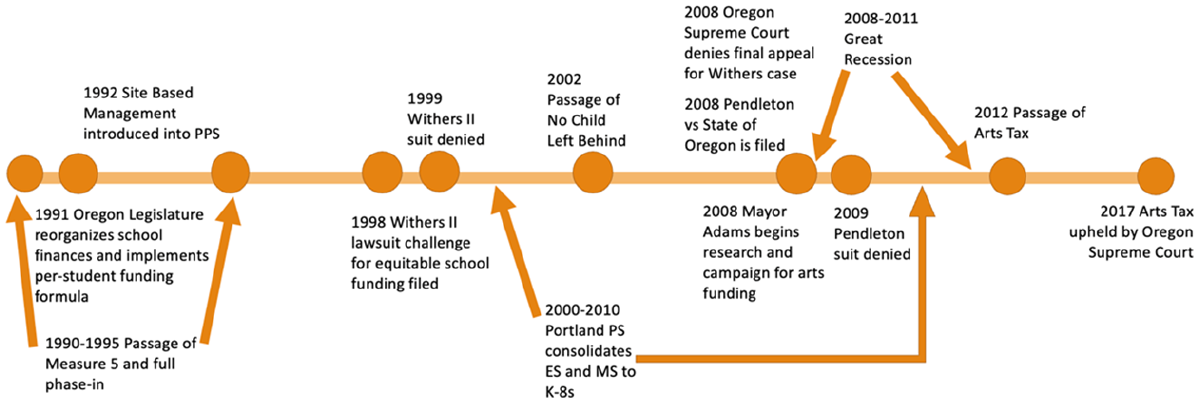
Completed timeline from data collection.
The condition of PPS arts education in 2008 led civic leaders to the Arts Tax as a path to support the overall arts community in Portland. Their research also showed that the public would support the measure if it helped restore arts education in public schools. 50 The original purpose of this study was to investigate the direct and indirect effects of budget cuts and tax policies on public school music education and understand the ArtsPAC justification for the Arts Tax. The participants confirmed that music programs that survived between 1990 and 2008 were still on par with the areas surrounding Portland. Therefore, the direct effects of the 1990s tax policies were budget cuts, but the indirect effect was inequality of access to music education across the city.
I consolidated many emergent in vivo codes from interviews and archives into three chronological themes of budget cuts, response to budget cuts, and site-based management. The coded interview and archival data in this investigation was used to build historical context and fill in the timeline, but the themes also pointed to specific policy decisions that helped explain the unequal outcomes among school music programs. I used a public policy analysis to further explore the three chronological themes.
Theodoulou and Cahn define tax policy analysis as “the process by which general judgments about quality, goal attainment, program effectiveness, impact, and costs can be determined.” 51 Dunn describes policy evaluation as answering the question “of what value is the outcome?” 52 Dunn goes on to describe values as a representation of objects on a “spectrum of behaviors involving choice.” 53 Each event on the timeline up to the passage of the Arts Tax in 2012 involved a stakeholder group and their values, judgments, and behaviors regarding school funding. These values and behaviors determined the choices of each stakeholder group that then affected Portland’s school funding and the fate of individual school music programs. The largest single policy issue was not Measure 5 or the Arts Tax, as I had originally thought. Instead, the policies related to decision making in the form of site-based management appeared to have the largest effect.
I identified the stakeholder groups as (1) voters in the state of Oregon, (2) state level legislators and judiciary, (3) PPS district administrators, (4) PPS building level administrators, (5) City of Portland civic leaders and Act4Art/ArtsPAC members, (6) parents and students, and (7) PPS music teachers. The framework for the policy analysis is seen in Figure 4 and is a linear synthesis of all previous data collection and qualitative analysis. Each theme identifies stakeholder groups, demonstrated values/behaviors, and the observable outcomes.
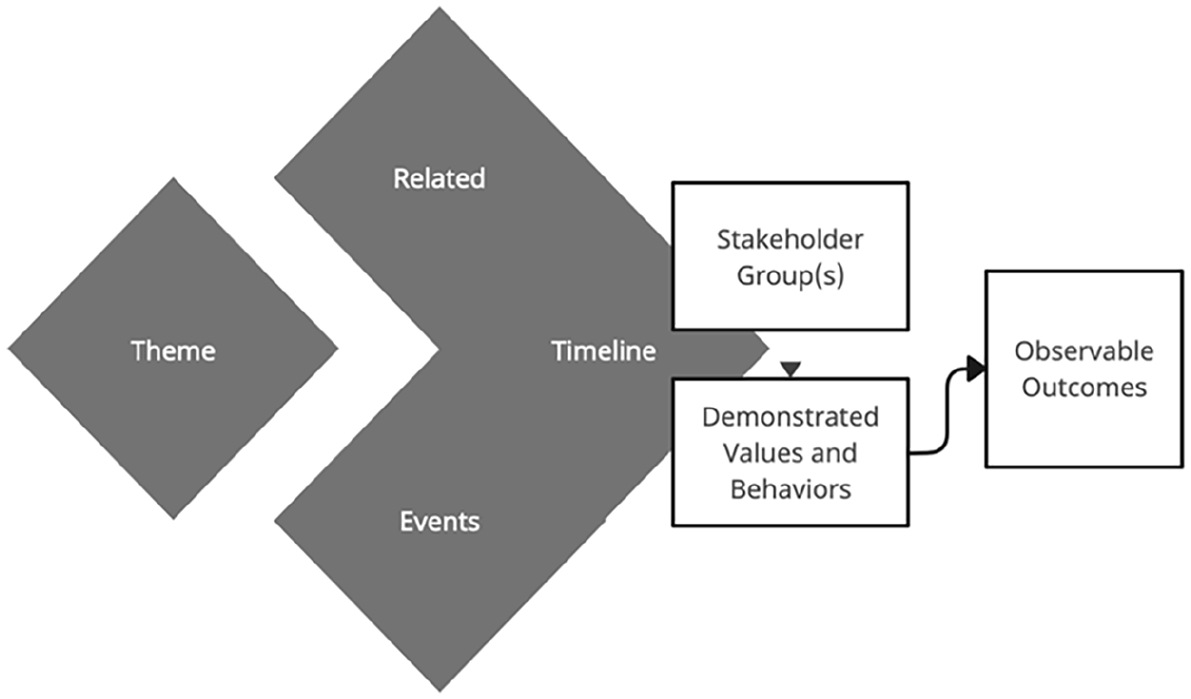
Framework for policy analysis in historical context.
Chronological Narrative Theme 1: Budget Cuts
Voters mandated, through Measure 5, that Oregon cut property taxes but also maintain school funding and equalize funding distribution. The state completed the first and last of those tasks but failed at the second. The state’s primary response to lower revenue was to move money from other state services, which was insufficient, and to create an equitable per-student funding formula across the state. However, the formula did not account for such things as a need for remodeling older buildings or the higher cost of living for teachers in Portland. When Portland attempted to raise their own local revenues to make up for this deficit, the state responded with Measures 47 and 50, which limited how much property tax assessments could rise each year. 54 The lack of support at the state level forced PPS leaders to make deep budget cuts. Therefore, the values and choices of the voters and legislators were in misalignment with district leaders, parents/students, and teachers. However, many of the district leaders, parents, and teachers were likely part of the voting group that helped pass Measure 5.
In other Oregon school districts, large groups of parents attended school board meetings to save their music programs from cuts. It could be that the size of PPS, with over 100,000 students at that time, contributed to a lack of similar behavior and statement of values among Portland parents. That lack of action among Portland parents is further demonstrated by the Withers lawsuit, which was not filed by plaintiffs in the Portland area but by rural Deschutes County. The upholding of budget cuts by the state supreme court was not necessarily a statement of values by the judiciary itself, but rather a confirmation of the values set by the voters, legislators, and parents. Therefore, the observable outcome was that the state had no accountability or legal mandate to make up the funding that was lost through Measure 5.
Chronological Narrative Theme 2: Response to Budget Cuts
When district leaders in Portland Public Schools realized that the state was not going to adequately fund schools, they approached the cuts in several ways. They first reduced personnel to the bare minimum, which included layoffs as well as non-replacement of retirements and resignations. They also froze all purchasing and eliminated district support for music specific expenditures such as buses for field trips, updated curricula, and elementary band/orchestra.
As these cuts were implemented, the state’s new per-student funding formula provided building principals with an incentive to recruit students from outside their boundaries. While that behavior could be seen as unethical, it was not without precedent. In the ‘70s and ‘80s, Jefferson High School, the only majority Black high school in Portland, was chosen to become an arts magnet as part of desegregation efforts supported with federal funding. PPS policy allowed students from outside the Jefferson boundary to attend the school for arts courses and then return to their home high school for other classes. Therefore, the idea that school boundaries were flexible within the district, especially for the purposes of arts instruction and securing funding, was already happening prior to Measure 5.
At the same time, the consolidation of elementary and middle schools to K–8 buildings to conserve resources increased full-time non-itinerant music faculty. However, these teachers could not adequately serve the aims of both elementary general music and middle school ensembles and left many students unprepared for high school vocal and instrumental music. The secondary teachers especially noted how the lack of preparation affected their ensemble enrollment, which then put their classes or programs at risk. In 2002, the passage of No Child Left Behind created a federal mandate to prioritize English and math, which created further pressure to move scarce resources away from the arts. 55 Over the eighteen years beyond Measure 5, the gradual decrease of music instruction across the city eventually led to the conditions that Mayor Adams and the ArtsPAC found in their field research. 56
The stakeholders, district leaders, and building administrators demonstrated behaviors that were perceived as crisis management, rather than what was in the best interest of student learning. The observable outcome is that in a time of crisis, music was deprioritized in the curriculum to address other needs.
Chronological Narrative Theme 3: Site-Based Management
The most important policy that was implemented in response to the Measure 5 budget cuts and had the longest lasting impact on music education in Portland was site-based management. PPS introduced site-based management partially as a more democratic way to handle tightening budgets. This policy seemed to make the best out of a difficult situation, allowing principals to independently make decisions that were most relevant or effective for their individual buildings. However, when faced with the options of keeping music or using limited resources in other ways, and in the absence of a mandate to include music in the curriculum, each individual school was able to make the decision to keep or cut their programs.
As a result, this policy appears to have had the most direct effect on the access and quality of music programs in Portland. The participants specifically referenced Measure 5 and other initiatives that their building administrators prioritized over music. Site-based management allowed administrators to deprioritize music. If they did not have a personal connection to the music teacher or a personal conviction of the importance of music, other values took precedence.
The only schools generally safe from cuts to the music program were those where the parents stepped in to fundraise for individual music teacher positions, or where administrators used music to attract boundary-exception students and attain more per-student funding from the state. This means that the secondary programs were de facto in competition with each other, and over time, music students gravitated to only a few schools. But it was site-based management that first allowed principals freedom to recruit students as though the schools were independent from the district or neighborhood boundaries. The parents, teachers, and building administrators demonstrated behavior that either upheld or deprioritized music at their individual schools.
Conclusions
Oregon is not the only state in the 1990s and 2000s that experienced economic turmoil from overreliance on one type of industry, nor is Oregon the only state to have experienced the cultural phenomenon known as the Tax Revolt. Portland is also not the only urban school district that turned to site-based management policies. 57 Therefore, there is much that can be learned from this case and applied to general knowledge about school funding and music education.
First, music and other arts electives were treated in Portland as something extraneous in the curriculum, making them susceptible to cuts when budgets were threatened. This is a well-documented problem in urban areas where there is a prevalence of low-income or Title-I schools. This phenomenon continues to exist even though since 2002, federal law has stated arts are a core subject equal to math and English for a comprehensive and well-rounded curriculum during the school day. 58 What makes Portland unique among cities, and perhaps a model for others, is that non-education leaders placed a high value on the arts for the community and sought to correct the problem at the school level. Another unique factor for Portland was that the leaders valued the pedagogical training of professional educators, as the Arts Tax only funds state-certified teachers hired for school-day instruction. While there is funding through the Arts Tax for visiting teaching artists, those individuals work with the certified music or art teacher rather than as an underpaid replacement for certified teachers, as is seen in many other cities. 59
Second, parents played a role in advocating for the inclusion of arts in the curriculum. The extent to which parents were willing or able to transfer their students to schools with thriving programs, lobby their building or district administrators, or fundraise to protect teaching positions was key to the survival or demise of individual music programs in Portland. The power that parents wielded in this story stands in contradiction to the conventional wisdom that parents have little say in, or effect on, public school policy. 60 Parent advocacy has been documented in other studies and implies that parents could be mobilized to save music in the curriculum when budget cuts are imminent. 61
Finally, the role of site-based management has not been studied as a factor affecting access to music education. This policy could have major implications for school music as school choice continues to expand. Student learning outcomes, teacher retention, and competition between schools could all be affected by site-based management policies. 62 On a larger scale, as seen in Portland, greater autonomy and independence for schools may lead to increased inequities in their offerings and outcomes. 63 Further study of this policy may provide additional advocacy strategies for music educators.
Footnotes
Declaration of Conflicting Interests
The author declared no potential conflicts of interest with respect to the research, authorship, and/or publication of this article.
Funding
The author received no financial support for the research, authorship, and/or publication of this article.
1
Daniel Smith, Tax Crusaders and the Politics of Direct Democracy (London: Routledge, 2013), 18.
2
3
Marci Major, “How They Decide: A Case Study Examining the Decision-Making Process for Keeping or Cutting Music in a K–12 Public School District,” Journal of Research in Music Education 61, no. 1 (2013): 5–25.
4
5
Tina Beveridge. “A Tale of Two Cities: Lessons in Advocacy and Funding from Seattle and Portland,” Arts Education Policy Review 125, no. 1 (2024): 48–57.
7
8
Adams, “Federal Timber Payments,” 1–61; John Hampton and Carol Wood, “Federal Timber Contracts: Who Will Bear the Ultimate Costs if Congress Denies Modifications,” Willamette Law Review 19, (1983): 175–98, https://heinonline.org/HOL/P?h=hein.journals/willr19&i=181
9
10
Oregon Department of Revenue, ”A Brief History of Oregon Property Taxation” (Summary Report, 2009), 1–10.
11.
Brian Greber, K. Norman Johnson, and Gary Lettman, “Conservation Plans for the Northern Spotted Owl and Other Forest Management Proposals in Oregon: The Economics of Changing Timber Availability” (Technical Report, Oregon State University College of Forestry, Agricultural Experiment Station, 1990), 1–57.
12
Joel Berke and John Callahan, “Serrano v. Priest: Milestone or Millstone for School Finance,” Journal of Public Law 21, no. 1 (1972): 23–72, https://heinonline.org/HOL/P?h=hein.journals/emlj21&i=29; Beth Cookler, “The Impact of the Tax Revolt and School Reform on Oregon Schools During the 1990s” (Master’s thesis, Portland State University, 2014), 23–4 [1564782], https://www.proquest.com/dissertations-theses/impact-tax-revolt-school-reform-on-oregon-schools/docview/1615826903/se-2?accountid=14541; University of California, Berkeley, “1980–82 Early 1980s recession” (Oral History Report, 2021), 
13
Jack Citrin, “Proposition 13 and the Transformation of California Government,” California Journal of Politics and Policy 1, no. 1 (2009): 1–9. Patricia Costa Kim, “Making Music Their Own: School Music, Community, and Standards of Excellence in Seattle, 1885–1975,” Journal of Historical Research in Music Education 21, no. 2 (2000): 162–79.
15
Cookler, “Impact of the Tax Revolt,” 24–5.
17
Cookler, “Impact of the Tax Revolt,” 24–5.
18
Henkels, “Measure 5,” 1.
19
20
Cookler, “Impact of the Tax Revolt,” 69.
21
Sam Adams, Conversation with the author, January 4, 2020.
22
Beveridge, “A Tale of Two Cities,” 5–6.
23
Ibid.
24
“Wittemyer v. City of Portland” (Case Summary Decision, Oregon Supreme Court, 2017).
25
Albert Mills, Gabrielle Durepos, and Elden Wiebe (eds.), “Bounding the Case,” in Encyclopedia of Case Study Research (London: Sage, 2010), 56–9.
26
Edwin Amenta, “Making the Most of an Historical Case Study: Configuration, Sequence, Casing, and the US Old-Age Pension Movement,” in The Sage Handbook of Case-Based Methods, ed. David Byrne and Charles Ragin (London: Sage, 2009), 351–66.
27
28
Sergio Salvatore and Jaan Valsiner, “Between the General and the Unique: Overcoming the Nomothetic Versus Idiographic Opposition,” Theory & Psychology 20, no. 6 (2010): 817–33.
29
Sarah Tracy, “Qualitative Quality: Eight ‘Big Tent’ Criteria for Excellent Qualitative Research,” Qualitative Inquiry 16, no. 10 (2010): 837.
30
John Creswell and Cheryl Poth, Qualitative Inquiry and Research Design: Choosing Among Five Approaches, 4th ed. (London: Sage, 2018), 157–9.
31
Johnny Saldaña, The Coding Manual for Qualitative Researchers, 3rd ed. (London: Sage, 2015), 200–6.
32
Judith Green and Monaliza Chian, “Triangulation,” in The Sage Encyclopedia of Educational Research, Measurement, and Evaluation, ed. Bruce Frey (London: Sage, 2018), 1717–20.
33
34
Edward Waters, David Holland, and Bruce Weber, “Economic Impacts of a Property Tax Limitation: A Computable General Equilibrium Analysis of Oregon’s Measure 5,” Land Economics 73, no. 1 (1997): 72–89.
35
National Center for Education Statistics, “Characteristics of the Largest 100 Public Elementary and Secondary School Districts in the United States, 1991–2001”; Henkels, “Measure 5,” 2; Oregon Department of Revenue, “A Brief History,” 1–10.
36
Laurie Wimmer, Conversation with the author, December 15, 2021; Frank McNamara, Public School Finance Programs of The United States and Canada: 1998–1999, Oregon (Confederation of Oregon School Administrators, 1999), 1–22; Withers v. State of Oregon Summary Report (Oregon Court of Appeals, 1999).
37
Withers v. State of Oregon Summary, 1999.
38
Ibid.
39
Pendleton School District v. State of Oregon Summary Report (Oregon Supreme Court, 2009).
40
Pendleton vs. State of Oregon Summary, 2009.
41
Dale, Darlene, George, Jane, Jerry, Kelly, Kevin, Mike, Ryan, and Sam are participant pseudonyms.
42
Thomas Timor and Marguerite Roza, “‘A False Dilemma’: Should Decisions About Education Resource Use Be Made at the State or Local Level?,” American Journal of Education 116, no. 3 (2010): 397–422.
43
Beveridge, “A Tale of Two Cities,” 5–6.
44
Carlos Abril and Brent Gault. “The State of Music in Secondary Schools: The Principal’s Perspective,” Journal of Research in Music Education 56, no. 1 (2008): 68–81; Carlos Abril and Brent Gault. “The State of Music in the Elementary School: The Principal’s Perspective,” Journal of Research in Music Education 54, no. 1 (2006): 6–20; Beveridge, “No Child Left Behind,” 4–7.
45
Abril and Gault, “The State of Music in the Elementary School,” 6–20. Abril and Gault, “The State of Music in Secondary Schools,” 68–81; Kevin Gerrity, “No Child Left Behind: Determining the Impact of Policy on Music Education in Ohio,” Bulletin of the Council for Research in Music Education 179, (2009): 79–93.
46
Abril and Gault, “The State of Music in the Elementary School,” 6–20. Abril and Gault, “The State of Music in the Secondary School,” 68–81. Kenneth Elpus, “Evaluating the Effect of No Child Left Behind on US Music Course Enrollments,” Journal of Research in Music Education 62, no. 3 (2014): 215–33. Cydney Spohn, “Teacher Perspectives on No Child Left Behind and Arts Education: A Case Study,” Arts Education Policy Review 109, no. 4 (2008): 3–12.
47
National Center for Education Statistics, table generator tool “Fiscal Data, District Level, 2006–2015,” Accessed December, 2021.
48
Wittemyer v. City of Portland, 2017.
49
Portland Public Schools Arts Staff, “State of Affairs, 2014–15, Arts Specialist Survey” (Power-Point presentation at Portland Public Schools Board Meeting, January 2015).
50
Beveridge, “A Tale of Two Cities,” 5.
51
Stella Theodoulou and Matthew Cahn, Public Policy: The Essential Readings, 2nd ed. (London: Pearson, 2013), 192.
52
William Dunn, Public Policy Analysis, 5th ed. (London: Routledge, 2012), 309.
53
Dunn, Public Policy, 310.
54
Ballotpedia, “Oregon Measure 47, Property Tax Reduction and Increase Limitation Initiative,” https://ballotpedia.org/Oregon_Measure_47,_Property_Tax_Reduction_and_Increase_Limitation_Initiative_(1996); Ballotpedia, “Oregon Measure 50, Limits on Property Tax Rates and Assessed Property Value Measure,”
55
Beveridge, “No Child Left Behind,” 1.
56
Beveridge, “A Tale of Two Cities,” 5.
57
Sonya Douglass, Janelle Scott, and Gary Anderson, The Politics of Education Policy in an Era of Inequality, 2nd ed. (London: Routledge, 2025), 101–20.
58
Eugenia Costa-Giomi and Elizabeth Chappell, “Characteristics of Band Programs in a Large Urban School District: Diversity or Inequality?,” Journal of Band Research 42, no. 2 (2007): 1–19. Ronald Kos Jr., “Music Education and the Well-Rounded Education Provision of the Every Student Succeeds Act: A Critical Policy Analysis,” Arts Education Policy Review 119, no. 4 (2018): 204–16. Ryan Shaw and Amy Auletto, “Is Music Education in Tune with the Pursuit of Equity? An Examination of Access to Music Education in Michigan’s Schools,” Journal of Research in Music Education 69, no. 4 (2022): 364–81.
59
Nick Rabkin, “Teaching Artists and the Future of Education,” Teaching Artist Journal 10, no. 1 (2012): 5–14.
60
Charles Russo, “Conflicts Over Directing the Education of Children: Who Controls, Parents or School Officials?,” Journal of Education 186, no. 2 (2006): 27–40.
61
Kenneth Elpus and Adam Grisé, “Music Booster Groups: Alleviating or Exacerbating Funding Inequality in American Public School Music Education?,” Journal of Research in Music Education 67, no. 1 (2019): 6–22; Major, “How They Decide,” 5–25.
62
Sean Powell, The Ideology of Competition in School Music (Oxford: Oxford University Press, 2023), 27–8.
63
Klaus Beiter, “Why Neoliberal Ideology, Privatisation, and Other Challenges Make a Reframing of the Right to Education in International Law Necessary,” The International Journal of Human Rights 27, no. 3 (2023): 425–70.