







Abstract
Budget cuts have reduced courses and student services within California community colleges. This coincides with the growth of low-income Latino male (Latinos) and Latina female (Latinas) student enrollment. Budget cuts have been implemented throughout the system, including in the Extended Opportunity Programs and Services (EOPS), which disproportionately serve low-income Latino/a students. The purpose of this study was to analyze the experiences and perceptions of low-income Latino/a students enrolled in the community college and in EOPS at a time of budget cuts. The research revealed that the students in the study experienced additional difficulties in completing their educational objectives due to budget cuts, resulting in the perception that their education was of less social significance. To ensure full and equal access for this student population, students, educators, and administrators will need to become advocates for student equity at a time of budget cuts.
Introduction and Background
The California community college system is undergoing two significant and countervailing transformations. While Latino male (Latinos) and Latina female (Latinas) students have been increasing in both size and proportion of student enrollment in the California community colleges, education budget cuts are diminishing the capacity to meet present and future needs (Chavez, 2008; Hayward, Jones, McGuinness, & Timar, 2004). As a population whose enrollment in higher education is contingent upon the accessibility, affordability, and support systems built into the current structure of the community colleges, budget cuts threaten to exclude a growing segment of low-income Latino/a students in the present and into the future. This places the function of the community college system at odds with its mission and threatens to unravel post–Civil Rights era efforts to overcome racial segregation in higher education.
To understand how this process has developed, it is necessary to look at several background factors. This begins with a look at the significant growth in Latino/a enrollment in the California community college system in recent years and a socioeconomic analysis of this group as a means to understand their specific needs. Furthermore, an examination of the type of needs-based programs that are utilized by this group within the community college, and the particular way that budget cuts affect socioeconomically vulnerable students will provide a useful framework for understanding the basis for this study.
Latino Enrollment in the Community College
According to the 2010 U.S. Census, Latinos/as comprise 16.7% of the U.S. population. As of 2009, 2.5 million Latino/a students were enrolled in institutions of higher education nationwide (National Center for Education Statistics, 2010). It is estimated that about 38% of Latino/a students enroll in public community colleges (Kohler & Lazarín, 2007).
By 2004, Latinos comprised 35% by of California’s total population by 2004 (Public Policy Institute of California, 2006). Furthermore, Latinos are projected to be the largest ethnic group in California by 2020, and an absolute majority by 2050 (Public Policy Institute of California, 2008). In California’s education system, Latino/a students are already a majority in K-12, representing 52% of all students enrolled in public schools (Fry & Gonzales, 2008). In California in 2010, about 735,000 Latino/a students were enrolled in higher education, comprising 34% of total enrollment in community colleges, 27% in the California State University, and 15% at the University of California (California Post Secondary Education Commission[CPEC], 2010). About 80% of Latino/a students in the state that enter higher education begin in a community college, making it the most significant entry point for this group (Martinez-Wenzl & Marquez, 2012).
Latinos/as are projected to constitute 48% of California’s college-age population by 2015 (Chavez, 2008). Despite being the fastest growing sector eligible for higher education, they have the lowest rate of enrollment of all ethnic groups in all three California systems (CPEC, 2007). They also have the lowest rates of completion or transfer at 47%, compared to White students at 60%, Asian-Pacific Islanders at 58%, and African American students at 53% (Moore & Shulock, 2010). Despite increasing demand, poverty is a significant factor contributing to proportionally lower enrollments and rates of retention than their counterparts.
Latino/a Students and Poverty
Latino/a students entering into the community college tend to come from lower-income families and attend more racially segregated grade schools. At the national level, Latino/a students enrolled in public schools are more likely than other groups to reside in households at or below the poverty level—28% versus 16% (Fry and Gonzalez, 2008). Furthermore, “the median household income of non-Hispanic public school students is $60,372, and of Hispanic public school students it is $40,248. While 59% of non-Hispanic public school students live in households whose income exceeds $50,000, only 38% of Hispanics do” (Fry & Gonzalez, 2008, p. 13). Students from low-income families have to pay a larger percentage of their income for college, making these families much more dependent on financial aid and loans (National Center for Public Policy and Higher Education [NCPPHE], 2008). From these ranks, roughly 80% of Latino/a students apply for aid, and 63% receive some form of aid or loan (Rendón, Nora, Cabrales, Ranero, & Vasquez, 2008).
A high Latino/a student poverty rate is also the reality in the California community college. As a whole, Latinos/as have the highest poverty rate in California at about 23% (Bohn, 2011). In California, Latino/a high school students experience the highest rates of segregation and poverty (Martinez-Wenzl & Marquez, 2012). For example, 40% of Latinos/as attend a school where 90% or more of the student population is from an underrepresented ethnic group, and the average Latino/a student attends a school where 73% of the students are considered low-income (Orfield, Seigal-Hawley & Kuscera, 2011). These patterns of segregation and poverty continue into the community college (Martinez-Wenzl & Marquez, 2012).
Latino Students and EOPS
Due to high rates of poverty, many Latino/a students across the nation rely on needs-based assistance programs. For instance, the federal, income-based Pell Grant Program serves an estimated 39% of Latino/a students in higher education (Kantrowitz, 2011). While the specific state-based programs vary, the Extended Opportunity Program and Services (EOPS) is a popular financial aid program in California serving many Latino/a students in the community college. The EOPS program in the California community college system was established in 1969 with the passage of Senate Bill 164. This affirmative action program was created to facilitate open access for students affected by language, social, and economic disadvantage through the procurement of financial and technical support to assist with the completion of their educational goals (Leon, 1980).
According to the California Community College Chancellor’s Office, Latinos/as are now the largest group of participants in the EOPS program. For instance, while Latinos/as are 30% of total California community college students and 60% of the Frontier College student population (the focus of this study), they were 40% of enrollees in EOPS statewide and 78% of enrollees at Frontier College in 2010-2011(California Community College Chancellor’s Office [CCCCO], 2011a; CCCCO, 2011b).
Budget Cuts and Inequity
While the 1950s and 1960s were periods of mass investment in education, the 1970s and 1980s saw a transition toward reduced spending at the national and state level. Mortenson (1994) documents the gradual erosion of state support for public higher education funding, noting that between 1952 and 1971 state and federal funding grew each year and then began to steadily decline thereafter.
As a reflection of this trend, college tuition and fees nationally increased 439% from 1982 to 2007 (adjusted for inflation), while median family income only rose 147% (NCPPHE, 2008). Not only are students paying more to access education, but growing demand has also increased competition for fewer campus resources. There is already increasing demand overall for access to higher education, estimated to have risen 25% between 2003 and 2012 (Kissler & Switkes, 2005; Shulock & Moore, 2005). These countervailing tendencies—increased demand at a time of declining public investment and higher individual costs—are creating a crisis of access for certain segments of the student population, especially those students with social disadvantages and with fewer resources. For example, as cited by Osei-Kofi and Rendón (2005), “In the fall of 2003 at least 250,000 prospective students were shut out of higher education [nationally] due to rising tuition or cutbacks in admissions and course offerings” (p. 254).
This trend has occurred even more acutely at the California state level. The state’s general fund investment in community colleges decreased by 2% during 2001-2002 to 2003-2004, while student fees were increased by more than 60%, from US$11 to US$18 per unit (CCCCO, 2011c). This led to substantial reductions in course section offerings and a 5% decline in enrollment since the fall of 2002 (a reduction of 175,000 students from the projected enrollment level prior to the budget cuts and related schedule reductions; Shulock & Moore, 2005).
Following the onset of recession in 2008, budget cuts for the 2009-2010 fiscal year amounted to US$520 million, shutting 140,000 students out of California community colleges (CCCCO, 2011c). For 2011-2012, another budget cut in the amount of US$400 million has been implemented, which is projected to affect the enrollment of another 400,000 students (CCCCO, 2011c). Prior to this series of budget cuts, enrollment in California community colleges had been steadily trending upwards. For instance, enrollment had increased 44% overall between 1995 and 2010, yet per student funding in 2009-2010 (adjusted for inflation) school year was lower than it was in 1995-1996 (CCCCO, 2011c).
At the Southern California community college campus that is the focus of this study (Frontier College), budget cuts have diminished capacity. According to a Frontier College August 2009 Budget Update, the school cut US$1,136,000 from its budget in 2008-2009. Further budget cuts for the 2011-2012 school year were projected to be between US$4 million and US$11 million (York, 2011). Cuts affect all aspects of campus life, including support programs such as EOPS. In the 2007-2008 calendar year, the budget for EOPS stood at US$106.786 million statewide, of which US$2,383,811 was allocated to Frontier College. In 2008-2009, Frontier’s EOPS funds were reduced to US$2,381,270, with a cap of 2,362 students. By 2009-2010, Frontier’s allocation had been reduced to US$1,436,903, with the cap of students reduced to 1,425, with a further funding reduction to US$1,386,449 in 2010-2011.
Prior growth in the enrollment of low-income Latino/a students in the California community colleges and a trend toward increased demand into the future is being counteracted by budget cuts that are reducing capacity to serve these same students.Programs such as EOPS within the community college attempt to address previous inequities produced by a history of racial segregation within higher education. The reduction of education budgets and programs such as EOPS may also reduce civil rights era efforts toward racial equity in higher education, providing the context for this study.
Literature Review
There is a limited range of literature that looks at the subject of budget cuts and low-income Latino/a students in the community college. A 2004 study by the National Center for Public Policy and Higher Education (NCPPHE) states that the consequence of budget cuts on a national level has been to squeeze out more vulnerable students unable to navigate and persist in the community college system at a time of increased competition and declining support (Hayward et al., 2004). The research of Levin (2007) identifies that budget cuts in the community colleges negatively affect “nontraditional students.” This category includes Latinos/as who are the first in their families to attend college (First-Generation students).
There is a gap in the literature pertaining to the experiences of low-income, Latino/a students in the California community college at a time of budget cuts. The significance of this study is that it will help develop the body of literature examining the experience of Latino/a students in the California Community College (and needs-based programs such as EOPS) at a time of budget cuts. By examining these experiences, it will be possible to support the hypothesis that budget cuts have a significant effect on this population’s ability to persist.
Purpose Statement
The purpose of the current study was to examine the perceptions of Latina/o students enrolled in EOPS regarding (a) The effect of education budget cuts on persistence at a California community college; and (b) the reasons for the budget cuts.
Method
This study was conducted using qualitative methodology, a phenomenological approach, and was grounded in the advocacy-participatory worldview. Critical Race Theory also informed the research design. The research attempted to understand the significance that a group of low-income, Latino/a students ascribe to their experience with budget cuts in the community college system and in the EOPS program. Due to the small sample size, the results of the research can best be understood as hypotheses about the population.
Qualitative research involves the systematic collection, organization, and interpretation of textual material derived from discourse. It is used in the exploration of meanings of social phenomena as experienced and articulated by research participants themselves, based on their observations in the natural context (Malterud, 2001). The process of research involves data collection based on emerging questions and procedures and data analysis using an inductive method to identify and construct themes based on emerging patterns (Creswell, 2009).
The advocacy-participatory worldview gives voice to the experiences of historically marginalized or underrepresented people and intertwines the research with a political agenda of reform (Creswell, 2009). This way the experiences of the students can be communicated as a form of self-advocacy. Lastly, the research design employed Critical Race Theory in the analysis. Critical Theory perspectives are concerned with empowering human beings to challenge and transcend social constraints imposed on them through race, class, and gender oppression (Fay, 1987).
Participants
The participants in the study included 11 Latino/a students enrolled in EOPS at Frontier College, as well as two staff members working in the EOPS office. Students were informed of the study through email notification (through EOPS) and through flyers posted in the EOPS office. Students were selected based on having been enrolled in EOPS and the college for at least one year between 2008 and 2010. Staff members were contacted directly by the researcher.
These criteria were used to identify a sample of students who had been pursuing their education at a time when budget cuts were being implemented. Seven of the students were female and four were male. The group ranged in age from 18 to 25. In terms of identity, five students identified themselves as Mexican American, three as Mexican, two as Chicano/a, and one as Hispanic. At the time of the study, the two staff members were both working within the EOPS program at Frontier College. One female and one male counselor were selected. 1
Interview Protocol
The interview protocol developed from two research questions. The first was as follows: How do low-income Latino/a students enrolled in the Extended Opportunity Programs and Services (EOPS) perceive the effect of education budget cuts on their persistence in the community college? The second was: How do low-income Latino/a students in the EOPS program perceive the reasons for the budget cuts?
The specific methodology used was individual face-to-face interviews. It was the perception of the researcher that the individual face-to-face, open-ended, and semistructured interviews would yield the most information. A semistructured interview refers to the aim of the researcher to keep focus on the research questions while allowing for the possibility of unanticipated follow-up questions. Open-ended questions allowed the interviewees to introduce unanticipated concepts, go on tangents, or otherwise go off the track of the current question in a way that may provide relevant data to the researcher.
The interview questions were designed to encourage the students to consider, analyze, and contextualize any significant change or modification that might have affected them as a student and EOPS participant. They also explored for possible secondary effects as students negotiated between multiple obligations including school, family, and work schedules. The questions also allowed the students to reflect on what they understood to be the experiences of other students. The second research question was structured to explore what the students perceive to be reasons for the budget cuts. More specifically, how do the students understand why there are cuts, who is making them, and who is affected? The two staff members were asked similar questions as a means to triangulate the data through the inclusion of staff perspectives of student experience and for their perceptions of the reason for budget cuts.
Procedure
The procedure for data collection began with securing approval through the Institutional Review Boards (IRB) of the associated institutions. Low-income Latino/a) students from the EOPS program were then selected for the interview process. Low income is described in Table 1 below. Ethnicity and economic status were the primary determinants of participant selection as the purpose of the study was to explore how low-income Latino/a students are being affected by budget cuts. Age, gender, and language were not specific factors considered in this study. The third criterion was the length of student enrollment in the EOPS program. Participants selected had at least one-year experience in the EOPS program. Students (or former students) that had been in the program for less than one year were excluded, since they might have not been in the program long enough to experience any changes as a result of budget reductions.
Extended Opportunity Program and Services (EOPS) Income Requirements.
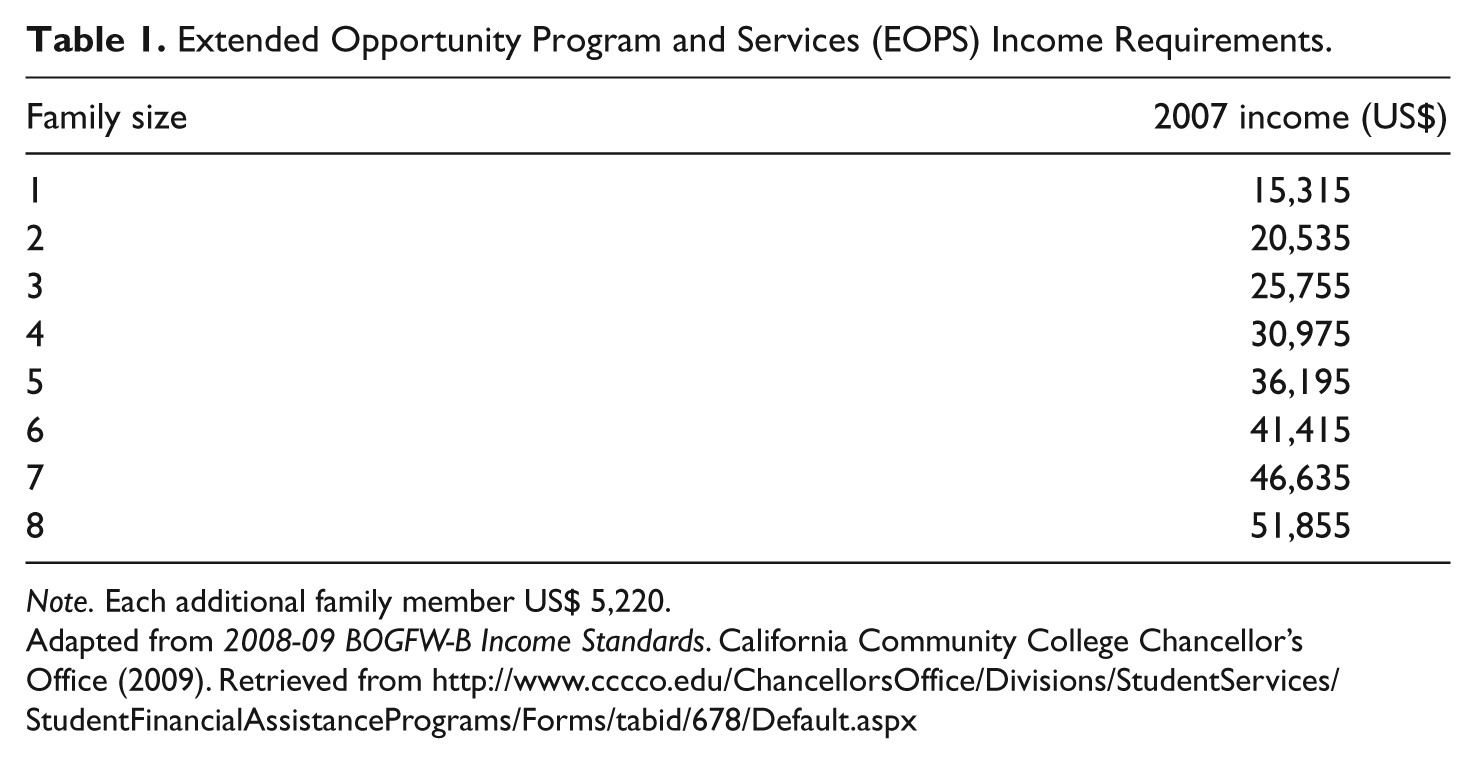
Note. Each additional family member US$ 5,220.
Adapted from 2008-09 BOGFW-B Income Standards. California Community College Chancellor’s Office (2009). Retrieved from http://www.cccco.edu/ChancellorsOffice/Divisions/StudentServices/StudentFinancialAssistancePrograms/Forms/tabid/678/Default.aspx
Student confidentiality was carefully maintained in all aspects of the study. Eight of the student interviews were conducted on the campus, and three were conducted off-site near the campus. One of the staff interviews was conducted on campus, and the other near the campus. Upon meeting and before the interviews began, the research participants were presented a consent form that disclosed all relevant details and purposes of the study. Participants were informed that their participation was voluntary and subject to termination at their desire. They were provided detailed information about the purpose of the study, their rights as a voluntary participant, and where to obtain more information about research process. The interviews ranged from 30 to 55 min.
Data Analysis
The data was analyzed using the method of content analysis and discourse analysis. Several stages of coding took place, beginning with initial coding done in a line-by-line format. Focused coding was then used to combine and subdivide into more aligned and useful categories. Axial coding was then used to relate categories of codes to each other and bring the data back together into a coherent whole using a combination of inductive and deductive reasoning (Bryant & Charmaz, 2007). Coding was facilitated using the computer program ATLAS.ti (Version 6.211). The data was then triangulated through the collection and analysis of field notes and through the inclusion of staff interviews about student experience. While the student data is the core data for the research project, the staff members provide useful supplemental data.
Results
Experience With the Budget Cuts
Based on the first research question about student experience at a time of budget cuts, the following three themes emerged from the data: diminished access, reduced support, and delayed completion. Pertaining to the second question about student perceptions of the reasons for the budget cuts, the following two themes emerged: devaluation of education and race and class discrimination. Lastly, the staff interviews produced the following two themes derived from the question of student experience: reduction of access and services and inequity. Each of the themes will be described in the following subsections.
Diminished Access
A dominant emerging theme from the research pertained to diminished access. The students spoke of fewer available classes, reduced access to support services like libraries, and fewer available slots in the EOPS program to new students. As participant eleven commented, “A lot of people that want to go to school and get their education, and now it’s like there’s not room for anybody. There’s not enough instructors or classes.”
Some students described having to juggle their schedules to accommodate for work or family obligations. As participant five explained:
Before . . . there were more campus classes with different times that you could adapt your school schedule with your work schedule, and now . . . you have to try and get it first before it fills up, and then you have to see if your work schedule will fit into that, and if it doesn’t, then you have to drop the class.
For students seeking access to assistance programs such as EOPS, their experiences also reflect diminished access. Participant six told the story of how he convinced three friends to apply for the program. He explained that when they arrived at the office, “there was actually a podium with a sign that said ‘EOPS has been closed off for the fall semester.’”
Reduced Support
For many low-income, Latino/a students, support services are also needed to help sustain their efforts. For example, the students identified four aspects that derive from being low-income that hinder their pursuit of education. These include: the lack of personal funds to pay for schooling, the lack of family resources for support, the negative impact of recession on them and their families (in the form of unemployment or reduced hours), and the need to increase their workload or obtain more work to make ends meet. This sentiment was captured by participant four, who explained:
Well . . . my family, we have a lot of economic problems, so we all work so we don’t have that much time, and plus hours at work are not like that many so we have to reduce some expenses… Basically, we have to spend the minimum on everything that is not school related.
For these reasons, forms of support and assistance provided through the college are considered essential by the students for persistence. Participant seven described how the EOPS book subsidy reduction from US$300 to US$150 affected her: “I only get $150 . . . [and] it’s only for books, and I can’t get a dictionary, and I can’t get pencils or scantrons. You know, little things that you need . . . It’s like you use to get all these things, and now you don’t.”
Students also identified the reduction in counseling, scaled-back library hours, the elimination of high school outreach programs, and the reduction of work-study hours as other problems. Participant ten described her frustration with diminished access to the computer lab: “When I first started here, like the library wouldn’t be as overfilled . . . and now you have to wait in line, and there’s not enough . . . those resources are going away.” Participant two described how increased restrictions and monitoring of service recipients accompanied the cutbacks. She described how she felt squeezed out of EOPS: “I just kind of like gave up on it. The book funding just wasn’t there … [but] you still have to do your progress reports, but we don’t have no funding, we can’t give you book money. At that point I was like well, what’s the point?”
Many of the participants, as first-generation college students, communicated that support services were crucial to their successful navigation of higher education. Participant three summarized, “Some people need a little bit of help; they don’t know how to go about succeeding in the university. I happen to be one of those people, and it helped me.” This sentiment was echoed by participant one, who explained that the value of personal support “goes a long way for somebody who hasn’t had such a support.”
Reduced access to counselors was identified as being a major detriment. As participant eight described her observation of reduced EOPS counseling support, “I guess they are just too overwhelmed with so many students . . . with the budget. . . . they couldn’t have as many students as they would want.” A final main theme emerging from the students’ experiences is with the difficulty of delayed completion.
Delayed Completion
In referencing experiences with delayed completion, students discussed feelings of demoralization and pressures to drop out. Participant one described his own anxiety about delayed completion and financial uncertainty this way: “It kind of makes me panic sometimes because you hear all kinds of horror stories about people not being able to complete their degrees . . . I start scrutinizing every move . . . and think am I using my time wisely here?” Participant two described how some students, including herself, get discouraged, explaining, “They lose interest . . . I’m not going to tell you that I haven’t thought about just quitting school, and going and getting a job. The interest is gone; the motivation and the determination isn’t there.” Participant five recounted why some of her friends and classmates had dropped out:
Well, some of them stop showing up because if they didn’t get the class that they needed, it puts back everything that they had already planned . . . and sometimes you don’t want to wait . . . and [if] you’re not going to be able to do it in the timeframe, then what’s the point of doing it anymore?
Reasons for the Budget Cuts
The second part of the research process focused on how students perceived the reasons for the budget cuts. The two themes that emerge from the data are devaluation of public education and race and class discrimination.
Devaluation of Public Education
The students perceived that a community college education is less socially important than in the past. Participant eight communicated how people in decision-making positions seem to be less concerned with the educational needs of people like her:
Maybe a lot of people don’t think that education is that important, which is wrong because everyone now is coming back to school . . . and not being able to come to school just because some person thinks that education is not that important, they like cut a lot of budgets, programs, and the college itself, is just wrong because a lot of people don’t have the money.
Participant two further adds:
I think it’s because like a lot of people in the government . . . they send their kids off to private schools and everything, and these community colleges are basically for the people. The working class people, the low income people, so it really doesn’t affect them.
Race and Class Discrimination
The students believed that their socioeconomic and ethnic background puts them at a disadvantage when it comes to decision-making about budgets. As participant three asserts: “These people are rich. They don’t see it from . . . [a] minority perspective . . . they come from rich families . . . I think that has to do a lot why they’re cutting budgets.” Participant ten describes this process this way:
Because a lot of people are getting an education…I think that they’re starting to see that a lot of minorities and people are getting out there . . . Everyone in some way or another is about their race so when they’re seeing that, it’s the Mexican that’s giving me the job now; It’s this person who has a Ph.D.; it’s this person who has a Master’s. I just have a Bachelor’s…like how does that work?
She further adds that EOPS is being cut “because of who they service . . . disadvantaged people, Hispanic people; first general college students.” Participant nine concludes: “It’s always . . . the people on the bottom that usually suffer the most when things hit the fan.”
Staff Perceptions
Staff perceptions tended to validate the students’ perception of their experience. The two major themes that emerged from the staff interview data were reduction of access and services and inequity.
Reduction of Access and Services
Pertaining to the theme reduction of access and services, staff members’ observations overlapped with student perceptions that there was less access for new students, reduced services for existing services, and delays through the educational pipeline. EOPS staff member one describes her experience in seeing the number of students admitted to the EOPS program decline. “So I think we were at like 2,000 plus students way back when I started . . . Now we are down to I think 1,000 or 1,300 . . . So, definitely in terms of numbers the budget has impacted us.” Staff member two shares this conclusion, identifying that “EOPS has experienced some pretty severe cuts . . . [such that] . . . it has had an impact on the program as far as the number of students we could admit.”
Inequity
The theme inequity reflects how the staff members see this student population as existing in a secondary social position based on three concepts: that these students have less influence with policy-makers, that budget cuts are an extension of the discrimination that they experience in society at large, and that budget cuts increase their hardship as students. This overlapped with the student perceptions that prejudice factors into budget cut process. This is summarized by staff member one, who concludes:
Many of those low income students are people of color, then that is going to impact even greater . . . [their] pathway . . . to get into higher education. And . . . we are already having a dearth of students of color at that level. And so with that, with the budget cuts, it is going to even impact that more.
Discussion
The study reveals that the sample of Latino/a students perceive that budget cuts are affecting them in specific ways. This includes diminishing access, reduction of support services, and delay in completion of their educational objectives. It also shows that these students perceive that these budget cuts are driven by a devaluation of public education and race and class discrimination. If the experience of these students reflects that of the larger low-income, Latina/o student population in the community college, it is possible that budget cuts could increase exclusion and attrition rates for this group.
Community colleges provide a significant entry point for low-income Latino/a students into higher education. Programs specially designed to subsidize economically and socially disadvantaged students (such as EOPS) also provide secondary access points, since other potentially prohibitive costs are incurred beyond enrollment. As state subsidized institutions with a large low-income student population, community colleges and needs-based programs such as EOPS sustain a significant portion of students. Tertiary access takes the form of the community college providing an affordable pathway to transfer to the university. A fourth and final point of access is the role that moral support and guidance play in providing students with assistance and experience.
The students and staff participants perceived that the budget cuts have constricted access and diminished the capacity of internal support systems within the California community college. While students maintain the ability to register and enroll, they were increasingly unable to access courses and services that facilitated progress. What can previously be conceived as “access points”: open enrollment, low registration fees, and subsidy programs such as EOPS, were being transformed into “choke points” as internal support capacity erodes in relation to demand.
For low-income, Latino/a students enrolled in the EOPS program, support services play a significant role in their educational experience. This includes material support in the form of monetary subsidies. Students in the research linked the utility of subsidies, such as money for textbooks and the availability of computers, to the economic challenges or hardship they face off-campus. Many were acutely aware of how diminished subsidies strained their finances.
The moral support and guidance provided by counselors was also identified as a key factor. Since many of these students identified themselves as first-generation students, with no family members or friends to assist in the navigation of the educational pathways, counselors were identified as key intermediaries in the process.
The reduction of these resources may negatively affect the persistence of this student population. This was supported by the students reflecting on the experience of known family members, friends, or acquaintances who had dropped out or were denied access to services. This was also corroborated by the staff members observing the enrollment and persistence patterns of students in EOPS. Lastly, students identified the negative impact of delayed completion, which they associated with fewer classes available and reduced support services.
Delayed completion led some to opt for what they felt was more productive use of their time, such as working more hours, enrolling in private schools, or simply stopping out. Students also communicated that while they might be able to sustain their enrollment in community colleges with cost increases, they were less confident about how they would fare with rising costs in the 4-year institutions resulting from the budget cuts. Since being a student in the community college requires a significant commitment of time and energy, a precarious financial situation at home coupled with reduced access and support in the campus may lead students from this population to reconsider their enrollment leading to stop-out or drop-out.
The findings also revealed that students and the staff believed that social inequities based on social class and race played a role in how budget cuts are determined and implemented. Students generally perceived themselves as socially and politically marginalized in the decision-making process that influenced how budget cuts were decided and implemented. Specifically, they conceived of the people in decision-making positions (politicians and voters) as wealthy and White, not connected to the community college experience, and generally unconcerned with the difficulties for people of color like themselves experiencing the effects of budget cuts. As a result, budget cuts were consciously directed at programs such as EOPS because of this dissociation.
The staff also shared in the belief that funding for programs such as EOPS was being reduced because of the limited social power of the student population that relies on the program, which is comprised of low-income, underrepresented racial groups. Because of their limited social power, the staff believed that the students were already experiencing conditions of inequity prior to the implementation of the budget cuts, which only exacerbated the situation.
Limitations
This study has four limitations that may affect its transferability. First, the study was limited to one college campus and 11 students and two staff members. Their experiences and perceptions of this population cannot represent all low-income Latinos/as in the community college or in the EOPS program. Second, since qualitative research is subjective, and while objectivity was pursued in every element of the study, the researcher may not have addressed the issue of subjectivity and intersubjectivity as extensively as possible, resulting in research bias. The third limitation has to do with the nature of the campus where the study was conducted. The research site is located at a site where Latino/a students constitute the majority of the overall student population, which may not be the same conditions for similar students on other campus and may affect perceptions. Lastly, since the researcher focused on only one ethnic group amongst a variety of different ethnic groups that rely on the EOPS Program at Frontier College, findings may be specific or limited to the experiences and perspectives of that group only.
Implications for Practice
The perceptions of low-income Latino/a students in the community college at a time of budget cuts reveal that this student population may experience high rates of exclusion, attrition, and demoralization as a result. This presents a challenge to students, educators, and administrators to become advocates for student equity at the state level (where budget allocations are determined) and within the community college itself (where budget allocations are disbursed), especially at the nodal points of access and support. It may also necessitate a reconsideration of how funds are allocated at a time of budget cuts. More emphasis may need to be placed on sustaining programs oriented toward meeting the needs of the low-income, Latina/o population, which depend in larger proportion on programs such as EOPS.
Since community colleges are an entry point to higher education for the majority of low-income Latino/a students, and because this population depends on the access and support services historically provided, budget cuts may have a disruptive impact on enrollment and persistence. Any change in the budget cutting trend will require a paradigm shift that reemphasizes the importance of colleges and programs designed to overcome historical and institutional inequities based on race and class discrimination. It will necessitate the rejuvenation of the principle of open access and state-funded support.
To realize this, students, faculty, and staff will need to engage in advocatory roles at three levels: the individual, the institutional, and at the state level. The first level of engagement what Levin (2008) refers to as being a “street-level bureaucrat.” This refers to small actions that individual faculty and staff can do to work against prohibitive policies (such as budget cuts) to provide support for marginalized students at the point of individual contact.
The second point of engagement takes place at the institutional level. It can be expressed through the activities of shared governance bodies. Through these entities, students, faculty, and administrators can play a role in resisting, negotiating, or ameliorating the effects of budget cuts on vulnerable student populations. Through ongoing advocacy at these junctures, a culture can be forged that slows the implementation of resource reductions and prevents them from undermining student equity. More specifically, funding can be preserved or increased to prioritize access points and support services for this student population.
At the third level of engagement, faculty, staff, and students can leverage political power through education-based organizations (student associations, professional organizations, collective bargaining units, etc.) at the state level. Broad coalitions comprised of organizational bodies representing students, faculty, staff, administration, and community members will need to be formed or strengthened. Coordinated and sustained political action must be developed and maintained by the social forces vested in the education sector to exert pressure on policy-makers at the state level to increase state revenues to fully fund public education, especially those aspects of access and support that may be essential to the success of low-income, Latino/a students.
Lastly, alternative funding formulas can be explored to reprioritize the elements of access, support, and equity at a time of budget cuts. This could take the form of efforts to lobby for increased revenues at the state level. At the institutional level it could take the form of a strategic plan that articulates an institutional value system that prioritizes the funding of student needs in these categories, even at a time of scarcity. If an institution values the success of the most vulnerable students, this may carry over to acts of individual advocacy that can help develop and support a culture of equity, access, and support for low-income Latino/a students. The absence of such efforts may lead to the increased exclusion, attrition, and inequity for low-income, Latino/a students in the California community college.
Footnotes
Declaration of Conflicting Interests
The author declared no potential conflicts of interest with respect to the research, authorship, and/or publication of this article.
Funding
The author received no financial support for the research, authorship, and/or publication of this article.