







Abstract
Students benefit when faculty develop their teaching practice. This study aimed to identify why faculty seek professional development (PD), barriers to addressing classroom needs, and the benefit of PD in developing an understanding of classroom diversity at an HSI. Data from over 400 participants indicate a desire for classroom and online engagement activities. Faculty also described PD as facilitating the building of a community of peers engaged in student success while better understanding shifting demographics.
The face of higher education is changing. Less than half of U.S. public school students are White, while Hispanic, Black, Asian, and students of two or more races are expected to continue to grow through 2028 (de Brey et. al, 2019). Many (Ribera et al., 2017) argue that students’ integration and persistence are impacted by faculty who act as key gatekeepers in the academic and social spheres that encompass a student’s life. In this role of “primary institutional agent,” faculty are often expected to facilitate a school’s commitment to student success. The capacity to promote student achievement is typically increased/decreased in the first place where students engage with faculty: the classroom. As the classroom often forms the center of students’ university experience (McCormick & Lucas, 2014), faculty need to recognize the influence they have on students’ sense of belonging and success.
However, connecting with students may be challenging to faculty who do not understand the needs of the populations their institutions serve (Stout et al., 2018). Umbach and Wawrzynski (2005) found that faculty members’ “behaviors and attitudes affect students profoundly” and play a significant role in student retention (p. 21). Thus, understanding “the barriers students experience in not only getting to college but through college” (Tovar, 2015, p. 65) may be particularly important for the success of a diverse student body. While some students face barriers including lack of finances, information, and support (Page & Scott-Clayton, 2016), others, especially first-generation college students or those from underserved communities, face alienation upon arriving at universities. Strayhorn (2018) suggests that increasing positive student climate, including sense of belonging, is critical for those tasked with improving student persistence. By enacting student-centered practices, faculty can positively impact academic persistence (McDavid et al., 2018).
Although evidence shows that infusing diversity constructs through Professional Development (PD) impacts K-12 students’ success (Westwood, 2018), little research exists on the promise of PD for faculty at Research I institutions to grow their understanding of teaching practices relative to the growing diversity in their classrooms, as well as their roles in impacting student success. In this study, we sought to answer why faculty at a Hispanic Serving Institution (HSI) seek PD, what challenges they identify as being barriers to addressing classroom needs, and the ways in which faculty may use what they learn in PDs to improve their classroom practice and meet diverse students’ needs.
Conceptual Framework
Support for students’ integration into the college environment has been associated with persistence, particularly for minority and underrepresented populations who may be navigating the complex transition from community colleges to a four-year university (Deil-Amen, 2011). Our work has focused on identifying asset-based approaches toward students’ learning and success (Valenzuela, 1999), particularly for faculty working at a very diverse campus. By providing faculty with opportunities to build upon students’ and faculty’s social/cultural capital, as well as their personal experiences, faculty have an opportunity to counter the negative impact that deficit-approaches and misconceptions about students can have on their outcomes (Bridgeland et al., 2006).
An asset-based perspective requires that faculty be not only responsive to students’ needs, but move away from focusing on deficits and capitalizing on the assets, experiences, and opportunities students bring with them into the classroom. Condon et al. (2016), for example, have shown that PD often represents a start for faculty seeking approaches toward meeting the needs of students regardless of background. Two decades ago, Barr and Tagg (1995) asserted that faculty need assistance in shifting their approach from teaching as rote knowledge, to creating supportive learning environments responsive to the diversity of the 21st century student body. The benefit of systematic PD includes faculty experiencing growth in teaching practice (e.g., new knowledge and skills), and students expressing an increase in supportive classroom experiences, positively impacting retention and graduation rates (Condon et al., 2016)
The development of PD opportunities present challenges that merit recognition and careful planning. One challenge is the mismatch of faculty perceptions of effective teaching practices. Faculty who define their primary role as content expert and researcher rather than teacher may resist calls for PD (Benito-Capa et al., 2017). Brownell and Tanner (2012) acknowledged issues of time constraints and lack of career incentives, but also propose an unacknowledged barrier which is the “tensions between a [faculty member’s] professional identity and the call for faculty pedagogical change” (p. 339). A faculty member’s teaching methods may reflect their self-identity, and changing teaching practices may require faculty to make changes in personal and professional identity.
Another barrier to PD is time, especially those who are tasked with research responsibilities, committee assignments, and in many cases, larger class sizes. Komarraju et al. (2010) suggest that faculty with the skills to promote university goals, sustain research priorities, and understand the influence they have in promoting student success do not simply appear on human resource’s doorstep - they are nurtured. Thus, a need exists to continually train and grow instructors’ skills which may ultimately impacts student success and persistence.
The growth in online education presents additional challenges in offering PD to faculty who may be uncomfortable from a pedagogical perspective. Miller et al. (2019) argue that hybrid and online delivery of PD was not well received by faculty, who preferred face-to-face approaches that afforded community building and engaging with peers on problem-solving. Nonetheless, modeling “the type of learning environment that you want faculty to create for students,” was important in successfully engaging faculty in active, collaborative classroom work (Miller et al., 2019, p. 115). We argue that regardless of mode of delivery, engaging faculty in well organized, focused and responsive PD can help support their growth as they navigate through the changing higher education landscape.
Moreover, not all PD is the same. Effective PD must be high impact, teaching- and learning-centered, and treated as a scholarly work to build on the knowledge base of good teaching practice (Ginsberg & Bernstein, 2011). Approaching pedagogy from a scholarly aspect emphasizes the connection between research and higher education teaching and could help reframe faculty members’ expectations regarding teaching as a scholarly endeavor. Doing so, Boyer (1990) argued, could support highlighting both the value of PD and the ways in which these efforts could directly benefit the students in their classrooms.
Consequently, PD could potentially transform faculty members’ approach to engaging students and provide faculty with a greater ability to adjust to the needs of the changing student body. Webster-Wright (2009) cites over two-decades of research pointing to the impact professional learning can have if instituted in a supportive community over a long term, while simultaneously acknowledging the disparateness between theory presented in most PD trainings and practice in most classes. The ensuing skills gained by faculty could further fulfill the purpose of higher education.
Methodology
This study is part of a larger longitudinal, mixed-method study in which faculty members at Southwest University (SU, pseudonym, same is true of all other names used) participated in PD over the course of two academic years. In this section we first describe the study’s site, participants, and the PDs offered, and then the data analyzed and methods used.
Study Site, Participants, and the PDs Offered
SU is an urban and highly diverse campus in the South with a growing enrollment of approximately 50,000 students. This site provides a rich opportunity for studying students of varying ethnicities, races, and SES due to dramatic enrollment growth. The university’s ability to attract students from varied backgrounds presents opportunities to address the academic and sociocultural needs of a rapidly changing student body. To address the new demographics of college-goers, The LEARN Program, funded by a Department of Education Title V grant, was created in 2015, and sought to provide (1) free tutoring in key “gateway” courses, online tutoring/mentoring to traditionally underserved students, and PD that integrated culturally responsive and asset-based approaches for faculty.
To aid with the Faculty PD component, the university partnered with AVID (Advancement via Individual Determination) - known for promoting student success in K-20 settings. The AVID Framework aims to help develop culturally relevant teaching that creates a more equitable classroom and environment for all students (Hungerford-Kresser & Amaro-Jiménez, 2020). For SU, AVID was a good partner as both institutions use an asset-based approach that is focused in providing broader access to higher education for students from underserved populations, while fostering excellence in research and teaching. A critical component of engaging faculty in culturally relevant pedagogy discussions was the presentation of de-identified demographic data about their students at the start of the PD. In 2016, the first year of implementation, topics for PD were identified through a campus-wide needs assessment. In addition to partnering with AVID, the LEARN Program identified faculty members from different ranks on campus who were in departments with high percentages of D/F/W courses. In the 2016-17 year, a total of three Faculty Fellows were identified, and four Faculty Fellows joined the program in the 2017-18 academic year. Between the 2016–17 and 2017–18 year, a total of 14 PD sessions were implemented at SU as part of the LEARN Program. Sessions were 3 hr in length and were offered over lunch. Four of these sessions were delivered by AVID personnel, and the remaining nine were delivered by LEARN Fellows. The model called for AVID to support the development of LEARN Faculty Fellows as peer coaches which Huston and Weaver (2008) argue is a model that promotes both short-term and long-term benefits for faculty. The offerings included how to build classroom community, strategies to increase motivation, and ways to engage students in face to face and online courses.
PD participants
Faculty from all colleges at SU participated in the PDs, with faculty from the College of Liberal Arts (21.25%), Business (13.35%), Nursing (13.62%), Engineering (10.9%), and Science (10.35%), having the most representation. The majority of PD participants were Associate Professors (21.9%), Assistant Professors (18.6%), and Lecturers (16.7%); 11.9% were Graduate Teaching Assistants who also serve as instructors for undergraduate courses. A 64.6% of the participants were female, 35.4% were male; 52.2% are White, 7% African American, 9.98% Hispanic, and 17.2% Asian.
Data Collected and Analyses
We draw on data collected from three data sources: faculty evaluations of the PDs they attended, data provided on a PD registration survey where faculty indicated their reasons for attending PD, and artifacts created that were directly related to the PDs offered. The PD registration survey contained eight questions collecting contact information, college or school they are associated with, rank and other supplemental information. Participants were also asked the reasons for choosing the selected PD sessions. A total of 430 responses from the PD registration survey were analyzed. The Faculty PD Evaluations instrument had five closed-ended questions and three open-ended questions. A total of 268 session evaluations were gathered and analyzed for this manuscript. The closed-ended questions on the survey used a Likert rating scale, denoting 1 as Strongly Disagree to 5—Strongly Agree. For these questions, faculty were asked to rate their level of understanding of the high engagement strategies introduced in the sessions they attended, their likelihood of using the strategies, as well as the quality of the session (effectiveness of the presenter(s), materials used, demonstration of strategies). For the open-ended questions, faculty described what they found to be the most valuable, the changes, if any, of participating, and what suggestions they had to improve the sessions.
We used the Constant Comparative Method (Strauss & Corbin, 1990) to analyze and code all the qualitative data gathered. This analysis was done in three passes using NVivo to code and organize and triangulate the data. First, emergent themes, subthemes, and patterns in the data were identified, and processes for ensuring that coding was consistent and reliable were developed (Lincoln & Guba, 1985). In the second pass, emergent themes and subthemes were confirmed, merged, and/or eliminated. The third and final pass allowed us to more closely identify similarities and differences in the coding, and agree, as a group, on the most salient themes which are described next.
Findings
In this section we share the findings of our study, beginning with why faculty sought PD. We then identify what faculty perceived as being the barrier(s) to addressing classroom needs and conclude with their perceptions of how the PDs they attended supported (or otherwise) their development and understanding of classroom diversity and students’ needs.
Why Do Faculty Seek PD?
An analysis of a total of 308 comments made by 268 participants on the PD evaluation forms gathered suggest three salient needs for PD: (1) increasing skills to improve student engagement, motivation, and success, (2) learning about new strategies, approaches, and tools and comparing these to what they already use, and (3) growing professionally and becoming a better instructor. Each of these themes is elaborated next.
Increasing skills to improve student engagement, motivation, and success
Learning how to engage students in F2F, online and hybrid environments, small and large classes, and during and after classes was a recurring theme in participants’ responses. While faculty used engagement strategies in their classrooms, they had a desire to improve their practice (“I always need to learn more about student engagement”). Interestingly, while a large group specifically mentioned seeking ideas for increasing engagement in their F2F and their large classes, the majority sought strategies for engaging students online: “Students like asynchronous assignments online, but they can feel disconnected when not ‘live.’ I want to know how to make interactions more personal.” Regardless of class size or format, learning how to make these “interactions more personal” was important. For participants, engaging students meant that students felt directly connected to the course and its content as well as the professor/peers. As one of them eloquently put it, they wanted their “. . . students to feel like more than a number in the classroom.”
For these instructors, student engagement and developing students’ sense of belonging in their classroom was a faculty responsibility. The PD participants did not take their role as “gatekeepers” lightly (Ribera et al., 2017), and placed the onus on the faculty rather than the student (“I’d like to improve my students’ sense of belonging through my actions as an instructor.”). Participants linked their students’ engagement in their courses/content to persistence and success.
Learning new evidence-based strategies and approaches
A desire to learn new teaching strategies was another common thread in the responses. Although most were not familiar with AVID, which had been part of the LEARN Program at SU for 2 years, many of them knew the terms used and came to learn more about how they could use this framework in their classes (e.g., “Learn more about using WICOR strategies,” “Interested in learning WICOR”). While the majority described themselves as “always on the search for new ideas,” others attended because they were particularly interested in learning new ways for using tools and pedagogical approaches they knew about. The most cited tools included Blackboard Collaborate/Ultra (e.g., “Have not used Ultra and would love to see how I can use it in my classes”), rubrics, and Wikis.
But learning about these new tools did not come without some apprehension about their use, and they hoped the PD would provide the information they needed: “Never used rubrics, but hear they can work in big classes effectively. I’d like to pass info on to my (Name of Course) –a class for grad students who are learning about teaching small and big classes.” Others were open to learning everything they could, as the following participant said it best, “I am open to all information.” Several participants described a need to learn more about how they could leverage the use of technology to reach students where they are.
Ultimately, participants were there to learn about what worked, where, when, and for whom. While being able to learn about “the latest methods of instruction” was important, most participants were eager “to learn more teaching strategies to reach my students” so they could expand their teaching toolbox in meaningful ways. By linking course design aspects with student-specific needs, they hoped that the implementation would impact their students’ success (McDavid et al., 2018).
Growing professionally and becoming a better instructor for students
This PD helped to sensitize faculty to the demographic shifts evident in their classrooms. While some sought to participate in PD because they hoped to join academia in the near future (51 of the participants were teaching assistants), the majority considered becoming a better and more prepared professor as an opportunity to impact the lives of all their students and improve their overall learning experience (McCormick & Lucas, 2014).
Participants were also not shy to acknowledge there were topics they did not know about and/or they could learn more about. Some also acknowledged they did not have much teaching experience in higher education: “I truly believe in learning and teaching founded upon proven principles updated with innovation. Although I am a certified schoolteacher in (state), I am in need of formal higher education training and I am open to learn and improve.”
Faculty participants had a variety of expectations of PD, including improving their skills to more fully engage students and acquire new strategies for motivating students that differed widely. Faculty also sought to grow professionally and become better instructors through the PD offerings. But as participants sought to learn new strategies, new approaches, and acquire new technological tools to support their students, they also sought efficiencies and support as they juggled a growing workload (Brownell & Tanner, 2012).
What Challenges Faculty Identify as Being Barriers to Addressing Classroom Needs?
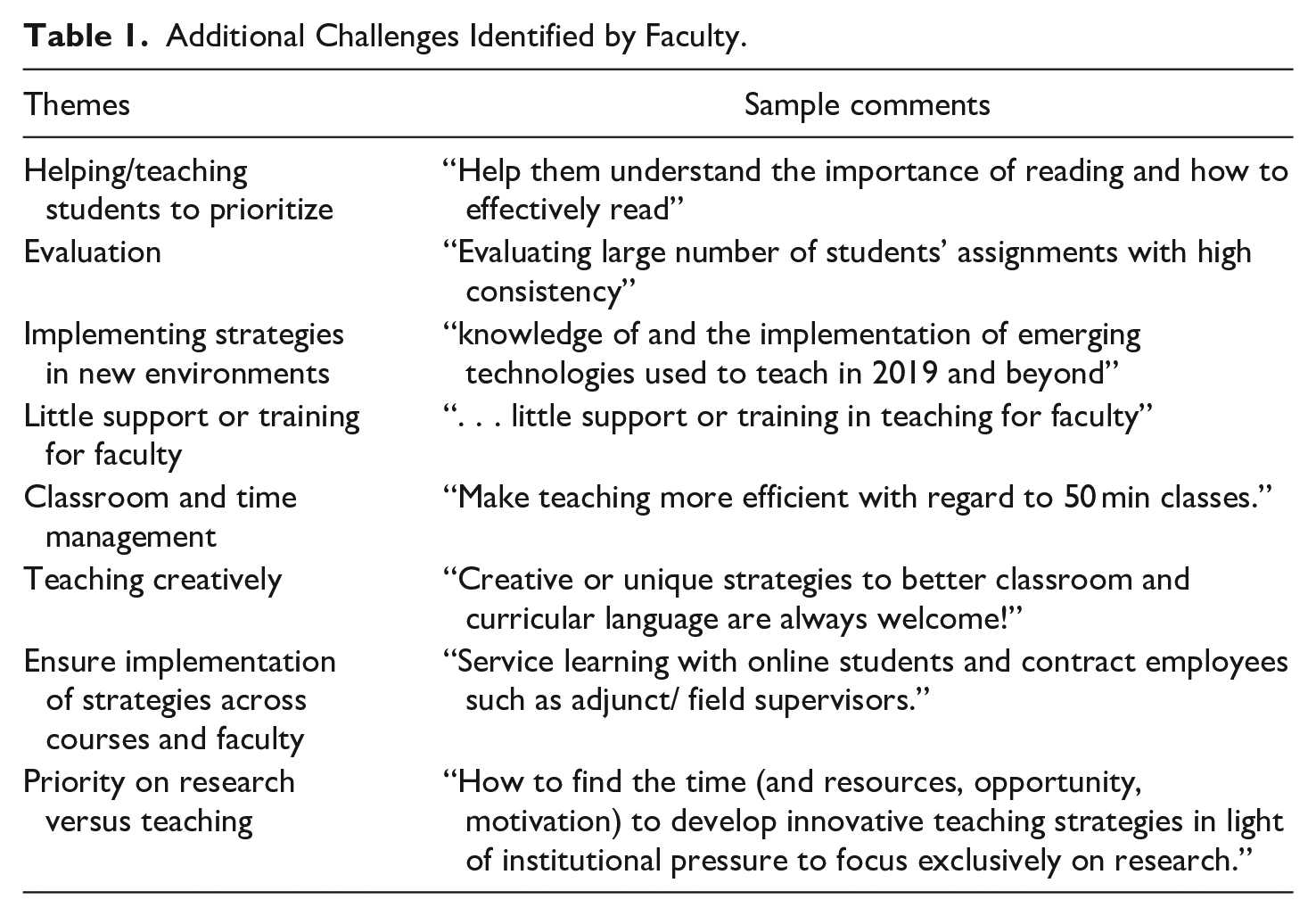
Here we detail three critical challenges that PD participants mentioned they experience in their classrooms. It is worth noting that many found common ground in connecting on these issues despite being from different disciplines, sharing ideas for overcoming them, and building community through their common experiences. Table 1 presents additional challenges shared.
Additional Challenges Identified by Faculty.
Connecting with students
The most frequently cited challenge for faculty was connecting, engaging with, and motivating their growingly diverse student population. These participants sought to establish the rapport needed to make sure students would continue participating despite any challenges they faced. Several participants felt: “At times it is difficult to get students excited about the material and more of them to participate in answering questions. I pretty much have the same students responding each time and showing enthusiasm.”
Large classes and online teaching
Faculty were also cognizant that eliciting rapt engagement and connecting with students was more difficult to accomplish when classes were large and online. Faculty cited three additional concerns related to teaching large classes. First, faculty wrote about the difficulties of making sure their students were continuously focused on the assignment when faculty were not able to check themselves. A second concern was adapting their course-related activities to a format that was conducive to learning for all students. Faculty described, for example, not being able to use the same group activities they would have normally used given the large number of students in their courses. A third concern, was the lack of additional support to ensure that students were on-task, engaged, and learning, especially in online environments, as it is a “completely different model.” Faculty described classroom management issues, and a lack of resources and support that is, no graders or teaching assistants, for managing large classes.
Meeting students’ needs
Meeting students’ needs was another critical challenge raised by faculty participants. Faculty described “needs” in terms of levels of expertise with the subject, different learning styles, and different academic trajectories. As a faculty member who teaches lower division courses stated, “(t)here are students from various field of studies,” in the core courses as well as students with different levels of academic preparation and faculty find that it is “challenging to convey same message to different students.” While they believe that the use of high impact strategies could potentially assist in this endeavor, they also noted that, “Reigning [sic] in the chaos that can come with active learning approaches can be challenging, as is simultaneously meeting the needs of students who sit at very different places on the college readiness spectrum.” However, faculty also noted that some students may resist to engaging with unfamiliar strategies. As one stated, “Getting students comfortable with working collaboratively and out of their comfort zone creatively and in group settings” was a struggle.
Moreover, not having “100% attendance and participation” was linked to the two most important challenges faculty noted their students face: work/life balance plus a lack of requisite skills to perform well in their courses.
. . .since I’m teaching future teachers, the course is full of in and out of classroom tasks, lesson plans, field experiences, etc., so students need to find the time to complete these while also working and tending to family obligations. All of these things make it difficult for them to be fully prepared for class and engaged.
Tending to these obligations impacted the ways in which students successfully managed their time or not. Consequently, faculty awareness of students’ academic and life challenges was also raised by participants as factors that they needed to consider. Faculty acknowledged that some of their students needed more support in acquiring skills expected in postsecondary education such as learning how to critically read texts, how to properly write about what they have learned, and how to be prepared to learn. While these challenges framed their expectations of PD, faculty also expressed a desire for PD to impact their own growth as teachers and scholars (Komarraju et al., 2010). Faculty participants shared that they expected PD to offer evidence-based practices that were high-impact and could be readily used with the diverse student body in their classrooms, all while being part of a supportive community of committed peers.
In What Ways Could Faculty Use What is Learned in PD to Improve Their Classroom Practice and/or Meet Diverse Students’ Needs?
From the 268 participants who attended the 14 sessions, 51.5% strongly agreed and 34.3% agreed that their level of understanding of teaching strategies and working with diverse populations had increased as a result of attending these. Faculty cited becoming “aware of the students (sic) background and the needs and concerns they may have during classes,” doing “better for 1st generation” students, and being “. . . more understanding and think about students background” three of the PD outcomes.
Similarly, a total of 61.9% strongly agreed and 29.1% agreed that they planned to take one or more of the ideas they had learned in the PD and put them into practice. A total of 100 survey responses dealt with changes, if any, in faculty thinking concerning pedagogy and/or teaching as a result of participating in the PDs offered. Qualitative data showed that faculty could effectively integrate new strategies such as 10-2 format (10 min of lecture followed by 2 min of debriefing about what was taught) into their teaching as early as the next day. Faculty also cited learning about the R1 students, learning styles, and how to leverage campus and community resources to support student learning reassured pedagogical efforts already occurring in their classes.
Though improving their classroom practice and learning more about students’ needs were important outcomes of participating in the PDs, being able to hear that “a lot of my issues and concerns were shared by colleagues from other departments and colleges” was also an important contribution. Being able to self-reflect on their own implementation was an important component of each session and is the third take away; best stated, “Most of the presentation helped critically analyze my class.” Instructors reflecting on their students’ needs, and the potential changes to their classroom practice because of the PDs, appeared to help faculty consider the difference between saying and showing that they care about their students.
The presentation of demographic data about their students at the start of the PD, elicited surprised comments from faculty who did not realize the depth of diversity in their classrooms, including the number of transfer and first-generation students. Discussions on approaches to better serve first-generation and students from underserved populations led to reflections from faculty about the development of greater empathy for the challenges faced by the students. For these faculty, “The notion of caring [and] what that means and how it is demonstrated” is an important distinction. Faculty did not see caring as leniency or lowering rigor: “Students feeling that we should care doesn’t necessarily mean being easy.” Thus, R-1 institutions that are also minority serving will need to understand ways to effectively manage access and excellence for the next generation of diverse researchers and professionals in a changing economic landscape (Doran, 2015).
By learning about the students in their classroom through the de-identified demographic data shared and committing to learning and using strategies that engaged nontraditional and more diverse students, faculty felt they demonstrated caring for their students. To this end, faculty expressed the need for PD that focuses on not only pedagogy but also understanding the students in their classrooms, citing a need for opportunities to learn “how to view, learn from student perspective” in a collaborative and supportive environment. Being able to do so does not come without challenges and barriers, as shown already. However, PD participants saw the value and promise of how PD may be able to afford them opportunities to plan their instruction in ways that are more supportive and inclusive (Komarraji et al., 2010) while also acknowledging the time, modality, and infrastructure constraints they may experience at their institutions.
Conclusions and Recommendations
Our study sought to understand why faculty seek professional development, what barriers inhibit faculty from addressing classroom needs, and how PD supports their classroom needs. Feedback from approximately 400 faculty participants in PD sessions suggest faculty are deeply committed to professional growth and their students’ success. Faculty sought to develop rapport with students, particularly those online, that would allow faculty to support persistence not only in their courses but throughout their academic career. But as faculty face a growing list of responsibilities (Komarraju et al., 2010), they also sought PD sessions that provided readily accessible learning strategies that did not require substantial preparation and could be incorporated easily into their courses to build connections with students. Faculty were driven to engage with PD as they sought to increase their skill level at motivating and engaging students, but they also acknowledged the need to utilize new tools and technologies. Murthy et al. (2015) point out that as new technology is introduced in the classroom, faculty need pedagogical strategies for adopting student-centric approaches that supports engagement, particularly in large classes.
The PD also engaged faculty in recognizing the differences between traditional and non-traditional students by analyzing enrollment data for their courses. Our data showed that faculty were often surprised by the depth of diversity in their classrooms, including the percentage of transfer and first-generation students. Discussions on approaches to better serving first-generation and students from underserved populations led to reflections from faculty about the development of greater empathy for the challenges faced by the students, and strategies in the classroom that allowed for all students to more deeply engage with each other and the material.
Developing an intentional, coordinated, evidence-based PD program for faculty requires consistency and engagement of participants in identifying faculty’s, as well as students’ needs, to support student success. The faculty engaged in PD for SU shared positive reviews of the workshops; however, to keep this new knowledge and new skills active, PD must be on-going and relevant to faculty’s practice. We offer the following suggestions for others interested in using PD to foster faculty engagement in student success.
Engage faculty in analyzing data about the students in their classes. Learning about our R1 students’ learning styles, SES, status (first-generation, transfer, etc.) help faculty by providing a context for students’ efforts at successfully completing their coursework.
PD should connect faculty across disciplines and engage them as peers committed to student success helped build a community of scholars/teachers that faculty appreciated.
Assist faculty in developing recognition of different experiences that 21st century college students are experiencing today, and share strategies for how to leverage resources in the community to support student learning, including service-learning opportunities.
PD can afford opportunities to more fully respond to faculty’s needs by building a supportive community of scholars and teachers that can provide ready-to-use student success strategies in the classroom and provide relevant information to faculty about their students. We encourage other universities to engage with faculty as partners in these important efforts as we seek to support our changing student body achieve its goals.
Footnotes
Declaration of Conflicting Interests
The author(s) declared no potential conflicts of interest with respect to the research, authorship, and/or publication of this article.
Funding
The author(s) disclosed receipt of the following financial support for the research, authorship, and/or publication of this article: Funding for this project was obtained from the U.S. Department of Education’s Developing Hispanic-Serving Institutions, Title V, Program.
