







Abstract
This paper takes a historical perspective in the narration of state land use legislation and the role of the federal government in championing these regulations. Four phases are identified and the key legislative reforms in each phase are discussed. The author argues that to effectively address the current land use problems the federal government needs to take a leading role in studying the land use issues to identify problems that are common to the states and to provide direction in how to address them.
Keywords
Introduction
In the US the power to regulate land use rests with state governments. Over time, however, this power devolved to local governments through state enabling legislation, initially, to enable local governments to deal with the land use conflicts that arose in the development of the industrial city. 1 As urban problems shifted, state governments pulled back some of this power to help them address concerns that were of a regional nature and could not be adequately tackled at the local level. 2 The federal government has also played a crucial role in land use regulation through the Standard Acts and environmental laws, among other interventions. 3
There has been a renewed interest in state planning legislation following the adoption of several state smart growth and climate mitigation laws across the country. 4 Climate change is an urgent problem that calls for updating local land use regulations, and meeting this challenge will require coordinated action among local, state, and federal governments. Therefore, it is important to understand how these three levels of governments have collaborated previously on land use regulation and how lessons from such cooperation can assist in dealing with the new land use challenges of our time. This paper provides a historical account of state planning legislation and the federal government’s role in bringing order to land use decision making. The purpose of the paper is to identify important lessons in this historical trajectory of state legislative reform in order to help us address the current realities of urban development. We commence with a discussion of Progressive Era reforms and the inception of the Standard Acts in the 1920s and then proceed to the current climate mitigation laws adopted by state governments. The players and institutions involved in the development of planning legislation attest to the enduring attributes of the planning profession: it is interdisciplinary, it is a continuous and iterative process, and it is highly politicized.
The roots of state planning legislation in the US can be traced back to the Standard State Zoning Enabling Act (SZEA, 1921) and the Standard City Planning Enabling Act (SCPEA, 1928), generally referred to as the Standard Acts. The main goal of the Standard Acts was to guide state governments in the delegation of zoning and planning powers to the local level. Herbert Hoover, the then Secretary of the US Department of Commerce observed with respect to the inchoate industrial city that:
The enormous losses in human health and in money, which have resulted from lack of a city plan which takes into account the conditions of modern life, need little proof. The lack of adequate open spaces, of playgrounds and parks, the congestion of streets, the misery of tenement life and its repercussions upon each new generation, are an untold charge against our American life.
5
The Standard Acts thus provided guidance to the states so they can enable local governments to plan their growth to obtain greater order and efficiency in the physical development of their land. The model acts culminated decades of advocacy by civic leaders and social activists at the local level and reflects a directional path in planning legislation, with issues first identified at the local level by planners, echoing realities on the ground, and then bubbling up to the state and federal levels where action is eventually taken to address these problems. Often, there is a lag between when land use issues are identified at the local level and when the states and federal government step in to address these concerns through modifications in existing laws. This is manifested time and again with respect to housing congestion, urban sprawl, environmental degradation, and now climate change.
Civic leaders and advocates like Jane Adams were concerned about the horrors of 19th century housing congestion for decades before the federal government intervened with the model legislations to guide states’ delegation of land use regulatory power to local governments. Planners were concerned about sprawl, environmental degradation and pollution for years before efforts were made to create regional governments to tackle these problems. 6 Environmental groups and scientists have been concerned with global warming for decades and only recently have resilience planning and climate mitigation policies been adopted by the states to tackle the problem. This lag suggests the need for shrinking the critical path from local to state and federal levels in planning legislation.
The Four Phases of State Planning Legislation
For purposes of this discussion, I have classified the development of state planning legislation into four phases: i) the first phase starts in the Progressive Era with the housing reform movement that led to the birth of organized city planning in the US 7 but before the enactment of the Standard Acts (1900 to 1920); ii) the second phase spans the period from the publication of the Standard Acts in the 1920s to 1960, a period when most states passed zoning and planning enabling legislation; iii) the third phase stretches from 1961 to the end of the twentieth century, marking the period of revision of state zoning and planning legislation, and including the quiet revolution; and iv) the fourth phase is a time of consolidation of state planning legislation in the twenty-first century and the advent of climate change.
Phase one: The formative years, 1900 to 1920
This period is characterized by an uncoordinated approach to managing the disjointed parts of the industrial city. By 1900 some 25 million (33%) of the US population lived in cities. 8 Lured by opportunities for factory work and a better life, streams of immigrants and rural dwellers moved to the urban centers. As Peterson observed, “No public agency, whether local, state, or national, had guided cities’ growth on a unified basis to this point.” 9 With little if any regulation on land use, this gave rise to overcrowded and unhealthy living conditions. The ills of the industrial city were evident in the juxtaposition of polluting industry to residential neighborhoods, slums and inadequate housing, polluted rivers, and congested streets, among others.
The City Beautiful Movement 10 and the Parks Movement 11 had sought to improve urban conditions through the physical improvements of cities. However, these interventions made no appreciable impact on the living conditions of the new immigrants, and the urban poor. This task was taken up by social reformers such as Jane Adams through the settlement house movement that started in Chicago and spread to other parts of the country. Mary K. Simkhovich, and Florence Kelly, disciples of Jane Adams, formed the Committee on Congestion of Population (CCP) in New York City in 1907 to address the prevailing social ills of the city. With the assistance of Benjamin Marsh, a social reformer, they organized anti-congestion exhibits and in 1909 held the First National Conference on City Planning and Congestion in Washington, DC. The conference included luminaries from professions in engineering, architecture and landscape architecture, municipal government, and civil society groups. It is generally conceived that the inception of organized city planning in the U.S. began with this national conference, an amalgam of both social activists and physical planning professionals who met to deliberate on the “urban problem.” 12
We see here the manifestation of the interdisciplinary nature of urban planning in the very foundation of the profession. Perhaps it was a realization that the problems of cities are multifaceted; they are sociological as they are physical, economic as well as political. Current efforts to address problems of climate change, biodiversity, environmental degradation, could benefit from this multidisciplinary approach that has been the historical harbinger of the profession.
Although there were disagreements among participants about priority setting at the 1909 conference, it did not dim the importance and significance of its achievements. For, while social activists advocated social intervention programs, those in the design professions saw the problem differently and argued for prioritizing order and predictability in urban development. Thus, “when Frederick Law Olmsted, Jr., for example, advocated German zoning in his 1909 speech, he viewed it as a means to promote order and assure predictable land uses.” 13 Even Benjamin Marsh, an avowed socialist and Secretary of the CCP, advocated German style zoning for regulating and addressing the congestion problem. 14
The conference influenced the adoption of New York City’s comprehensive zoning ordinance in 1916, the first of its kind in the country. Buoyed by shop owners along Fifth Avenue who wanted to limit the encroachment of sweat shops on their businesses, the city hired Edward Bassett to draft regulations stipulating use, building height limitations, setback requirements, and lot coverage for all land in the five city boroughs. The ordinance that resulted prevailed for nearly a half century until its modification in 1961. 15
Unlike New York City, however, some cities adopted less comprehensive land use regulations, perhaps because of pushbacks from property owners and a more challenging political environment. Following the fire of 1871, Chicago adopted nuisance laws to protect property against fire and safety, and in 1893 passed legislation to limit building heights to 130 feet for downtown buildings. Later in 1916, the city formed a Zoning Commission to oversee development regulation. In 1919 the state of Illinois passed the Glackin Law. Named after state senator Edward Glackin, the ordinance gave any municipality the right to regulate land use if it receives approval from 40% of property owners in the neighborhood. Table 1 shows that six states provided some form of enabling authority to local governments to regulate land use before the publication of the Standard Zoning Enabling Act in 1921.
Phases in the Development of State Zoning and Planning Legislation.
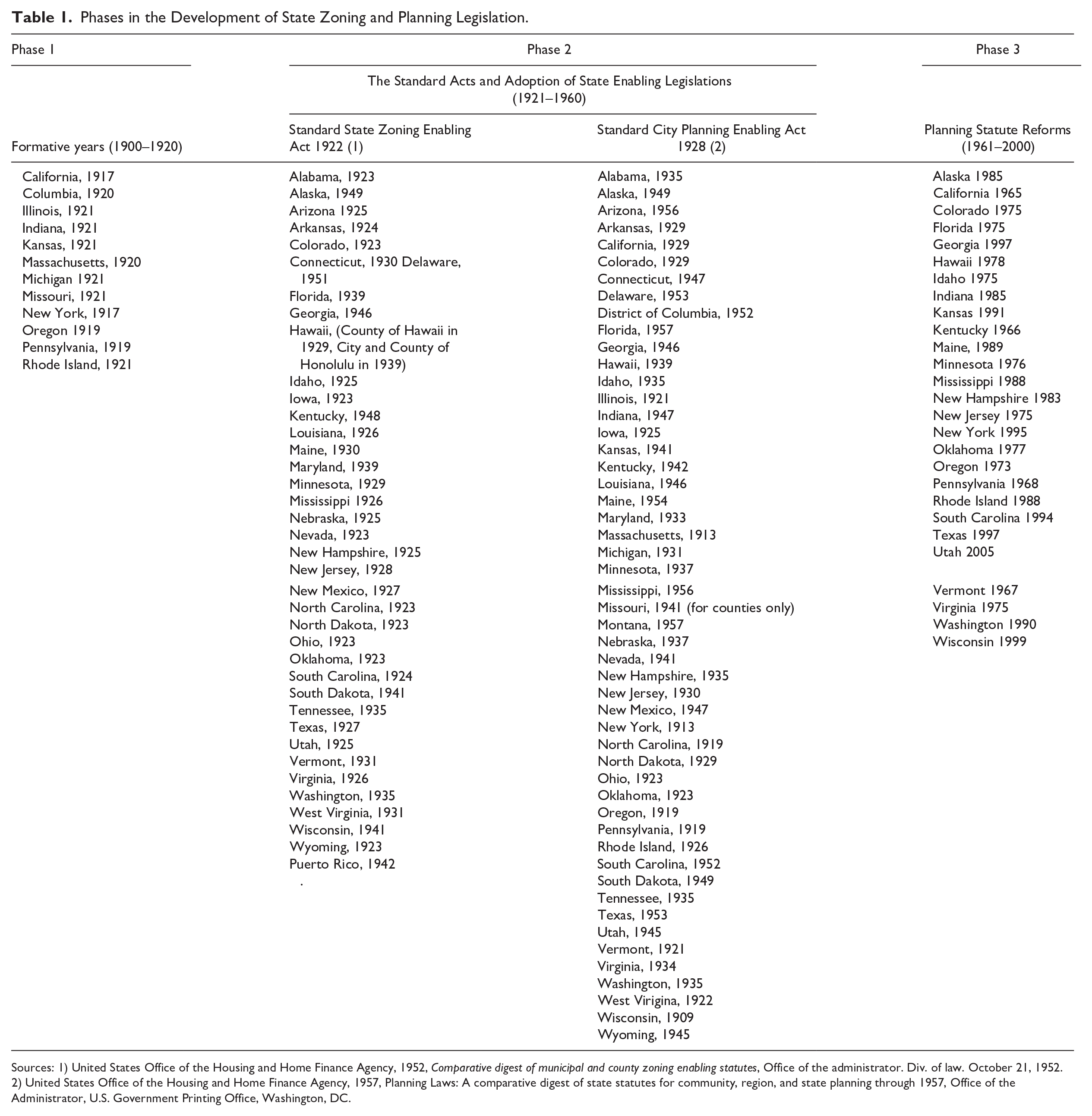
Sources: 1) United States Office of the Housing and Home Finance Agency, 1952, Comparative digest of municipal and county zoning enabling statutes, Office of the administrator. Div. of law. October 21, 1952.
2) United States Office of the Housing and Home Finance Agency, 1957, Planning Laws: A comparative digest of state statutes for community, region, and state planning through 1957, Office of the Administrator, U.S. Government Printing Office, Washington, DC.
Whittemore 16 provides an interesting account of the adoption of zoning in the City of Los Angeles in 1908 (a first in the country), that in many ways shows how the tool was deployed in cities across the country at the time and why the federal government had to intervene. He noted that “land-use regulation in Los Angeles, . . . . . represents the outcomes of battles pitting one political group against another, quite in disregard of the common purpose this regulation is intended to serve, with the most powerful usually winning at the expense of others.” It is in this hodge-podge of state and local land use regulatory environment, coupled with the urgency to address the chaotic physical development in the industrial city that the Standard State Zoning Enabling Act was drafted in 1921.
Phase 2: The Standard Acts and Their Adoption, 1921 to 1960
In the second phase of state planning legislation, we see a national effort to provide guidance on the granting of land use regulatory power to local governments. By this time, and as shown in Table 1, it had become evident that some states had adopted zoning enabling legislation, and some form of zoning was being applied by a limited number of cities to control land use without state direction. This atmosphere created an urgent need for the federal government to step in to streamline zoning in the country; local planning in that era was much less prevalent and there was arguably less harm in having local governments follow their own paths with planning than with regulations.
Herbert Hoover appointed the Advisory Committee on City Planning and Zoning (ACCPZ) to draft model statutes to guide the grant of such power by the states to local governments. The advisory committee was comprised of experts from diverse fields such as landscape architecture, engineering, real estate, law, and city planning. The diversity of the Committee’s membership again displays the interdisciplinary nature of the profession. Edward Bassett, an influential member of the committee was impressed by his observations of zoning as it was practiced in Germany and wanted to emulate it in the US, writing in his autobiography, “I realized that I found the kind of work that interested me. And I foresaw that the whole subject was almost unexplored in this country and that it offered a vast field of progressive legislation.” 17
The SZEA was informed by a national level review of what was happening at the local and state levels and an on-the-ground assessment of land use challenges brought before the courts. The committee noted that it did an “exacting and painstaking study in relation to existing state acts and court decisions and with reference to zoning as it has been practiced and found successful in cities and towns throughout the country.” 18
The SZEA outlined the content of state zoning enabling legislation to include the grant of power, the division of the municipality into use districts, a statement of purpose, procedures for establishing and amending the zoning regulations, and the establishment of a zoning commission and a board of adjustment. The Act also specified that property owners and the public must be given notice and an opportunity to participate in discussions that precede the adoption of a land use ordinance. It is significant to note that there was a huge overlap between the ACCPZ and the committee that created the NYC zoning ordinance. The outcome is that the recommendations dealt exclusively with developed uses and almost not at all with undeveloped and developing lands. In essence, one may argue that this oversight and the emulation of similar land use control by other cities contributed to the uncontrolled outward expansion of cities.
The SZEA provided a structure for state zoning enabling statutes, as well as standardized contents and wording for such legislation. It also aimed to ensure that land use controls at the local level withstood court challenges. It was for these reasons that the committee cautioned states that their enabling legislation should be as close in wording to the SZEA as possible, stating: “Modify this standard act as little as possible. It was prepared with a full knowledge of the decisions of the courts in every case . . . A safe course to follow is to make only those changes necessary to have the act conform to local legislative customs and modes of expression.” 19
The first draft of the SZEA was completed in 1921. An updated version of the model statute was printed by the US Government Printing Office in 1924 with another revision and final publication in 1926. The purpose of the SZEA was not so much to promote desirable development as to prevent undesirable and incompatible land uses. As stated in the SZEA, zoning is “not intended to enhance the value of buildings but to conserve that value.” 20 Hence a familiar language in local zoning ordinances was “to lessen congestion in the streets, to secure safety from fire, panic and other dangers.”
As seen in Table 1, by 1923, following the publication of the SZEA, 9 states had adopted some versions of the model Act, and by 1930, twenty-five states had adopted state zoning enabling legislation. According to Fischel, in January 1926 there were 425 municipalities with zoning ordinances, comprising half of urban residents in the US and that before 1910, there was not a single zoning ordinance in the United States but by 1930, it had spread to all sections of the country. He also observed that by 1936, 1,246 municipalities constituting 70 percent of the U.S. population had adopted zoning. 21
Why Did the States So Willingly Adopt the Standard State Zoning Enabling Act?
The first edition of the SZEA sold 55,000 copies and within 2 years all but five of the forty-eight states adopted enabling legislation modeled on the SZEA. It is puzzling that the states readily adopted the model Act since they were not mandated by the federal government to do so, and the adoption of the SZEA was not tied to federal funding. This issue deserves consideration since it provides a window to how the federal government could approach similar legislation on a national scale to deal with the current land use problems related to climate change.
The most basic of explanations is that the SZEA enabled the states to avoid the complexity and expense of drafting their own legislation from scratch and the federal government’s endorsement also lent legitimacy and practicality to zoning laws, making it easier for states to implement them. Besides cost and legitimacy, the rapid urbanization of cities in this era created haphazard development, and the states viewed zoning as a tool that would help local governments to guide and control the expansion of cities and to manage problems of congestion. According to Haar, progressive reformers believed in the transformational power of zoning to improve living conditions in cities. 22 The experiences of states that had adopted zoning showed that it could help municipalities to decrease land use conflicts, ensure access to light and air, mitigate against the dangers of fire and disease, and facilitate the efficient provision of municipal infrastructure. It was also believed that zoning would contribute to the efficient management of cities because it decreased the discretionary powers of elected officials and provided for better coordination of land use by technical and competent municipal officials. 23
It also became quite evident over time that nuisance laws could not effectively address the problems of conflicting land uses in the industrial city. Municipal governments had since the middle of the nineteenth century used nuisance ordinances to regulate land use to protect private property from incompatible uses associated with urban and industrial growth. 24 As an example, following the Great Chicago Fire of 1871 that decimated much of the central city, the state of Illinois enacted the Cities and Villages Act in 1872 granting local governments the power to control nuisance activities affecting health, safety, and the general welfare of residents. However, these lawsuits resolved nuisance activities between a few landowners but could not address the nuisance activities affecting hundreds of property owners simultaneously. By the 1890s it became evident that the courts were no longer an effective venue to resolve these land use disputes. A comprehensive land use regulatory tool was needed. 25
As Cooke noted, “Planned urban expansion through the application of comprehensive planning principles to the regulation of height and bulk had the potential to alleviate the chronic traffic congestion and other health and safety concerns associated with escalating density that plagued Chicago’s Loop district in the first decades of the twentieth century.” 26 Similarly, Tiwan and Walsh observed that “Chicago’s city government had made previous attempts to control undesirable land uses, including an 1837 municipal code that prohibited any landowner or tenant from maintaining nuisances, such as dead animals, dung, putrid meat, or fish entrails on their property. Such piecemeal approaches proved insufficient to meet public demand for controlled development, and in 1920 the newly created Chicago Zoning Commission began preparing a comprehensive zoning ordinance.” 27
Another compelling reason for the states’ adoption of the SZEA is that the model Act was supported by a wide range of civic and real estate groups that had significant influence on the decisions of state government. Zoning was welcomed by the National Association of Real Estate Boards and by municipalities because they believed the new tool would help them protect property values and enhance municipal revenue. Developers, mortgagers and brokers expected zoning to stabilize property values and the urban land market, thus reducing their investment risks. Schwieterman and Caspall in their account of zoning in Chicago observed that business and real estate professionals supported zoning because it would help increase land values by upwards of $1 billion—the equivalent of more than a $1,000 per household in the city. 28 Hirt asserts that it was zoning’s effect in increasing property values rather than health and safety that motivated the adoption of zoning laws in the US because she argued, industrial uses were the most restrictive zones in Germany whereas in the US single family residential zones were and still are the most restrictive. 29
John P. Mitchel, New York City’s mayor in 1916, is quoted by Hirt as justifying zoning to the city’s Board of Estimates and Apportionment as follows: “It has come to be recognized that to maintain real estate values and prevent enormous economic waste, a reasonable limitation by districts must be put upon the heights of buildings to which buildings may be carried and the uses to which real estate may be devoted.” 30
The states may have also adopted the SZEA because it was viewed as an instrument for social engineering. For example, a 1911 State of Virginia enabling legislation allowed cities and towns to zone areas according to race, dividing blocks by white persons and “colored” persons, and racial zoning codes were upheld by the Virginia Supreme Court in Hopkins v. City of Richmond in 1915. Besides Richmond, other cities adopted similar regulations until after they were struck down by the US Supreme Court in Buchanan v. Warley in 1917.
According to Chirstopher Silver, “In contrast to the German model, the US version of zoning consistently sought to regulate land use in terms of the likely population those uses served, and for the express purpose of separating the undesirable classes from the more affluent.” 31 He also noted that in 1917, the Chicago Realty Board led by realtors from the Kenwood, Hyde Park, and Oakland neighborhoods urged Chicago to adopt racial zoning because the dispersion of African Americans into White neighborhoods could result in a $250 million depreciation in property values. It was also the view of Mayor J. Barry Mahool, a nationally recognized member of the “social justice” wing of the Progressive Movement, that "Blacks should be quarantined in isolated slums in order to reduce the incidents of civil disturbance, to prevent the spread of communicable disease into the nearby White neighborhoods, and to protect property values among the White majority.” 32
In a gist, the SZEA was eagerly adopted by the states because it served their interests and purposes at the time. It provided a means for the states to support local governments in their efforts to control the development of incompatible land uses, it helped to improve the living conditions of urban residents as it relates to public health and enabled local governments to protect property values. It is questionable whether such a novel land use regulatory instrument would be widely acceptable to the states today in this politically charged atmosphere. The history of the SZEA does show however, that the federal government can play the trail blazing role on land use matters affecting state and local governments and that such guidance would be dexterously followed by the states if it is closely tied to their interests.
The Standard City Planning Enabling Act (SCPEA 1928)
A close reading of the SZEA and the footnotes that accompany it appears to show that the ACCPZ may have expected planning to be embedded within the zoning powers granted to local governments. First the SZEA requires municipalities to form planning commissions which will “undertake the painstaking, careful and prolonged detailed study that is ordinarily involved in the preparation of a zoning ordinance and map.” 33 Section 3 of the model act states that zoning shall be done in accordance with a comprehensive plan to promote health and the general welfare of the community. An interpretation of this wording suggests some level of planning at the local level was expected as part of the zoning process. Nonetheless, a separate planning enabling statute, the Standard City Planning Enabling Act (SCPEA) was prepared by the ACCPZ in 1928, several years after the SZEA was first published. As Table 1 shows, even prior to the publication of the SCPEA, some states allowed local governments to engage in planning activities under local charter provisions, or under some general statutory authority. Under these state statutes, planning commissions were empowered to make decisions and recommendations for the development of their municipalities.
The SCPEA benefitted greatly from the insights of Alfred Bettman, a practicing attorney who is credited with drafting Ohio’s law in 1915 that granted municipalities the power to form planning commissions. He also provided the amicus brief in the Village of Euclid v. Ambler Realty Co. (1926) case that came before the US Supreme Court. The Standard City Planning Enabling Act (1928) covered several subject areas namely i) the organization, membership and powers of the city planning commission, ii) the content of the masterplan, iii) provision for the adoption of the masterplan by the local legislative body, iv) provision for approval of public improvements by the planning commission, v) control of private subdivisions of land, and vi) provision for the creation of regional planning commissions and a regional plan. 34
Table 1, Phase 2 shows that the SCPEA influenced the granting of planning power to municipalities across the country so that by 1936 forty-seven of the forty-eight states had formed a state planning agency 35 and by 1950 all states except Arizona (1956), Mississippi (1956), Montana (1957), and South Carolina (1952) had passed planning enabling legislation. The added value of the planning enabling legislation may have been to ensure that local governments prepared comprehensive plans that articulated a shared vision of their future, following which zoning can then be used to regulate the physical development of the community.
As Doebele observed, in New Mexico, “the state’s population was growing rapidly so that from 1930 to 1960 the urban population increased from 25% of the state’s population to 62%. While the state gave municipalities the right to zone in 1927, it was not until 1947 that the state provided municipalities the right to form Planning Commissions. Thus, for twenty years a hiatus existed between the implementation of land-use controls, and provision for an adequate agency to formulate the basic policies toward which such controls should be directed.” 36
The drafting of the SZEA and the SCPEA showed the important role that the federal government played in guiding state planning legislation. Since then, however, this role has been muted. State smart growth and climate mitigation laws have been formulated with no federal government oversight resulting in a patchwork of such legislation. The US Environmental Protection Agency, the agency most directly responsible for such policies, develops and enforces regulations without commitment from the states or local governments. Besides, whatever actions the agency is taking are limited to its operations with little or no state buy-in. Thus, the EPA’s 2024–2027 Climate Adaptation Plan “focuses on priority actions the agency will take over the next 4 years to allow the agency to deliver on its mission to protect human health and the environment, even as the climate changes.” 37 There doesn’t seem to be an expectation for state and local government involvement, nor has this been the goal of the agency. Like the Progressive Era, a more effective approach to tackling the climate change problem for municipalities would be for the federal government to examine land use practices across the country to find common problems and to provide legislative direction on the states’ response to these problems.
Phase Three: Planning Statute Reforms, 1961–2000
Two main issues influenced the third phase of state planning legislation, which stretched from 1961 to the end of the twentieth century: growth management, and legislative reforms. By the mid-twentieth century, it became evident that some land use issues such as environmental degradation, watershed protection, and destruction of natural resources, had to be managed on a regional scale to be effective. As Bosselman and Callies noted in their report, “It has become increasingly apparent that the local zoning ordinance, virtually the sole means of land use control in the United States for over half a century, has proved woefully inadequate to combat a host of problems of statewide significance, social problems as well as problems involving environmental pollution and destruction of vital ecological systems, which threaten our very existence.” 38 Thus, states began to claw back some of the land use regulatory powers that they had ceded to local governments to enable them to tackle these problems on a wider scale.
This was also the period when the environmental and civil rights movements were crystalizing into a potent force in the US. Spears calls this the “field of movements” to capture the different strands of environmentalism of the period. 39 These started in earnest in the 1950s with concerns about the health effects of chemicals that were used in farming such as dichlorodiphenyltrichloroethane (DDT) on human health 40 and to protest against the effects of industrial activity on minority communities. 41 The groundbreaking book by Rachel Carson, 42 Silent Spring nicely captured the rationale behind these movements. The environmental and civil rights movements and the public’s concern over the contribution of human activity to climate change coalesced in the birth of smart growth. 43 Smart growth seeks to direct and manage growth and to protect agricultural, open spaces and environmentally sensitive areas from urban expansion.
The Council on Environmental Quality commissioned a study of states that were in the forefront of promoting smart growth, the outcome of which was documented in The Quiet Revolution in Land Use Controls in 1971 by Fred Bosselman and David Callies. The authors reviewed innovative land-use regulations in nine states and identified key trends and lessons for land use controls. Two important observations in the report that are very much relevant today are first, that there has been a change in our understanding of land from one in which land is regarded as a commodity that can be traded for economic gain to one that sees land as a resource that should be managed, and second is the realization of the interconnectedness of land use decisions.
Hawaii set the stage for the “quiet revolution” when the state passed its Land Use Law in 1961 and created a state Land Use Commission to manage the state’s land resources. Unlike other states, Hawaii never ceded its land use regulatory power to local governments. The state’s economy also depended on agriculture, notably sugar cane and pineapple, and thus it saw a need to preserve its fertile land. The state’s Land Use Commission divided the state into four districts: conservation, agricultural, rural, and urban, and stipulated conditions and procedures for the development of each district. Conservation districts are the most restrictive because they are state owned lands on which there is forest and water resources. Only the Commission had power to change land use in this district.
There is evidence that Hawaii’s approach to land use regulations was successful in preserving farmland. "The records show that from the time the Land Use Commission drew up its first district boundaries in 1964 up to the latter part of 1970, it received requests for more than 100,000 acres to be re-classified into urban district, where economic valuations are obviously the highest. Of those 100,000 acres, only 30,000 acres were given urban classification by the Commission. Of the 30,000 acres reclassified into urban district, only 3,500 acres were considered prime agricultural lands.” 44
Like Hawaii, the Vermont Environmental Control Law, 1970 (also known as Act 250), required a statewide comprehensive land use plan. The law was accompanied by legislation dealing with specific concerns of importance to the state such as water and air pollution, open space preservation, shoreland and flood plain protection and other land use measures. The responsibility for administering the law was placed in the hands of a statewide agency, the Vermont Environmental Board and nine District Environmental Commissions. The commissions had the responsibility of reviewing local development plans that had potential impacts on the environment and quality of place such as air and water pollution, transportation, and scenic and natural beauty. In 2020 Brian Shupe wrote a Commentary piece in the Vermont Times-Argus, on the law’s 50th anniversary. Shupe acknowledged the positive impacts of Act 250 in helping to preserve the state’s natural resources but also called for the law’s update to meet current challenges such as climate change and to “better align the law with our land use and community development goals.” 45
Not all the nine state planning laws reviewed by the authors required state-wide land use planning. Some were regional in scope. California created the San Francisco Bay Conservation and Development Commission in 1965 and authorized it to prepare a development plan for the San Francisco Bay area. The Minnesota Legislature created the Metropolitan Council of the Twin Cities Area in 1967, to coordinate the planning and development of the metropolitan area of Minneapolis and St. Paul. Other interventions included the Massachusetts zoning appeals law, the Maine site location law, and the Wisconsin shoreline protection program, among others.
Besides the greater level of state intervention in land use, many states also began to reform their land use regulations that were adopted in the early part of the twentieth century to meet their changing needs and priorities beyond what was conveyed in the SZEA. In 2002 when the American Planning Association published the Growing Smart Legislative Guidebook, it stated then that the planning tools of the 1920s were incapable of meeting the challenges of the twenty-first century because there is now i) a need for more intergovernmental collaboration in addressing urban problems, ii) a shifting view of land not as a commodity to be bought and sold but as a resource to be properly managed, iii) a more engaged citizenry in the planning process, and iv) a more challenging legal environment by the courts. 46
The land use reforms that began in the 1960s and accelerated to the end of the century were tailored to address these issues. Ohm observed that Wisconsin’s zoning enabling legislation had to be revised to make it user friendly and to meet the state’s land use regulatory needs: “the zoning enabling legislation in Wisconsin is complex and not at all useful in its grant of power nor its procedural requirements . . . it presents unnecessary difficulty to an ordinary citizen in an attempt to understand it, to the agency to use it, and to the planning staff to administer it.” 47 Ohm suggested changes to Wisconsin’s planning laws to create a uniform law that will bring together numerous land use laws that existed in the state, to lessen confusion and complexity in existing laws, and present a more comprehensive approach for dealing with issues of growth and change.
Thus, in 1999, the Wisconsin Legislature and Governor Tommy Thompson enacted the “Smart Growth Law”, which was an update of the state’s planning enabling law. Among other changes, the law required all Wisconsin municipalities to have a comprehensive plan in place by 2010 without which they would not be able to regulate land use. The legislation also aimed to ensure that all zoning and development decisions were based on a broadly supported vision for the development of each municipality.
As shown in Table 1, besides Wisconsin, towards the end of the twentieth century, there was a proliferation of what is termed “smart growth” legislation in states across the country. Bolen et al. 48 documented this in their assessment of state legislative reforms. At least twenty states enacted laws that explicitly require smart growth, defined as growth that takes place in areas that have the infrastructure and services available to serve new development and where activities of daily living are in proximity. In 1998, the Arizona state legislature passed the Growing Smarter Management Act adding new growth-conscious elements to community plans. In Illinois in 2000, the Governor consolidated all growth management initiatives into Illinois Tomorrow, a voluntary, incentive-based approach aimed at “balanced growth.” In Maine under the Growth Management Act of 1988, the Legislature created a list of state goals to guide State and municipal planning and regulatory action, encouraging orderly growth and development in appropriate areas, preventing sprawl, preserving agricultural and forest land, and preserving natural resources and the environment. Maryland’s Smart Growth Program of 1997 sought to save the state’s valuable natural resources by directing development to areas where infrastructure is already available.
To wit, the last half of the twentieth century was marked by significant state intervention in land use and control. Indeed, when Callies revisited “the quiet revolution” a decade after their first report, he observed an “exponential increase in citizen participation in the land use control process which was already burgeoning at the time of The Quiet Revolution.” 49 But he also noted a resurgence of local land use control powers and an incursion of the federal government into land use controls at the local level. The greater role that Callies observed of the federal government in land use, however, never materialized. While several land use reform bills have been considered in Congress, such as H.R.10294, a bill to establish a national land use policy, none of them became law. Instead, the federal government has since retreated from the scene and has resorted to an incremental land use reform approach using instruments such as incentives rather than legislation. An example is the Biden administration’s incentive based Pro-Housing initiative, which incentivizes local governments to increase housing production through zoning and land use regulatory reform. The American Planning Association’s Smart Growth Legislative Guide that was discussed earlier provided a nation-wide model for land use reform, but the document had limited impact in legislative reforms perhaps because it did not emanate from a federal agency.
As we have seen from previous federal government leadership roles on land management, the retreat of the federal government on this matter is puzzling. After all, the federal government has used regulations to influence state and local governments to act on such matters as the adoption of hazard mitigation plans and for poverty alleviation through the Community Development Block Grant (CDBG) program. For example, with respect to hazard mitigation, federal law requires that “States must have an approved Standard State Mitigation Plans . . . . . . . . as a condition of receiving non-emergency Stafford Act assistance and FEMA mitigation grants.” 50 This regulation lays out a planning process that states must follow, the expected content of the mitigation plan, and the strategies that must be included in the mitigation plan, among others. That the federal government has thus far been quiet in providing a comprehensive model for states and local governments to address the existential challenge of climate change is perplexing.
Phase Four: Twenty-first Century Climate Change Preparedness
While the federal government has taken a back seat on the subject, climate change and its impacts have gained traction in state and local level policy discussions in the twenty-first century. 51 Table 2 shows the potential impacts that climate change will likely have on the different regions of the US if mitigation measures are not implemented. As the table shows, most regions are likely to see increased heat waves, flooding, drought, wildfires, hurricanes and sea level rise.
Effects of Climate Change on Regions of the US.

Source: Nuccitelli, Dana, 2023, How climate change is affecting every U.S. region. Accessed June 30, 2024 from https://yaleclimateconnections.org/2023/11/how-climate-change-is-affecting-every-u-s-region/
It has become palpable that without adequate intervention, significant climatic shifts will occur in the environment, and cities and states will face challenges for which prevailing laws are inadequate. Most concerning is the “climate resilience gap”. According to the Union of Concerned Scientists, the climate resilience gap is “the scope and extent of climate change–driven conditions for which people (individuals, communities, states, and even countries) remain unprepared, leaving them open to potentially harmful impacts.” 52 A 2022 survey of state planning laws by the American Planning Association (APA) and summarized in Table 3 found that only four states have a statute that requires a hazard mitigation element in a state level comprehensive plan, and twenty-one states have a statute that requires an element for hazard mitigation in local comprehensive plans. The study led the APA to conclude that “few states have updated their laws in response to the growing threats posed by a changing climate and increasingly frequent and severe natural disasters. While state planning-enabling laws, overall, look quite different than their 1920s models, there is still considerable room for improvement when it comes to promoting community resilience through planning. 53
Priorities of State Planning Legislation.

Source: American Planning Association, 2022. 2022 Survey of State Planning Laws: Land Use, Hazard Mitigation, and Climate Action, https://storymaps.arcgis.com/stories/142eec1ae7fe42be915b6767ac811e40
The State of Washington is at the vanguard of legislative changes in response to climate change. In 2023, the state updated its planning law to improve climate change response that included a goal to “ensure that comprehensive plans, development regulations, and regional policies, plans, and strategies adapt to and mitigate the effects of a changing climate; support reductions in greenhouse gas emissions and per capita vehicle miles traveled; prepare for climate impact scenarios; foster resiliency to climate impacts and natural hazards; protect and enhance environmental, economic, and human health and safety; and advance environmental justice.” 54 The 2021 New Jersey amendment to the state’s planning law included climate change vulnerability assessment as part of the land use plan element. 55 Maine’s 2021 changes required climate vulnerability assessment as part of inventory and analysis of a community, 56 and Virginia’s 2023 law change encouraged resilience strategies to be included in comprehensive plans. 57
The Georgetown Climate Center keeps a record of climate mitigation measures passed by states to address the looming effects of climate change. Table 4 shows that forty-one states have adopted either a law or have a plan to address climate change and adapt to its impacts. Not all the state laws listed in the table have a land use component in them, but they provide a starting point for addressing climate change. What is missing is a comprehensive nationwide analysis of the effects of climate change and guidance from the federal government on what needs to be done. Absent this national guidance, each state is pursuing its own course of action. Table 2 showed that some of the climate change impacts are regional in scope. That being the case, a more effective approach might be at the very least to develop regional responses to climate change rather than a piecemeal uncoordinated approach, a situation which in the Progressive Era incited the federal government to act and to develop the Standard Acts.
Planning for Climate Change Resilience.
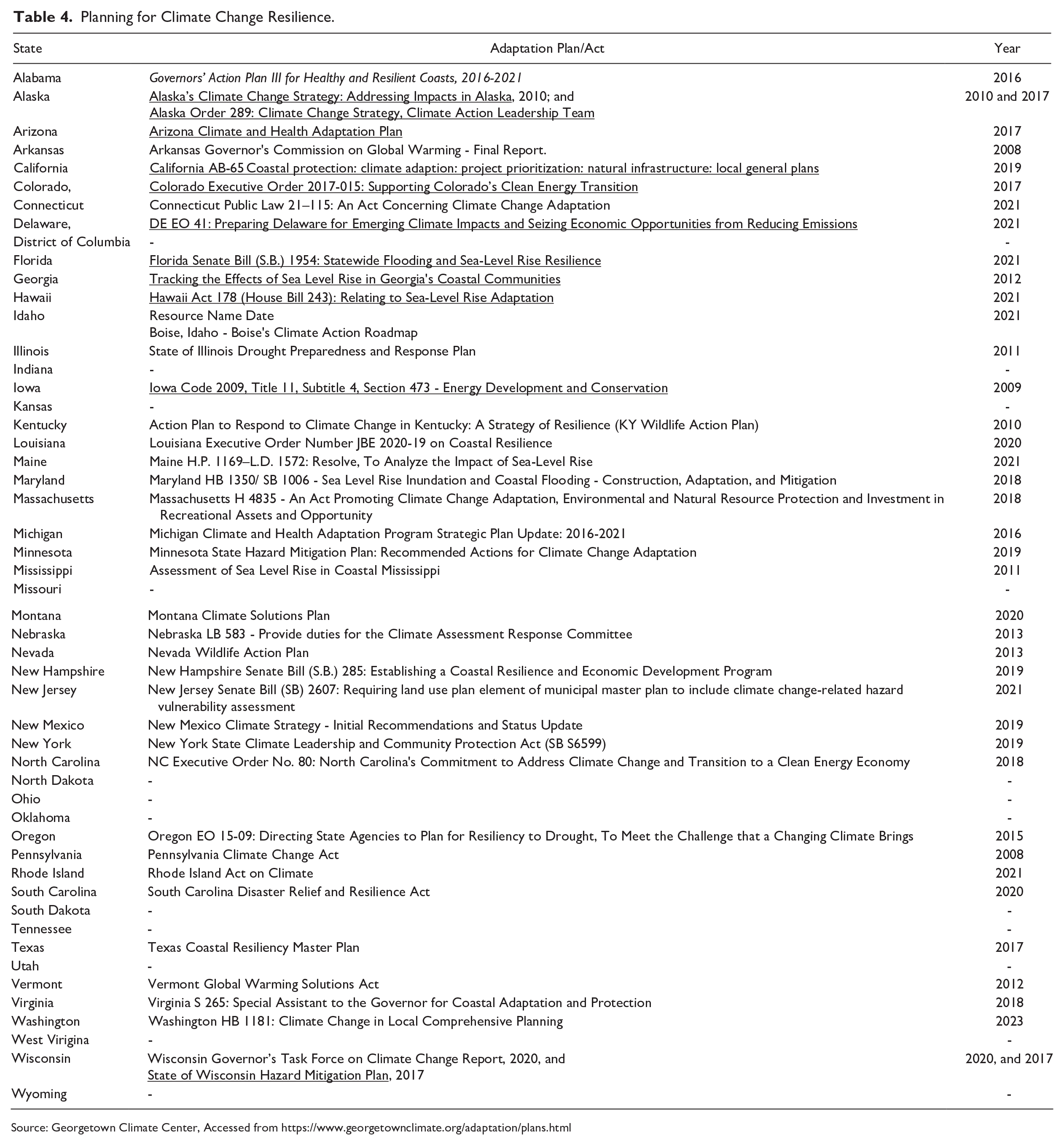
Source: Georgetown Climate Center, Accessed from https://www.georgetownclimate.org/adaptation/plans.html
When Haar wrote about the adoption of zoning in the US in the early twentieth century, and of its legalization in Euclid v. Ambler Realty Co. in 1926 by the US Supreme Court, he called it a revolution in land use prudence. Haar might as well have been commenting on the crossroads at which we find ourselves in the twenty-first century with respect to climate change when he wrote:
Earlier efforts of the state courts to stretch old theories to fit new economic and social patterns of metropolitan growth led in the 1920s to a redefinition and expansion of the police power in the United States. Today, as we struggle to understand the deeper implications of new versions of urban form that we recognize as fundamentally different from earlier permutations, a similar reexamination from a contemporary perspective is imperative.
58
It beckons the reader whether a re-examination of the police power of local governments may be needed in the context of climate change, the more reason why the federal government’s leadership role is needed.
Conclusion
Climate change is an urgent problem that calls for updating local land use regulations. Meeting this challenge requires strong federal guidance, which is currently lacking. The history of land use planning over the past century shows us that the federal government can play this leadership role. We have seen that in the early years of the industrial city, and left on their own, state and local governments used one tool at their disposal, nuisance laws to manage their ill-fitting parts, which proved unsuccessful. Realizing this shortcoming, the federal government stepped in to provide a leadership role and guide the states through the development of the Standard Acts. For the most part, the model Acts were well received and helped to make a difference in managing land use conflicts. The last six decades can be characterized as the “missing years” of the federal government. Not in the sense that the federal government has not acted, but that it has failed to provide a coordinated and comprehensive guide on climate change for the states and local governments.
The story of planning legislation in the US shows the enduring role and influence of the federal government. The federal government’s bold decision to intervene and provide clarity and direction in land use regulation had a profound impact in the development of state planning enabling legislation. Although the challenges in land management have shifted, their impacts are in many ways as acute as those of the industrial city. The issues of resource conservation and climate change cannot be resolved by the states alone or by the piecemeal actions of local governments because their impacts are supra local and regional in scope. The history of the federal government’s role in land use regulation provides the following lessons for action. First, like in the Progressive Era, the federal government needs to convene an interdisciplinary team of experts to study and identify areas of climate change impacts at the local level across all states. Second, the expert team should recommend effective ways that the states can respond to these climate related challenges tailored to the impacts they will exact at the regional level, since these effects vary by region of the country. Third, the federal government should incentivize the states to adopt and implement climate change mitigation and adaptation measures using carrots and sticks as appropriate. It is inconceivable that the states will willingly adopt a federal directive on climate change today as they did with the SZEA without some prodding by the federal government. To conclude, it is time to bring the federal government back in to play the leading role as it did in the 1920s to study current land use challenges, to identify issues of common concern, and to provide a model framework that will enable cities and states to effectively address current and emerging land use concerns.
Footnotes
Acknowledgements
The author wishes to acknowledge the research assistance of Cayla Mahoney-Potter, his graduate assistant who helped in the data gathering and research process that culminated in the development of this paper.
Declaration of Conflicting Interests
The author(s) declared no potential conflicts of interest with respect to the research, authorship, and/or publication of this article.
Funding
The author(s) received no financial support for the research, authorship, and/or publication of this article.

Notes
Author Biography