






Abstract
Purpose:
The treatment of aortoiliac occlusive disease (AIOD) has largely shifted to endovascular techniques, with primary stenting constituting the preferred treatment approach. The goal of the current study was to summarize available literature and to determine whether covered stents are superior to bare metal stents for the treatment of AIOD, in terms of both periprocedural and long-term outcomes.
Methods:
A meta-analysis of 47 studies was conducted with the use of random effects modeling. The incidence of adverse events during follow up among the individual included studies was synthesized.
Results:
Most of the lesions were located at the common iliac arteries and were chronic total occlusions. The procedure was technically successful in almost all cases in both groups, with a low rate of periprocedural complications observed in both groups. The reported primary patency rates for the non-covered and covered stent group during an average follow up of 24.3 months among the individual studies, were 84% and 92% respectively, while surgical or endovascular re-intervention was required in 10% of non-covered stent cases and in 6% of covered stent cases. Eight studies comparing covered vs non-covered stents in terms of patency demonstrated superiority of covered stents (OR: 2.47; 95% CI: 1.01-6.01; p = 0.047 Combining TASC C/D lesions together 12 studies reported 92% (95%CI:89%-95%) primary patency in the covered stent group, while 7 studies reported 75% (95%CI: 60%-88%) primary patency for cases treated with non-covered stents.
Conclusion:
This study demonstrated that covered stents are safe and effective when utilized for the treatment of AIOD. Covered stents were associated with a statistically significant higher odds of primary patency in both the overall cohort and in more complex TASC C/D lesions. However, additional high-quality comparative analyses between covered vs bare metal stents and between several types of covered stents are needed to determine the most optimal treatment modality for AIOD.
Introduction
Aortoiliac occlusive disease (AIOD) impacts the aortic bifurcation and iliac arteries. The diseased lesions are either stenotic or fully occlusive resulting in a triad of signs and symptoms including claudication, weak peripheral pulses, and/or impotence. 1 Historically, the treatment of AIOD was accomplished with open surgical techniques, which demonstrate good long-term patency rates but also high peri-operative mortality and morbidity rates.2,3 For this reason, standard treatment for AIOD in the last couple decades has largely shifted to an endovascular approach. 4 Bare metal stents (BMS), including balloon-expandable and self-expanding stents have shown favorable technical success and durable vessel patency.4-7 Covered stent grafts, originally intended for aneurysms or arterial ruptures, are now commonly used for AIOD, as they offer a potential advantage in preventing in-stent restenosis and reduce the risk for distal embolization in complex disease.4-7
The polytetrafluoroethylene (PTFE) covering of covered stents prevents the exposure of macrophages to atherosclerotic tissue, reducing cytokines and growth factor secretion and directly blocks smooth muscle cell migration and neointimal tissue growth, due to its design (i.e. stent struts).8,9 Additionally, covered stents have been associated with improved flow patterns (i.e. laminar flow) compared to bare metal stents 10 and as such lower thrombosis risk, especially in “kissing-stent” procedures.11,12 However, clinical decision making regarding the most optimal stent type remains uncertain, due to the limited number of comparative studies and the lack of specific treatment protocols.7,13,14 The goal of the current study was to summarize all available literature and to determine whether covered stents are superior to bare metal stents for the treatment of AIOD in terms of both periprocedural and long-term outcomes.
Methods
Search Strategy and Selection Criteria
This systematic review and meta-analysis was performed according to the PRISMA (Preferred Reporting Items for Systematic reviews and Meta-Analyses) guidelines. 15 Systematic searches were conducted in PubMed/Medline, Scopus and Cochrane Central, by 2 independent investigators, who were blind to each other. Any disagreements or discrepancies were resolved by consensus. A study was included in this meta-analysis if it fulfilled the following predefined inclusion criteria: i) prospective/retrospective analyses reporting on patients with AIOD treated with covered stents or bare metal stents; ii) single-arm or comparative studies reporting on short-and/or late-term outcomes; iii) studies published up to May 2020. When duplicates were identified, the most recent study was included unless the earlier version reported more relevant outcomes.
Data Extraction, Outcomes, and Risk of Bias Assessment
Two experienced abstractors independently and blind to each other extracted the relevant data from the eligible studies and the final decision was reached by consensus. The main outcomes were restenosis/re-occlusion, primary patency (<50% restenosis), surgical or endovascular re-intervention, major amputation and all-cause mortality during an average follow up of 24.3 months among the individual studies. Secondary outcomes included technical (<30% residual stenosis) and procedural success (<30% residuals stenosis, without any intraprocedural complications) and the rate of perioperative complications. Risk of bias was assessed by 2 investigators with the Robins-I tool for non-randomized studies and any discrepancies in quality assessment were resolved via consensus. 16 Assessment of risk of bias is presented in Supplementary Table 1.
Statistical Synthesis and Analysis
Two groups were synthesized including cases treated with covered vs. non-covered stents (i.e. balloon expandable stents, self-expanding stents) respectively. The cumulative incidence of primary and secondary endpoints and the corresponding 95% confidence intervals (CI) were estimated. Odds ratios (OR) between covered vs non-covered stent group for primary and secondary outcomes were synthesized. In all tests, a random effects model was used to account for heterogeneity among studies and in cases of I2 > 75%, the variation across studies was attributed to heterogeneity. 17 A forest plot was used to graphically display the effect size in each study and the pooled estimates of outcomes. STATA 14.1 (StataCorp, College Station, Texas) was used as statistical software.
Results
Characteristics of the Included Studies
Literature search after duplicates were removed, yielding 94 potentially relevant articles, 56 of which were retrieved for full-text evaluation after screening for titles and abstracts. 47 studies eventually met the predefined eligibility criteria and were included in this meta-analysis and systematic review as illustrated in the PRISMA flow diagram (Figure 1). 39 studies were single-arm and 8 were comparative between covered vs non-covered stents, enrolling overall 6,219 patients (covered stent group: 1,820 vs non-covered stent group: 4,399).2,5,11,12,18-60 Among the single-arm studies, 18 reported on the outcomes of non-covered stents, whereas 21 reported on the efficacy and safety of covered stents.

PRISMA search flow diagram.
Important Demographics of the Patients and Lesion Characteristics
More than two thirds of the patients were males (69%) with a mean age of 65.2 years. The majority of the patients (76%) had a smoking history and (75%) hypertension (HTN) at baseline. More than half of the included patients (64%) had any type of dyslipidemia, while 29% and 45% were diabetics and had coronary artery disease, respectively. Approximately, one third of the patients presented with rest pain and/or ischemic tissue loss [i.e. critical limb ischemia (CLI)], whereas the rest presented with lifestyle limiting claudication. Most of the lesions were located at the common iliac artery and were chronic total occlusions (CTOs). The average lesion length among the individual studies was 44.6 mm with a mean maximum target vessel stenosis of 90%, among studies with available data. Five studies reported on the degree of classification with more than 74% of the patients having moderately or severely calcified lesions. Details regarding the prevalence of comorbidities of the whole cohort and the 2 groups (covered vs non-covered stent groups) can be found in Tables 1 and 2 and are illustrated in Figure 2. Important lesion characteristics are presented in Table 3 and Supplementary Table 2.
Important Study and Patient Characteristics.*

* CS: covered stent, N: number of patients, NR: not reported, SD: standard deviation, RC: Rutherford classification, yrs: years.
Additional Baseline Patient Characteristics.*
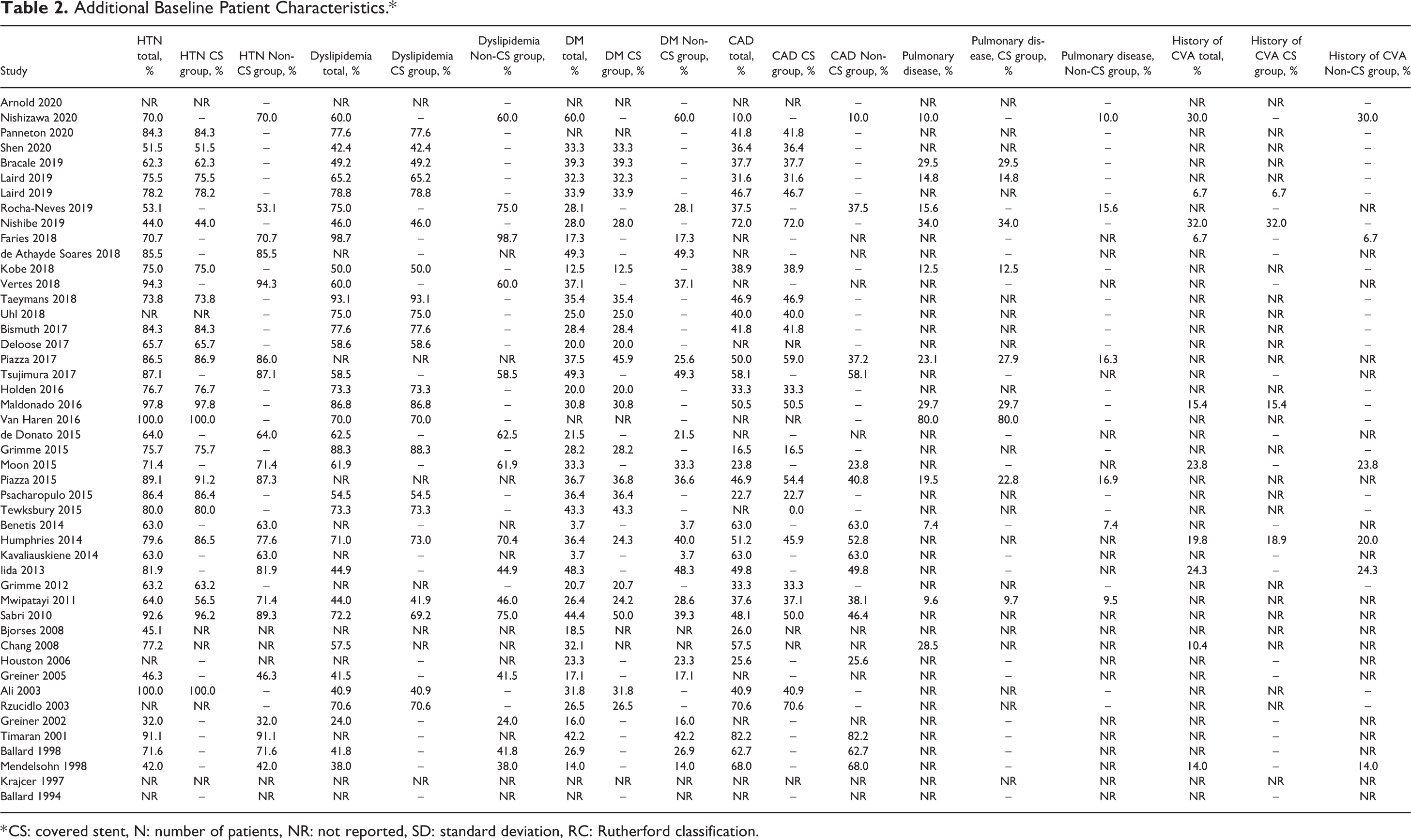
* CS: covered stent, N: number of patients, NR: not reported, SD: standard deviation, RC: Rutherford classification.

This chart presents the main baseline characteristics among the covered versus non-covered stent groups.
Important Lesion Characteristics.*
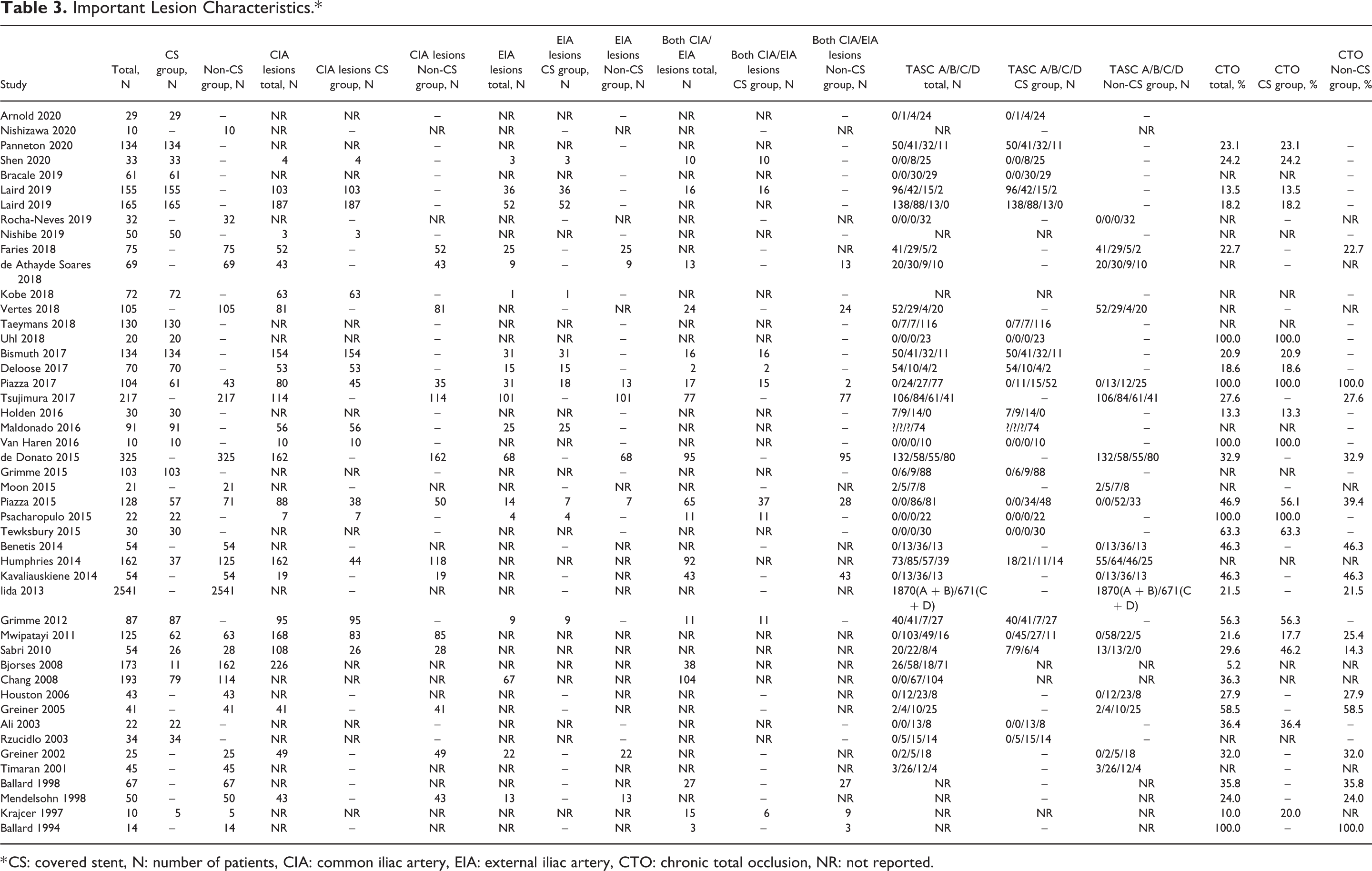
* CS: covered stent, N: number of patients, CIA: common iliac artery, EIA: external iliac artery, CTO: chronic total occlusion, NR: not reported.
Periprocedural (30-Day) Outcomes
The procedure was technically successful in almost all cases in both groups [99% (95% CI: 98%-100%)], while technical success was 99% (95% CI: 97%-100%) and 100% (95% CI: 99%-100%) among the non-covered and covered stent groups, respectively. Overall perioperative complications, including access site hematoma, iatrogenic perforation, pseudoaneurysm formation, acute stent thrombosis, and/or distal embolization were observed in 8% (95% CI: 6%-11%) of all cases, while 7% (95% CI: 4%-11%) of the non-covered stent cases and in 8% (95% CI: 5%-11%) of the covered stent cases among the individual included studies experienced adverse events perioperatively. Ten studies investigating 30-day mortality among 719 (covered stent group: 383 vs non-covered stent group: 139) patients undergoing endovascular therapy for AIOD reported 7 deaths, 4 for the covered stent group and 1 for the non-covered stent group. Details regarding the periprocedural outcomes are presented in Supplementary Table 3.
Long-Term Outcomes
Overall re-occlusion/restenosis (>50% vessel diameter stenosis) occurred in 16% (95% CI: 12%-21%) and in 8% (95% CI: 6%-11%) of the patients in the non-covered and covered stent groups, respectively. The reported primary patency rates for the non-covered and covered stent group during follow up, were 84% (95% CI: 80%-87%) vs. 92% (95% CI: 89%-94%) respectively, while surgical or endovascular re-intervention was required in 10% (95% CI: 6%-14%) non-covered stent cases and in 6% (95% CI: 4%-9%) of covered stent cases, among the individual included studies. Major amputation was required in approximately 1% (95% CI: 0%-1%) of all the patients (non-covered stent group: 2%; 95% CI: 1%-4% vs covered stent group: 0%; 95% CI: 0%-1%). The all-cause mortality rate during the average follow up of the included studies was 7% (95% CI: 3%-12%) and 9% (95% CI: 3%-18%) for the non-covered and covered stent group, respectively. Details regarding the relative and absolute frequencies of outcomes during follow up can be found in Supplementary Table 3.
Primary Patency Stratified by TASC Classification
Overall, 8 studies compared the primary patency of covered vs non-covered stents regardless of TASC classification. Two studies had an average follow up of 12 months, while 6 studies reported outcomes during a follow up ranging between 12 and 24 months. Primary patency was statistically significant superior among the cases treated with covered stents vs non-covered stents (Covered stent group: N = 297/338 vs Non-covered stent: N = 465/611; OR: 2.47; 95% CI: 1.01-6.01; p = 0.047). In Figure 3 the forest plot of the comparison between covered and non-covered stents, in terms of primary patency is presented. 15 studies reported primary patency rates separately based on the TASC classification of the target lesion. Combining TASC C/D lesions together 12 studies reported 92% (95% CI: 89%-95%) primary patency in the covered stent group, among the studies with available data, while 7 studies reported 75% (95% CI: 60%-88%) primary patency for cases treated with non-covered stents. Six studies investigating the outcomes of non-covered stents in TASC D lesions reported 76% (95% CI: 60%-89%) primary patency, whereas the primary patency of covered stents was 92% (95% CI: 88%-95%) among 8 studies investigating TASC D lesions. Four studies with a mean follow up greater than 12-months compared covered vs non-covered stents for TASC C/D lesions in terms of patency (Covered stent group: N = 239/269 vs Non-covered stent: N = 165/259; OR: 4.50; 95% CI: 2.74-7.39; p < 0.001), demonstrating statistically better patency rates among the lesions treated with covered stents (Figure 4). Details about the relative and absolute frequencies of primary patency rate stratified by TASC classification are presented in Supplementary Table 4.

This forest plot presents the comparison between covered and non-covered stent groups in terms of primary patency.

This forest plot presents the comparison between covered and non-covered stent groups in terms of primary patency, including only TASC C/D lesions.
Discussion
This study was a meta-analysis and systematic review of 47 studies, including subjects that underwent endovascular therapy for AIOD with either covered or non-covered (balloon expandable stents, self-expanding) stents. This study demonstrated favorable technical success rates in both groups, with only a few periprocedural complications. Long-term analysis revealed 8% and 16% re-occlusion/restenosis rates among the covered stent group and the non-covered stent group, respectively. Among the individual studies that reported primary patency rates, the covered stent group exhibited 92% primary patency rate during an average follow up of 24.3 months, whereas the non-covered stent group primary patency was 84%. Sensitivity analysis including the double arm studies showed statistically significant better patency rates among the covered vs non-covered stents, even when including only the more complex TASC C/D lesions.
Approximately 30% of patients with symptomatic PAD have AIOD. 13 Endovascular therapy has been increasingly applied for AIOD, with primary stenting constituting the primary treatment option for complex entities. However high-level evidence from randomized controlled trials has been limited and as such it remains unclear, which is the most optimal stent graft for AIOD. A retrospective post hoc analysis of the “Covered versus Balloon Expandable Stent Trial” randomized trial (COBEST) assessed the long-term outcomes of covered vs BMS for AIOD, over a time interval of 60 months. 14 The study demonstrated 74.7% and 62.5% 60-month primary patency for the covered stent and BMS group respectively. 14 Additionally, a subgroup analysis of the study showed clear survival benefit of covered stents over BMS in TASC C/D lesions (HR: 8.65; 95% CI: 54.25-75.75; p = 0.003). 14 Although they were single-arm studies, more recent analyses confirmed previous reports supporting the utilization of newer covered stents for the treatment of anatomically complex iliac artery disease.23,24
The “Atrium iCAST Iliac Stent Pivotal Study” (iCARUS), was a multicenter study enrolling 152 subjects with AIOD treated with covered stents at several sites in USA and Germany. 23 The authors reported that covered stents are safe and effective for AIOD, demonstrating 96.4% 9-month primary patency (no revascularization/ bypass/ target limb amputation). 23 Similarly, an analysis from the BOLSTER multicenter study provided satisfactory 9-month clinical outcomes, in terms of target lesion revascularization with newer balloon-expandable covered stents. 24 Additionally, a prospective single arm multicenter study (VBX FLEX study) by Bismuth et al. studied 134 patients with 213 iliac lesions undergoing endovascular therapy with balloon expandable covered stents. 5 The study demonstrated exceptional technical success (100%), with only 3 patients experiencing a major adverse event during 9-month follow up. 5 Furthermore, this study showed that no covered stents exhibited a discernable change in length after final deployment as determined by independent core laboratory, providing significant evidence that using covered stents for AIOD is feasible and safe. 5 Similarly, based on the results of this meta-analysis, which summarized all available literature, covered stents exhibited favorable technical success and durable patency over time, with relatively low re-intervention rates over an average follow up of 24.3 months among the individual included studies.
Bracale et al. studied 61 patients with symptomatic TASC C and D AIOD treated with VIABAHN stents (W.L. Gore and Associates, Flagstaff, Ariz) 22 and reported 96.7% technical success and 94.9% 36-month primary patency rate. 22 Thus, the authors suggested that covered stents constitute a reasonable treatment option for complex AIOD, promising favorable efficacy and long-term patency. 22 In our study, a sensitivity analysis including only TASC C/D lesions, demonstrated clear superiority of covered stents over non-covered stents, in terms of patency. Although only a few direct comparisons between covered vs non-covered stents were made, the pooled estimates of adverse events during follow up were clinically better among the covered stent group. Therefore, this study, summarizing all available literature, could support the use of covered stents as primary treatment for atherosclerotic disease at the aortoiliac segment. The benefits of covered stents are likely attributed to its design, which provides a seal for friable atherosclerotic plaques and an impermeable barrier to neointima formation, limiting the risk for distal embolization and in-stent restenosis respectively. 61 However, in the absence of high-quality evidence additional research is warranted in order to validate our results and determine which would be the most optimal stent type for AIOD in terms of efficacy and cost-effectiveness.
Limitations
The results of the present study should be interpreted in the context of several limitations. First, most of the data was provided by real-world studies and as such limited by potential selection bias. Third, due to the heterogeneity in reported outcomes, only limited direct comparisons could be made between covered vs non-covered stents. Additionally, it should be taken into account that most of the pooled estimates were unadjusted risk estimates, indicating that the patient, procedural, and study characteristics might have confounded the outcomes. Moreover, due to lack of data, no direct comparisons were made based on the technique utilized to treat AIOD (i.e., kissing stents, covered endovascular reconstruction of the aortic bifurcation etc.) in terms of short-and long-term outcomes. Further prospective studies are warranted to estimate the annual risk of restenosis/occlusion for covered vs non-covered stents, providing direct comparisons to help identify the most optimal treatment modality for patients with AIOD.
Conclusion
Covered stent grafts, originally intended for aneurysms or arterial ruptures, have commonly been used for AIOD. This study, summarizing all available literature, demonstrated that covered stents are safe and effective when utilized for the treatment of AIOD. This study also provided evidence that covered stents were associated with statistically significant higher odds of primary patency, even when treating complex lesions (i.e. TASC C/D). However, considering that most data were provided by real-world studies, additional high-quality comparative analyses (between covered stents vs BMS and between several types of covered stents) are needed in order to determine the most optimal treatment modality for AIOD.
Supplemental Material
Supplemental Material, sj-pdf-1-ves-10.1177_15385744211010381 - Covered Stents for Endovascular Treatment of Aortoiliac Occlusive Disease: A Systematic Review and Meta-Analysis
Supplemental Material, sj-pdf-1-ves-10.1177_15385744211010381 for Covered Stents for Endovascular Treatment of Aortoiliac Occlusive Disease: A Systematic Review and Meta-Analysis by Austin Mallory, Stefanos Giannopoulos, Paul Lee, Damianos G. Kokkinidis and Ehrin J. Armstrong in Vascular and Endovascular Surgery
Supplemental Material
Supplemental Material, sj-pdf-2-ves-10.1177_15385744211010381 - Covered Stents for Endovascular Treatment of Aortoiliac Occlusive Disease: A Systematic Review and Meta-Analysis
Supplemental Material, sj-pdf-2-ves-10.1177_15385744211010381 for Covered Stents for Endovascular Treatment of Aortoiliac Occlusive Disease: A Systematic Review and Meta-Analysis by Austin Mallory, Stefanos Giannopoulos, Paul Lee, Damianos G. Kokkinidis and Ehrin J. Armstrong in Vascular and Endovascular Surgery
Supplemental Material
Supplemental Material, sj-pdf-3-ves-10.1177_15385744211010381 - Covered Stents for Endovascular Treatment of Aortoiliac Occlusive Disease: A Systematic Review and Meta-Analysis
Supplemental Material, sj-pdf-3-ves-10.1177_15385744211010381 for Covered Stents for Endovascular Treatment of Aortoiliac Occlusive Disease: A Systematic Review and Meta-Analysis by Austin Mallory, Stefanos Giannopoulos, Paul Lee, Damianos G. Kokkinidis and Ehrin J. Armstrong in Vascular and Endovascular Surgery
Supplemental Material
Supplemental Material, sj-pdf-4-ves-10.1177_15385744211010381 - Covered Stents for Endovascular Treatment of Aortoiliac Occlusive Disease: A Systematic Review and Meta-Analysis
Supplemental Material, sj-pdf-4-ves-10.1177_15385744211010381 for Covered Stents for Endovascular Treatment of Aortoiliac Occlusive Disease: A Systematic Review and Meta-Analysis by Austin Mallory, Stefanos Giannopoulos, Paul Lee, Damianos G. Kokkinidis and Ehrin J. Armstrong in Vascular and Endovascular Surgery
Footnotes
Declaration of Conflicting Interests
The author(s) declared the following potential conflicts of interest with respect to the research, authorship, and/or publication of this article. Dr. Armstrong is a consultant to Abbott Vascular, Boston Scientific, Cardiovascular Systems Incorporated (CSI), Gore, Medtronic, Philips, and PQ Bypass.
Funding
The author(s) received no financial support for the research, authorship, and/or publication of this article.

Supplemental Material
Supplemental material for this article is available online.
References
Supplementary Material
Please find the following supplemental material available below.
For Open Access articles published under a Creative Commons License, all supplemental material carries the same license as the article it is associated with.
For non-Open Access articles published, all supplemental material carries a non-exclusive license, and permission requests for re-use of supplemental material or any part of supplemental material shall be sent directly to the copyright owner as specified in the copyright notice associated with the article.
