







Abstract
The objective of this study was to determine whether reaching for objects with varying levels of preference associated with them elicited influenced motor control in a reaching task. Forty healthy adults were asked to reach for seven different types of candy, which they ranked by personal preference from being the most preferred to the least preferred. In this repeated measures design, data were analyzed on 39 participants who tended to demonstrate greater movement efficiency in movement time and movement units when reaching for candy in which they associated with greater preference (p < .0167). Although no differences were found between conditions with peak velocity and percentage of movement time to peak velocity (p > .0167), these dependent variables appeared to trend in the direction of similar movement efficiency. Therapists can use this knowledge to help guide clinical reasoning when designing treatment plans and approaches. Future research is needed to further examine intensity along the continuum of preference and its implications for occupational therapy practice.
Meaning is a multidimensional concept of great importance to the profession of occupational therapy. When a person ascribes meaning to an occupation, it can lead to enhanced motor performance. This is a fundamental assumption within the profession of occupational therapy and has been corroborated by numerous research findings (Hartman, Miller, & Nelson, 2000; Holubar & Rice, 2006; Kircher, 1984; Lough, Rice, & Lough, 2012; Murphy, Trombly, Tickle-Degnen, & Jacobs, 1999; Rice, Davies, & Maitra, 2009; Rice & Renock, 2006; Sietsema, Nelson, Mulder, Mervau-Scheidel, & White, 1993; Wu, Trombly, & Lin, 1994). The findings of these studies have direct implications for occupational therapy practice, where it is the desire of the therapist and the client for the client to be successful at a variety of occupations. However, what is meaning? And how does one ascribe it? How intense does the level of meaning have to be to elicit a greater motor performance?
In their Conceptual Framework for Therapeutic Occupation (CFTO), Nelson and Thomas (2003) describe meaning as the interpretation one makes out of the occupational form (or context). Meaning is a subjective experience that cannot be directly accessed or manipulated by others. The occupational form, however, is external to the person and may be altered by outsiders. How a client ascribes meaning is dependent on the interaction between his or her developmental structure (or unique qualities) and the physical and sociocultural aspects of the occupational form. Due to these variations, individuals may ascribe different meanings to the same occupational form (Nelson & Thomas, 2003).
Although one can never fully predict what kind of meaning a person will assign to an occupational form (i.e., objects), it is the objective of the occupational therapist to synthesize the occupational form based on his or her knowledge of the client’s developmental structure. This is done in the hope that meaning will occur, and the client will experience what Nelson and Thomas (2003) describe as purpose, or a desire to act. Although meaning is a subjective experience, the resulting motor performance (as a result of being exposed to a specific object) is often assumed to be similar in a group of individuals who share something in common (e.g., college students, healthy adults, persons with cerebral vascular accident (CVA) or traumatic brain injury (TBI); Rice & Renock, 2006). Moreover, it has also been assumed that the more an object is liked, or desired, the more efficient the resulting motor performance (Rice & Renock, 2006). Objects that have been examined under this premise include occupationally embedded exercise (also known as purposeful or materials-based activity) versus rote exercise, preference, choice versus no choice, hands-on learning versus demonstration, keeping versus not keeping, immediate versus prolonged exposure, and contextual relevance and ownership.
In her seminal research, Kircher (1984) studied the effect of purposeful versus non-purposeful occupation among 26 healthy adult females using a counterbalanced design. Purposeful occupation was operationalized as jumping with a rope, and non-purposeful occupation as jumping in place. Each participant was attached to an electrocardiogram (EKG) during the experiment. Using the Borg Scale of the Rate of Perceived Exertion (RPE), participants were asked to stop jumping once they felt they were working very hard (a Level 17 on the scale). Results indicated that participants’ heart rates at a predetermined RPE were significantly higher when jumping with a rope than jumping without one. In other words, when engaged in purposeful occupation compared with non-purposeful occupation, a higher heart rate was able to be obtained before the participants felt like they were working very hard.
Wu, Wong, Lin, and Chen (2001) investigated the influence of visual spatial neglect, side of lesion, personal preference, and functional goals on motor control of reaching for a beverage in 27 persons with stroke. Wu and her colleagues found that although functional goals (defined by reaching for a beverage and taking a drink versus reaching for a beverage and not taking a drink) and personal preference (determined by verbal report as well as actually choosing to reach for a specific beverage) influenced movement time and reaction time, the influence of visual spatial neglect and side of lesion influenced overall motor performance in a more robust fashion.
LaMore and Nelson (1993) recruited 22 adults with mental disabilities to participate in a task of painting figurines. In one condition, participants were given a choice of which figurine to paint whereas in another condition, participants were not given a choice in which figurine to paint. This was done in a counterbalanced fashion so that each participant experienced both conditions and acted as his or her own control. The researchers counted the number of times the participants dipped the paint brush into the paint as well as recorded the time the participant painted. Results indicated that when given a choice, participants painted more than when not given a choice.
More recently, Lough et al. (2012) examined the effect of choice versus no choice during a coloring task in children with autism spectrum disorder. Choice was operationalized as the children were provided two conditions hinging on being able to choose, or not being able to choose which template, each with its own version of a “smiley” face, to color. Results showed that when the children had a choice, they colored longer and used more variety of colored markers compared with the no-choice condition.
Holubar and Rice (2006) studied the effects of context (familiar or unfamiliar) and ownership (object owned by the participant or owned by the researcher) on quality of movement during a reaching and placing task involving 32 adult women. The familiar context was the participant’s home and the unfamiliar context was the research laboratory. The object was a mug that was either owned by the participant or the researcher, the size and shape of which were similar to each other. The results indicated that participants’ movements were statistically significantly more efficient (indicated by less movement time) when reaching for their own mug regardless of the context. Movement units were statistically significantly fewer when participants reached for their own mug in the lab setting compared with at home. No significant differences were found on the factor of context.
Rice and Renock (2006) examined the effects of preference on quality of reach among 43 healthy adult females. Participants ranked magazines from the most to the least preferred and were then asked to reach for the middle of three magazines from a “line up” that contained their most preferred, least preferred, and neutrally preferred choices. The results were that the quality of movement was less efficient when reaching for a neutrally preferred magazine in comparison with a least preferred magazine as indicated by a greater movement time and more movement units. No differences in quality of movement were found between reaching for one’s most and least preferred magazines.
The overarching theme of the studies mentioned above is that they use contrasting objects with the intention that certain conditions will elicit greater meaning (and therefore better motor performance) than others. The range of objects used, and the variety of dependent variables measured, across these studies suggests the pervasiveness of meaning to enhance occupational performance in many ways. Generally, the studies mentioned above support this idea; however, the majority of objects were chosen by the researchers. Perhaps these preselected objects did not elicit enough of, or the sort of meaning the researchers expected for every participant. This may explain why some participants performed better in the condition that was predicted to be less meaningful.
Besides the Rice and Renock (2006) study, participants’ preferences for the objects presented to them were not taken into account. Rice and Renock (2006) directly measured preference for a variety of magazines by asking participants to rate them on a 1 to 10 scale, before engaging in a reaching task. It can be assumed that liking or not liking something can affect the intensity of meaning one feels toward an object or situation. A particular preference for an occupational form can therefore affect one’s motor performance. Further investigation is needed to examine the role of preference on meaning and motor performance. If many of the studies above assumed a greater liking for a particular occupational form, can just as strong a disliking for an occupational form also affect motor performance? The disliking of an occupational form could occur for a number of reasons, for example, level of perceived risk, fear, and disgust (Fuller, Thomas, & Rice, 2006; Rice & Thomas, 2000; Thomas & Rice, 2002). Perhaps these negatively associated situations could also contribute to one’s meanings and subsequent motor performance. Interestingly, Rice and Renock (2006) found no differences in the efficiency of participants’ movements when reaching for magazines they liked the most (positive association) and those they liked the least (negative association). These results do not coincide with the abovementioned assumption that the more an object is liked, or desired, the more efficient the resulting motor performance.
The purpose of this study is to build on prior research into participant preference. In the majority of prior research, participant preference for the experimental condition was assumed. In addition, this current study seeks to investigate the influence that personal preference has on objects beyond magazines (Rice & Renock, 2006). Participants in this study will be asked to rate how much they like or dislike a given occupational form. By measuring a participant’s preference, important information can be gathered about how both ends of the positive/negative continuum affect a person’s intensity of meaning, but little is known about the motor control response to negatively associated items. Therefore, the hypothesis of this study is that the reach movement kinetics and kinematics will be more efficient when reaching for candy with great preference than when reaching for candy with less associated preference.
Method
Participants
A sample of convenience was used to recruit participants from the midwest portion of the United States. Participants (n = 40) were healthy adult men and women ages 18 to 51 years (M = 25.5 years, SD = 5.6 years) and consisted of college students, faculty members, and community members of either hand dominance. Recruitment strategies involved word of mouth, e-mail, and flyers posted on local bulletin boards. Exclusion criteria were any orthopedic or neurological impairment that would adversely affect performance in the task, and/or peanut allergies.
Instrumentation
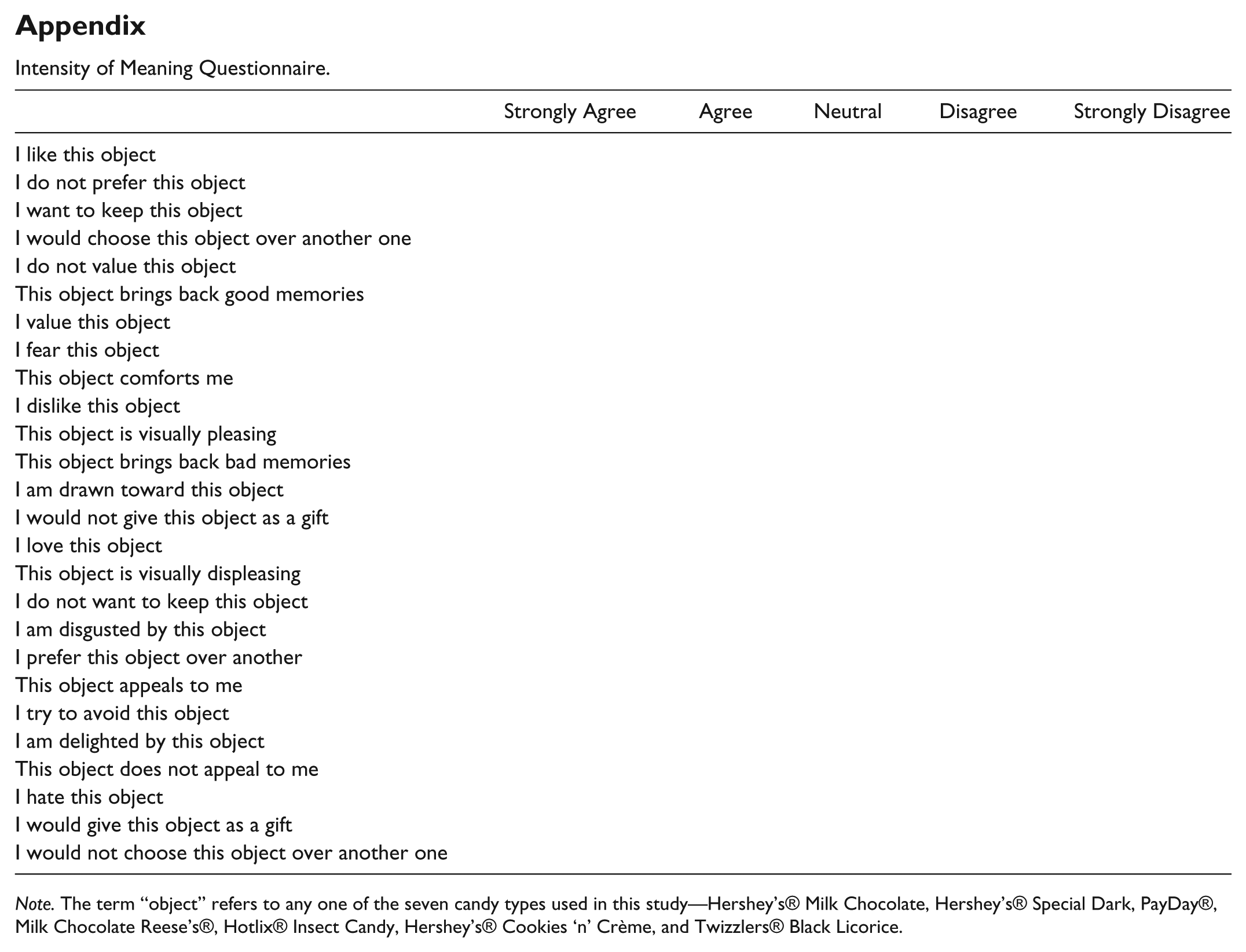
Prior to this study, a pilot survey was conducted to gather a variety of opinions about preferences for different types of candy. A survey consisting of 26 questions using a Likert-type scale was developed specifically for this study (see Appendix). Questions were designed to estimate the intensity of meaning associated with seven types of candy. Nine occupational therapy and physical therapy students and faculty at the sponsoring university took part in the pilot survey. Faculty members served as a panel, providing expert opinion about the survey design. A measure of kurtosis of the survey results revealed a good dispersion of preferences for the different types of candy among the participants. Internal consistency using Cronbach’s coefficient alpha (α; Cronbach, 1951) was found to be between .86 and .954. In general, a coefficient that approaches .90 is indicative of high internal validity (Kielhofner, 2006). This suggests that the level of agreement between question items for each of the seven types of candy was high.
Apparatus
Three dimensional kinematic and kinetic data were collected at 100 Hz using Qualysis Track Manager Version 2.3 integrated with four ProReflex cameras. The system recorded the x-, y-, and z-positional coordinates of reflective makers attached to bony landmarks on the participants’ dominant upper extremities.
Dependent Variables
Based on the results and feedback gathered from the pilot survey, intensity of meaning was measured on a 26-question Likert-type scale (see Appendix). The types of candy that were used in this study were Hershey’s® Milk Chocolate, Hershey’s® Special Dark, PayDay®, Milk Chocolate Reese’s®, Hotlix® Insect Candy, Hershey’s® Cookies ‘n’ Crème, and Twizzlers® Black Licorice. Although there was some variation in size, shape, and mass of the individual types of candies, all were relatively similar in that they approximated “Bite Sized” pieces (Figure 1). Each question associated with the candy had five potential responses including strongly agree, agree, neutral, disagree, and strongly disagree. For positively worded statements, a response of strongly agree indicated a highly positive intensity of meaning whereas for negatively worded statements, a response of strongly agree indicated a highly negative intensity of meaning. These responses were coded using a numerical system and converted into intensity of meaning scores.
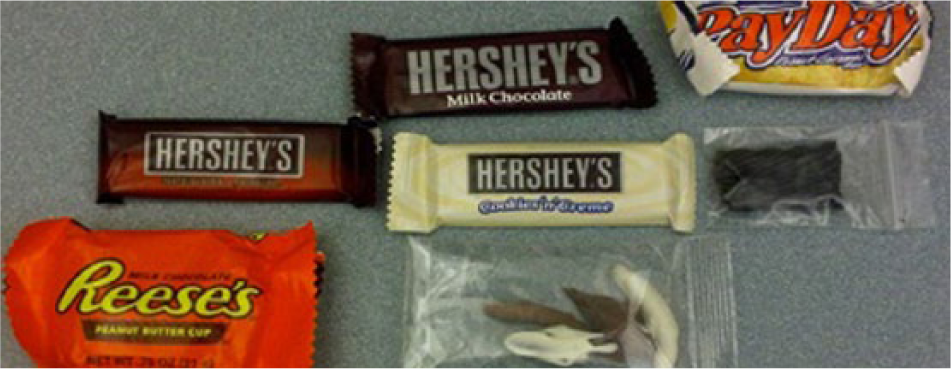
Candies.
Kinetic and kinematic data were measured in terms of movement time, peak velocity, percentage of movement time to peak velocity, and movement units.
Statistical Analysis
This study used a randomized repeated measures research design using focused contrasts. Tests of normality and skewness (Kolmogorov–Smirnov, D’Agostino–Pearson, and Shapiro–Wilk) were statistically significant at α = .05 for all kinetic and kinematic dependent variables. Therefore, one-tailed Wilcoxon Signed Ranks tests for dependent measures were used to compare the differences between the most preferred and the neutrally preferred candies, between the most preferred and the least preferred candies, and finally between the neutrally preferred and the least preferred candies. Because of the three statistical comparisons for each dependent variable, alpha was set at .0167 to control for Type 1 error. Effect sizes were also calculated for each comparison. According to Cohen (1988), .2 represents a small effect size, .5 represents a medium effect size, and .8 represents a large effect size.
Randomization
The order of presentation for each candy bar was organized in a 7 × 7 Latin square design to control for any sequence effects. Each participant was randomly assigned, using permutated blocks via a computer program (RAPB, Version 1.0, X), to one of the seven possible orders of presentation groups.
The preference questionnaires contained identical items for each of the seven candy types used in the study. However, question orders were randomly assigned according to candy type such that each participant encountered the questions in a different order 7 times.
Procedure
This study was approved by the sponsoring university’s Biomedical Institutional Review Board prior to commencement. All participants gave informed consent at the data collection site before taking part in the study. Data collection occurred from October 2011 through January 2012. Reflective markers were placed on bony landmarks of the participants’ dominant upper extremities including the sternum, acromion process, mid-humerus, lateral epicondyle of the humerus, mid-forearm, ulnar styloid process, and the metacarpophalangeal joint of the third digit. Participants were randomly assigned to an order of presentation group and based on the order of presentation, one of the seven candy types was placed on the table in the participant’s line of reach. Participants were asked to sit comfortably at a table and to place their dominant hand on a Big Red Switch™ (also located on the table) and when the investigator said “go,” the participant was instructed to reach for the candy, grasp it, and bring it back to the Big Red Switch™. The candy was located 40 cm from the edge of the table directly in front of the participant and was 35 cm from the center of the Big Red Switch™ (see Figure 2). As participants reached for the candy, motion cameras captured the positions of the markers on their dominant upper extremities. After reaching for each type of candy, participants filled out a corresponding hard copy of a 26-question Likert-type scale to measure the level of meaning as well as its intensity toward the particular candy bar they just encountered. This procedure was repeated until each participant reached for and filled out the questionnaire for all seven types of candy represented. Each session was approximately 30 min long. At the end of the session, the participants had the option of keeping the candy they reached for.
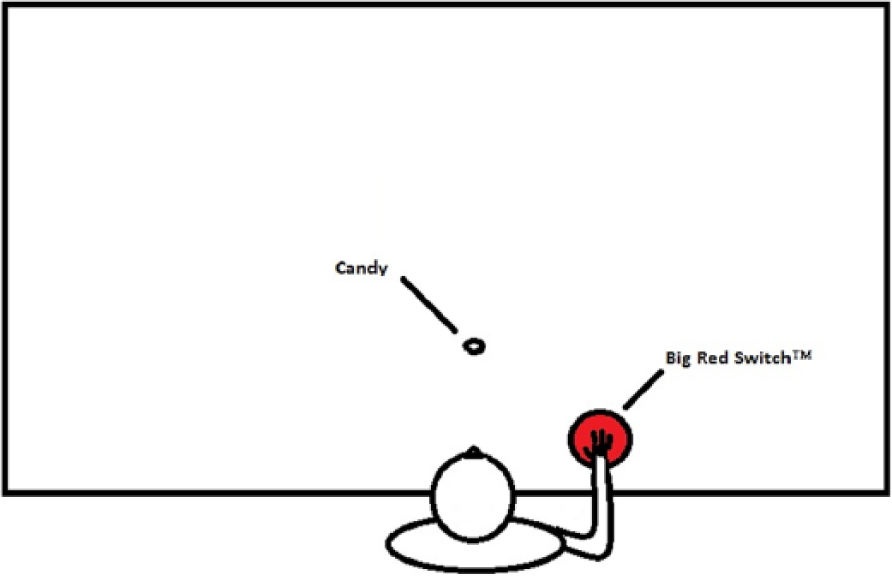
Research set-up for right-hand dominant person.
Results
Forty participants took part in the study. Data from one participant were removed due to instrumentation failure. Data for the remaining 39 participants were reduced using Visual 3D Version 4.87 and interpolated using a max gap fill of 10 samples. Data were smoothed using a dual pass Butterworth filter with a cut-off frequency of 10 Hz.
Data from the preference questionnaires were coded and converted into intensity of preference scores. Only scores from participants’ most preferred (scores of 4 or 5), least preferred (scores of 1 or 2), and neutrally preferred (score of 3) candies were analyzed (see Table 1). That is, only three candies for each participant were included in the analysis—a participant’s most preferred, neutrally preferred, and least preferred candies.
Frequency of the Most, Neutral, and the Least Preferred Candies.
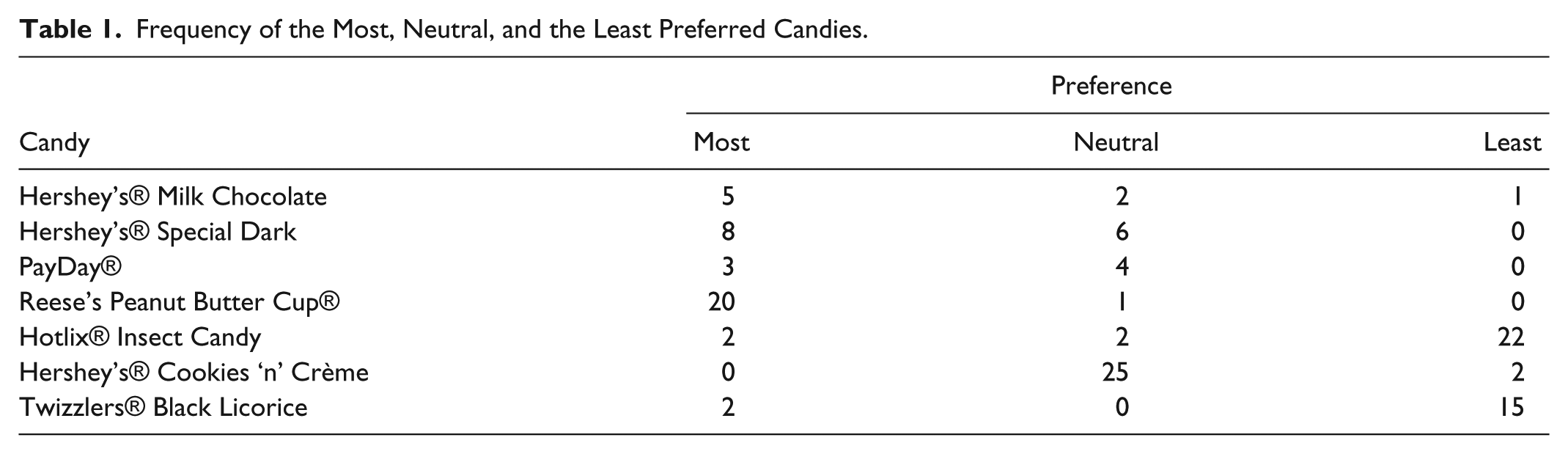
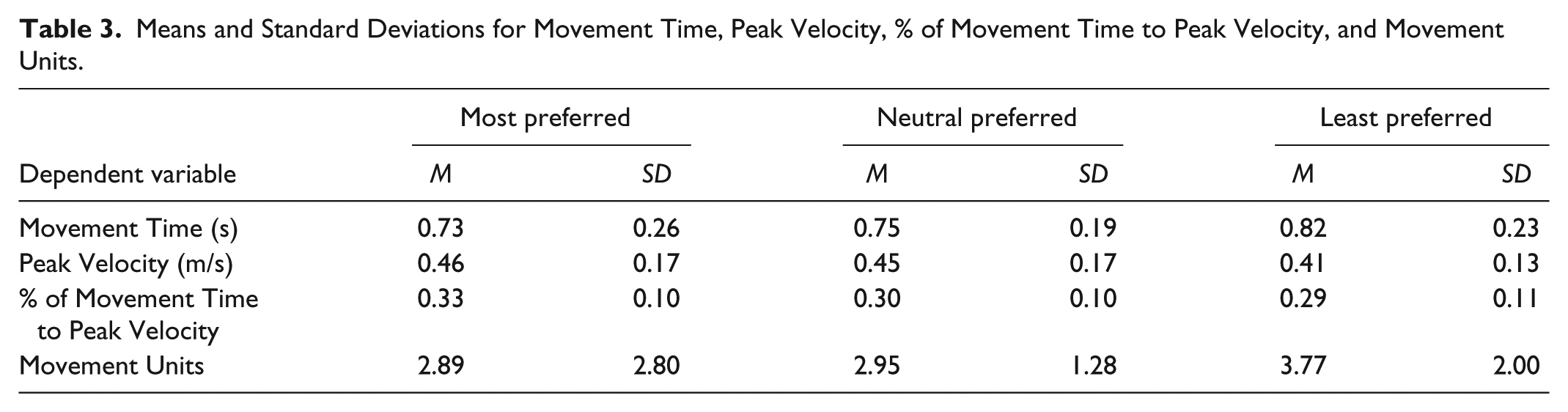
Table 2 presents the test statistic, significance level, and the effect sizes, and Table 3 displays the means and standard deviations for each comparison. There was no significant difference in movement time when comparing the most preferred and the neutral condition, but there was a significant difference between the most and the least preferred comparisons and between the neutral and the least preferred conditions. The effect sizes for the latter two comparisons were small. When considering peak velocity, there was no significant difference for any of the three comparisons; however, similar to the movement time, effect sizes were small for the latter two comparisons. For percentage of movement time to peak velocity, there were no significant differences for any of the three comparisons, but there were small effect sizes for the first two comparisons (i.e., between the most and neutral comparisons and between the most and the least preferred comparisons). There was no significant difference in movement units when comparing the most preferred and the neutral conditions, but there was a significant difference between the most and the least preferred comparisons and between the neutral and the least preferred conditions. The effect sizes for the latter two comparisons were small.
Wilcoxon Rank Scores, p Values, and Effect Sizes.
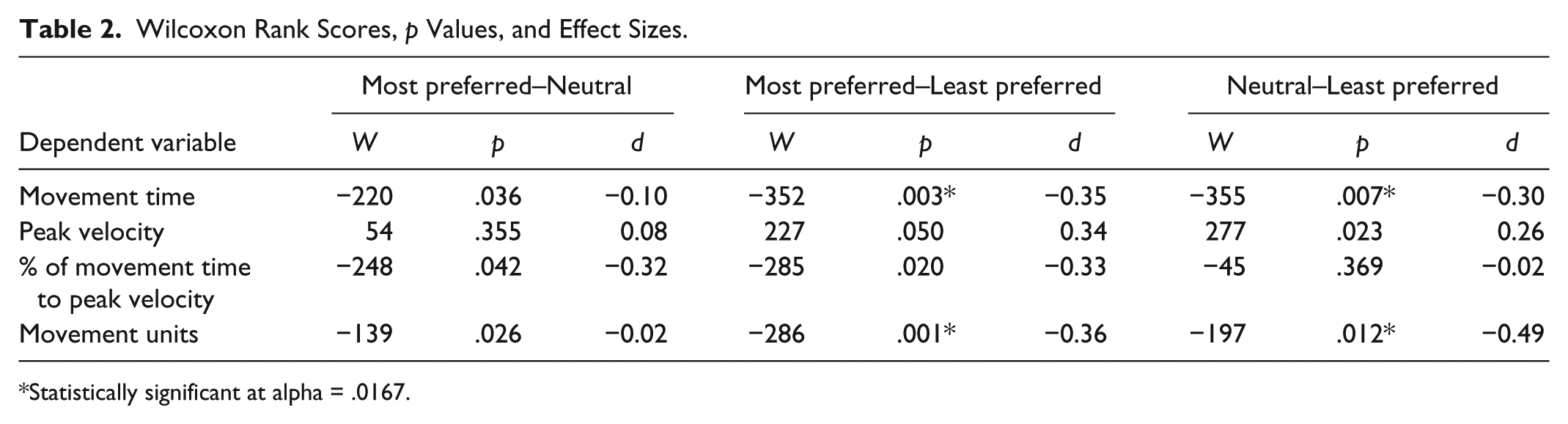
Statistically significant at alpha = .0167.
Means and Standard Deviations for Movement Time, Peak Velocity, % of Movement Time to Peak Velocity, and Movement Units.
Discussion
In accordance with emerging research, this research dealt with exploring the influence that personal preference has on the motor control actions when reaching for candies with varying levels of associated personal preference. The results of this study partially support the hypothesis in that there was significantly greater movement efficiency in terms of movement time and movement units, particularly when reaching for neutrally preferred candies over the least preferred candies and the most preferred candies over the least preferred candies. Although not reaching statistical significance, the relative magnitude of the means in the most preferred versus neutrally preferred condition demonstrated a trend toward being more efficient than in the least preferred versus neutrally preferred condition. This is a similar phenomenon to the results of Rice and Renock (2006) in which no significant differences were found between conditions with regard to percentage of movement time to peak velocity.
There have been several studies supporting the premise that items associated with more preference, or meaning, have resulted in more efficient movement (Lamore & Nelson, 1993; Lough et al., 2012; Rice et al., 2009; Rice & Renock, 2006; Wu et al., 2001). The significant differences found in the current study corroborate the general findings in the aforementioned studies in that conditions associated with greater meaning yield greater movement efficiency. A common assumption in these studies is that participants made their choices based on positive associations they had with the objects of choice and preference. In the current study, all significant comparisons were in line with this where conditions associated with greater preference were more efficient than those conditions with less preference. The unique findings for this study hinge on including conditions that are specifically identified as being the least preferred. It is plausible to assume that the least preferred candies may have been less motivating compared with those that were neutrally preferred, causing participants to be more careless in their reach. For example, black licorice was one of the least preferred candies and perhaps participants felt more apathetic toward reaching for this candy than a neutrally preferred candy such as Hershey’s® Cookies ‘n’ Crème.
Last, other participants may have experienced curiosity with a particular candy type they were less familiar (or experienced) with causing their reach to be less automatic and efficient than a candy type in which they were more familiar. Participants may have still been trying to process information or form an opinion about those novel candy types while they were reaching, rather than being focused on the reaching task itself. This could have potentially drawn mental processes away from the reaching task and reduced the quality of reach movement. Holubar and Rice (2006) have provided evidence for this phenomenon by establishing that when participants reach for their own mug (a familiar object), the efficiency of their reach movement (in terms of movement time and movement units) is greater than when reaching for the researcher’s mug (an unfamiliar object) regardless of the context.
In summary, there are several plausible reasons one might put forward as to why objects with greater preference result in greater movement efficiency. It can be argued, however, that the intensity of meaning associated with an object may not influence the motor control of a reach so much as the actual preference one has for that item. Not only do individuals have unique preferences for particular items, but associated with these preferences is a degree of intensity associated with that level of preference. It is possible to intensely like one item while intensely dislike another item. That is to say that preference can be thought of as a continuum with non-preferred items on the low side and preferred items on the high side. The closer to the polar ends of this preference continuum, the greater the intensity for the non-preferred and preferred items, respectively. It may be pragmatic, therefore, that during clinical reasoning, occupational therapists consider the individual client’s preference when designing treatment plans.
A limitation of this study is that the candies were not of equal size. Quality of reach movement is dependent on target size (Fitts & Deininger, 1954; Marteniuk, MacKenzie, Jeannerod, Athenes, & Dugas, 1987), and there was variability in the size and shape of the array of candies in this study. It is possible that this variability could have introduced a confounding error as smaller targets commonly elicit less efficient movement quality. This, however, seems unlikely in that the packaging of the most preferred object (Reese’s Peanut Butter Cup) and the least preferred object (Hotlix Insect Candy) were nearly identical in size. Another limitation is the difficulty in anticipating what is meaningful to different individuals. The researchers chose different types of candy in the attempt to elicit meaning and varying levels of intensity of meaning. It is possible that candy (in general) was not meaningful to some individuals because they do not eat it. It is also possible that although an individual may choose a type of candy over another, or want to keep the candy, he or she responds with negative meaning because of nutritional habits. It should also be noted that some individuals had never tried the candy they were reaching for so rating the level of intensity of meaning was difficult. The authors aimed to choose candy that elicited strong positive and negative meaning by performing a pilot study with a small sample of individuals. Also, caution must be taken when applying these results to populations other than healthy adults as the findings may not be generalizable to other groups. A final limitation includes the fact that the artificial nature of the lab may have caused participants reach movements to differ from those used in their natural environment.
Future research focusing on the varying intensity of meaning should be conducted with different populations. This sample was composed of healthy individuals. A future research study could apply similar methodology to a sample of individuals who are recovering from a cerebral vascular accident, who have been diagnosed with arthritis, or who have had orthopedic surgery such as tendon repair in the hand. Efficient reach movements will be part of the therapeutic rehabilitation of these individuals and a study showing the relationship between varying levels of personal preference and motor performance is important to consider.
Conclusion
This study examined the effect of intensity of meaning on the efficiency of a reach movement in healthy adults, while reaching for candies of varying preferences. Preference was determined by analyzing the survey responses provided by participants with regard to each type of candy involved in the study. It was found that candies associated with greater preference, in general, resulted in greater movement efficiency. In other words, the meaning that participants ascribed to the candies ultimately influenced the way in which they reached for them. The results demonstrate that negatively associated objects can influence the quality of participants’ motor performance. Further research is needed to corroborate these findings to support the use of such objects in therapy.
Footnotes
Appendix
Intensity of Meaning Questionnaire.
| Strongly Agree | Agree | Neutral | Disagree | Strongly Disagree | |
|---|---|---|---|---|---|
| I like this object | |||||
| I do not prefer this object | |||||
| I want to keep this object | |||||
| I would choose this object over another one | |||||
| I do not value this object | |||||
| This object brings back good memories | |||||
| I value this object | |||||
| I fear this object | |||||
| This object comforts me | |||||
| I dislike this object | |||||
| This object is visually pleasing | |||||
| This object brings back bad memories | |||||
| I am drawn toward this object | |||||
| I would not give this object as a gift | |||||
| I love this object | |||||
| This object is visually displeasing | |||||
| I do not want to keep this object | |||||
| I am disgusted by this object | |||||
| I prefer this object over another | |||||
| This object appeals to me | |||||
| I try to avoid this object | |||||
| I am delighted by this object | |||||
| This object does not appeal to me | |||||
| I hate this object | |||||
| I would give this object as a gift | |||||
| I would not choose this object over another one |
Note. The term “object” refers to any one of the seven candy types used in this study—Hershey’s® Milk Chocolate, Hershey’s® Special Dark, PayDay®, Milk Chocolate Reese’s®, Hotlix® Insect Candy, Hershey’s® Cookies ‘n’ Crème, and Twizzlers® Black Licorice.
Declaration of Conflicting Interests
The author(s) declared no potential conflicts of interest with respect to the research, authorship, and/or publication of this article.
Funding
The author(s) received no financial support for the research, authorship, and/or publication of this article.