







Abstract
The study of human occupation requires a variety of methods to fully elucidate its complex, multifaceted nature. Although qualitative approaches have commonly been used within occupational therapy and occupational science, we contend that such qualitative research must extend beyond the sole use of interviews. Drawing on qualitative methodological literature, we discuss the limits of interview methods and outline other methods, particularly visual methods, as productive means to enhance qualitative research. We then provide an overview of our critical ethnographic study that used narrative, visual, and observational methods to explore the occupational transitions experienced by immigrants to Canada. We describe our use of occupational mapping and participatory occupation methods and the contributions of these combined methods. We conclude that adopting a variety of methods can enable a deeper understanding of the tacit nature of everyday occupation, and is key to advancing knowledge regarding occupation and to informing occupational therapy practice.
This article responds to calls in the occupational therapy literature to broaden the use of qualitative methodologies and methods, particularly for advancing understanding of occupations as embedded within contexts (Frank & Polkinghorne, 2010; Molineux & Whiteford, 2011; Polatajko, 2010). To begin, it is essential to articulate a working definition of occupation as understood for the purposes of this article. Occupation is used to refer not strictly to “all that people need, want and are required to do” but also extends further to encompass “how doing contributes to processes of being, becoming and belonging” (Wilcock, 1998). This definition reflects that our aim is to stress the tacit and experiential nature of everyday doing to capture its dimensions of meaning, which extend beyond elements that are immediately and directly observable or able to be articulated. This definition is informed by the work of several scholars who have proposed definitions of occupation that attend to its breadth, complexity, and situated nature (e.g., Hocking, 2009; Whalley Hammell, 2004; Whiteford, Klomp, & Wright-St Clair, 2005; Wilcock, 1998).
In discussing the potential of occupational science research to inform occupational therapy practice, Molineux and Whiteford (2011) suggested expanding beyond narrative approaches to address the multi-dimensional nature of occupations. In advocating for methodological pluralism, they highlighted the need to study occupation from micro- to macro-scales, and encouraged a focus upon the ways in which occupations are situated within contexts and extend beyond individual decisions and actions. Polatajko (2010) similarly argued that “no single method of inquiry is sufficient” (p. 58) for studying the complexity of occupation. Rather than focus upon the scales at which occupations take place, she proposed an approach seeking to address: Who? What? When? Where? How? Why? She explained that answering each these questions requires different strategies, stressing that the multivariate nature of occupations necessitates multiple research methods.
In discussing specific actions to move qualitative occupational therapy research “from the first to the second generation” (p. 51), Frank and Polkinghorne (2010) provided recommendations that address issues raised by Molineux and Whiteford (2011), and Polatajko (2010). For example, they contend that qualitative methods should be used to explore explicit and literal meanings as well as implicit and unstated meanings. This can be encouraged by achieving deeper immersion into research contexts and paying more attention to observational methods, among other strategies. Despite acknowledging that ethnography, phenomenology, and grounded theory have been extensively used within the profession, they stressed that moving occupation-focused research forward will require employing these qualitative methodologies “in a more complete and effective manner” (Frank & Polkinghorne, 2010, p. 56).
Drawing upon a critical ethnography undertaken to study the integration of immigrants within a Canadian city, we illustrate insights about occupation that can be gained by incorporating additional qualitative methods. Previous publications have reported on the study findings (Huot, 2013; Huot, Dodson & Laliberte Rudman, 2014; Huot, Laliberte Rudman, Dodson, & Magalhães, 2013.). Although our study included narrative and in-depth interviews, the purpose of this article is to address how our additional use of visual and observational methods enabled more complex understandings of occupation. We begin by highlighting the limitations of interview methods that have been discussed within the literature and provide an overview of some of the visual methodologies that have been developed to enhance qualitative research. We then describe our ethnography and discuss our implementation of occupational mapping and participatory occupation. Finally, we address the contributions of these methods ultimately arguing that they provide fruitful means for elucidating the implicit nature of everyday occupation.
Using Qualitative Methods to Study Human Occupation
If narrative methods for research on occupation have been well justified (Molineux & Whiteford, 2011), why stress the need for additional methods? Outside the occupation-based literature, Suzuki, Ahluwalia, Arora, and Mattis (2007) explained that data sources and the methods used to collect them shape the data that are produced, the meanings that can be drawn, and the knowledge that can be derived from them. Thus, different methods can lead to different understandings. Nunkoosing (2005) and Polkinghorne (2005) suggested that interviews often provide initial and surface descriptions and reflections, but that additional methods offer opportunities for increased depth and reflection. For instance, observing naturalistic settings can lead researchers to identify behavioral aspects that may not be obtained through interviews (Suzuki et al., 2007). This may particularly be the case for accessing tacit knowledge that cannot be readily spoken about. In her ethnographic research of quilting, Dickie (2003) noted that “the central role of learning in the quilt making activities I observed was much less evident in interviews” and stressed that her observations were essential for identifying ways this occupation was socially situated. Non-verbal methods can also provide a way of accessing “prediscursive and extradiscursive events” related to emotions that may not be expressed in words (Nunkoosing, 2005, p. 705). Using additional methods can thereby serve as a means of “crystallization” to provide multiple views of an experience (Tracy, 2010).
The tacit nature of daily occupation can make the details involved in participation difficult to verbalize because respondents may not have reflected upon their occupational engagement in such detail, or may assume that such “minutia” may not be relevant for research. As Dickie (2003) sought to explicate the role of learning in quilt making, she explained that while all participants acknowledged its importance, she felt they did not emphasize it in their discussions because they thought it was obvious and unexciting. Yet, such detail is vital for “scholarship dedicated to generating knowledge of occupation itself” (Hocking, 2009, p. 140). Although a variety of non-verbal methods have been developed and are worthy of further exploration for studying occupation, we focus on literature attending to visual and observational methods given that we used forms of mapping and participant observation in our ethnography to address tacit aspects of occupation.
Visual methods have been identified as a way forward in the study of occupation (Hartman, Mandich, Magalhães, & Orchard, 2011). Diverse visual methods and methodologies exist; for example, Photovoice (Strack, Magill, & McDonagh, 2004) and body mapping (Meiring & Müller, 2010). Within our study, we drew upon literature adopting participant-generated drawings, which have been used to study a range of issues such as women’s experiences of menopause and heart disease (Guillemin, 2004) and what children liked and disliked about their living situations (Cauduro, Birk, & Wachs, 2009). Subjective and mental mapping, as specific forms of drawing, have also been used to examine issues such as children’s experiences of physical activity, space and place in Australia (Darbyshire, MacDougall, & Schiller, 2005), and people’s lived experience of community in Panama (Powell, 2010). Several authors highlighted how they used visual methods in conjunction with others like interviews and focus groups (Cauduro et al., 2009; Darbyshire et al., 2005; den Besten, 2010; Guillemin, 2004; McLees, 2013).
Despite the variety of approaches used to address different topics, similarities across studies are noted. When asking participants to draw, several authors suggested implementing such methods following an initial interview to help build rapport. This can address the initial apprehension by some participants toward engaging in creative processes (Guillemin, 2004; McLees, 2013). Authors also emphasized the need to have the images explained as drawing results in both a process and a product (Cauduro et al., 2009; den Besten, 2010; Guillemin, 2004; Powell, 2010; Suzuki et al., 2007). Creating the image or map can act as a thinking aid (Ball & Gilligan, 2010), can serve as a process of meaning making (Guillemin, 2004), and can facilitate dynamic interactions between researchers and participants to help get at the practices, performances, and “everyday-ness” of life beyond interviews (McLees, 2013). As expressed by Powell (2010), “more than providing a sense of the physical spaces that we traverse through, maps can shed light on the ways in which we traverse, encounter, and construct racial, ethnic, gendered, and political boundaries” (p. 553).
Visual methods have been described as an interactive exercise because participants interact with the image they are drawing and with the researchers by telling stories as they draw. Given the aesthetic flexibility enabled by drawings (e.g., maps do not have to be to scale), they promote a multisensory way of expressing lived experience (Ball & Gilligan, 2010; den Besten, 2010; Powell, 2010). Participants can refer to the visual aid they created when discussing particular issues to help “show” the places where researchers may not be able to go (McLees, 2013). The interpretations of the final product stem from the images themselves, from participants’ explanations of the images, and from the other research methods used (Ball & Gilligan, 2010). Drawings can, therefore, provide a different kind of access (Ball & Gilligan, 2010) and promote deeper reflection as explaining the product requires thinking about the image, the significance of what was drawn, and its relationship to what was discussed in earlier interactions with the researcher (Cauduro et al., 2009; Guillemin, 2004). These methods can “add to the richness of interview data by allowing respondents to visually express different ways of describing the places in which they engage” as well as what they do there (McLees, 2013, p. 286). As participants self-select the details to include, visual methods can also help to redress power imbalances in research (Ball & Gilligan, 2010; Lal, Jarus, & Suto, 2012). This is particularly important when studying occupation as participation is always situated within contexts characterized by power relations and particular forms of privilege and resistance (Hocking, 2009).
Visual methods are receiving increasing attention in research on occupation and can be further developed. For example, Phelan and Kinsella (2011) used photographs to study the relationship between occupation and identity for children with disabilities through the use of photoelicitation interviews; Gastaldo, Magalhães, Carrasco, and Davy (2012) used body mapping in their research with undocumented migrant workers; and Hooper (2011) used drawing to examine the occupation of teaching. Results of a scoping review of Photovoice studies conducted by Lal et al. (2012) found that while the use of this method is rising in health research, the number of studies in the occupational therapy literature remained limited. This results in “missed opportunities to develop emic-based, action-oriented research that can directly influence the lives of people affected by illness and disability” (Lal et al., 2012, p. 186). Likewise, Hartman (2011) proposed that art-based methods can be used with interviewing methods to study occupation, suggesting that the creative process for designing visual material engages different thought processes.
Within our study, we used a particular approach to participant observation and labeled participatory occupation in combination with a specific visual method we termed occupational mapping. Participant observation has a long history as a qualitative method, is often combined with other qualitative methods, and has been used within the study of occupation specifically (Cauduro et al., 2009; Frank & Polkinghorne, 2010; Jacques & Hasselkus, 2004; Polkinghorne, 2005; Townsend, 1996). This previous research has shown that researchers can gain a better understanding of the occupations and contexts under study by observing people in a naturalistic setting. As qualitative methods and alternative knowledge paradigms (e.g., constructionism and participatory paradigms) have evolved, the role of the researcher in participant observation has shifted from that of an “objective” complete observer toward more a reflexively subjective observer who is more actively involved with the informants (Bryman, 2001). In our study, we drew on examples of previous research using participant observation to study occupation and embraced a reflective approach that extended beyond simply observing occupation to actively participate in informant-selected occupations.
Enacting Ethnographic Methods
Our critical ethnography examined the integration experiences of immigrants living in a mid-sized city in Ontario, Canada, with the aim of raising awareness of the structural barriers they faced in enacting occupation and negotiating their identities within the host community. Ethnographies address how people’s lives are shaped in relation to the broader contexts within which they are embedded by focusing on their socio-historically situated experiences (Lecompte, 2002). This can entail, as in the case of our study, exploring how migrants’ daily occupations are shaped in part by immigration policies that can impact their legal status, eligibility for health and social services, among others.
Critical ethnography in particular aims to highlight relationships between social groups and structures that people are often unaware of as they carry out their occupations but that nonetheless influence how they act (Georgiou & Carspecken, 2002). Achieving this required an approach that we adapted from Carspecken (1996), which studies social action occurring within social sites and aims to understand that action by exploring the locales and social systems within which those sites are embedded. This included dialogical data generation through the use of multiple qualitative methods that informed each other. Ethics approval was obtained from the University of Western Ontario.
Here, we focus on the methods used to co-construct visual and observational data with immigrant participants who formed part of the larger ethnographic study (Huot, 2013; Huot, Dodson & Laliberte Rudman, 2014; Huot, Laliberte Rudman, Dodson, & Magalhães, 2013). Eight participants, four males and four females, had migrated from countries in Central and Northern Africa, Eastern Europe, and Latin America. They engaged in 3 to 5 sessions each (37 sessions over a 10-month period) including an initial narrative interview, creation of an occupational map, participation in selected occupations, and two follow-up interviews. These combined methods enabled us to gain access to the tacit nature of immigrants’ occupations to develop a deeper understanding of how they negotiated the barriers and enablers shaping their daily lives.
Occupational Mapping
Drawing upon Carspecken’s (1996) description of social activities as occurring within sites that are situated within broader locales, we sought to explore the relationship between immigrants’ occupations and the places where those occurred. Carspecken described an observational process occurring within a specific site (i.e., classroom). As our study occurred in multiple sites throughout the community, the methodological approach was altered to reflect this diversity. Literature on mapping (Powell, 2010) informed the occupational mapping method developed for this study, which served to identify the varying sites of importance to the participants and to highlight their occupational engagement therein.
Given our interest in the tacit nature of occupation in everyday life, participants were asked to draw their map of the city and to describe the places they went as well as what they did there. These maps detailed local spatial use and served as a way of identifying routine occupations that participants’ may not have thought relevant enough to highlight explicitly during interviews. For instance, dominant themes in interviews about social integration following migration tended to highlight challenges related to locating suitable housing, navigating credential recognition processes, and trying to secure employment. Respondents were less likely to discuss issues such as going to the grocery store or taking their children to the park in any great detail. Yet these routine occupations are also an important part of immigrants’ integration into the host society. Understanding the multiple occupations built into participants’ daily lives necessitated a method of identifying these. As discussed by McLees (2013), it is often difficult for participants to express “the nuance of daily movements, practices, and relationships that create the foundation of their experience” (p. 293). Once people began thinking about their varied occupations while drawing the maps, these could then be further discussed in subsequent sessions.
The participants were provided with a large sheet of paper, pencils, and colored markers. The maps created were specific to the time in which they were drawn, as were the routines participants described when explaining their maps. Guillemin (2004) explained that drawings are neither fixed nor stable; rather “the drawing as a visual product is a visual record of how the drawer understands his or her condition at that particular place and time” (p. 275). Their situations can change over time due to a variety of factors (e.g., getting a new job, buying a car, having a child). Key observations can nonetheless be made when interpreting the maps and examples of these are highlighted below.
Participatory Occupation
After drawing and explaining their maps, which gave a sense of what participants routinely did, they were asked to select different occupations they could engage in with the researcher during two separate meetings. We referred to these sessions as “participatory occupation” rather than participant observation because the primary author was actively involved to gain insight into the nature of their engagement. The occupations selected included visiting community service providers, attending an annual festival, participating in an English conversation club, going to grocery stores, preparing meals, having tea, visiting workplaces, engaging in family activities, sculpting, going shopping, attending mass, and visiting someone in the hospital. Rather than conduct passive observations, the researcher participated in the occupations with the informants, such as slicing vegetables for meal preparation or singing at church. Sessions lasted from 1 hr to an entire afternoon.
These sessions entailed engaging in the occupations and compiling a record of descriptions and field notes. Descriptions included details of the occupation such as the setting and what roles the participants were fulfilling (e.g., employee, parent). The active nature of some sessions (e.g., riding a bicycle) made it challenging to capture some details. When audio recording was not possible, field notes were taken from memory following the session. The occupational mapping and participatory occupation sessions enhanced familiarity with the context of participants’ lives and increased awareness of the occupations embedded within them. The record was a detailed account of the participants’ occupations, social interactions, places and activities, and of the researcher’s reflections (Carspecken, 1996).
Data Analysis
The range of methods employed in our study necessitated various means of analysis to interpret the depth and breadth of data generated. It was also necessary to conduct analysis across the various forms of inter-related data (transcripts, maps, field notes). This occurred through an iterative process of data collection and analysis, whereby knowledge generated through one method informed understanding of the others. Audio-recordings of the interviews, occupational mapping, and participatory occupation sessions (when and where possible) were transcribed verbatim by the primary author. The transcripts were analyzed using a three-stage approach including whole-text analysis (Ryan & Russell Bernard, 2003), low-level (line-by-line) coding, and high-level (theoretical) coding (Carspecken, 1996). Individual codes were reorganized into categories and each category was then explored by examining its component codes to further elaborate findings (Huot et al., 2013).
The record generated from the participatory occupation sessions was re-read throughout the course of data generation and served to highlight themes, issues, and areas of inquiry that were addressed in later interviews and emphasized in ongoing analyses of textual data. For instance, while cooking with a participant, she noted differences in the ingredients available, cost of food, and experience of shopping in grocery stores versus outdoor markets. This led to follow-up discussions regarding food, such as changes in diet and meal preparation. Data generated throughout the sessions were also used to help interpret the potential meanings of interactions observed during the participatory occupation sessions, as well as the responses shared during the interviews. For example, after participating in a range of domestic responsibilities with many of the informants, follow-up questions regarding changes to the household division of labor were asked. We learned that some had experienced transitions stemming from familial separation, some no longer had domestic staff as they did back home, and others had difficulty securing employment leading to more time at home.
The maps themselves provided additional insights through the creation of visual data. Each map was first analyzed individually to describe its contents (e.g., types of places included). In addition to exploring what was drawn on the maps and how things were presented (e.g., specifically or more abstractly), we considered what was absent such as large blank spaces in general, or a lack of specific places like grocery stores. The maps were then compared and contrasted. Exploring the content within and between them enabled further exploration of occupations as the participants drew where they went, and explained what they did there and why it was important to them. The maps were not considered in isolation. Insights drawn from the analysis of data generated through other methods informed our understanding of the maps and analysis of the maps contributed to our interpretation of additional textual and observational data. This was possible because the different types of data collected enabled participants to address their experiences in a variety of ways. For instance, the maps of those with vehicles differed markedly from those who relied on public transportation, leading to detailed discussions regarding challenges to community mobility if one had to take buses. In telling their stories, drawing their maps, engaging in occupations, and answering questions over the course of the sessions, the participants got to “show and tell,” as well as reflect upon how their occupations, the places where those occur, and their connections to identity affected their integration experiences. Quality criteria outlined by Carspecken (1996) and Jamal (2005) that are specific to the ontological and epistemological positioning of critical ethnographic research were used to ensure trustworthiness.
Insights Gained Through Visual and Observational Methods
Here, we discuss the main insights drawn from our analysis of the occupational maps, and then present two detailed examples of occupational maps and participatory occupation sessions. The sample maps presented were recreated from the originals to protect confidentiality. The examples also highlight key threads that emerged throughout interactions with the two participants.
Occupational mapping highlighted the temporal nature of integration, as those who had lived in the city longest had the most detailed maps. Other differentiating factors were also noticed through comparison. For instance, participants who used public transportation drew more geographically concentrated maps, whereas those with vehicles covered a larger area and were more likely to draw roads. Public places were particularly notable as every map included a park, library, or pool. All but one of the maps had at least one shopping center. Community organizations and service providers were also included on all maps (e.g., Young Men’s Christian Association [YMCA]). Five of the eight maps included a hospital, in part, because these participants had young children and had given birth in the city and/or used the emergency room with their children. Other places that appeared on more than one map included children’s schools, grocery stores, and places of worship. Many also included places of employment or study (e.g., English-language course, university). The absence of particular places was also notable, reflecting the lack of some occupations within participants’ lives. For example, although employment was raised in many of the sessions as vital for integration, half of the participants were unemployed; thus, workplaces were absent from most maps despite emphasis placed upon productivity during interviews.
Makane had emigrated from Eastern Europe, was married and had two children. He had previously lived in other Canadian provinces and cities. The dominant thread across sessions with Makane was work. Not only did he describe the different types of jobs he had held while living in Canada but he also explained the process of obtaining them (e.g., continuing education) and the complexity involved in maintaining secure employment. He was one of the few participants working full-time. This contributed to a very structured routine that he “micro-managed” to help him balance his work and family life.
While his workplace certainly appeared on his map (Figure 1), given that he had lived in the region for approximately 4 years, Makane’s map was also one of the most detailed. He began by drawing his neighborhood and worked his way outward to include a number of roads, some leading to neighboring towns. The places drawn also varied widely, including multiple shopping centers, a farmer’s market and grocery store, hospital, places for his children, the downtown, and the university. This facilitated discussions regarding comparisons with other places he had lived and ways that being a father shaped his routine, among other topics. Spending time with Makane reinforced many of the themes he emphasized during the interviews. The participatory occupations he selected reflected both his home and work life. These included spending time in his workplace to observe the demands of his job, which enabled observation of some of the social interactions that he described as stressful. His emphasis upon saving money was highlighted through observations in his home where he showed me renovations he was undertaking independently to spare expenses. During this time, we also engaged in family-oriented occupations, such as bicycling with his children and playing with them in the yard, visiting the nearby community garden and grocery store, as well as preparing food and having dinner that highlighted his approaches to parenting and household management.
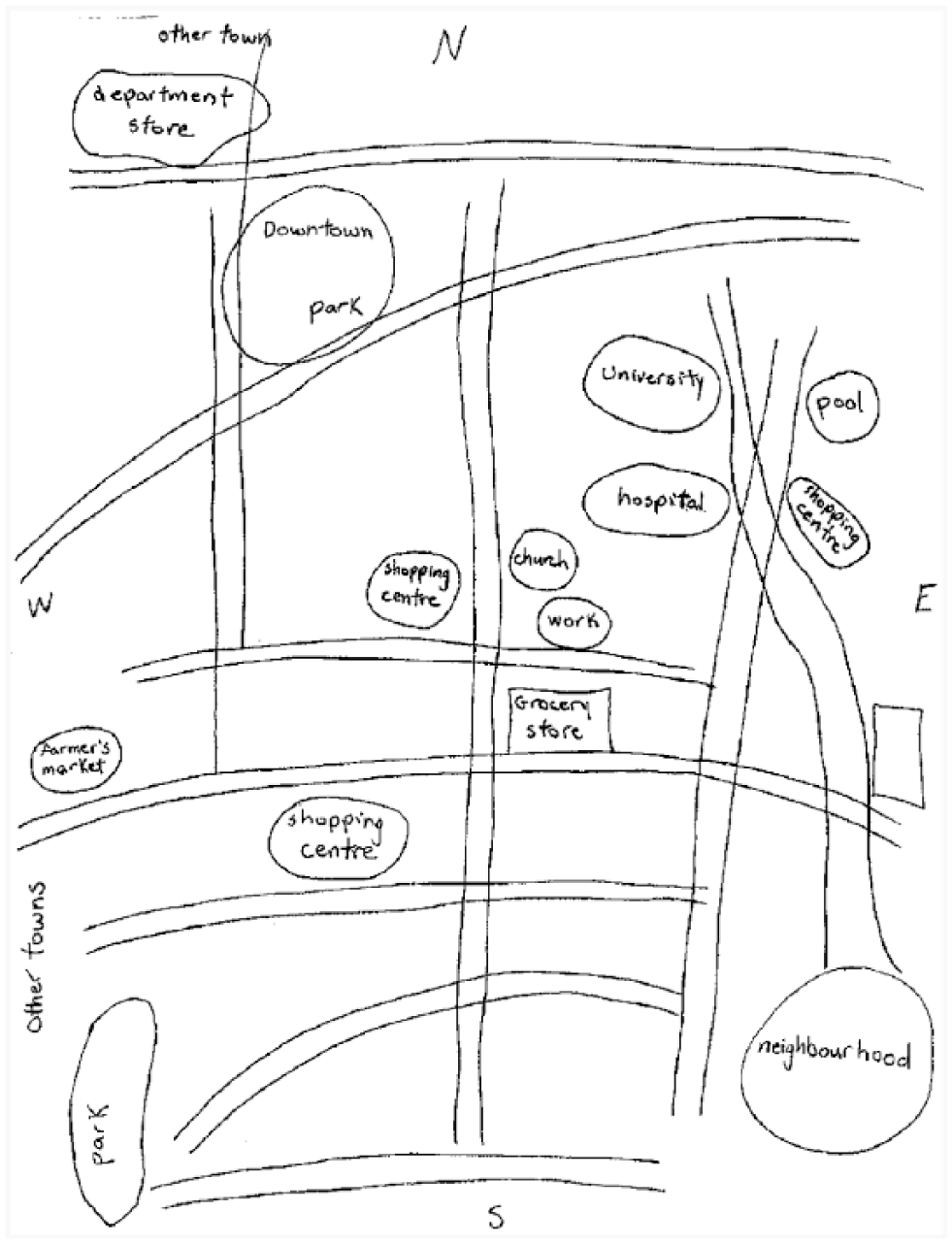
Recreation of the map drawn by Makane.
Rose immigrated to Canada from Central Africa and had one child. Like Makane, she had also previously lived in another province. Becoming autonomous was the predominant theme in sessions with Rose. Following delays in family reunification, her husband did not immigrate and her marriage ended. She explained that being a single mother in Canada forced her to become independent and self-sufficient. Unlike Makane, Rose was only employed part-time and like many other participants, she was seeking a full-time job. This influenced her routine as she had to balance her work and community involvement with the responsibilities of single parenthood. For instance, she had not completed her English-language courses because after getting her job, she was unable to do both concurrently. Although she had a fairly structured daily routine, her employment entailed meetings in other cities and led to a variable work schedule that complicated her routine and posed challenges in securing child care.
Her routine occupations were represented on her map (Figure 2). In addition to her home, Rose’s map included her workplace, church, and child’s school, a community organization, two shopping centers and a plaza, a grocery store, hospital, and public pool. She had recently moved within the city and was less familiar with her new neighborhood than her previous one. She explained this while drawing her map, stating that she no longer visited certain places because they were further away, and that she planned to seek out places within her new neighborhood (e.g., park). One theme heavily emphasized by Rose, which did not figure as strongly in the sessions with Makane, was the importance of her faith in helping her deal with challenges she faced. This informed her selection of our participatory occupations. The first session entailed spending time in her home talking, having tea and wrapping Christmas presents. We then went to the mall to purchase an additional gift. We attended mass together for the second session. Her child came with us and afterward we returned to her home to have lunch. She described the importance of having this 1 day of rest every week to spend quality time with her child and to relax from the accumulated stress of the week.
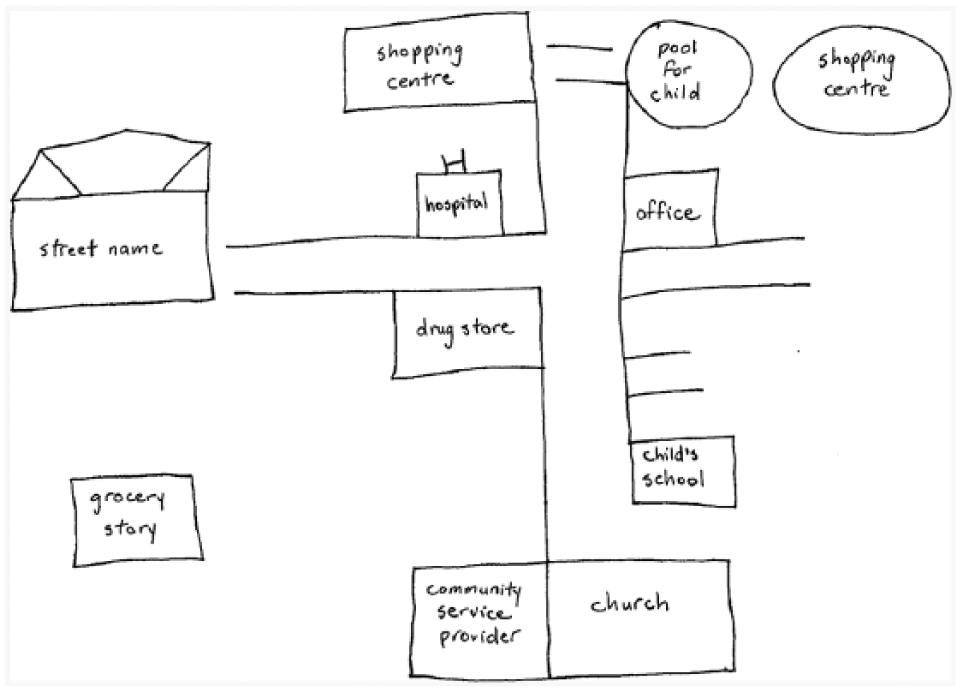
Recreation of the map drawn by Rose.
Makane’s and Rose’s maps had several similarities including the presence of roads, a hospital, church, public pool, shopping centers, workplace, and grocery store. This may stem from some of their commonalities, such as having young children, owning vehicles, living in a similar area of the city, and being employed. Some of the key differences between their maps include Makane’s addition of other cities on the map’s periphery, parks, and the local university. Rose also included her child’s school and a community organization that she collaborated with as part of her job.
Overall, the eight participants’ maps, descriptions of their drawings, and engagement in occupations helped elucidate the tacit nature of daily occupations as embedded in place. This relationship was often not singular or explicit as some of the places appearing across maps were used for different purposes by different people. For instance, the community had mixed-use spaces such as a community school center, which comprised community service providers, public and Catholic elementary and secondary schools, and a Catholic chapel. As a result, this center, where some of the participatory sessions took place, served a number of purposes and appeared on several maps as a site where different occupations occurred (e.g., children attending school, accessing services). Particular organizations also enabled varied occupations. One community service provider appeared on several maps, yet people described doing different things there, such as volunteering, attending meetings, or engaging in community activities. Equally, some occupations that were observed during participatory sessions were also described as occurring in a number of places, such as religious practice in places of worship, in children’s schools, and in homes. The use of occupational mapping and participatory occupations highlighted by the participants’ drawings led to a deeper understanding of the centrality of both routine and meaningful occupations in their daily lives.
Discussion
The dialogical data generated throughout the multiple sessions offered insight into how the participants understood, situated, and negotiated their occupations within the larger community and social systems in which they lived. For instance, one participant provided a strong critique of the city’s transit system. She had difficulty drawing her map in part because of her reliance on public transportation, which complicated her development of a sense of direction because of the circuitous routes used by buses. She drew the places that she went and described her occupations but emphasized that her daily routine was challenging to organize due to bus schedules and indirect routes. Our participatory sessions involved going to places she needed to frequent, such as the grocery store, and her explaining that she often takes a taxi to return to be able to save time and to buy more to reduce her number of visits. This theme was reiterated in interviews when explaining the challenges she faced while engaging in required occupations as a single mother with three children who does not own a vehicle.
The use of multiple methods and meetings enabled insights from earlier sessions to inform ongoing data collection and analysis. Although the initial narrative interview asked participants to describe their experience of migration and of settling and integrating into the host community, their stories often did not include descriptions of the particularities of their daily lives (e.g., cleaning the house, making dinner). The use of occupational mapping and participatory occupations informed the development of follow-up interview questions that addressed specific routine and meaningful occupations highlighted during those sessions. This enabled deeper discussion of the tacit aspects of occupation, then could have been addressed in response to more general questions, such as “Can you tell me about what you do on a typical day?” Having been shown by their maps and observed through participatory sessions, questions could be framed more directly stemming from their experience. For instance, rather than simply explaining that one “does groceries,” one could further explain why a particular grocery store was selected or why particular items were purchased from different places.
Molineux and Whiteford (2011) argued that not only is an understanding of occupation and its relationship to health and well-being essential for effective occupational therapy practice, they further stressed that an understanding of humans as occupational beings can be used to advocate for enhanced services beyond “traditional health and social care boundaries” (p. 246). The methods we used enhanced our understanding of the participants’ occupations, as well as how the process of negotiating transitions to occupation following international migration was situated within a particular socio-historic context. Our work reinforces Suzuki et al.’s (2007) assertion that more nuanced and complex appreciations of phenomena can be achieved by using multiple qualitative methods because “the complexity of what we learn as a field depends on our willingness to creatively weave those data into a tapestry of meanings that reflect the lived experience of those whose lives are being investigated” (p. 323).
The call to expand conceptualizations of occupation, and concomitantly to use methodological tools that enable such expansion, has existed with the occupation-based literature for several decades with renewed emphases tied to the continued development of occupational science (Bailliard, 2015; Frank & Polkinghorne, 2010). As an early example, one can look to McColl (1994) who stated that “occupational function or dysfunction is an experienced phenomenon, rather than objectively observable one” (p. 75) in her discussion of the principles of holism that should inform occupational therapy practice. More recently, Hocking (2009) has referred to occupation as “the knowledge people have about the things people do, rather than engaging in, performing, carrying out or doing an occupation” (p. 142). Layering occupational mapping and participatory occupation onto narrative and in-depth interviews enabled better familiarization with the context of the participants’ experiences, as well as insights into aspects of occupation that were seemingly too mundane or tacit to speak about. Attending to occupation in this way opens up examination of occupation to the inclusive definition of occupation proposed at the outset.
Footnotes
Declaration of Conflicting Interests
The author(s) declared no potential conflicts of interest with respect to the research, authorship, and/or publication of this article.
Funding
The author(s) disclosed receipt of the following financial support for the research, authorship, and/or publication of this article: The primary author received a Social Sciences and Humanities Research Council of Canada doctoral award to support this research.