







Abstract
Preschool Activity Card Sort (PACS) is a valid measure of preschoolers’ participation and is a useful and unique tool for focusing on the extent and frequency of their participation. However, given the cultural differences between Japan and other countries, researchers should consider these differences when adapting the PACS for use with children in Japan. The purpose of this study was to select culturally suitable activity items to develop the Japanese version of PACS (PACS-JPN). A two-round survey of parents (who had typically developing children aged between 3 and 6 years) was conducted. The final version of the PACS-JPN included 98 activity items. The PACS-JPN reflects Japanese sociocultural background and allows occupational therapists to assess preschoolers’ actual participation by assessing multiple aspects of children’s community life. The psychometric properties, including the validity and reliability of the PACS-JPN should be examined in future research.
Introduction
Just like children who develop typically, children with disabilities live in the community, using local resources and living with local residents. Occupational therapists’ support is designed to encourage children’s participation in these communities. During childhood, preschoolers’ participation is strongly influenced by sociocultural factors. For example, children need to acquire skills to use fork, spoon, or chopsticks according to their food culture. Therefore, occupational therapists should provide support for preschoolers and their families while considering such factors. The International Classification of Functioning, Disability and Health defines participation as “involvement in a life situation” (World Health Organization, 2001). Participation adds value to children’s quality of life because it allows for the acquisition of skills and competencies, connection with others and the community, and finding purpose and meaning in life (Law, 2002). In particular, the accumulation of various participation experiences has been shown to promote children’s growth (Bianchi & Robinson, 1997; d’Entremont et al., 2017; Ehrmann et al., 1995; Huston et al., 1999; Larson, 2001).
Children’s participation is often affected by their family and community environments (Law, 2002). Sometimes, families or communities can provide children with opportunities to tackle new activities or ask for challenges. However, communities and families can limit children or deprive them from new participation opportunities by controlling access to certain activities, even unintentionally. It is reported that children’s participation is less diverse in families reporting lower income, single-parent status, and lower respondent parent education (Law et al., 2006). Richardson (2002) reported that adults’ involvement in the play activities or offering assistance may interrupt children’s play interactions. In addition, a lack of environmental modifications would be an accessibility barrier for children with disabilities (Simeonsson et al., 2001). Therefore, when assessing the participation of children, it is important to consider not only children’s ability to perform activities and their level of independence but also how much opportunity is given to them to take part in activities.
The Preschool Activity Card Sort (PACS) is a semistructured interview that measures the participation of 3- to 6-year-old children (i.e., preschool-aged) in activities (Berg & LaVesser, 2006). The PACS consists of a picture sort and an interview. Photographs depicting children participating in 85 typical, everyday activities are organized into seven domains: self-care, community mobility, high-demand leisure, low-demand leisure, social interaction, domestic, and education. High-demand leisure is a domain that includes vigorous play activities, such as running, climbing, and throwing a ball. Low-demand leisure is a domain that includes sedentary play activities, such as coloring, building with blocks, and watching television. The therapist shows each photograph to the child’s parents and asks them whether their child engages in this activity. The parents rate each photograph with the following choices: (a) yes, my child participates; (b) yes, with adult assistance; (c) yes, with environmental accommodations; and (d) no, my child does not participate in this activity. If the parents answer “no” for an activity, the reasons for not completing the activity are explored, as they are related to the child, the parent, and the environment (Berg & LaVesser, 2006). The therapist then asks the parents to identify five activities to establish a treatment goal and to rate the relative importance of each activity, the frequency at which the activity is performed, the extent of the child’s current participation (from 0 = currently not participating at all to 10 = fully participating), and the parents’ satisfaction with the child’s participation. The typical time taken to administer the PACS is 30 min to 1 hr.
The PACS has been translated into Spanish (Stoffel & Berg, 2008) and Arabic (Malkawi et al., 2015). The Spanish version has been translated so that the PACS can be used for Hispanic/Latino individuals living in the United States. The Arabic version is a translated and modified version of the PACS that is used in Jordan. It consists of 95 activity items that are common for Jordanian children. Items common to Jordanian children were determined through a two-round ranking by parents living in Jordan. The content validity of each version and the psychometric properties of the Arabic version have been examined (Berg & LaVesser, 2006; Malkawi et al., 2015, 2017; Stoffel & Berg, 2008). In some research, the PACS has shown several participation patterns for preschool children. LaVesser and Berg (2011) compared the participation patterns of typically developing 3- to 6-year-old children and children with an autism spectrum disorder, and they revealed children with autism participated in fewer activities than typically developing children in all seven domains of the PACS. Gronski et al. (2013) report that preschoolers attending a head start program participated in fewer activities in the community mobility domain of the PACS than the control group. Stoffel and Berg (2008) investigated the participation patterns of children living in the United States and report that Spanish-speaking children who were not born in the United States participated in fewer activities in the education domain of the PACS than English-speaking children. As these reports show, the PACS is useful for quantitatively assessing and comparing children’s participation.
Although some assessment tools are currently available for the measurement of children’s activities in Japan (Haley, 1992; Liu et al., 1998), these tools mainly evaluate self-care and mobility function, and they do not contain aspects of participation that are important for preschoolers, such as play and community activities. Currently in Japan, comprehensive community care that promotes community life by providing life support services for the elderly is being promoted. Today, support targets are expanding from the elderly to children, and support for children’s community life is also emphasized; thus, a tool that can assess children’s participation by providing an overall rating of the child’s community life and identifying the support needs of children living in the community is needed for occupational therapists. The PACS is useful for the assessment of a broader range of activities, but cultural differences between Japan and other countries may influence its adaptation for Japan. For example, chopsticks are used for meals beginning in early childhood in Japan, but such items are not included in other countries’ PACS. In addition, some traditional play activities in Japan are not included in the PACS. Therefore, we should consider these differences in lifestyle and children’s traditional play when developing the Japanese version of the PACS (PACS-JPN). Thus, the aim of this research was to conduct a content validity study to select culturally suitable activity items for inclusion in the PACS-JPN.
Method
While developing the PACS-JPN, we referred to the methodology used in the previously developed PACS and the Activity Card Sorts (ACS) (Hamed et al., 2011; Laver-Fawcett & Mallinson, 2013; Malkawi et al., 2015; Packer et al., 2008; Uemura et al., 2019). The ACS is a measurement tool of older adult participation (Baum & Edwards, 2008), and the PACS is similar to the ACS. We used a two-step process for selecting activities to include in the PACS-JPN. First, the initial list of potential activities was created from two elements; the first element was derived from existing PACS items, and the second element was derived from existing research conducted in Japan on children’s lives (item generation). Next, activities were selected and reduced using a two-round survey (item selection and reduction).
This study was approved by the local ethics committee of Nagoya University, School of Health Sciences based on the Helsinki Declaration (approval number: 2017-0373-2), and undertaken with permission from the corresponding author of the PACS (Berg & LaVesser, 2006).
Item Generation
Item generation for the PACS-JPN involved two steps: In the first step, according to the past ACS development process, the activities were collected from the two available versions of the PACS (Berg & LaVesser, 2006; Malkawi et al., 2015). One available version is the original PACS and the other is the Arabic version. The Arabic version consists of 95 activity items, 24 of which are newly added items common to Jordanian children. In the second step, extensive questionnaire data from a private company’s research institution (Benesse Educational Research and Development Institute, 2016) and a white paper on child health (The Japanese Society of Child Health, 2011), which included samples of Japanese children, were used to identify additional potential activities for inclusion in the PACS-JPN. Through these two steps, a wide range of items that are likely to be common for Japanese children were included in the PACS-JPN candidate items. When similar wording for items from different sources existed, two occupational therapists, including the corresponding author and two nursery schoolteachers, analyzed the intent and undertook relabeling and integration of the items under mutual agreement. This process generated a total of 119 potential PACS-JPN activity items.
Translation
Translation was conducted according to the process described by the World Health Organization for forward and back translation of the assessment tools. An expert panel was formed for the forward translation; the panel included the original translator and an expert in health. Both members of the panel were occupational therapists holding master’s or PhD degrees. First, the list of generated items was translated from English to Japanese by the original translator, who was familiar with the terminology of participation and whose native language was Japanese. Then, the expert panel member reviewed the Japanese translation to identify inadequate expressions or phrasing. Through this process, the final list in Japanese was produced.
The final list in Japanese was given to an independent bilingual translator, whose native language was English, for back translation from Japanese to English. The translator had no knowledge of the PACS and was not a health professional. The panel identified problematic items in the back translation to finalize the list for item selection and reduction.
Item Selection and Reduction
In this research, the Delphi method was used to examine the potential items for the PACS-JPN. It is characterized by a repetitive process in which participants answer the same question during two or more rounds. The Delphi method is a valid methodology and is used to support decision-making, particularly in the fields of social and health sciences (Landeta, 2006). In this study, a two-round questionnaire was used to obtain participants’ opinions.
Participants
The inclusion criteria for both Rounds 1 and 2 were parents who had at least one typically developing child aged between 3 and 6 years and who were able to read and write in Japanese. Participants were recruited via daycare centers, preschools, and kindergartens in the southern area of Gifu Prefecture through personal and professional contacts. The southern area of Gifu Prefecture was chosen for participant recruitment due to its convenience and geographical location.
All potential participants received information that included an explanation of the research and provided written informed consent prior to their participation. All participants were free to decline answering any questions or withdraw.
Round 1: Instruments and Procedures
The questionnaire was divided into two sections. In the first section, participants rated the commonality of each of the 119 listed activities on a 5-point ordinal scale (0 = children do not do this activity, 1 = few children do this activity, 2 = some children do this activity, 3 = a lot of children do this activity, and 4 = most children do this activity) in response to the question “How common do you think it is for Japanese preschoolers to do this activity?” (Malkawi et al., 2015). Next, when activities that the participants felt appropriate for preschoolers were not on the questionnaire, participants would add the activities.
Participants voluntarily responded to the questionnaire during their free time. To return the questionnaire by postal mail, prepaid and addressed envelopes were used to increase the response rate (Laver-Fawcett & Mallinson, 2013; Uemura et al., 2019). The response period was set to 45 days.
Round 2: Instruments and Procedures
The questionnaire in Round 2 was modified in terms of the activity list section. Based on the participants’ responses in Round 1, items newly mentioned by more than one participant were identified as new items for inclusion and were added to the Round 2 questionnaire. As in Round 1, participants rated the commonality of each item on the same 5-point ordinal scale. Participants rated all the listed activities. They voluntarily completed the questionnaire and returned it using the prepared stamped and addressed envelopes. Round 2 questionnaire was sent only to those who answered in Round 1. One month after the end of the response period for Round 1, the Round 2 questionnaire was distributed. Same as Round 1, the response period was set to 45 days. Data collection for Rounds 1 and 2 was conducted from April to August 2018.
The means and standard deviation were calculated for each activity item, and items were ranked by a mean value. A cutoff level was set to select the most common items in Round 2. This was set to a mean value of less than 2.0 (Laver-Fawcett & Mallinson, 2013). This refers to the selection of items that participants thought “some,” “lots,” or “most” preschoolers do in their lives.
Results
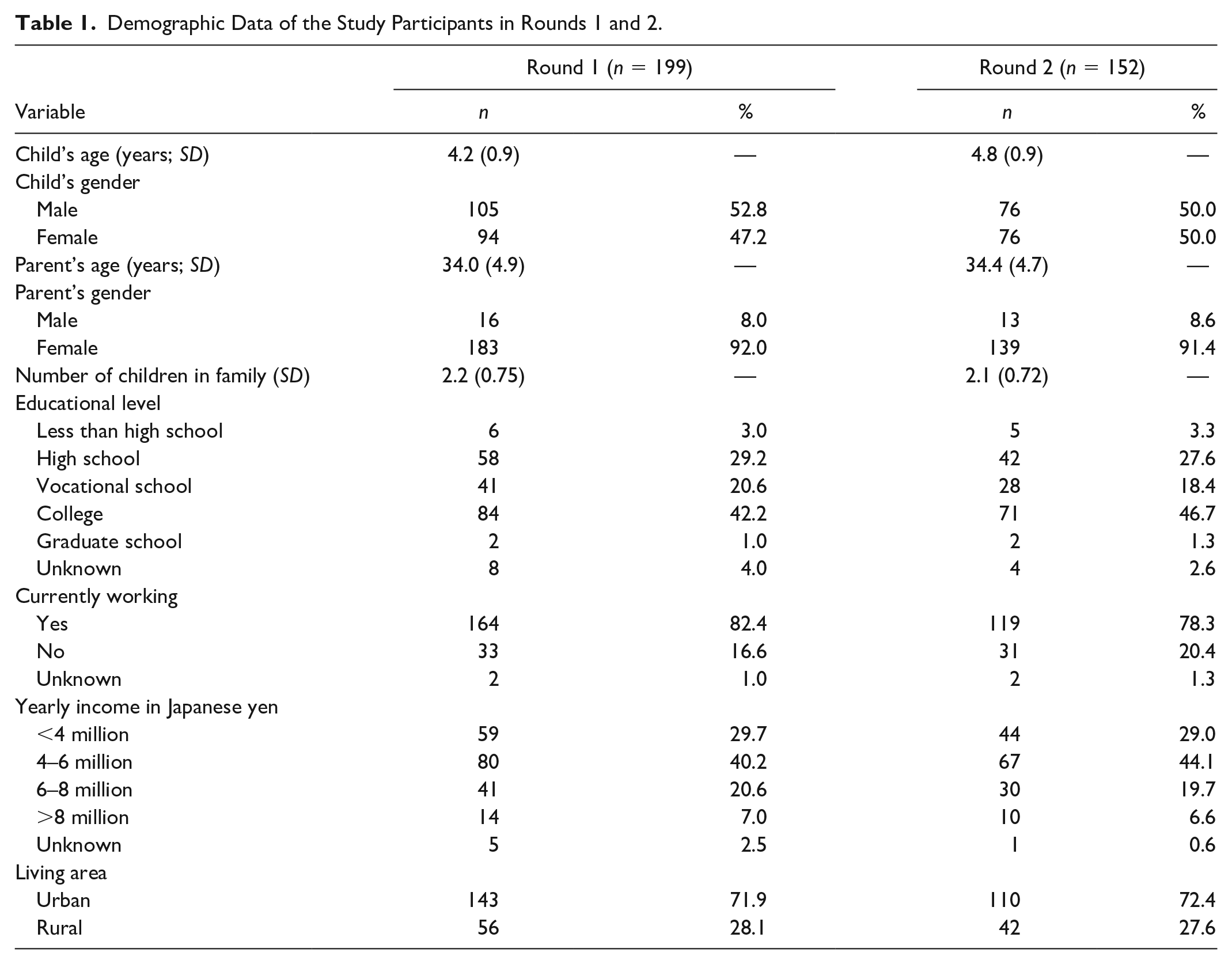
General information on the participants is shown in Table 1. We distributed the questionnaire to 895 people at the beginning of Round 1 and received responses from 199 people. The response rate was 22.2%. In Round 2, responses were received from 152 of 199 people. The attrition rate from Round 1 to 2 was 23.6%. The average age of the children in Round 1 was 4.2 ± 0.9 years, and the proportion of boys was 52.8% (n = 105). In Round 2, the average age of the children was 4.8 ± 0.9 years, and the proportion of boys was 50.0% (n = 76). About 70% of the individuals in Rounds 1 and 2 lived in the urban area.
Demographic Data of the Study Participants in Rounds 1 and 2.
Figures 1 and 2 show a list of items exceeding the cutoff value in Round 1 and Round 2, respectively. In Round 1, 103 items of the 119 items exceeded the cutoff value, and 20 types of activities were listed from the participants as potential new items. Therefore, in the Round 2 questionnaire, 20 items were newly added to the Round 1 questionnaire, and a total of 139 items were included. As a result of the Round 2 research, 119 items of 139 items exceeded the cutoff value.
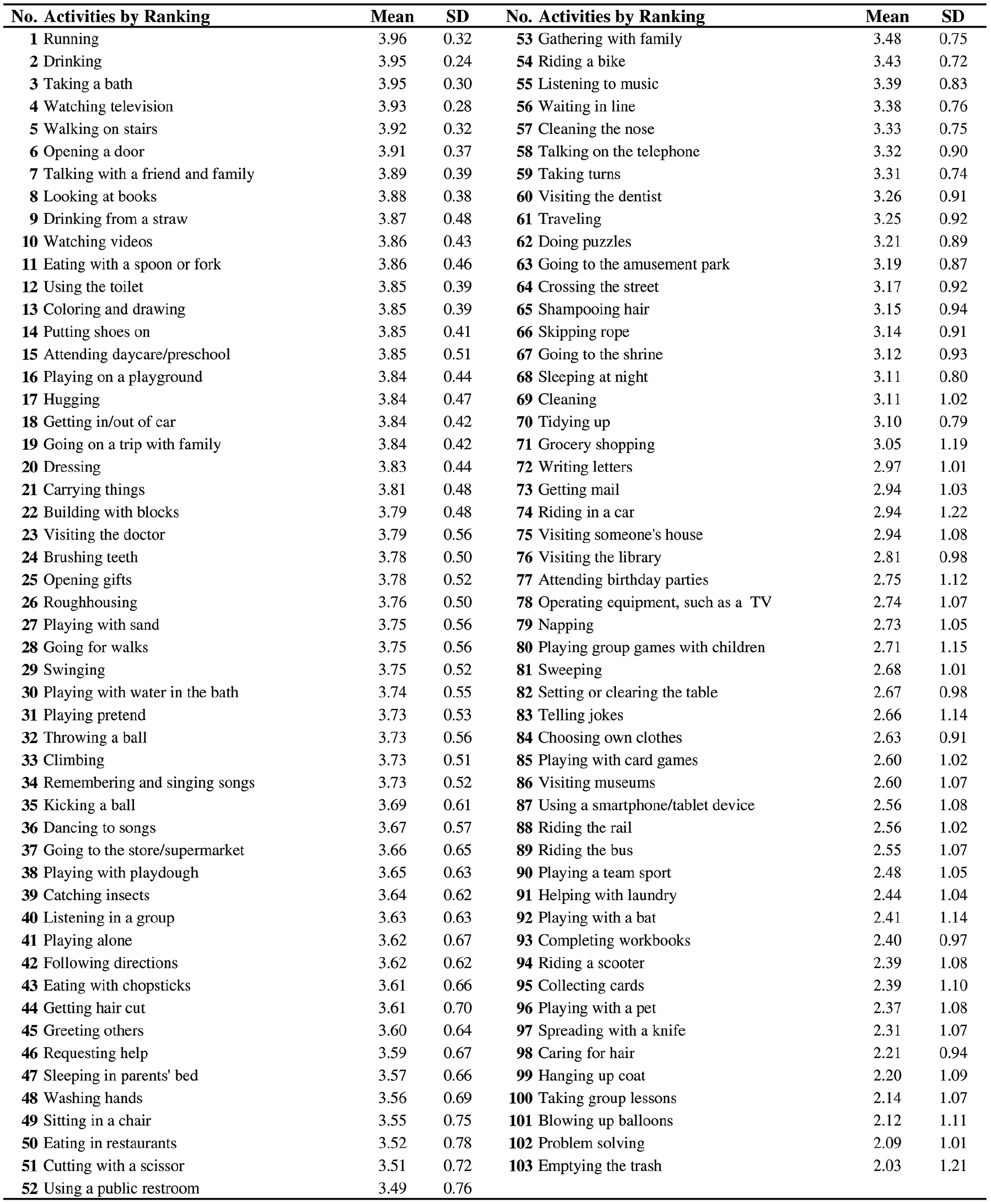
Potential PACS-JPN activity items ranked above the <2.0 cutoff point in Round 1.
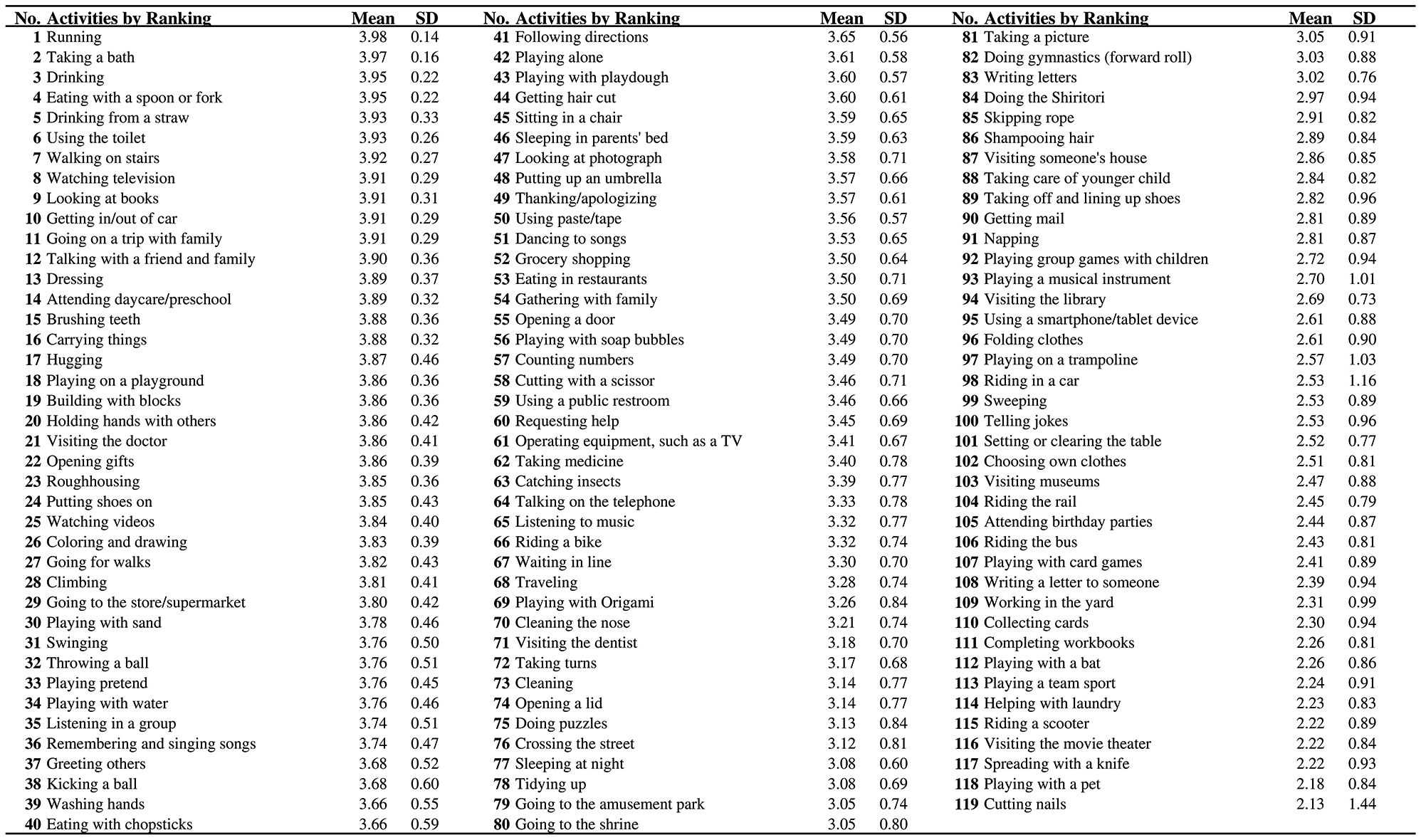
Potential PACS-JPN activity items ranked above the <2.0 cutoff point in Round 2.
For the 119 items that exceeded the cutoff value in Round 2, items that were similar in meaning were combined or relabeled to form a single item. Two occupational therapists, including the corresponding author and two nursery schoolteachers, undertook combining and relabeling the items under mutual agreement. For example, “drinking” and “drinking from a straw” were combined to form the item “drinking from a cup/straw” to indicate the act of drinking while using different tools. In addition, “watching television/videos,” “playing with sand/playdough,” “playing with a ball/bat,” “riding a bike/scooter,” “looking at books/photographs,” and “cleaning/sweeping” were generated. “Getting in/out of car” was an element of “riding in a car” and was included with this item. Similarly, “telling jokes” was included with “talking with a friend and family”; “playing with card games” was included with “playing group games with children”; and “operating equipment, such as a TV” was included with “watching television/videos.” “Hugging,” “holding hands with others,” and “roughhousing” were combined to create the item “engage in physical contact,” which encompassed these three actions. Likewise, “taking a bath” and “shampooing hair” were combined into “washing body and hair”; “sleeping at night,” “sleeping in parents’ bed,” and “napping” were combined into “sleeping”; “cutting with a scissor” and “using paste/tape” were combined into “handcrafting”; “going to the store/supermarket” and “grocery shopping” were combined into “shopping”; and “riding the rail” and “riding the bus” were combined into “using public transportation.” Overall, 98 items were included in the PACS-JPN.
These 98 items were classified into seven domains based on the mutual agreement of the two occupational therapists and two nursery schoolteachers: 16 items in the self-care domain, 16 items in the low-demand leisure domain, 12 items in the high-demand leisure domain, 18 items in the mobility and community activity domain, 16 items in the social interaction domain, 13 items in the education domain, and 7 items in the domestic domain (Figure 3).
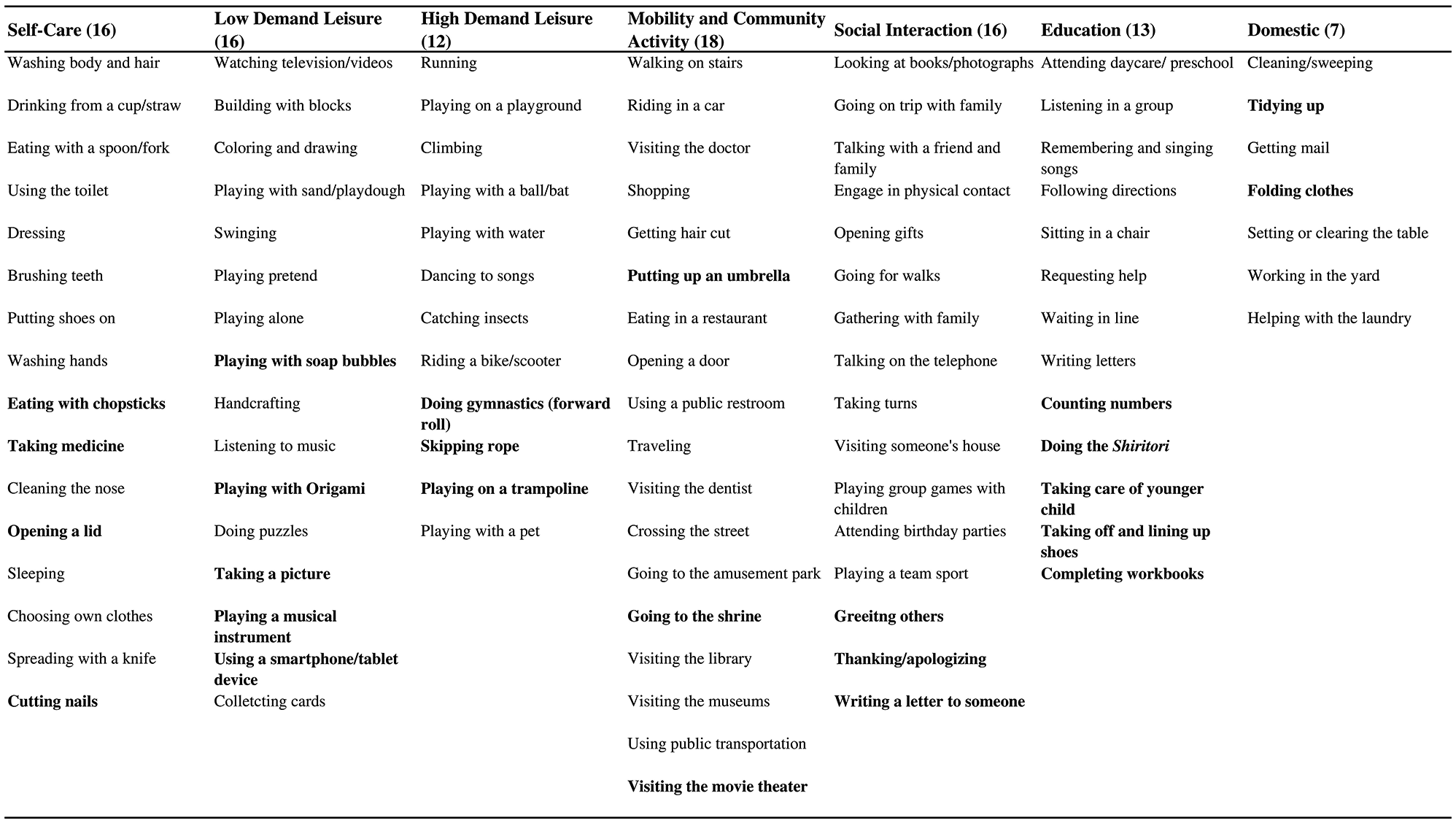
Final PACS-JPN activity items listed by domain.
Twenty-five items were selected as new activities in the PACS-JPN. Most of these new items were included in the self-care, low-demand leisure, and education domains, and the domestic domain had the least number of new items. Except for the domestic domain, the number of items increased in all domains when compared with the original PACS. In particular, the low-demand leisure domain increased by five items from the original PACS. However, the domestic domain decreased by three items from the original PACS.
Discussion
The PACS focuses on the extent and frequency of participation, not on the level of independence displayed when children perform the activities (Berg & LaVesser, 2006). For this reason, items included in the PACS must cover activities commonly performed by preschool children in their target countries without duplication in the item content. After Round 2, some of the original version’s items were combined (e.g., drinking from a cup/straw, playing with a ball/bat, riding a bike/scooter). We also combined or relabeled original items that were similar in meaning with items newly added in the questionnaire survey (e.g., watching television/videos, playing with sand/playdough, handcrafting). These items were originally treated as independent content in the questionnaire. However, as a result of the Round 2 survey, more items than we expected exceeded the cutoff level. Therefore, combining and relabeling items were executed in terms of clinical convenience for the PACS-JPN. No combined or relabeled items seemed to be Japan-specific content. Procedures for combining items have also been used in the development of the PACS and the ACS in other countries (Hamed et al., 2011; Malkawi et al., 2015; Packer et al., 2008; Uemura et al., 2019). As mentioned above, the PACS is focused on evaluating the range of participation, not on the level of independence or achievement for the activities. Therefore, it seems better to combine items that have similar aspects. By combining items with duplicate content, the final list includes a wide range of activities while suppressing the total number of items.
Nevertheless, the 98 items of the PACS-JPN outnumber the 85 to 95 items of other versions of the PACS. The PACS-JPN has added new items that are common and culturally specific to Japan. For example, “playing with origami” was newly included. Origami is a Japanese word and is known in other countries. Origami is played by folding a colored paper to make shapes, such as animals and plants. “Gymnastics” and “skipping rope” are done in elementary school physical education classes and are popular activities for preschoolers in Japan. It is common for Japanese preschoolers to use umbrellas because there is a rainy season in Japan, and it is a rainy region in the world. Shiritori is a Japanese word game that is similar to the English game called “word chain.” In addition, Japanese people generally take off their shoes when entering their home, and the item “taking off and lining up shoes” is considered to reflect this aspect of Japanese culture. These newly added items include content necessary for evaluating common participation activities of children living in Japan. Therefore, although the PACS-JPN has a slight increase in the number of items when compared with other versions, it is necessary to meet the purpose of widely evaluating common participation activities of children living in Japan.
In the PACS-JPN, the high-demand leisure domain had a lower number of items than the low-demand leisure domain. This result is consistent with other versions of the PACS (Berg & LaVesser, 2006; Malkawi et al., 2015). Moreover, the low-demand leisure domain of the PACS-JPN increased by five items from the original PACS, whereas the high-demand leisure domain increased by only two items from the original. It appears to reflect the current situation in Japan. In 2012, the Ministry of Education, Culture, Sports, Science, and Technology set infantile exercise guidelines and recommended that during early childhood, children should exercise more than 60 min each day. Meanwhile, in recent years, there has been an increase in the amount of time that children engage in sedentary play, such as drawing, playing with clay, and building with blocks (The Ministry of Education, Culture, Sports, Science and Technology, 2012). High-demand leisure is a domain that includes vigorous play with a large amount of physical activity. By contrast, low-demand leisure is a domain that includes sedentary play with a small amount of physical activity. The increase in the number of items in the low-demand leisure domain of the PACS-JPN seems to reflect the characteristics of Japanese children’s leisure time.
The domestic domain included fewer items than the other domains, and this is probably because at the age of 3 to 6 years, children begin to experience household chores, and this is the stage where they acquire the ability to accomplish this. Moreover, in the PACS-JPN, the number of items classified in the domestic domain was less than that in the American version of the PACS (11 items). According to a survey by the Cabinet Office in Japan, Japanese children help with household chores less than children in the United States (Youth Affairs Management and Coordination Agency, 1996), and the relatively small number of items in the domestic domain of the PACS-JPN seems to reflect this cultural difference. However, five new items were added to the education domain in the PACS-JPN, and the total number of items in the education domain was more than that in the American version of the PACS (10 items). Regarding home education in Japan, Katagiri (2013) reports that parents tend to want to let their children study (write letters, complete workbooks, and so on), rather than have them help with the household chores, and they do not force children to help with the household chores. The results of this study may reflect the Japanese way of thinking about parenting and home education.
Among the newly included 25 items, some items are not necessarily unique to Japan. For example, taking medicine, opening a lid, greeting others, thanking/apologizing, and so on seem to be common content also performed outside of Japan. Through previous PACS development, activities common to each country have been confirmed, and most of these activities were included in the PACS-JPN (Figure 3). However, when developing the original version of the PACS, Berg pointed out the limitations of extracting activities commonly experienced by preschool children from a survey (Berg & LaVesser, 2006). In this study, we created the Round 1 questionnaire based on the activities included in the existing versions of the PACS, and a free response field was provided so that participants could add other activities if they found that an activity was not included in the questionnaire. As a result, 20 activities were newly added to the list in the Round 2 questionnaire. Through this process, activities that were not necessarily unique to Japan, but that had not been extracted during previous PACS development, were added to the PACS-JPN.
In addition, while “playing on the computer,” which was included in the original PACS, was omitted, “using a smartphone/tablet device” was newly included in the PACS-JPN. This change seems to reflect the historical background of the development of each PACS. Compared with 2006, when the original PACS was developed, smartphones are now more prevalent, and they play the role of computers. As in this example, common activities change with the times, so the PACS-JPN items should be reviewed after a certain period.
The areas targeted for recruitment in this study were those with few climatic and geographical features such as heavy snow. The items extracted in this study did not include those that were affected by climate or geography, and it was considered that items that could be implemented in any region of Japan be selected. However, the socioeconomic level of the recruitment area was not as high as that of metropolitan areas, which may have influenced the results of this study. There may be common activities for children living in the metropolitan area that were not extracted in this study.
Limitations and Future Directions
In this study, participants were recruited from a geographically limited area of Japan. Therefore, whether the items extracted this time are common in other Japanese regions should be investigated. In addition, because this research was conducted in areas where the socioeconomic level was not so high, there may be differences in activities and participation items when compared with metropolitan areas, and research in areas with different socioeconomic levels is needed. In addition, there is a possibility that immigration will increase in Japan in the near future. All the study’s participants spoke Japanese as their native language, but future research that involves modifying the PACS-JPN items may need to examine common activities not only for Japanese children but also other ethnic groups.
As pointed out in the development of previous versions of the PACS, there is a possibility that there may be unexplored activities in the PACS development process. In the future, as the modification of the existing PACS and the development of other countries’ versions are promoted, unexplored, common activities for preschool children should be investigated.
Conclusion
Based on our findings, 98 items that reflected the Japanese sociocultural background were selected as activities for inclusion in the PACS-JPN. The PACS-JPN is a tool that allows occupational therapists to assess children’s actual participation by comprehending the entire community life of the child, and it enables them to identify the children’s support needs while living in their communities. Because the content validity study of the PACS-JPN was conducted in this research, the psychometric properties including test–retest reliability, internal consistency, and concurrent validity of the PACS-JPN should be examined in the future.
Footnotes
Acknowledgements
The authors thank Dr. Christine Berg and Dr. Patti LaVesser from the Program in Occupational Therapy at Washington University School of Medicine, St. Louis, Missouri, for their permission to develop a Japanese version of the Preschool Activity Card Sort.
Declaration of Conflicting Interests
The author(s) declared no potential conflicts of interest with respect to the research, authorship, and/or publication of this article.
Funding
The author(s) disclosed receipt of the following financial support for the research, authorship, and/or publication of this article: This work was supported by the Japan Society for the Promotion of Science (JSPS) KAKENHI Grant Number 19K19906.
Research Ethics
This study was approved by the local ethics committee of Nagoya University, School of Health Sciences based on the Helsinki Declaration (approval number: 2017-0373-2).
Patient Consent
All potential participants received information that included an explanation of the research and provided written informed consent prior to participation.
