







Abstract
Individuals with spinal cord injuries (SCI) report low physical activity participation levels. A lack of physical activity can lead to increased secondary health concerns, such as cardiovascular, psychological, genitourinary, and musculoskeletal complications. Adaptive sports, such as quad rugby, allow individuals with SCI to maintain appropriate physical activity levels. This grounded theory study aimed to explore the experiences of individuals learning about and participating in quad rugby after SCI in the United States. Twelve participants from seven states across the United States completed semistructured interviews. Four themes emerged: benefits of quad rugby participation, enabling quad rugby participation, barriers to quad rugby participation, and motivation for continued participation in quad rugby. This study highlights the importance of an early introduction to quad rugby after SCI and the biopsychosocial benefits of participation. Occupational therapy practitioners can address barriers identified in this study through innovative approaches and advocacy efforts.
Plain Language Summary
People with spinal cord injuries (SCI) often report low levels of physical activity, leading to various health problems. Quad rugby, an adaptive sport, offers an opportunity for individuals with SCI to maintain physical activity levels. This study focused on understanding the experiences of individuals in the United States who learned about and participated in quad rugby after their SCI. Four key themes emerged through interviews with twelve participants from seven states: the benefits of quad rugby participation, enabling quad rugby participation, barriers to quad rugby participation, and motivation for continued participation in quad rugby. The findings emphasize the importance of introducing quad rugby early after SCI and highlight the physical, psychological, and social benefits of participation. Occupational therapy practitioners can play a crucial role in addressing the identified barriers through innovative approaches and advocacy efforts.
Introduction
A spinal cord injury (SCI) results from damage to the spinal cord or the surrounding spinal nerves and tissue responsible for communication between the brain and the body (National Institute of Neurological Disorders and Stroke [NINDS], 2021). The damage can result in temporary or permanent changes in sensory, motor, and autonomic functions (Ahuja et al., 2017). These impairments can negatively affect occupational performance and participation in daily activities. The National Spinal Cord Injury Statistical Center (NSCISC) reports an annual incidence of SCIs to be approximately 54 cases per 1 million people in the United States (NSCISC, 2022). Approximately 78% of new SCI cases since 2015 are among males, and they are more prevalent among Non-Hispanic White individuals (56.4%), followed by Non-Hispanic Black individuals (24.8%; NSCISC, 2022).
SCI can result in paraplegia or tetraplegia. Tetraplegia, or quadriplegia, is caused by injury to the spinal cord’s cervical segment, which involves any degree of paralysis to all four extremities and trunk musculature; individuals may have some extremity function (Ahuja et al., 2017). Paraplegia indicates an injury to the thoracic, lumbar, or sacral sections of the spinal cord, resulting in loss of sensory and motor functions with any degree of paralysis involving the lower extremities and the trunk, depending on the injury level (Ahuja et al., 2017). Both tetraplegia and paraplegia significantly affect daily activities, including participation in physical activity and leisure occupations. Regular physical activity after SCI, such as adapted sports, has been associated with greater independence and functional abilities (Szeliga et al., 2022).
Adaptive sports are modified for individuals with disabilities, increasing inclusion and participation for varying functional levels. Adaptive sports can help reduce secondary health complications and hospitalization, improving cardiorespiratory function and physical independence (Stephens et al., 2012). Despite known benefits, evidence indicates an approximate 4-year transition into regular participation in adaptive sports and recreation from the time of injury (Malm et al., 2019). Multiple studies have explored the benefits and barriers to adaptive sports participation after a life-altering injury (Barclay et al., 2016; Jaarsma et al., 2014; Malm et al., 2019; Roberton et al., 2011); however, there is limited research on this topic in the United States. While there are different types of adaptive sports for individuals with SCI, limited research exists on the experiences and perspectives of quadriplegic athletes and the influence of rehabilitation on participation. Quad rugby, formerly known as Murderball, is an adaptive form of wheelchair rugby designed for individuals with quadriplegia and is played indoors on a hardwood court with specialized wheelchairs (Bauerfeind et al., 2015). Each team consists of 12 players, and all players have an impairment affecting three extremities. This study aimed to explore the experiences of individuals learning about and participating in quad rugby after SCI in the United States.
Method
Study Design
This study utilized a constructivist grounded theory approach based on Charmaz (2006) to allow for an understanding of the social processes and how individuals construct their experiences. This approach considers the multiple perspectives of the researcher(s) and participants while enabling themes to emerge through an inductive analysis process (Charmaz, 2006). The institutional review board at Touro University Nevada approved this study (IRB#000152).
Participants
Participants were recruited via purposive sampling by distributing online flyers to quad rugby teams across the United States to highlight varying experiences. A total of 12 participants from seven states completed the interview (M age of 35.33, SD = 8.56, range = 22–49; 11 males and one female). See Table 1 for complete participant demographics. Inclusion criteria were individuals with any level or type of SCI, participation in quad rugby, 18 years or older, and ability to understand written and spoken English.
Participant Demographics.
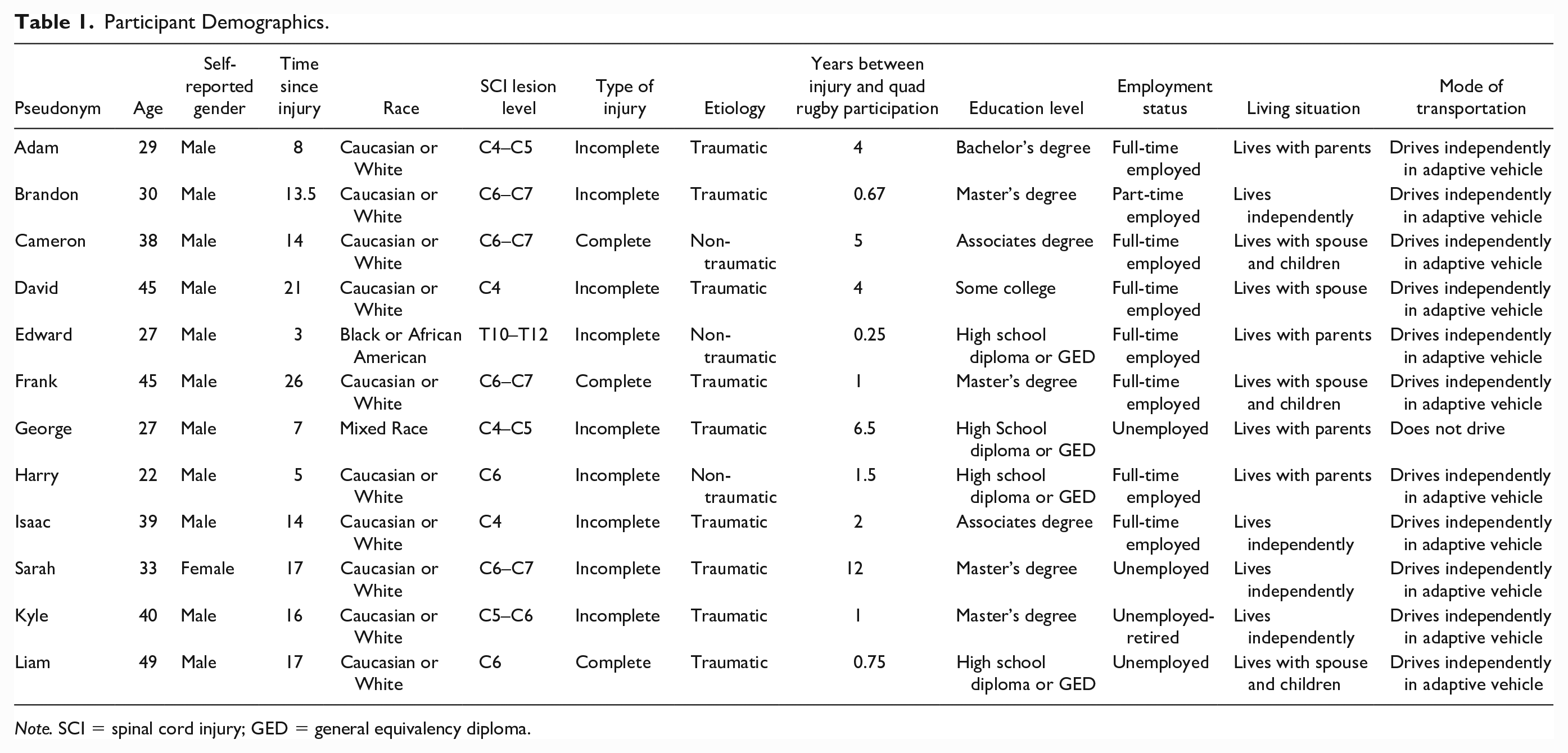
Note. SCI = spinal cord injury; GED = general equivalency diploma.
Data Collection
Following Charmaz’s (2006) approach, an initial semistructured interview guide was developed through clinical reflections on the topic, reading pertinent literature, pilot interviews, and input from an individual with lived experience. The initial interview guide consisted of predominantly broad, open-ended questions. The questions focused on understanding individuals’ experiences and perceptions of being introduced to and participating in quad rugby. We conducted a pilot interview with two participants and refined the interview guide accordingly. After obtaining written informed consent, semistructured interviews were conducted virtually through a secure video conferencing platform from March through May 2022. The first author reflected on and recorded her preconceived ideas about the study topic before interviewing all participants individually through reflective journaling. Interviews lasted 25 to 60 min. All participants were given pseudonyms to ensure confidentiality.
Data Analysis
All interviews were digitally recorded, anonymized, and professionally transcribed verbatim. Transcripts were checked for accuracy by the primary author. We used an iterative process of constant comparison throughout the data analysis to facilitate the identification of themes and patterns (Charmaz, 2006).
The first author completed multiple readings of each transcript, including notes taken after each interview, as a preliminary analysis. Memos of emerging ideas were recorded and discussed with the second author before initial coding. Two researchers then coded the interview transcripts using an initial (open), axial, and selective coding method (Charmaz, 2006). An inductive analysis approach was used to analyze the data and form codes, categories, and themes (Charmaz, 2006). Initial codes were created using a line-by-line coding strategy and gradually reduced to derive a series of categories. Both authors met to discuss emerging processes and structures following the initial coding. Themes were developed after examining the categories and discussing the congruency of emerging findings. Verbatim participant quotes with pseudonyms are included to provide a rich and reliable portrayal of the participant’s experiences.
Trustworthiness
To ensure trustworthiness, triangulation (use of different sources and materials), peer review (regular sessions between the first two authors to discuss methods, findings, and interpretations), identification of researcher bias (reflexive journaling), member checking/respondent validation (emailing research participants for verification), and rich descriptions were employed. In addition, an audit trail was developed with memos, interview notes, and diagrams depicting emerging themes.
Results
Aligned with constructivist and grounded theory research, our findings are not assumed to be complete as they are subjectively understood, contextually positioned, and acknowledged as a work in progress and continually evolving (Charmaz, 2006). The quad rugby players in this study shared their subjective experiences and perceptions of being introduced to and participating in quad rugby following their SCI. The players typically expressed the importance of the sport in their recovery and well-being, highlighting biopsychosocial benefits and motivating factors while shedding light on the occupational injustice caused by barriers to participation and enabling factors. Four overall themes emerged with multiple subthemes: benefits of quad rugby participation (physical, social, and psychological benefits), enabling quad rugby participation (early exposure, peer mentoring, social and familial support), barriers to quad rugby participation (limited access, high costs, inequality of adaptive sports), and motivation for continued participation in quad rugby (athlete identity, camaraderie, advocacy).
Benefits of Quad Rugby Participation
The advantages of participating in quad rugby include physical and psychosocial benefits. Every participant (n = 12) reported psychosocial benefits, such as improved overall attitude and outlook after participating in quad rugby. For example, It was such a big lift for me mentally to get back and be involved in something that I did before but adapting it in a way I never thought possible. That was a huge lift in my spirit and mental state. It’s a way to be mentally fit and healthy. My wife notices when I’m not playing wheelchair rugby. She’s like, “you’re a little more uptight and a little angrier.” She says, “go play some rugby.” It’s helped me long term just mentally. (Frank) Before I played rugby, I had a hard time being with myself and being able to go out and do stuff and be active. So, when I came across rugby, a light turned on in my head like, hey, quit being sad; there’s stuff out there for you. You’re not alone. It changed my mentality about everything. (Harry)
Several participants also reported improvement in their activities of daily living (ADLs), a return to independence, and “normalcy” as a result of engaging in quad rugby (n = 6).
When I was hurt, going into that gym was like a return to normal. Those guys [mentors] walked me step by step through all the independence milestones with their own life experiences. (Brandon) When I first got injured, my mom had to put me on the toilet, in the shower, in the car, in bed. And now I’m doing all those things on the fly, and I felt that. Had I not had adaptive sports when I did, I’d probably still be struggling with a lot of those things. (Edward) It opens so many doors. I think just on a connection level, being able to meet people in your situation. It’s not only being able to meet people, but what it teaches you on a day-to-day basis, how to use your chair, how to push your chair, how to transfer, how to get dressed, how to feed yourself, how to brush your hair, it does everything. (Harry)
Gains in strength and mobility from quad rugby allowed participants to engage in other desired leisure occupations and everyday activities (n = 8).
My strength and conditioning were good from rehab after injury, but my cardio went to another level with rugby. Also, learning the game, the rules, and how to play it. It sharpened my mind, which in turn translated to my body, so there’s a metaphysical connection. It just requires everything that any other sports ask of you: physical stamina, intelligence, recognition of play, and situational awareness. (David) Just having more energy throughout the entire day, being able to push further, and things like that. Also mentally too, just more clear, kind of more optimistic. (George) I notice a difference after each time I play, after each practice, after each tournament. I feel better about myself. I feel healthier. I feel warmer because, as a quadriplegic, I’m always cold, so I just feel really good and am generally in good spirits after playing. (Liam)
Many participants reported camaraderie and a sense of belonging as benefits of engaging in quad rugby; they felt most comfortable socializing with other adaptive athletes like them and their families (n = 6).
It’s the camaraderie, getting together with other people that have the same disabilities as me. In day-to-day life, people don’t understand, and it’s hard for me to explain what I go through every day, but I don’t have to do that when I’m in a group of people with chairs because they already know. (Kyle) You sort of become brothers with these guys because they’re sharing experiences and personal things that they don’t share with anybody. You’re talking about how you go to the bathroom or what you do to be sanitary. You’re talking about things that you won’t just talk about with some stranger. You’re talking about family issues, divorces, and mental health issues. And to me, those are big aspects of a family. (Frank) Not many people in your circle have been through or understand what you’ve gone through. So, to be around a sport where literally everybody that you’re around has some kind of familiarity with that. I think it just makes for a really easy bond. (Isaac)
Playing quad rugby increased motivation for rehabilitation and exercise, supporting physical and mental growth; injury led to isolation, whereas quad rugby led to socialization (n = 4).
It is a sport built for quads, and it was a way that I could go burn off energy, get my heart rate up, lower my nerve pain, and things like that. (Adam) I also go to Adaptive CrossFit now and lift weights because of rugby. They adapt their workout to my abilities. It’s a really fun challenge, and I have learned a lot. (Brandon) I was uncomfortable being around many people with disabilities, and then I got there, and it was amazing because you couldn’t tell. It didn’t seem like a “special feel-good sport,” you could immediately tell how athletic everyone was, and I loved that. (Sarah)
Many participants reported that participation in quad rugby led to a goal-oriented approach to life, and some experienced a broadened view of life, society, hope, and the future (n = 8).
I’m active on my own as an individual, but I’m definitely more driven as an athlete. It’s like training for a purpose. We have a season, a match, a game coming up, things I want to train for, and it helps keep me motivated and keep that drive going. (Isaac) Since my injury, my life slowed down tremendously. Playing on the team, meeting new people, sharing my experiences, and learning from others’ experience has shifted my mindset. My values changed as well. (David) Playing [wheelchair rugby] over the years has definitely broadened my view on life and society. It helped me identify my purpose, what I want to do in the future, why I want to do it, and the impact I want to have. And it all stems from playing, coaching, being involved, and seeing the impact that adaptive sports has on others. (Brandon)
Enabling Quad Rugby Participation
The importance of early high-quality exposure to quad rugby. Many participants found their health care providers’ role in rehabilitation helpful in introducing the sport of rugby (n = 5). For instance, one participant stated, Really quickly, my occupational and physical therapist realized, and instead of the typical therapy sessions, they actually took me to [rugby] practice, and they saw how much it motivated me. (Brandon)
However, participants reported confusion surrounding the sport of quad rugby, as many believed it was played on an outdoor grass field rather than an indoor court when they first learned about it (n = 7). This confusion hindered interest and prolonged time before quad rugby participation.
I wish that I knew it was played on a basketball court and not a grass field; that’s the reason why I didn’t show up for a year. (David)
The movie Murderball supported understanding and interest in quad rugby (n = 5).
The nurse at the rehab hospital pulled me aside and said, “Hey, you should watch this movie Murderball.” I remember a quarter of the way through the movie, I said, “Mom, I’m gonna play this sport.” (Brandon) In rehab, they showed me Murderball and actually put me in a rugby chair. (Adam)
The timeline for engaging in adaptive sports post-injury varied. However, many participants longed to be introduced earlier, citing the importance of an early introduction to the sport (n = 8).
It was probably close to five years before I even learned about quad rugby and six before I started. If I would’ve learned about it sooner, I would’ve been so much happier. (Cameron) I mean, honestly, how great it would’ve been knowing about it earlier. I probably would’ve gotten involved sooner, honestly, and taken it more seriously, maybe getting a real rugby chair sooner, so I could’ve taken advantage of the physical, mental, and emotional aspects quicker. I don’t think I had my own chair until two or three years in. (Frank)
Several participants reported the benefits of receiving peer mentors in the rehabilitation that helped them in various stages of recovery, such as community reintegration and introduction to quad rugby (n = 5).
I remember a guy that came into the hospital with the same injury as me. He said, “Hey, I play this sport called wheelchair rugby, and I think you would be good at it.” He invited me, and I had the opportunity to go to a wheelchair rugby tournament while still in the hospital. I ended up being interviewed that day, and they asked if this was something I would like to do one day. And I said, “Definitely! I’m gonna do this one day.” (Frank) It [peer mentoring] just gave me a lot of motivation to carry on. I had missed so many inpatient therapy sessions they were getting ready to kick me out. It [peer mentoring] turned me around, and I ended up doing an entire year of extremely intense rehab afterward and playing quad rugby. (Adam)
In addition, social and familial support increases participation in quad rugby. Encouragement and support from friends and family motivated participants to play and helped manage tournament travel (n = 9). Several new avenues, along with peer mentoring and the Murderball movie, facilitated quad rugby participation. Social media and the internet allowed participants to find local quad rugby teams and connect them with other adaptive athletes in their area of residence (n = 4).
My family has probably supported me the most with it. My father was the one that told me there was a team out here because he had worked with the founder of the team before, and he brought the pamphlet in one day after work, and I read it, and I was like, perfect. I know what I want to do now. (Harry) My mom found the program I started through a Facebook group for moms of SCIs. (Brandon) Initially, my father went to a few practices with me and then my wife for the most part, and then my son. He’s probably been to 50% or more of tournaments and practices with me, and without him, it’s much more difficult, but it’s doable. (Liam) My wife, I couldn’t do a lot of the trips without her . . . she’s a good support, and she loves the game now. (Cameron)
Barriers to Quad Rugby Participation
Limited access, high costs, and inequality of adaptive sports present significant barriers to participation. The geographical location and proximity of the nearby team were the primary hindrances to engaging in adaptive sports (n = 7).
I live in a medium size town in California and the closest wheelchair rugby teams are 3 hours away. (Brandon) I live in a rural area and even if Utah had a team, it would take me two and a half hours to get to practice. (Cameron) Myself and another guy that play on the team are about 2 hours away. (Liam)
Many participants reported a lack of funding and the absence of proper equipment being key challenges that deterred them from participating in quad rugby and physical activities (n = 9).
A new rugby chair would be close to 6 grand. So, the first step would be getting equipment, and it’s expensive. There are grants for those, but they usually only pay half. (Cameron) Wheelchair rugby is not a cheap sport. Usually, there’s only one team per state. Sometimes there are multiple in larger states or a warmer climate, but to compete and play tournaments, you have to travel. And so that starts to add up. (Frank) The challenge is having a chair that fits properly and is not bent or out of shape. (Harry)
All 12 participants reported that the COVID-19 pandemic negatively affected their sports participation and, subsequently, their physical activity levels.
Seattle gyms have been a huge obstacle. I’ve written lots of letters, but that’s been really frustrating to see just how everybody else is back to participating in their sports, but we are still struggling to get a space for us to practice at. (Sarah) The whole season was shut down for a year because of COVID. So, I did not play or get in my rugby chair for almost a year and a half. My physical activity was definitely down during that period. (Liam)
The inequality between the availability of adaptive sports compared with able-bodied sports was reported among many participants (n = 7).
What’s really frustrating is that in the Pacific Northwest, there aren’t any legitimately good outdoor adaptive sports programs, and they usually have a lot of ableism involved. (Sarah) The disadvantages that we face are real. For the average person to be able to compete in an adaptive sport, they’ll have to make a 5, 6, 7, 8,000 dollars investment for a simple court sport. I don’t know if you want to call that unfair or not, but it doesn’t seem really equitable to the people who are trying to participate. (Liam)
Motivation for Continued Participation in Quad Rugby
Motivational factors for continued involvement in quad rugby include athlete identity, camaraderie, and advocacy for future quad rugby athletes. One factor for continued motivation for playing quad rugby was maintaining an athlete’s identity (n = 11).
Wheelchair rugby is what helps me to stay positive, stay motivated, you know, stay in that frame of mind. I’m active on my own as an individual, but I’m definitely more driven as an athlete. So for me, it’s more like training for a purpose, we have a season, we have a match, or we have a game coming up. Those are the things I want to train for and what help to keep me motivated and keep that drive going as well. (Isaac) I come from a sports background that involved competition. I was a professional athlete before my injury. (David) Sports, in general, has always been inspiring to me because you have the athletic portion of it and the fitness portion, but there’s also a lot to it as far as strategy. (Frank)
Advocating for individuals with SCI and teaching the next generation of adaptive athletes was an important factor in why many players continue to play quad rugby (n = 5).
The opportunity to see some of these newly injured guys and see them come to practice in a power wheelchair, and you look at them, and you’re like, dude, what are you doing in that power chair? You’ve got more ability than that. Then, to motivate them and ask are you driving a car yet? Why aren’t you driving a car? That will give you so much more independence, and so those sorts of things. And that camaraderie of being with the team and, for me, being a mentor is a huge motivating factor that keeps me coming back. (Frank) It really is my personal drive just because I like to stay active and it’s a really fun activity. But really, my motivation is more so with building a team here, building an organization, and helping to grow adaptive sports and wheelchair rugby specifically here in our area. (Isaac)
Discussion
This qualitative study explored the experiences of individuals learning about and participating in quad rugby after SCI in the United States. Findings illustrate the benefits, facilitators, and barriers to engaging in quad rugby. Participants reported improved physical, psychological, and social health. Novel findings include the confusion surrounding quad rugby, exposure to the sport from the movie Murderball, improved ADL performance as a result of quad rugby participation, the impact of geographical location and proximity of the team, and motivational factors such as advocating for individuals with SCI and teaching the next generation of adaptive athletes.
Consistent with previous research (Barclay et al., 2016; Price et al., 2011), peer mentoring provided a comprehensive introduction to the sport, hope for the future, and motivation for therapy during rehabilitation. Several participants reported the benefits of learning from others with SCIs. A novel finding was that many players found the movie Murderball valuable in understanding quad rugby and motivating. Lack of exposure and confusion led to an extended time after injury before participating in quad rugby. Incorporating Murderball or online videos may be an effective way for occupational therapy practitioners (OTPs) to introduce quad rugby to clients. Participants also expressed the need for earlier introduction, reinforcing the role of OTPs and health care professionals in introducing adaptive sports to clients earlier in the rehabilitation process and incorporating peer mentoring programs to support the transition post-discharge. The firsthand experience of being able to get in a rugby chair during rehabilitation offered hope for recovery. It encouraged participants to look beyond the disability and see how adapting activities could result in re-occupying their identities and re-engaging in meaningful occupations. Participants reported that peer support also helped visualize a positive future. Finding ways to engage clients in adapted sports and peer mentoring during rehabilitation may be an effective way to support motivation for therapy, positive coping, and long-term goal setting.
Existing studies document the positive influence of the internet in helping identify different adaptive sports teams and physical activity opportunities (Litchke et al., 2012). We also found evidence of social media and online resources helping participants find quad rugby teams and financial support. Developing a comprehensive resource guide and educating clients and their caregivers may be beneficial and another opportunity for OTPs to help facilitate adaptive sports participation. Education could include information on community reintegration, physical activity, adaptive sports participation, secondary health complication management, participation risks, injury prevention, funding opportunities, and support group resources for clients and caregivers.
A lack of access to necessary equipment, limited financial funds, and proximity of the teams were primary obstacles to quad rugby participation. Similar findings have been documented outside the United States (Barclay et al., 2016; Jaarsma et al., 2014; Roberton et al., 2011). Participants also identified the negative impacts of the COVID-19 pandemic and inequality between adaptive sports and sports for able-bodied individuals. Participants reported reduced physical activity and increased stress and isolation as sports complexes were shut down and social gatherings were restricted. These restrictions may not have been as limiting for able-bodied athletes, with less equipment and space needed to participate in sports. Many adaptive sports still face challenges in finding a gym space to practice post-pandemic. These disparities and financial hardships shed light on a more significant issue of occupational injustice and adaptive sports inaccessibility. A rugby chair can cost up to ten thousand dollars, but most financial grants only cover half the cost, leaving individuals to pay the rest. Barriers to adaptive sports participation hinder participation, leading to further isolation and reduced physical activity. Reduced physical activity can also increase secondary health complications (Roberton et al., 2011; Stephens et al., 2012). OTPs and other rehabilitation professionals must acknowledge these disparities and work to support occupational justice for participation in adapted sports for all individuals with disabilities. OTPs should consider supporting clients in identifying and applying for grants and financial support, locating support groups, finding opportunities to peer mentor, and advocating for adaptive sports in their community. Opportunities for physical activity and adaptive sports can be included in client-centered treatment plans to allow individuals to explore and engage in meaningful leisure activities.
Numerous findings on the benefits of engaging in quad rugby from the present study were consistent with the existing literature on this topic and population. Studies have reported the general benefits of physical activity, including improved pulmonary functions, cardiovascular endurance, muscular strength, health-related quality of life, and subjective well-being (Barclay et al., 2016; Diaz et al., 2019). Most individuals with SCI are primarily motivated to participate in physical activity to maintain their health and prevent the onset of secondary health complications (Kehn & Kroll, 2009). Findings from this study highlight the additional psychosocial benefits and improved outlook on life from participation. Adaptive sports provide an avenue to maintain existing social relationships and create new ones. Participants reported that relationships with individuals of similar lived experiences motivated them to keep working on their overall health and well-being. Participants in the current study also reported improvement in ADL performance. Participating in adaptive sports helped improve transfers, dressing, self-feeding, and functional mobility, providing independence. Regardless of physical activity status before the injury, all participants expressed interest in maintaining an active lifestyle through engagement in adaptive sports. Benefits reported by participants in this study are common areas addressed by OTPs in clinical practice. Adaptive sports can be another occupation-based treatment to meet functional goals during rehabilitation.
Many discoveries regarding the motivation for quad rugby were consistent with previous research. Eleven out of 12 players were athletes before their injury, and upholding that identity was important. As demonstrated in previous research, disability often becomes the dominant characteristic of social identity for individuals with disabilities (Litchke et al., 2012; Stephens et al., 2012). Therefore, maintaining an expression of an athlete’s identity is at the forefront of adaptive sports participation, as it provides opportunities to prove and differentiate themselves from disability stereotypes. OTPs should consider how pre- and post-injury identities influence this population’s occupational performance and physical activity levels. In addition, advocating for the next generations of adaptive athletes and passing the knowledge to new athletes provided significant encouragement to engage in quad rugby and maintain an active lifestyle, supporting physical and mental health.
Participants were all located in the United States, limiting the generalizability of findings internationally. While the participants represented seven states, findings may not be generalized across the United States. Because participants varied in the amount of time playing quad rugby and what year they experienced their SCI, introduction to the sport may have been affected by advances in technology and media representation of quad rugby. Limited gender representation in this study’s sample size may limit the generalizability among different gender groups. The study was conducted during the COVID-19 pandemic, which affected the availability of adaptive sports and possibly the thematic findings. Despite these limitations, the lived experiences shared by the participants in this study provide valuable information for clinicians and researchers.
Future research on this topic should include more diverse participants and explore the lack of gender representation in quad rugby and research surrounding adaptive sports and disability. Because most participants were athletes before their injury, future research should examine the benefits of participation among those not previously athletes.
Conclusion
An early introduction to quad rugby can support increased participation after injury, and peer mentoring increases motivation for rehabilitation and adaptive sports. However, geographical locations, high costs, and improper or lack of sporting equipment may deter participants from participating in quad rugby, reducing physical activity and increasing isolation. Client-centered and occupation-based interventions can incorporate adaptive sports like quad rugby to enable exploration and participation in a meaningful activity with significant biopsychosocial benefits. Quad rugby provides numerous benefits for individuals with SCI for overall health and well-being across all areas of occupations. Rehabilitation clinicians, such as OTPs, play an essential role in supporting participation in quad rugby. Advocating for and empowering individuals with SCI to address barriers to quad rugby participation can support occupational justice efforts to improve equitable access to adaptive sports for all individuals.
Footnotes
Acknowledgements
We thank the High Rollers Adaptive Sports Foundation for their support in helping recruit participants for this research. The most appreciation is expressed to the 12 participants who contributed their time and experiences to this study. In addition, we thank Bradley Boe, President of the High Rollers Adaptive Sports Foundation, for his assistance in developing interview questions.
Authors’ Note
An abstract of this study has been submitted and accepted for a poster presentation at the American Occupational Therapy Association Inspire 2023 conference.
Declaration of Conflicting Interests
The author(s) declared the following potential conflicts of interest with respect to the research, authorship, and/or publication of this article: Both authors serve as board members of the High Rollers Adaptive Sports Foundation. The authors report no other conflict of interest that could be perceived as influencing the feasibility of the research reported.
Funding
The author(s) received no financial support for the research, authorship, and/or publication of this article.
Internal Review Board
IRB approval was obtained from Touro University Nevada (IRB#: TUNIRB000152).
