






Abstract
This study examined the effects of parental physical illness and its severity on college students’ life satisfaction through the role-balance framework, with occupational balance as a potential mediator. In this cross-sectional study, 324 college students from the United States completed an online survey. The students reported their parents’ health/illness status and responded to measures assessing perceived family demand, family–school conflict, occupational balance, and life satisfaction. Path analyses revealed that parental illness heightened college students’ perceived family demands, which subsequently contributed to increased family–school conflict and reduced occupational balance. Furthermore, occupational balance fully mediated the relationship between family–school conflict and life satisfaction. The findings highlight the importance of examining multiple role conflicts in understanding the effects of parental physical illness on college students’ adjustment. Promoting occupational balance may be a potential intervention to help college students cope with the challenges of parental illness.
Plain Language Summary
When a parent becomes physically ill, the whole family feels the impact. For college students, this can mean stepping into extra responsibilities as emerging adults, such as helping with personal or emotional care, or even pitching in financially. These added demands can easily spill over into their college life, making it harder to juggle what’s expected at home with what’s expected at school. Even though this situation is common, we still don’t know enough about how parental illness affects college students, especially when it comes to balancing home and school roles and how this balance influences their overall life satisfaction. This study explores how parental physical illness might shape students’ well-being by increasing family demands, creating more conflict between family and school, and affecting their sense of occupational balance—their ability to engage in a healthy mix of daily activities. Using data from 324 college students, the results showed that having a parent who is ill tends to increase students’ family responsibilities. Those increased demands then contribute to more family–school conflict, which ultimately lowers their life satisfaction. The good news is that occupational balance seems to help: students who maintain a varied and meaningful routine, whether that includes family time, schoolwork, jobs, community activities, relaxation, or socializing, were less affected by the strain of family–school conflict. Overall, finding ways to support students in maintaining balance across their daily roles may be an important way to help them cope with the challenges that come with having a parent who is ill.
Keywords
Introduction
From a family systems perspective, a crisis or stressful event—such as illness—affects not only the ill individual but also other family members and the family system as a whole (Prime et al., 2020). When a parent becomes physically ill, their children are confronted with a potentially stressful situation, as they navigate various social, emotional, psychological, and economic challenges (Chen, 2017; Pedersen & Revenson, 2005). Research suggests that children of physically ill parents are at an increased risk for adjustment difficulties, emotional problems, and functional somatic symptoms (Jørgensen et al., 2022; Merikukka et al., 2020). Some studies (Kallander et al., 2021; Rainville et al., 2012) indicate that older school-age children appear to be at the greatest risk for psychological symptoms due to life complications associated with their parents’ diagnosis and treatment. College students, as emerging adults, may need to take on greater household responsibilities when their parents are physically ill, including providing personal and emotional care as well as financial support for their families (Ornstein & Caruso, 2024). These duties can interfere with college life, making it difficult to balance the competing demands of home and school. However, there is a dearth of research on the impact of parental illness on college students. To address this gap, the current study examines the impact of parental physical illness and its severity on college students’ life satisfaction through a role-balance perspective.
Parental Illness and Children’s Adjustment
A parent’s chronic illness can have significant and enduring impacts on their children, stemming from disruptions in family dynamics, increased stress, and heightened feelings of unpredictability and insecurity in the child’s life (Landi et al., 2022). Children may face the possibility of losing a parent or experiencing reduced parental availability, along with threats to social and financial resources, increased household responsibilities, and changes to daily schedules and routines (Duzen et al., 2026; Sommers-Spijkerman et al., 2022). They may also struggle with feelings of guilt, isolation, or worry about their parent’s well‑being, particularly when the illness is serious or progressive (Tossani et al., 2022).
In addition, children of parents with chronic illness often take on caregiving roles, which can lead to increased stress, anxiety, and feelings of responsibility beyond their developmental years (Sieh et al., 2013). They may experience role reversal or role confusion as they navigate their own development alongside caregiving demands (Van der Werf et al., 2020). The unpredictability of a parent’s illness can also create instability, which may hinder a young person’s ability to plan for the future or form secure attachments (Szepsenwol et al., 2022; Van der Werf et al., 2020). These emotional burdens can interfere with school performance, social relationships, mental and physical health, and overall quality of life, with impacts that may persist into adulthood (Kaasbøll et al., 2021; Kettell, 2020; Tossani et al., 2022).
Much of the existing literature on parental chronic illness has examined its effects on the functioning of school‑aged children and adolescents. However, the experiences of college students in this context have received far less empirical attention. This gap is notable, as emerging adulthood brings unique developmental tasks, such as increasing independence, identity exploration, and academic and social transitions (Wood et al., 2018), which may interact in distinct ways with the demands of having a chronically ill parent.
Family–School Conflict and College Students’ Adjustment
Adjustment to college is crucial for the academic performance and psychological well-being of emerging adults. An individual’s ability to adjust academically, socially, and emotionally significantly affects their educational outcomes and mental health (Cobo-Rendón et al., 2023; Credé & Niehorster, 2012). Because this transition is inherently challenging, having a parent with a chronic illness may exacerbate the risk of adjustment difficulties (Mitchell & Abraham, 2018). Some students may be required to assume additional family responsibilities due to their parents’ illness (e.g., taking a part-time job to provide financial support, assisting an ill parent with personal care activities, caring for younger siblings) (Knopf et al., 2022; Mackie et al., 2022). These obligations often create conflict between the academic and social demands of college and necessary family duties. Consequently, students balancing multiple roles (e.g., student, caregiver, employee) may struggle with role-life balance (Moberg et al., 2017), ultimately impacting their learning and well-being (Suchak, 2014; Suh et al., 2022). The ability to navigate these competing demands carries significant physical and mental health consequences (Liswandi & Muhammad, 2023; Matuska, 2012).
Role Balance
Role balance refers to “the tendency to become fully engaged in the performance of every role in one’s total role system, to approach every typical role and role partner with an attitude of attentiveness and care” (Marks & MacDermid, 1996, p. 421). It is the ability to effectively manage multiple roles and associated responsibilities, such as academics, work, social life, and personal well-being, within an integrated system without experiencing excessive stress or burnout. People strive to balance the everyday tasks of socially defined roles (e.g., parent, son/daughter, student, employee), each of which carries a specific set of rights, duties, expectations, norms, and behaviors that one must navigate and fulfill (Barnett, 2014).
For college students, achieving role balance is crucial, as they often juggle coursework, full-time or part-time jobs, extracurricular activities, and relationships (Mills, 2020; Reed & Kennett, 2017). When students maintain a healthy balance, they experience lower stress levels, improved academic performance, and better mental health (Bishop et al., 2019; Yusuf et al., 2022). However, an imbalance, such as prioritizing one role at the expense of others, can lead to exhaustion, anxiety, and decreased motivation (Sprung & Rogers, 2021). A study found that role imbalance was negatively associated with overall college adjustment among college students who had a family member with a chronic illness (Suchak, 2014).
Occupational Balance as a Mediator
Occupational balance, a central concept in occupational science, refers to an individual’s perception of having an appropriate amount and variety of occupations across work, relationships, leisure, rest, personal development, and self‑care to support overall health and well‑being (Dhas & Wagman, 2022). Here, “occupations” refer to goal-directed, meaningful, and purposeful everyday activities that people engage in to occupy themselves as individuals (e.g., looking after themselves) and within their social and economic environments (e.g., contributing to family, school, work, and communities) (Meyer, 1977; Townsend & Polatajko, 2013). A person experiencing occupational balance engages in a diverse range of meaningful activities that promote well-being and life satisfaction. This may involve engaging in both challenging and relaxing occupations, participating in tasks that are meaningful personally and within a sociocultural context, and balancing activities focused on caring for oneself with those directed toward caring for others (Dür et al., 2015).
Occupational balance has been linked to a wide range of health and well-being outcomes across diverse populations and contexts (e.g., Binesh et al., 2021; Lipskaya-Velikovsky et al., 2025; Yazici & Yildirim, 2025). It has also been associated with health and well-being indicators among family members of individuals with chronic illness or disability, particularly those who provide ongoing assistance to someone with functional impairments (Günal et al., 2022; Prieto-Botella et al., 2024). A qualitative study suggested that family members of people in palliative care strived to maintain valued roles and occupations (Nissmark & Malmgren Fänge, 2020). However, family caregivers often experience restrictions in occupational balance due to multiple role responsibilities and caregiver burden, which affect their health and well-being (Ramos et al., 2022; Röschel et al., 2022).
College students’ occupations are affected by the demands placed on them (Reed & Kennett, 2017). When a parent is chronically ill, students may need to juggle competing occupations and activities due to increased responsibilities and potential role conflict. Maintaining occupational balance during such periods of stress can be challenging. However, achieving occupational balance may operate as a buffer against the negative effects of parental illness and family–school role conflict on college students’ well-being and life satisfaction.
The Present Study
College students whose parents live with chronic illness represent a population vulnerable to psychological adjustment difficulties, as they often navigate multiple roles during emerging adulthood. Family–school conflict may arise when academic and familial responsibilities compete for students’ time, energy, and internal resources. To manage this conflict, students may sacrifice personal needs and disengage from meaningful activities, thereby disrupting their occupational balance (Bjorgvinsdottir & Halldorsdottir, 2014). Drawing on family systems theory, the role balance model, and the occupational balance framework, this study examined how parental physical illness influences college students’ life satisfaction through increased family demands and family–school conflict and explored the potential mediating role of occupational balance. Evaluating life satisfaction may serve as an early indicator of adjustment difficulties and could provide valuable information not captured by assessments of psychosocial problems (Kallander et al., 2021).
The hypothesized path model examining the impact of parental illness on college students, comparing students with and without a parent living with a physical illness, is depicted in Figure 1. A parallel path model was hypothesized to examine the impact of parental illness severity on students’ life satisfaction among those with a parent living with an illness (Figure 2). Occupational balance was expected to mediate the relationship between family–school conflict and life satisfaction.
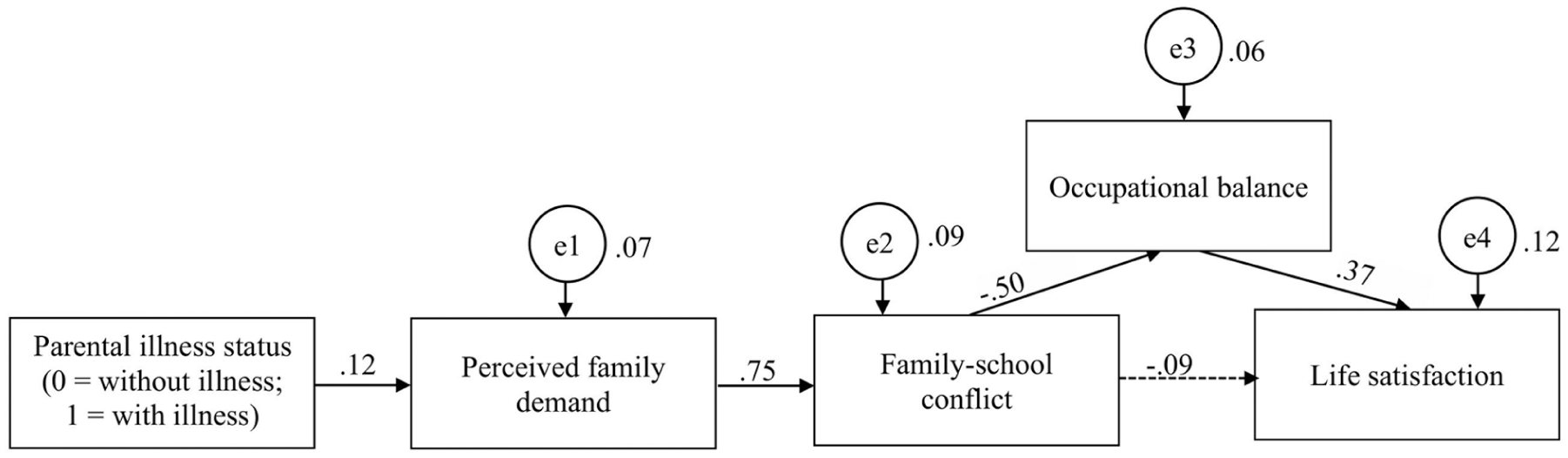
Model fit diagram for the hypothesized path model of parental illness status (with versus without illness) on life satisfaction with estimated standardized path weights.
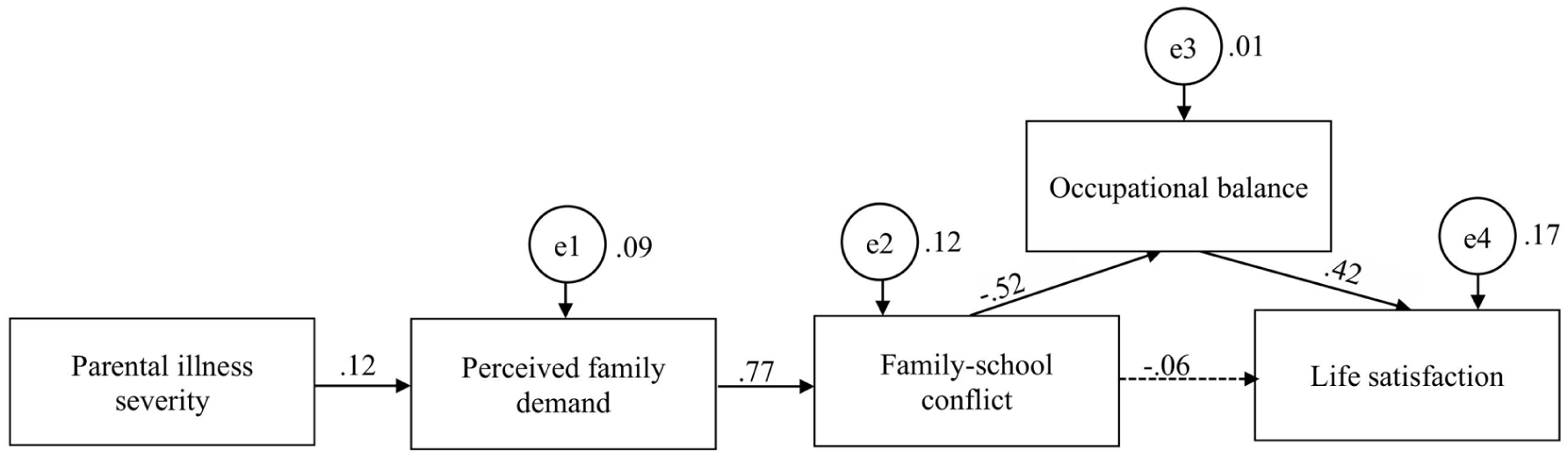
Model fit diagram for the hypothesized path model of perceived parental illness severity on life satisfaction with estimated standardized path weights (among students of parents with physical illness).
Methods
Participants
The sample consisted of 324 college students representing 45 U.S. states. Regarding gender identity, 205 (63%) participants identified as female, 91 (28%) as male, 14 (4%) as transgender or nonbinary, and 14 (4%) did not report. With respect to race/ethnicity, 159 (49%) participants identified as White, 48 (15%) as Asian or Pacific Islander, 45 (14%) as Black or African American, 26 (9%) as Hispanic or Latinx, 20 (6%) as biracial or multiracial, 16 (5%) as other (e.g., American Indian or Alaska Native, Middle Eastern, or Caribbean/West Indian), and 10 (3%) did not report their racial or ethnic identity. Class levels were nearly evenly distributed among freshmen (n = 69, 21%), sophomores (n = 75, 23%), juniors (n = 65, 20%), and seniors (n = 69, 21%), with 12 (4%) participants not reporting. Finally, 168 (52%) participants lived at home with their parent(s), while 146 (45%) did not.
Measures
Parental Illness Status
Participants reported whether their parents had received a physician-confirmed diagnosis of a chronic medical illness. Those who indicated that at least one parent had a diagnosis were given a follow-up question to assess the perceived severity of the illness on a 4-point scale, ranging from 1 (not serious at all) to 4 (very serious).
Perceived Family Demand (PFD; Boyar et al., 2007)
The 4-item PFD scale assesses an individual’s global perception of the intensity of responsibility within the family (e.g., “I have a lot of responsibility in my family”) on a 5-point Likert-type scale, ranging from 1 (strongly disagree) to 5 (strongly agree). Evidence of dimensionality, discriminant validity, predictive validity, and internal consistency has been reported (Boyar et al., 2007). This scale showed good internal consistency in this study (α = .87).
Family–School Conflict (FSC; Olson, 2014)
The strain-based (FSC-strain; 5 items) and time-based (FSC-time; 5 items) family-to-school conflict subscales of Olson’s (2014) Work–Family–School Conflict (WFSC) measure assess perceived role conflict in terms of strain (e.g., “Due to stress at home, I am often preoccupied with family matters at school”) and time (e.g., “My family life often conflicts with my school class schedule”). Items were rated on a 7-point Likert-type scale ranging from 1 (strongly disagree) to 7 (strongly agree). The two subscales were combined to generate an overall family-to-school conflict score in this study. Results of a confirmatory factor analysis supported a single-factor structure, with factor loadings ranging from .80 to .91. The 10-item measure demonstrated excellent internal consistency with the current sample (α = .95).
Occupational Balance–Questionnaire (OB-Quest; Dür et al., 2014)
The 10-item OB-Quest is a generic instrument that assesses occupational and life balance of patients and healthy people. Each item is rated on a 3-point scale, where 1 indicates a positive score and 3 a negative score. Items were subsequently reverse-scored so that higher scores reflected better life balance. An acceptable internal consistency reliability (α = .70) was obtained in this study.
Satisfaction With Life Scale (SWLS; Diener et al., 1985)
The 5-item SWLS measures global evaluative judgment of life satisfaction on a 7-point scale, ranging from 1 (strongly disagree) to 7 (strongly agree). The SWLS has been used extensively to assess the life satisfaction component of subjective well-being. Strong evidence of this scale’s internal reliability, convergent validity, and discriminant validity—specifically from emotional well-being measures—has been documented. Moreover, the SWLS has shown sufficient sensitivity to changes in life satisfaction over the course of intervention (Pavot & Diener, 2009). In the current sample, the scale’s internal consistency was good (α = .87).
Procedure
The research protocol was approved by the Institutional Review Board of the City University of New York (CUNY). College students in the United States were recruited via various online methods, including postings on social media, discussion forums (e.g., Reddit), and research websites (e.g., Psychological Research on the Net). Participants completed the study measures through an online questionnaire on the SurveyMonkey platform. At the onset of the study, an internet-based informed consent form was presented, outlining the study’s risks and benefits, the voluntary nature of participation, and the assurance of anonymity. Consent was provided by clicking the “I agree to participate in this study” button. As an incentive, participants could choose to enter a drawing for one of thirty US$50 gift cards. Data were collected between February 2021 and February 2022. The reporting of this cross-sectional observational study follows the STROBE (Strengthening the Reporting of Observational Studies in Epidemiology) recommendations (von Elm et al., 2008).
Statistical Analysis
Descriptive statistics were used to summarize the main study variables, and correlation analyses were conducted to examine the associations among them. Because the main study variables did not meet the assumptions of normality, nonparametric statistics (e.g., Kendall’s tau-b correlation, Mann–Whitney test, Kruskal–Wallis test) were employed to examine the relations among study variables. Harman’s single-factor analysis was conducted to assess the potential for common method bias (Podsakoff et al., 2003). Results revealed that the total variance extracted by a single factor was 39.43%. Since this is the recommended 50% threshold, it suggests that common method bias was not a significant concern and did not substantially distort the data in this cross-sectional study.
Path analysis, a form of structural equation modeling (SEM), was conducted to test the hypothesized models and examine the mediating effect of occupational balance on the relationship between family–school conflict and life satisfaction. This statistical methodology enables the examination of structural relationships among observed variables while concurrently analyzing direct and indirect paths (Schumacker & Lomax, 2010). Model fit was evaluated using several fit indices, including χ2/df, comparative fit index (CFI), Tucker–Lewis index (TLI), root mean square error of approximation (RMSEA), and standardized root mean square residual (SRMR). Acceptable model fit was defined by the following criteria: χ2/df ≤ 5 (Schumacker & Lomax, 2010), CFI ≥ 0.90, TLI ≥ 0.90, RMSEA ≤ 0.08, and SRMR ≤ 0.08 (Byrne, 1994; Hu & Bentler, 1999). Statistical analyses were primarily conducted in IBM SPSS Statistics version 30 (IBM Corp., 2024), and path analyses were performed in AMOS version 30 (Arbuckle, 2024). Conventional decision rules for statistical significance (p < .05) and effect size (small = .10, medium = .30, large = .50) were applied when interpreting the results.
Results
Descriptive Statistics and Correlation of Variables
One hundred eighty participants reported that at least one of their parents (father = 64, mother = 68, both parents = 48) had been diagnosed with a medical illness, while 144 participants reported that neither of their parents had a physical illness. Parents’ medical diagnoses included cancer (n = 37), type 1 diabetes (n = 22), type 2 diabetes (n =26), multiple sclerosis (n = 5), chronic pain (n = 17), chronic fatigue (n = 4), asthma (n = 9), cardiovascular disease/heart disease (n = 17), and others (e.g., arthritis, chronic obstructive pulmonary disease [COPD], Crohn’s disease, etc.; n = 43).
Relations Between Main Study Variables
Parental illness status was dummy coded (0 = no parent diagnosed; 1 = at least one parent diagnosed). Compared to their peers, college students with an ill parent reported significantly higher perceived family demand (z = −2.37, p = .018), greater family–school conflict (z = −3.28, p < .001), and lower occupational balance (z = −3.21, p < .001). Levels of life satisfaction, however, were similar across both groups (z = −1.28, p = .200).
Table 1 presents the correlations between study variables. Perceived family demand was strongly and positively correlated with family–school conflict (τb = .54, p < .001), while demonstrating mild negative correlations with both occupational balance (τb = .20, p < .001) and life satisfaction (τb = .12, p = .002). Family–school conflict was moderately negatively associated with occupational balance (τb = −.35, p < .001) and mildly negatively associated with life satisfaction (τb = −.20, p < .001). In addition, occupational balance was moderately positively correlated with life satisfaction (τb = .31, p < .001). Similarly, among college students with an ill parent, perceived parental illness severity was positively correlated with both perceived family demand (τb = .27, p < .001) and family–school conflict (τb = .21, p = .002).
Kendall’s tau-b Correlations Between Study Variables.
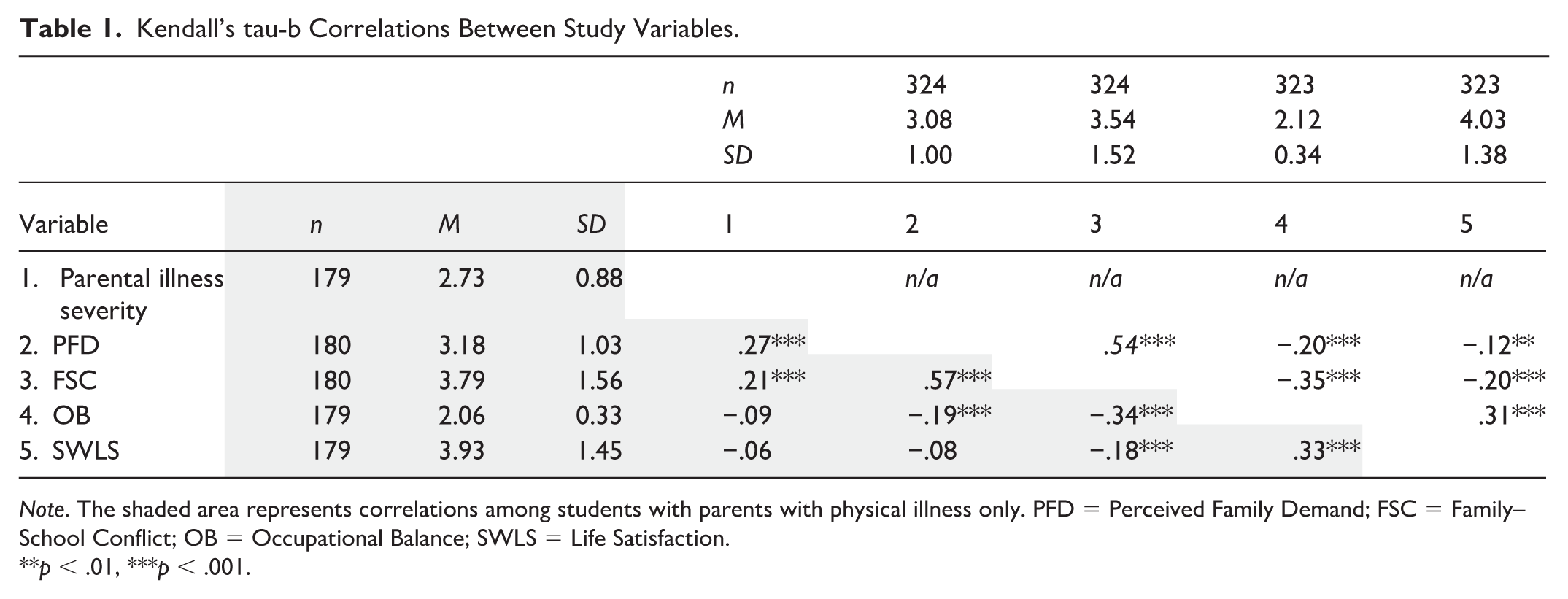
Note. The shaded area represents correlations among students with parents with physical illness only. PFD = Perceived Family Demand; FSC = Family–School Conflict; OB = Occupational Balance; SWLS = Life Satisfaction.
**p < .01, ***p < .001.
Path Analyses
A path analysis was conducted to test the hypothesized model regarding the relationships between parental illness status (with versus without illness), perceived family demand, family–school conflict, occupational balance, and life satisfaction (Figure 1). The following model fit indices suggested a relatively good fit: χ2/df = 3.085; CFI = 0.952; TLI = 0.905; SRMR = 0.056; and RMSEA = 0.080 (90% CI [0.037, 0.127], p-close = 0.114).
The squared multiple correlations indicated the model explained 2.1% of the variance in perceived family demand (p < .001), 55.8% in family–school conflict (p < .001), 25.1% in occupational balance (p < .001), and 17.4% in life satisfaction (p = .002). The standardized regression weights revealed a significant mild direct effect of parental illness status on perceived family demand (β = 0.15, p = .021), a strong positive effect of perceived family demand on family–school conflict (β = 0.75, p < .001), a strong negative effect of family–school conflict on occupational balance (β = −0.50, p < .001), and a moderate positive effect of occupational balance on life satisfaction (β = 0.37, p < .001). Family–school conflict had no direct effect on life satisfaction (β = −0.09, p = .234). However, the analysis of indirect effects demonstrated that family–school conflict had a significant indirect effect on life satisfaction (β = −0.18, p < .001), which was explained through occupational balance. The results suggested that occupational balance fully mediated the relationship between family–school conflict and life satisfaction. The standardized direct, indirect, and total path effects are reported in Table 2.
Direct, Indirect, and Total Effects of the Hypothesized Mediation Path Model of Parental Illness Status on Life Satisfaction.
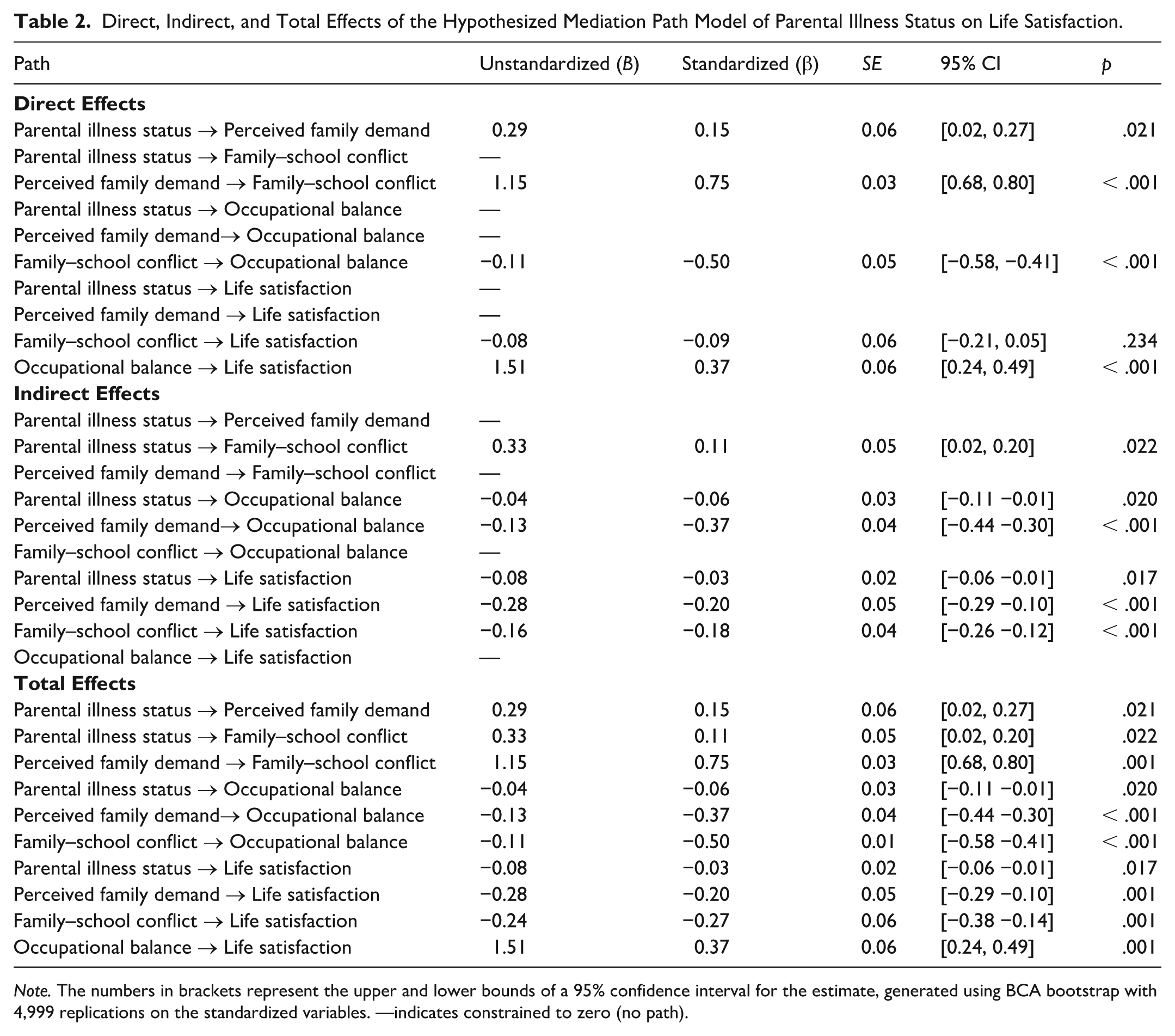
Note. The numbers in brackets represent the upper and lower bounds of a 95% confidence interval for the estimate, generated using BCA bootstrap with 4,999 replications on the standardized variables. —indicates constrained to zero (no path).
Another path analysis was conducted to test the hypothesized model on the relationships between perceived parental illness severity and other study variables among students who had parents with physical illness (Figure 2). The model fit indices indicated a good fit: χ2/df = 1.523 (p = .179); CFI = 0.982; TLI = 0.964; SRMR = 0.050; and RMSEA = 0.054 (90% CI [0.000, 0.126], p-close = .391).
The squared multiple correlations indicated the model explained 13.3% of the variance in perceived family demand (p < .001), 58.8% in family–school conflict (p < .001), 26.8% in occupational balance (p < .001), and 20.3% in life satisfaction (p = .002). Results revealed a significant moderate direct effect of perceived parental illness severity on perceived family demand (β = 0.37, p < .001), a strong positive effect of perceived family demand on family–school conflict (β = 0.77, p < .001), a strong negative effect of family–school conflict on occupational balance (β = −0.52, p < .001), a moderate positive effect of occupational balance on life satisfaction (β = 0.42, p < .001). No direct effect of family–school demand on life satisfaction was observed (β = −0.06, p = .579). The analysis of indirect effects showed that family–school conflict had a significant indirect effect on life satisfaction (β = −0.21, p < .001) through occupational balance. The results suggested that occupational balance fully mediated the relationship between family–school conflict and life satisfaction. Table 3 reports the standardized direct, indirect, and total path effects.
Direct, Indirect, and Total Effects of the Hypothesized Mediation Path Model of Perceived Parental Illness Severity on Life Satisfaction.
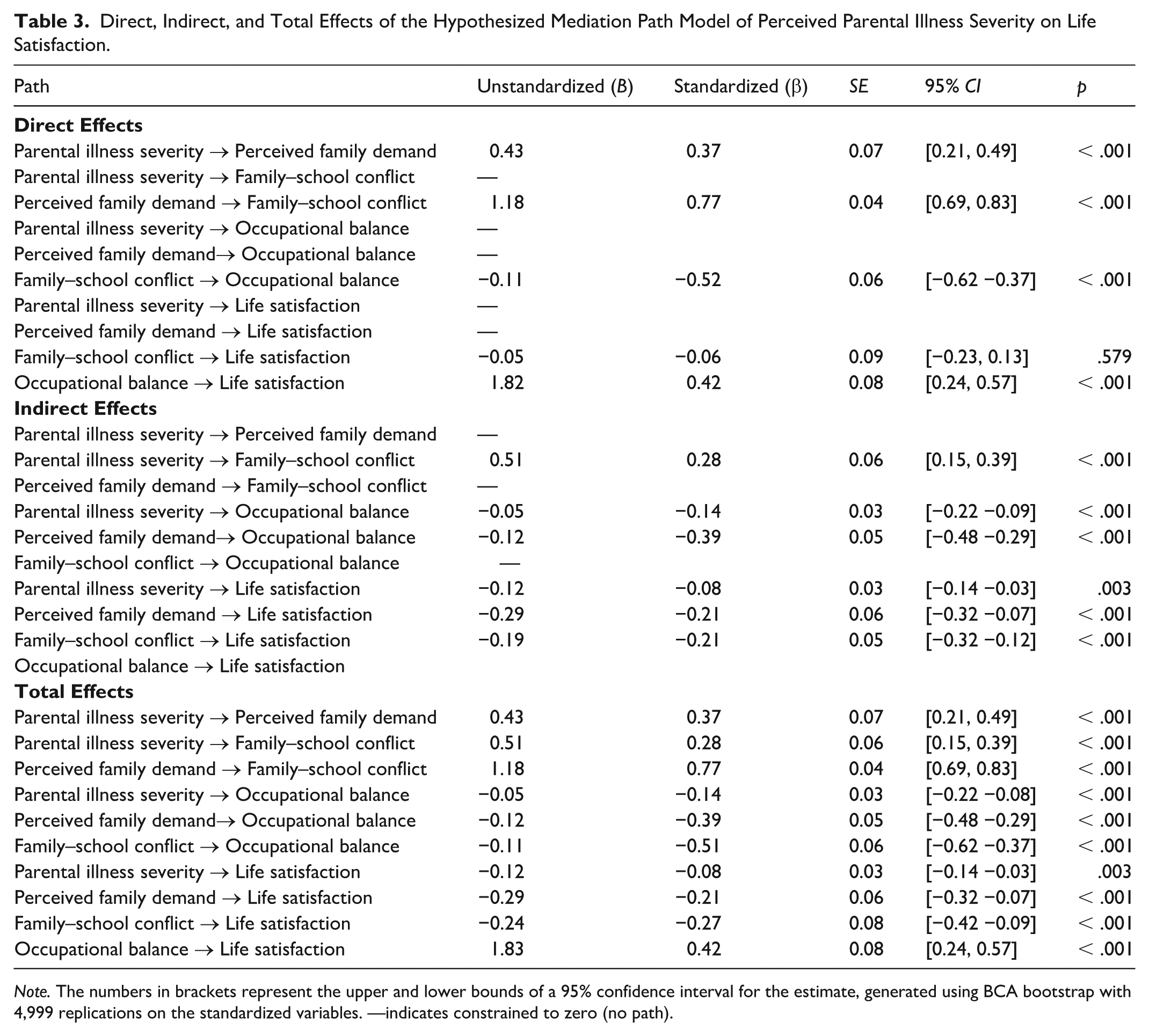
Note. The numbers in brackets represent the upper and lower bounds of a 95% confidence interval for the estimate, generated using BCA bootstrap with 4,999 replications on the standardized variables. —indicates constrained to zero (no path).
Discussion
As expected, college students with physically ill parents, compared to those with healthy parents, reported greater family demands, more family–school conflict, and lower occupational balance. Yet both groups showed similar levels of life satisfaction, suggesting that, despite experiencing parental illness as a stressful event, young adults demonstrate resilience and may even experience growth (e.g., Jessop et al., 2022; Kinnunen et al., 2021). Such positive outcomes may emerge through strengthened family bonds and the sense of purpose and emotional maturity that comes from supporting their parents and family (Duzen et al., 2026). Young adults may find meaning in life through a parent’s illness, form closer relationships with family members, develop self-efficacy and a sense of gratification, allowing them to feel satisfied in most areas of life even when they experience heightened stress and have less time for personal activities (Dang et al., 2024). Similarly, among students with an ill parent, perceived illness severity was linked to perceived family demand and family–school conflict but was unrelated to life satisfaction. These results suggest that the effects of parental illness on college students are not predetermined; rather, they may depend on a complex interplay of stressors, coping resources, and contextual factors (Ahn et al., 2025; Landi et al., 2022).
The findings differ from Jørgensen et al.’s (2022) study, which reported a strong association between parental illness and life satisfaction among adolescents. Such a discrepancy may stem from variations in sample characteristics and differences in the measurement instruments employed across studies. They may also reflect the possibility that parental illness exerts different effects on adolescents than on college students, given developmental, contextual, and role‑related differences between these groups (Wood et al., 2018). Research suggests that youth’s life satisfaction decreases drastically throughout adolescence and emerging adulthood (Orben et al., 2022), and that various family, school, and community factors may play different roles in shaping life satisfaction across these developmental periods (Handa et al., 2023). Therefore, it is possible that parental illness has a different degree of impact on college students’ life satisfaction than on adolescents, and that emerging adults’ life satisfaction is less directly affected by parental illness because they possess greater internal and external resources (e.g., cognitive and emotional maturity, self-regulation, autonomy) (Wood et al., 2018) and derive satisfaction from a wider range of life domains (e.g., work, community, social relationships) (Handa et al., 2023). This highlights the importance of adopting a developmental lens and a life‑span approach to understand the impact of parental illness on children, adolescents, and emerging adults.
Applying a life-balance approach and an occupational balance framework to understand the relationship between parental illness and college students’ adjustment, the hypothesized path models were supported by the data from this study. The results suggest that parental illness heightens college students’ perceived family demands (Knopf et al., 2022), which subsequently contributes to increased family–school conflict (Moberg et al., 2017). The effects of family–school conflict on life satisfaction are then mediated by occupational balance. Achieving and maintaining occupational balance may serve as a buffer, mitigating the negative impacts of parental illness on college students (Huertas-Hoyas et al., 2025).
Research has reported that family role shifts and redistributions are common following parental illness, and children and young adults often take on more household responsibilities to accommodate family needs (Duzen et al., 2026). According to Pedersen and Revenson (2005), the severity of parental illness, regardless of the type of diagnosis, has indirect effects on child and adolescent adjustment. More severe parental illness is associated with more functional impairments, which have a greater impact on the parents’ ability to fulfill familial roles and responsibilities, increasing distress in family members and risks of poorer adjustment in children and adolescents (Kallander et al., 2018; Pakenham & Cox, 2015). Similarly, the current study revealed that parental illness heightens perceived family demands for college students, and perceived family demands increase with the perceived severity of parental illness.
When parents are physically ill, especially when their ability to function is impaired, college students, as emerging adults, are often expected to assume greater family responsibilities. These roles may include handling household chores, caregiving for ill parents, elderly relatives, or younger siblings, and managing family finances (Mackie et al., 2022; Ornstein & Caruso, 2024). Furthermore, some students may need to provide financial support to cover medical bills, medications, and other illness-related costs. Beyond instrumental tasks, these students are also frequently expected to provide emotional support for their parents and other family members (Van der Werf et al., 2020). Consistent with previous research (Ireland & Pakenham, 2010; Kallander et al., 2018), this study found that higher levels of parental illness severity and functional impairment were associated with increased caregiving and family demands.
Although assisting with family duties can yield positive outcomes for college students, such as enhanced self-reliance, increased resilience, and a sense of self-efficacy (Dariotis et al., 2023), assuming emotional, practical, or financial responsibilities that exceed their developmental capacity can significantly harm their well-being (Greene et al., 2017).
Consistent with the literature, the results of this study suggest that the heightened family demands placed upon college students due to parental illness may conflict with their academic pursuits, campus life, and interpersonal relationships (Kettell, 2020; Moberg et al., 2017; Van der Werf et al., 2020), ultimately impacting their overall well-being and quality of life (Suchak, 2014). The cumulative burden of these demands likely increases young adults’ vulnerability to psychological distress (Greene et al., 2017; Landi et al., 2021).
The findings suggest that occupational balance may mitigate the impact of family–school conflict on college students’ life satisfaction. This aligns with research indicating that occupational balance mediates mental health outcomes during challenging circumstances (Lipskaya-Velikovsky et al., 2025; Tapia et al., 2022). Despite the pressures of parental illness, engaging in a balanced and varied set of purposeful daily activities—encompassing family, school, work, community involvement, relaxation, and social engagement—may buffer college students against the negative effects of family–school conflict. Consequently, students could benefit from targeted strategies designed to help them maintain these valued roles and occupations amid heightened family demands.
It is important to note that achieving occupational balance is not always feasible, as the stress associated with managing multiple roles can significantly undermine an individual’s ability to maintain equilibrium across life domains (Huertas-Hoyas et al., 2025). While occupational balance is a potent mechanism for maintaining life satisfaction, it remains a fragile state. The cumulative demands of family, school, and social responsibilities can exceed an individual’s capacity to self‑regulate, making balance difficult or even impossible to achieve without external support. This reality underscores the need for an ecological framework of support, in which resources at the individual (e.g., self-management strategies, adaptive coping skills), interpersonal (e.g., practical and emotional support), organizational (e.g., flexible academic accommodations, such as deadline extensions, hybrid attendance options, or reduced course loads), and societal (e.g., access to affordable medical care) levels work together to enable and sustain occupational balance for college students experiencing stressful life events, such as parental illness (Ornstein & Caruso, 2024).
Limitations
This study has several limitations. The use of convenience sampling introduces potential selection bias. It is possible that the current sample consists of particularly high-functioning college students, whereas those most negatively affected by parental illness, including individuals unable to attend college or who have dropped out of higher education (Kettell, 2020), may not be represented. Furthermore, the relatively small sample size limits the generalizability of the findings. The exclusive use of self-report measures inherently posits potential for reporting biases. While self-reports provide essential insights into students’ subjective experiences, they may not always align with objective realities. For instance, the severity of parental illness was assessed based on participants’ perceptions, which may not correspond to the actual medical condition. Future research should incorporate objective clinical evaluations or corroborating medical data alongside student reports.
This study did not address other forms of role conflict, such as those involving peer and romantic relationships, extracurricular activities, or employment, which may also impact student outcomes. Future research should explore a broader range of role conflicts (e.g., family–work, work–school, family–romance) to better understand their collective influence on well-being. Furthermore, the study’s cross-sectional design precludes establishing causal relationships between variables. The mediating effect of occupational balance warrants further verification through longitudinal or experimental designs (Maxwell & Cole, 2007).
Conclusions
The findings offer critical insight into the experiences of college students navigating parental physical illness—a significantly stressful life event for emerging adults. Beyond typical academic pressures and developmental milestones, such as career planning and interpersonal navigation, these students often assume expanded family roles. The resulting conflict between home and school demands highlights the necessity of maintaining occupational balance. Occupational therapists and health professionals can support these students by evaluating their role participation, identifying imbalances, and fostering essential skills, such as time management, boundary setting, and self-care, to help them manage competing demands and maintain personal well-being more effectively.
Footnotes

Ethical Considerations
The IRB at the City University of New York (CUNY) approved this research (#2021-0061). The author complied with the ethical guidelines stipulated by the APA for this study.
Consent to Participate
As proved by the CUNY IRB, participants were presented with internet-based informed consent at the onset of the study. Participants were informed of study risks and benefits, participation was voluntary, and identity will not be disclosed. Participants gave their consent to participate in this online, anonymous survey study by clicking on the “I agree to participate in this study” button on the consent form. No personally identifiable information was obtained from the participants.
Consent for Publication
As proved by the CUNY IRB, participants were presented with internet-based informed consent at the onset of the study. The consent form included a statement indicating that the data collected during the study may be published. Participants gave their consent to participate in this online, anonymous survey study by clicking on the “I agree to participate in this study” button on the consent form.
Funding
The author disclosed receipt of the following financial support for the research, authorship, and/or publication of this article: This research was funded by a PSC-CUNY Award (# 63023-00 51)
Declaration of Conflicting Interests
The author declared no potential conflicts of interest with respect to the research, authorship, and/or publication of this article.
Data Availability Statement
The datasets generated and/or analyzed during the current study are available from the corresponding author upon reasonable request.
Artificial Intelligence (AI) Use
The author used Microsoft Copilot to edit grammar and improve clarity. The author used AI for this purpose because it improved efficiency in editing while maintaining the author’s original ideas. The author reviewed and verified the accuracy of all content and takes full responsibility for the work.