






Abstract
The World Federation of Occupational Therapists emphasizes sustainability as a core component of occupational therapy education and practice. This study examined how Israeli occupational therapists perceive and apply sustainability, formally recognized but inconsistently embedded in health and social care systems. Using a cross-sectional, exploratory design, an online survey with open- and closed-ended questions was distributed via email and social media. One hundred eleven occupational therapists from diverse practice areas participated. Data were analyzed using descriptive statistics and directed content analysis. Social equity was rated as the most important sustainability principle (78.4%), followed by economic prosperity (41.4%) and environmental integrity (31.5%). Reported barriers included lack of knowledge (21%), time constraints (15%), limited organizational support (14%), limited influence (11%), and lack of incentives (11%). Findings indicate that while Israeli occupational therapists value sustainability, additional education, resources, and institutional support are needed to facilitate its integration into practice, consistent with international patterns.
Plain Language Summary
Sustainability refers to meeting present needs without compromising the ability of future generations to meet their own. In healthcare, this includes reducing waste, conserving resources, promoting economic and social responsibility, and ensuring equitable access to services. Occupational therapists support individuals’ participation in meaningful daily activities that promote health and engagement in everyday life, thereby playing an important role in advancing sustainable healthcare practices. In Israel, there is no educational, regulatory, or licensure pathway for occupational therapy assistants; therefore, occupational therapy services are provided exclusively by licensed occupational therapists. Accordingly, this manuscript refers only to occupational therapists. This study examined how occupational therapists in Israel understand and apply sustainability in their professional practice. An online survey was distributed nationwide, and 111 occupational therapists responded. The survey included questions addressing knowledge, attitudes, skills, and perceived barriers related to sustainability. Results indicated that most therapists valued sustainability and recognized its importance for individuals, communities, and the environment. Social equity, ensuring fairness and equal opportunities for all, was identified as the most important sustainability principle. However, participants reported limited knowledge about sustainability in occupational therapy and indicated that the topic had not been included in their professional education. The main barriers to implementing sustainable practices were a lack of knowledge, limited time, insufficient organizational support, and a lack of incentives. These findings suggest that although Israeli occupational therapists value sustainability, additional education, training, and workplace support are needed to integrate it into professional practice and promote more sustainable healthcare systems.
Introduction
Sustainability, Health, and Occupational Therapy
Sustainability, defined as “meeting present needs without compromising the ability of future generations to meet theirs,” is a critical global challenge affecting environmental, social, and economic systems (World Commission on Environment and Development, 1987). Increasing evidence shows that sustainable practices improve environmental conditions and promote healthier lifestyles, thereby influencing human health and well-being. Reductions in environmental pollutants improve air and water quality and are associated with lower rates of respiratory and cardiovascular disease, while sustainability-oriented lifestyle practices, such as active transportation through walking and cycling simultaneously, promote physical health and reduce carbon emissions (Garcia Diaz & Richardson, 2023; World Federation of Occupational Therapists [WFOT], 2018). In practical terms, sustainable occupational therapy practice may involve relatively small-scale, context-dependent actions, such as using telehealth to reduce travel, reusing therapeutic materials, or reducing resource consumption in clinical settings. However, the extent to which such practices can be implemented is still often shaped by organizational and systemic constraints, particularly in institutional environments where occupational therapists may have limited influence over infrastructure, procurement, and policy.
Nevertheless, as sustainability awareness has been evolving, Occupational therapy is increasingly recognized as an important contributor to sustainable development. The WFOT identified sustainability as a professional responsibility and provided guiding principles for integrating environmental, social, and economic considerations into occupational therapy education and practice (WFOT, 2012, 2018). These guidelines emphasize the relationship between occupation, health, and environmental conditions and call on occupational therapists to expand their clinical reasoning to include sustainable occupational lifestyles and to work collaboratively to foster environmentally responsible practices. (Laflamme, 2024). In the context of health and occupational therapy, the American Occupational Therapy Association (AOTA, 2022) adopted Policy E.16 in 2022, formally committing to sustainability as the integration of environmentally sustainable practices into occupational therapists’ core roles. The policy recognizes that climate-related environmental changes and resource insecurity increasingly affect quality of life and multiple dimensions of well-being, creating conditions that may restrict participation in meaningful, culturally relevant, and sustainable occupations. Despite these developments, integration of sustainability into education and practice remains uneven worldwide (Santos et al., 2025; Sassen et al., 2022). Although sustainability has been increasingly recognized as a global priority and a professional responsibility within occupational therapy, there remains limited empirical evidence regarding how occupational therapists understand and implement sustainability in everyday clinical practice, particularly outside English-speaking contexts. This gap is especially relevant in countries where sustainability is formally recognized at a policy level but inconsistently integrated into professional education and practice.
Conceptual Models: Occupation, Environment, and Sustainability
The relationship between occupation, health, and the environment is articulated in the International Classification of Functioning, Disability and Health (ICF) (World Health Organization [WHO], 2001), which conceptualizes health as a dynamic interaction between individuals and their environments. Similarly, the Person–Environment–Occupation (PEO) model (Law et al., 1996) posits that participation and occupational performance emerge from the fit among personal, environmental, and occupational factors. These frameworks highlight the relevance of environmental contexts to occupational engagement and provide a conceptual foundation for considering sustainability within occupational therapy practice.
Sustainability in Occupational Therapy Practice
For over two decades, Wilcock and Hocking (2024) have advocated for occupational therapists to acknowledge their duty to safeguard the environment by promoting ecological lifestyles and mindful occupational choices. Since then, sustainability has increasingly been positioned as integral to occupational therapy practice and education. Contemporary scholarship has further examined the reciprocal relationship between human occupation, environmental conditions, and health and well-being (Dieterle, 2020; Garcia Diaz & Richardson, 2023; Ung et al., 2020). In line with the WFOT perspectives, these relationships are shaped by broader contextual factors, including economic systems, public policies, demographic trends, health and social care infrastructures, cultural values, and historical practices (Ikiugu & Pollard, 2015; Kielhofner, 2002), which structure opportunities for occupation and influence the sustainability of occupational participation at individual, community, and societal levels (Pollard et al., 2020; Wagman, 2014). In response, occupational therapists have begun adapting practice to promote sustainability, including reducing waste, encouraging engagement in sustainable occupations, incorporating telerehabilitation, and advocating for environmentally responsible policies and professional development (Smith et al., 2020; Ung et al., 2020). Moreover, recent scholarship has also questioned whether traditional occupational therapy models sufficiently integrate sustainability, calling for more explicitly occupation-centered and ecologically oriented perspectives (Drolet et al., 2020; Drolet & Lafond, 2025). Despite this conceptual development and call to action, empirical evidence regarding how sustainability is enacted in occupational therapy practice remains limited. Much of the literature consists of qualitative studies or theoretical analyses rather than systematic examination of practitioners’ knowledge, attitudes, and behaviors (Pollard et al., 2020). Garcia Diaz and Richardson (2023) and Wagman (2014) have emphasized that occupational therapists are well positioned to support sustainable lifestyles through education, prevention, and environmental design, yet rigorous research documenting how these roles are understood and implemented is sparse (Garcia Diaz & Richardson, 2023).
To date, empirical investigation of sustainability in occupational therapy practice remains limited and geographically concentrated. Three recent empirical studies conducted in Canada (Chan et al., 2020), Australia (Seville et al., 2023), and the United Kingdom (Murray et al., 2025) have begun to address this gap. Chan et al. (2020) provided one of the first profession-specific investigations of occupational therapists’ knowledge, attitudes, and practices related to sustainability, offering a structured analytical framework for this emerging domain. All three studies found that while many occupational therapists value environmental sustainability in their personal lives and support socioeconomic equity, there remains a perceived incongruence between personal commitment and professional implementation. These findings suggest a need for greater exposure, education, and structured guidance within the profession. Recent interprofessional initiatives similarly emphasize climate literacy as a core competency for health professionals, positioning practitioners as both learners and agents of change in addressing the climate crisis (Okatch et al., 2024).
More recently, Du et al. (2025) extended this work by examining how occupational therapists perceive their professional role in responding to climate change, highlighting tensions between professional responsibility, organizational constraints, and perceived scope of practice. Together, these studies underscore the importance of examining how sustainability-related roles and responsibilities are understood within different national and health care contexts. Ung et al. (2020) further argue that occupational therapists should act as agents of change by promoting eco-responsible practices while considering individuals’ occupational intentions and the ecological consequences of daily actions. The present study builds on this body of work by applying the Chan et al. (2020) framework within the Israeli context, enabling an examination of whether similar patterns emerge within a distinct sociopolitical and health care system. Specifically, Israel is considered a climate change ‘hot spot’ within the Middle East and North Africa region, experiencing increasing heat waves, reduced precipitation, and declining air quality, with documented implications for population health (Donchin et al., 2024; Okatch et al., 2024). These environmental changes disproportionately affect vulnerable populations, including older adults and individuals with chronic conditions, commonly served by occupational therapists (Lador et al., 2025; Shapira et al., 2024). In this context, examining how occupational therapists conceptualize and implement sustainability is not only theoretically relevant but also clinically urgent. Israel has formally committed to advancing sustainable development through national reporting aligned with the United Nations 2030 Sustainable Development Goals (SDGs; United Nations, 2019). However, implementation across municipal and sectoral levels remains uneven; for example, evaluation of the Healthy Cities Network indicates substantial variability in the scope and depth of SDG-related initiatives across cities (Donchin et al., 2024). Therefore, this study’s aims are twofold: (a) to explore occupational therapists’ perspectives on their knowledge, attitudes, and skills related to sustainability, and (b) to identify the challenges and opportunities they face in integrating sustainability into their professional practice and their expectations from their workplace.
Methods
Study Design
This cross-sectional, exploratory study design employed an anonymous online survey with open- and closed-ended questions.
Participants
Licensed occupational therapists practicing in Israel were invited to participate in the study. The inclusion criteria were (1) a valid OT license from the Israeli Ministry of Health and (2) working in either government or private health care settings.
Measures
Survey Instrument and Translation Procedure
The researchers used the Chan et al. (2020) survey due to its theoretical framework. The survey comprised 7 thematic sections, including demographics (6 questions), sustainability awareness and importance (4 questions), self-perceived knowledge, attitudes, and skills (1 multi-item question), professional and organizational context (5 questions), perceived barriers and capacity for change (6 questions), sustainability-related actions and decision making (2 questions), and future competency needs (4 questions; Supplemental Appendix A). The questions were developed based on the reflection questions provided in the WFOT (2018) guiding principles. The questionnaire was translated into Hebrew with the author’s permission following established guidelines for cross-cultural adaptation (Guillemin et al., 1993). A forward–backward translation procedure was conducted by two independent bilingual (Hebrew–English) translators to ensure conceptual and linguistic equivalence. A multidisciplinary expert committee of researchers in the field reviewed all versions to resolve discrepancies and ensure semantic, idiomatic, experiential, and conceptual equivalence. Pre-testing with native speakers confirmed the comprehensibility and cultural appropriateness of the translated items. As a result, the final Hebrew version closely mirrored the original, preserving its content and intent.
Survey Rationale and Structure
The Chan et al. (2020) survey was used because it offers a theoretically grounded, profession-specific framework for examining occupational therapists’ knowledge, attitudes, skills, and actions related to sustainability. Adopting this instrument enabled us to build on existing work, maintain content relevance, and support comparison with existing literature. The analysis proceeded in two iterative stages. First, responses were independently grouped into the main thematic categories. The responses were then reviewed in detail, with attention to identifying keywords and overall meaning, and assigned to the most relevant categories. In the second stage, responses were organized around the core concepts of knowledge, attitudes, skills, potential for change, and action. A focused review was subsequently conducted to determine which categories and illustrative responses would be included in the final analytic framework and reporting, consistent with a directed content analysis approach. To strengthen rigor, a third occupational therapist-researcher with qualitative research experience independently reviewed a subset of the coded data. Rigor was further supported through triangulation across qualitative components, ongoing peer-review discussions during analysis, and reflexive dialogue among the authors, thereby enhancing the transparency and credibility of the findings. The 29-question survey consisted of demographic information, including age, gender, cultural background, geographical location, work situation, and field of work, followed by four sections on sustainability: (a) understanding of sustainability (attitudes, knowledge, and skills), (b) sustainable occupational therapy practices, (c) sustainability about individuals and communities, and (d) suggestions for professional competency in sustainability. Multiple-choice and open-ended questions were included in all the sections to ensure data consistency. Specifically, the survey included closed-ended questions with multiple-choice options and Likert-type-scale items from 1 (low) to 5 (high) or 1 (low) to 10 (high) to measure importance, knowledge, skill, interest, challenge, impact, and capacity. In addition, open-ended questions were used to gather specific insights into the attitudes and beliefs of Israeli occupational therapists.
Data Collection Procedure
After receiving ethical approval from the Ariel University institutional review board (AU-HEA-ML-20211215), Israeli occupational therapists were invited to participate via an anonymous electronic survey link hosted on the Qualtrics platform. Between 26 December 2021 and 12 March 2022, a brief description of the survey and link were distributed via relevant professional occupational therapy social media groups and emails to large health and educational organizations that employ occupational therapists. Participants were provided with an information statement prior to accessing the survey, which specified that participation was voluntary and that submission of the completed survey constituted implied consent. To ensure data integrity, Qualtrics duplicate-prevention features (single response per device/IP) and an internal attention-check item were applied. Participation was entirely voluntary, and no compensation or incentives were offered. As the survey invitation was disseminated through open networks without a defined sampling frame, the denominator of invited participants could not be established, precluding calculation of a response rate.
Data Analysis
Descriptive quantitative data were analyzed using means, frequencies, and percentages with IBM SPSS-29 software. To analyze the open-ended responses, we conducted a directed content analysis (Hsieh & Shannon, 2005). We adopted the categorization framework from the Canadian survey, using the categories they created and applying the pre-established categories they developed (Chan et al., 2020).
Results
Participant Characteristics
Of the 6,430 licensed occupational therapists with the Israel Ministry of Health (Knesset, 2021), 198 began responding to the survey. However, as the survey progressed, attrition increased as the questions became more specific. Of the 111 participants (100% female) who filled out the survey, 73 completed it in full, while the remaining participants omitted several questions. Given that specific survey segments included open-ended questions and considering the nascent nature of the field, we opted to include respondents who completed at least 50% of the survey. Work seniority ranged from 1 to 44 years (M = 17, SD = 11). Table 1 details further participant demographics.
Participant Demographics (N = 111).
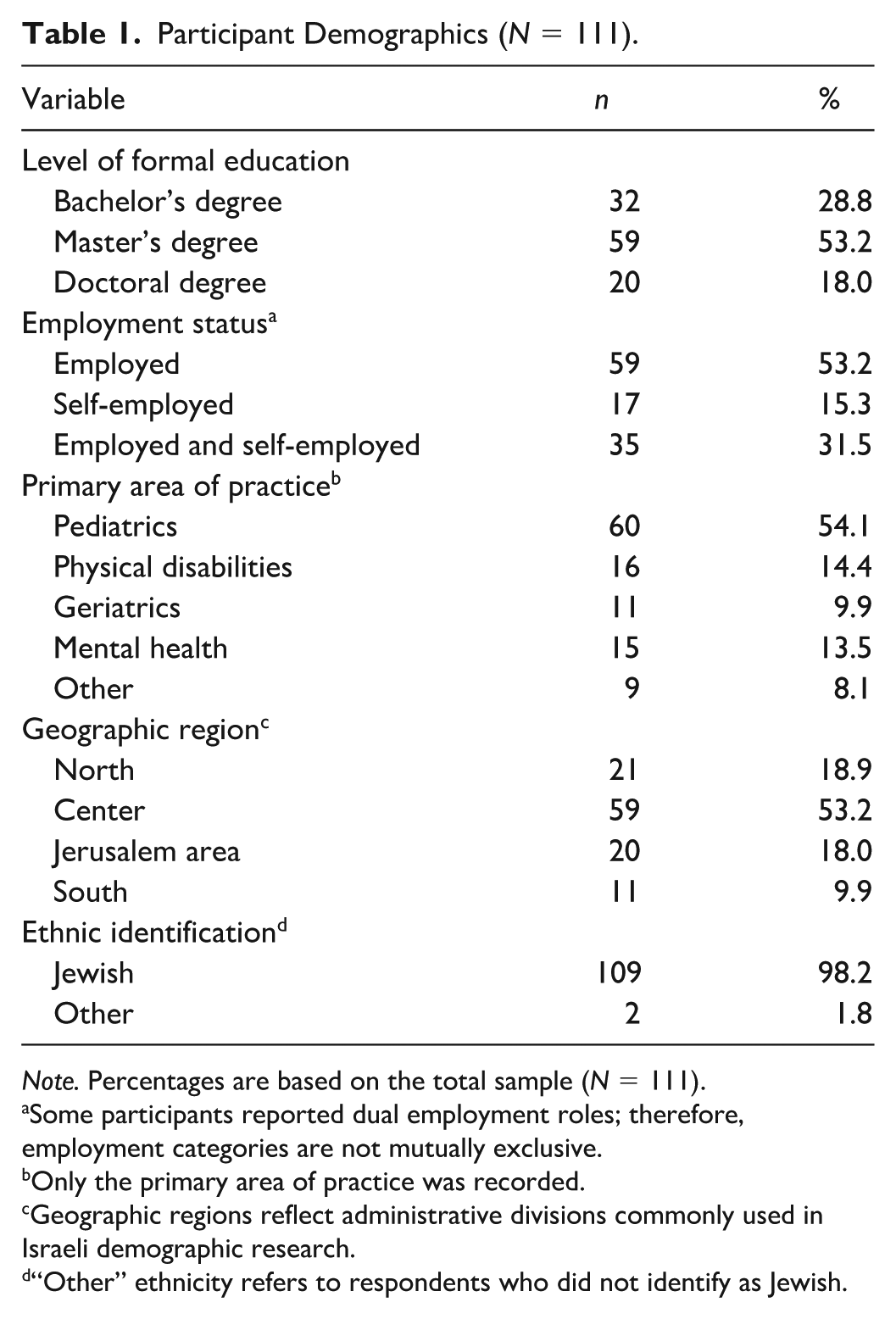
Note. Percentages are based on the total sample (N = 111).
Some participants reported dual employment roles; therefore, employment categories are not mutually exclusive.
Only the primary area of practice was recorded.
Geographic regions reflect administrative divisions commonly used in Israeli demographic research.
“Other” ethnicity refers to respondents who did not identify as Jewish.
The quantitative results of the four sections, understanding of sustainability, sustainable occupational therapy practices, sustainability in individuals and communities, and suggestions for professional competency in sustainability, will be presented and augmented with descriptive examples expressed by the participating occupational therapists. Data distribution was examined using the Shapiro–Wilk test. Results indicated that although several variables approximated normality, at least one variable significantly deviated from normality.
Knowledge and Understanding of Sustainability
Understanding current knowledge in occupational therapy regarding sustainability is important for identifying the field’s strengths and limitations and for creating sustainability guidelines (Chan et al., 2020). Ninety-one percent of respondents indicated they were unaware of the 2012/2018 WFOT position statement advocating sustainability in occupational therapy practices. Only 22.5% (n = 25) of them reported having a high or quite a high level of knowledge of sustainability, while the remaining reported low levels.
Despite limited awareness, participants emphasized sustainability as highly important and closely related to occupational therapy. For example, participants noted that “sustainability corresponds with the profession’s values” and that “prosperity in all aspects is closely related to personal well-being and quality of life.” Most participants (74%; n = 82) reported low knowledge of sustainability practices. In contrast, 23% (n = 26) reported high knowledge, and 3% (n = 3) moderate knowledge.
Although participants have limited formal knowledge of sustainability policies, they expressed a deep personal commitment to ecological practices. One individual stated, “I try to live my life ecologically as much as possible.” Another hoped for its integration professionally, “It is important to me in my private life, and I hope it is integrated in my professional life as well.”
The data also reflected an awareness of the broader implications of individual actions and the need to integrate sustainability into broader societal practices: “This is our future; we must integrate sustainability into our daily activities, into our personal and social attitudes.” These insights reveal a commitment to sustainability, emphasizing its importance beyond formal professional guidelines and illustrating its deep integration into occupational therapy’s personal values and actions.
Education
Over half of the participants (56.8%; n = 63) reported that sustainability was not included in their occupational therapy education. Only 4.5% (n = 5) reported that it was included, and 23.4% (n = 26) were uncertain. Experienced occupational therapists who began their careers before the current focus on sustainability noted that it was entirely absent from their initial training. Reflecting on the era, many participants agreed that sustainability was unimportant 20 years ago.
In contrast, newer occupational therapists described sustainability as increasingly integrated through concepts linking occupation, environment, and health. Both experienced and newer therapists stated that they are interested in continuing studies on applying sustainability to occupational therapy practice: “I would like to delve deeper into the field from the foundation and its relevance to the present day, and not as something superficial and general as has been done until today.” They also voiced their desire for “training that gives practical ideas” and “reliable information about sustainability and occupational therapy.”
Universities prioritizing sustainability education and research can serve as living laboratories for sustainable practices, inspiring students through hands-on experiences and demonstrating real-world applications of sustainability principles to solve complex problems. Moreover, by incorporating sustainability concepts across disciplines, universities can foster a generation of graduates prepared to develop innovative solutions and make responsible decisions that balance economic, environmental, and social considerations in their careers and communities.
Attitudes, Interests, and Values
Participants rated the importance of the three pillars of sustainability: environmental/ecological integrity, economic prosperity, and social equity (1 = low importance and 5 = extremely important). Social equity was most frequently rated as extremely important (78.4%; n = 87). Participants emphasized community health, equitable services, and resource sharing. Participants delineated the community health-related role as “providing health services for each client and ensuring social equity in the health care field.” Specifically, occupational therapists stated the importance of “social involvement and social tolerance, helping others, caring, and volunteering to strengthen the community and social concern for the weak,” and “exchanging resources of knowledge, equipment, professional skills, and strengthening social ties.”
Economic prosperity was rated as extremely important by 41.4% (n = 46). Participants emphasized the importance of increasing service capacity in urban and rural areas by expanding the team to deliver remote services. They also emphasized economic-related avenues when working with clients, including supporting return to productivity and promoting cost-effective consumption and resource sharing within communities. Regarding urban planning, participants noted that “it is important to consider universal design (e.g., mindful architecture, accessibility) while considering available options and budgets.” Only 31.5% (n = 36) rated environmental/ecological integrity as extremely important, such as “changing daily habits that harm the environment” and “cultivating the habit of recycling.” Nevertheless, participants described practical, environmentally sustainable behaviors, for example: “Recycling and reducing consumption, combined with work on management skills, promotes action.” Occupational therapists expressed the power of collective community as responsibility and shared action.
Workplace Attitudes and Culture: Personal Level
Their personal values and implementation possibilities impact occupational therapists’ actions. On a personal level, 25% felt that their actions promoting sustainable environments are low within their practice setting (Figure 1).
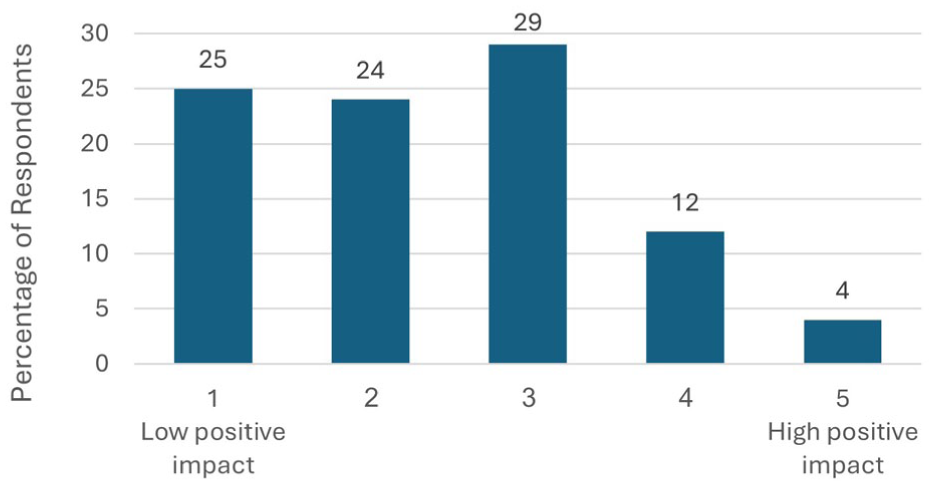
Impact of occupational therapists’ actions within their practice setting on promoting sustainable environments (Personal level).
In addition, 21% felt that their actions had a low impact on their clients’ development of sustainable occupational practices/lifestyles (Figure 2).
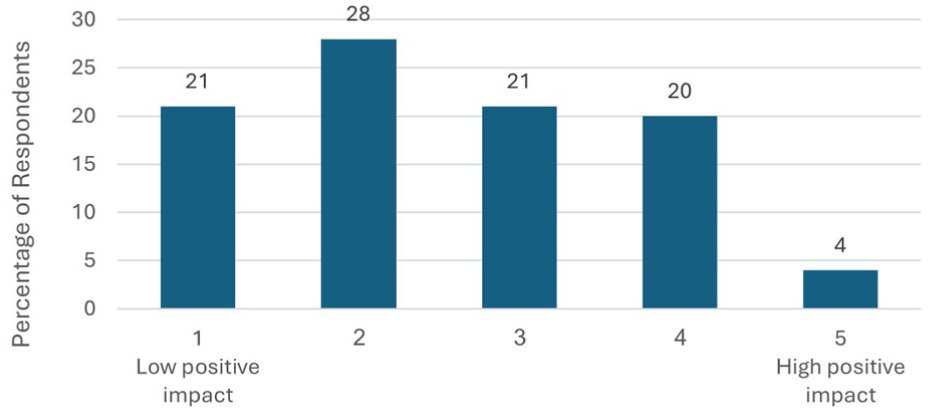
Impact of occupational therapists’ actions on their clients’ development of sustainable occupational practices/lifestyles.
Most Occupational therapists cited lack of awareness, limited resources, and socioeconomic barriers as constraints. Some noted that clients facing significant functional or economic challenges may have limited capacity to address sustainability due to preoccupation with daily survival; clients dealing with “socioeconomic barriers and significant functional difficulties may not be emotionally available to consider sustainability in the rehabilitation process.”
Workplace Attitudes and Culture: Organizational Level
Most respondents indicated that their organization either lacked a sustainability policy (24.9%; n = 28) or was unsure about it (24.07%; n = 27). Participants described a lack of knowledge and understanding about the relationship between sustainability and occupational therapy within their organizational environment. However, they noted that “sustainability is not prioritized; thus, incentives are not offered, resulting in reduced motivation to promote sustainability in the workplace.” When asked about organizational sustainability policies (i.e., environmental or ecological integrity, economic prosperity, and social equity), 32.4% (n = 36) reported none, 30% (n = 33) were unsure, and 13.5% (n = 16) reported yes. However, only 10.8% (n = 12) reported knowing how to access these policies.
From a cultural perspective, occupational therapists also noted inequalities in service provision across regions and called for greater environmental awareness through education and professional development.
Skills and Implementation of Sustainable Practices
Findings indicated a self-assessed low level of knowledge about sustainable practices on a scale of 1 to 5 (M = 2.35, SD = 1.4) and limited skills to help individuals and communities choose a healthy, sustainable occupational lifestyle (M = 2.40, SD = 0.99). Interest in developing sustainable practice was slightly higher (M = 2.52, SD = 0.99). Nevertheless, 58.6% (n = 65) believed occupational therapists have a responsibility to promote sustainable lifestyles, while 37% (n = 41) were unsure, and 4.5% (n = 6) disagreed. When asked if their occupational therapy education taught them how to address sustainability in practice, 56.8% (n = 63) reported no, 23.4% (n = 26) were unsure, and 4.5% (n = 6) reported yes.
Barriers and Capacity for Change
The greatest challenge preventing occupational therapists from integrating sustainable practice in their work was knowledge (21%; n = 23), followed by time (15%; n = 17), organizational support (14%; n = 16), ability to influence (11%; n = 12), and incentive (11%; n = 12) (Figure 3).
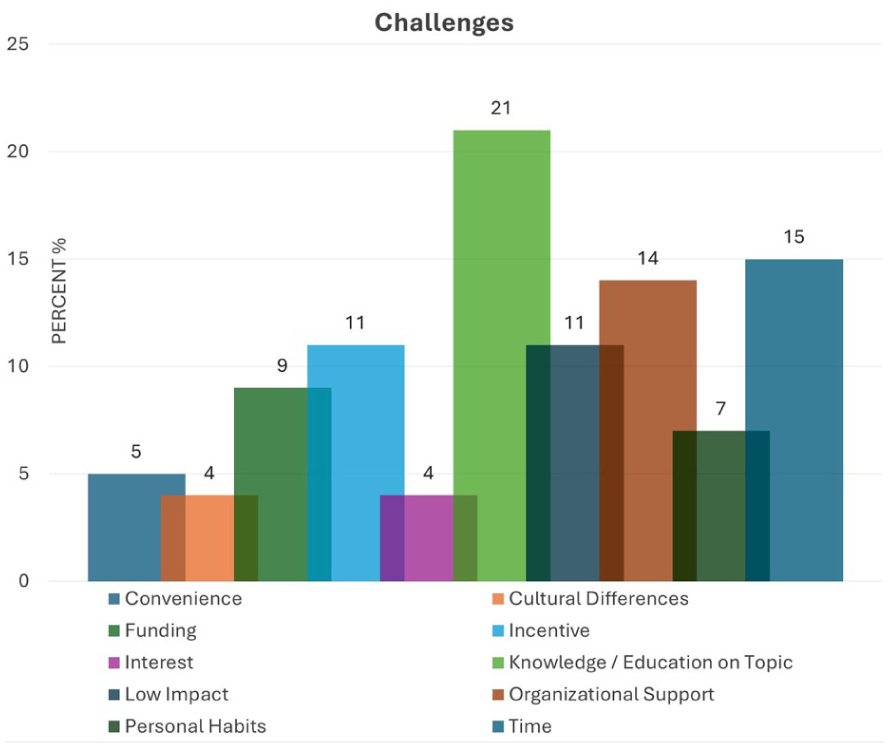
Challenges preventing occupational therapists from integrating sustainable practice in their work.
Discussion
This study explored Israeli occupational therapists’ perspectives on sustainability and its incorporation into practice. The findings indicate limited familiarity with sustainability frameworks and guidelines, alongside strong endorsement of sustainability as an important professional value. Participants reported barriers to integrating sustainability into practice, including limited knowledge, organizational constraints, and insufficient training. In 2012 and 2018, WFOT (2012, 2018) published position statements and guidelines on environmental sustainability and sustainable practice within occupational therapy. Notably, only a small proportion of respondents were familiar with these position statements. This pattern suggests a gap between positive attitudes toward sustainability and its practical implementation within occupational therapy. The tension observed between participants’ endorsement of sustainability and its limited implementation may also reflect broader theoretical constraints within the profession. Drolet et al. (2020) and Drolet and Lafond (2025) suggest that traditional occupational therapy models, often grounded in individualistic and productivity-oriented assumptions, may inadvertently limit integration of ecological responsibility into everyday practice. Their call for occupation-centered and ecologically oriented perspectives highlights the need to foreground interdependence between humans and ecosystems. Viewed through this lens, the challenge may not only be educational or organizational but also conceptual, requiring a deeper integration of sustainability into how the profession understands occupation, participation, and justice (Murray et al., 2025).
This lack of familiarity aligns with the findings from English-speaking countries, as shown in the Canadian (Chan et al., 2020) and Australian (Seville et al., 2023) occupational therapy studies. Similar to our findings, most study participants considered environmental sustainability essential in their daily lives, yet rated its importance lower in professional practice. They also reported barriers to integrating sustainability into practice. Likewise, in response to open-ended survey questions, several participants in our study commented on the potential of utilizing existing occupational therapy models to guide environmentally sustainable practice.
The Israeli context provides an additional explanatory layer. Israel has centralized and highly digitized welfare and health care systems that ensure broad access to essential services. However, income support, housing availability, and regional inequities remain significant challenges. These structural conditions, intensified by recent national crises, create a complex environment in which sustainability, equity, and participation are particularly salient (Filc, 2018; Shpaizman et al., 2024). Occupational therapists in Israel practice in a high-demand, resource-constrained system, where sustainability is increasingly recognized as a value but remains weakly integrated into training, organizational policy, and clinical routines. This contextual tension may explain the discrepancy between participants’ positive attitudes and the reported implementation challenges. Similar workplace-level barriers were reported in Canada (Chan et al., 2020), and although Australian practitioners reported greater institutional endorsement (Seville et al., 2023), they also noted limited implementation resources. Interpreting these findings through the ICF and PEO frameworks highlights the central role of environmental context in shaping occupational performance. From a sustainability perspective, these models encourage critical examination of how occupations are performed and how routines, contexts, and task demands may be modified to promote both human and ecological health (Dennis et al., 2015). The observed gap between values and implementation may therefore reflect challenges in translating conceptual recognition of environmental influence into structured practice change.
Like previous findings (Chan et al., 2020; Seville et al., 2023), the current study highlights the challenges of transferring sustainable values and behaviors from personal to professional contexts. By emphasizing eco-responsibility, occupational therapy has the potential to contribute to broader systemic change by aligning human occupation with the SDGs, thereby improving both environmental and societal outcomes (Du et al., 2025; Labonte, 1991), while recognizing that therapists may need to balance these values with client-centered practice. Occupational therapists explicitly referenced sustainability within practice models and emphasized eco-humanist values and global professional responsibility. Strengthening training and organizational support may enable occupational therapists to translate these values into meaningful professional action. Translating key documents may improve accessibility. Future research should examine whether awareness differs in countries where sustainability frameworks and SDGs (United Nations, 2019) have been formally translated.
At a societal level, these findings accentuate the potential role of occupational therapists in advancing sustainability-related responses that support participation, health equity, and community well-being in Israel, particularly in contexts shaped by population density, environmental pressures, and social diversity.
Limitations
This study has several limitations that affect the generalizability of its findings. First, the sample may not be representative of the broader occupational therapy population, as occupational therapists with a preexisting interest in sustainability may have been more inclined to respond. Consistent with the findings indicating that occupational therapy staff perceive limited organizational investment in sustainability, a self-perpetuating cycle may emerge in which reduced institutional support contributes to lower professional engagement with the topic. Furthermore, although the survey instructions explicitly stated that participation was intended for licensed occupational therapists, it was not possible to verify that all respondents met this criterion, as the survey was distributed broadly and completion was based on implied consent. Second, all data were based on self-reports and therefore reflect participants’ perceptions of their knowledge, attitudes, and skills rather than objective assessments of competency. These constructs are not equivalent, and the findings should be interpreted as indicative of perceived preparedness rather than verified knowledge or behavior. Third, the study was conducted in Israel, and its findings may not fully reflect global patterns, highlighting the need for cross-cultural research. Fourth, not all participants completed the survey, which may have affected the robustness of the data. Finally, while the study was exploratory and descriptive in design, consistent with the original survey, the instrument was used as a set of conceptually distinct items; therefore, internal consistency metrics (e.g., Cronbach’s α) were not calculated. Future research would benefit from using validated instruments to assess knowledge, attitudes, and practices related to sustainability in occupational therapy.
Study Implications and Future Directions
This study offers several implications for occupational therapy education, practice, and research.
Education: There is a need to integrate sustainability concepts into occupational therapy curricula at both undergraduate and postgraduate levels and in continuing education.
Practice: The findings highlight the need for the development and feasibility testing of educational and organizational interventions aimed at increasing sustainability-related knowledge and capacity among occupational therapists, rather than the immediate implementation of formal guidelines. Research: Future studies should aim to validate instruments for assessing sustainability in occupational therapy and to evaluate the impact of sustainability-focused interventions on client outcomes. Cross-national comparative studies will be valuable in developing globally informed practice models.
Conclusion
Our study found that occupational therapists have a basic understanding of the importance of sustainable living. They are taking small steps to incorporate sustainability into their personal lives, but are unsure how to apply it to their professional practices. They also face significant institutional obstacles that prevent them from making meaningful changes in their client work. The study results suggest that incorporating sustainability into occupational therapy education and practice is critical but also requires advocating for organizational changes to support individual and team professional efforts. While the study focused on Israel, it highlights the need for a global exploration of occupational therapists’ perspectives to promote greater impact on sustainable change. This exploratory study provides preliminary findings and was designed to offer initial insights into occupational therapists’ perspectives and practices regarding sustainability. While the findings offer valuable contributions, they should be interpreted with caution as they reflect early-stage observations that require further investigation and validation through more comprehensive and rigorous research. Accordingly, the findings highlight the need to develop and test the feasibility of educational and organizational interventions aimed at increasing sustainability-related knowledge and capacity among occupational therapists, rather than the immediate implementation of formal guidelines. Future studies should examine the effectiveness of such interventions and their impact on the scope of occupational therapy practice.
Supplemental Material
sj-docx-1-otj-10.1177_15394492261464102 – Supplemental material for Sustainable Practice in Occupational Therapy: An Exploratory Survey of Israeli Practitioners’ Knowledge, Challenges, and Practice
Supplemental material, sj-docx-1-otj-10.1177_15394492261464102 for Sustainable Practice in Occupational Therapy: An Exploratory Survey of Israeli Practitioners’ Knowledge, Challenges, and Practice by Michal Hochhauser and Sonya Meyer in OTJR: Occupational Therapy Journal of Research
Footnotes
Acknowledgements
We thank the occupational therapists who participated in this study.

Ethical Considerations
This study complied with ethical guidelines and standards for research involving human participants. Approval (AU-HEA-ML-20211215) was obtained from the Ariel University Institutional Ethics Committee.
Consent to Participate
Informed consent to participate was secured from all participants prior to their involvement in the study.
Consent for Publication
Informed consent for publication was secured from all participants prior to their involvement in the study.
Funding
The authors received no financial support for the research, authorship, and/or publication of this article.
Declaration of Conflicting Interests
The authors declared no potential conflicts of interest with respect to the research, authorship, and/or publication of this article.
Data Availability Statement
The data underlying this article cannot be shared publicly for the privacy of individuals who participated in the study. The data will be shared on reasonable request to the corresponding author.
Use of Artificial Intelligence Statement
The authors used ChatGPT, OpenAI, GPT-5.5, accessed May 24, 2026, to assist with English language editing prior to submission.
Supplemental Material
Supplemental material for this article is available online.
References
Supplementary Material
Please find the following supplemental material available below.
For Open Access articles published under a Creative Commons License, all supplemental material carries the same license as the article it is associated with.
For non-Open Access articles published, all supplemental material carries a non-exclusive license, and permission requests for re-use of supplemental material or any part of supplemental material shall be sent directly to the copyright owner as specified in the copyright notice associated with the article.
