







Abstract
In the era of media convergence, Internet users’ levels of access to current political information are diverse. Based on selective exposure theory, this study employed K-means clustering and multinomial logistic regression and 2017 Chinese National Survey Data Archive data to study the correlation between the Big Five personality traits and political information exposure. The results showed that Internet users can be divided into three types, according to the frequency of their access: comprehensive, domestic modern, and apathetic. Netizens with high extroversion were correlated with regular browsing of current political information from comprehensive accesses. Those with high agreeableness were correlated with a preference for current political information as relayed by domestic modern media. Those with high levels of neuroticism were correlated with paying little attention to current political information.
Introduction
The new information technology represented by the Internet and big data has promoted the rapid development of media convergence (Choi & Shin, 2017). Channels exposing Internet users to current political information are diverse, with the mutual integration and coexistence of traditional and modern, official and unofficial, and domestic and foreign media. A report delivered at the 19th National Congress of the CPC argued that the influence and propaganda power of the political news media and other communications platforms should be further enhanced (The State Council, 2017). The 14th 5-year Plan for China further proposed the promotion of in-depth media convergence, implementation of an omni-media communication project, and strengthening of new mainstream media (The State Council, 2021). Political news plays an important role in promulgating propaganda and promoting citizens’ adherence to acceptable ideology and political socialization. Internet users’ access preferences with regards to current political information are types of selective exposure (Stockmann, 2013). Personality is correlated with netizens’ choices in this area (Kim & Kim, 2018). However, previous studies on the selection of political media platforms have been insufficient. There has also been little research on clustering netizens according to their use frequency of political information channels. Therefore, it is significant to determine the selective mechanism employed by Internet users when accessing current political information. The research question is the correlation between the Big Five personality traits and political information exposure.
The contributions and innovations of this work are as follows. First, the clustering of Internet users and associated correlation were analyzed, dividing them into three types: comprehensive, domestic modern, and apathetic. Second, this study found that netizens with high extroversion were correlated with frequent browsing of current political information through comprehensive accesses. Netizens with high agreeableness correlated with a preference for obtaining current political information from domestic modern media. Netizens with high levels of neuroticism correlated with paying little attention to current political information. Finally, this study found that the relationship between political communication and personality is unique in authoritarian countries, and specifically explored the difference between China and Western nations.
This study was structured as follows. In Part 2: Literature Review, I adopted selective exposure theory of political communication and the Big Five personality traits from media psychology. In Part 3: Method, I described the data obtained from the 2017 Netizen Social Consciousness Survey Data in the Chinese National Survey Data Archive (CNSDA) and the innovation and significance of K-means clustering and multinominal logistic regression. In Part 4: Results, K-means clustering was used to classify netizens exposed to different channels of current political information as one of three types. Multinominal logistic regression was employed to address the correlation between the Big Five personality traits and political information exposure. In Part 5: Conclusion and Discussion, I described the conclusions, limitations, and future research directions.
Literature review
Why is it important to understand people’s selective exposure to political news channels?
People’s selective exposure to political news channels is important to academics, citizens, and the government. In terms of theory, research on selective exposure to current politics has been abundant, and important theories have been developed for decades; thus, it is a research question that scholars from around the world have considered essential. In practice, selective exposure to current politics is significant for both citizens and the government. In the era of the metaverse and digital government, citizens often choose political news channels based on their political attitudes.
In theory, people’s selective exposure to political news channels has become an increasingly important research question since the 1940s. The theory of selective exposure originated in 1944 in The People’s Choice by Lazarsfeld et al. The book described how voting behavior was influenced by the selective exposure to political news media during the US presidential election in 1940, defining selective exposure as when people choose to browse current political information according to their political interests (Lazarsfeld et al., 1944).
First, there are a number of important theories about selective exposure to political news. Selective exposure theory is based in cognitive dissonance theory, which refers to the anxiety or tension generated when people’s attitudes and behaviors are inconsistent with one another. When individuals are exposed to political news that does not accord with their values, they experience emotional resistance (Festinger, 1957). Confirmation bias theory is an important part of cognitive dissonance. Confirmation bias occurs when people pursue exposure to information that benefits them and ignore that which contradicts their own cognition (Taber & Lodge, 2006).
Second, selective attention theory is similar to selective exposure theory, but the former is more frequently applied in cognitive science. Selective attention is related to cognition, while selective exposure is associated with behavior (Johnston & Dark, 1986). Eye tracker experiments have found that selective attention can affect political news preferences. Although attitude consistency has not been found to be significant, people often choose to pay attention to news obtained from what they perceive as higher-quality sources (Kruikemeier et al., 2018; Sülflow et al., 2019).
Third, in addition to non-incidental exposure, people may also experience incidental exposure to political news (Nanz & Matthes, 2020). With the wide use of social media, people are often unconsciously and passively exposed to political news. This phenomenon is called incidental news exposure (Kümpel, 2020). The emergence of the Internet, big data and algorithms make it easier for people to be trapped in information cocoons, resulting in problems with information quality. Echo chambers increase the possibility of being exposed to similar and self-reinforcing information (Sindermann et al., 2020).
In practice, selective exposure to current political information is an important issue for both citizens and the government. First, for the former, selective exposure to information related to current politics occurs when netizens access current political information through mass or social media, based on the influence of their personal political attitudes and preferences (Carlson, 2019; Castro-Herrero et al., 2018; Stroud, 2010). The Internet and mass media influence citizens’ selective exposure to current political news, and exposure to different types of media can lead to changes in political behavior (Kaiser et al., 2021). In terms of digital political media, first-time voters can be greatly affected by political news as offered in digital media (Ohme et al., 2018).
Second, exposure to current political information has increased citizens’ understanding of the current political situation and the greater body of political knowledge, thus forming public opinion. This phenomenon has both advantages and disadvantages. Selective exposure to political news can moderate political participation. Based on their political interests, people may become more willing to participate in public affairs after selectively browsing current political news (Knobloch-Westerwick & Johnson, 2014). Conversely, if public opinion is based on misinformation, the result can be information islands and ideological biases (Mukerjee & Yang, 2021), adversely affecting public relations. Therefore, in interacting with the people, some governments have tended to guide citizens toward selective exposure to official information in order to reduce the administrative cost of dealing with the mass incidents.
In sum, it is important to academics, citizens, and the government to understand how people select political news channels. Thus, we need to understand how people choose political news channels.
How are people selectively exposed to political news channels?
People’s selective exposure to political news channels is influenced by objective policies and subjective preferences. Although most citizens obtain their political information from sources such as mainstream media portals and political movies (Guess, 2021; Jomini Stroud, 2007), different countries tend to offer different political news channels. It is important to note that with regards to subjective preferences, the validity of applying selective exposure theory to how people select political news channels has been debated. Some scholars believe that political ideas and news style affect selective exposure, while others question this. Further research is needed in this area.
Influenced by objective policies, citizens from different countries tend to choose different political news channels. In Western countries, people obtain political information from mass media (e.g. The New York Times) and social media (e.g. Meta, Twitter). Political information on Meta tends to focus on public affairs and it may promote agenda-setting (Feezell, 2018). Exposure to different types of political media can enhance the perception of political authenticity. When people are exposed to politicians on the TV news and browse politicians’ personal social media accounts, citizens’ perception of their authenticity is enhanced, helping individuals to engage in appropriate voting behavior and facilitating decision-making (Luebke & Engelmann, 2022). In China, people also access and browse current political news through mass media (e.g. People’s Daily) and social media (e.g. Weibo, WeChat) (Jia et al., 2019; Zhu et al., 2013). In addition to obtaining current political information from domestic media, the Chinese are also exposed to news from Western media, per their personal political attitudes (Huang & Yeh, 2019).
In terms of subjective preferences, the validity of the application of selective exposure theory to political news continues to be debated. One view is that people choose political news that matches their political tendencies. Political ideas such as ideology, populism, and authoritarianism directly and indirectly affect selective exposure to political news. In the era of media convergence, ideology can moderate the complex mechanisms of news sources and selective exposure. Direct navigation platforms such as Meta positively influence selective exposure, while news platforms such as Google have the opposite effect (Cardenal et al., 2019). Populism can also affect selective exposure. Populists seldom read traditional media, and prefer nonpartisan media (Stier et al., 2020). China’s political communication under the authoritarian regime is significant to this type of research. Previous work on the relationships between different types of newspapers (e.g. party media, commercial media) and authoritarian politics found that the Chinese are selectively exposed to current political news (Stockmann, 2013). Additionally, the style of current political news can affect selective exposure. Styles can be positive, satirical, casual, or serious. People who are selectively exposed to positive and casual political news are often more willing to spend time receiving such news (Knobloch-Westerwick & Meng, 2009; Stroud & Muddiman, 2013).
The other view is that selective exposure theory has been unable to adapt to real-world practices in recent years. In the era of integrated media, people click on news websites through Meta and other social software, making the audience for such news websites more diversified (Nelson & Webster, 2017). Different from traditional media, social media disrupts selective exposure and forces people to gradually adapt to current political information being disseminated via various media (Masip et al., 2018; Stroud, 2008). People do not completely reject news that contradicts their own views. In fact, audiences can often be attracted to news that is deeply opposed to their political attitude (Garrett et al., 2013).
In sum, people’s selective exposure to political news channels can be influenced by objective policies and subjective preferences. Related to subjective preferences, one’s personality can also influence the selective exposure to current political news.
Big Five personality traits
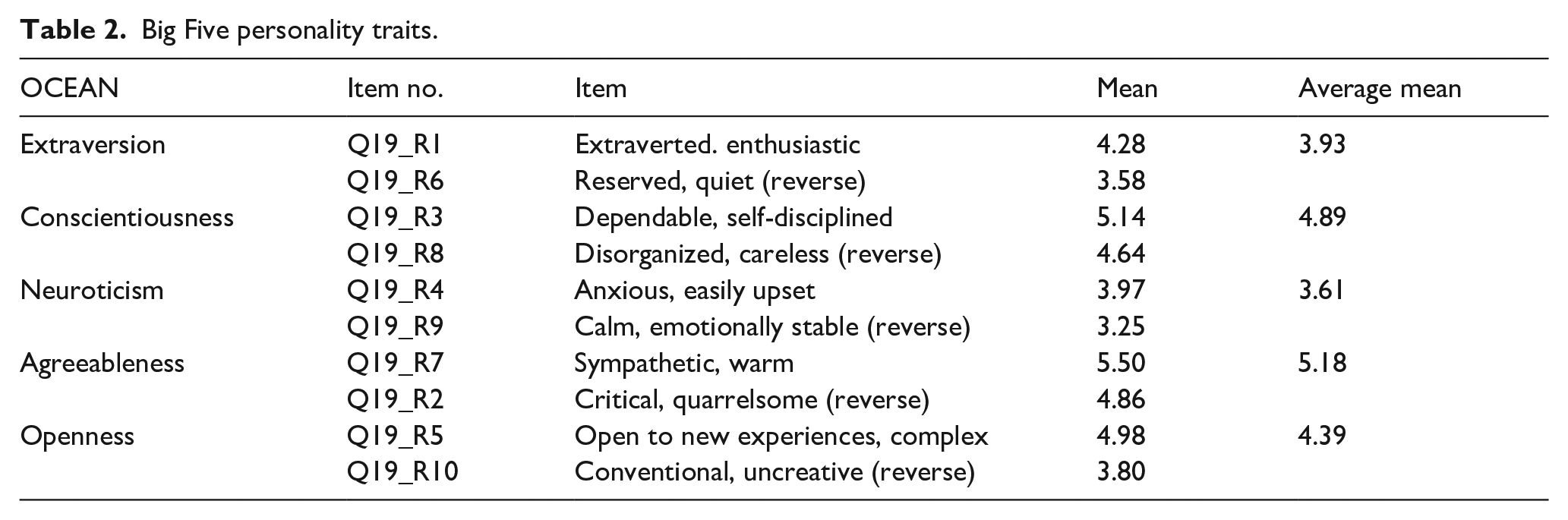
The theory of the Big Five personality traits (i.e. the five factor model) was developed by Fiske (1949). It is made up of five types: extraversion, conscientiousness, neuroticism, agreeableness, and openness, and is widely used in media psychology research. Extraversion describes those who are outgoing and passionate, conscientiousness those who are autonomic and reliable, neuroticism those who are annoyed and dysphoric, agreeableness those who are friendly, and openness those who are creative (Cottam et al., 2015). In recent years, in order to improve the efficiency of such research, scholars have developed shortened Big Five personality scales. For example, the 10 Item Personality Inventory (TIPI) is a 10-item measure for the five factor model (Gosling et al., 2003). The items are listed in the present research in Table 2.
Previous research has formed categories of people exposed to political media. For example, studies have used K-means clustering to classify journalists who publish political news into five groups, according to their political tendencies (Rogstad, 2014), and netizens into three categories, according to their news preferences (i.e. those uninterested in news, those who prefer traditional media, and those who favor modern media) (Lee & Yang, 2014). The present research uses K-means clustering to construct categories, based on previous research on this topic. The use of K-means clustering to identify three types people is one contribution and innovation of this work.
Extraversion correlates with current political media use (Seidman, 2013). People with high extraversion tend to be very enthusiastic and have a positive attitude toward public affairs. They hope to increase their awareness of political and social issues by obtaining political information from different media (Brailovskaia & Margraf, 2016). They tend to be very social, and therefore feel as if they need to know a great deal of political information in order to easily accommodate a variety of social situations. This contributes to their increased exposure to a wide range of current political media (Correa et al., 2010). Previous studies have demonstrated that high extraversion is correlated with selective exposure to political news, but the specific type of political news remains unknown. This question can be resolved by K-means clustering. Therefore, I propose H1.
H1: High levels of extraversion are correlated with selective exposure to a specific type of political news.
People with high conscientiousness tend to pursue established principles and responsibilities, and take political topics and public affairs seriously (Roberts et al., 2014). Previous studies have confirmed that highly conscientious people tend to focus on political information, often from modern media such as digital media and new media (Choi & Shin, 2017). Such people tend to engage frequently with news media and become actively involved in public affairs (Ha et al., 2013). Therefore, an enhanced sense of responsibility is their motivation to pay attention to current political news disseminated by modern media (Gil de Zúñiga et al., 2017). Previous studies have found that high conscientiousness is correlated with selective exposure to political news, but the specific type of political news remains unknown. This question can be resolved by K-means clustering. Therefore, I propose H2.
H2: High levels of conscientiousness are correlated with selective exposure to a specific type of political news.
People who are highly neurotic are sensitive to political and social problems, and prone to anxiety, insecurity, and depression (Barlow et al., 2014). Previous research has found that neuroticism is correlated with media use. For their own protection, those who are highly neurotic are less likely to use social media and may even be unwilling to obtain social media accounts. This allows them to avoid negative political information (Bogg, 2017; Bowden-Green et al., 2021). Previous studies have demonstrated that high levels of neuroticism are correlated with selective exposure to political news, but the specific type of political news remains unknown. This question can be resolved by K-means clustering. Therefore, I propose H3.
H3: High levels of neuroticism are correlated with selective exposure to a specific type of political news.
People with high levels of agreeableness tend to be warm when they interact with others, often making them very socially popular (Ashton et al., 2014). Previous research has found that highly agreeable people enjoy reading current political news. They not only use their excellent social resources to find political information, but also provide political information to their social circle (Seidman, 2013). Also, people who are highly agreeable have the ability to distinguish truth in political news (Calvillo et al., 2021). Previous studies have demonstrated that high levels of agreeableness are correlated with selective exposure to political news, but the specific type of political news remains unknown. This question can be resolved by K-means clustering. Therefore, I propose H4.
H4: High levels of agreeableness are correlated with selective exposure to a specific type of political news.
In terms of real political information, people who are highly open are easily exposed to political information (Gerber et al., 2011; Matz et al., 2017), because they tend to focus on and talk about novel affairs (Sindermann et al., 2020). Openness promotes Democrats’ use of current political news media (Kim & Kim, 2018) and can influence political liberalism through dark music media (Xu & Peterson, 2017). Previous studies have demonstrated that high levels of openness are correlated with selective exposure to political news, but the specific type of political news remains unknown. This question can be resolved by K-means clustering. Therefore, I propose H5.
H5: High levels of openness are correlated with selective exposure to a specific type of political news.
Aims and expectations
Previous research has contributed to selective exposure theory as is relates to current politics and the Big Five personality traits, as detailed in the development trends and research frontiers of this field. The extant literature has provided the novel research goals and design of the present research. Previous work on this topic has defined the concepts of selective exposure and the Big Five personality traits. It is beneficial to clarify the definitions and further explore these notions in a novel context. Previous studies have also explored the relationship between current political information exposure and the Big Five personality traits, providing a foundation for the variables selection explored herein.
However, there are certain deficiencies in the previous research on this topic. In terms of research method, many studies have conducted regression analyses on participants, but did not often subdivide the participants according to specific conditions. Previous work has also focused on selective exposure to political information in Western countries, but research in the context of China is lacking. Therefore, the contribution and innovation of the present research is its discussion of the correlation in the context of China, after clustering the Internet users.
Method
Data
In order to understand the social consciousness of Chinese netizens, the 2017 Netizen Social Consciousness Survey Data was designed and conducted by Prof. Deyong Ma of the Department of Political Science, School of International Studies at Renmin University of China from April to May of 2017. The data were then collected by the CNSDA. The questions addressed personality, media exposure, and other topics. The data can be download from http://www.cnsda.org/index.php?r=projects/view&id=69084413.
The survey was released through the Wenjuan website: https://www.wenjuan.com. This company specializes in online surveys and has more than 4 million registered users. It sends links to various questionnaires to registered users every day, who then choose whether or not to answer. Netizens who answer questions are awarded points or equivalent prizes. To ensure the reliability and validity of this survey, each IP address can respond to a survey only once. Answers from 2,379 Chinese netizens were collected through random sampling in 2017, mainly from users of the Wenjuan website (Ma, 2017).
Independent variables
The Big Five personality traits have been evaluated using a variety of different measurements. For example, the 15-item Big Five Inventory (BFI-15) and 10 Item Personality Inventory (TIPI) are short measurements (Rogoza & Fatfouta, 2019). In the present research, independent variables were measured using the TIPI because it is consistent with the first 10 items on the Q19. The TIPI is a 10-item measure of the Five Factor Model (Gosling et al., 2003): extraversion (Q19_R1, Q19_R6), conscientiousness (Q19_R3, Q19_R8), neuroticism (Q19_R4, Q19_R9), agreeableness (Q19_R7, Q19_R2), and openness (Q19_R5, Q19_R10). Reverse items were also employed to change the coding direction (Q19_R6, Q19_R8, Q19_R9, Q19_R2, Q19_R10). All items can be found in Table 2.
Innovation and significance of K-means clustering
Cluster analysis and K-means clustering
Cluster analysis is used in exploratory research to identify the characteristics of each category through dimensionality reduction. Cluster analysis can be divided into hierarchical and non-hierarchical clustering. K-means clustering is a form of the latter. The method should be employed when the number of categories is known, so that the difference in observations within the same category is minimal and observations of different categories are highly heterogeneous. One limitation is that it is necessary to decide how many categories there will be before classification begins, based usually on previous studies or subjective determination. If the number of selected categories is not appropriate, the clustering results will be difficult to explain (Lin, 2007).
Previous studies have focused on classifying media. People can get political information from Western media and domestic media (Huang & Yeh, 2019), direct navigation media and news media (Cardenal et al., 2019), party media and commercial media (Stockmann, 2013), etc. It can also be divided into three categories: tabloids, traditional media, and digital media (Kaiser et al., 2021). Previous researchers have also developed various clusters for people exposed to political media. One study used K-means clustering to classify journalists publishing political news into five groups, according to their political tendencies, and judged how likely they were to be politically non-neutral (Rogstad, 2014). Others used K-means clustering to classify netizens into three categories, according to their news preferences: those uninterested in the news and those who follow either traditional or modern media; they then conducted an in-depth study on the influence of education on each of these three types (Lee & Yang, 2014). These works have provided the theoretical foundation for this research. However, in contrast to previous clustering, the innovation of the present work is using K-means clustering to group three types of people.
K-means clustering process
The first step is to select and cbind the items according to previous research, practice, hypotheses and subjective judgment. The selected cluster items should be independent (Lin, 2007). I ran the code in R Studio. In order to select cluster items, I used the cbind function to cbind 12 items about the frequency of use of political news media (Q15_R10–Q15_R22) and renamed it prefernews (Imai, 2018).
Second, I selected the appropriate cluster center in order to run the K-means clustering. The number of observations in different categories needed to be as balanced as possible. The number of clusters had to be two to four, because as the numbers gradually increase, it is difficult to explain and rename according to the mean of each category (Lin, 2007). In terms of the number of types, this study innovatively chose three. No such classification has been made in previous studies. Selective exposure theory was applied to reflect the heterogeneity of people’s exposure to political media. I tried different numbers of cluster types for this data analysis. The reason for choosing three was that the results of the clustering were determined to be the most explanatory. Two could only reflect regular or little exposure, and this division would not have reflected the uniquely Chinese context. If divided into four groups, the clustering results differed little from one another, and it was difficult to rename each group. If I had continued to add categories, the heterogeneity would have been further weakened and the research rendered meaningless. Thus, three categories were determined to be the most reasonable. Research bias in this clustering method should be tested through meta-analysis, which is an avenue for future research. In R Studio, using the kmeans function to cluster prefernews and choosing centers = 3 to produce the three types (Imai, 2018).
Finally, the interpretation and renaming of the results must be done by the researcher, usually via descriptive statistics (e.g. the mean of each item). Then, a suitable name is given according to the characteristics of each category (Lin, 2007). In R Studio, kmprefernews$centers showed the mean of the current political information preferences for each group (see Table 3) (Imai, 2018). In order to avoid the out-of-order, I set seed to 3. Then, using the table function to show the number of people (kmprefernews$cluster) in each group (see Table 3). I summarized the characteristics of each type of netizen’s political news preferences according to the mean and renamed it as one of three types (i.e. comprehensive, domestic modern, and apathetic).
Dependent variables
Twelve items reflecting the use frequency of political news media (Q15_R10–Q15_R22) were clustered (Q15_R17 was missing from the public data) and a new dependent variable (i.e. kmprefernews$cluster) generated. Variable 1 was comprehensive, Variable 2 domestic modern, and Variable 3 apathetic. Why they were renamed in this way is explained in Section 4.2 (K-means clustering). The innovation of the present research is its discussion of the correlation after clustering the Internet users into three types.
Control variables
The control variables were chosen to ensure unbiased estimation and included gender (Q1), age (Q2), region (Q4), political status (Q5), occupation (Q7), and education (Q61). First, researchers have already conducted studies on gender and the selective exposure to political news in countries and regions with varying economic levels (Ahmed, 2020). Gender has been found to correlate with political news exposure (Benesch, 2012). Moreover, the correlation between gender and selective exposure to political news was found to be more obvious when mediated by education (Ahmed & Madrid-Morales, 2021). Second, previous research has also found that people of different ages have different political news preferences. Frequent reading of political news by young people can promote political participation (Holt et al., 2013). In particular, people born after 2000 often browse political news in different media channels and have greater variety in their preferences than older people (Diehl et al., 2019). Third, location has also been correlated with selective exposure to political news (Hmielowski et al., 2021). Due to the differences between urban and rural areas, people living in such regions are often exposed to different political news. Taking the news during the COVID-19 pandemic as an example, rural residents were often exposed to news about their local area, but infrequently read specific news about their particular rural community (Kim et al., 2020). Fourth, researchers have found that political affiliation is correlated with selective exposure to political news (Ma & Lewis, 2020). Party often affects journalists’ selective release of political news (Helfer & Aelst, 2016). Fifth, previous studies have shown that different occupations allow for different socioeconomic statuses in China, and occupational differences are correlated with selective exposure to political news (Zheng et al., 2021). Finally, education is correlated with the selective exposure to current political news through various media. In general, the higher the level of education, the higher the probability of selective exposure to political media and political participation (Neundorf et al., 2016). At the same time, media exposure can also have a counteractive effect on educational level (Ahmed & Cho, 2019). Based on previous studies, these six control variables were determined to be appropriate for the present research.
Methods of data analysis
The data were run through R Studio for the descriptive statistics, K-means clustering, and multinominal logistic regression. The descriptive statistics included frequency and mean. The K-means clustering divided 12 current political news media into three types. Then, the netizens were divided and renamed as either comprehensive, domestic modern, or apathetic. Running the multinomial logistic regression required the dependent variables to be mutually exclusive and exhaustive. The multiple logistic regression took the three kinds of people with different preferences for political information access channels as the dependent variable. The comprehensive group was set as the control group, and domestic modern and apathetic groups designated as the treatment group. This study then explored the influence mechanism of personality on these three preferences.
Results
Descriptive statistics
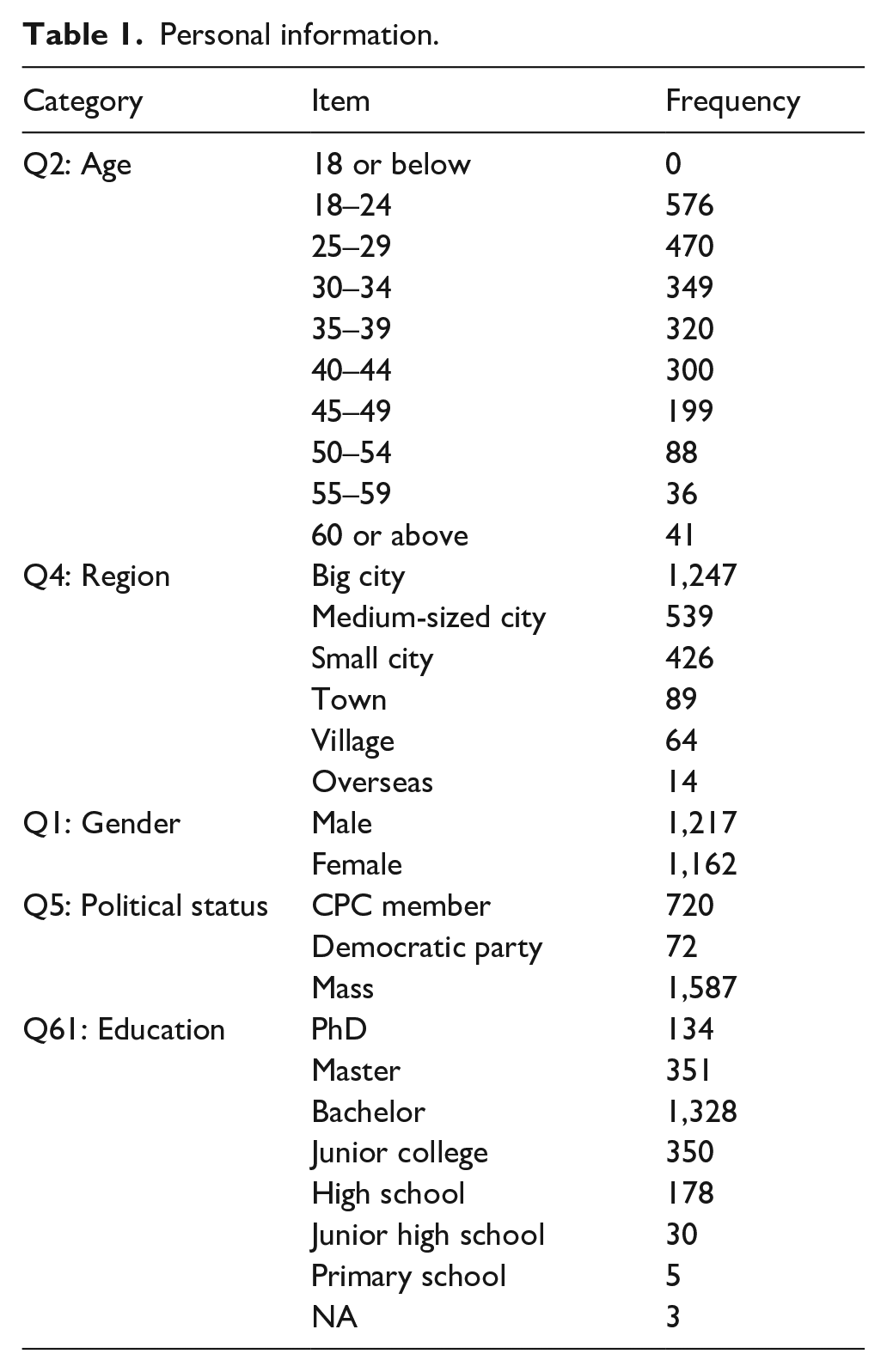
From Table 1, it can be seen that there were 1,217 men and 1,162 women who responded to this survey. Most netizens were between 19 and 24 years old; few were above the age of 55. In terms of region, most were from large cities. For political status, the largest group was mass (1,587), followed by CPC member (720), and democratic party (72). In addition, most respondents had received the bachelor’s degree. Occupations were divided among 21 types, so they are not listed in Table 1. Most were employees of enterprises and companies (692), followed by college or high school students (458).
Personal information.
From Table 2, it can be seen that the mean of agreeableness was the highest (5.18), so many respondents were determined to have strong social skills and be highly appealing to others. This was followed by the mean of conscientiousness (4.89), indicating that many participants were trustworthy and had good self-management abilities. In terms of openness, the mean (4.39) indicated that netizens held an above-average favorable attitude toward innovation. The mean of extraversion was 3.93. Finally, neuroticism was the lowest (3.61), which was between somewhat inconsistent and intermediate, indicating that a small number of respondents had psychological problems such as anxiety.
Big Five personality traits.
K-means clustering
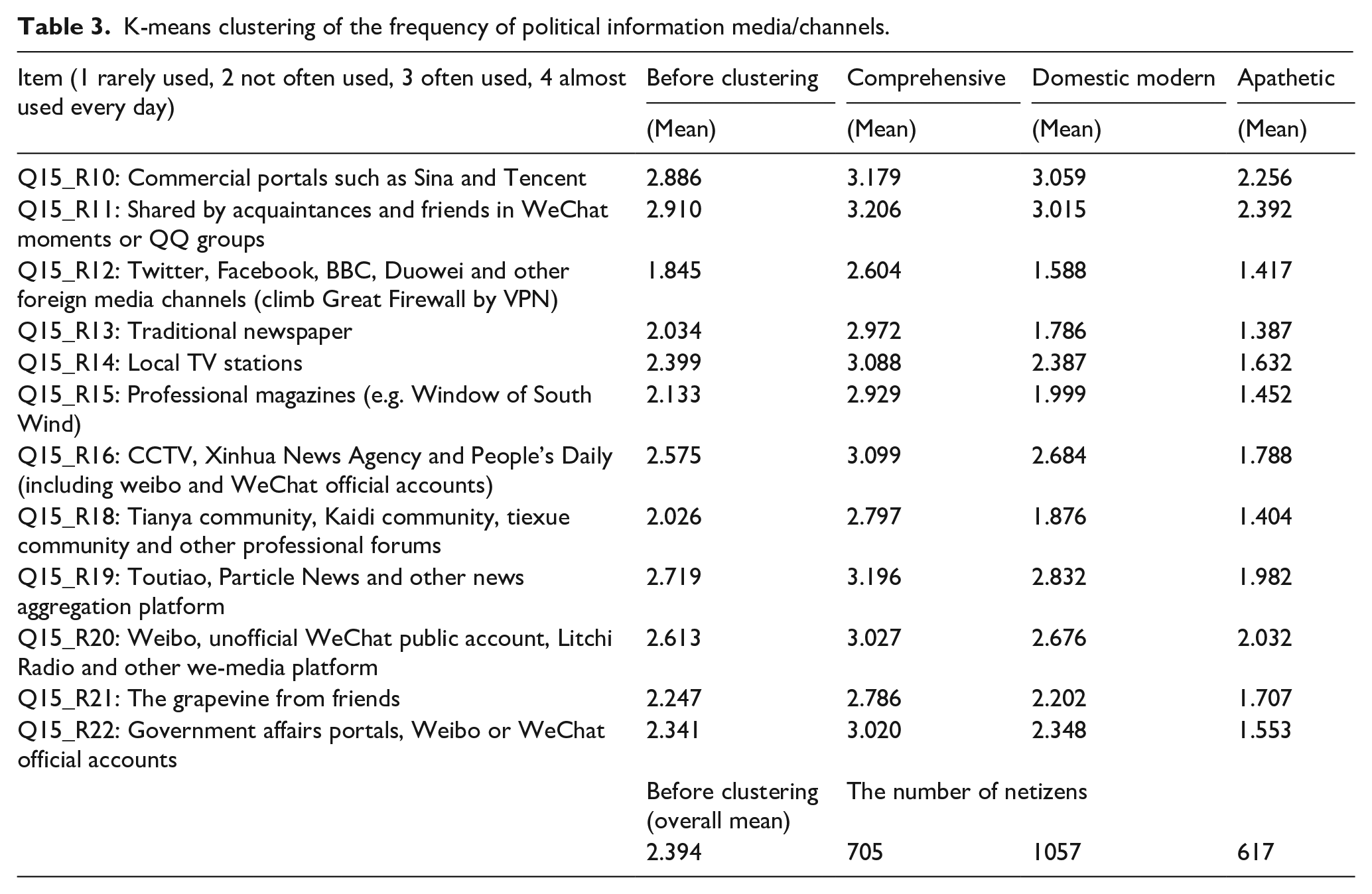
The detailed method for the K-means clustering is shown in Section 3.3 (Innovation and significance of K-means clustering). In R Studio, first, I used the cbind function to cbind the 12 items about use frequency of political news media (Q15_R10 to Q15_R22) and renamed it prefernews. Next, I used the kmeans function to cluster prefernews and chose centers = 3 to produce three types. Then, kmprefernews$centers showed the means of the current political information preferences for each group (see Table 3). To avoid the out-of-order, I set seed to 3. Finally, I used the table function to show the number of people (kmprefernews$cluster) in each group (see Table 3) (Imai, 2018). I then summarized the characteristics of each type of political news preference according to the mean and renamed it as one of three types (i.e. comprehensive, domestic modern, and apathetic).
K-means clustering of the frequency of political information media/channels.
Frequency of current political information media
From Table 3, it can be seen that the mean of Internet users’ use of 12 current political information channels was 2.394. Most had a tendency to obtain current political information from a variety of different channels. Except for foreign media (such as by climbing the Great Firewall through VPN), the other items were between “not often used” and “often used.”
First, the frequency for sharing political news through social media such as WeChat Moments and QQ Groups was the highest (2.910). WeChat is an instant messaging app frequently used in China. Moments is a social function for ordinary people on WeChat. Users can post text and pictures on Moments and share political news and other links. QQ Groups is an online platform that many people use to chat and communicate in China. People can share and discuss current political information in QQ Groups. Respondents’ access to current political information mainly came from their social networks and was influenced by strong relationships such as relatives and friends. Second, participants also browsed news through commercial portals such as Sina and Tencent (2.886). These are news platforms that also communicate political information. The third-highest was the integration platforms Toutiao and Particle News (2.719). These platforms aggregate news from different sources and recommend news based on algorithms. They reflect the influence of convenience and the precision push of information integration platforms. The fourth was we media such as Weibo (2.613). Weibo is a social media platform based on users’ relationships. Individuals can access it through a PC or mobile phone and engage in instant message sharing with the public in the form of text, pictures, videos, etc. The open information release function provides netizens with real-time diversified political information. Fifth, although party media and official media (2.575) represent official political communication in mainland China, its score was lower than that of social networks and business portal channels. The sixth highest in frequency was television programs by local news stations (2.399). TV is not as convenient as a cellphone, so this is likely why this category was less popular than others. The seventh was government affairs websites and the official Weibo and WeChat accounts (2.341). The owners of these channels are the government; they share political information on official websites and have registered official accounts on social media apps to share political information. “Internet+” public affairs channels have been improving in recent years, providing netizens with reliable political information, but the use frequency here was not high. The eighth was political insider from grapevine news (2.247), showing that some netizens had the advantage of information asymmetry. The ninth was political magazines (2.133). Few respondents browsed physical magazines to obtain current political information. The 10th was newspapers (2.034). At present, Internet users rarely browse current political information in hard-copy newspapers. The 11th was community forums (2.026). Major communities did not appear to conform to the Internet trend in recent years. The 12th and final group was climbing the Great Firewall by VPN (1.845).
Comprehensive group
From Table 3, it can be seen that the comprehensive group of respondents (705 people) preferred political information channels in a variety of fields, including traditional and modern, official and unofficial, and domestic and foreign media. All the means of the current political information preferences in the comprehensive group were higher than the means before clustering, and no respondents indicated between “rarely used” and “not often used”. This shows that people in this group were interested in all types of current political news, no matter the source. Therefore, this work summarized the characteristics of this type of political news preference and named it comprehensive.
Domestic modern group
From Table 3, it can be seen that respondents from the domestic modern group (1,057 people) were the largest of the three types of netizens. This group preferred domestic modern media and paid less attention to foreign news and traditional media. Compared with the general situation, the means for some items were higher and for other items lower. People in this group only received political news from domestic sources and showed no interest in information from foreign sources. They preferred modern, advanced digital media and rarely used traditional media such as newspapers. Therefore, this study defined this type of Internet user as domestic modern, based on the characteristics of their political media preferences.
Apathetic group
From Table 3, respondents from apathetic group (617 people) did not pay attention to current political information and held a relatively indifferent attitude toward public affairs. Their frequency was mostly between “rarely used” and “not often used.” The means for the apathetic group were all lower than the overall mean. People in this group expressed political apathy. They had no interest in current political information and seldom used political news media. Therefore, this study defined this type of Internet user as apathetic, based on the characteristics of their political media preferences.
Theoretical and practical boundaries among the three types
Because there was high heterogeneity between each pair of two groups, it was concluded that there was high heterogeneity among the three groups.
Boundary between the comprehensive and domestic modern groups
From the perspective of a theoretical boundary, Chinese living abroad have extensive access to political news (Huang & Yeh, 2019). In terms of practical boundaries, the domestic modern group preferred to read political news on modern Chinese media. Unlike the domestic modern group, the comprehensive group received political news from all channels (all the means in the comprehensive group were higher than before clustering), including political news from overseas (comprehensive Q15_R12 = 2.604; domestic modern Q15_R12 = 1.588) and from traditional channels (comprehensive Q15_R13 = 2.972; domestic modern Q15_R13 = 1.786).
Boundary between the comprehensive and apathetic groups
Theoretically, people with political apathy don’t read political news at all (Pinkleton et al., 2012). However, politically active people with active political participation like to read political news from all sources (Gil de Zúñiga et al., 2012). In terms of a practical boundary, the comprehensive group read political news from all channels (all the means for the comprehensive group were higher than before clustering). However, the apathetic group rarely read political news (the means for the apathetic group were all lower than the overall mean).
Boundary between the domestic modern and apathetic groups
In terms of theory, people who are interested in domestic modern news often read political news (Hong & Zhang, 2020). However, people with political apathy barely read such news (Kim, Chen et al., 2013). In terms of a practical boundary, the domestic modern group preferred to read political news on modern Chinese media (all the means for modern Chinese media were above 2). However, the apathetic group rarely read political news (the means for the apathetic group were all lower than the overall mean).
Multinomial logistic regression
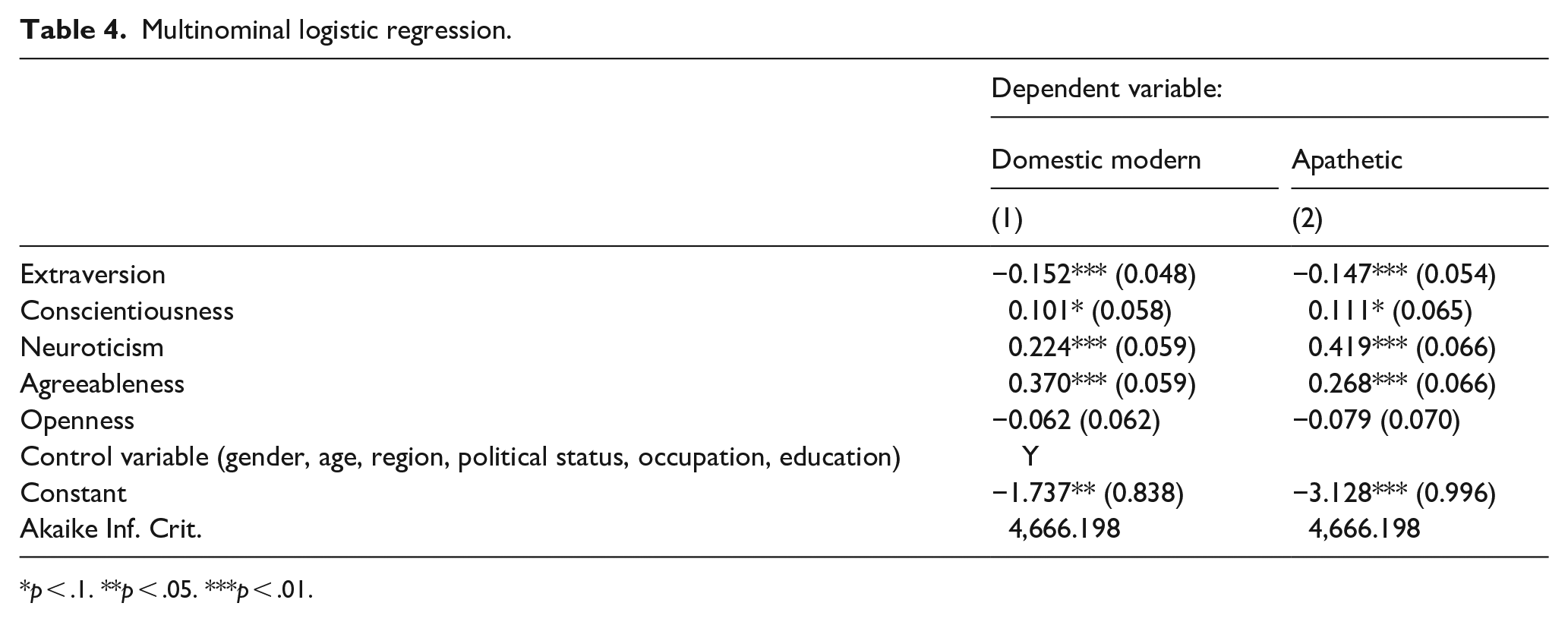
Running the multinomial logistic regression required the dependent variables to be mutually exclusive and exhaustive categories. The dependent variables obtained after K-means clustering must be mutually exclusive. This is because different group are highly heterogeneous. The interpretations in this research relied on the tutorial for multinomial logistic regression provided by Princeton University (Torres-Reyna, 2014). I used the multinom function in the nnet package. The multinomial logistic regression took the three kinds of people with various preferences regarding political information access channels as the dependent variable. In the regression model (see Table 4), the comprehensive group was set as the control group and the domestic modern and apathetic groups as the treatment group. Therefore, the mean for the comprehensive group cannot be shown.
Multinominal logistic regression.
p < .1. **p < .05. ***p < .01.
Extraversion
When extraversion was increased by 1 unit, the coefficient for the domestic modern type of Internet users decreased by 0.152 units as compared to that of the comprehensive type, and the coefficient of the apathetic type decreased by 0.147 units, also as compared to that of the comprehensive type (p < .01). The order of preference for access to political information was comprehensive > apathetic > domestic modern. This empirical result supports H1.
The more extroverted the participants were, the more likely they were to browse current political information offered on all channels. Generally speaking, those with high extroversion tend to be energetic and pay attention to social phenomena. They are enthusiastic about social communication and seek to broaden their social circle extensively for satisfaction and self-efficacy.
People with high extroversion tend to crave social attention, and exposure to political news from all channels can help them keep abreast of the latest social issues. This information becomes capital for gaining social attention, helping them to improve their political and social identities. Also, people with high extroversion tend to have a strong desire to express positive emotions; they are optimistic about the future and eager to create a good social image. By scanning all media for political information, they become more articulate and social. Moreover, those with high extroversion tend to prefer current political information from all fields and spend a lot of time browsing and discussing current political topics. They not only consider the political news for mainland China, but also that of foreign political news. Some who are highly extroverted do not value a consistent life and consider being bored as a betrayal; they prefer to live a life of adventure and excitement. Perhaps this is why they browse foreign information.
Conscientiousness
When conscientiousness was increased by 1 unit, the coefficient for the domestic modern type increased by 0.101 units as compared with that of comprehensive type, and the coefficient for the apathetic type increased by 0.111 units, also as compared to that of the comprehensive type (p < .1). However, the significance was so weak that it was almost negligible. Thus, this empirical result rejects H2.
Compared with the comprehensive type, conscientiousness has little significant correlation with domestic modern and apathetic types. Netizens with high conscientiousness generally have a strong sense of responsibility and take work and life seriously, and exhibit a rigorous and practical attitude. They tend to have strong self-discipline and time management skills, and can endure intense study and work pressure. However, conscientiousness did not predict Internet users’ preference for access to current political information, which may be because individuals who are more responsible devote much of their time to their own work and lives, and do not have preferences with regards to current political media. In other words, it was not possible to simply classify the preferences of conscientious netizens into one of three types. Perhaps the preference resides between types. Due to research limitations, this study could not further explore this phenomenon.
Neuroticism
When neuroticism was increased by 1 unit, the coefficient for the domestic modern type of Internet user increased by 0.224 units, as compared with that of the comprehensive type, and the coefficient for apathetic Internet users increased by 0.419 units, also as compared to that of the comprehensive type (p < .01). The order of participants’ preference for access to political information was apathetic > domestic modern > comprehensive. This empirical result supports H3.
The more neurotic netizens are, the more apathetic they tend to be to current political information. Those with high neuroticism are generally more prone to anxiety and depression. When they face setbacks and injustices in life, they find it difficult to control their emotions in the short term and deal rationally with emergencies. They also tend to have a negative attitude toward life, and may exhibit extreme behaviors in serious cases.
Individuals who are highly neurotic do not focus on current affairs and political news. This it is because when they avoid exposure to too much information, especially negative political reports, they are better able to keep calm. The highly neurotic tend to actively avoid current political information because they are afraid of the harm that negative current political news may cause. Moreover, highly neurotic Internet users tend to be vulnerable. They refuse to engage in social networking and are not interested in other people’s comments and feedback on current politics. Political apathy reduces the possibility of communicating with others, and such individuals tend to be happy being alone. Additionally, when highly neurotic Internet users share less political information on social media, they experience reduced anxiety. They care so much about the persona they create on social media that avoiding online comments related to political news gives them a sense of security. In other words, avoiding political news may be shameful but useful.
Agreeableness
When agreeableness was increased by 1 unit, the coefficient for the domestic modern type of Internet user increased by 0.370 units, as compared with that of the comprehensive type, and the coefficient for the apathetic type increased by 0.268 units, also as compared to that of the comprehensive type (p < .01). As agreeableness improved, the order of Internet users’ preference regarding access to political information was domestic modern > apathetic > comprehensive. This empirical result supports H4.
Individuals who are more agreeable tend to pay more attention to domestic political information. In most cases, they prefer to help others and participate in public welfare and charitable activities. At the same time, they tend to be humble. They care about others’ emotions in social situations and promote harmony and a friendly atmosphere.
Internet users who are highly agreeable tend to pay more attention to current political information released by the modern media in mainland China. The current political information provided by domestic media often agrees with core socialist values and contains propaganda featuring positive political news, catering to the preferences of this group. Moreover, people who are highly agreeable tend to be considerate and get along well with their classmates and colleagues. They often pay attention to the current political information provided by domestic modern media, can timely understand social situations, and seek to provide help and solve problems immediately. Additionally, agreeable people are willing to serve their society, good at connecting with the masses, and well-suited to work in Chinese politics. This makes them more likely to master current political information provided by domestic modern media, in order to better deal with social relations.
Openness
Compared with the comprehensive type, openness had no significant correlation with either the domestic modern or apathetic types. This empirical result does not support H5.
Netizens who are highly open tend to be innovative, imaginative, and creative. They are curious about the world and open to new things. Their system of thought is refined and they have strong cognitive and critical thinking abilities. Also, individuals who are very open are more inclined to continuously improve their awareness of innovation. Although many previous studies have emphasized that openness can promote the use of political media, the present study did not find evidence of this phenomenon in the context of China. This may be because China’s political system is different from that of Western countries, so there is no significant difference in the choice of political media among netizens in China with open personalities. It may also be because the mean of openness of the Chinese netizens surveyed was not very high and there was no significant difference in their perceptions of different media. Due to research limitations, this study was not able to further interpret this result.
Conclusion and discussion
Based on selective exposure theory, this study adopted K-means clustering and multinomial logistic regression, and used 2017 CNSDA data to study the correlation between Big Five personality traits and netizens’ preferences regarding how they obtain current political information. The results show that Internet users can be divided into three types, according to the frequency of their access to political information channels: comprehensive, domestic modern, and apathetic. The empirical results supported H1, H3, and H4 but not H2 or H5. Conscientiousness and openness were not correlated with predicting preferences regarding access to current political information. Highly extroverted respondents were correlated with browsing current political information through general access channels (i.e. the comprehensive group). Those who were highly agreeable correlated with obtaining current political information through domestic modern media (i.e. the domestic modern group). Highly neurotic respondents correlated with apathetic preference (i.e. the apathetic group).
The Big Five personality traits correlated with selective exposure to political news. First, people with high levels of extraversion were found to be interested in comprehensive types of political news and liked to participate in politics by browsing both online and offline political news (Gil de Zúñiga et al., 2017; Quintelier & Theocharis, 2013). The highly extroverted personality plays a moderating role in social media consumption (Kim, Hsu et al., 2013). This result is consistent with those of previous studies. Second, people with low levels of conscientiousness prefer to read and spread fake news, putting pressure on the social order (Lawson & Kakkar, 2022). Highly conscientiousness people tend to participate in politics and vote after reading political news (Martin & Sharma, 2022). However, the results of the present research show that conscientiousness is not correlated with selective exposure to political news, reflecting the particularity of the Chinese context. Third, when people are more emotionally stable, they tend to browse political information more extensively (Gerber et al., 2011). However, those who are highly neurotic tend to be apathetic toward political news and social media (Bowden-Green et al., 2021). This result is basically consistent with that of previous studies. Fourth, highly agreeable people are only interested in certain types of information (Gerber et al., 2011). They have a strong ability to identify political information, making them likely to prefer political news related to the party with which they identify (Ahmed & Tan, 2022). Those who are not agreeable prefer fake news, while those who are agreeable prefer real news, indicating that more agreeable people pursue quality in their news (Buchanan, 2021). Many Chinese believe that official news from mainland China is more authentic and the official modern media has developed in recent years, which may cause them to prefer domestic modern news. Fifth, Previous studies have not only suggested that people who are highly open motivate others to browse electronic news (Russo & Amnå, 2016), but also have suggested that high openness affects the heterogeneity of selective exposure to political news (Sindermann et al., 2021). However, the results of this study show that in the Chinese context, openness is not correlated with selective exposure to political news. Based on previous research, this study innovatively clustered participants in order to better explain the correlation between the Big Five personality traits and access preferences regarding selective exposure to political news.
The primary contribution of the present research was to study political communication from the perspective of psychology. It showed that highly extroverted netizens are more willing to explore current political information across all channels. It is worth noting that highly agreeable respondents preferred to read current political information published by the modern media in mainland China. This phenomenon reflects the successful political socialization of the Chinese media. In addition, highly neurotic netizens tend to escape from information cocoons to save themselves.
There are some research limitations in this research. First, although this study carried out multinomial logistic regression and divided netizens into treatment and control groups, it could only explain correlations among variables. The endogeneity problem was not completely solved, so it was difficult to clarify causality among variables by any robust test. The questionnaire survey was cross-sectional. Even though Prof. Ma distributed the survey for many years, it was not a follow-up survey because the participants were different. Second, due to the lack of questionnaire items, the questionnaire designer did not use the complete version of the Big Five personality measurements, so the latent variables selected in this research were not sufficient. Third, it has been 5 years since 2017, so the use of media may have changed. Fourth, the innovation of three types of netizens determined by K-means clustering may suffer from research bias.
Future research should make the following improvements. First, a follow-up survey should be conducted to identify causal effects. Also, experiments should be carried out to explain causal relationships between variables, solve the endogeneity problem, and make the results more robust. Future work should also adopt the method of cognitive neuroscience to carry out those experiments and focus on selective attention or selective exposure to political news via instruments such as an fMRI, EEG, or eye tracker. Second, the complete Big Five personality questionnaire should be used in future analyses. For example, future research could use the NEO-PI-R with 240 items or only focus on a specific personality trait. This would allow for a more accurate exploration of the influence mechanism of the Big Five personality traits and selective exposure to current political information. Third, future research should conduct a survey in 2022 or later in order to explore present media use. Fourth, subsequent researchers should continue categorizing netizens into the three categories of comprehensive, domestic modern, and apathetic. When more people use the same types, research bias in the clustering method can be tested through meta-analysis.
Footnotes
Acknowledgements
The author thanks Tao Li for his encouragement. He appreciated the potential of the research idea and gave valuable comments on the method part in the earliest version of the manuscript. He is professional, careful, and patient. The author also thanks the two anonymous reviewers and editors for their great comments.
Declaration of conflicting interests
The author declared no potential conflicts of interest with respect to the research, authorship, and/or publication of this article.
Funding
The author received no financial support for the research, authorship, and/or publication of this article.