







Abstract
Studies on Myanmar public employees’ job satisfaction are very limited. To understand which factors affect these employees’ job satisfaction, this study adopted Herzberg’s two-factor theory and tested its applicability in assessing self-administered survey data (N = 1,225). Results showed that Herzberg’s original sets of motivators and hygiene factors can measure government employees’ job satisfaction and that both motivators and factors are important in explaining job satisfaction. Specifically, public service motivation and religiosity contribute to job satisfaction, and family orientation’s negative effect on job satisfaction is statistically significant. Formulating flexible work schedules and dependent care programs can reduce employees’ work-family conflicts.
Introduction
Public debates in Myanmar have now centered around public services amid Myanmar’s Civil Service Reform Strategic Action Plan 2017–2020 intends to improve the quality of public services and public servants as well (Union Civil Service Board, 2017). Accordingly, about 900,000 civil servants provide services to 52 million Myanmar citizens, and following the plan, all government organizations have struggled to improve service quality. However, the current quality of public services is below public expectations. Government employees are essential actors who interact with citizens daily, but they are often regarded as unhappy. However, employees with high job satisfaction levels will offer high-quality services (Kim, 2005), as job satisfaction has a direct positive relationship with job performance (Borgogni et al., 2010; Fernandez & Moldogaziev, 2013). Job satisfaction is associated with high productivity, low absenteeism, and low turnover (see Yang & Wang, 2013) and influences organizational commitment (Boardman & Sundquist, 2009; Cantarelli et al., 2016) and retention (Vinokur-Kaplan et al., 1994). Conversely, low morale can result in lower productivity and higher turnover (Durst & DeSantis, 1997). Knowing the job satisfaction of Myanmar government employees is necessary to fill the knowledge gap in Myanmar context.
Despite decades of study on job satisfaction, research on Myanmar public employees’ job satisfaction is very limited and prior studies could be found very rarely. A review of the literature revealed only one study, conducted by Thant and Chang (2021), that used a qualitative research approach to present Myanmar government employees’ job satisfaction and dissatisfaction factors. Considering the present situation, determining how Myanmar government employees feel about their jobs and the factors influencing job satisfaction still deserves scholarly attention.
Myanmar, one of the least developed countries in Southeast Asia, has had unique contextual factors such as political instability, low economic development, and ethnic armed conflicts for many decades. The country’s military controlled the state power until 2011 and managed public service provision. As a result, the nature of government employees was shaped by the pre-democracy government amid inevitable corruption and abuse of authority in Myanmar’s civil service. Due to a generalized phenomenon of corruption in public service delivery, citizens’ trust in government employees is not high (Union Civil Service Board, 2017). A survey jointly conducted by the Union Civil Service Board of Myanmar and the United Nations Development Program in 2016 reveals that the salary and pension of government employees are insufficient to cover family expenses. Myanmar government employees want recognition from senior officials for their performance or effort (Thant & Chang, 2021). However, Myanmar government employees are less likely to be recognized and fairly promoted (Union Civil Service Board, 2017). The legacy of the military government’s long rule discourages Myanmar government employees from engaging in bottom-up communication for complaints and suggestions. Eventually, their concerns go unexpressed due to fear of rebuke.
Despite these significant concerns, interestingly, Myanmar government employees show a high level of motivation due to their passion for helping others. The majority of Myanmar government employees enjoy their work and are proud of being government employees. The contradiction between the situational factors and the real motivation of government employees in Myanmar implies the need to understand what are the motivational factors and dissatisfaction factors of government employees. In order to answer the question, the present study employs a quantitative approach to identify factors contributing to job satisfaction and dissatisfaction of Myanmar government employees. This study, one of the prior studies in the Myanmar context, tries to expand the knowledge of job satisfaction of Myanmar government employees. Herzberg’s two-factor theory has widely been used to explain private- and public-sector job satisfaction and provides a useful research framework, and this study has no exception.
Literature review
Job satisfaction
In public administration, Kim (2005) defined it as “an affective or emotional response toward various facets of one’s job” (p. 246). Gordon (2011) defined it as an “employee’s reaction to what he or she receives from the job” (p. 191). Numerous job satisfaction studies in various fields, including psychology, sociology, economics, management science, and public administration, have utilized the traditional model of job satisfaction that encompasses three main aspects: organizational (relationships with coworkers, work environment safety), job (skill/task variety, task significance, autonomy, feedback), and individual characteristics (age, gender, education, rank) (see Yang & Wang, 2013). DeSantis and Durst (1996) categorized job satisfaction determinants into four groups: job, work environment, personal characteristics, and monetary or non-monetary rewards.
Most studies followed two approaches: (1) global job satisfaction that assesses the overall satisfaction with work and (2) the facet approach that determines which job factors make individuals feel satisfaction or dissatisfaction (Spector, 1997). The global job satisfaction approach is applied when the bottom line or overall attitude is of interest. The facet approach can be useful to identify areas of dissatisfaction that organizations can improve. This can be associated with any aspect or part of a job. Therefore, many studies focused on job satisfaction’s antecedents and effects, but it is still unclear which aspects are most important.
Public-sector job satisfaction studies
Public administration researchers have studied job satisfaction as a dependent variable following the traditional model. For example, Ting (1997) found organizational and job characteristics were the dominant factors in explaining federal government employees’ job satisfaction. Wright and Davis (2003) found a significant relationship between work environment (job characteristics and work context) and job satisfaction. Additionally, personal characteristics, like gender, age, education, and race, also affect job satisfaction (Blackburn & Bruce, 1989; Durst & DeSantis, 1997; Jung et al., 2007). For example, Ellickson and Logsdon (2002) found both work environment factors and demographic characteristics affected US municipal government employees’ job satisfaction.
Moreover, public managers were highly motivated by intrinsic factors such as development opportunity and recognition than extrinsic factors such as salary and tangible benefits (e.g. Khojasteh, 1993; Rainey, 1982; Rawls et al., 1975). In contrast, Buelens and Van Den Broeck (2007) reported that intrinsic rewards such as self-development opportunity and recognition less motivate public employees. Some other studies found that public and private-employees’ motivational factors were not so different (Crewson, 1997; Gabris & Simo, 1995). On the other hand, employees’ motivators and motivation would be different on the basis of their personality traits (e.g. Furnham et al., 1999; Judge & Ilies, 2002). Nevertheless, different findings conflict, and research continues to debate job satisfaction’s explanatory power. Thus, fully understanding this topic remains significant.
Public administration literature has reported inconsistent findings and correlations (Rainey, 2014) related to extrinsic and intrinsic motivators because no extensive model or standard measurement of job satisfaction exists (Traut et al., 2000) that includes antecedents, correlates, and consequences. As an attempt, Cantarelli et al. (2016) conducted a meta-analysis and reported 43 job satisfaction correlates. They found positive and strong correlations, as well as positive but moderate correlations and negative correlations between job satisfaction and 43 other variables. Thus, extrinsic and intrinsic factors affect employee job satisfaction, including pay, family-friendly policies, workplace relations, and the work itself (Crewson, 1997; DeSantis & Durst, 1996; Dilulio, 1994; Lee et al., 2006; Maidani, 1991; Moynihan & Pandey, 2007; Spector, 1997; Taylor & Westover, 2011; Ting, 1997). Moreover, Thant and Chang (2021) reported that motivators and hygiene factors have mix-contribution to both job satisfaction and dissatisfaction of government employees.
Furthermore, religious teaching and factors in personal life influence job satisfaction of public employees in the Myanmar context (Thant & Chang, 2021). In their study, religious teaching refers to the belief of employees in religion, and it could be referred to as an internally driven belief or a motivator. On the other hand, factors in personal life mainly associated with family issues such as working away from family or parents and family-work balance. This factor has social or external pressures on employees; thus, family orientation could be justified as a hygiene factor.
In addition, public service motivation (PSM) is an important factor in public organizations as an individual with a high level of PSM (“rational motive, norm-based, and affective motives”) shows a positive attitude toward public sector employment and is more likely to seek the job in government organizations so that he can satisfy his needs (Perry & Wise, 1990, p. 370). Similarly, Pandey and Stazyk (2008) stated that individuals who have high levels of public service motivation seek jobs in the government sector to serve the public and are satisfied with their jobs. More interestingly assertions are that public service motivation has a significant relationship with job satisfaction (Naff & Crum, 1999), and job satisfaction is the consequence of public service motivation (Vandenabeele, 2009). A meta-analysis conducted by Homberg et al. (2015) also revealed the direct relationship between public service motivation and job satisfaction.
Herzberg’s two-factor theory
As Herzberg’s two-factor theory encompasses a wide range of intrinsic and extrinsic job satisfaction factors, some public administration studies (Hur, 2018; Khojasteh, 1993; Maidani, 1991; Thant & Chang, 2021; Zhang et al., 2011) have applied it to the public sector. Herzberg et al. (1959) developed this theory to study workers’ emotional states in an industrial context, arguing motivators (achievement, advancement, growth opportunity, recognition, responsibilities, and the work itself) contribute to job satisfaction, while hygiene factors (benefits, company policy/administration, interpersonal relationships, job security, physical working conditions, salary, supervision, and supervisory relationships) only prevent job dissatisfaction. Additionally, a lack of motivators does not necessarily lead to job dissatisfaction, and hygiene factors do not necessarily generate job satisfaction. Motivators are more closed to higher-order needs, and hygiene factors are associated with lower-order needs of Maslow’s needs hierarchy theory (Hur, 2018). To verify the theory, Herzberg (1966) surveyed 1,685 employees with different occupations, finding strong support for the theory.
Since its development, many scholars have tested the theory and criticized the fixed distinction between motivators and hygiene factors (Burke, 1966; Dunnette et al., 1967; Ewen, 1964; Gordon et al., 1974; Hur, 2018; Khojasteh, 1993; Lee et al., 2006; Malinovsky & Barry, 1965). They argued that as there is a positive relationship between motivators and hygiene factors, they are not independent, and some variables can contribute to both job satisfaction and dissatisfaction. Despite these criticisms, many job satisfaction studies have applied Herzberg’s two-factor theory in various contexts (Alshmemri et al., 2017; Chu & Kuo, 2015; Holmberg et al., 2018; Lundberg et al., 2009; Ruthankoon & Olu Ogunlana, 2003).
Some public administration studies have employed this theory to study public employees’ job satisfaction. Malinovsky and Barry (1965) found both hygiene factors and motivators were positively related to blue-collar workers’ job satisfaction. Maidani (1991) determined that both private and public employees valued motivators significantly higher than hygiene factors, but public employees ranked hygiene factors higher than their private-sector counterparts. However, Khojasteh (1993) found public-sector managers valued motivators significantly higher than hygiene factors, whereas their private-sector counterparts were more hygiene factor oriented.
A few scholars have modified Herzberg’s theory and directly tested it with city managers. Zhang et al. (2011) found managers are more likely to be motivated by intrinsic factors and a different set of factors (city government performance, manager’s policy-making influence, and manager-council relationships), while hygiene factors and a few motivators caused frustration. The authors concluded the theory can determine city managers’ job satisfaction by identifying special sets of motivators and hygiene factors different from Herzberg’s original factors. Following the original set, Hur (2018) tested seven motivators and seven hygiene factors. It confirmed hygiene factor similarities for both public- and private-sector employees but not motivator similarities. However, the hygiene factors did not contribute to job satisfaction, while the motivators did. Thus, Herzberg’s hygiene factors apply to private and public sectors, motivators contribute to public managers’ job satisfaction, and hygiene factors have no effect.
As the knowledge of public-sector job satisfaction in Myanmar is troubling and related research is scarce, the present study attempts to identify the important motivators and hygiene factors in public sector job satisfaction and fill the gap by challenging Herzberg’s two-factor theory’s applicability in assessing Myanmar government employees’ job satisfaction, examining motivators’ and hygiene factors’ influence, and exploring potential ways to improve job satisfaction. It offers two hypotheses:
H1: Government employees will feel job satisfaction when motivators are met.
H2: Government employees will not feel job satisfaction when hygiene factors are met.
Methodology
Sample and data source
The study’s sample consisted of government employees working at the Department of Education and Training (DET) within the Ministry of Border Affairs (MOBA) in Myanmar. The MOBA is responsible for the socio-economic development of border areas, and the DET particularly provides human resource (HR) development training for ethnic youths in the border areas. The DET was chosen as the main agency for a few reasons. The DET offers various levels of education and vocational training, especially to the youth from border areas, through one university, two degree colleges, 44 development training schools, 44 vocational training schools for women, nine mechanical schools, and one central training school. 1 Various types of training schools are located in different parts of Myanmar with diverse ethnic employees, professions, and skills. Most employees under the DET work in border areas and interact with various ethnic people, cultures, and languages. Their working environments are mostly diverse and conditions are much more challenging than those of other government employees. Therefore, government employees under the DET represent different ethnicities and professions.
Data were collected through a self-administered survey focusing on the job satisfaction of government employees in different positions with different responsibilities. Therefore, the sample contained administrative staff, from junior clerks to deputy directors, and teaching staff, from assistant lecturers to professors. On 5 September, 2019, a total of 1,550 survey questionnaires were distributed to 35 different training schools and headquarters in different locations. Some training schools were omitted because of location-related communication and transportation difficulties. Employees’ participation in the survey was entirely voluntary. Participants took a week to complete the questionnaire. The school administration collected all returned questionnaires and sent them back to the researcher by mail service. Approximately 85% of the questionnaires (1,313 employees) were collected, of which 88 responses were rejected for incomplete information. A total of 1,225 responses (approximately 79%) were valid. The consent form accompanied the questionnaire and was signed by participants. The sample included 65% female and 35% male employees. Nearly 70% percent of participants fall in the age group of 20s to30s, only 21% were in their 40s, and the 50s group belongs to 10%. Regarding responsibility, 42% of respondents were teaching in different training schools while the other 58% were working in administrative jobs at those training schools.
Developing measurement scales
This study developed a job satisfaction scale by following classical scales: the Michigan Organizational Assessment Questionnaire (MOAQ) Subscale (Cammann et al., 1979), Spector’s (1997) Job Satisfaction Survey (JSS), Hackman and Oldham’s (1974) Job Diagnostic Survey (JDS), the long form of the Minnesota Satisfaction Questionnaire (Weiss et al., 1967), Lester's (1987) teacher job satisfaction scale, Ellickson and Logsdon’s (2002) job satisfaction scale for municipal government employees, and Gordon’s (2011) job satisfaction scales. Based on previous literature and these scales, the questionnaire was modified. The resulting questionnaire comprised two dependent variables (job satisfaction and dissatisfaction); Herzberg’s original six motivators and seven hygiene factors; the addition of public service motivation (PSM), religiosity, and family orientation; and demographic variables. PSM, religiosity, and family orientation were added: (1) to assess job satisfaction of government employees believed to have strong PSM levels; (2) because in Myanmar, most people follow Buddhism and religious teachings even in the workplace; and (3) because most Myanmar public employees highly value their families. Thus, the study supposes these factors will substantially influence Myanmar government employees’ job satisfaction.
Measured variables
A seven-point Likert scale (1 = strongly disagree to 7 = strongly agree) measured the dependent variable and the 16 independent variables (motivators and hygiene factors). Appendix 1 presents the confirmatory factor analysis (CFA) and reliability scores.
Dependent variables
Drawing from the MOAQ, three items measured overall job satisfaction: (1) All in all, I am satisfied with my job; (2) In general, I like my job; and (3) In general, I like working here (Spector, 1997). Additionally, a reliability test and CFA were conducted (Cronbach’s alpha: .90).
Another dependent variable, dissatisfaction, was measured with three measured items that were borrowed from MOAQ and transformed into: “All in all, I am dissatisfied with my job,” “In general, I do not like my job,” and “In general, I dislike working here” (Cronbach’s alpha: .9).
Motivators
Three items measured the work itself, representing employees’ good/bad feelings when doing the actual job. The measured items are borrowed from Spector’s (1997) JSS, such as “I like the things I do at work,” “I feel a sense of pride in my job,” “My job is enjoyable” (Cronbach’s alpha: .86).
Five items, drawn from Spector’s (1997) JSS and Minnesota Satisfaction Questionnaire (MSQ) (Weiss et al., 1967), measured recognition (Cronbach’s alpha: .76). Since it is an important motivator, employees’ perceptions of the recognition of supervisors and rewards are measured. The feelings of employees related to recognition are evaluated by the reversed items “I do not feel that the work I do is appreciated” and “I do not feel that my efforts are rewarded the way they should be.” To what extent employees are satisfied with supervisor recognition was measured with “My supervisor always recognizes me when I do a good job.”
Employees’ feelings of achievement at work were measured with four item scales directly borrowed from MSQ (Cronbach’s alpha: .76). Employee’s own achievement and achievements of others at work were evaluated (e.g. “I have chances to do my best at all times,” “I take pride in others’ achievements (coworkers and subordinates).”
Another four items borrowed from Gordon (2011) and Hackman and Oldham (1974) measured growth possibility and career development opportunities. The items “I have opportunities for personal growth and development at my job,” “I receive adequate job training to perform my job well,” “I have educational or learning opportunities for my career development,” and “My organization supports my career development” measure the feeling of an employee about his or her career development (Cronbach’s alpha: .79).
Four items determined employees’ responsibility levels at work. All items were directly borrowed from MSQ items. For instance, “I can fully plan and manage my work,” and the reversed item, “I cannot have the chance to make decisions for my own work” are used to know how the employee feels about his or her responsibility (Cronbach’s alpha: .48).
Three items evaluated employees’ advancement opportunities: “There are opportunities for advancement in this job,” “I can get ahead in my current job,” and a reversed item “Less opportunity to have advancement in this job,” which were drawn from MSQ items (Cronbach’s alpha: .72).
Five questions, borrowed from Perry (1996), measured participants’ PSM levels, reflecting public interest, social justice, and civic duty dimensions (Cronbach’s alpha: .84). Lastly, four new items were developed to measure religiosity. The lack of reliable measures of religiosity in the Myanmar context inspired the researcher to develop new items (Cronbach’s alpha: .84). For example, “I can mitigate some disappointments by religious teachings” and “I follow religious teachings even in the workplace.”
Hygiene factors
For interpersonal relations, four items assessed employees’ relationships with supervisors, coworkers, and subordinates (Cronbach’s alpha: .79). Items were drawn from Spector’s (1997) JSS and the MSQ (Weiss et al., 1967). (e.g. “I like the people I work with,” “My relationship seems good with my supervisor”).
Three questions measuring overall working conditions are borrowed from MSQ and Gordon (2011), such as “The conditions where I work are good,” “The physical surroundings where I work are good,” and “Necessary equipment and resources are provided to do my job well” (Cronbach’s alpha: .65).
Three items assessed employees’ perceptions on policies and administration (Cronbach’s alpha: .84). The questions were derived from MSQ and Lester’s (1987) teacher job satisfaction scales. “My organization provides good administrative works to all employees” is a modification of the MSQ item. Two more items were borrowed from Lester (1987), such as “The administration clearly defines its policies” and “The administration communicates its policies well.”
Regarding supervision, five measured items such as “My immediate supervisor is quite competent in doing his/her job,” “My immediate supervisor gives me assistance when I need help,” and “My supervisor listens to employees’ suggestions and ideas for improvement” were drawn from Spector’s (1997) JSS, Lester’s (1987) teacher job satisfaction scale, and Ellickson and Logsdon’s (2002) municipal government employees’ job satisfaction scale. The items measured employees’ opinions of supervisors’ competencies and helpfulness (Cronbach’s alpha: .83).
Four items assessed employees’ pride in their job (Cronbach’s alpha: .80). Items for measuring the status of an employee’s job were borrowed from the MSQ and Gordon (2011). The modified version of items access to what extent employees take pride in their job in society are: (e.g. “My job gives me a chance to have a definite place in the community.” and “I take pride in my job”).
Three items, drawn from the MSQ and Spector’s (1997) JSS, measured salary satisfaction (Cronbach’s alpha: .70). The measured questions are: “I am being paid a fair amount for the work I do,” “I feel satisfied with my salary although it is not high,” and one reversed item “My salary is less than I deserve.”
Four items that are modified from MSQ items examined how employees perceived job security importance and job security level in their positions (Cronbach’s alpha: .88). Example questions are: “The current job is secure for my life” and “Working as a government employee is a secure job.”
Lastly, five items measured family orientation, specifically how employees value and prioritize family issues (Cronbach’s alpha: .7). Based on the culture of Myanmar society (see Cultural Atlas Website; Cifuentes, 2016; Nwe, 2009) and discussion with the key informants from the MoBA in Myanmar, the questions were developed (e.g. “To live with or live nearby family and parents is a great opportunity,” “I do not care about promotion but I do care to live with my family”). As Cronbach’s alpha values for responsibility and working conditions did not reach .7, they were excluded.
Results
Descriptive statistics
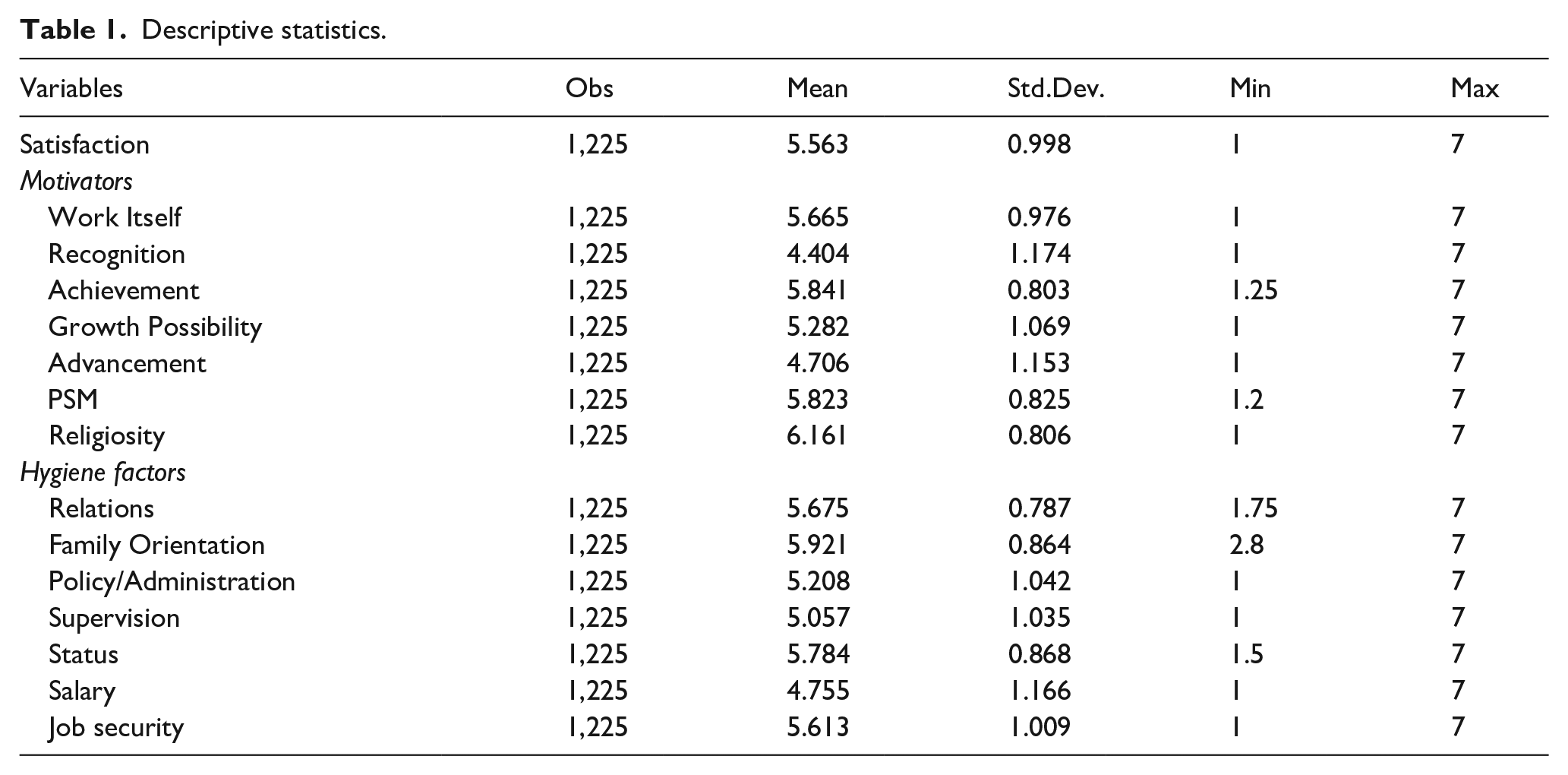
Table 1 presents all the variables’ descriptive statistics. A mean value above 5.5 for job satisfaction implies that respondents generally positively perceive job satisfaction. Among the motivators, religiosity had the highest mean value, followed by achievement, but PSM, status, the work itself, and growth possibility were also important, while recognition was the lowest. For hygiene, family orientation, relations, job security, policy and administration, and supervision were important for explaining job satisfaction.
Descriptive statistics.
Regression analysis
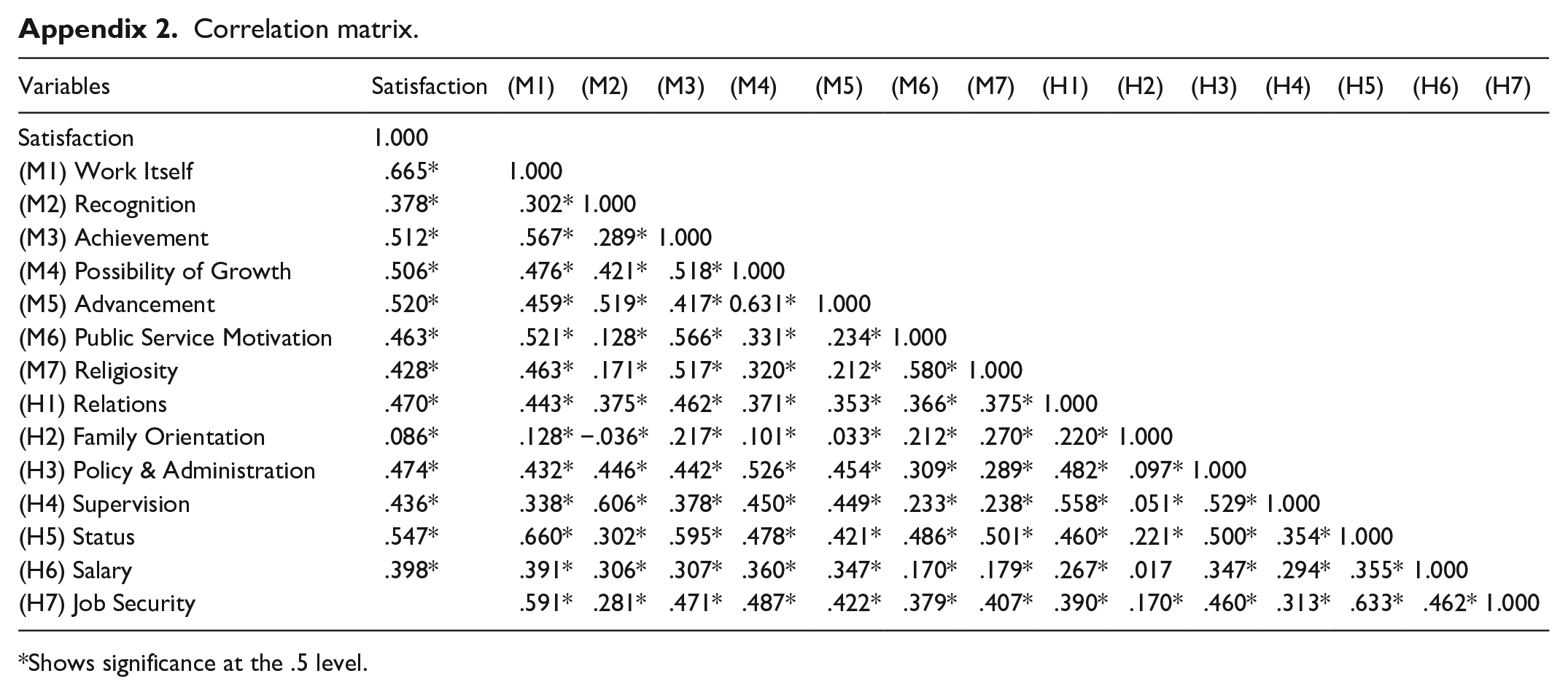
An ordinary least square regression analysis tested how motivators and hygiene factors influence job satisfaction. Prior to regression analysis, the study produced a correlation matrix (Appendix 2). Surprisingly, job satisfaction was correlated with not only motivators but also all hygiene factors. All the measured variables showed many significant relationships. Although several correlations were significant, the regression analysis did not show a multicollinearity problem with these variables because the variance inflation factor (VIF) values were less than 10 (Hair et al., 2014; Kennedy, 2003): the largest VIF value was 2.5, while the mean VIF was 1.95.
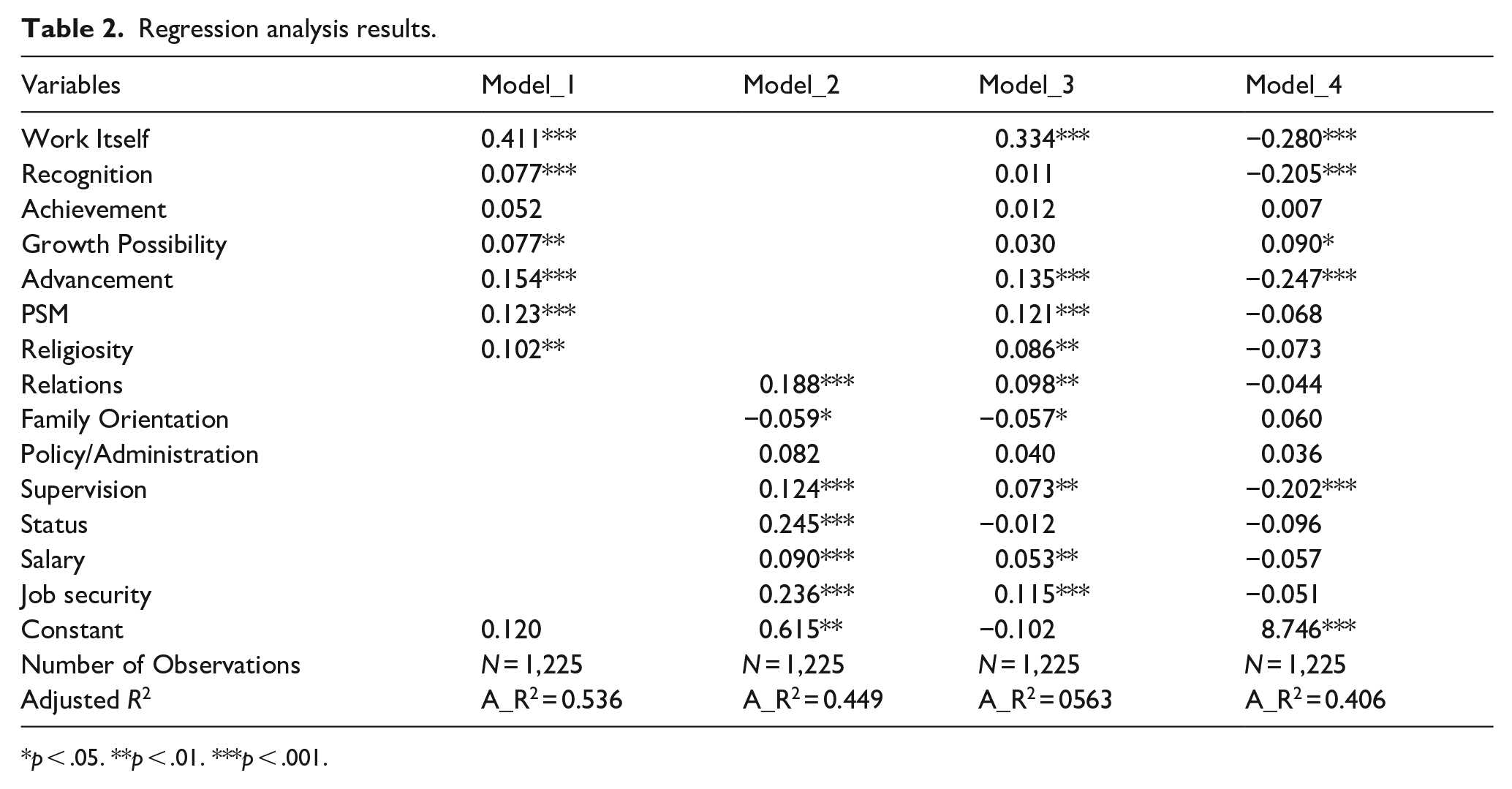
Table 2 presents the regression results for job satisfaction with motivators (Model_1), job satisfaction with hygiene factors (Model_2), job satisfaction with both motivators and hygiene factors (Model_3), and job dissatisfaction with both motivators and hygiene factors (Model_4). All four models showed relatively high goodness of fit, as their significance levels were below .001, and significantly explained job satisfaction variations among employees (the R2 values were 54%, 45%, 56%, and 40%). In Model_1, six of seven motivators had a significant positive association with job satisfaction. Model_2 shows all hygiene factors, except policy and administration, were statistically significant. Notably, family orientation had a positive, significant association with dissatisfaction (p < .01).
Regression analysis results.
p < .05. **p < .01. ***p < .001.
These models considered that motivators determine job satisfaction and hygiene factors assess dissatisfaction. However, after regression analysis (Model_3), only four motivators showed significant effects on job satisfaction, and five hygiene factors were significant. For example, family orientation (hygiene factors) is negatively significant (p < .05). In Model_4, four motivators and one hygiene factor show significant relationships with dissatisfaction.
Thus, job satisfaction appears among government employees who understand their work’s nature, believe they have advancement opportunities, have high PSM levels, follow their religious beliefs, have good work interpersonal relationships, have a good supervisor or mentor, believe their salary is high enough, and recognize their government job is secure. However, government employees who follow family-oriented culture are understandably less likely to experience job satisfaction. Moreover, recognition, achievement, and growth possibility did not produce any significant effects. On the other hand, work itself, recognition, growth possibility, advancement, and supervision affect dissatisfaction.
Discussion
Government employee motivators
This study confirmed Herzberg’s two-factor theory’s applicability to assess government employees’ job satisfaction. H1 proposed that the work itself, recognition, achievement, growth possibilities, advancement, PSM, and religiosity (motivators) would create job satisfaction. Model_1 generally confirmed this hypothesis.
Government employees felt enthusiastic if they knew and appreciated the nature of their work. As study participants were providing educational and training services for young people from border areas, they felt satisfied with their job because they helped improve others’ well-being. Therefore, a positive relationship was easily found between the work itself and job satisfaction.
Additionally, government employees feel satisfied if they have growth possibilities because people’s growth needs can serve as motivators (Herzberg, 1968). As such, training and career development programs can improve employees’ knowledge and skills to further apply in their careers. Recognition is also a significant motivator for government employees. When their efforts are recognized, they feel job satisfaction. The positive, significant relationship between recognition and job satisfaction also supports Khojasteh (1993), who revealed that recognition has a higher motivating potential for public-sector managers.
As government organizations are usually hierarchical, expecting a future promotion motivates employees (Rainey, 2014). Therefore, advancement can be an important motivator. Accordingly, promotional opportunities have a powerful effect on job satisfaction (Ellickson & Logsdon, 2002), and a lack of opportunities can decrease job satisfaction (Ting, 1997), as confirmed by this study. The results also revealed that PSM is positively associated with job satisfaction, supporting the arguments that job satisfaction is a consequence of PSM (Vandenabeele, 2007) and that PSM can predict job satisfaction (Homberg et al., 2015). According to Cifuentes (2016), most Myanmar civil servants value civic duty and want the opportunity to make a difference. Thus, government employees’ prosocial behaviors could result in job satisfaction.
Lastly, religiosity is a strong motivator, showing a positive, significant association with job satisfaction because it is important to general citizens (Hill et al., 2000) and religion plays an important role in bureaucrats’ work-lives (Bednarczuk, 2019). In Myanmar, most government employees follow Buddhism in the workplace. Thus, if employees can follow their religious beliefs at work, job satisfaction levels will increase, as found in Bednarczuk’s (2019) study.
Government employee hygiene factors
As Model_2 indicates, relations, family orientation, supervision, status, salary, and job security are hygiene factors that can lead to government employees’ job satisfaction if certain conditions are met. Regarding family orientation, a negative relationship emerged with job dissatisfaction because Myanmar society maintains a communal culture that values family very highly (Nwe, 2009), and public employees prioritize their family members rather than career advancements (Cifuentes, 2016). Thus, government employees who prioritize family issues may have higher work-family conflict, leading to dissatisfaction.
In public organizations, rules and procedures are often paradoxical, and subordinates rely on supervisors for clarification. A significant relationship between supervision and job satisfaction implies that if subordinates view supervisors as competent and supportive, they will be satisfied with the supervision factor.
In Myanmar society, government employees have a certain social position within the community, and they value civil service status, prestige, and job stability (Davidsen et al., 2018). Additionally, many Myanmar people are proud of being government employees. This study found a positive relationship between status and job satisfaction as high social status can lead to government employees’ job satisfaction.
Furthermore, previous studies have reported contradicting findings on whether salary is a hygiene factor or motivator for public-sector employees. As a high salary can result in satisfaction, this study found a positive relationship between salary and job satisfaction, meaning salary is a hygiene factor and can reduce government employees’ dissatisfaction (Hur, 2018; Maidani, 1991; Moon, 2000; Zhang et al., 2011).
This study also discovered a positive association between job security and job satisfaction, implying government employees are more likely to be satisfied because their employment is relatively secure. This finding is consistent with that of Karl and Sutton (1998), who found both public- and private-sector employees highly value job security.
Motivators’ and hygiene factors’ effect on job satisfaction
In daily work settings, employees may encounter motivators and hygiene factors simultaneously. This study observed motivators’ and hygiene factors’ combined effect on government employees’ job satisfaction (Model_3). Only four of seven motivators (the work itself, advancement, PSM, and religiosity) significantly contributed to job satisfaction. Thus, employees feel more satisfied when these four out of the seven motivators show a higher level. The variation of the other three motivators does not significantly change employees’ satisfaction levels.
As Model_3 indicates, relations, family orientation, supervision, salary, and job security are hygiene factors that also contribute to job satisfaction. Thus, H2 was not supported. Having a good relationship with supervisors, coworkers, and subordinates can affect government employees’ job satisfaction. This finding is consistent with previous studies that revealed having a good relationship with coworkers is positively associated with job satisfaction (Ting, 1997; Yang & Wang, 2013).
Employees with strong family orientations might feel stressed and encounter work-family conflicts, defined as inter-role conflicts in which an employee must participate in both work and family roles. Thus, participation in one role makes it more difficult/stressful to participate in the other (Greenhaus & Beutell, 1985). A lack of work-family balance results in reduced job satisfaction (Saltzstein et al., 2001). Additionally, supervision had a positive relationship with job satisfaction, supporting previous works claiming good supervision can increase subordinates’ job satisfaction (Ellickson & Logsdon, 2002; Traut et al., 2000).
Although salary was originally a hygiene factor, it also contributed to job satisfaction. Many studies have found salary has a positive, significant effect on public-sector employees’ job satisfaction (Ellickson & Logsdon, 2002; Khojasteh, 1993; Steijn, 2004; Ting, 1997; West & Berman, 2009). In Myanmar, government employees expect salary increments because their pay is relatively low. When this happens, they feel happy and satisfied with their work. Lastly, job security strongly impacted job satisfaction, similar to previous findings (DeSantis & Durst, 1996; West & Berman, 2009).
Only one hygiene factor, supervision, shows a significant relationship with dissatisfaction (see Model_4). This study found significant relationships of motivators and hygiene factors with the job satisfaction of Myanmar government employees. Work itself, advancement, and supervision are overlapping factors in Model_3 and Model_4, showing significant effects on both job satisfaction and dissatisfaction of government employees in the Myanmar context.
Conclusions
This study asserts only some of Herzberg’s original motivators and hygiene factors can measure Myanmar government employees’ job satisfaction and suggests both motivators and hygiene factors contribute to job satisfaction. The work itself, advancement, PSM, and religiosity are strong motivators, while relations, supervision, salary, and job security (hygiene factors) are also important for job satisfaction, as confirmed by previous studies.
Policy implications
PSM, religiosity, and family orientation showed significant results and deserve special attention. One popular argument, highlighted by Homberg et al. (2015), claims PSM can predict job satisfaction. Accordingly, this study revealed that PSM has a strong, positive influence on job satisfaction (Rainey, 1982), as public-sector employment may be an important satisfaction source in itself. Employees with high PSM levels frequently join the government, but organizations can also shape these levels (Moynihan & Pandey, 2007). Therefore, managers play an important role in government employees’ job satisfaction. They should create a favorable organizational environment that can increase job satisfaction.
Religiosity was also an important factor. King and Williamson (2005) reported that religiosity has a positive relationship with job satisfaction, but only when the work environment accepts religious expression. In Myanmar, most employees follow religious teachings in the workplace. This has important implications for the public sector’s work environment, as workplace religious freedom can increase government employees’ job satisfaction.
Lastly, family-orientation culture negatively impacted job satisfaction, as employees who prioritize family issues felt stressed balancing work and family. From the managerial perspective, formulating family-friendly work policies like flexible schedules and dependent care programs can help reduce work-family conflict and increase job satisfaction. A flexible schedule can help employees balance work and family obligations; a dependent care program can reduce employees’ family-related anxieties and promote concentration during work. Managerial support is crucial for the creation of these policies and a family-supported workplace environment (Ko et al., 2013).
Theoretical implications
This paper extends the knowledge as an exploratory study using Herzberg’s two-factor theory and adding three factors important for Myanmar government employees. The results may help researchers and policymakers understand the determinants of government employees’ job satisfaction in Myanmar.
From a theoretical perspective, the combined effect of motivators and hygiene factors can explain 56% of the total variation in government employees’ job satisfaction. Based on the results, both motivators and hygiene factors affect Myanmar government employees’ job satisfaction, but certain hygiene factors were also associated with dissatisfaction. Although many studies have reported PSM and job satisfaction’s positive correlation (Kim, 2005; Naff & Crum, 1999; Taylor, 2007, 2014), the present study is the first to confirm PSM strongly affects job satisfaction in Myanmar.
Similarly, many studies in numerous fields have assessed religiosity’s effect on job satisfaction, but little is known about how religiosity affects public-sector employees’ job satisfaction. In this study, religiosity had a positive effect because religion is important to citizens’ lives (Hill et al., 2000), and individuals’ desires to express their religious beliefs at work (Atkinson, 2000). Therefore, this study asserts religiosity positively affects job satisfaction for Myanmar government employees.
Lastly, previous research has widely studied work-family conflict’s negative impact on job satisfaction. Thus, this study’s findings are not surprising and have important implications for job satisfaction in Myanmar’s public sector. The strong family-oriented culture among Myanmar government employees is the root cause of work-family conflict, which can reduce job satisfaction.
Limitations
This study admits that it inevitably contains limitations. First, the self-reported survey could have biased the results. Second, the possibilities for measuring certain variables, including family orientation and religiosity, were limited. Third, among the seven motivators, recognition, achievement, and growth possibility were not significant in the combined model, but this study could not determine the reasons behind this result. Fourth, data were extracted from government employees working at the Department of Education and Training within the MOBA. Thus, the results’ generalizability may be limited. Nevertheless, the findings are consistent with previous studies, indicating their reliability. Future researchers can further expand and strengthen this topic by using various data sets and studying different Myanmar government organizations.
Footnotes
Appendix
Correlation matrix.
| Variables | Satisfaction | (M1) | (M2) | (M3) | (M4) | (M5) | (M6) | (M7) | (H1) | (H2) | (H3) | (H4) | (H5) | (H6) | (H7) |
|---|---|---|---|---|---|---|---|---|---|---|---|---|---|---|---|
| Satisfaction | 1.000 | ||||||||||||||
| (M1) Work Itself | .665* | 1.000 | |||||||||||||
| (M2) Recognition | .378* | .302* | 1.000 | ||||||||||||
| (M3) Achievement | .512* | .567* | .289* | 1.000 | |||||||||||
| (M4) Possibility of Growth | .506* | .476* | .421* | .518* | 1.000 | ||||||||||
| (M5) Advancement | .520* | .459* | .519* | .417* | 0.631* | 1.000 | |||||||||
| (M6) Public Service Motivation | .463* | .521* | .128* | .566* | .331* | .234* | 1.000 | ||||||||
| (M7) Religiosity | .428* | .463* | .171* | .517* | .320* | .212* | .580* | 1.000 | |||||||
| (H1) Relations | .470* | .443* | .375* | .462* | .371* | .353* | .366* | .375* | 1.000 | ||||||
| (H2) Family Orientation | .086* | .128* | −.036* | .217* | .101* | .033* | .212* | .270* | .220* | 1.000 | |||||
| (H3) Policy & Administration | .474* | .432* | .446* | .442* | .526* | .454* | .309* | .289* | .482* | .097* | 1.000 | ||||
| (H4) Supervision | .436* | .338* | .606* | .378* | .450* | .449* | .233* | .238* | .558* | .051* | .529* | 1.000 | |||
| (H5) Status | .547* | .660* | .302* | .595* | .478* | .421* | .486* | .501* | .460* | .221* | .500* | .354* | 1.000 | ||
| (H6) Salary | .398* | .391* | .306* | .307* | .360* | .347* | .170* | .179* | .267* | .017 | .347* | .294* | .355* | 1.000 | |
| (H7) Job Security | .591* | .281* | .471* | .487* | .422* | .379* | .407* | .390* | .170* | .460* | .313* | .633* | .462* | 1.000 |
Shows significance at the .5 level.
Declaration of conflicting interests
The author declared no potential conflicts of interest with respect to the research, authorship, and/or publication of this article.
Funding
The author received no financial support for the research, authorship, and/or publication of this article.