







Abstract
Expert involvement has received increasing academic attention, and expert typology, organizational types and knowledge utilization have been well documented and well theorized. However, the literature on expert involvement is remarkably silent on how to understand the internal structure of expert groups and the influence they bring to bear. In this study, we seek to bridge this gap by theorizing and empirically demonstrating the internal discrepancy in expert network. We do so through an in-depth qualitative analysis of data from an empirical study on urban planning decision-making in China. Building on existing literature, participant observation and interview data, the study elaborates an expert network model that analyses how government choices, organizational characteristics, and capital in network resources shape expert influence. The empirical analysis indicates that the role an expert receives in policy making is a consequence of different expert networks. Based on this, we developed the concept of “resources empowerment expert network” to understand the logic of resource flow in network and discuss how this concept can contribute to the broader literature on expert involvement.
Introduction
Expert involvement has spurred accumulating attention both in theory and practice for decades. Experts hold a prominent position in guiding and shaping policy-making and needed by decision-makers in numerous ways (C. Boswell, 2008; Lundin & Öberg, 2014; Roberts et al., 2020). Expert organization can play central roles in facilitating new policy ideas and diffusing new forms of expertise (Laage-Thomsen, 2022). Conversely, scholars argues that experts are ineffective or manipulated by bureaucrats (Jasanoff, 1990; Yang, 2019), or discuss experts by types and roles (Fleming & Rhodes, 2018; Xufeng, 2009).
However, how differences within experts create influence are significantly less studied and understood than typology of policy experts and organizations. Few attempts construct a framework that explains why experts “choose to be” different types or are “formed by” different features, and how these differences produce impact. Thereby, there is no quantifiable or assessable standard for “how to measure the impact of expert in decision-making” (Abelson, 2018). Further, these works focus on developed Western nations, scant empirical research addressing the efforts of governments worldwide to build science advisory capacity, especially lack of evidence for how preferences might vary between different researchers or scientific providers (Akerlof et al., 2022). These lacunae seem to be especially regrettable for studies of expert involvement.
We try to construct a theoretical model of expert influence by analyzing action logic of expert network, and test it with empirical evidence. We discuss two related questions. First, when we consider experts as a sub-dividable organizational structure, what are their respective key factors? Second, how do these structural features generate influence? Our propositions are examined through participatory observation of urban planning decision-making process in China. We conducted this participatory research as one of the main actors in policy process, which is popular in recent years (Seo, 2022; Turner et al., 2020), thus present a more detailed picture of urban planning decision-making in China. As invited observers, we participated in the meetings related to Regulatory Detailed Planning (RDP), which is one of the two statutory planning in China. The process continued for 6 months. Our data is collected from participant observation and interviews, together with documentation from government and urban planning experts.
Our analysis elucidates that expert network is formed by network resources of different expert groups, derived from government choice, organizational characteristic, and capital, which will generate different expert involvement and strategies. Further, these network resources can be used to enhance expert influence through network structure, or “resource empowerment expert network” as proposed in this study.
By doing so, this study contributes to the existing literature on expert involvement in three ways. First, it goes beyond expert typology and reveals that, similar to decision-makers, there is a complex network within experts, extending the existing literature on expert involvement. Second, it attempts to operationalize the concept of expert influence by constructing an analytical framework, enriches the application of network tools. Third, it extends existing methods by adapting participant observation.
To tackle these issues, this study is structured as follows: in the following section, we review the theoretical insights drawn from the existing literature on expert involvement in decision-making, together with typology of policy expert studies and their recent development. Thereafter, the third section identifies and describes network resources, comprising a short overview of network concept and outlines the analytical framework. We then present research setting and research design, which draws a context of urban planning decision-making in China. Next, we present network resources and strategies in different network through qualitative study. Finally, we summarize combined influence of resources and structures within expert network on decision-making, and discuss generalizability of research findings.
Expert involvement studies: Gaps in expert internal structure
Owing to the increasingly technical and complex nature of many policy issues, research of expert involvement in decision-making has received increasing attention. While a comprehensive review of the literature on expert involvement is beyond the scope of this study, the majority of studies on this topic can be roughly grouped into three theoretical streams: experts’ key role in decision-making, vis-à-vis expert and expertise is unwelcomed by decision-makers, and the study of expert typology. In turn, these three streams provide different theoretical expectations as far as expert involvement is concerned.
Studies of expert involvement are a crucial initiative emphasizing the need for experts and reliance on scientific knowledge by decision-makers. Government officials report that expert and academic research is valuable to them and had a practical influence on their policy advice and decision-making (Bakir et al., 2021; Hirschman & Berman, 2014). Expert involvement in decision-making system design can provide a forum for political dialog between different cognition, rationality, and values, which results in a consensus decision-making model that reduces decision-making risk and enhances the effectiveness of administrative decision-making (Busch, 2009; Fischer & Leifeld, 2015). Decision-makers are increasingly reliant on advanced knowledge to understand and address complex societal problems (P. M. Haas, 1992; Jennings & Hall, 2012). Moreover, scholars use the term “useful myth” to describe the contribution of experts and knowledge to policy-making (J. Boswell, 2018). As the product of expert involvement, the growing role of expertise in policymaking is highlighted.
Conversely, certain authors found that expert and expertise is seen as exceedingly politicized and “unwelcomed by policymakers.” Caplan (1979), who first proposed this issue, surveyed 204 high-level decision-makers and showed that there was no significant relationship between expert knowledge and their final decisions. Expert involvement is often used as political ammunition rather than scientific decision-making, and is also regularly rejected or delegitimized by politicians (Nichols, 2017). The legitimacy of knowledge discourse is not respected and its influence on decision-making is not high (Montpetit, 2008; Richards, 2019). Experts and academic research can only make an impact under certain conditions (Duina, 2022; P. Haas, 2004). In such situations, we need expert involvement in taking appropriate action to guide policy and attenuate the inexorable entanglement of policymakers and experts, if decision-making is to be scientifically sound.
Beyond these disputes, other scholars explore a middle path, highlighting the “extent” of expert involvement (e.g. Funke et al., 2021; Metz, 2013; Newman & Head, 2015), one of which presents research on typology of expert involvement. Epistemologically, expert involvement can be recognized as individual dimension and institutional dimension (Shen et al., 2021). Scholars have studied this by discerning policy experts as actors, or by developing in conjunction with intellectual organization research. Individual dimension dedicates to role and logic action of experts in decision-making and the logic of action. For example, Medvetz (2010) argues that policy experts draw on a series of idioms such as those of the academic scholars, political aides, entrepreneurs, and media specialists to construct a unique albeit synthetic professional identity. Pielke (2007) proposes four modes of action for experts: Pure Scientist, Science Arbiter, Issue Advocate, and Honest Broker of Policy Alternatives, based on their individual understanding of “science” and “democracy.” Institutional dimension is mainly the study of expert organizations. Research on intellectual organizations discusses the concept (Brennan & Connell, 2000) and measure (Dumay, 2009) of intellectual capital. Reed classifies the expert organizational forms into collegiate, bureaucratic, and network organizations by their knowledge base, power strategy, and occupational types (Reed, 1996). Think tank is a typical intellectual organization. Researches on think tanks mainly identify and classify the organization by funding, agenda setting, ideological, and research (Abelson, 2018; Ahmad, 2008; McGann & Weaver, 2000). Generally, these types of think tanks clarify the policy outputs, intellectual and other capital, organization and staffing, funding, and other relevant features.
In summary, despite the proliferation of work on typology of experts’ roles from the mid-1990s, the internal structure of expert network has surprisingly received limited attention. Most of previous studies on expert involvement focus on static division of expert types, neither having formed an “understanding of the internal structure of experts” through typology of expert involvement, nor having emphasized the action patterns of different types of experts in the same policy filed. Thereafter, certain scholars have noted that there may be network structures among experts that are similar to those of decision-makers (Plehwe et al., 2018). Yet, the empirical literature is far behind the normative debate; more specifically, there is a gap between the scholarly literature on the structural features of expert network and publications on the role of experts in the policy process, with a few exceptions focusing on selected cases (e.g. Schrefler, 2010; Stephens & Stephens, 2021). This is somewhat puzzling given the key role played by different experts and the impact they can have.
More notably, there is a lack of policy tools to study the logic of the expert actors’ actions and to develop a theoretical framework. A few exceptions are focusing on the “dynamics” of the internal structure of experts, for instance, Williams (2021) constructs the behavior of policy experts as a dynamic process rather than a static role, uses “mapping spatial distance” to provide an explanation for policy experts’ network relationships. Inspired by network perspective in expert involvement studies, we apply a theoretical framework to explore the internal structure of expert network and to conduct “dynamic” research on how expert network exerts influence in decision-making process.
Network in policy expert research
Network provides an opportunity for expert involvement study. An important stream of public policy research is to explore how experts are connected to different actors and coalitions (Montpetit & Lachapelle, 2016). Complex network of relationships across established fields and professions (Tchilingirian, 2018) that connect various actors in knowledge-policy relationships (Eyal, 2013) and enhance professional credibility. Network analysis approach provides a link between structure types and actor strategies that has been relatively absent in expert research.
Research state that experts may have different regularities from other actors. For example, experts’ action and strategic choices are differently from other policy actors such as government officials, entrepreneurs, NGOs and citizens (Xufeng, 2009). Therefore, research on expert networks and policy networks ought to proceed in different directions. However, current research on networks in policy processes focuses on relations with governments and other actors, and less on the internal structure of experts. Most research on expert network views experts as a macrocosm, studying the relationships between expert and other groups rather than internal relations of the expert network (Maasen & Weingart, 2005). This may be due to there is minimal analysis of how network structures are formed and the comparative analysis of these networks (Grossmann, 2013), or previous studies on the impact of various individual motivations on the formation of expert roles are scarce (Zhu & Zhang, 2016). Experts have different tendencies in constructing network, and the way in which networks are formed affects actors’ influence and strategies (Teets, 2018).This could address the fact that “knowledge strategies” in expert networks are difficult to operationalize or study empirically (Christensen, 2021; Hesstvedt & Christensen, 2021; Marsh, 1998). However, the existing research does not provide a clear answer as to what expert networks demonstrate internally and what the relationship is between this internal situation and actor strategies and how the network generates influence.
Prevailing network research considers network resources and network structure as the two main aspects that generate strategies. Resource Dependence Theory (RDT) provides a major conceptual framework for network research, which describes that organizations and individuals participate in policy networks as being mutually dependent on each other in terms of resources. When applying Resource Dependence Theory to policy networks, two types of resources, material-institutional and socio-structural, can be converted to influence the promotion of organizational goals and survival (see Figure 1). “Material-institutional resources” (MIRs) describe the direct influence of network resources on actors’ strategies. It refers to the set of financial, political, human, informational and institutional goods, services and intangible “states of mind” that organizations deploy in support their preferred political positions and policy options. It indicates the process of generating actor standpoint and capital as a result of organizational preferences and policy choices, reveals the interconnections among organizational characteristics. Focusing on specific network resources, numerous scholars analyze network resources and focus on government choice, organizational characteristic, and capital. Government choice refers to the definition of an intellectual organization by decision-makers (Abelson & Carberry, 1997; Ahmad, 2008). Organizational characteristic refers to the fact that knowledge and intelligence-related institutions differ in many ways when established, such as organizational structure, operation methods, budget, staff, goals, objectives, and research topics (McGann & Sabatini, 2011). There are more diverse perspectives to measure capital held by actors. Bourdieu (1986) argues that experts’ capital is derived from academic, political, economic, and media. It is noteworthy that while previous studies have considered that capitals, such as cultural capital (Medvetz, 2006), are not associated with network structure, our study considers cultural capital. Based on the above, this study concludes that capitals that influence expert network include academic, political, economic, media, intellectual, cultural, human, and others.

A brief illustration of the RDT theory.
MIRs are crucial to the exercise of actor strategies within policy networks: they create differences in influence and help explain who gets what results and why. The other is “social structural resources” (SSRs), which refers to a continuous pattern of communication and exchange of resources between three or more actors and organizations, describing a network of “points” and “lines” that form a “network”, that is, the process of generating actors’” strategies. This pathway responds to the notion that the main operationalizations of network structure are network nodes or centrality, inter-nodal relationships, and high degree of clustering formed through network (Reagans & Zuckerman, 2001). Further, following on from studies point out that the analytical difficulties of network structure lie in operational indicators of network formation (Sandström & Carlsson, 2008), there are also empirical studies that innovatively integrate resource dependency and social capital into a framework that combines longitudinal data to analyze how individual social capital influences the resources of organizations in policy networks and the structural position of organizations in policy networks, how individual and organizational social capital affects organizational influence in policy networks (Rethemeyer & Hatmaker, 2007), describing how “individuals and the characteristics they possess generate actor strategies as part of organizational resources” and “how individual actors improve the organization position in the network structure and thus the process of influence,” provides an analytical ideas for this paper. Meijer et al. (2013) analyze technical expertise and knowledge by suggesting that “knowledge is not transferred directly from experts to the public, but is constructed in the course of interactions between various expert actors,” to characterize the transfer of expert knowledge in network structures. The article develops the analysis by five dimensions: patterns of interaction with high or low network centrality, formal or informal rules, closed or semi-open patterns of participation, convergent or divergent powers and interests, and expert knowledge as knowledge transfer or knowledge creation, focusing on the role of knowledge actors in the policy process and the processes by which expert knowledge flows through the structure. In addition, the research results on actor strategies are summarized, and the strategies adopted by experts to improve the discourse power in the policy process are roughly divided into three categories. The first is information transmission strategy, which focuses on how actors influence policy-making through the transmission of information, knowledge and professional opinions. Information transmission strategies include professional suggestions and opinions (P. M. Haas, 1992) and data and evidence transmission (Nutley et al., 2007) to support the rationality of specific policy choices. The second is the interest coordination strategy, which focuses on how actors promote policy issues by coordinating the opinions and goals of different stakeholders. Interest coordination strategies include: ① Cooperation and joint advocacy: Actors cooperate with other stakeholders to form alliances or advocacy groups to jointly promote specific policy objectives (Weible et al., 2009). ② Consultation and compromise: Actors seek consultation and compromise in the process of policy formulation to reach consensus and cooperation of all parties (Ansell & Gash, 2008). ③ Public mobilization and opinion influence: Actors influence the views of policy makers on specific issues by mobilizing public opinions and organizing activities (Leach, 2006). The third type is power application strategy, which focuses on how actors use their power, status and influence to promote policy issues. Power application strategies include: ① Political lobbying: Actors influence the decision-making of policy makers through political lobbying to promote specific policy issues (Bauer & Jensen, 2011). ② Policy advocacy and publicity: Actors convey their views and goals to policy makers and the public through publicity, media activities and other means (Cook, 1998).
Accordingly, we combine resource dependency theory’s consideration of material-institutional and social structures, and the characteristics of expert knowledge transmitted in network structures, to derive an analytical framework for the influence of policy expert networks, as shown in Figure 2. This framework explicates the processes by which expert network resources and network structures generate influence. Network resources describe the process by which organizational characteristics and policy choices determine actor standpoints and capital, and through which pathways actor strategies are generated. Network structure describes the process by which expert actors use their own characteristics and the resources they have as an individual feature to make connections with others and generate network influence through these connections. Influence, as one of the most central issues in decision-making research, can be defined as “the ability of an actor to shape decisions in accordance with their own preferences (Dür, 2008),” where the three elements are the actor, the actor’s preferences for a particular policy, and the policy decision that the actor is trying to influence. On this basis, Christensen (2021) indicated that the process of expert influence can be traced from the actor’s preferences to the final policy decision, encompassing the expert’s initial preferences, the contact and relationship between experts and decision-makers, expert’s attempts to communicate these preferences to policy maker, the policy maker’s reaction to these attempts to influence, and the expert’s preferences the extent to which they are reflected in the final policy decision. In his latest research expert influence is further defined as the ability and process by which expert actors generate policy decisions based on their knowledge-based preferences (Christensen, 2023). Based on the above, “expert influence” in this paper can be summarized as “the process by which experts attempt to change and influence policy through the mechanism of networks.”
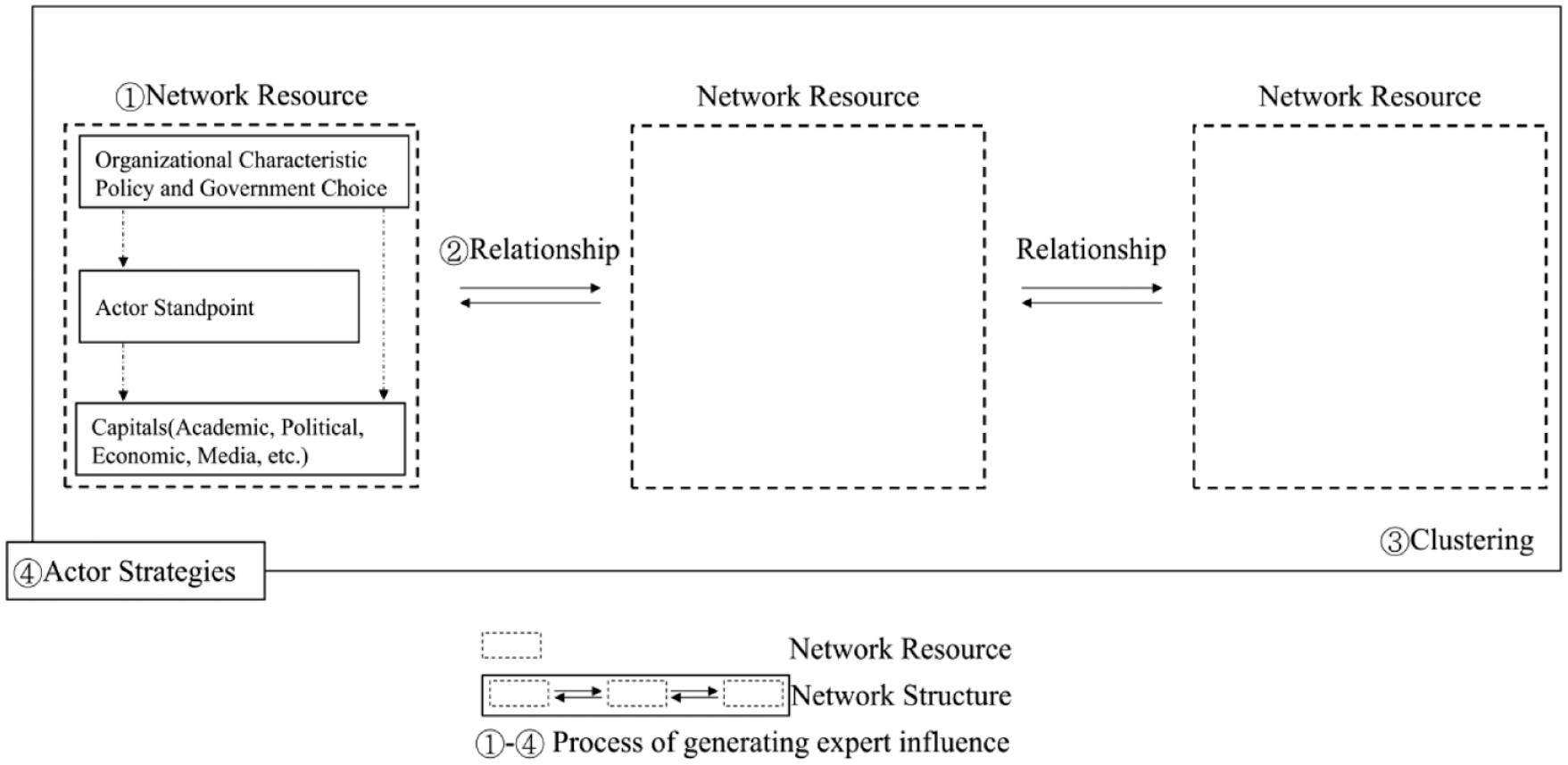
Expert influence processes based on network resources and network structure.
Methods and features of expert selection networks
Case selection: RDP in China
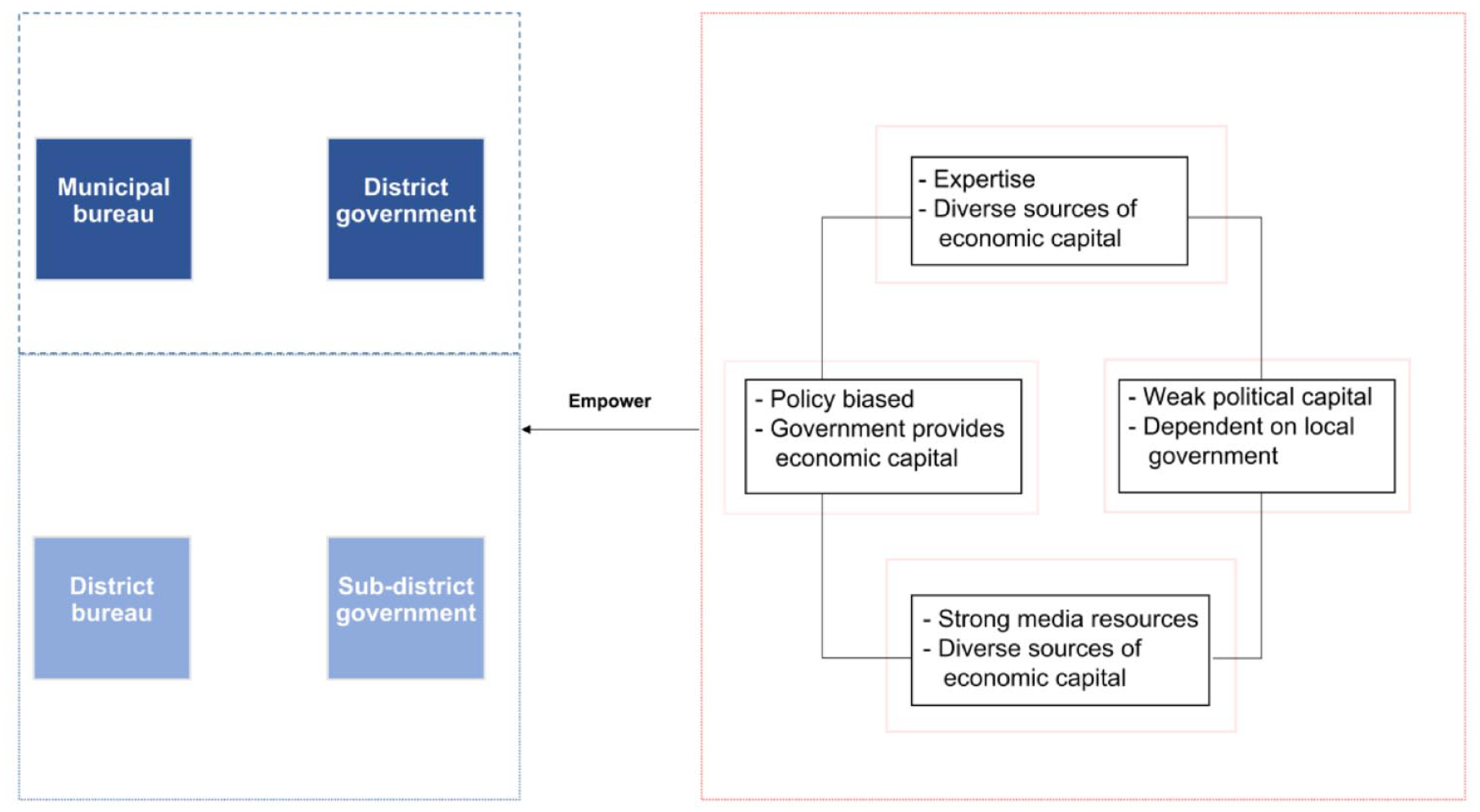
As one of the two types of statutory Detailed Plan in China, Regulatory Detailed Planning (RDP) is an important measure for the Chinese government to regulate urban public resources and safeguard public interests. The main decision makers involved in the RDP process are the municipal government, municipal bureaus, district government, district bureaus and sub-district government (Figure 3). The document is prepared by the district government and the district bureau and submitted to the municipal bureau. After that, the district government entrusted the district bureau to supervise and guide the sub-district government to entrust the design team to prepare the specific planning plan. The sub-district government is the main executor and organizes the meeting. The design teams (See the right half of Figure 2) regularly report the project progress to the decision makers. In the decision-making process, the preferences and actions of different levels of governments and different types of experts can be fully seen.
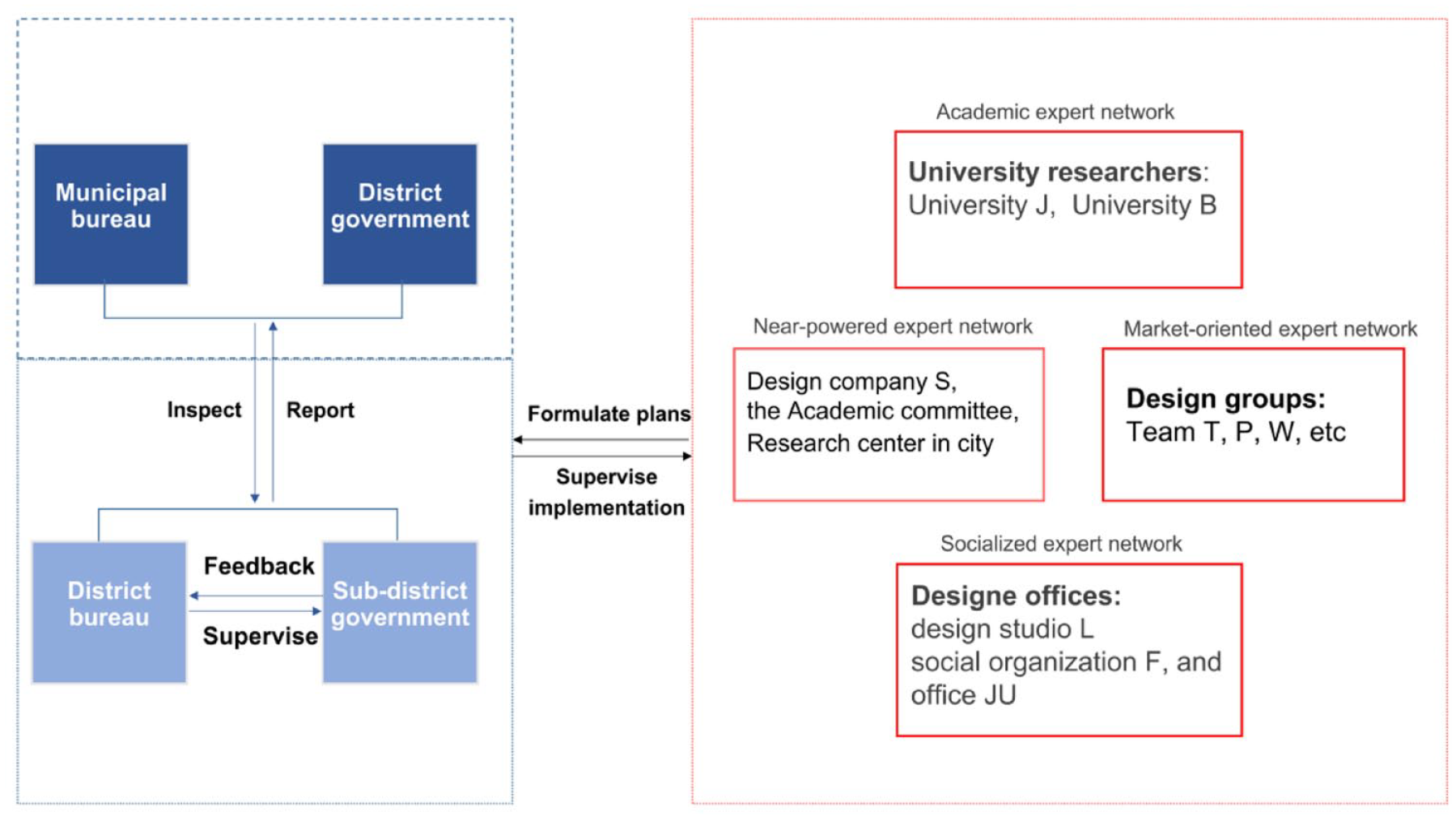
Relationship between decision-makers and design groups in RDP.
Data collection and analysis
This study is exploratory. According to “small social scenes house sufficient materials for adequate explanation (Rock, 1979)” and considering completeness of available research data, ongoing, in-depth cases are more reflective of inter-actor relationships. Since it is the main purpose to pay attention to the way detailed experts take action through the network, close observation is adopted to avoid the interference of secondary data. Previous research in this area has been conducted in the form of “after-the-fact” interviews and questionnaires. The importance and difficulty of observing meetings has been recognized (Papadopoulos, 2018). We conducted an empirical study with cases that followed decision-making process of RDP. We were involved as a design team, attending one to two project meetings per week from January to August 2021. When meetings were held, we faithfully recorded participants’ language, and non-verbal interactions such as tone of voice, facial expressions, unspoken gestures, and other potentially relevant elements in circumstances. Complementary to the meetings, we conducted semi-structured and focused group interviews with meeting participants and relevant actors. This analysis is part of a larger study we conducted with the Chinese urban planning experts. While the findings provided here are primarily from conference transcripts and interview data, we also synthesized other data, such as regulatory documents such as legal copies and planning assessments, organizational documents such as government work reports, annual summaries and plans, In-Government directive documents, and engineering costs, and illustrative documents such as design plans and control plans. These contents served as tests and supplements to enrich our deeper understanding of meetings’ content. All interviews are anonymous in accordance with the request of the interviewees.
Features of Expert Selection Networks
Through literature on expert characteristics and data collected from case studies, different types of expert networks involved in the decision-making process are identified. Based on the current typological research on policy experts in academia and the types of experts actually involved in this case, we have typified these four types of planning expert networks (as shown in Table 1): One is Near-powered expert network, which has close connections with decision-makers and can be called “government agents.” They have abundant political capital. The second is academic expert network, which has established for social or public needs. Such experts have authority due to their rich professional knowledge. The third is market-oriented expert network, which has established for self-needs and has weak political capital. They usually use economic capital to reach cooperation with local governments. The fourth is socialized expert network, who has rich media resources and use these resources to link to other professional networks. Their sources of economic capital are extensive.
Features that influence experts’ choice of network.
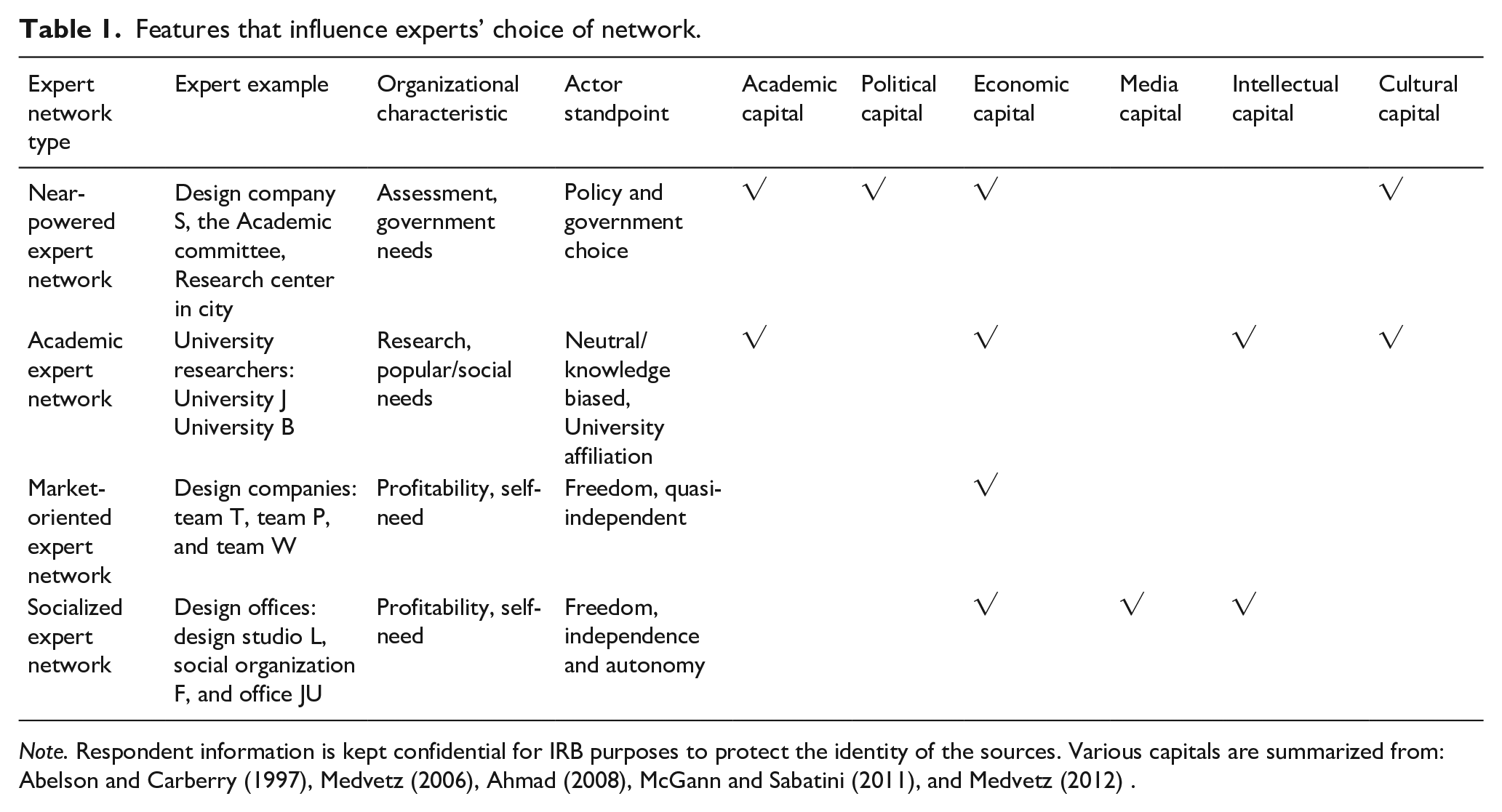
Note. Respondent information is kept confidential for IRB purposes to protect the identity of the sources. Various capitals are summarized from: Abelson and Carberry (1997), Medvetz (2006), Ahmad (2008), McGann and Sabatini (2011), and Medvetz (2012) .
Resources and strategies in different expert network
Near-powered expert network: Possess strong political capital
Such organizations are established under the leadership or carry out actions under the guidance of governments. Typical representatives are design company S and the Academic committee. The relationship between experts and decision-makers is crucial, which is very close to power. As demonstrated in Figure 4, such experts propose or evaluate plans, and negotiate with the municipal government whether to proceed with a new round of planning. Thus, the knowledge produced by experts in this institute is a “precondition” for RDP. As a “government-chosen” evaluation team, Academic committee assesses the rationality of projects for both municipal and local governments during the policy evaluation process. Therefore, Power application strategies are the main actor strategy they adopt to influence the policy process, thereby influencing the decisions of policy makers.
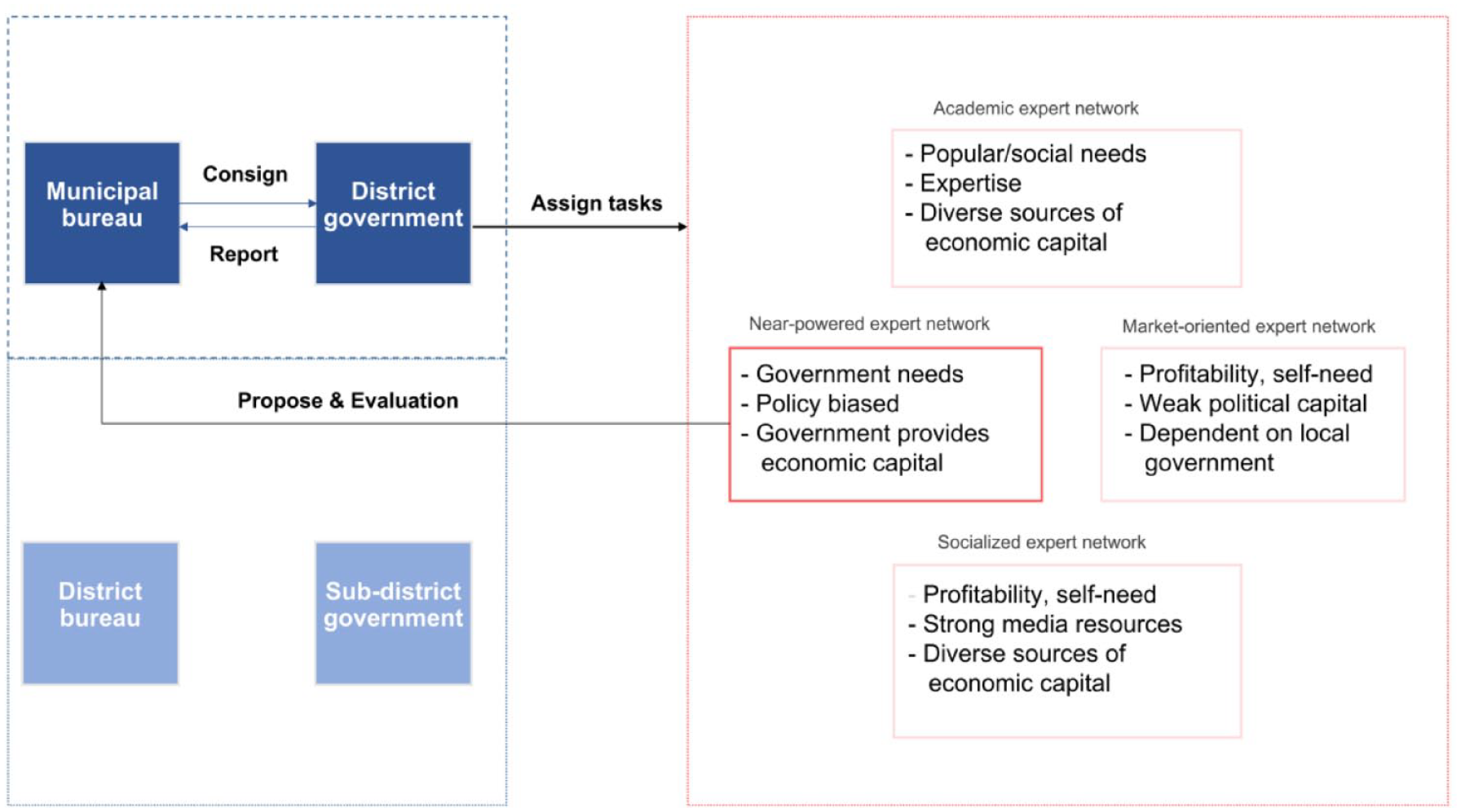
Near-powered expert network resources and generated strategies.
Experts in such organizations usually have high political capital and certain academic capital. Their economic capital only comes from government contracts and their media capital is weak. Their intellectual capital is more from professional knowledge, their research topics are decided by governments, and their output is mainly about recommendation reports on design solutions. The relationship between such experts and governments is close, as one such expert said: “District government is supposed to hire evaluation team, but we actually finalize experts together with them. . . We are responsible for paying for the assessment, including transporting and contacting experts, sending out meeting notices. . . One of the assessors is an employee of our institute, but the incumbent vice president should not be invited, because he was originally so highly associated with us” (Interview EN1). In fact, when determining evaluation teams, governments directly authorize design groups to hire evaluation teams to ensure project successes, even if they should have hired a team that the design team was not familiar with.
Government agents
The near-powered expert network is familiar with decision-makers’ difficulty and expresses them in concrete terms, in a way, to advocate for decision-makers and close the distance with the municipal government and enhance trust. Expert EN3 said in a meeting, “Each system has its own requirements. Do you think the top (government) will agree completely? Do not agree, how do I go to guard the project?” Subsequently, municipal leaders said this expert did raise a dilemma of current government departments, namely, it is difficult to mobilize certain horizontal resources (Participatory Observation M5).
Strong administrative ties
A common strategy used by near-powered experts is to demonstrate their strong ties to municipal decision-makers and thus increase their influence. As one design expert expressed, “Everyone here is familiar with each other. If we didn’t take the lead and wangle the government, no one else could, right? Our design plan is also difficult, so many plans have been made. . . I have already tried my best” (Participatory Observation M6). Strong ties are also reflected in that positions can be exchanged between government leaders and near-powered experts. In this case study, the district chief was originally the dean of a relevant municipal design group, which is similar to the “revolving door” phenomenon of American think tanks.
It is important that “showing connection with decision-makers’ superior to decision-makers” is a strategy that is common to all types of expert networks, however, decision-makers have different perceptions of the connection between different expert networks and superior decision-makers. Although experts attempt to elaborate the link with higher authorities in the same way, trust placed by the street offices is differed from the “near-powered experts’ link with district government” to the “market-oriented experts’ link with district government.”
As demonstrated in Table 2, same demonstration may achieve different results. We infer that such strong connections in near-powered expert network can enhance influence. Moreover, we cross-checked this with interviews. A designer mentioned that “if there is someone inside planning bureau, a lot of materials will be obtained first, then our plan will start earlier than others, and naturally it will be done well” (Interview EN2).
Different effects in near-powered and market-oriented network.
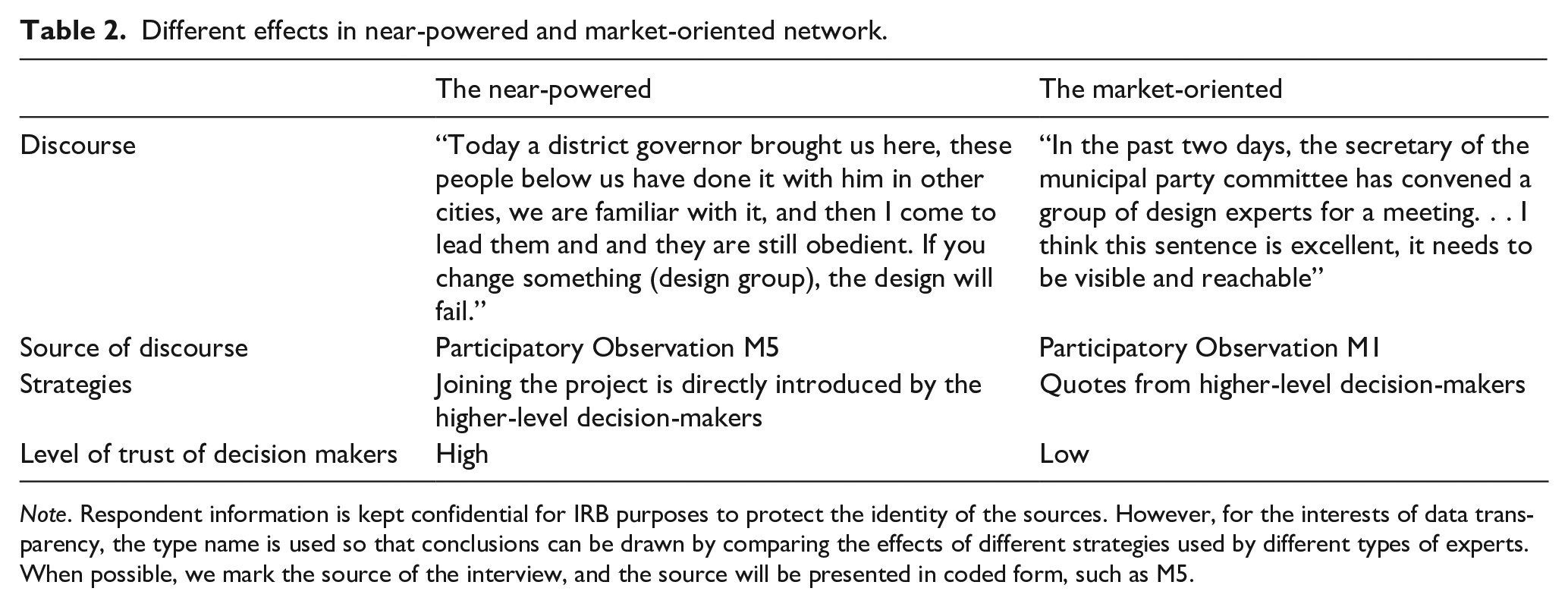
Note. Respondent information is kept confidential for IRB purposes to protect the identity of the sources. However, for the interests of data transparency, the type name is used so that conclusions can be drawn by comparing the effects of different strategies used by different types of experts. When possible, we mark the source of the interview, and the source will be presented in coded form, such as M5.
Academic expert network: Authority from complex knowledge
They are academically focused, and thus are authoritative in decision-making processes that require complex knowledge. Typical representatives are university researchers, such as University J and B.
These scholars conduct policy research as researchers and are more accountable for knowledge than power (Misztal, 2012). They mainly favor research, such as publishing in journals, holding academic seminars, and delivering lectures. Such organizations usually involve universities and research institutes, where the organizational characteristic is research-oriented, serving the needs of knowledge, society and public. Their research is knowledge-oriented. Experts in such organizations usually have high academic capital, and their sources of economic capital are diverse, such as topics, funds, and projects. Their intellectual capital comes from professional knowledge, and their outputs are mostly papers, monographs, conference discussions, and curriculum design. However, their political capital and media capital are relatively weak. The significant difference between academic experts and others is whose interests they serve.
As demonstrated in Figure 5, decision-makers need experts to provide professional knowledge owing to the complexity of policy issues, and experts thus find their own market. In such circumstances, information transmission strategies are a common strategy for such experts to transfer knowledge and professional opinions to decision makers to influence policy-making. As one university teacher expressed, “If there is a huge controversy and uncertainty, this is the time when he sincerely needs professional intervention. Therefore, you must be high enough to not be crushed (by the power). This is the time when professionalism is really a kind of power. This is the most basic meaning of the existence of our profession” (Interview EA1). “This (between governments and planning experts) is a relationship of dialog. Clearly, it is not an absolutely equal relationship. Governments have resources, the designer has the expertise to influence the way the resources may be used” (Interview EA2).
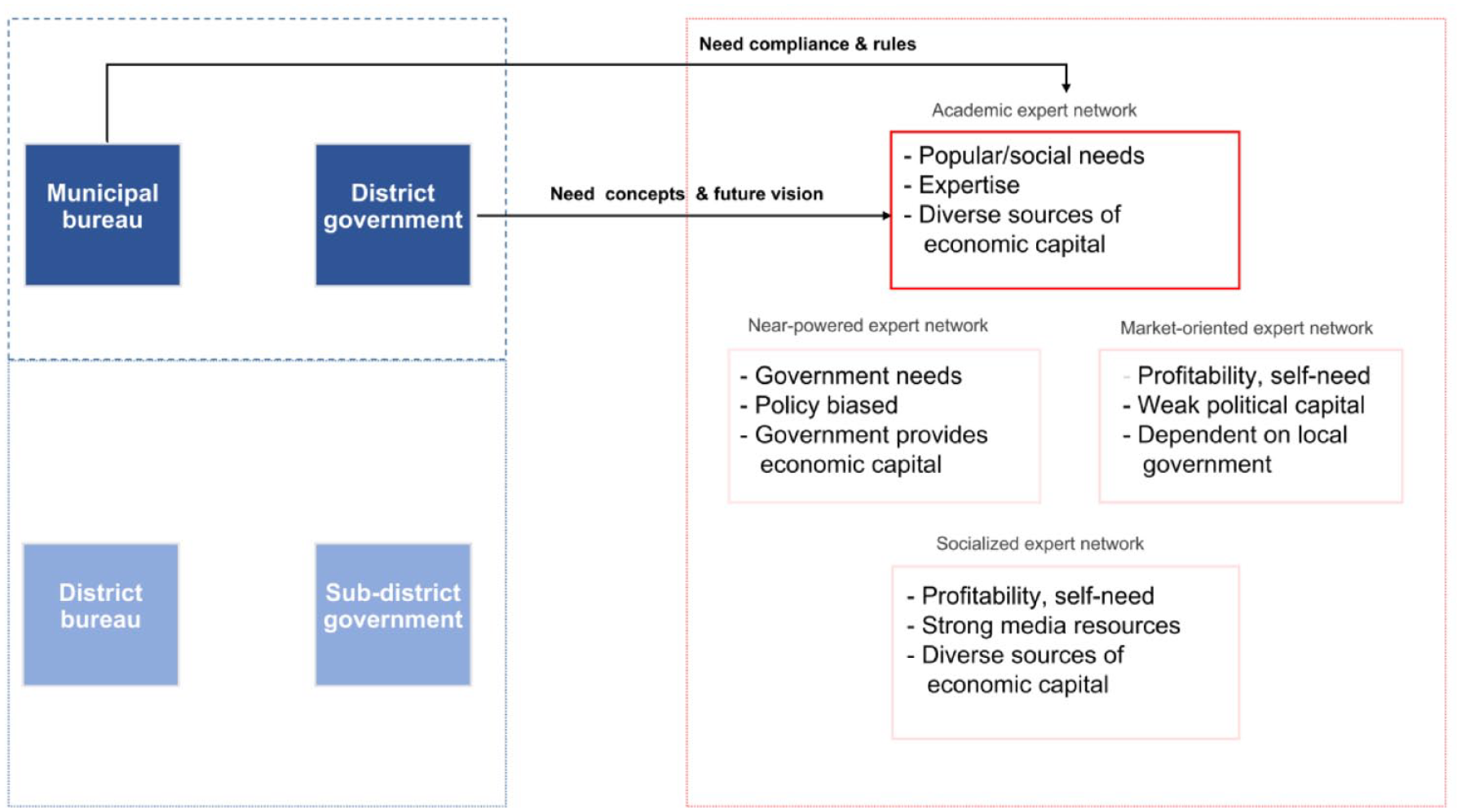
Academic expert network resources and generated strategies.
However, being “too scholarly” is a fatal flaw, and the measure of a good policy report is not academic rigor, but functionality in the policy making process. Academic expert network is often criticized for their inability to find a balance between academic rigor and policy functionality. “Different decision-makers have different concerns. I’ll give you an example. Planning bureau leader and district secretary are concerned about different things.” The planning bureau leader is more concerned about compliance, and the secretary is more inclined to development concepts and future planning. A design director said, “and these teachers in universities still want to talk about design concepts to try to impress them” (Interview EN4). It is important to successfully balance academic rigor and functionality in decision-making process. “So, it’s about finding the difference between different decision-makers” (Interview EN4).
In addition to the authority brought by complex knowledge, academic experts have more human resource advantages. Human capital is the professional analysts generated by intellectual organizations (Stone, 2007). As one college faculty member said, “The biggest help (as a college teacher) is that there are many students, and social capital is very useful” (Interview EA3).
Market-oriented expert network: Economic capital is used to collaborate with local governments
This type of organization is established for profit-making purposes and operates organizations with market-oriented techniques. They focus on economic capital, and typical representatives are large design companies that concretely implement program design, such as design teams T, P, W, and so on. As shown in Figure 6, such experts mainly accomplish specific design tasks assigned by decision-makers and collaborate with other design teams. Compared with former types, design groups are established for profit-making purposes, and main logic of its research is freedom and independence. The economic capital is a more singular contract, and political and media capital are weaker. Their intellectual capital mainly comes from professional knowledge, and outputs are dominated by specific proposals and drawings.
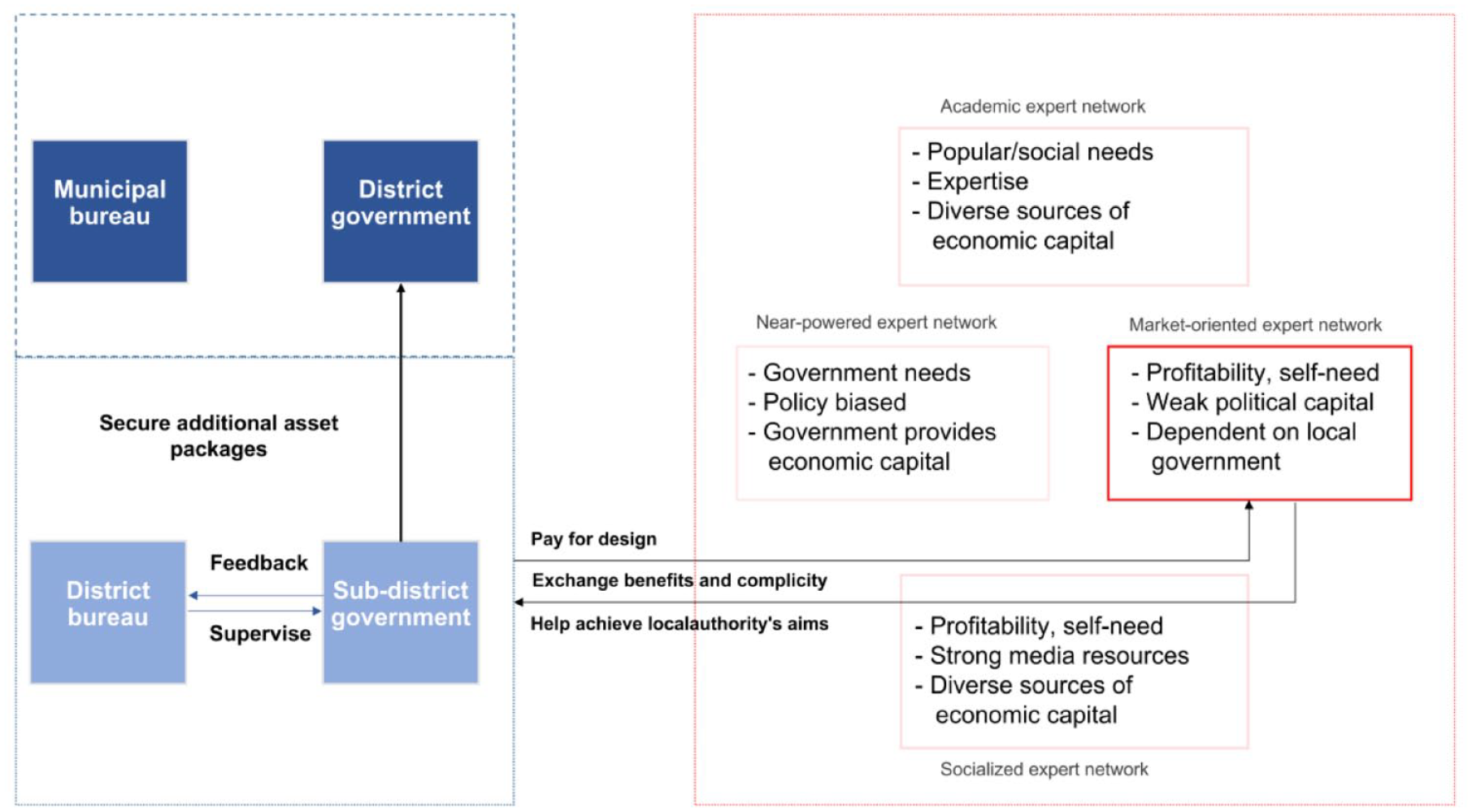
Market-oriented expert network resources and generated strategies.
Near-powered and market-oriented experts have certain similarities, for example, they both pay attention to the concerns of decision-makers. However, the most obvious difference between them is political capital. Taking design company W, as an example, in the mid-term evaluation, there is a possibility that “near-powered experts will be invited to modify the scheme for academic reasons, but in fact, near-powered experts will intervene in market-oriented experts' whole design process (Interview EM1).”
The market-oriented tends to use economic capital as a tool to exchange benefits with the government. During the project meeting, decision-makers exposed funding problems, which is the focus of the market-oriented. The market-oriented saw the uncertainty within decision-makers about funding implementation. To achieve their “concerns about funds implementation” and “reducing workload,” expert EM3 used “Party birthday” of governments as the tacit knowledge to get more benefits for themselves: “I do feel that with the power of our big team, we have done so much work in two weeks with your order, but I feel that you do not even implement the money. You still have to ask us if you want this or that. . . This is not nonsense. If we won’t be able to finish it before July 1st, we all work for nothing! You might as well say how much money you can ask for, and where to focus, and we will concentrate on it! (Participatory Observation M2).”
In addition to utilizing economic capital, the market-oriented also collaborates with local governments by helping to achieve their goals. Interest coordination strategies are commonly used by such experts to seek consultation and compromise in the process of policy-making in order to reach consensus and cooperation of all parties. In a project meeting, the sub-district government wanted to remove many articles from the site, however, was afraid that the public would not agree, “The advertisements on the side like this should not be located here, this can be removed. This wall will be completely demolished, this is also not allowed” (Participatory Observation M9). Simultaneously, he mentioned that “when the deputy secretary of municipal government came here to look at this place, it looks messy” (Participatory Observation M9), in order to further achieve their own demolition goals through the conversations of senior leaders.
Socialized expert network: Improving centrality by exchanging resources with the media
Socialized experts maintain close ties with media and the masses, and engage in events related to social activities. In addition, they may be employed by actors in market-oriented network to complete specific projects. Typical representatives are design studios that concretely project implementation, such as design studio L, social organization F, and office JU. Moreover, these design offices are established for profit, however, their research logic is freer and more independent than that of the market-oriented. Experts in these organizations usually have low political and academic capital. Their economic capital is also derived from clients. However, their media capital is more diverse and richer. Their intellectual capital comes from popular knowledge and is more closely linked to the masses. The research topics and outputs are similar to the market-oriented. These experts have relatively low academic capital, so they prefer to use popular knowledge more often to counterbalance their lack of professional knowledge. A district government leader mentioned, “The media are less professional generally and like to arouse general interest. Take Design Studio L as an example. It is engaged in community creation (small area design). Including RDP, we will not seek them as the main design group. Because RDP involves too many things, he can’t figure it out. . . Since we are not willing to bring him to do projects, then he has to take strengths to complement weaknesses, and use the pressure of social media to solve some problems (Interview DC1).”
Socialized expert network generates and disseminates knowledge primarily through the media capital, rather than implementing specific design solutions. Actors cooperate with other stakeholders to form alliances or advocacy groups to jointly promote specific policy goals, which is one of the interest coordination strategies. The non-governmental status of socialized experts is the main structural constraint on their influence, and they need to draw on peripheral resources to achieve influence. One socialized expert mentioned, “The director of a famous media contacted me several times, and he wanted to promote the history and spirit of this site.” (Participatory Observation M4)
Socialized experts are an important source of information for the media, and media coverage, in turn, promotes the visibility of such experts as “media intellectuals” (Schlesinger, 2009). Therefore, they have an increasingly high profile in governments and the media as an important source of information and advice. This self-promotional role allows them to market themselves as research and analysis-oriented institutions in the minds of the government and public (Abelson, 2002). Thus, when socialized experts are connected to the media, this entire network adds to the credibility of the entire expert network. As one designer said, “Government asked Team T to take the lead in the design, they are our party A, and our designers were invited to do the design. . . We searched for some media to promote it, and when we became famous, governments felt like, hey! Team T has done a good job in this area. The overall evaluation of implementation is high. Who actually did it? We did! But governments don’t care, they see you all as a whole. After media coverage, the government or the developers feel very happy, because they all need publicity and to be informed of what they are doing locally, whether it is for achievements or performance, they all need it (Interview ES1).”
Actors in socialized expert network often have a background in social organizations and use resources such as “non-profit legal and financial independence, dispassionate scientific endeavours, and service to democracy or non-state actors” (Sending & Neumann, 2006) to build their credibility and increase their influence and that of the entire expert network. However, after the reputation has been established, that is, after socialized expert network enters the network with media capital, as illustrated in Figure 7, they use “close contact with media and public” as their advantageous resource. A designer mentioned, “In cooperation with governments, I now think that our team is doing a good job in linking resources. . . In fact, we are cooperating with many parties to enhance our influence. For example, their professional skills in different majors must be able to support us. . . If we can find a partner, we will try our best to cooperate with them, so as to ensure the position of a node. Then use this comprehensive force to promote yourself (Interview ES2).”
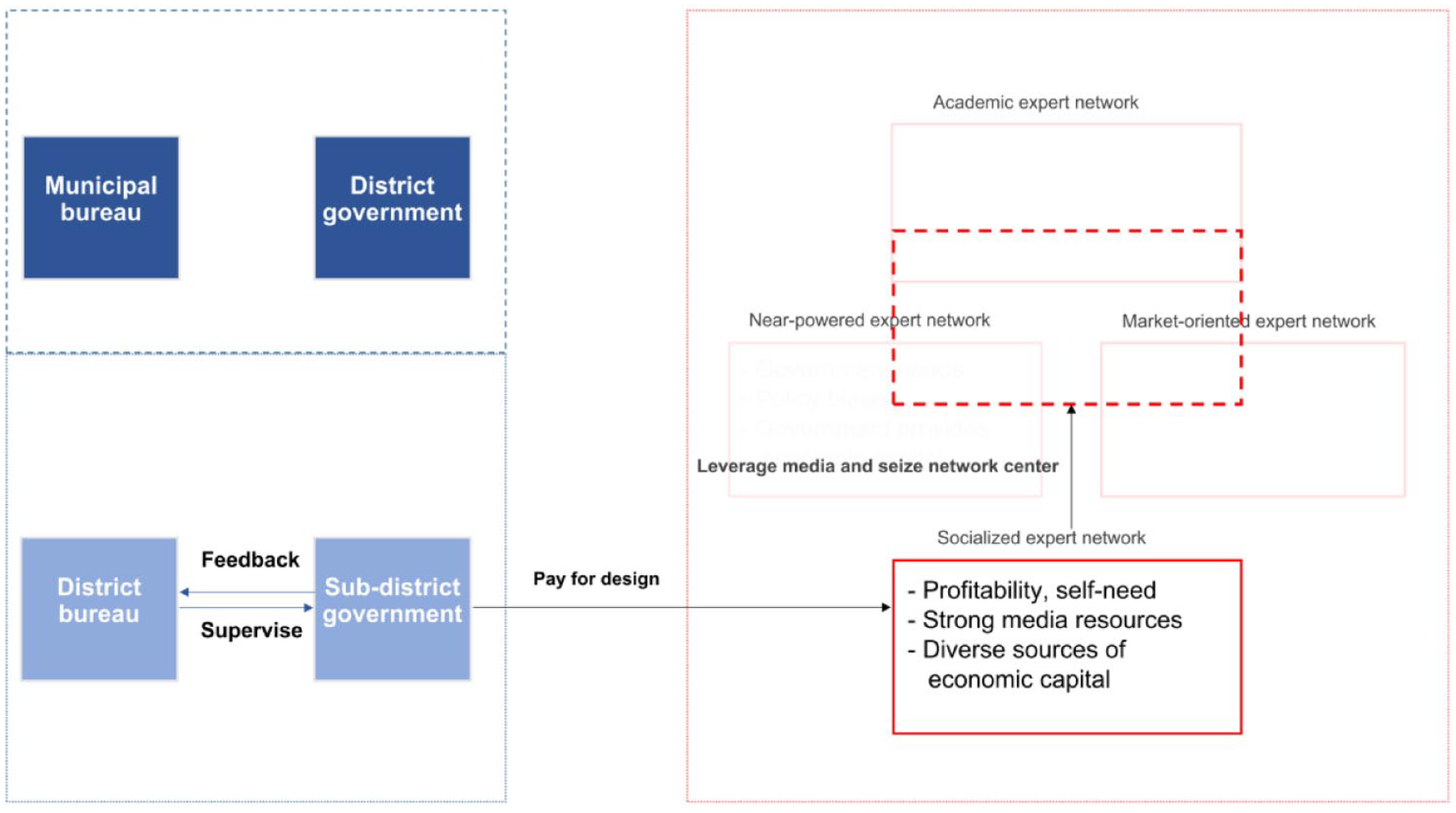
Socialized expert network resources and generated strategies.
In efforts to increase their network centrality, the socialized attempts to seize the central position of the overall expert network. When it reaches the center, as illustrated in Figure 6, it has a competitive advantage over the market-oriented and the academic, and it can make use of media publicity to gain a close relationship with decision-makers at multiple levels. This trend of “cooperating with government” reveals that the socialized has a tendency to transition to the near-powered. In case of need, the socialized can “act as a mechanism to connect knowledge production and policy” (Krizsán & Zentai,V, 2005), bridging the gap between science and politics.
In short, the socialized generates influence by linking to peripheral resources such as the media. Thereafter, they increase the influence of the entire expert network based on improving their own influence, and thus create a link between science and politics.
Resource empowerment: Logic of resource flow in expert network
How can expert network have more far-reaching influence? Our close observation of interaction between the Chinese urban planning experts and officials reveals that experts increase their “voice” by optimizing node, flowing relationship, and clustering advantage.
Node optimization: Expert optimal capital overlay
First, actors in expert network have “multiple identities.” When an expert joins a decision-making process, huge structural tension is formed, which can easily cause internal consumption. However, when an expert has “multiple identities,” most obstacles can be eliminated. Thus, when a specific actor in expert network has multiple identities, it may bring about a stronger power, thereby consolidating political foundation and increasing the overall network influence where he is located. In addition, the more fluidly experts switch identity between different expert networks, the more effective influences they have. This actor is analogous to a policy entrepreneur, acting as a pivotal node in the network, even more with the concomitant effect of expanding expert community influence. “I think the factor that [XX] has a college background is a very important point for us to be more influential in RDP and to receive more and more projects. He combines his teaching with career completely. So, this kind of research and practice will support and complement each other in the future, the boundaries between them will become more and more blurred. . . Furthermore, you know, the chairman of this team, who a cadre is working in government for many years, so a person with government background has advantage in promoting something. This means he knows how to achieve a win-win situation in administrative discourse (Interview EM4).”
Research institutions with government backgrounds and experts who maintain personal relationships with key government decision-makers easily stand out as key advisers. It is noteworthy that good decision-making relationships are extremely scarce resource, and the vast majority of experts do not have effective access to maintain it. Therefore, they should try to cultivate more people to participate in decision-making process and increase sustainable impact of expert network. “So, I also often tell [XX] teacher that if those leaders do not force you to participate in, you just allocate someone else to do jobs. Then I believe this is also an essential point to develop the team (Interview EM5).”
Second, expert networks become multifaceted. Expert networks make a difference in constructing their self-image and actual influence: they are able to present themselves to the public as participants who remain as neutral as possible and only provide evidence (Westermeier, 2018). Alternatively, they demonstrate their familiarity with policy and support for bureaucratic views to decision-makers. This increases comprehensive impacts of the expert network. Staff in Municipal Planning Bureau explain that “Experts also have different orientations. For instance, common people, market, the power, the media. The media generally with less professional target the common people who are more likely pleasure-seekers. While some other groups pursue government departments' security and have high quality on the professionalism. As a result, there is a big contradiction between popular knowledge and professional knowledge. We generally know that they have tendencies, but it is more likely that many experts can only match one identity (Interview DC1).” Expert network is multifaceted when facing different subjects and are able to increase their combined impact. “Some experts may say specific things to specific people, and they can solve problems that ordinary people can’t solve or can’t solve easily, and those are more wonderful (Interview DC1).”
Third, superior resources are superimposed. As mentioned earlier, the endogenous factors influencing experts’ choice of network lie in different positions and resources held by actors, and each has different resource advantage. Thereafter, various types of experts select the capital advantages they hold and combine them to increase the overall expert network influence. Building and maintaining a decisive network enables the expert network not only to keep flexibility but also control over valuable resources, as opposed to constructing a complete organization to organize other actors.
Relationship flow: Conspiring with like-minded decision-makers and competing and cooperating with other knowledge providers
Conspiring
It has been argued that the emergence of other knowledge providers has contributed to a competitive situation within expert network, which is a crisis for think tanks (Galushko & Djordjevic, 2018). However, this sort of competition and connection with other knowledge providers is also an opportunity that will increase overall network influence. When discussing whether to hold a bridge design proposal, expert EM3 opposed, saying, “I think if we are really talking about how many bridges completed during the art season, maybe not at this time. . .” While expert EM4 thought it was possible to hold part of the call for proposals, “I think it is possible to use the call for proposals as a phase, and then the call for proposals is selected to see how the proposal will be implemented (Participatory Observation M10).”
Competing
In a follow-up interview with the head of the sub-district government, he answered, “It’s not really (to distrust them). We usually don’t listen to one side of the story when making decisions, but if they argue, it makes people believe in professional power. Normally we always overrule expert, but here we have different opinions, which gives people a sense of trust. Having multiple voices opens up our minds to a more integrated approach (Interview DS1).” Moreover, it means that the preceding dispute over “bridge design proposal” has provided government trust in expertise. If experts realize that they lack critical resources and capabilities when attempting to impose an impact on the policy, they may turn to collaborate with other experts who have those resources (Xue et al., 2018). Based on this view, it may be further concluded that an appropriate competitive relationship increases the entire expert network influence.
Cooperating
Burt’s Structural Holes theory suggests that the more network one has, the more efficient one can be without duplicating sources of information. Social network theory also states that network centrality reflects the degree of centrality of network position occupied by an expert (Freeman, 1978). The higher the network centrality of an expert is and the stronger the connection to external resources is, the greater that expert’s influence becomes. In Figure 7, market-oriented experts often attempt to establish connections with other types of experts to improve their social reputation and credibility. In project meetings, market-oriented experts used several panels to present design content such as “slow-living,” cultures and so on, and gather experts from various backgrounds to enhance their status as market-oriented experts by presenting linkable resources. Specifically, they propose “suitable for living” to link up with “departments” (administrative power) and “Suitable for sightseeing and slow life” to link up all kinds of living facilities and compete with other market-oriented experts to demonstrate their influence. In cultural section, esthetic education uses the expertise of their own team. They contacted “Suitable for learning” with academic experts and “intelligent platform” with socialized experts. The text segments “suitable for [XX]” are requirements in government policy. Market-oriented experts are prone to seize these requirements in the policy text, that can be used to corporation and compete with other experts.
Cluster advantage: Building a knowledge community
As shown in Figure 8, expert network constructed a new “knowledge community” by strengthening the integration of its optimal capital. A more closely related and well-resourced expert network is reconstructed with individual experts as nodes, and the overall power of expert community is expanded through continuous actions. This process can be divided into three phases.
Cluster advantage—Building a knowledge community.
An additional benefit of such event-based forums is the ability to respond more flexibly to demands of accountability. Complete organizations demand more accountability and operational transparency (Ahrne & Brunsson, 2011), and this “loose” forum model can reduce the likelihood and degree of accountability. A leader of team T said, “We only write these two parts. . .. Part of it is about the situation of the planning process; another is the planning of the 15-min living circle. This is the content of previous academic meeting output and the figures are reported by various design groups, not only our individual things. You have to make a choice, for we have no idea what can be reported, what cannot be reported (Participatory Observation M13).”
It is noteworthy that the logic of resource empowerment described above is not a simple linear relationship between each part. Experts could be key players in policy process by adapting their action strategies according to different decision-makers they face and at different policy stages.
Discussion and conclusion
This study addresses the core issue of internal discrepancy in expert networks based on a review of the relevant literature on expert involvement. Based on network research, this study summarizes a theoretical model and traces the expert involvement in urban planning decision-making process in China, to understand how expert network generates policy influence. By analyzing range of expert actions, we emphasized the concrete influence of resources and structural differences within the expert network in the decision-making process.
First, expert involvement differs in action logic according to network features. Owing to the differences in government choices, organizational characteristics, capital and other features, we find that individual experts and their organizations form different expert networks. Information transmission strategy, interest coordination strategy, and power application strategies are three strategies commonly used by experts in the policy process. They tend to choose according to the resources of different types of experts. Although the four types of expert networks attempt to play a key role in the decision-making process, their action strategies differ. As the “government agent,” near-powered expert network can contain other actors by its strong connection with government and improve its network influence. Academic expert network focuses on academic research and tends to use their complex knowledge to provide advice for decision-makers who have a weak professional knowledge background, or play to this advantage in the scenario requiring high professional degree. By utilizing their economic capital, market-oriented expert network exchanges the interests with the grass-roots government to reach cooperation, and strives for resources from the superior government. Socialized expert network exchanges resources with the media to improve its influence, and thereafter attempts to occupy expert network center.
Second, “Nodal” experts or organizations can play a bridging role. The “center” position of socialized expert network is clearly visible, and it has more proactive action strategies than other types of expert network. Decision-makers and academics should focus on bridging instruments that can bring their world closer together (Newman et al., 2016). The socialized with extensive media resources and social organization resources, such as designer studio L, is more likely to become advocates of public opinion, and their voices are more likely to be noticed by decision-makers. Pivotal professional organizations play a bridging role in decision-making like policy entrepreneurs, and can continuously enhance the effectiveness of professional knowledge penetration. We suggest that the role of the socialized expert network as a bridge tool should be further exploited, and thereafter developing a more efficient and proactive approach to policy making.
Third, the differential resource overlay of different types of expert networks can create an impact-enhancing effect of “resource empowerment.” This is similar to existing research that suggests that “the functional mix of experts reduces policy ambiguity” (Piggin & Hart, 2017). Experts with “multiple identities” or “consensus authority” in the expert network are “matchmakers,” and their optimal resources are superimposed to achieve node optimization. Thereafter, certain experts look for decision-makers with views similar to its own, and carry out appropriate competition and cooperation with other expert networks to improve the overall influence of expert group in decision-making process. On the basis of increasing advantageous resources, a knowledge community is formed with expert network to reconstruct an expert network with more superior resources and higher influence. It is important to emphasize that influence through network structure is not a simple linear logic. After a closer network is formed, the superior resources of experts will be further strengthened and stronger expert network will be woven to improve expert influence.
Our study provides several contributions to the existing literature. Firstly, it goes beyond the oft-repeated argument in work on expert involvement and finds different types of expert networks adopt action strategies to exert their influence in the decision-making process. Secondly, it also shows using network to study expert involvement can not only reflect the complex interaction among experts but also help form an organic combination of the network structure and knowledge strategy. Thirdly, we provide a specific measurement tool for the expert influence which was considered to be difficult to quantify before. Therefore, expert involvement can be improved more specifically. Finally, the way to quantify the influence of experts is to generate an analytical framework and provide explanations for the framework. This framework has undergone case studies and can also be used for large N sample testing in the future.
Despite the insights provided, this study has certain limitations. First, the findings are based on a single case study. However, it is worth mentioning that scholars believe that it is beneficial to achieve the theoretical goal of the study with a particular case. Since we highlight the important value at the micro level, which has been surprisingly neglected in existing studies, this may reveal new theoretical and empirical insights (Yin, 2018). Second, the expert network we discussed is within the urban planning, however, considering that it attempts to elucidate the relationship within the expert network and the process of exerting influence by using resources with other actors such as bureaucrats, we believe that it has the same promotion value in other policy fields. Third, it mainly conducts research in the context of Chinese policies, therefore, its applicability in those of other countries and regions remains to be verified. In many other countries, political and administrative decision-makers need to be analyzed separately because of their fundamentally different roles and knowledge requirements. Furthermore, this study does not clearly distinguish “different level government” and “authorities and bureaus” as different forms of government subject. In fact, when we conduct theoretical review and empirical research, it is found that there are certain differences between the two or several of them in their attitudes toward professional knowledge. Owing to the limitation of length, it is regrettable that we cannot discuss this in depth. Future studies can attempt to expand the mechanism proposed in this study to relevant policy areas in other countries, and further distinguish the practical scenarios of interaction between officials of different departments and planning experts. In addition, since the influence of network structure formation is not linear, the question of how to optimize the structure in the actual situation so as to make experts obtain the best allocation of resources is also worth exploring.
Supplemental Material
sj-docx-1-cpp-10.1177_15396754231199170 – Supplemental material for How network resources empower expert involvement? Evidence from urban planning decision-making in China
Supplemental material, sj-docx-1-cpp-10.1177_15396754231199170 for How network resources empower expert involvement? Evidence from urban planning decision-making in China by Yuchen Guo, Huiling Xu and Shi Wu in Chinese Public Administration Review
Footnotes
Acknowledgements
This research was made possible through funding from the National Social Science Fund of China. Interview contributions are gratefully acknowledged, as are comments from Zhu Qianwei, Chen Qiang, Zhao Ji. Special thanks to School of Innovation & Entrepreneurship Tongji university.
Geolocation information-Shanghai, China Mainland
Author contributions
Conceptualization: Yuchen Guo; Data curation: Yuchen Guo, Huiling Xu; Methodology: Yuchen Guo, Huiling Xu; Project administration: Shi Wu; Formal analysis and investigation: Yuchen Guo, Huiling Xu; Visualization: Huiling Xu; Validation: Shi Wu; Writing - original draft preparation: Yuchen Guo, Huiling Xu; Writing—review and editing: Yuchen Guo, Huiling Xu, Shi Wu; Funding acquisition: Yuchen Guo; Supervision: Yuchen Guo.
Declaration of conflicting interests
The author(s) declared no potential conflicts of interest with respect to the research, authorship, and/or publication of this article.
Funding
The author(s) disclosed receipt of the following financial support for the research, authorship, and/or publication of this article: This work was supported by the [the National Social Science Fund of China] under [grant number 22CZZ019].

Supplemental material
Supplemental material for this article is available online.
Data availability statement
Data available on request from the authors. The data that support the findings of this study are available from the corresponding author upon reasonable request.
All citations have been listed in the reference list. There are no other kind of reproduced material (figure, table, photograph, etc.).
References
Supplementary Material
Please find the following supplemental material available below.
For Open Access articles published under a Creative Commons License, all supplemental material carries the same license as the article it is associated with.
For non-Open Access articles published, all supplemental material carries a non-exclusive license, and permission requests for re-use of supplemental material or any part of supplemental material shall be sent directly to the copyright owner as specified in the copyright notice associated with the article.
