







Abstract
This article aims to extend the political market framework by exploring whether policy demand or supply is the key consideration for local governments’ policymaking and under what financial conditions local governments favor one over the other. We expect that local governments with good fiscal conditions are more likely to respond to public demand, but local governments with poor fiscal conditions pay more attention to supply influences. To test this idea, this study examines the moderating role of fiscal conditions within the political market framework regarding what factors account for adopting local governments’ Pay-As-You-Throw (PAYT) recycling programs in solid waste management (SWM). The results of the fixed-effect logistic model support that fiscal conditions play a moderating role in shifting organizational attention on the supply side based on cross-section data covering 1,840 local governments in the United States.
Introduction
This research develops and applies a political market framework to explain the impact of local governments’ fiscal conditions on their choices to adopt and implement PAYT recycling programs. As conceptualized by the public choice school, this framework identifies policy outputs as the consequence of the interplay between the aggregative public demanders and the governmental suppliers (Crain, 1977; Keohane et al., 1998). Building on this premise, public administration scholars delve into the dynamics between local political institutions and public demand, seeking to understand how institutional structures shape the representation of communities and interest groups in public policy decision-making (Deslatte et al., 2017; Kim & Lim, 2018; Lubell et al., 2005, 2009). Consistent with the framework, previous empirical research highlights the moderating role of institutional arrangements and finds that the form of government will amplify or diminish the impact of different interest groups on policy choices (Carr, 2015; Lubell et al., 2009).
This article aims to extend the political market framework by using the concept of organizational attention to explain whether financial conditions draw attention to local policymakers in preferring demand-side or supply-side factors. While this framework frames policy choices as the outcomes of the interaction between the aggregated policy demanders and governmental suppliers, it ignores that public agencies are constrained by their information-processing capacity and are limited to addressing all the aggregative demand and supply factors in reality (Jones & Baumgartner, 2005; Terman, 2015). Thus, public agencies prioritize their attention toward some considerations over others based on signals (i.e., budgetary shifts, executive orders, and external shocks). Accordingly, this study extends the framework by demonstrating that political outcomes are determined by political institutions and “subject to attention constraints” (March et al., 1983). Specifically, we ask under what signals local government pays more attention to policy demand factors than supply factors or vice versa. To address this question, we build the link between fiscal conditions and organizational attention to explore whether the condition of financial resources shifts organizational attention allocated between policy demand and supply on policy choices. In this research, the expectation is that local governments with good fiscal conditions demonstrate higher responsiveness to public demand because they possess enough financial resources to meet the needs of local communities. On the other hand, local governments with poor fiscal conditions have to deal with limited financial resources and thus tend to focus more on the supply side instead of public demand, when they make decisions on community-based programs to improve organizational efficiency and save money.
To examine this research expectation, this study constructs several fixed-effect logistical models (state-level) to test the moderating role of fiscal conditions within the political market framework in the context of what factors account for adopting PAYT recycling programs by local governments. Moreover, this research uses cross-section data covering 1,840 local governments (including counties, cities, and townships) collected from the 2010 to 2014 American Community Survey, the 2012 Census of Government Finance, and the 2015 ICMA Sustainability Survey. The results support that local government shifts organizational attention between policy demand and supply on policy choices under different conditions of financial resources within the political market framework.
This inquiry contributes to the literature in two ways. First, this study refines the political market framework by using the concept of organizational attention to explore whether policy demand or supply is the key consideration for local governments’ policymaking and under what financial conditions local governments favor one over the other on policy choices. Previous research has examined the moderating effect of local institutional arrangements on policy choices. It suggests that different structures of local political institutions will filter public demands by amplifying or muting a certain interest of specific constituencies to affect policy outcomes (Deslatte et al., 2017; Kim & Lim, 2018; Lubell et al., 2005, 2009). These articles have tested the interaction effects between supply-side variables (specifically, political institutions) and demand-side variables within the political market framework in local policy choices. However, there has been little discussion about whether demand-side or supply-side variables drive more attention to local policymakers and under what context local government favors one over the other in policy choices. Upon considering this research gap, this study explores whether local governments’ fiscal conditions filter their organizational attention by prioritizing public demand or supply in political decision-making.
Second, this study’s empirical result reveals how financial resources affect policy choices through moderating organizational attention. While previous research has shown that financial resources directly influence policy decisions, the role of financial resources is debated (Berry & Berry, 1999; Kwon et al., 2009). Since a lack of fiscal capacity could motivate but also constrain the action on policy adoption, the mechanisms that underpin fiscal conditions are not fully understood. Based on the literature on organizational attention, this study provides an alternative perspective that the levels of fiscal conditions drive local government’s attention, which causes local government to favor demand-side or supply-side factors in policymaking. Thus, local governments with good fiscal conditions amplify demand-side factors and mute the supply-side factors to affect policy outcomes. In contrast, governments with poor fiscal conditions tend to do the opposite.
Pay-As-You-Throw recycling program
With increasing concerns about climate change and environmental damages due to incremental solid waste pollution, local governments have used various policy instruments to reduce waste disposal and increase the recycling rate (Alves et al., 2020; Ukkonen et al., 2021). As part of this effort, public officials target PAYT programs as a market-based policy instrument to reduce municipal solid waste (MSW). Two general objectives of the programs are reducing waste at the source and increasing recycling rates by avoiding landfills, thus reducing negative environmental impacts in MSW management systems (Elia et al., 2015). Similarly, like other local utilities for electricity, gas, and water, this strategy utilizes a unit pricing system for collecting, transporting, and disposing of MSW services (Folz & Giles, 2002). PAYT programs aim to charge customers on MSW services based on how much solid waste they discard; therefore, local citizens pay for how much they throw away. Since it is very flexible to apply PAYT programs, local governments adopt and implement various forms of these programs (US EPA, 2016). However, the three most common types are container price, unit price, and weight price systems (Folz & Giles, 2002).
Only a few innovative communities in the United States adopted these environmental-friendly programs 20 years ago. While this number has increased in recent years, the adoption rate is still below expectation, which means that only 1-in-10 of the local governments have adopted this program (International City, County Management Association [ICMA], 2016). Currently, most local governments collect revenues from MSW services by a portion of property taxes or a fixed bill amount that does not provide incentives to reduce waste due to no variation in the amount of garbage taken away (US EPA, 2016). Besides, some municipalities have a long tradition of curbside recycling collection by sports clubs, which collect recyclable waste at no charge. Compared to traditionally fixed pricing systems and voluntary curbside recycling programs, PAYT creates a direct economic incentive to recycle more and generate less waste while simultaneously reducing the disposal cost for municipalities (Gradus et al., 2019). Although this program is efficient for waste reduction and recycling with economic, environmental, and equity advantages, the adoption rate is still low among local governments in the United States (Bauer & Miranda, 1996; Canterbury, 1998; Kutzmark & Canterbury, 1996). Considering the dramatic shifts in Chinese imported policy of recyclable commodities in 2018 and the North American recycling industry has relied on Chinese export markets for a long time, the US municipalities have to search for alternatives to encourage waste reduction (Gradus et al., 2019; ICMA, 2018). Thus, the research on PAYT instruments has a real influence on how local officials have to tackle the shift in international exported markets (ICMA, 2018).
Theoretical framework: Political market framework
The demand and supply sides of the political market
The political market provides a theoretical framework for examining what factors affect local governments’ choice of PAYT based on demand and supply (Callan & Thomas, 1999). On the demand side, the rising support within the general electorate is the major factor underlying the willingness of governments to adopt and implement PAYT programs (Pennington, 2000). According to voter-centered public choice theory, local governments will pay attention to public reaction to some policies that reflect the median voter’s preferences. Thus, the median voter’s preferences on environmental regulation and sustainability posit an incentive structure that compels local governments to adopt and implement PAYT programs (Pennington, 2000).
Furthermore, the majority preferences of local constituents and interest groups are shaped by socioeconomic attributes and demographics (Callan & Thomas, 1999). Like most sustainability policies, communities with higher education levels are more likely to take action on PAYT programs, which suggests more educated constituents pay more attention to environmental issues and, hence, more supportive climate protection (Folz & Giles, 2002; Gradus et al., 2019). However, unlike most sustainability programs, higher-income communities are less likely to implement PAYT programs (Callan & Thomas, 1999; Gradus et al., 2019). Previous studies assume that PAYT programs less attract wealthy communities because those communities have engaged in recycling activities or are not motivated by recycling programs with revenue generation (Callan & Thomas, 1999; Gradus et al., 2019). Moreover, it will be a financial burden for large poor families because they pay more for commodities and use more than other households, as well as the extra fee due to PAYT (Yeung & Chun, 2018). Thus, communities with large household sizes at higher poverty rates are reluctant to act on PAYT.
Furthermore, Folz and Giles (2002) contribute citizen participation and public opinion to the question of whether some characteristics of cities will increase the likelihood of PAYT adoption than others. However, they fail to find a noticeable relationship. Thus, they argue that it fails to predict PAYT adoption by the level of citizen support for recycling and the type of recycling participation.
Moreover, problem severity measured by landfill capacity shows a strongly significant impact on implementing recycling programs (Callan & Thomas, 1999; Folz & Giles, 2002). PAYT programs will save landfill and generate savings in tipping fees, transportation, and transfer costs (Folz & Giles, 2002). With the remaining years of landfill life decreasing, the local need may have stronger incentives to adopt and implement PAYT to reduce solid waste and increase the recycling rate.
On the supply side, both political and economic factors affect whether governmental suppliers act on PAYT programs (Wamsley & Zald, 1973). First, political factors suggested by the political market framework point out the role of local political institutions in policy choices (Kim & Lim, 2018). In particular, the form of government and elective or executive leadership is associated with the policy choice of PAYT programs (Carr, 2015). The form of government is a vital factor within the political market framework, which moderates policy choices. Due to high-powered incentives, the political form of government is more responsive to local communities’ interests to gain electoral support. Thus, elected officials will prefer this program if local public opinion (e.g., a more significant proportion of highly educated people) will support it (Frant, 1996). However, the administrative form of government is motivated by low-powered incentives and more interested in career advancement by building good reputations and achieving better performance (Frant, 1996; Jimenez, 2020). While PAYT has strategic benefits in developing more environmental, economic, and equity communities, most of the residents are unwilling to pay the minimum waste charge, and it is a challenge for local officials to persuade citizens to pay for their MSW services (Elia et al., 2015; Yeung & Chun, 2018) . Therefore, compared to the political form of government, the administrative form is more likely to adopt this program because it prefers sustainability and environmentally friendly programs. Furthermore, the political ideology of leadership among local governments also matters in the policy choice of PAYT. Gradus et al. (2019) imply that more liberal governing boards will be less likely to embrace PAYT because they expect that the Democrat governing body does not want to put a cost burden on individual households.
Second, the economic factors are suggested to determine policy outcomes. Particularly, budgetary considerations limit the policy choices of SWM among local governments, including governmental revenue and expenditure. Conventionally, US municipalities rely on the property tax as their revenues to fund solid waste services (Callan & Thomas, 1999; Gradus et al., 2019). Property tax dependence is the proportion of the total government revenue from property taxes. Thus, local governments with higher levels of property tax dependence are more likely to adopt PAYT to gain more revenue to cover the SWM expenditure (Gradus et al., 2019). In addition, PAYT is a useful instrument for achieving economic goals by reducing MSW expenses (US EPA, 2016). With less MSW produced by residents, savings in collection and disposal costs are primarily reduced by local governments. Therefore, local governments can gain economic revenues by adopting and implementing a well-designed PAYT program that can cover the MSW costs of collecting, composting, and transportation (US EPA, 2016). Therefore, Gradus et al. (2019) argue that local governments with more public expenditure per capita might have more incentives to adopt PAYT to save money.
Organizational attention and the moderating role of fiscal conditions
American federalism offers scholars a huge natural laboratory to study the determinants of policy choices at the state and local levels. Over the last several decades, scholars have developed various theoretical approaches to explain internal determinants and external diffusion, which drive different policy choices by state and local governments across the nation (Berry & Berry, 1990; Walker, 1969). Inspired by public choice studies, public administration scholars have adopted the political market framework in explaining decision-making and policy change by conceptualizing internal determinants into demand and supply sides in recent years (Curley et al., 2023; Deslatte et al., 2018; Tong et al., 2019). The public choice school views policymaking as a political marketplace in which representative democracy processes aggregated demands of constituents into public policy. However, most of the time, suppliers do not represent or respond to the preferences of demanders (Holcombe, 2016). In this case, public administration scholars argue that institutional arrangements alter the influences of public demand by amplifying or muting different preferences of constituents on policy outcomes (Deslatte et al., 2017; Lubell et al., 2005, 2009). This promising literature provides theoretical support for the moderating role of political institutions in policy choices by examining forms of local government in various policy areas: land use and urban growth (Deslatte et al., 2017; Lubell et al., 2009), climate protection and sustainability (Krause, 2012; Yi & Feiock, 2012), and economic development (Lubell et al., 2005, 2009).
Although previous literature focuses on the moderating role of political institutions, which demonstrates that policy outcomes are the consequences of the interaction between public demand and supply under the constraints of political institutions, political outcomes are not only determined by political institutions but also “subject to attention constraints” (March et al., 1983). In order to interpret how attention moderates political outcomes, this study extends the concept of organizational attention into the political market framework. Organizational attention states that policymaking is the consequence of prioritizing the attention of public agencies and policymakers toward some issues over others in agenda-setting (May et al., 2008, 2009; Terman, 2015). Researchers tend to investigate the antecedents and consequences of organizational attention in public sectors. A comprehensive discussion on the strategies used by public agencies to focus their attention on organizational structures, political institutions, coalitions, and the flows of information (Bansal et al., 2018; Breeman et al., 2015; Kingdon, 2011; Mortensen et al., 2015). An additional discourse examines organizational attention’s influence on reorganization, performance, and budgeting (Jones & Baumgartner, 2005; March et al., 1983; May et al., 2008). Most studies focus on how governments distribute attention across various issues and how this allocation influences policy output and organizational performance.
According to the concept of organizational attention, this paper frames it as the mechanism that moderates the order of prioritizing policy demand over supply in the political market framework and vice versa. On the demand side, democratic governments are designed to respond to societal demands by adopting new policies (Knill et al., 2020). However, on the supply side, the administrative ability of the government to pursue its responsibilities may often be determined by the size of the agency budget (Pennington, 2000). It has a cost in the planning, transitioning, and implementing a new program, which means that governments with more economic resources tend to respond to societal demands (Knill et al., 2020). The level of fiscal conditions determines the ability of local government to meet the majority preference. On the other hand, local governments tend to avoid political conflict on the demand side and will have more rational and strategic decision-making on the supply side when they are facing fiscal stress (Bourdeaux, 2018; Jimenez, 2014; Justice & Yang, 2018). For example, local governments had to shrink their public service responsibilities and utilize organizational strategies in the retrenchment process due to the limited financial resources during the Great Recession (Jimenez, 2014; Justice & Yang, 2018).
While PAYT can generate revenue for local SWM, it is costly because of the shift from a tax-based system to a price-based system. The transition of PAYT needs public education and promotion programs to improve residents’ knowledge and positive attitudes toward recycling policies. Thus, local governments with extra funding pay more attention to public demand and can afford the expense of public education and advertainment (Gradus et al., 2019). On the other hand, government supply may draw more attention when they have poor fiscal conditions. Therefore, fiscal conditions are critical for moderating organizational attention shifts between demand and supply, which influences the policy choice of PAYT.
Hypotheses
Since relevant variables have been tested in the previous studies in the literature of PAYT, this paper focuses on examining the moderating hypotheses of local fiscal conditions shaping organizational attention between public demand and supply (Callan & Thomas, 1999; Folz & Giles, 2002; Gradus et al., 2019). In this article, we examine the relationship between the characteristics of public demand and the implementation of PAYT under the condition of good fiscal conditions among local governments, as well as the relationship between the characteristics of governmental and the implementation of PAYT under the condition of poor fiscal conditions among local governments. Therefore, based on the demand side, this paper tests the impact of socioeconomic attributes and demographics (higher education level, income level, and poverty rate). As for the government supply side, political institutions (form of government and the ideology of major governing bodies) and economic factors (property-tax dependence and public expenditure) are included in the paper.
Public demand
Communities with higher income levels are less likely to take action on PAYT. Wealthy communities often have better infrastructure and various volunteering activities on recycling, implying that they are less likely to be attracted by PAYT to solve their solid waste problems. Moreover, communities with higher poverty are less likely to implement PAYT. Because the payment for solid waste will be a financial burden for large households with poor financial situations, which may resist the adoption. Besides, PAYT is more popular among well-educated constituents, so communities with higher education levels are more likely to implement PAYT (Batllevell & Hanf, 2008; Gradus et al., 2019). In the context of budgetary considerations, local governments are more willing to respond to those public demands when they have more administrative capacity. Thus, we predict that communities with these characteristics of public demand are more likely to take action on PAYT under good fiscal conditions.
H1a: Under the good fiscal conditions of solid waste management, the local income level is negatively related to the local governments taking action on PAYT recycling programs.
H1b: Under the good fiscal conditions of solid waste management, a higher proportion of college-educated constituents is positively related to the local governments taking action on PAYT recycling programs.
H1c: Under the good fiscal conditions of solid waste management, the poverty rate is negatively related to the local governments taking action on PAYT recycling programs.
Governmental supply
In contrast, local governments pay more attention to the supply side when they have limited financial resources. First, a manager/administrator form of government is more likely to take action on PAYT because they prefer environmental-friendly programs to achieve sustainability goals. Second, local governments with more public expenditure are more likely to implement PAYT. Public expenditure is a key indicator in measuring the size and ability of public organizations. More public expenditure means more services that local governments provide and more administrative staff they employ. However, higher public expenditures can also lead to government inefficiency or waste of public money. Since the transition and implementation of a new program require finance and human resources, local governments might have more incentives to PAYT when they have more public expenditure per capita. Third, local governments that rely more on property tax are more likely to adopt PAYT to collect fees to support their SWM expenses. Finally, political affiliation matters, which suggests that the Democrat governing boards will be less likely to adopt PAYT because they are reluctant to add financial burden to individual households.
H2a: Under the poor fiscal conditions of solid waste management, the manager form of government is positively associated with the implementation of PAYT recycling programs.
H2b: Under the poor fiscal conditions of solid waste management, local government’s public expenditure is positively associated with the implementation of PAYT recycling programs.
H2c: Under the poor fiscal conditions of solid waste management, the local government’s property tax dependence is positively associated with the implementation of PAYT recycling programs.
H2d: Under the poor fiscal conditions of solid waste management, the Democrat governing boards are negatively associated with the implementation of PAYT recycling programs.
Research design
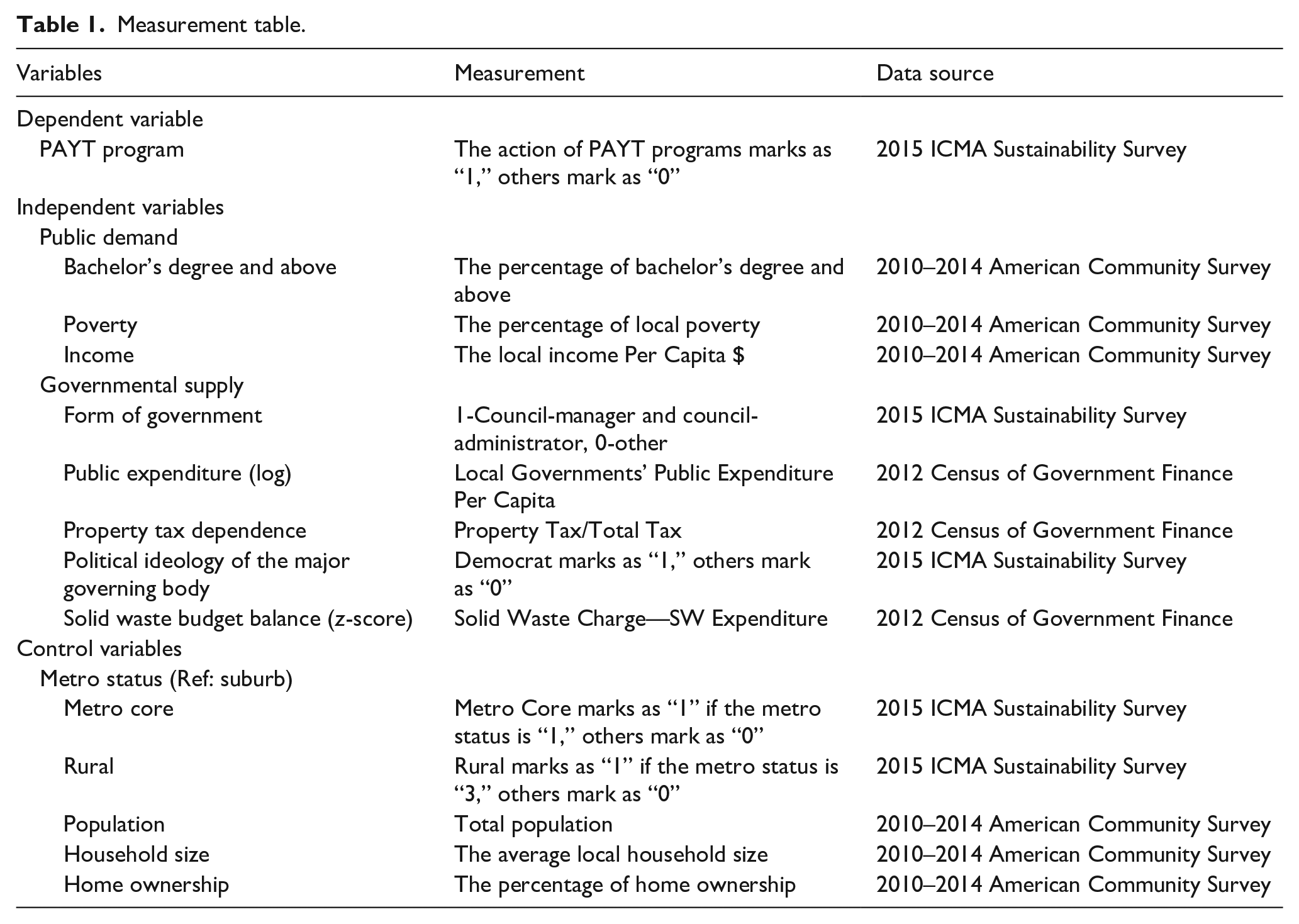
This paper uses nationwide US samples to examine the research question. The unit of analysis of this research is local government and covers 410 counties, 1,124 cities, and 308 townships across the United States. Within this paper, the sampling frame consists of 1,842 local governments from four sources: the American Community Survey 2010 to 2014, (2) Census of Government Finance 2012, and (3) ICMA Sustainability Survey 2015 (Table 1). The ICMA Sustainability Survey was administered in paper format via direct mail, with an online submission option. The survey was sent to 8,562 local governments and achieved a response rate of 22.2%, with 1,899 local governments responding.
Measurement table.
Consequently, we collected 1,842 observations after merging three datasets. However, the merging process of various datasets presents challenges to effectively combining these datasets. Therefore, there are missing observations during the data-cleaning process.
The dependent variable is whether a local government has adopted the PAYT program to reduce or manage waste, as gathered from the ICMA Sustainability Survey 2015. Specifically, it is the PAYT program with charges based on the amount of waste discarded. Since the dependent variable is a binomial variable coded with a “1” for the presence of implementation and “0” otherwise, the logistic regression is appropriate in this case. The logit method is used when that explained variable is 1 or 0, indicating whether a certain event has occurred.
The independent variables are grouped into three categories: public demand, governmental supply, and control variables (Measurement shown in Table 1). To measure the demand-side variables, we use the rate of higher education, poverty rate, and average income level to capture the socioeconomic attributes and demographics of local communities, which are collected from the 2010 to 2014 American Community Survey. On the supply side, the political factors are measured by the form of government and ideology of the major governing body based on the data collected from the 2015 ICMA Sustainability Survey. The form of government is a dummy variable that measures the form of government council-manager or council-administrator and is coded as 1 and 0 otherwise. The ideology variable is marked as one if the Democrat is the majority of the governing body in the local jurisdiction and 0 otherwise.
Moreover, the economic factors are measured by public expenditure and property tax dependence from the 2012 Census of Government Finance. The logarithm of local total expenditure per capita measures public expenditure. Also, property tax dependence is calculated by dividing the local property tax by the total tax. Finally, we use a standardized score of the surplus of the solid waste budget to measure fiscal conditions. We denote the solid waste balance as solid waste charge minus its expenditure.
Four control variables are included in models: population (the total population size), metro status (there are three metro statuses: metro core, suburbs, and rural areas that are marked as “1, 2, and 3”), region (geographical areas: the Northeast and West Coast, Northeast, and West Coast), and household size (the average local household size). First, we control communities by their metro status: metro core, suburbs, and rural areas. Since more large cities are located in metro cores, they are more likely to implement recycling programs than other areas. The adoption and implementation will be lagged in rural areas. Lacking administrative knowledge and staffing will obstruct the process of PAYT adoption.
Moreover, geographical region is also a control variable because the Northeast and West Coasts of the US generally have more environmental policies than the North, Central, and South (Gradus et al., 2019). Last, previous empirical results show that with increasing household size, it is more unlikely to adopt PAYT (Gradus et al., 2019), and this indicator comes from the 2010 to 2014 American Community Survey. Considering communities with large households and poor families, it is difficult for local governments to implement PAYT recycling programs. All descriptive statistics for key variables are presented in Table 2.
Descriptive statistics of key variables (n = 1,842 local governments).
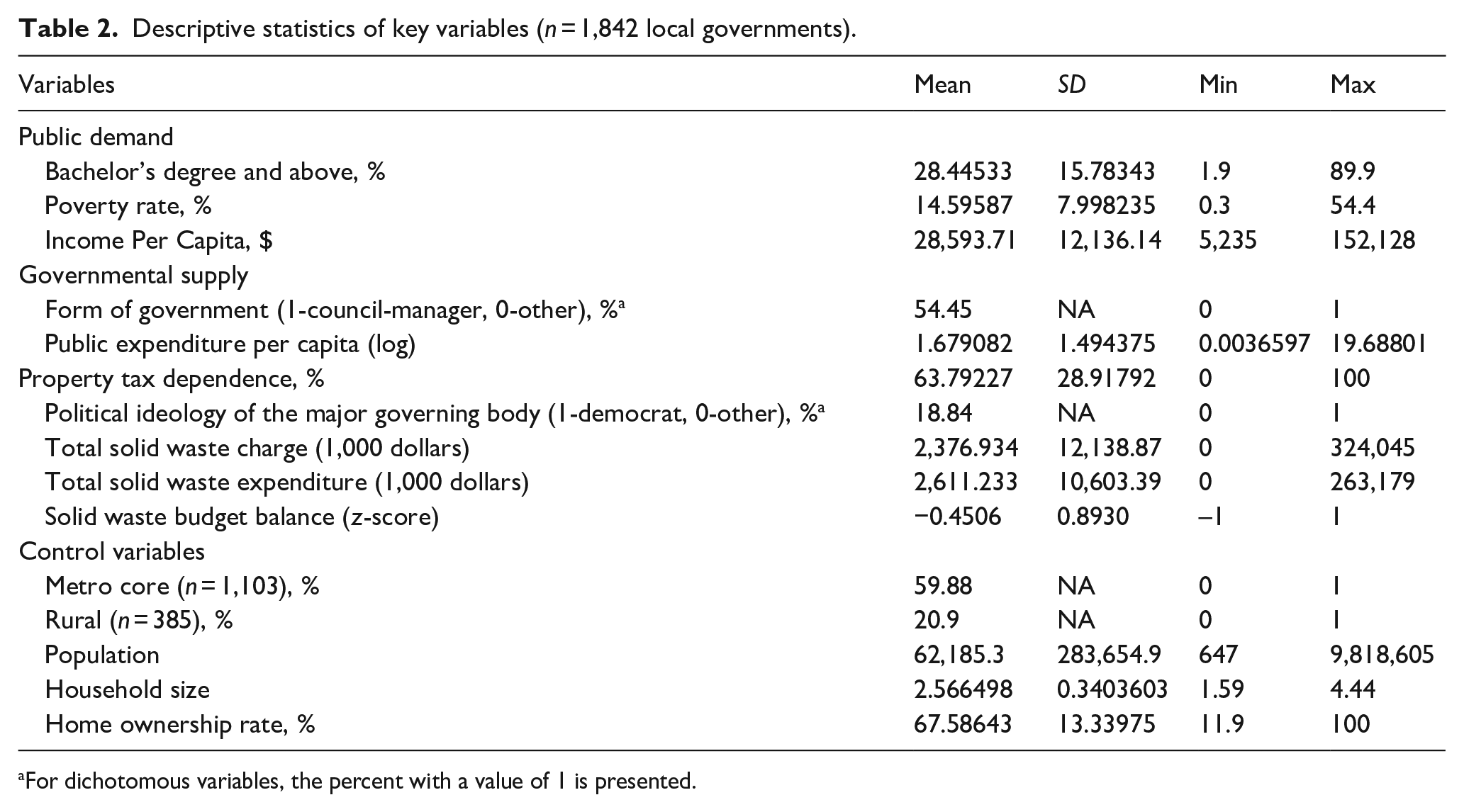
For dichotomous variables, the percent with a value of 1 is presented.
For the analysis, we fit four state fixed-effect logit models. Specifically, we operationalize the first two models (without and with institutional interaction) based on previous work on the political market framework developed earlier to estimate the determinants of policy choices (Deslatte et al., 2017; Lubell et al., 2009). To test our hypotheses, the last two models use fiscal conditions in the solid waste budget as a moderator to interact with demand and supply-side variables.
Since state-level policies vary across the US, we use state-level fixed effects to control for the variance explained by state-level differences. In this analysis, the cross-sectional domain is state. Many states passed new legislation to encourage or require municipalities to offer recycling services to their households. They adopted various recycling programs to reduce the need for landfill storage. Thus, a motivative inter-governmental environment can explain the local adoption of innovative recycling programs. Some intergovernmental studies show that state programs motivate local sustainability programs (Conroy & Berke, 2004) and municipal recycling (Callan & Thomas, 1999). Therefore, this paper uses the state-level fixes effect model to eliminate the significant state-to-state differences in local government sustainability action (Knack, 1995).
Results and discussion
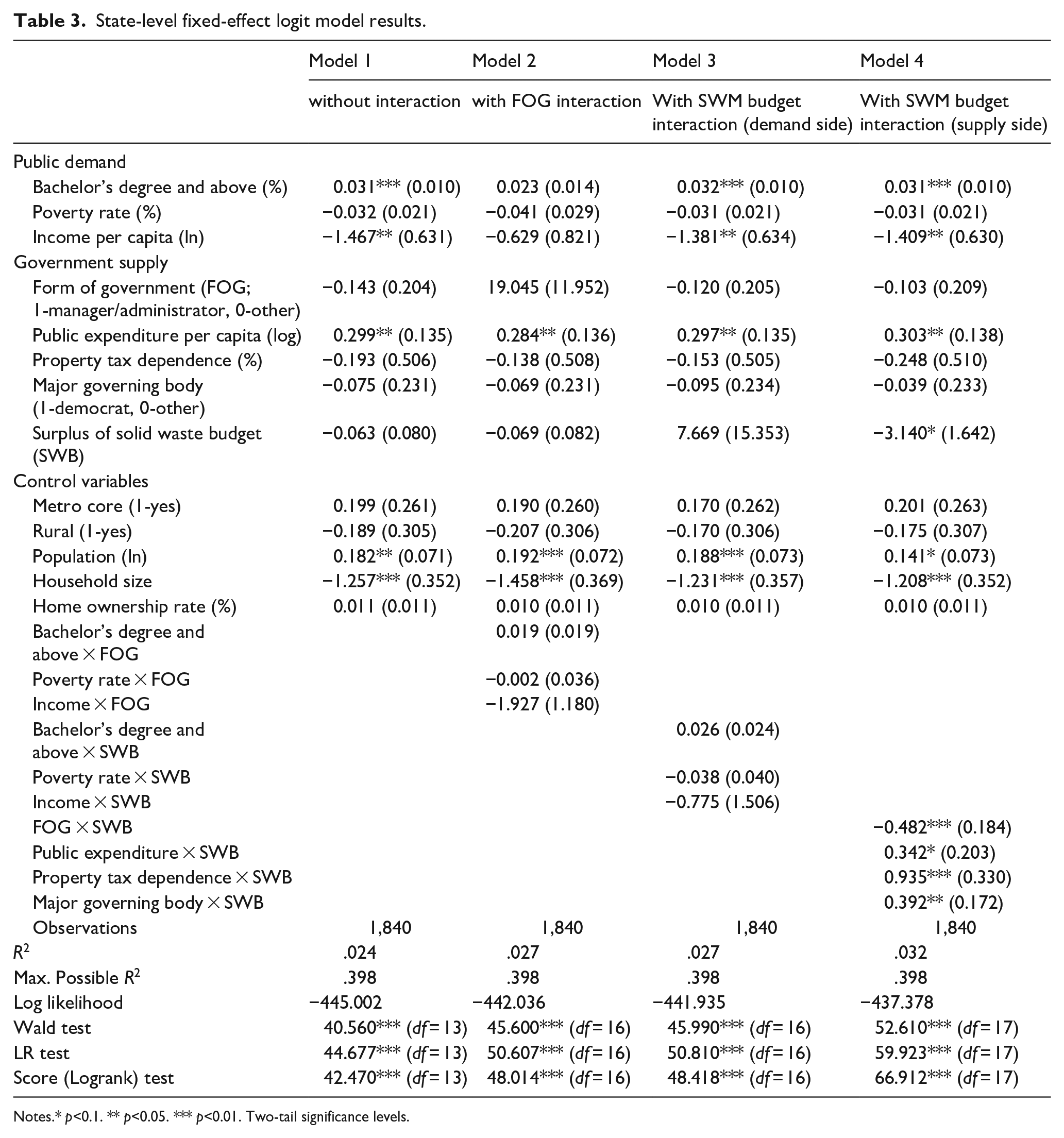
Table 3 reports hypothesis testing results based on state-level fixed-effect logit models. The regression analyses provide compelling evidence that the surplus of solid waste budgets is a moderating factor influencing the strength and direction of the relationships between supply-side variables and PAYT adoption within the political market framework.
State-level fixed-effect logit model results.
Notes.* p <0.1. ** p<0.05. *** p<0.01. Two-tail significance levels.
Model 1 answers what factors affect local governments’ PAYT program actions. On the demand side, it shows that the percentage of bachelor’s degrees and above and income level have a statistically significant impact on the local governments, which suggests that communities with higher education levels and less wealth concentration are more likely to take action on the PAYT program than others. These results are consistent with previous literature (Batllevell & Hanf, 2008; Gradus et al., 2019). PAYT is more acceptable among well-educated constituents. However, wealthy communities are less likely to be attracted by this program because they already have better infrastructure and various recycling volunteering activities. On the supply side, local governments with more public expenditure are more likely to implement PAYT. More public expenditure means more services that local governments provide and more administrative staff they employ. Thus, local governments might have more incentives to take action on PAYT when they have more financial and human resources administrative capacity.
In Model 2, we add the form of government as an interaction with the demand-side variables based on the traditional political market framework. The results do not support the moderating role of political institutions in the relationship between demand-side factors and the adoption of this program. Similarly, Model 3 does not support the hypothesis that the solid waste balance moderates the effect of demand-side variables on the adoption of PAYT programs.
However, the SWM budget balance significantly moderates the supply-side variable on adopting PAYT programs based on Model 4. Hypothesis 2a is supported, as the administrative form has a stronger positive effect on PAYT adoption when the surplus of the SWM budget is low (or negative). When financial resources are constrained, the pressure to adopt PAYT programs might increase, and the local governments with managers/administrators in charge are more likely to adopt some policy tools, such as the PAYT program, to enhance the efficiency of the solid waste system. This suggests that in situations where the budget is tight, local governments with a manager/administrator in charge are more proactive in adopting PAYT programs to manage resources efficiently. As the surplus grows, the urgency to adopt such programs might reduce, leading to a lesser impact.
Hypothesis 2b is not supported. The effect of public expenditure on PAYT adoption is positive and grows stronger as the surplus increases. This suggests that in financially healthier conditions (higher surplus), local governments with higher public expenditure are more likely to adopt PAYT programs, which contrasts with our hypothesis. While the poor fiscal condition of SWM brings local government’s attention to the supply side, it appears that local governments with greater financial resources are better positioned to invest in new waste management initiatives like PAYT.
The moderating effect of the surplus of the SWM budget on the relationship between property tax dependence and PAYT adoption is inconsistent with Hypothesis 2c. This indicates that in financially abundant conditions, local governments with higher property tax dependence are more likely to adopt PAYT. Governments that rely on property taxes might face greater pressure from their constituents to adopt environmentally friendly policies and maintain fiscal responsibility to their taxpayers. Therefore, local governments that rely heavily on property taxes need to ensure a stable revenue stream. Local governments can explore and implement innovative waste management solutions like PAYT in a healthier fiscal position.
Hypothesis 2d is supported. The Democrat governing boards are negatively associated with the implementation of PAYT recycling programs under the poor fiscal conditions of solid waste management. Moreover, the impact of a Democratic governing ideology on PAYT adoption becomes significantly more positive as the surplus increases. This suggests that Democratic commissions may support PAYT adoption, but their willingness or ability increases with more significant financial resources (Figure 1).
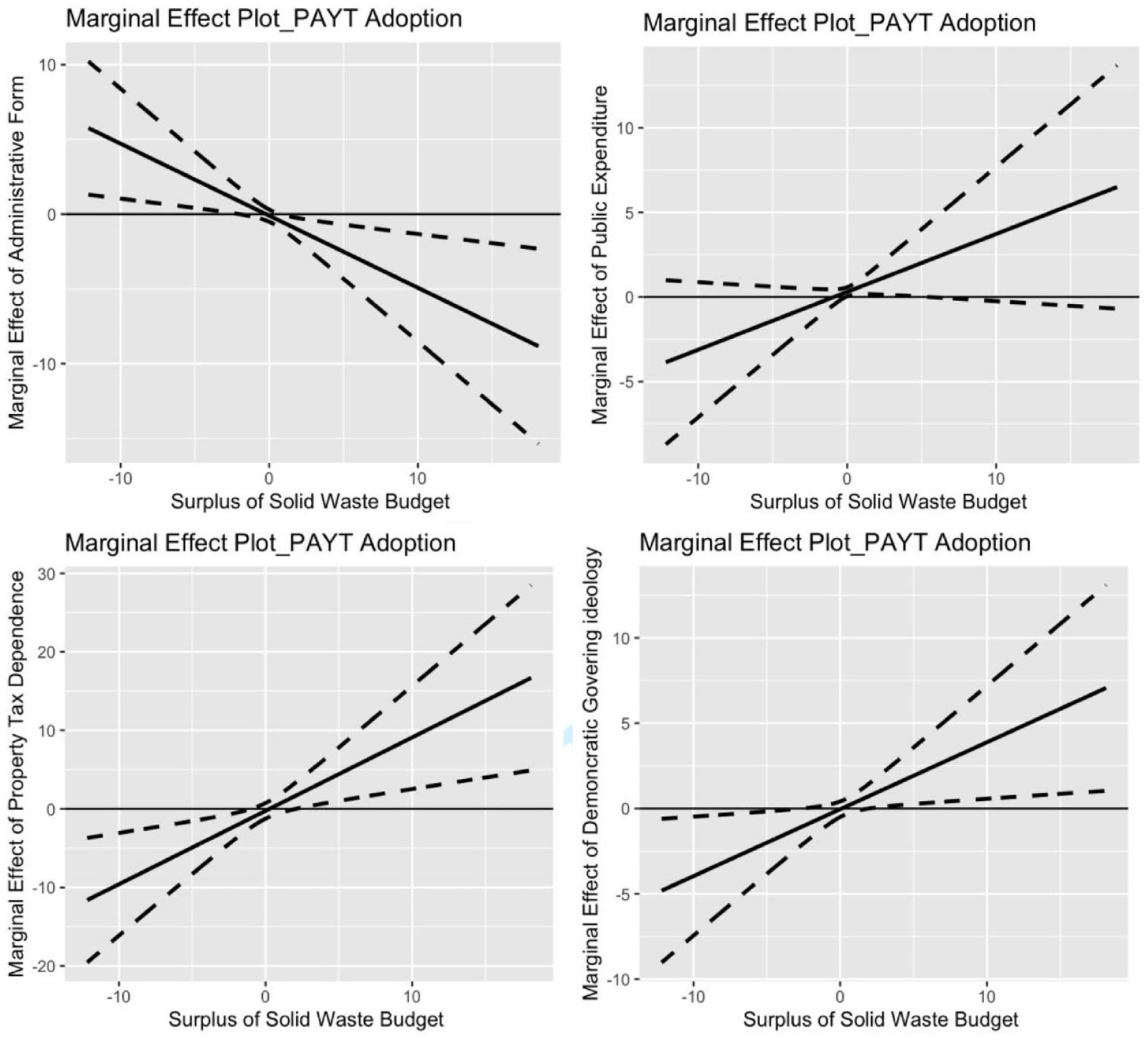
Marginal effects of the interaction terms in model 4.
When the political institution interacts with demand-side variables, the traditional political market framework does not significantly influence PAYT adoption. In contrast, the interaction between SWM budget surplus and supply-side variables shows significant results, indicating that financial conditions are more crucial in influencing PAYT adoption. Based on the sample analysis, 506 out of 1,840 local governments have a surplus in their solid waste budget, 504 have a balanced budget (0), and the remaining have a budget deficit. This distribution highlights that a substantial number of local governments are operating under tight fiscal conditions, which may explain why the interaction between budget surplus and supply-side variables is significant. It suggests that in financially constrained environments, local governments are more responsive to supply-side incentives and pressures when considering the adoption of PAYT programs.
Limitations
Although this model has a novel idea that posts a fiscal condition as an indicator interaction, it still has some limitations. The first concerns the risk of self-selection bias. This risk is inherent in ICMA surveys, but more broadly to other surveys and methods by including human participants. However, this sample includes local governments from all major geographic regions and divisions, ensuring a broad representation across the United States. The survey sample statistics show that larger municipalities, areas in the West, and local governments with managers/administrators tend to have higher response rates than others. This finding is consistent with the literature, which indicates local governments with managers/administrators and areas in the South Atlantic and Pacific Coast are more likely to address sustainability issues.
Moreover, several important factors are absent in this model because of the limited data source. On the demand side of the political market framework, problem severity is a big issue. Folz and Giles (2002) contend that the increasing amount of solid waste and maintaining expected landfill capacity show the severity of the solid waste problem. Also, strong support from the public and interest groups plays a vital role in selecting policy instruments. However, this research cannot test those two factors due to a lack of data.
Last, this study uses a cross-sectional data frame to run a logit model instead of panel data, while the dependent variable is gathered from the surveys conducted in 2015. However, it is unknown when a local government takes action on PAYT programs. Although independent variables were collected before 2015, it is possible that the action of PAYT programs happened earlier than the time when independent variables were collected.
Conclusion
Overall, this article explains how fiscal conditions interact with both public demand and governmental supply in the political equilibrium within the political market framework. In addition, we have contributed to the literature in several ways. First, this study refines the political market framework by using the concept of organizational attention to explore whether policy demand or supply is the critical consideration for local governments’ policymaking and under what financial condition local governments favor one over the other on policy choices. Since there has been little discussion about whether demand-side or supply-side variables drive more attention to local policymakers, this research fills this gap by exploring whether local governments’ fiscal condition filters their organizational attention by prioritizing public demand or supply in political decision-making.
In addition, this study highlights the moderating role of economic factors instead of political factors. Previous research has examined the moderating effect of local institutional arrangements on policy choices. It suggests that different structures of local political institutions will filter public demands by amplifying or muting a particular interest of specific constituencies to affect policy outcomes. Budgetary considerations are an essential indicator of economic factors and are vital to policy choices. However, most studies treat them as the outcomes of political processes. Therefore, the results call for attention to budgetary considerations and more research to investigate its role in the political market framework.
Moreover, this study provides an alternative perspective that the fiscal condition drives local government’s attention, which causes local government to favor demand or supply-side factors in policymaking. In sum, the role of fiscal conditions in explaining what factors account for the action of PAYT programs is remarkable. To develop a full picture of the political market framework, there is abundant room for further progress to take the variables of context into account.
