







Abstract
Digitally supported relational public service (RPS) symbolizes a forward-looking effort to realize relational governance, yet its implementation faces two persistent challenges: the difficulty of measuring relationality and structural resistance. This study provides a Chinese pathway to address these challenges by examining how social media use can enhance public service motivation (PSM). We develop and empirically test a multi-level relational origin model of PSM. Findings show that social media use significantly strengthens PSM by satisfying three key antecedents: structurally, China’s social media control policy institutionalizes PSM as a normative public value; societally, social media fosters socialization; and individually, it fulfills public service employees’ basic psychological needs. These results offer context-specific modifications to two Western theories and advance the relationality turn in public administration scholarship.
Keywords
Introduction
Digital development has tightened social connections, making the quality of relational ties increasingly critical for governance. This reflects the broader turn to relational governance, which emphasizes trust, reciprocity, and co-production as central to contemporary public administration (Donati, 2010). Digitally supported relational public service (RPS) embodies this orientation by redesigning service provision around interpersonal relations. It leverages the collaborative and social-construction capacities of digital technologies to enhance interdependence, co-production, networked coordination, and mutual responsiveness. Yet RPS remains difficult to implement because the concept of relationality lacks clear metrics, and its heavy reliance on interpersonal agency risks a structural-functionalist impasse (French et al., 2025).
We argue that social media use, by fostering public service motivation (PSM), offers a feasible pathway for realizing digitally supported RPS. As a digital relational space, social media embodies the relational capacities of digital technologies and, in doing so, helps generate PSM. PSM refers to an individual’s inclination to respond to motives grounded in the missions and values of public institutions (Perry & Wise, 1990).PSM can serve as an indicator of RPS, since its canonical dimensions—attraction to public policy, commitment to the public interest, compassion, and self-sacrifice (Perry, 1996)—as well as its behavioral effects, such as encouraging public sector employees to engage in cross-sector collaboration, co-creation with citizens, and trust-building practices, all implicitly embody relationality. Moreover, as a cross-level construct shaped by structural, societal, and individual antecedents (Bao & Zhong, 2021; Florczak et al., 2023; Verka et al., 2025), PSM embeds relationality in broader contexts and mitigates the agency-centric bias of RPS.
Therefore, this study examines how social media use fosters PSM as a critical pathway to advancing digitally supported RPS in China. First, it advances theoretical development by integrating RPS and PSM, clarifying their origins and natures (Bao & Zhong, 2021; Florczak et al., 2023; Verka et al., 2025; Wilson et al., 2024), and identifying how PSM provides a feasible pathway for realizing RPS. Second, it outlines a practical roadmap for implementing digitally supported RPS, addressing the persistent gap between substantial theoretical progress on what these concepts are and why they matter, and the insufficient actionable knowledge on how to implement or foster them effectively in practice (Wilson et al., 2024; Witesman & Christensen, 2023). Finally, it provides contextual evidence on the adaptation of these Western-derived concepts within China’s governance environment (D. Chen et al., 2024; Lee et al., 2020; Roach et al., 2022), showing that whereas RPS in Western contexts often relies on interpersonal mobilization, in China it is sustained through multi-level coordination. Moreover, it demonstrates how the Chinese context enriches the Perry’s four-dimension PSM framework with a relationality dimension, thereby extending Western conceptualizations with locally grounded insights.
Theoretical Foundation
RPS as a Western reform agenda builds on Bartels and Turnbull’s (2020) relational ontology, which takes interactional structures and networks as the unit of analysis, tracing lived trajectories of iterated interaction, and thus generate meanings. Wilson et al. (2024) further situates its realization in the UK as depending on dispersed, long-term, relationship-oriented mobilization rather than central strategy. Applied to China, its weakness lies in an interpersonal focus that limits structural applicability.
To address this, this study develops a multi-level model of PSM, building on Vandenabeele (2007) and Vandenabeele and Breaugh (2025) and synthesizing Institutional Theory, Identity Theory, and Self-Determination Theory (SDT). At the macro level, Institutional Theory explains how PSM becomes institutionalized through meaning structures (legitimacy, rationales) and resource structures (power, technology, policy), embedding public service values into collective belief systems (March & Olsen, 1989). At the meso level, Identity Theory identifies how such institutional values are internalized via socialization and role expectations—the “logic of appropriateness”—mediated by interactions with parents, teachers, and supervisors in family, schools, and organizations (Vandenabeele, 2007; Vandenabeele & Breaugh, 2025). At the micro level, SDT explains the psychological mechanisms of internalization: competence, relatedness, and autonomy. Fulfillment of these needs through collaboration, bonding, and self-expression accelerates the transformation of external norms into intrinsic motivation (Duan et al., 2023). Although other psychological mechanisms, such as the negative impact of job hindrance demands on PSM, have been noted in Dash et al. (2022), they are not basic psychological needs and thus fall beyond the scope of this study. Taken together, this model demonstrates how relationality can be embedded structurally, transmitted societally, and internalized across levels. Contextually, it is realized in China through the institutional promotion of PSM via social media control policy, reinforced by collective dissemination, and ultimately resulting in individual internalization.
The deeper difference between these two trajectories reflects the tension between compulsion and volition. Western liberal traditions emphasize autonomy and free choice, assuming that greater freedom enhances the quality of motivation for public engagement. By contrast, Confucian traditions highlight collectivism, duty, and harmony, framing service to society and the state as a moral obligation. Institutionally, liberal democracies rely on dispersed mobilization, local autonomy, and social innovation, whereas China’s authoritarian regime institutionalizes and reinforces PSM through policies such as social media regulation, cadre evaluation, and ideological propaganda. In sum, the “compulsion–volition” distinction emerges from the interplay of cultural values and institutional structures: cultural traditions (Confucian vs. liberal) provide the meaning resources for legitimacy, while political regimes (authoritarian vs. democratic) supply the implementation resources, producing divergent definitions and practices of relationality.
Although relational ontology fundamentally calls into question linear causality by emphasizing mutual constitution and reciprocal shaping among actors (Crossley, 2010; Dépelteau, 2013; Donati & Archer, 2015), different strands of relational sociology provide useful insights into this complexity. For instance, Crossley argues that relations are not static links but trajectories of repeated interaction, shaped by past and anticipated future connections, thereby complicating simplistic cause–effect assumptions. Donati and Archer’s relational subject framework further contends that social relations can exert downward influence on actors and cannot be reduced to individual agency alone. Building on this, Donati’s notion of relational realism posits that relations are constitutive of social reality rather than mere emergent byproducts. To balance such ontological sensitivity with empirical rigor, this study adopts a theory-testing model as an analytical tool to generate evidence on the relational genesis of PSM in China. Our model does not assert unidirectional causality; instead, it treats hypothesized paths as provisional and open to reciprocal feedback. In doing so, we aim to avoid the relativist impasse and offer a middle path that respects relational ontology while retaining the capacity to test theoretically grounded mechanisms.
Hypothesis
We hypothesize the causal effect of social media use on PSEs’ PSM through three mechanisms: (1) policy-driven institutionalization, (2) socialization effects of social media use, and (3) the role of psychological needs satisfaction in accelerating PSM internalization.
Mechanism Hypothesis: China’s Social Media Control Policy and PSM
According to the PSM framework, this study hypothesizes China’s social media control policy as a structural antecedent driving the institutionalization of PSM, representing an initial step in the PSM generation process.
This institutionalization is predicated on the alignment of PSM promotion with the policy’s objectives. Rapidly evolving alongside platform adoption, China’s social media control policy serves as a core strategy of authoritarian governance (W. Tang & Zhang, 2023). Its primary aim is to assert state ideology’s dominance in the information sphere by promoting official narratives and reducing the visibility of dissenting information, thereby facilitating ideological dissemination and mobilizing public support (C. Wang et al., 2024). PSM, rooted in cultural and political factors, aligns well with the state’s ideological dominance. Culturally, PSM resonates with traditional Confucian values (e.g., “benevolence,” “integrity,” “harmony,” and “responsibility”) and China’s collectivist tradition prioritizing collective interests (Lee et al., 2020). Politically, PSM aligns with the ruling Chinese Communist Party’s agenda of “serving the people,” “cadres should take responsibility,” “anti-corruption,” and “improving public service levels,” as well as core socialist values like “dedication,” “patriotism,” and “friendliness” (People’s Daily Online, 2024).
We posit that this policy facilitates PSM institutionalization through two primary structural mechanisms: meaning and resources. The meaning mechanism involves government legitimization of PSM by embedding it within public discourse. State-run media, which dominate political and policy reporting and are widely perceived as credible, serve as key channels for PSM dissemination (C. Wang et al., 2024). The state further promotes PSM on social media through official propaganda, paid online commentators (“50-cent army”), and agenda-setting to shape permissible discourse (M. Tang & Huhe, 2020). The resources mechanism secures PSM implementation by censoring and regulating content that deviates from it. Technical controls, such as the “Great Firewall,” advanced filtering, and opaque algorithmic suppression, target dissent and misinformation (Zhang et al., 2022). Legally, despite nominal constitutional guarantees of free speech, the lack of concrete statutory or judicial enforcement allows the state to suppress speech deemed inconsistent with PSM (Ruan et al., 2021). Regulatory bodies further ensure compliance through directives, supervision, and penalties, creating strong deterrence (Chin et al., 2022). This control is enforced via a multi-layered regime (self, co, external regulation) through a network of party-led governance involving various actors (government agencies, platform companies, social organizations, and netizens), enhancing the effectiveness and accountability (Z. Wang et al., 2023).
In sum, given that promoting PSM aligns with the strategic aims of China’s social media control policy, this policy is hypothesized to institutionalize PSM through the structural mechanisms of meaning and resources. Accordingly, we propose the following hypothesis:
Mechanism Hypothesis: Social Media Use and Socialization
This study next hypothesizes the socialization mechanism as a societal antecedent that facilitates the internalization of PSM, thereby completing the second step of the PSM generative process. Social media use is positioned at the intersection of macro-level structural influences and micro-level individual affective needs, collectively shaping this socialization. At the macro level, under the influence of China’s social media control policy, social media has evolved into a closed socialization arena that systematically promotes the dissemination of PSM-related information (Ahmed & Weber, 2018). Through content generation, circulation, and interactive engagement within this arena, individuals are gradually exposed to, learn from, and partially internalize PSM, thereby advancing a politically preconditioned socialization process (Luqiu & Kang, 2021). At the micro level, social media engagement influences individuals’ affective dispositions, enhancing their receptivity to socialization. Beyond transmitting factual information, social media conveys positive societal imagery and evokes affective responses, such as national pride and a sense of belonging. These emotional resonances, in turn, stimulate behaviors integral to socialization, including learning, imitation, and active engagement (C. Chen et al., 2025). In sum, social media use acts as a “connecting space,” bridging macro-level structural narratives with micro-level psychological requisites, thus advancing the socialization process.
However, studies in liberal democracies often report opposite findings. Social media may expose PSEs to ambiguous or superficial communication, leading to overload that consumes time, displaces traditional socialization, and hinders nonverbal cues and feedback, ultimately fostering social alienation (Demircioglu & Chen, 2019; Ritz et al., 2016). This study argues that the Chinese context may mitigate such negative effects. China’s social media control policies increase informational consistency and reduce misinformation (at least in the political domain), thereby dampening the “noise effects” frequently observed in Western settings and allowing social media to serve more effectively as a channel for political socialization. This leads to the following hypothesis:
Mechanism Hypothesis: Social Media Use and Competence Needs, Relatedness Needs
This study hypothesizes that social media use satisfies basic psychological needs as a final mechanism contributing to PSM internalization. As aforementioned, autonomy is systematically constrained in the Chinese context by both policy (e.g., social media control) and culture (e.g., Confucian collectivism). It therefore does not contribute to the relational genesis of PSM. Accordingly, this study focuses on competence and relatedness needs, which are more consistent with China’s context and more aligned with the research objective.
Social media use can fulfill the competence needs of PSEs through the acquisition of political knowledge. Initially, PSEs gain political knowledge through peer discussions or news consumption. Motivated by the potential visibility of their online expressions, they engage in deeper cognitive processing, integrating new information with existing understanding. Subsequently, by publicly sharing these refined knowledge structures, individuals can identify gaps or inconsistencies, further deepening their political comprehension (Rico et al., 2020). This in-depth political knowledge is linked to heightened internal political efficacy, thereby fulfilling PSEs’ competence needs (Lemmer et al., 2023).
Nevertheless, some empirical research reports negative effects. Low-quality or biased political information may impair judgment and weaken competence needs (Cao & Yu, 2019). We argue that China’s social media control policies may mitigate such risks. These policies have been shown to enhance the accuracy, reliability, educational value, and overall quality of the political information environment (M. Tang & Huhe, 2020), thereby creating conditions where political knowledge acquisition is more likely to strengthen, rather than undermine, competence needs. Based on this, we propose the following hypothesis:
Social media use is hypothesized to fulfill the need for relatedness through two key pathways: social support and social capital. First, social media use enhances various forms of social support. Online affirmation and care foster respect and emotional support; a sense of belonging promotes social companionship; sharing new information or perspectives enhances informational support; and obtaining material support or services boosts instrumental support (Abad et al., 2023). Collectively, these forms of social support help satisfy individuals’ relatedness needs. Second, social media use enhances three complements of social capital: structural, relational, and cognitive. Structural social capital, defined as an individual’s network of social connections, is reinforced by maintaining close online relationships within interest communities and professional networks (Jing et al., 2023). Relational social capital involves the quality of relationships within a network, deepened by online interactions that foster trust, repeated exchanges, and social bonding (Abad Santos et al., 2023). Cognitive social capital represents shared knowledge and understanding, facilitated by online information exchange. These forms of social capital are strongly positively correlated with relatedness (Abad Santos et al., 2023; Jing et al., 2023).
However, social media may also weaken social support and social capital when hostile interactions, such as trolling or provocative posts, diminish authenticity and trust, thereby eroding relational bonds (Bolton et al., 2013). This study argues that China’s social media control policy may mitigate these risks by suppressing hostile content and promoting prosocial narratives, thus sustaining the positive role of social media in fulfilling relatedness needs.
Causal Hypothesis: Social Media Use and PSM
As social media use fosters the structural, societal and individual antecedents of PSM, it may consequently enhance PSEs’ PSM. Based on this, we hypothesize:
Taken together, the theory-testing model is depicted in Figure 1. This study empirically tests the effects of social media use on socialization (H2), competence needs (H3), relatedness needs (H4), and PSM (H5). We do not directly test the effects of socialization, competence, and relatedness needs on PSM for two reasons. First, doing so would extend beyond our primary objective, which is to demonstrate how social media use drives the relational origins of PSM. Second, prior research has already established strong theoretical consensus and robust empirical support for these relationships (Bao & Zhong, 2021; Florczak et al., 2023; Verka et al., 2025).
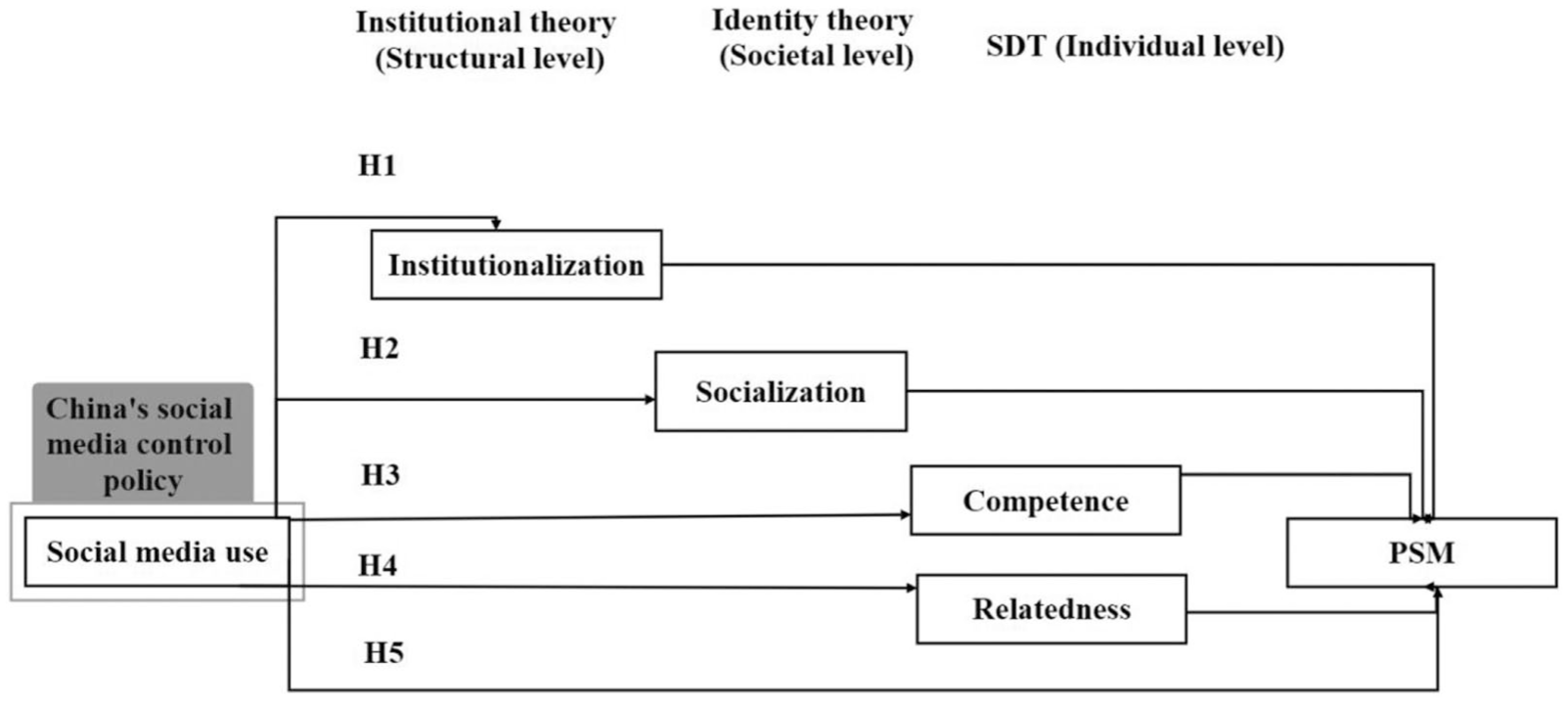
Theory-testing model.
We also do not directly examine the institutional effects of China’s social media policy due to the absence of pre-policy data. Nevertheless, we provide indirect evidence of policy influence. As discussed in Section 2, policy, societal, and individual antecedents are deeply intertwined and mutually reinforcing: policy shapes and guides societal and individual factors, which in turn reflect and internalize policy orientations. Given this synergy, these three antecedents are expected to influence PSM in a consistent direction (e.g., positively). Therefore, evidence of positive effects from societal and individual antecedents also indirectly supports the influence of policy.
Methods
Research Design
Our initial analysis employs an Ordinary Least Squares (OLS) model with province and time fixed effects, and standard errors clustered at the provincial level to account for potential within-province correlation. The OLS model takes the Equation 1:

In the Equation 1, i, p, and t represent individuals, provinces, and years respectively.
A key challenge with OLS, however, is potential endogeneity arising from selection bias. For instance, in Equation 1, PSEs are not randomly assigned to different levels of the PSM variable; instead, these levels are likely shaped by both observable and unobservable characteristics (e.g., inherent attributes of the PSEs), potentially leading to biased estimates of β2. To address this potential bias and improve the robustness of our causal inference, we subsequently employ propensity score matching, as specified in Equations 2 and 3.

In the Equation 2,
After successful matching, the Average Treatment Effect on the Treated (ATT) for the treatment group can be calculated as shown in Equation 3:

In the Equation 3,
Propensity score matching simulates a randomized controlled trial by matching treated and untreated individuals who are similar on observed covariates. Unlike OLS, which relies on statistical control via regression, propensity score matching explicitly balances the distribution of observed covariates across treatment and control groups, offering a more robust strategy for mitigating bias from observed selection (Rosenbaum & Rubin, 2023). Nevertheless, we acknowledge that bias due to unobserved characteristics may persist.
Data
This study utilizes pooled cross-sectional data from the 2017 and 2018 waves of the China Netizens’ Social Awareness Survey (CNSAS). The CNSAS is an annual online survey conducted since 2012 by Professor Ma Deyong’s team at Renmin University of China, targeting Chinese internet users to understand their social awareness structure (Ma, 2017, 2018). We selected the 2017 and 2018 waves specifically because they contain all variables essential for this research, and the survey design and implementation remained highly consistent across these years.
The CNSAS covers a broad range of topics, including basic demographic characteristics, media usage, psychological traits, political attitudes, and value orientations. For this study, we focused on respondents whose self-reported occupations were government employees or staff members of public institutions (commonly referred to as “Shiye danwei”). The final analytical sample comprises 956 valid responses and covers all 33 provincial-level administrative regions in China. Demographically, the sample consists of approximately 38% male respondents, with an average age range between 30 and 35 years, and 56% identifying as members of the Communist Party of China. While males are slightly underrepresented compared to general population statistics for this occupational group, the sample provides a relatively representative profile of China’s PSEs.
We also accounted for potential sources of survey bias. First, response bias, common in online surveys, occurs when participation likelihood is systematically related to the research topic, potentially leading to non-representative samples. For instance, if PSEs with higher PSM are more likely to respond, while those with lower PSM opt out, this may result in an overestimation of PSM levels. However, empirical evidence from Chinese public organizations indicates no significant association between PSM and response bias, nor consistent differences in PSM levels between respondents and non-respondents (D. Chen et al., 2024). Therefore, systematic PSM-related response bias is unlikely to significantly undermine the representativeness or external validity of our findings. Second, as the CNSAS targets internet users, the sample does not encompass the entire Chinese population. Nevertheless, given that over 78% of China’s population are internet users—a proportion that continues to grow—the survey possesses meaningful potential for generalizability. To further ensure data quality and minimize bias, the research team implemented several rigorous measures. These included: (1) disseminating the questionnaire across diverse online platforms (e.g., Wenjuanxing, Sina Weibo, Kaidi Network, Tianya Forum) to achieve broad and heterogeneous sample coverage; (2) restricting submissions to one per IP address to prevent duplicate responses; (3) manually screening out invalid responses indicating a lack of serious engagement; and (4) providing redeemable reward points upon completion to incentivize thoughtful participation (Ma, 2017, 2018).
Variables
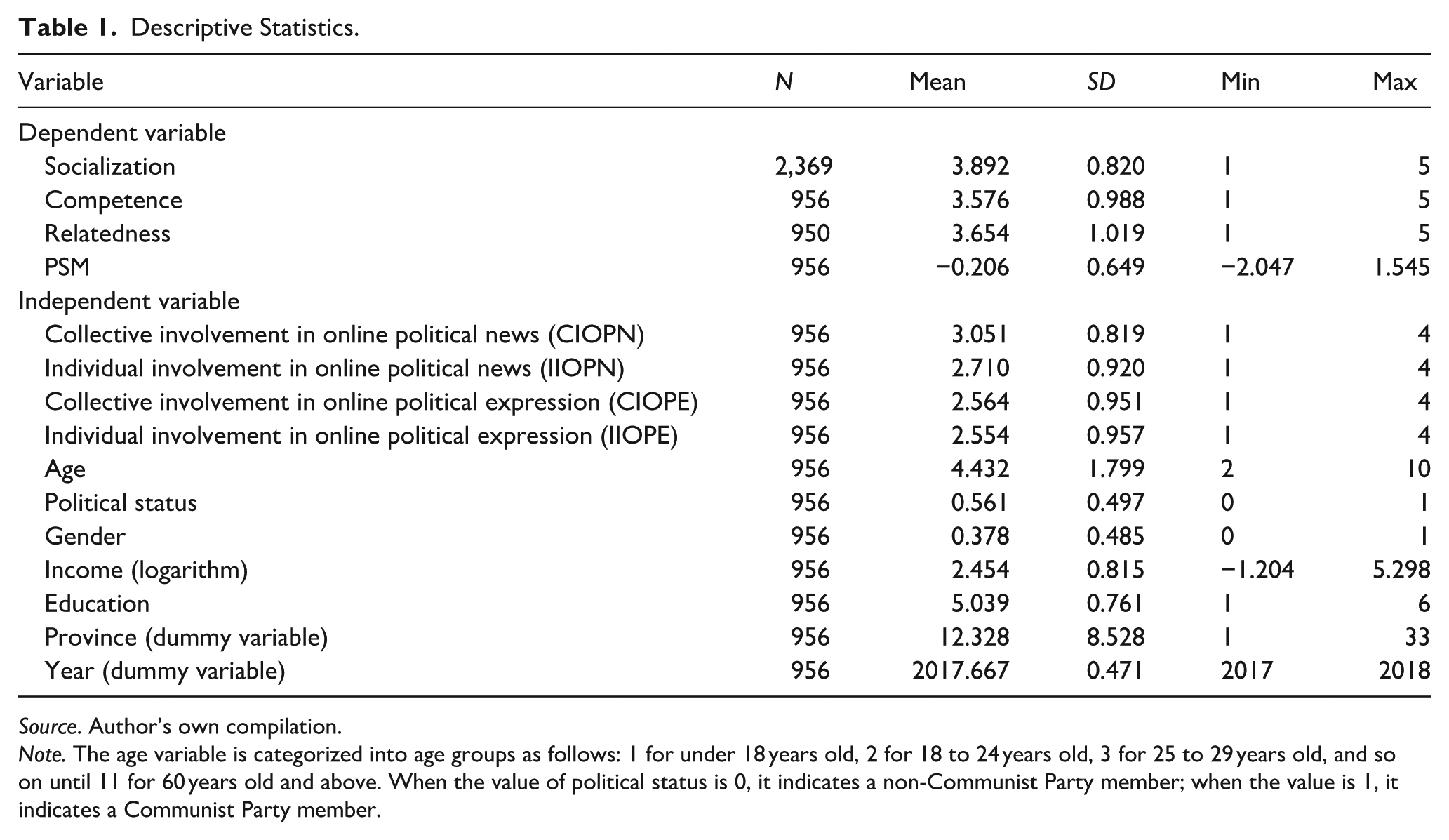
Descriptive statistics of the variables are shown in Table 1, and the measurement methods are provided in Table A1.
Descriptive Statistics.
Source. Author’s own compilation.
Note. The age variable is categorized into age groups as follows: 1 for under 18 years old, 2 for 18 to 24 years old, 3 for 25 to 29 years old, and so on until 11 for 60 years old and above. When the value of political status is 0, it indicates a non-Communist Party member; when the value is 1, it indicates a Communist Party member.
The dependent variable is PSM. We developed a PSM index based on Perry’s (1996) four-dimensional framework, which includes attraction to policy making (APM), commitment to public values (CPV), compassion (COM), and self-sacrifice (SS). These four dimensions have been cross-validated through confirmatory factor analysis in East Asian countries by Kim (2009) and are widely recognized as the standard measurement of PSM in empirical research. These dimensions demonstrated acceptable convergent validity, with Average Variance Extracted (AVE) values for all dimensions exceeding 0.5. Reliability analyses, including internal consistency (Cronbach’s α: 0.73–0.89) and Raykov’s ω, also indicated satisfactory levels, supporting acceptable composite reliability. Initially, these dimensions were reverse-coded on a 1-to-5 scale, with 1 representing “very low” and 5 indicating “very high.” We then standardized each indicator and calculated the average of these standardized scores to obtain the PSM measure in standard deviation units from the mean. This method aligns with established practices, such as Yu’s (2023) PSM measurement approach.
The independent variable, social media use, is measured through four types of online political interaction: collective involvement in online political news (CIOPN), individual involvement in online political news (IIOPN), collective involvement in online political expression (CIOPE), and individual involvement in online political expression (IIOPE). Although these four modes may vary in their effects on PSM, such differences reflect the nuanced functions of social media interactions rather than fundamental variations in relationality. A detailed typology therefore falls beyond the scope of this study. In practice, these forms of participation also often occur simultaneously and are intertwined. Accordingly, while the empirical analysis presents evidence from all four modes, the theoretical framework and hypothesis testing combine them. This approach provides multiple sources of evidence for the relational origin of PSM and better reflects real-world practices. Responses were coded on a four-point scale, with 1 representing “almost never use,” 2 representing “infrequent use,” 3 representing “regular use,” and 4 representing “almost daily use.” The study also controls for potential influences of demographic factors, including age, political affiliation, gender, income level, and educational attainment.
Results
Descriptive Statistics
As Table 1 reveals, the majority of PSEs in the sample exhibit a slightly below-average PSM (−0.206). Moreover, there is a significant individual variation, with some PSEs scoring more than two standard deviations below the mean, while others exceed the average by more than one standard deviation. This implies that actual PSM levels among Chinese PSEs may be lower than expected, highlighting a gap between assumed and actual PSM. The internal consistency of the measures is acceptable, with a Cronbach’s α of 0.70. Additionally, all variance inflation factors (VIFs) are below 2, indicating no multicollinearity issues. Detailed descriptions of the survey questions are provided in Table A1.
Hypothesis Tests
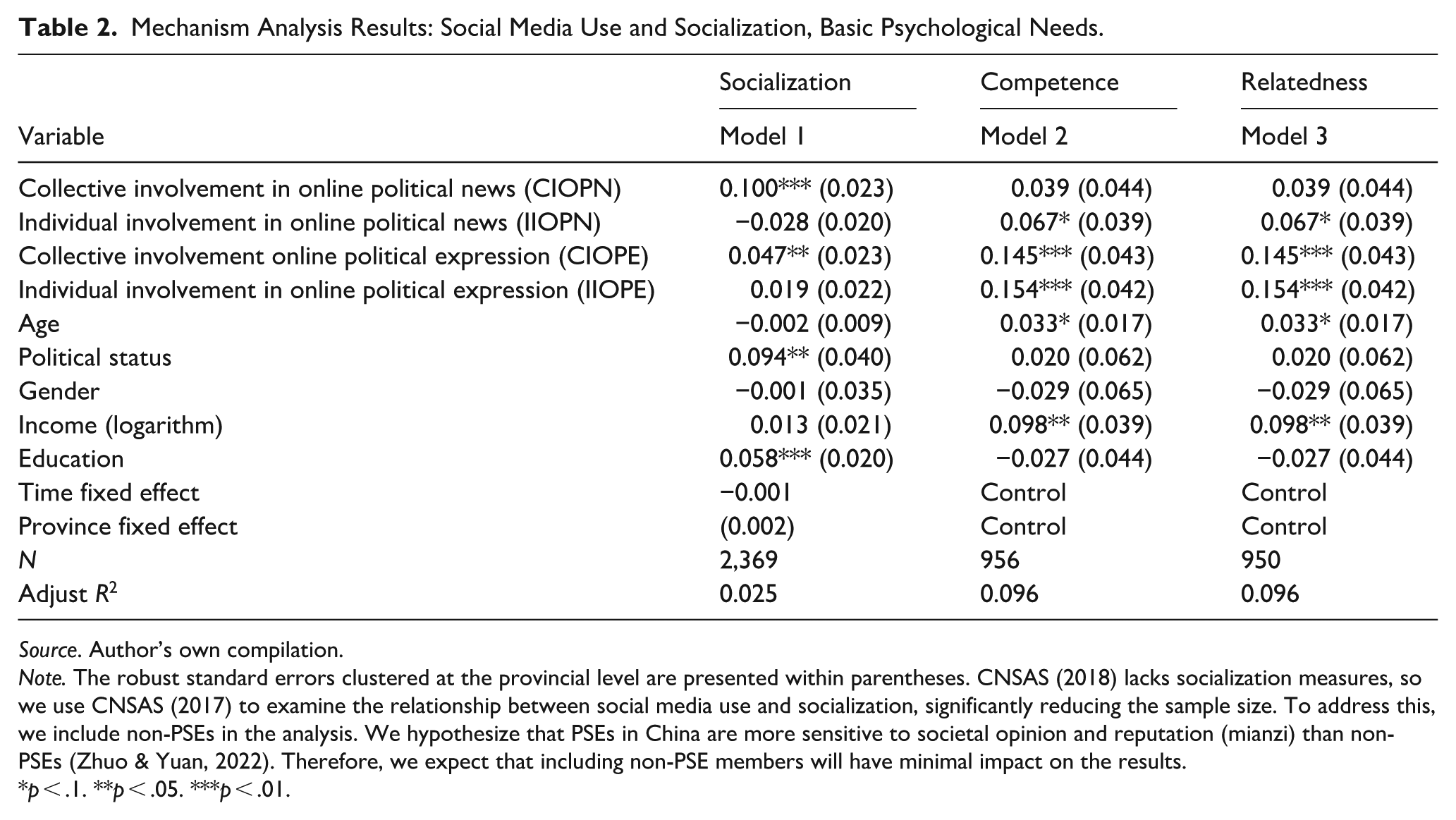
Mechanism analysis results are shown in Table 2. Model 1 reveals a highly significant positive impact of CIOPN and CIOPE on PSEs’ socialization (p < .01), thus basically supporting H1. The standardized coefficients indicate moderate effects (β = 0.100 for CIOPN; β = 0.047 for CIOPE), and the model explains about 2.5% of the variance in socialization (Adj. R2 = 0.025). Model 2 reveals a highly significant positive impact of CIOPE and IIOPE on PSEs’ competence needs (p < .01), thereby basically supporting H2. Effect sizes are moderate to strong (β = 0.145 for CIOPE; β = 0.154 for IIOPE), with the model explaining 9.6% of the variance (Adj. R2 = 0.096). Similarly, Model 3 reveals a highly significant positive impact of CIOPE and IIOPE on PSEs’ relatedness needs (p < 0.01), thereby basically supporting H3. Additionally, All models show that IIOPN has statistically insignificant and relatively weak effects on PSEs’ socialization, competence needs, and relatedness needs. The coefficients (β = 0.145 for CIOPE; β = 0.154 for IIOPE) again indicate substantive effects, with an explanatory power of 9.6% (Adj. R2 = 0.096).
Mechanism Analysis Results: Social Media Use and Socialization, Basic Psychological Needs.
Source. Author’s own compilation.
Note. The robust standard errors clustered at the provincial level are presented within parentheses. CNSAS (2018) lacks socialization measures, so we use CNSAS (2017) to examine the relationship between social media use and socialization, significantly reducing the sample size. To address this, we include non-PSEs in the analysis. We hypothesize that PSEs in China are more sensitive to societal opinion and reputation (mianzi) than non-PSEs (Zhuo & Yuan, 2022). Therefore, we expect that including non-PSE members will have minimal impact on the results.
p < .1. **p < .05. ***p < .01.
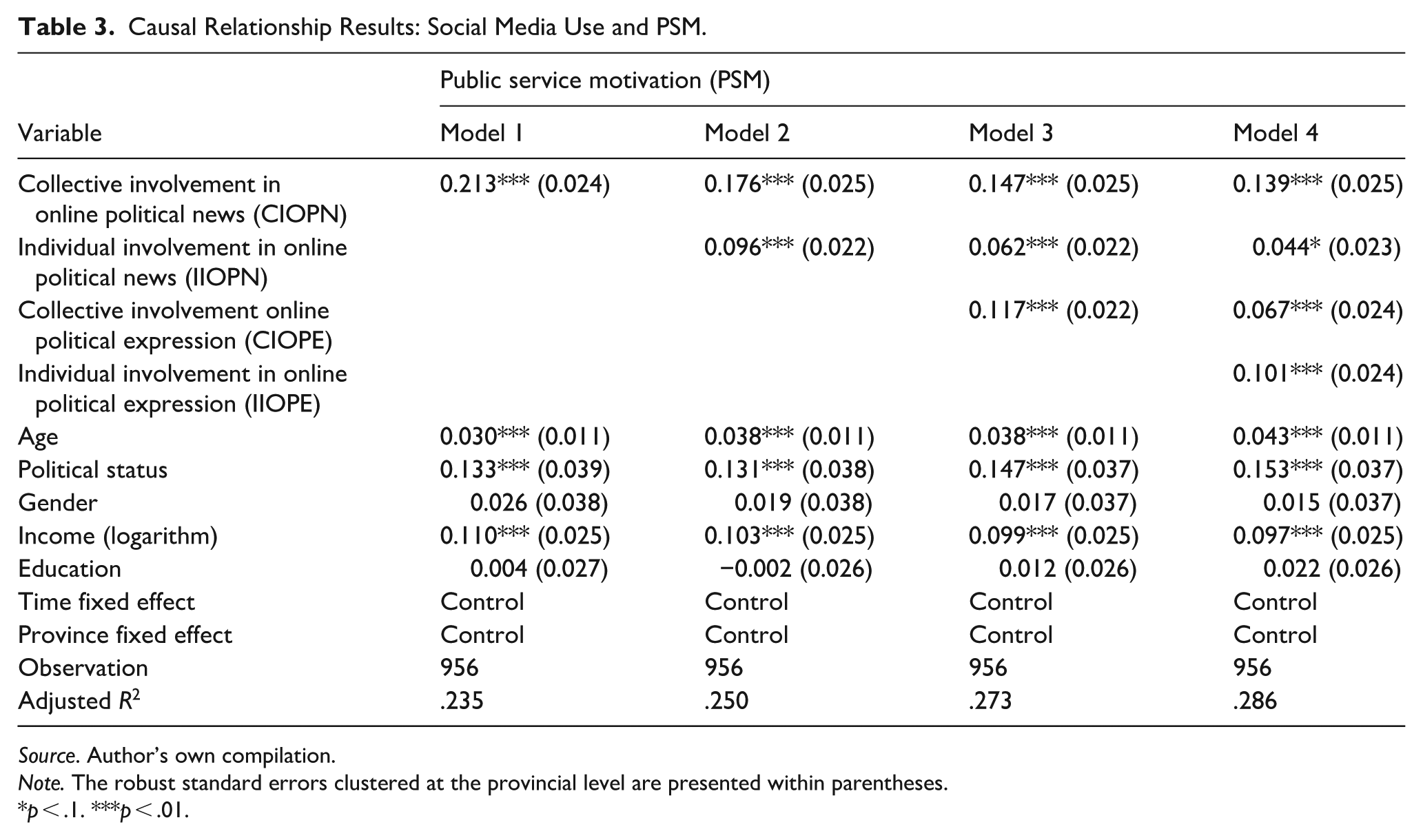
Causal relationship results are presented in Table 3. Model 1 incorporates all control variables alongside CIOPN. Models 2, 3, and 4 progressively introduce IIOPN, CIOPE, and IIOPE, respectively, building upon Model 1. A consistent pattern emerges across all models: when controlling for given conditions, CIOPN, CIOPE, and IIOPE all have a highly statistically significant positive impact on PSEs’ PSM (p < .01). Effect sizes are moderate to large (e.g., β = 0.139 for CIOPN; β = 0.067 for CIOPE; β = 0.101 for IIOPE in Model 4), and the overall explanatory power improves from 23.5% in Model 1 to 28.6% in Model 4 (Adj. R2 = 0.286). Therefore, H4 is basically supported: social media use can significantly enhance PSEs’ PSM.
Causal Relationship Results: Social Media Use and PSM.
Source. Author’s own compilation.
Note. The robust standard errors clustered at the provincial level are presented within parentheses.
p < .1. ***p < .01.
Moreover, Model 4 shows that when CIOPE and IIOPE are controlled for, the influence of IIOPN on PSM weakens significantly in both significance and magnitude (p > .1). This suggests that IIOPN’s impact on PSEs’ PSM might be indirect, mediated through its association with other variables in the model. In other words, IIOPN has no significant impact on PSEs’ PSM. This aligns with our mechanism analysis results, which indicate that IIOPN fails to improve socialization or basic psychological needs.
Robustness Check
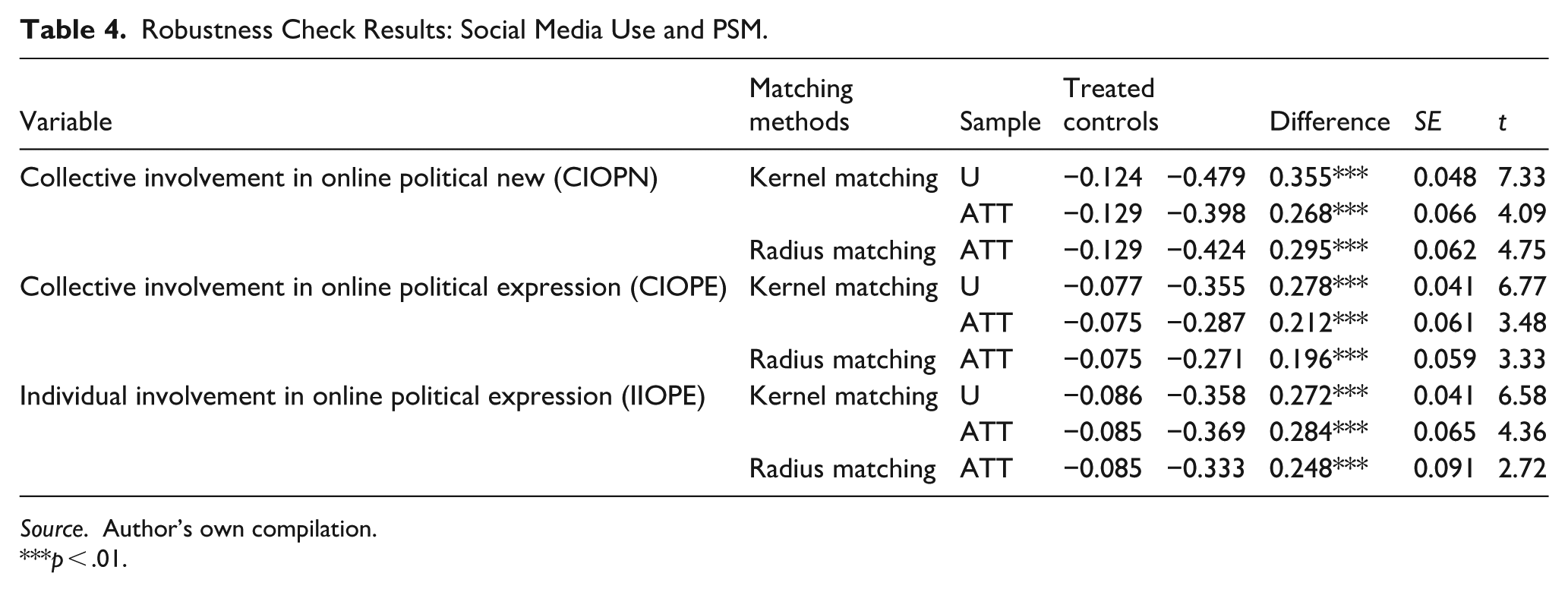
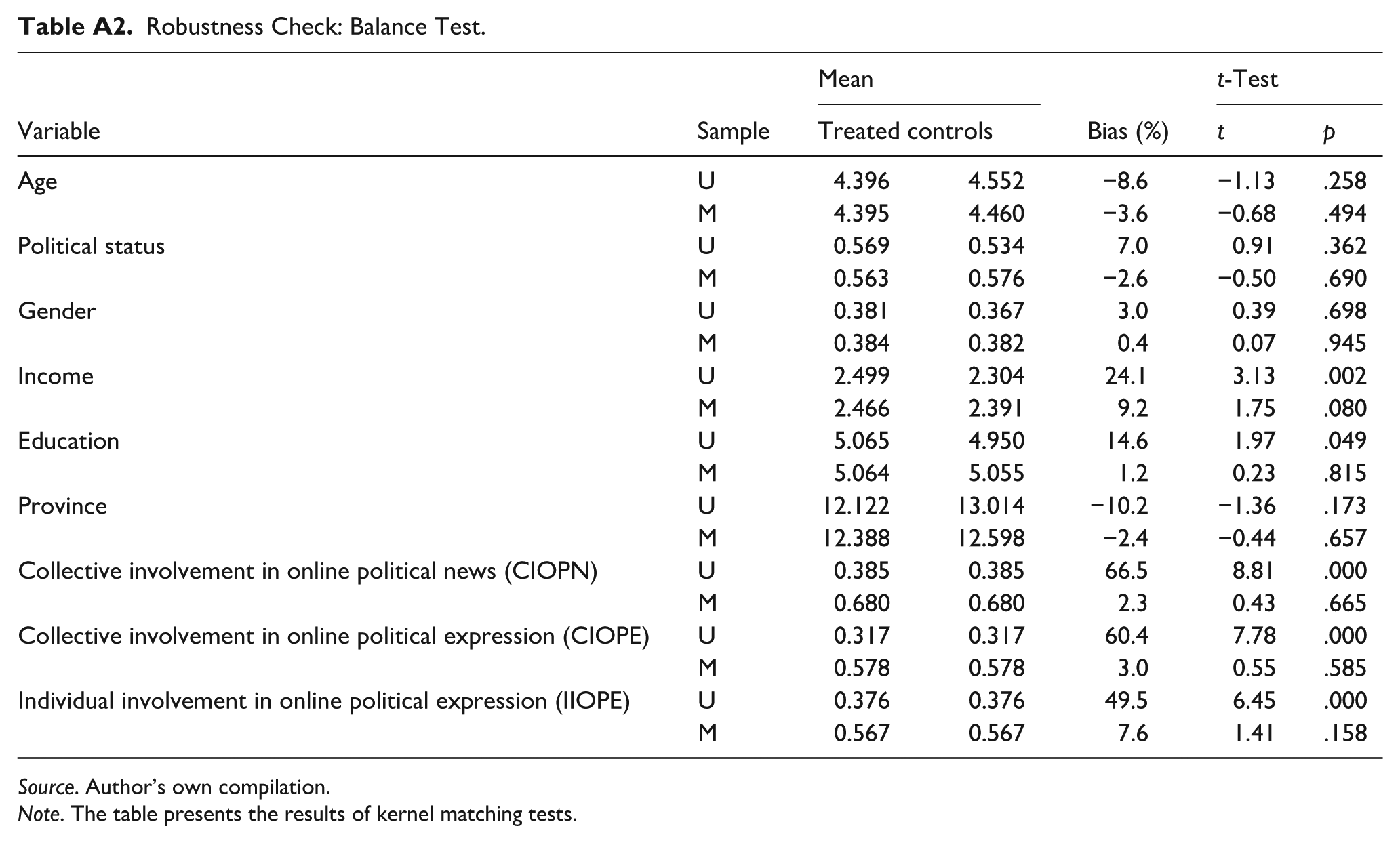
We conduct a robustness check using propensity score matching. This matching procedure involved two key steps. First, we verified the critical assumptions for valid propensity score matching: the Conditional Independence Assumption (CIA) and the Common Support Assumption (CSA). The CIA posits that treatment assignment is independent of the outcome conditional on observed covariates, while the CSA requires substantial overlap in the propensity score distributions between treated and control groups (Rosenbaum & Rubin, 1983). We confirmed both assumptions were adequately met. Covariate balance checks after matching, detailed in Table A2, showed standardized mean differences below 0.1 for all covariates and non-significant t-tests between matched groups, indicating successful balance and effective reduction of confounding on observed characteristics. Furthermore, substantial overlap in the propensity score distributions was observed, with 467 observations available in both groups across nearly the entire range, confirming ample common support.
Subsequently, treatment effects were estimated using two widely used PSM algorithms: Radius Matching with a caliper of 0.1, and Kernel Matching. Radius Matching includes control units whose propensity scores are within a specified distance (0.1) of the treated units, mitigating the risk of poor matches from forced distant pairings and enhancing result quality and robustness. A potential drawback is the exclusion of treated units without suitable matches, which may reduce sample size. In contrast, Kernel Matching uses a kernel function (such as Gaussian) to weight all control units based on their propensity score proximity to each treated unit, employing the full control sample for smoothed estimates and potentially greater statistical efficiency. The estimation results are presented in Table 4. Across both the Radius Matching and Kernel Matching specifications, we find consistently positive and statistically significant effects (p < .01) of CIOPN, CIOPE, and IIOPE on PSM among PSEs. ATT estimates suggest substantial effect sizes (e.g., 0.295 for CIOPN, 0.196 for CIOPE, and 0.248 for IIOPE), confirming that the magnitude of influence is both statistically and practically significant. These findings strengthen the robustness of a positive causal relationship.
Robustness Check Results: Social Media Use and PSM.
Source. Author’s own compilation.
p < .01.
Conclusion and Discussion
Discussion
This paper provides an implementation pathway for achieving the governance goals of digitally supported RPS in China: namely, by using social media to promote PSM among PSEs. Our theoretical analysis demonstrates this by establishing a multi-level relational origin of PSM to address the structural limitations in RPS, whereas PSM emerges from multi-level interactions: Macro-level policy, grounded in Institutional Theory, functions as a structural force shaping value orientations and promoting institutionalization. Connecting to the meso level, Identity Theory highlights how socialization mechanisms facilitate the internalization of PSM. Finally, at the micro level, SDT posits that fulfilling individuals’ basic psychological needs accelerates this internalization.
This study then empirically tested this theoretical model, operationalizing social media as a digital relational space that embodies these multi-level interactions and thereby generates PSM. At the macro level, social media control policy reflects structural relational shaping. Specifically, given the alignment between promoting PSM and China’s social media control policy objectives, this policy effectively reinforces PSM’s normative legitimacy and provides implementation support through the interplay of meaning and resource structures. This finding is consistent with Institutional Theory (Vandenabeele & Breaugh, 2025) and aligns with existing work in the Chinese context, such as Lee et al. (2020), which demonstrates the positive influence of Confucian culture on PSM. However, it contrasts sharply with findings from the Danish context, where regulatory policy changes were found to significantly weaken General Practitioners’ (GPs’) PSM (Jensen et al., 2020). This divergence strongly suggests that the mechanisms through which structural antecedents shape PSM are highly context-dependent (Hameduddin & Engbers, 2022). As Neumann and Schott (2023) also illustrate, contextual factors, such as whether an individual resides in Zurich, can significantly moderate PSM’s behavioral effects. Therefore, the external validity of this specific mechanism should be interpreted cautiously, accounting for the unique contextual conditions.
At the meso level, social media’s relational capacity lies in an intermediary space, connecting macro-level structural influences, such as access to state-endorsed value narratives (Luqiu & Kang, 2021), with micro-level psychological needs, including the cultivation of emotional belonging (C. Chen et al., 2025). This interplay facilitates a form of politicized socialization, consistent with Identity Theory (Vandenabeele, 2007) and offers a valuable extension to existing research on PSM socialization pathways. While previous studies have largely emphasized conventional sources of socialization—such as family, education, and organizational contexts (Florczak et al., 2023); public administration curricula (Huang, 2022); cognitive mechanisms like goal clarity (Kim et al., 2023); intra-organizational socialization practices (Woo & Kim, 2024)—our study underscores the growing relevance of social media as a contemporary digital socialization mechanism relevant to PSM development.
At the micro level, social media use significantly contributes to satisfying individuals’ needs for competence and relatedness. Notably, unlike competence and relatedness, we refrain from making definitive claims about the satisfaction of autonomy needs through social media use. This stance is grounded in institutional embeddedness theory, which posits that lower-level institutions are embedded within and influenced by higher-level institutions that exert pressure for value and structural consistency (Vandenabeele & Breaugh, 2025). China’s social media control policy, characterized by inherent ideological uniformity and censorship (Zhang et al., 2022), acts as a higher-level structural institution that likely restricts opportunities for individuals’ autonomous expression and choice. Consequently, the capacity of social media use to satisfy PSEs’ autonomy needs is inherently limited in this environment. Given this, our findings offer a potential qualification to the application of SDT in PSM research. While prevailing SDT-based propositions suggest PSM requires the simultaneous satisfaction of all three basic psychological needs—autonomy, competence, and relatedness (e.g., Vandenabeele & Breaugh, 2025)—our results suggest that competence and relatedness satisfaction alone may suffice to foster high PSM, even when autonomy is potentially limited by the institutional environment. This implies that the generative mechanism of PSM may possess greater institutional adaptability and contextual flexibility than previously assumed, particularly in settings characterized by strong regulatory discipline.
This study then empirically demonstrates that social media use significantly enhances PSM among PSEs. The above empirical findings offer valuable insights into the origins of PSM disputes. Our results support conceptualizing PSM as a composite value—a secondary tier of human values shaped by the interaction of fundamental values, culture, and individual experiences (Charbonneau & Van Ryzin, 2017; X. Wang & Niu, 2024)—rather than an inherent, fundamental human value often assumed to possess universal characteristics (Bao & Zhong, 2021; Verka et al., 2025). Accordingly, researchers should move beyond analyzing antecedents independently. Instead, PSM development is best understood as a multi-level, dynamic, and contextually embedded process. Such a process reflects both structural stability and embeddedness, driven by macro-level policy (Mechanism 1), and contextual adaptability and flexibility, facilitated by meso-level socialization (Mechanism 2) and micro-level individual psychology (Mechanism 3).
In sum, the relational nature of PSM is not only theorized but also empirically mobilized through the relational capacity of digital technologies. This relational understanding is strongly supported by existing scholarship across theoretical, empirical, and contextual domains. Theoretically, the concept of PSM emerged as a direct response to the perceived limitations of self-interested motivation. The dominance of self-interest was seen to shape public servants’ behavior and decision-making, contributing to political scandals such as Watergate and reducing public service to a low-trust “principal–agent” relationship. In contrast, scholars argued for recognizing and fostering intrinsic motivations among public servants, including commitment to the public interest, self-sacrifice, and altruism (Perry & Wise, 1990). PSM thus represents an effort to counter self-interested motivation, offering a potential corrective mechanism for restoring a high-trust “trustee–beneficiary” relationship in public service. Empirically, a growing body of research has increasingly recognized the relational influence of PSM. Prysmakova (2021) demonstrated that the relationship between PSM and job satisfaction is mediated by person-organization fit, with the indirect effect moderated by citizen interaction frequency. Similarly, Schönherr and Thaler (2024) found a positive correlation between PSM and managerial networking. Contextually, the relational nature of PSM appears particularly salient in China. This salience stems from deeply embedded norms of role obligations and relational harmony, rooted in Confucian culture and collective tradition, which have shaped China’s social structure and value system over 5,000 years (Lee et al., 2020). These long-standing norms constitute core moral standards that emphasize collective harmony and reciprocal obligations, may even take precedence over universal values such as honesty and legality. The practice of cultivating and maintaining relationships (“guanxi”) serves as a key manifestation of these norms, functioning not only as a primary means for resource access and problem-solving, but also as a vital mechanism for sustaining social order and fostering community trust (C. A. Chen & Kuo, 2024). Consequently, compared to other contexts, China provides a more fertile environment for the development of a relational PSM.
Accordingly, the relational nature of PSM responds to three critiques of Perry’s (1996) framework. First, by incorporating sensitivity to social norms and external evaluations, relationality offers a mechanism to mitigate social desirability bias in the original framework (Kim & Kim, 2016), providing a socially contextualized understanding and enhancing validity. Second, as a distinct construct, relationality helps clarify the differentiated or even contradictory effects observed for the four dimensions in complex contexts (Hayashi et al., 2024), allowing for more precise identification of its unique influence pathways in settings involving complex relationships such as policy acceptance, organizational adaptation, and social interactions. Third, grounded in cultural values prevalent in China (including collectivism, institutional role identity, and relationship orientation), this dimension enhances the cultural applicability of the original Western-centric framework, addressing issues of poor model fit and measurement equivalence previously encountered in Asian contexts (Korac et al., 2019).
Policy Recommendations
This study offers three key policy recommendations for promoting PSM. First, state social media policy combines regulation and control tool with high-quality knowledge resources and interactive platforms that enhance legitimacy and understanding. Second, social media platform could not only conform to state-led policies by disseminating PSM-related content to shape the information environment, but also foster group support and emotional cohesion through online communities, shared experiences, and peer reinforcement. Third, PSEs can actively use social media to access information that clarifies the scientific and legitimate foundations of PSM and engage in online interactions that provide social support and foster belonging.
Limitations and Future Research
This study has several limitations. First, due to data constraints, it employs multiple single-item scales to measure basic psychological needs. While single-item measures provide operational simplicity, they have well-documented statistical limitations, particularly given the availability of established multi-item scales. Future research should employ validated multi-item instruments to enhance reliability and validity. Second, this study assumes causal pathways from social media use to PSM. Relationalist epistemology, however, fundamentally questions the very notion of linear causality (Crossley, 2010; Donati & Archer, 2015). Future research could engage more directly with this epistemological debate to clarify the implications of relational assumptions for causal inference in public administration research. Third, the study verifies the relational genesis of PSM through four representative forms of online political interaction. Although these modes provide useful evidence, our findings suggest subtle differences in their effects on PSM, and other forms of digital engagement remain unexplored. Future research should broaden the measurement framework, examine alternative modes of interaction, and assess their implications for PSM. Finally, because this study is situated in China’s cultural and political context, its conclusions should be generalized with caution. Specifically, the relational essence of PSM identified here may not hold in Western contexts.
Footnotes
Appendix
Robustness Check: Balance Test.
| Mean | t-Test | |||||
|---|---|---|---|---|---|---|
| Variable | Sample | Treated controls | Bias (%) | t | p | |
| Age | U | 4.396 | 4.552 | −8.6 | −1.13 | .258 |
| M | 4.395 | 4.460 | −3.6 | −0.68 | .494 | |
| Political status | U | 0.569 | 0.534 | 7.0 | 0.91 | .362 |
| M | 0.563 | 0.576 | −2.6 | −0.50 | .690 | |
| Gender | U | 0.381 | 0.367 | 3.0 | 0.39 | .698 |
| M | 0.384 | 0.382 | 0.4 | 0.07 | .945 | |
| Income | U | 2.499 | 2.304 | 24.1 | 3.13 | .002 |
| M | 2.466 | 2.391 | 9.2 | 1.75 | .080 | |
| Education | U | 5.065 | 4.950 | 14.6 | 1.97 | .049 |
| M | 5.064 | 5.055 | 1.2 | 0.23 | .815 | |
| Province | U | 12.122 | 13.014 | −10.2 | −1.36 | .173 |
| M | 12.388 | 12.598 | −2.4 | −0.44 | .657 | |
| Collective involvement in online political news (CIOPN) | U | 0.385 | 0.385 | 66.5 | 8.81 | .000 |
| M | 0.680 | 0.680 | 2.3 | 0.43 | .665 | |
| Collective involvement in online political expression (CIOPE) | U | 0.317 | 0.317 | 60.4 | 7.78 | .000 |
| M | 0.578 | 0.578 | 3.0 | 0.55 | .585 | |
| Individual involvement in online political expression (IIOPE) | U | 0.376 | 0.376 | 49.5 | 6.45 | .000 |
| M | 0.567 | 0.567 | 7.6 | 1.41 | .158 | |
Source. Author’s own compilation.
Note. The table presents the results of kernel matching tests.
Acknowledgements
We acknowledge Bartels and Turnbull’s (2020) RPS framework and  work on PSM origins, which informed our comparative analysis.
Author Contributions
Yiting Wang developed the research design and wrote the first draft. Ailing Luo conducted the data analysis and contributed to result interpretation. Shurong Zhao supervised the project, provided critical revisions, and guided the overall development of the manuscript.
Funding
The authors disclosed receipt of the following financial support for the research, authorship, and/or publication of this article: This work was supported by the 2022 Central Chinese University Fundamental Research Program for Humanities and Social Science Cultivation Key Project [grant number ZYGX2022F].
Declaration of Conflicting Interests
The authors declared no potential conflicts of interest with respect to the research, authorship, and/or publication of this article.