






Abstract
Introduction
The dynamics of health care provision and its reception among patients are particularly important in the field of audiology, which is focused on effective communication for those with hearing, balance, and other ear disorders. With the projected increase in the Spanish-speaking population, a significant proportion of the American population will likely encounter language barriers when seeking hearing health care. Additionally, 15% of Hispanic/Latino adults have hearing loss (Cruickshanks et al., 2015). Most of those who speak Spanish in the United States (US) are of Hispanic and/or Latino descent, so study of both culturally and linguistically appropriate care is needed to meet this population's needs. By focusing on Spanish-speaking adults, this study also recognizes the growing demographics of Spanish speakers in areas or regions where English is the majority-spoken language of health care professionals.
Background
The intersection between language and health care service delivery is complex, influenced by factors such as patient-provider communication, health literacy, linguistic proficiency, and cultural awareness. Limited English proficiency can affect a person's ability to identify and seek health care services, contributing to disparities (Smith, 2010). These linguistic disparities are closely related to those that exist for racial and ethnic groups in health care, education, and access to services. For example, Latinx patients with limited English proficiency have reported dissatisfaction and mistrust of the health care system, negatively impacting health care access (Escobedo et al., 2023; Smirnoff et al., 2018). Racial disparities have been documented due to financial reasons, barriers for accessing services, and provider-patient communication in health care (Schut, 2021).
In health care, communication barriers can adversely affect the provider-patient relationship (Berdahl & Kirby, 2019). Language barriers have negative consequences for patient satisfaction and the health care system (Al Shamsi et al., 2020; Divi et al., 2007; Floyd & Sakellarious, 2017). These language-related barriers have also been identified in audiology (Arnold et al., 2022). Concordance between the provider's and patient's language can lead to increases in the patient's perception of the quality of care received (Lopez Vera et al., 2023), strong provider-patient relationships (Haskard-Zolnierek et al., 2023), and greater trust in providers (Daggett et al., 2023). In cases where audiologists and patients do not speak the same language, the risk of misdiagnosis and lowered patient satisfaction could increase (Bell et al., 2023). Language barriers are expected to be even more pronounced by hearing loss because hearing loss impacts an individual's ability to communicate effectively. Assessment and diagnosis of hearing loss involve verbal communication. In cases where patients and audiologists do not share a common language, additional barriers to this communication between provider and patient arise.
In addition to language barriers, access to health care services, including lack of reliable transportation and health insurance, have been shown to limit Spanish-speaking patients’ access to health care (Flores et al., 2004; Perreira et al., 2021). Transportation barriers can cause patients to miss appointments and delay care, leading to poor health outcomes (Syed et al., 2013). Significant race and ethnicity disparities exist for insurance coverage among underrepresented groups, including those of Hispanic/Latino origin (Gong, 2023). It is important to note that while these access issues may be related to infrastructure, linguistic and cultural barriers also exist. Beliefs, perceptions, and expectations regarding health and health care delivery can vary across cultures (Leijen & van Herk, 2021), impacting the effectiveness of a providers’ health communication and the patient's experience. Furthermore, differences in culture can play a significant role in shaping health-seeking behaviors, perceptions of illness and wellness, and expectations from providers. For example, cultural beliefs about hearing loss and health, the family's role in decision-making, and preferences for certain interventions can affect how a patient responds to services. Moreover, religion and cultural practices play a significant role in shaping individuals’ beliefs and approaches to health care. Understanding the connection between religion and health care can help providers have a better understanding of patient's decision-making processes and beliefs (e.g., practices regarding traditional medicine and home remedies, dietary practices, end-of-life care (Swihart et al., 2023).
The role of English-speaking audiologists in providing care to Spanish-speaking patients needs further exploration. There is a growing need for audiologists and other health care professionals to be acutely aware of the needs of Spanish-speaking patients and be able to communicate with clarity and cultural competence to provide appropriate services. The projected increase of the Spanish-speaking population in the U.S. will require all health care professionals, including audiologists, to be culturally sensitive and responsive to this diversity. Gaps in clinical practice are likely to include difficulties identifying and diagnosing hearing loss, evaluating patients, and recommending intervention practices (e.g., amplification and aural rehabilitation) for Spanish-speaking patients. With little guidance for English-speaking audiologists and limited access to resources for working with Spanish-speaking patients, serving an increasingly Spanish-speaking population may be a challenge. Understanding the experiences and perceptions of Spanish-speaking patients can guide the development of patient-centered (i.e., tailored) and effective communication strategies, programs, innovative service delivery models, and policies. Failure to provide culturally competent care can negatively affect access for patients seeking care.
Emerging recognition of the importance of patient-centered care, including respect for patients’ cultural and linguistic backgrounds, involves integrating the patient's preferences and values into care decisions (Epner & Baile, 2022). In the context of serving Spanish-speaking communities, patient-centered care may appear differently. It may involve language support through interpreters and/or bilingual staff, including audiologists, but it should also reflect a deeper cultural understanding and sensitivity. While some audiologists may rely on interpreters and/or bilingual staff, interpretation services do not address the need for providers to have cultural competence, which is critical for building trust and engaging with patients. Furthermore, nuances in translation, difficulty with scheduling, availability of trained providers, financial costs, and the additional time for interpreted appointments may present additional challenges (Jaeger et al., 2019; MacFarlane et al., 2020).
Therefore, this exploratory study sought to address these critical issues by focusing on the experiences of Spanish-speaking adults’ perceptions, attitudes, and experiences with hearing health care provided by English-speaking audiologists. The published research literature includes little information on this topic, so qualitative methodology was necessary to discover factors related to the provision of hearing health care services in the US to this population. By examining these experiences, this research aims to highlight areas where linguistic and cultural barriers exist, understand how they impact patient satisfaction and outcomes, and identify areas for improvement. The findings could have implications for training and practice in audiology, so that hearing health care can become more inclusive and responsive to the needs of diverse linguistic and cultural communities.
Methods
Study Design
The authors conducted data collection for this qualitative study in Oklahoma City, OK, USA. All data were collected through in-depth, semi-structured interviews with the primary investigator guided by a phenomenology approach. Phenomenology is an approach used in qualitative research to understand the lived experiences of others (Neubauer et al., 2019). The research aimed to answer the following question: “What are the experiences of Spanish-speaking patients with hearing loss when accessing hearing health care in an English-only speaking clinic?” Descriptive phenomenology was chosen because it represents the idea that only individuals who have personal experience with a phenomenon can give an accurate description of it (Sundler et al., 2019) and because little is known about these patients’ experiences. We sought to explore the aforementioned issues with hearing health care access from the experience of Spanish-speaking patients.
Participants
Recruitment was limited to adults who had been diagnosed with hearing loss by a licensed audiologist, spoke Spanish, and lived in the Oklahoma City metropolitan area. Individuals with hearing aids were also eligible to participate as a way to increase the external validity and diversity of the sample so that participants with hearing loss, regardless of their amplification use, could share their experiences. Participants were purposively recruited from the John W. Keys Speech and Hearing Clinic on the University of Oklahoma Health Sciences Center campus to identify those with hearing loss and who identified as either monolingual Spanish-speaking or bilingual Spanish-English speaking. There were no exclusion criteria for age, sex/gender, or any other sociodemographic characteristics. Audiologists identified potential and eligible study participants. Eligible patients were then provided with a flyer, which included details about the study, and were asked to provide their contact information if interested. All participants were initially approached face-to-face at the time of their audiology appointment, and subsequent correspondence was via email and phone call. The primary investigator then contacted interested patients to schedule an interview. Participants were informed of the aim of the study and the reasons for conducting the research during the informed consent process. To reduce any potential researcher bias, the interviewer prefaced interviews during the consent process with a statement that this research study's purpose was to share their lived experiences and that their participation could benefit other patients by identifying needs for increasing and barriers to care.
Data Collection Procedure
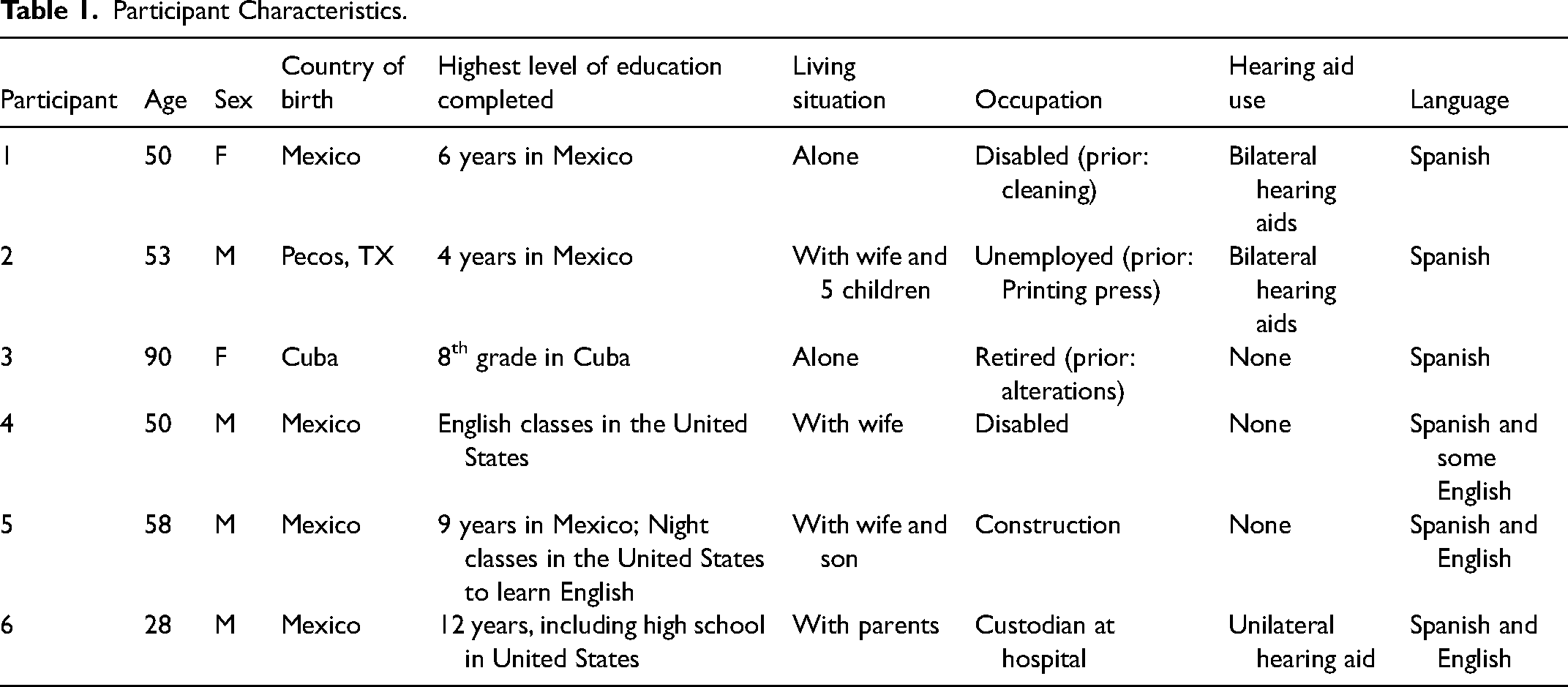
The Institutional Review Board at the University of Oklahoma Health Sciences Center approved the study (IRB #4935) prior to any study activities with human participants. The first author conducted interviews with all participants in Spanish. Interviews occurred in a private room at the university. Participants were interviewed alone, except for two participants who were accompanied by a family member (daughter or adult son). Interviews began with soliciting information related to the person's background, education, occupation, home environment, use of hearing aids, and identified use of language; this information was used for creating descriptive table about the participants (see Table 1). The interview guide included open-ended and probing questions pertaining to awareness of hearing loss and its cause, language acquisition, knowledge of the profession of audiology, hearing evaluation, utilization of hearing aids (if applicable), interpreters, and satisfaction with the services provided by an English-speaking audiologist or provider. The final question related to recommendations for improving his or her experience. The interviewer memoed throughout the 90- to 120-min interviews. Participants were allowed to take a break at any time. No repeat interviews occurred.
Participant Characteristics.
Data Analysis
Interviews were audio-recorded and were transcribed verbatim into Spanish and then translated to English by the first investigator due to the differing language proficiencies of the researchers. Translations and transcriptions were verified by an external bilingual reviewer and educator who was a native speaker of Spanish. The English transcripts were analyzed independently using inductive thematic analysis (Braun & Clarke, 2006). To begin the phenomenological process of analysis, researchers first set aside preconceived ideas about the phenomenon through bracketing. Second, transcripts were read in their entirety multiple times and without reflection before identifying meaning units. To identify meaning units, inductive coding was used to represent core ideas expressed by the participants; no preconceived coding scheme was used due to the limited background available at time of study design. Third, the units were then grouped into themes and sub-themes that represented the participants’ experiences via coding schemes. Fourth, through constant comparison, themes were compared and contrasted to ensure they accurately represented participants’ experiences. This process involved merging, redefining, renaming, and splitting themes. Fifth, themes were synthesized to create brief descriptions that captured the lived experiences. Last, validity and reliability checks via member checking with one participant and research triangulation were employed to ensure the trustworthiness and credibility of the results.
Coding and memoing were done by hand. Participant characteristics were described using descriptive statistics. Discrepancies were resolved through discussions between the two authors and by reviewing the codes and comparing them to the coding schematic. Saturation of the data was confirmed after coding the sixth participant's interview, which was the second interview after which no new codes emerged. This point of saturation was justified based on the nature of the hearing aid bank program, which all participants had received care and services from, and the homogenous backgrounds of the participants. The authors agreed to end data collection after the sixth interview. An external investigator with expertise in qualitative methods reviewed the findings and interpretations.
Results
Study findings are based on interviews with six adults (two female, four male). Years of education ranged from four years in Mexico to night adult education classes in the United States. Most participants lived with family, and two participants were currently employed. Hearing aid use varied from none to bilateral hearing aids. Participants identified as either monolingual Spanish- or bilingual Spanish-English speakers. The age range of participants was between 28 and 90 years. Participant characteristics are reported in Table 1. Within each of the three themes, sub-themes were identified. The findings below represent the participants’ experiences, and direct quotes are provided to illustrate the themes and essence of the phenomenon.
Theme 1: Perceived Barriers to Hearing Health Care
Participants discussed difficulties with finding an audiologist or hearing health care provider, scheduling and attending appointments, and understanding information presented to them during appointments.
Language
Language was a major factor in the participants’ choice of a medical provider, and many of the participants regularly saw Spanish-speaking physicians. However, none of the audiologists or staff at the clinic spoke Spanish, so participants who were not bilingual often had to rely on a family member to be the interpreter. For participants who did not speak English, the lack of availability of a Spanish-speaking staff member or interpreter during appointments was frustrating. Many participants felt that their limited proficiency in English made it difficult to communicate concerns or schedule appointments with the clinic. For the two participants with a family member present as an interpreter, scheduling of appointments was a challenge. One participant relied on his daughter, a fifth-grade student, to serve as the interpreter during appointments. He found the clinic hours of 8:00 am to 5:00 pm limiting, as his daughter had to return home from school before they could leave for an appointment.
Participants also spoke of the difficulty finding a Spanish-speaking provider or interpreter during appointments. They felt more comfortable, confident in, and had higher trust in Spanish-speaking providers.
Participant #4: If I know that they speak Spanish here, I am going to come here with more trust.
Participant #6: Because there are more people who do not speak English and a lot of people are afraid, afraid sometimes to come.”
These quotes highlight the importance of language alignment between health care providers and patients. The participant expresses a greater sense of trust when knowing that health care services are available in their native language (Spanish in this case). This trust likely stems from the expectation of clearer communication, better understanding, and a more personalized care experience. Non-English speakers, especially in an English-dominant environment, may feel fearful or intimidated about seeking health care services due to language barriers. This fear can be interpreted as a concern over being misunderstood, facial discrimination, or not receiving appropriate care, which represents a barrier to health care access for this population. Lastly, participants questioned the validity of their speech perception scores in English because they were unfamiliar with English-language speech recognition words.
Participant #5: So, when he goes to do the test and if he interprets the word incorrectly and pushes the button…now the test does not end well; The result is wrong.
This quote from Participant #5 shows the specific challenges during hearing testing when language barriers are present. The participant is referring to a situation where they, due to limited proficiency in the test language, misinterpreted a presented word and responded incorrectly. This misinterpretation can lead to inaccurate test results, implying that the reliability of a test can be compromised by language barriers. It also emphasizes the importance of language-appropriate testing and communication in health care.
Transportation
For participants who did not own a car, transportation was a barrier to attending appointments. Two participants relied on public transportation or a family member to their appointments, either due to not having a car or because of disability.
One participant reported having to wake up early to take two public buses and walk across campus to arrive on time for a 9:30 am appointment for her hearing aids.
Participant #1: …I have to wake up at 6 or 7 in the morning… At times, I am still sleeping. I do not have time to drink coffee or eat breakfast. Tidy up and walk about three blocks to get to where the bus passes.
The participant's return journey was equally long, so she would not arrive home until the afternoon. This quote demonstrates the logistical challenges and perceived personal sacrifices involved in access hearing health care services. The participant describes a daylong journey for an hour-long appointment or brief hearing aid drop-off. This narrative illustrates the effort and hardships that some individuals face when accessing care. The need to travel a distance on public transportation also points to issues of accessibility and the burden it places on individuals, especially in those who might already be dealing with health issues.
Cost
All participants in this study, including recipients of hearing aids through a limited income bank program, stated that the high cost of hearing aids is a barrier for other patients with hearing loss who may benefit from the devices.
Participant #2: And she [the audiologist] told me that they would cost at least $3000…and I have to see because I do not have money, I said, I cannot see them because I do not have money.
This quote sheds light on a critical barrier in accessing hearing health care: the financial cost of hearing aids. The participant's experience reveals the significant expense associated with the devices, leading to an inability to pursue them. There is a resigned acceptance in the participant's statement, underscoring a feeling of helplessness often felt by individuals who cannot afford health care services.
Theme 2: Success with Hearing Health Care
The second theme that emerged from the codes related to participants’ positive experiences with hearing health care and audiologists. Participants reported success with communication with interpreters and the hearing aids provided through the hearing aid bank program.
Spanish-speaking providers or interpreters
Limited English proficiency, an identified barrier described above, was overcome by seeking providers who were bilingual or who had bilingual staff or interpreters available for appointments. Participants reported positive experiences with providers and interpreters, explaining that they were familiar with terminology and described the information in an easy-to-understand way.
Participant #6: …they [interpreters] know what they are, what the doctors said, and they explain it to me better.
This participant's experience reveals a positive role of interpreters in health care settings for patients facing language barriers. The participant acknowledges that interpreters are valuable for understanding the provider's message more clearly. This indicates that interpreters can help by contextualizing the information presented in a way that is accessible to the patient. The patient's experience suggests that interpreters play a crucial role in improving communication between providers and patients who speak different languages, which can improve the overall quality of care.
However, all participants in the study, regardless of language status (i.e., bilingual English-Spanish or monolingual Spanish speakers), reported a preference for Spanish-speaking providers over interpreters. They felt more comfortable speaking directly to the provider in Spanish instead of indirectly through an interpreter. Participants also felt that interpreter's translations were not always accurate, especially for audiology-specific terminology.
Participant #5: Because sometimes the ones who are translating, they do not translate well…because sometimes they say a word, and they explain it to you, maybe they say another word…So when you communicate something to the interpreter and the interpreter says the same thing again, (laughs) sometimes the words change to other words.
This quote represents another significant issue in the use of interpreters in health care: the potential for miscommunication and inaccurate translation. The participant notes that sometimes interpreters may not translate effectively, leading to a change in the meaning of words. This change can lead to misunderstandings or misinterpretations of important health information. The perception that effectiveness of interpreters in health care can be variable emphasizes the need for accurate interpretation.
Participants who attended appointments with family members often relied on them as informal interpreters. For some participants, having a family member as an interpreter was preferable to an in-house interpreter because of the support provided. They reported feeling more comfortable with their family members but also felt that their family members knew them well enough to answer questions for them. However, family members’ translation may not always be reliable, especially for complex or unfamiliar terminology. Health care providers should be aware of the limitations of family member interpretations and, where possible, provide access to professional interpreters who are trained in translation and knowledgeable of the ethics and confidentiality around accurate interpretation.
One participant relied heavily on her son for transportation and interpreting for medical appointments. She said that she does not need to understand what her providers say because her son is always present. Having a family member who is aware of the communication difficulties associated with hearing loss, in addition to being employed in health care, made the participant comfortable for any conversations with her providers.
The impact of hearing loss and hearing aids
The participants in this study were asked about the impact of hearing loss on their lives at home or at work. The quotes below offer a multifaceted view of the experiences of individuals with hearing impairments, including emotional, social, and practical challenges. This can range from societal discrimination and stigma to inconveniences, demonstrating the diversity of needs and experiences in the community.
Participant #1: “I feel, like, bad because many people discriminate against the people who cannot hear or have something, a disability.”
Participant #1 expressed a personal and emotional response to the discrimination faced by individuals with hearing impairments or other disabilities. The societal stigma associated with disability extends to hearing loss and can lead to feelings of distress.
Participant #3: “…And the television, I see them moving the mouth but I do not hear what they say…I do not hear anything.”
Participant #3 describes the experience of watching television as a viewer with hearing loss. This quote illustrates the frustration and isolation that can be experienced by those with hearing loss.
Participant #4: Like the television that has the sound very high, well… that is when it bothers me the most.
Participant #4 shares discomfort with loud television volume, which is another effect of hearing loss on individuals’ sensitivity to sound.
Without the hearing aid bank program, most of the participants reported that they would have been unable to afford hearing aids. All participants described positive experiences with their hearing aids, explaining how the hearing aids have helped them communicate at work, at home, and with others.
Participant #1: I feel so happy with them (hearing aids)…Oh my God, I feel like a young person. It is like unwrapping a stuffed toy animal on Christmas.
Participant #2: I hear, now I hear my steps. Outside, I walk and I hear them. When I close the door, I hear it really loud. When I close the truck door, I hear everything I did not hear. And people talked and, well, I did not know what they were saying. Now, they are talking there and they are not talking with me, they are talking with others, and I hear them. And before? Noooo.
These quotes show the profound positive impact that hearing aids can have on an individual's life. There can also be a newfound awareness of everyday sounds when hearing aids are received.
Theme 3: Cultural Factors
Aspects of participants’ culture, such as strong religious beliefs, the importance of family, and the use of home remedies, were consistently mentioned during the participants’ interviews.
Religion
The impact of hearing loss in church was mentioned by some of the participants. All of the participants identified as Christian, regularly attending services in church where they often encountered difficulty hearing sermons or hymns.
Participant #2: ….in the chorus, I sing, and, well, I could not hear, and then the people want to give thanks to God and I did not hear that either.
This quote from Participant #2 illustrates the impact of hearing loss in a religious or spiritual context. Hearing loss impacted the participants’ abilities to fully engage in their religious practices. These quotes emphasize the importance of accessible and inclusive environments for individuals to engage in cultural activities.
Participant #6: But when there is a lot of noise, no, no, no, I do not hear the Father… Well, two things: I am sitting in the back, and there are a lot of children crying.
With this quote from Participant #6, the challenges faced in environments with background noise are reflected upon. This is a challenging listening situation because of the distance (participant is seated at the back) and the background noise (children crying), which are two sources of difficulty that can exacerbate hearing difficulties.
Participants reported that their faith helped them cope with their hearing loss.
Participant #5: Well, I think that, yes, if I did not have faith, I would have gone crazy. Because the noise that I have inside my ear, it is so– it bothers me a lot…Like right now, you are quiet and I am quiet, that is when it bothers me, and sometimes I feel hopeless…And so I say, ‘God, help me’.
For Participant #5, the crucial role of faith helps with coping with hearing difficulties. Faith is a source of comfort for this participant and helps the participant manage the stress and emotional strain caused by hearing loss.
Family
All participants interviewed talked about the importance of their family. Participants either lived with other family members or saw them regularly. Many participants felt that family was an important part of their culture and daily lives. Participants reported a strong sense of community, which they compared to the American culture.
Participant #4: …The Mexicans… We are like this. Look, a doctor told me this, he said, “Look, you all in Mexico, when something bad happens to their family members, they go to them, bringing chicken soup.”
Participant #4 reflects on a cultural difference about Mexican community practices that was observed by a physician. The reference symbolizes a cultural value to care, support, and solidarity. This anecdote highlights the participant's experience with respect of cultural nuances and suggests that providers who are aware of and sensitive to such cultural practices can foster a more welcoming environment for patients.
Participant #2: If there are Mexicans who speak Spanish in some place, we will go there…The Americans do not buy a lot…Why? Because we make food in the house. The Americans, no…So all of our businesses are calling us, and for this reason, they have Mexicans so that people can come with trust. So, if a doctor or here at this place has someone who speaks Spanish, more Mexican people are going to come…with more trust, they are going to come.
This quote discusses the cultural and linguistic preferences of the Mexican community. The presence of Spanish-speaking staff in businesses and health care facilities is seen as a trust-building factor.
One participant, who was going to receive hearing aids for the first time, had asked her sister about using hearing aids. Her sister's success with amplification helped the participant set her own expectations for hearing aids.
These quotes underscore the influence of cultural and linguistic factors on the trust and comfort levels of individuals in hearing health care. They also highlight the need for culturally competent care and the importance of linguistic representation to better serve diverse communities.
Use of home remedies
A theme related to home remedies emerged when participants were asked about the cause of their hearing loss. Two participants described experimenting with home remedies when they began having trouble hearing or experiencing tinnitus or vertigo. When asked about the outcome of trying the remedies, both participants reported that they were ineffective in improving their hearing or reducing vertigo attacks. Nonetheless, participants were receptive to trying them because of success reported by earlier generations of their family members.
Participant #2: Well, in Mexico, I heard some noises here (points to ear), eh, you know that they had you lie down. They put a straw in a little water…they put it here (points to ear). And do you know what came out? Do you know about ticks? It was what one got from, like, milking cows, and that was the solution.
Participant #5: That little rock is wrapped in cotton…and you put it in your ear…and when you are sick, it takes out all the air and all…It stops a lot of the sensations that you have inside, infections…It has not been useful to me. To many people, yes. My uncle, yes, he was cured.
These are accounts of traditional or home remedies used in Mexico for ear-related issues, such as removing ticks or treating ear infections. This narrative illustrates the diversity of health beliefs and practices that patients may have experienced in different cultural contexts. It is important for health care providers to be aware of and sensitive to such traditional practices, as they can influence patients’ health behaviors and beliefs.
Discussion
Thematic analysis of the interviews conducted with six bilingual and monolingual Spanish-speaking patients with hearing loss revealed three major themes: perceived barriers to hearing health care, success with hearing health care, and the importance of family, religion, and other cultural factors in this population. The knowledge gained from these interviews can serve as the foundation for delivering hearing health care services that are culturally and linguistically appropriate, thereby improving access, quality of care, and, ultimately, outcomes related to hearing loss and rehabilitation in this population.
Barriers due to limited proficiency with English contribute to disparities in health care and audiology. We are unable to attribute disparities identified through the participant interviews because their language proficiency and health literacy in English and Spanish were not assessed. Limited English proficiency and low health literacy negatively impact communication in health care settings, and patients who are monolingual speakers of Spanish with low levels of educational attainment may be vulnerable to poorer health outcomes (Sentell & Braun, 2012). Providers must learn to effectively communicate with all patients, including those who do not speak the same language as their patients.
In the US, practitioners are required to provide interpreters and language translation services to patients with limited proficiency in English if the services are required by an insurance provider or if federal or state funds (e.g., Medicare, Medicaid) are accepted. Providers may rely on family members or bilingual staff as a convenient way of communicating with patients who do not speak English. Although most of the participants reported using informal interpreters, including family members, providers should arrange for formal, trained interpreters to attend appointments. Untrained interpreters, especially family members, may be unfamiliar with the terminology required for accurate translation or may not reliably translate what the provider has said due to cultural values (e.g., a younger family member may not wish to disrespect an older person by asking sensitive questions) (Garcia & Gaeta, 2023). In addition to arranging for trained interpreters, audiologists may use teach-back methods, which involve asking the patient to explain or restate what the provider has said (Gaeta et al., 2021a). The teach-back method has also been recommended for individuals with low health literacy (Schillinger et al., 2003).
Spanish-language brochures or other written materials should also be utilized when available. However, readability concerns, especially for patients with low health literacy, should be considered when providing these materials. Readability of materials in audiology, such as outcome measures (Coco et al., 2017) and hearing aid user guides (Gaeta et al., 2021b), were found to be written at reading grade levels that were above those recommended for the average population (Doak et al., 1996). Providers who provide written materials to this population should prioritize ensuring that these materials are accessible by using plain language, incorporating visual aids, calculating readability using common formulae (e.g., Flesch-Kincaid readability), and supplementing written information with verbal instruction and demonstrations. The process of ensuring accessibility involves not only the translation of materials into Spanish but also simplifying the language to best align with reading levels for patients with low health literacy. In addition to language, cultural references should be considered when evaluating materials in another language to confirm that the materials are culturally appropriate for the target population. The findings of the current study underscore the importance of addressing language and cultural barriers in the delivery of hearing health care services. The readability of written materials is a critical component of overcoming these barriers, which, if not addressed, can exacerbate communication difficulties and negatively impact patient understanding.
Although distinct from language status, racial and ethnic disparities have been found for hearing testing and hearing aid uptake among Hispanic/Latino adults in the US, including low educational attainment levels, socioeconomic position, and insurance status (Nieman et al., 2016). The participants in this study who had hearing aids benefitted from a hearing aid bank program, which increased access. Audiologists may seek ways to provide services and/or devices at a reduced cost or seek ways to increase awareness of hearing loss.
The transportation barriers identified in this study were primarily related to participants relying on public transportation or family members for appointments. Disparities in transportation access are higher among those with limited English proficiency due to challenges using public transportation or accessing a vehicle (Cordasco et al., 2011). The transportation barriers experienced by participants may be associated with low socioeconomic position and/or other disabilities (Syed et al., 2013). One of the participants (Participant #1) described an hours-long, round-trip journey for an appointment due to two bus schedules and walking time from the nearest bus stop to the clinic. Another patient (Participant #3) could only attend appointments when her son could take time off. University clinics and/or community programs may offer services for reduced (including a sliding scale) or no fees, offering greater access to care, but accessibility, including public transportation, must be considered. Research on the accessibility of these clinics and transportation barriers associated with outcomes is needed.
Participants explained how they typically accepted the first appointment time offered because their limited proficiency in English prevented them from asking for later options. Participant #1 was often scheduled for the first appointment of the day, which then involved waiting for the bus to resume service in the early morning. When staff schedule appointments, they can inquire about a patient's transportation so that schedules (e.g., public transportation or working family members) can be accommodated. Failure to ask may lead to the aforementioned inconveniences, which may not be shared with staff at the time of scheduling.
Providers who would like to use their knowledge of Spanish must have adequate proficiency to communicate safely and effectively. Provider training should broaden to include culturally and linguistically sensitive standards of care. Efforts to recruit Spanish-speaking providers in audiology and schedule interpreters should remain a priority. Audiologists could also benefit from additional linguistic and cultural training to work with these patients given the diversity in the US.
All participants discussed the impact of hearing loss and the role of religion in their lives. Religion can play a role in a patient's beliefs about their health. While providers’ beliefs may not affect their care provision, the connection between religion and spirituality and health needs more study and training for providers (Dillard et al., 2021). As providers, providing culturally competent care means acknowledging any biases or beliefs that could affect their relationships with patients. The role of religion or faith, especially when combined with family support, reflects the need to consider the patient's spiritual and psychosocial factors. The psychological and emotional effects of hearing loss have been well-documented (e.g., Lawrence et al., 2020; Shukla et al., 2020), but they may be exacerbated for patients who have difficulty communicating their experiences and needs in a non-native or second language. Spiritual and religious support may be important for coping with feelings of isolation (Gray, 2009) and can help patients manage times of stress (de Brito Sena et al., 2021).
All participants were hearing aid bank program participants at the university clinic who had either enrolled, received one hearing aid, or received two hearing aids through the program. The hearing aid bank program provides a way for individuals with limited income to purchase hearing aids. We believe that saturation was reached after six participants due to this unique characteristic of all participants, contributing to their shared experiences; a similar study conducted in a general clinic population (i.e., those who purchased hearing aids outside of this hearing aid bank program) and/or in another geographical area would likely require more participants to reach saturation than the current study. We believe that this sample is representative of the individuals with these characteristics due to the nature of this clinic's and program's demographics; this was confirmed by saturation during data collection and analysis.
Conclusion
Some of the barriers to hearing health care identified in other studies on disparities were also identified in this study, including cost, scheduling of appointments, language, transportation, and accessibility of clinics (Arnold et al., 2022; Gaeta & Hang, 2023; Pratt, 2018; Reddy et al., 2019). The findings from this study provide preliminary evidence for identifying factors that are specific to US Spanish-speaking patients when accessing audiology services. Increasing access and reducing barriers will help improve care outcomes and experiences with services and provider-patient communication. Current and future research originating from this study explores ways to reduce the identified barriers in this population.
Footnotes
Declaration of conflicting interests
The authors declared no potential conflicts of interest with respect to the research, authorship, and/or publication of this article.
Funding
The authors received no financial support for the research, authorship, and/or publication of this article.
