






Abstract
Keywords
Background
Otolaryngology faces considerable challenges in recruiting Latinx physicians (Uppal et al., 2022), with Latinx residents accounting for only 6.3% of trainees despite representing 20% of the United States population—a proportion expected to grow to 29% by 2050 (Association of American Medical Colleges, 2021; Sepúlveda et al., 2022). This present growing diversity gap augments healthcare disparities in Otolaryngology, negatively affecting the health of Latinx communities (Batool et al., 2023). The literature suggests that Latinx physicians are more likely to serve Latinx and uninsured patients (Capers et al., 2021), highlighting the urgency to address the low representation in the Otolaryngology workforce.
Current diversity strategies, including funded rotations in medical school, mentorship, and research fellowships for underrepresented medical students, have achieved less than a 1% increase in Latinx representation amongst Otolaryngology residents in the last decade (Ortega et al., 2023; Tusty et al., 2021). This suggests that current diversity strategies may be insufficient, prompting the need to explore new approaches to recruit underrepresented medical students.
Purpose
There is limited research that investigates specific factors that could influence Latinx medical students’ interest in Otolaryngology. Latinx students often credit healthcare disparities in their decision to pursue a career in medicine and commonly seek out opportunities to become involved in community outreach during medical school (Vela et al., 2010). This study aims to evaluate the role that highlighting Otolaryngology health disparities and community outreach opportunities during undergraduate medical education might play in attracting more Latinx students to the specialty.
Methods
This study received exempt status from the Mayo Clinic Institutional Review Board (IRB# 23-002136) and was approved by the institution's Education Research Committee. An anonymous online survey was developed in consultation with the Mayo Clinic Research Survey Center. The survey was distributed nationally via social media (Facebook, Twitter, Instagram), LMSA chapters, and student group chats, remaining open for six weeks. Descriptive statistics (frequencies and percentages) were used.
Results
A total of 121 Latinx medical students participated, with response rates per question ranging from 85 to 121 participants. Table 1 summarizes demographic information.
Participant Demographic Information (N = 105).
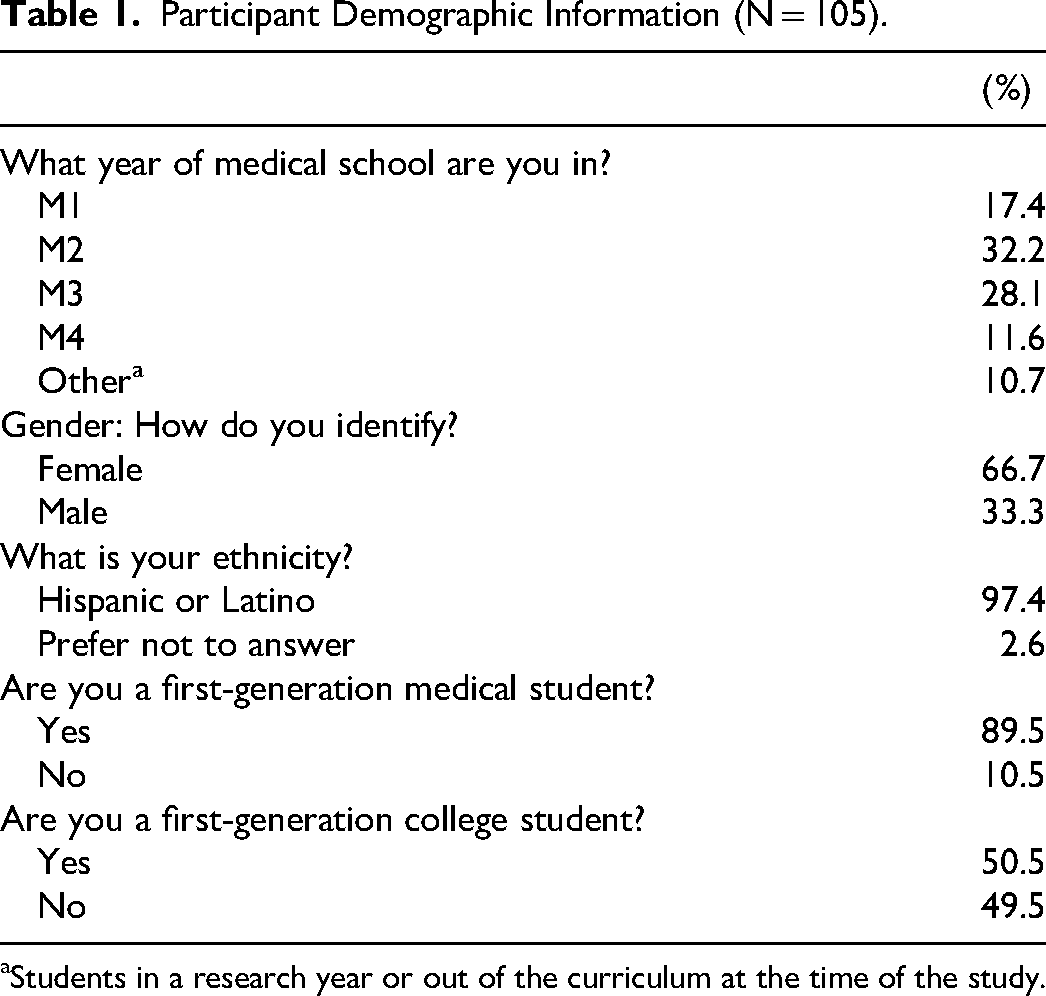
Students in a research year or out of the curriculum at the time of the study.
Most students (73.9%) were unfamiliar with Otolaryngology-specific disparities impacting Latinx communities, yet most expressed an interest in learning more about these disparities. Overall, students were unfamiliar with hearing loss and head and neck cancer disparities. Furthermore, most students (79%) reported an interest in getting involved in Otolaryngology community outreach if the opportunity was available to them. Table 2 summarizes the responses to each question.
Latinx Medical Student Familiarity with Otolaryngology Health Disparities Affecting Latinx Communities.
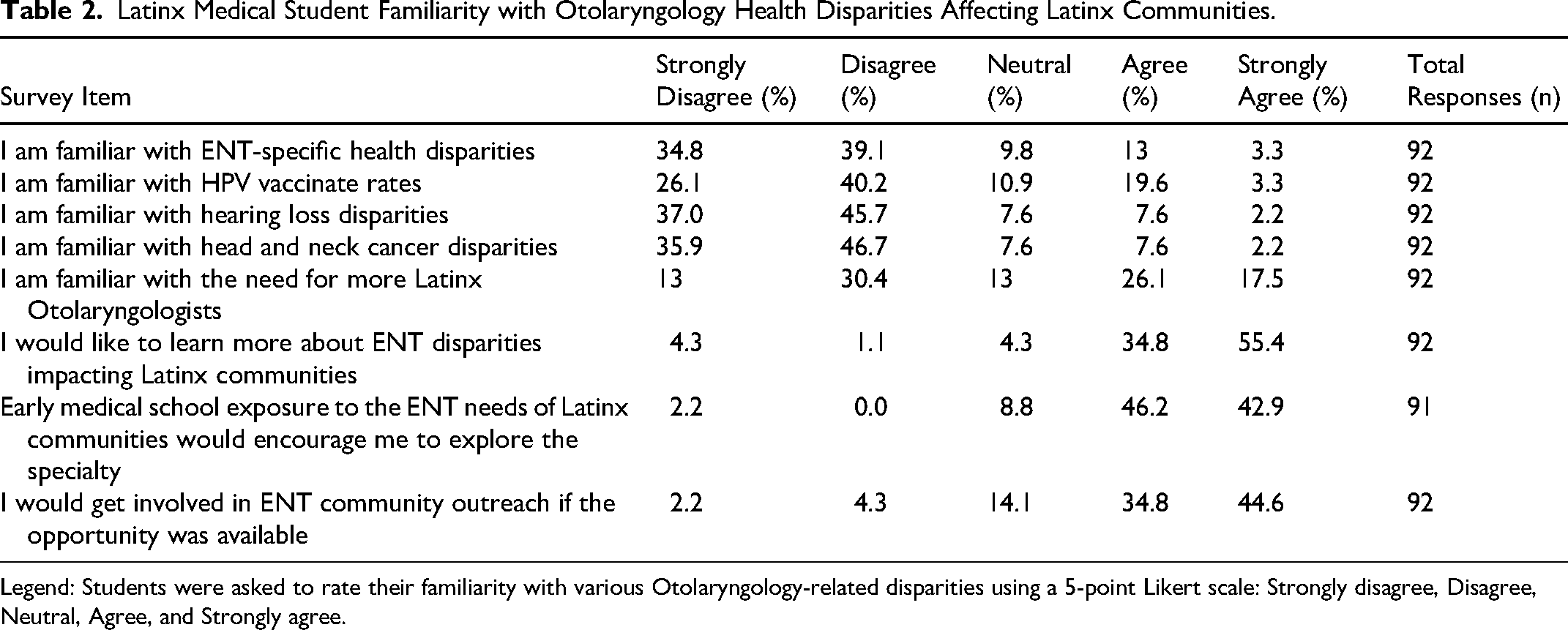
Legend: Students were asked to rate their familiarity with various Otolaryngology-related disparities using a 5-point Likert scale: Strongly disagree, Disagree, Neutral, Agree, and Strongly agree.
The highest-rated residency program attributes, deemed ‘necessary’ by respondents, were a department's commitment to diversity, equity, and inclusion (DEI), along with opportunities to serve Latinx patients, 69.2% and 66.7% respectively (see Figure 1). In contrast, international outreach opportunities received the lowest ratings among residency program factors.

Latinx Medical Student Responses Regarding the Importance of Specific Residency Program Attributes When Selecting a Residency Program (N = 91). Legend: Participants Were Asked to Rate Each Attribute Using a 4-Point Likert Scale: Not Important, Slightly Important, Important, and Necessary. the Figure Displays the Percentage of Respondents Selecting Each Response Category for Each Attribute.
Discussion
The results of this study suggest that leveraging the health equity interests of Latinx students is a potentially powerful diversity strategy to increase recruitment of Latinx medical students to Otolaryngology. Latinx medical students often are drawn to specialties that provide career opportunities for health equity work, namely family medicine and other primary care fields (Bazargan et al., 2006; Salhi et al., 2022). Otolaryngology, with many evident disparities (Batool et al., 2023), can be positioned similarly to attract students interested in addressing health inequities. The strategic promotion of health equity experiences in Otolaryngology presents an underutilized pathway for medical student recruitment aimed at specialty diversification, a concept previously unaddressed in the literature. Examples of actionable initiatives that Otolaryngology departments can adopt to operationalize this recruitment strategy include organizing health fairs and providing free head and neck cancer screenings.
Although conventional factors like research opportunities and geographic location remain as important considerations in residency program selection, the results of this study reveal that Latinx applicants also place substantial value on opportunities for health equity experiences. Otolaryngology residency programs should consider incorporating and highlighting these elements in their diversity efforts.
Limitations
This study is not without limitations. The small sample size limits generalizability despite attempts at a broad survey distribution. Additionally, inherent response biases exist in survey-based studies, though efforts were made to mitigate these through consultation with a survey research center.
Conclusion
Despite efforts to diversify the Otolaryngology workforce, the specialty continues to lag in representing the rapidly growing Latinx population in the United States. To date, no data has offered a foundation for rethinking Latinx medical student recruitment. This study highlights gaps in current strategies and identifies overlooked interests that, if leveraged, could encourage greater interest in the specialty. By integrating community outreach and health equity opportunities, programs can become more appealing not only to Latinx students but also to other underrepresented groups interested in serving marginalized populations. We hope these findings inspire a more targeted and effective approach to increasing Latinx representation in Otolaryngology.
Footnotes
Acknowledgements
The authors would like to acknowledge the Mayo Clinic Survey Research Center for their assistance in survey design.

Ethical Considerations
This study was deemed exempt by the Institutional Review Board (IRB# 23-002136) and was approved by the institution's Education Research Committee.
Consent to Participate
All participants provided written informed consent prior to participating in this study.
Funding
The authors received no financial support for the research, authorship, and/or publication of this article.
Declaration of Conflicting Interests
The authors declared no potential conflicts of interest with respect to the research, authorship, and/or publication of this article.