







Abstract
Instruction and support for students with intellectual disability in general education classes should be informed by research-based interventions. In this systematic review, we examined the focus and impact of interventions delivered in inclusive classes to support middle and high school students with intellectual disability. We identified 40 intervention studies involving 177 secondary students with intellectual disability attending a range of core academic and elective classes. These multicomponent interventions fell within five primary categories: systematic instruction, peer support arrangements, self-management strategies, peer-mediated communication interventions, and educational placement changes. Although the overall focus was fairly balanced across academic, social, and behavioral outcomes, each intervention approach prioritized somewhat different dependent measures. Moreover, although the impact of the interventions on most outcomes was positive, the methodological quality of these studies was somewhat varied. We offer recommendations for future research and practice aimed at strengthening the availability and implementation of effective interventions within inclusive secondary school classes.
Calls for the inclusion of students with intellectual disability in the United States have emerged from multiple directions. Parents have powerfully advocated for access to the same schools and classes attended by any other child in their community (e.g., Turnbull & Turnbull, 2014). Legislative and policy advances have opened up neighborhood schools, articulated a strong preference for educational experiences that take place in the same classes as other students who do not have disabilities, and emphasized access to the general education curriculum within these classrooms (e.g., Individuals with Disabilities Education Improvement Act [IDEA], 2004; No Child Left Behind Act of 2001, 2002). Researchers have documented an array of academic, social, behavioral, and other benefits associated with general education involvement (e.g., Morningstar et al., 2016). And national organizations have pressed for substantive changes in educational service delivery across the country (e.g., American Association of Intellectual and Developmental Disabilities [AAIDD] and The Arc, 2018; TASH, 2000).
A substantial proportion of students with intellectual disability now spend at least some of their school day in general education classes within their local schools (Kleinert et al., 2015; Wagner, Newman, Cameto, Levine, & Marder, 2003). Specifically, 17.0% of students with intellectual disability attend regular classes for 80% or more of their school day, 26.3% spend between 40% and 80% of their school day in regular classes, and 49.4% spend up to 40% of their school day in regular classes (U.S. Department of Education, Office of Special Education and Rehabilitative Services, Office of Special Education Programs, 2016). Other studies suggest these courses tend to be electives or specials (e.g., art, physical education) more so than courses addressing core academic content (e.g., language arts, mathematics, science; Kleinert et al., 2015). As illustrated by Brock (2018), the portrait of general education participation in the present day looks dramatically different than it did four decades ago shortly after the passage of the Education for All Handicapped Children Act.
Despite much progress, supporting the inclusion of students with intellectual disability remains challenging in secondary schools. The educational context can change dramatically as students leave elementary school and move through middle and high school (Carter, 2018). Academically, the curriculum becomes more challenging, class sizes increase, and academic attainments are allocated much more importance. Socially, the interpersonal dimensions of schooling are amplified as peer relationships play out in new ways and assume greater prominence. Behaviorally, students are expected to be more self-directed, to manage their own learning, and to work more independently. Observational studies focused on these secondary class contexts often present a portrait of missed learning and relationship opportunities for adolescents with intellectual disability (e.g., Carter, Sisco, Brown, Brickham, & Al-Khabbaz, 2008; Feldman, Carter, Asmus, & Brock, 2016; Kurth & Mastergeorge, 2012). Students are enrolled in general education classes, but often not accessing the prevailing curriculum or experiencing regular social interactions.
One enduring concern within the field of special education has centered on how best to support students with disabilities to receive the academic, social, and other benefits often attributed to inclusion in general education classes. What practices can general and special educators draw upon? Which of these approaches have been sufficiently evaluated? To date, the field has lacked a scoping review of interventions delivered to secondary students with intellectual disability in middle and high school classes. Prior literature reviews of specific interventions have been quite helpful in this regard. For example, reviews of peer support arrangements (e.g., Brock & Huber, 2017), systematic instruction (e.g., Spooner, Knight, Browder, & Smith, 2012), vocational interventions (e.g., Gilson, Carter, & Biggs, 2017), and self-determination interventions (e.g., Wood, Fowler, Uphold, & Test, 2005) have established each as evidence-based practices for students with intellectual disability. Most of these reviews, however, have combined studies carried out in both elementary and secondary schools or studies implemented in both special education and general education classes. Moreover, their intentionally targeted focus has meant that none of these reviews identifies the full array of interventions that have accrued some level of empirical support in inclusive secondary classes.
Understanding the focus and impact of available interventions is also important. Early advocacy for inclusion emphasized the social benefits of general education participation (Brown et al., 1979). Many scholars have argued that the communication and social skills difficulties experienced by many students with intellectual disability could be positively impacted by ongoing opportunities to learn alongside classmates without similar disabilities. More recently, the academic benefits associated with accessing the general education curriculum have been emphasized (Olson, Leko, & Roberts, 2016; Wehmeyer, Lee, & Shogren, 2016), with particular emphasis placed on engaging with core content such as language arts, math, and science. The belief that students with intellectual disability can learn challenging content when provided rigorous, individualized instruction has driven more recent movements. In addition to these social and academic benefits, the impact of inclusion on other behavioral outcomes (e.g., self-direction, task engagement, appropriate behavior) has also been anticipated. A broadly framed literature review that is inclusive of all intervention approaches could shed light on the extent to which each of these different domains has received attention, as well as how different interventions might impact outcomes in each of these areas.
As the field of special education has advanced, so has its commitment to elevating the rigor of available research. Establishing educational practices as research-based involves careful consideration of the methodological features and findings of available studies. How thoroughly are studies described? How well are they carried out? How convincing are their causal claims? The Council for Exceptional Children (CEC; 2014) established a set of quality indicators that can be used to examine the methodological features of intervention studies. Although individual studies need not meet every quality indicator to be informative, greater confidence can be placed on those studies that are methodologically stronger. Looking at interventions through the lens of these quality indicators could provide insight into the quality of the current knowledge base addressing the inclusion of secondary students with intellectual disability.
The purpose of this systematic review was to provide a comprehensive map of the literature addressing interventions delivered within general education classes to middle and high school students with intellectual disability. Our research questions were the following: (1) What interventions have been evaluated within inclusive classes? (2) What are the characteristics of the students who received these interventions? (3) What outcomes have been examined in these studies? (4) To what extent do these studies meet quality indicators of methodologically sound studies? Although we assert that the identification of evidence-based practices is best addressed within more focused reviews of specific intervention approaches, we also summarize the intervention effects reported within each study.
Method
Inclusion Criteria
We selected studies for this review based on six criteria. First, studies used experimental group or single-case designs reporting sufficient information to determine the experimental effect of an intervention. We defined an intervention as any instruction, support, or environmental arrangement (or packaged combination of these elements) that was both malleable and would be within the control of educators to implement or alter. Second, studies involved at least one middle or high school student who attended a general education class. Third, participating students had an intellectual disability, as evidenced by a disability label of intellectual disability, an IQ score below 70, or eligibility for the state’s alternate assessment. We adopted this more inclusive approach to account for variations in labeling conventions across the country and over time. For studies using a group design with mixed samples, more than 50% of participants must have had an intellectual disability or results must have been disaggregated for students with intellectual disability. Fourth, studies examined change in a participating student’s outcome resulting from an intervention delivered in a general education class. Fifth, studies took place in the United States. Sixth, studies had to be published in a peer-reviewed journal.
Search Procedures
We searched four electronic databases for studies published in print or online anytime before December 2017: Education Database, Education Full Text, ERIC, and PsycINFO. We used a combination of terms for intervention location (i.e., “inclusive education” OR “inclusive school*” OR “inclusion” OR “general education” OR “general education class*” OR “general curriculum” OR “mainstream*” OR “regular education”), grade level (i.e., “high school” OR “middle school” OR “junior high” OR “secondary education” OR “secondary student*” OR “school age” OR “adolescen*”), disability category (i.e., “intellectual development disorder*” OR “intellectual disabilit*” OR “severe disabilit*” OR “autis*” OR “developmental disabilit*” OR “cognitive disabilit*” OR “cognitive impairments” OR “retard*” OR “multiple disabilit*”), and research design (i.e., “empirical study” OR “quantitative study” OR “single-case” OR “single-subject” OR “multiple baseline” OR “multiple probe” OR “alternating treatment*” OR “parallel treatment*” OR “group design” OR “intervention*” OR “program effect*” OR “instructional effect*” OR “treatment” OR “randomized” OR “ABAB” OR “withdrawal”). We also reviewed the references of all identified articles (i.e., backward search) and examined studies citing each of the identified articles using the same databases (i.e., forward search).
Screening of Articles
The initial search produced a total of 2,391 article citations (Figure 1). First, we screened the titles and abstracts of all citations and retained articles that could not be easily excluded based on the inclusion criteria. This resulted in 154 potentially relevant articles. Second, we reviewed the full text of these articles to identify those meeting all of the inclusion criteria. An additional 116 articles were excluded, primarily because one or more of the inclusion criteria were not met. However, studies were also excluded when (a) an intervention was delivered in a special education setting and only generalization effects were examined in a general education classroom (Whitby, 2013), (b) cognitive information (e.g., IQ scores) was not provided for students with autism who received interventions in general education classrooms (Brown & Mirenda, 2006; Halle, Ninness, Ninness, & Lawson, 2016; Staniland & Byrne, 2013; Tekin-Iftar, Collins, Spooner, & Olcay-Gul, 2017), (c) the location in which the intervention was delivered was not clear (Light, Binger, Agate, & Ramsay, 1999; Shogren, Palmer, Wehmeyer, Williams-Diehm, & Little, 2012), (d) a study did not report or disaggregate results for students with intellectual disability (e.g., Cushing & Kennedy, 1997; Wehmeyer et al., 2011), and (e) a study did not demonstrate randomization or group equivalence at baseline (Palmer, Wehmeyer, Gipson, & Agran, 2004). Third, we applied forward and backward search techniques to all included articles. We retained 40 articles for this review. To determine inter-coder reliability on the screening of the articles, the second author independently screened 20% of the initial search results (n = 479) to determine whether each met the inclusion criteria. We calculated agreement by dividing the number of agreements by the number of agreements plus the number of disagreements and multiplied by 100%. Reliability was 99.6%.
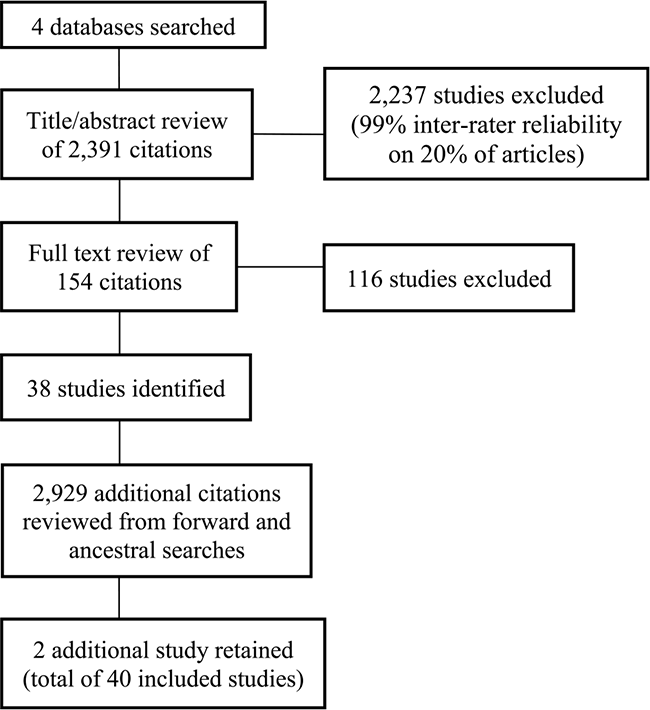
Article search and screening flowchart.
Coding of Articles
We coded variables addressing multiple aspects of the studies (see subsequent sections). Because studies may have included participants with other disabilities, we only coded information for students who met the inclusion criteria. When authors did not report information related to a particular variable, we reported it as unspecified. Because this review focused on the quality of reporting and on studies published over multiple decades, we did not communicate with study authors for clarification or to request additional information.
Student characteristics
We coded the number of participating students meeting the inclusion criteria, along with their sex, race/ethnicity, school level, disability label, level of severity, communication mode, and indication of problem behavior. Using the special education categories from IDEA (2004) reported by the authors, we categorized disability label as having a special education label of (a) intellectual disability only, (b) autism only, (c) a co-diagnosis of both intellectual disability and autism, or (d) other (e.g., multiple disabilities, learning disabilities). We coded the level of severity by noting whether or not the authors provided IQ scores or eligibility for the alternate assessment. We coded students’ communication mode by indicating how many students communicated using (a) verbalizations, (b) pictures, (c) devices, (d) gestures/signing, or (e) unspecified modes. We coded the number of students reported to use each and any mode of communication. We coded indication of problem behavior by noting whether and how the authors described a student’s problem behavior.
Setting characteristics
For the schools, we coded for the community locale (e.g., urban, rural, suburban). We coded the content area of the general education class as English/Language arts, math, science, social studies, electives (e.g., art, music, Spanish), career or technical education (e.g., veterinary science, cosmetology), or unspecified.
Intervention approaches
We described the interventions and categorized them broadly according to their primary focus as identified by each study’s authors. We also coded the duration of each intervention, its frequency, the instructional grouping in which it was delivered, and the materials that were used. We recorded the shortest duration any participant received intervention sessions across the study (i.e., a week or less, between 1 week and 1 month, between 1 and 3 months, more than 4 months) and the amount of time spent implementing the intervention within each session (i.e., less than 10 min, between 11 and 30 min or at various times throughout a class period, more than 31 min or throughout an entire class period). We coded the frequency of sessions as (a) more than once daily, (b) daily, (c) weekly, (d) less than weekly, or (e) unspecified. We coded the instructional grouping in which the intervention was delivered to the student as (a) individual (i.e., student working alone), (b) small group (i.e., student working with two to six peers), (c) large group (i.e., student working with more than six peers), (d) whole class (i.e., student working with the entire class), or (e) unspecified.
Interventionists
We coded who served as the interventionist, the training they received, and the training length. Interventionist roles could be (a) researchers, (b) special educators, (c) general educators, (d) paraprofessionals, (e) peers, (f) the student, and/or (g) other school personnel. We also considered students to be among the interventionists when they self-delivered parts of the intervention in their general education class (e.g., using a communication book, self-monitoring a predetermined behavior). We coded whether training for the interventionist included any of the following components: (a) feedback, (b) lecture, (c) written instructions/manual, (d) modeling, (e) rehearsal/role-play, (f) opportunities to ask questions, (g) the rationale of the intervention, (h) collaborative planning in creating elements of the intervention, (i) self-monitoring, (j) behavior skills training, (k) scripts, (l) goal-setting, or (m) study groups (Brock & Huber, 2017). We coded the approximate length of time for their initial training as (a) less than 30 min, (b) between 31 and 90 min, and (c) more than 91 min. For studies not indicating any initial training, we also coded whether the training utilized an ongoing coaching model and whether follow-up training or feedback was used after the initial training or onset of the intervention.
Dependent variables
We recorded the outcomes examined for students with disabilities, defined as those measures for which experimental control could be demonstrated within the design. We categorized each outcome as falling in one of the following domains: academic (i.e., content or standard-specific skill acquisition), behavioral (i.e., observable actions reflecting active engagement in the class, but not learning), social (i.e., communicative and interpersonal interactions), vocational (i.e., work-related tasks), self-management (i.e., monitoring one’s own behavior), or other (e.g., proximity to others, multiple domains measured across students).
Intervention design and efficacy
We coded the specific design used in each study. When experimental control could be examined for a particular dependent variable, we coded the change in the outcome due to the intervention as having a strong, positive, mixed, or no effect. We used visual analysis and definitions adapted from the CEC (2014) to classify each dependent variable into these four categories. For single-case demonstration studies, we used visual analysis to examine changes in the level, trend, and variability of data across phases, while considering the immediacy of an effect and the overlap of data points across phases. We did not calculate effect sizes (ESs) or consider author-reported metrics. We noted a strong effect when (a) a meaningful, therapeutic change was observed in at least three cases; (b) there were zero cases of no change or a contra-therapeutic change; and (c) no more than 25% of cases showed a weak effect. We noted a positive effect when at least 75% of demonstrations showed a positive, therapeutic change. We noted mixed effects if neither criteria for strong effects nor positive effects were met. Finally, we noted no effect if (a) there was no change in 50% or more of demonstrations or (b) there were counter-therapeutic effects in any demonstration.
For single-case comparative studies, we adapted guidelines for determining treatment effects provided by Gast and Ledford (2014). We noted strong effects when (a) all participants met criterion with the same intervention before other interventions, (b) a control set was measured at lower levels than the intervention throughout the study, and (c) the study included a best-treatment phase. We noted positive effects when (a) more than half of the participants met criterion with the same intervention before other interventions and (b) a control set was measured at lower levels than the intervention throughout the study. We noted mixed effects when (a) an equal number of participants met criterion with the same intervention before other interventions and (b) a control set measured at lower levels than the intervention throughout the study. We noted no effect when (a) no difference between interventions could be seen across participants or (b) studies did not measure a control set. For group-design studies, we determined the strength of effects based on the appropriate ES statistic utilized by the authors.
Generalization and maintenance
For generalization, we coded the conditions under which generalization measures were applied (i.e., separate probes after mastery in intervention, separate probes during baseline and after mastery in intervention, regularly throughout each experimental condition), a description of the generalization procedures, and its effect. For maintenance, we coded the conditions under which maintenance measures were applied, the time from mastery of the skill to the first maintenance data probe, and its sustained effects.
Social validity
For social validity, we coded the roles of any individuals completing measures (i.e., peers, general educators, special educators, paraprofessionals, students, other) and the focus of the measure (i.e., perceptions of the goals, feasibility/acceptability, and outcomes of the intervention).
Methodological quality
We selected the CEC (2014) quality indicators because they (a) were designed for research involving children with disabilities, (b) were developed by multiple scholars, and (c) address both single-case and group-design research. The indicators span eight categories—setting, participants, intervention agents, procedures, implementation fidelity, internal validity, dependent variables, and data analysis. Each category includes one or more items that apply to single-case design studies, group-design studies, or both. Operational definitions of each quality indicator are provided online as Supplemental Material. To aid synthesis, we combined items related to settings and participants into one category. As recommended, we operationalized some definitions to align with the focus of this review. Specifically, under the category of intervention agents, we coded whether the training procedures, the training frequency, and the training duration for interventionists were specified. For the procedures category, we coded whether the instructional grouping in which the intervention was delivered was described. Within the dependent variables category, we required a description be provided of the procedures used to calculate reliability.
Interrater Reliability
To determine the interrater reliability on the coding of the articles, a second coder—a doctoral student in special education—assessed 25% of the included articles. We calculated agreement by dividing the number of agreements by the number of agreements plus the number of disagreements and multiplied by 100%. Reliability averaged 88.3% (range = 86.3%-90.8%). In addressing disagreements, we reviewed the article to come to final consensus on the coding.
Results
Sixteen different journals published the 40 articles in this review. The included articles span nearly 25 years ranging from 1994 through 2017.
Student Characteristics
Within the 40 articles, 177 students with an intellectual disability met our inclusion criteria. The authors reported IQ scores for 73 students (M = 52.8)—8.2% of whom had an IQ score below 40 and 42.5% of whom had an IQ score between 40 and 55; just under half (49.3%) had an IQ score above 55. Of the remaining students, 62 participated in the alternate assessment and 32 were described by authors as having moderate (n = 5), severe (n = 22), or profound disabilities (n = 5). The majority of students was male (62.1%); the rest was female (37.9%). Seventy-seven students (43.5%) attended middle school and 100 students (56.5%) attended high school. The authors did not identify the race/ethnicity for 46 students (26.0%). Among the remaining students, 78 (44.1%) were European American, 32 (18.1%) were African American, 10 (5.6%) were Asian American/Pacific Islander, four (2.3%) were each Hispanic/Latino and multiple races/ethnicities, and two (1.1%) were Native American. The authors identified 107 students’ disability label as intellectual disability only (60.5%), 24 as autism only (13.6%), 26 as intellectual disability and autism (14.7%), and 21 as other disability labels (11.9%; for example, learning disabilities). The authors did not specify the modes of communication for 64 students (36.2%). Ninety-four students (53.1%) used verbal communication, 23 students (13.0%) used gestures or signing to communicate, 10 students (5.6%) used a high-tech communication device, and four students (2.3%) used pictures to communicate. In 26 studies, authors provided an indication of problem behavior for one or more students (e.g., noncompliance, disruptive behavior, self-injury, inappropriate touching).
Setting Characteristics
The authors did not specify the community locale for 11 studies (27.5%). Thirteen studies (32.5%) took place in urban schools, seven studies (17.5%) took place in suburban schools, and three studies (7.5%) took place in rural schools. The authors of six studies (15.0%) used other descriptors for community locale (i.e., “small town,” “metropolitan school district,” multiple states, or districts). The authors did not specify the content area of the general education class in which each student received the intervention for 76 students (43.0%), 51 of whom participated in one study (Carter et al., 2016). Sixty-one students (34.5%) received the intervention in core content area classes: 29 in science, 15 in English/language arts, 10 in social studies, and seven in math. Forty-one students (23.2%) received the intervention in electives (e.g., keyboarding, art), and nine students (5.1%) received it in career or technical education classes (e.g., cosmetology, auto mechanics).
Intervention Approaches
We identified five primary intervention approaches in this literature: systematic instruction, peer support arrangements, self-management strategies, peer-mediated communication interventions, and educational placement changes. However, it is important to emphasize that most studies examined multicomponent intervention packages (see Table 1). For example, some studies focused on systematic instruction also incorporated peer-mediated elements (Jameson, McDonnell, Polychronis, & Riesen, 2008; Jimenez, Browder, Spooner, & DiBiase, 2012), some self-management interventions included systematic instruction or peer-mediated components (Gilberts, Agran, Hughes, & Wehmeyer, 2001; Wehmeyer, Yeager, Bolding, Agran, & Hughes, 2003), and some communication interventions involved both self-management and systematic instruction elements (e.g., Hughes et al., 2000; Reilly et al., 2014).
Summary of Included Studies.
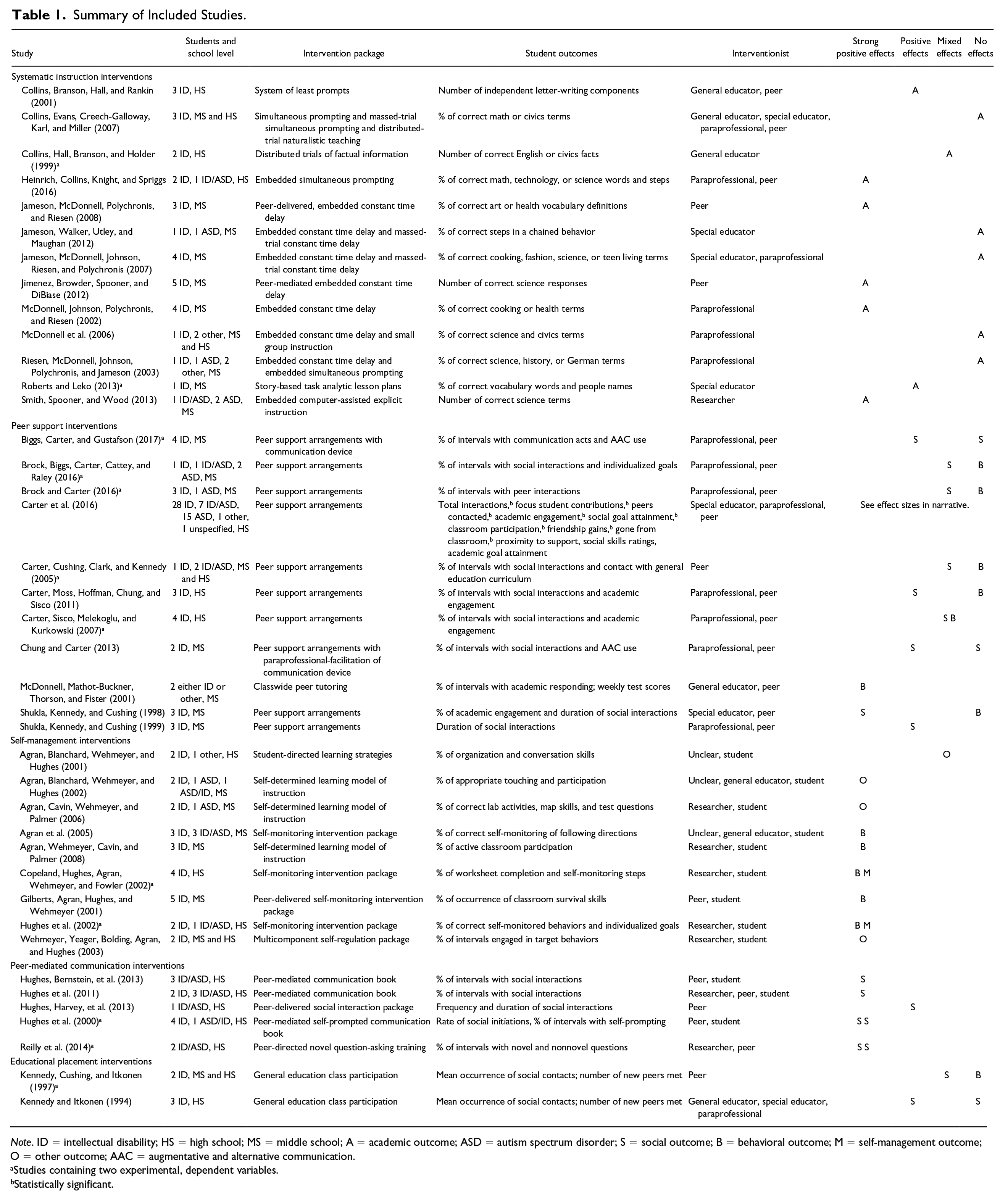
Note. ID = intellectual disability; HS = high school; MS = middle school; A = academic outcome; ASD = autism spectrum disorder; S = social outcome; B = behavioral outcome; M = self-management outcome; O = other outcome; AAC = augmentative and alternative communication.
Studies containing two experimental, dependent variables.
Statistically significant.
Systematic instruction (n = 13) consisted of antecedent and consequence arrangements (e.g., task direction, corrective feedback) presented in a prescribed fashion. This involved constant time delay procedures as well as simultaneous prompting and task analytic instruction in teaching discrete responses to academic-related skills and brief behavior chains resulting in the mastery of selected skills. Peer support arrangements (n = 11) involved peers in providing academic and/or social support directly from a peer support plan and under the guidance of a paraprofessional or special educator to the student throughout an ongoing period of time (e.g., class period). Self-management interventions (n = 9) generally involved researchers teaching students with intellectual and developmental disabilities to self-manage their own behaviors. These behaviors tended to be selected through consultation with the students and their teachers, and training occurred outside the class and incorporated pretraining of an intervention that students were required to implement on their own within the general education class. Peer-mediated communication interventions (n = 5) involved using communication books as a tool for students to engage in conversations with their peers. Books consisted of conversation prompts and questions using words and pictures as cues for the students and their conversation partners during downtime in their classes. They were episodically arranged for students and a peer(s) to engage in social conversations for a brief period of time (e.g., 10-15 min). Educational placement studies (n = 2) moved students from special education to general education classes.
The frequency and duration of the interventions varied only slightly across studies. In 15 studies (37.5%), interventions were in place for multiple months (i.e., greater than 31 days and less than 4 months) followed closely by 1 month for 14 studies (35.0%). Students in six studies received the intervention for about a week (15.0%), and one study (2.5%) reported spanning approximately one school year. The authors in four studies (10.0%) did not report the duration of the intervention clearly, nor could this information be ascertained from figures or graphs. Twenty-seven studies (67.5%) described interventions as delivered daily, six studies (15.0%) provided interventions weekly, and one study (2.5%) provided the intervention more than once per day. Six studies (15.0%) did not report the frequency of the intervention clearly.
The instructional grouping of students changed within some studies as part of the research design (e.g., Carter, Cushing, Clark, & Kennedy, 2005), the comparative nature of the intervention (e.g., McDonnell et al., 2006), or the pairing of two students in one class versus other students being the sole student in a class (e.g., Collins, Evans, Creech-Galloway, Karl, & Miller, 2007). Students received the intervention individually in 28 studies (40.0%), in small groups in 12 studies (30.0%), in a large group in one study (2.5%), and within the context of the whole class in one study (2.5%). The instructional grouping of students in four studies (10.0%) was unspecified.
Interventionists
Over half of the studies (70.0%) utilized more than one person to deliver the intervention to the students. Across all studies, peers participated as interventionists in 24 studies (60.0%), paraprofessionals in 18 studies (45.0%), special educators in nine studies (22.5%), researchers in eight studies (20.0%), general educators in seven studies (17.5%), and other unspecified personnel in three studies (7.5%). The student acted as an interventionist on a pretrained intervention in 12 studies (30.0%). Peers and paraprofessionals tended to participate in peer support interventions and peer-mediated communication interventions. Special educators participated frequently in systematic instruction interventions and researchers participated frequently in self-management interventions. General educators did not participate in any peer-mediated communication interventions.
Training of the interventionists consisted of multiple components including lecture/explanation in 31 studies (77.5%), modeling in 22 studies (55.0%), feedback in 20 studies (50.0%), rehearsal/role-play in 17 studies (42.5%), a rationale for the intervention in 13 studies (32.5%), scripts in 13 studies (32.5%), written instruction/manual in 12 studies (30.0%), opportunities to ask questions in nine studies (22.5%), collaborative planning in creating elements of the intervention in nine studies (22.5%), self-monitoring in six studies (15.0%), goal-setting in two studies (5.0%), study groups in one study (2.5%), and behavior skills training in zero studies (0.0%). Training for interventionists other than students was not reported or unclear in 16 studies (40.0%).
The authors did not specify the length of the training in 18 studies (45.0%). The authors provided less than 30 min of training in five studies (12.5%), between 31 and 90 min of training in nine studies (22.5%), and more than 91 min of training in six studies (15.0%). Training on peer support interventions tended to be longer, and training on systematic instruction tended to be shorter. In addition to the initial training, interventionists received follow-up training or support in 19 studies (47.5%). Interventionists received ongoing coaching in two studies (5.0%).
Dependent Variables
The intervention outcomes for 17 studies (42.5%) measured social skills (e.g., initiating conversation), 14 studies (35.0%) measured academic skills (e.g., science vocabulary), and 14 studies (35.0%) measured behavioral skills (e.g., following directions). Two studies (5.0%) reported self-management skills (e.g., self-monitoring), and five studies (12.5%) reported measures in other domains (e.g., multiple domains measured across students). As displayed in Table 1, the selected dependent variables varied considerably within and across the five intervention categories. Although nearly all of the peer support and peer-mediated communication interventions included some measure of social interactions, only a subset addressed behavioral skills and none addressed academic skills. In contract, studies addressing systematic instruction and self-management incorporated a much more diverse set of outcome measures (e.g., classroom survival skills, worksheet completion, self-monitoring steps, math terms, civics terms, vocabulary definitions).
Intervention Efficacy
Thirty-nine studies used single-case designs. Among these, 32 studies (82.1%) used designs to determine the efficacy of a single intervention, five studies (12.8%) used comparative designs to examine multiple interventions, one study conducted a component analysis using an A-B-A-B design (Carter et al., 2005), and one study used an A-B-A-C-A-B-A-C design to determine efficacy and compare interventions (Shukla, Kennedy, & Cushing, 1998). For the 53 dependent variables measured in these single-case studies, 23 (41.8%) showed strong effects, nine (16.4%) showed positive effects, nine (16.4%) showed mixed effects, and 14 (25.5%) showed no effect. All included single-case studies had to have the ability to demonstrate at least three replications of effect; 32 single-case studies (82.1%) had at least three demonstrations with students who met the inclusion criteria. Table 1 displays effects on dependent variables by study.
The one group-design study (Carter et al., 2016) involved 51 students in the intervention and measured postintervention effects for 11 dependent variables. Eight dependent variables showed significant improvement in the intervention group: total interactions (ES = 0.42), focus student contributions (ES = 0.34), peers contacted (ES = 0.50), academic engagement (ES = 0.31), social goal attainment (ES = 0.79), class participation (ES = 0.42), friendship gains (ES = 1.02), and gone from classroom (ES = −0.45). No differences across groups were found for proximity to direct support, social skills ratings, or academic goal attainment.
Generalization and Maintenance
Sixteen studies (40.0%) measured generalization of the dependent variable. Two studies (12.5%) measured generalization across one or more dimensions (e.g., different materials, different setting) after students met criteria in the intervention conditions. One of these studies (Smith, Spooner, & Wood, 2013) measured generalization across materials in both the baseline and intervention conditions during generalization probe sessions. Thirteen of these studies incorporated generalization measures into the study design (e.g., interacting with different peers across sessions, counterbalancing three sets of materials across sessions). The generalization data in 12 of these studies showed a positive effect, two studies showed a mixed effect, and two studies did not show an effect.
Twenty-one studies (52.5%) measured maintenance on the dependent variable after students met criteria during the intervention phase. Fifteen of these studies measured maintenance within 1 week of the student meeting criteria. One of these studies (Heinrich, Collins, Knight, & Spriggs, 2016) measured maintenance between 1 week and 1 month of the student meeting criteria. Four of these studies measured maintenance more than 1 month after the student met criteria, and it was not clear when maintenance was measured for one study (Jameson et al., 2008). All of these studies showed maintenance data at or near levels during intervention.
Social Validity
The social validity of the intervention was assessed in 29 studies (72.5%). One study (Collins, Branson, Hall, & Rankin, 2001) collected reaction statements from classmates before and after the students were included in the class. Three studies collected the frequency of interactions among random dyads within the high schools to determine a socially valid level of interaction for the included students. Ten studies reported the social validity of the goals of the intervention, 20 studies reported on the procedures of the intervention, and 22 studies reported on the outcomes of the intervention. The authors collected social validity data from general educators in 19 studies, the students in 17 studies, peers in 16 studies, special educators in 13 studies, paraprofessionals in 10 studies, and parents in one study.
Methodological Quality
Among the single-case design studies, only four studies met all of the relevant quality indicators (i.e., Biggs, Carter, & Gustafson, 2017; Brock, Biggs, Carter, Cattey, & Raley, 2016; Brock & Carter, 2016; Jameson et al., 2008). Reporting tended to be strongest in the areas of participants, settings, and procedures. Most commonly, researchers did not report adequate fidelity measurement information across participants, settings, interventionist, or experimental conditions in 19 studies (47.5%) and did not report any fidelity measurement information in 13 studies (32.5%). Researchers did not provide adequate descriptions of the baseline conditions and procedures in 22 studies (55.0%), primarily in studies evaluating systematic instruction and self-management interventions. Three studies (7.5%) lacked sufficient information regarding the individuals delivering the intervention and the training those individuals received. Ten studies (25.0%) did not provide adequate information regarding the training of the interventionists in terms of procedures, frequency, or duration. Overall, researchers described their procedures, dependant variables, and data analysis with an adequate level of information. The group design study (Carter et al., 2016) met all but three relevant quality indicators for its design (i.e., critical features of the setting, attrition, differential attrition). A summary of each quality indicator by study is provided online as Supplemental Material.
Discussion
Most students with intellectual disability spend at least some proportion of their school day within general education classes (Brock, 2018; Kleinert et al., 2015). Yet, supporting their access to the myriad of social and learning opportunities available within core content and elective/specials classes remains a persistent challenge. Our review identified 40 studies evaluating interventions delivered within inclusive middle and high school classes to students with intellectual disability. Findings from this growing area of the literature provide much-needed guidance for researchers and practitioners interested in strengthening the quality of supports available to students with intellectual disability.
First, available research has coalesced around five broad intervention approaches: (a) systematic instruction, (b) peer support arrangements, (c) self-management strategies, (d) peer-mediated communication interventions, and (e) educational placement changes. For general and special educators involved in the educational inclusion of students with severe disabilities, these intervention packages comprise potential instructional and support models for use in inclusive secondary classes. Although we were encouraged by the considerable empirical attention already directed toward these classes, it is also clear that this small range of intervention approaches is not yet sufficient to address the full range of educational needs experienced by students with intellectual disability. For example, many academic and behavioral interventions evaluated in special education classes have yet to be adapted for use in general education classes (e.g., Browder, Spooner, Ahlgrim-Delzell, Harris, & Wakeman, 2008; Spriggs, Mims, van Dijk, & Knight, 2017). Likewise, the impact of other practices specifically recommended to support inclusive education (e.g., universal design for learning, curricular modifications, personal accommodations, technology) has yet to be rigorously evaluated in these settings. As was evident in the 40 studies we reviewed, different intervention components such as these can be combined in multiple ways to meet the educational needs of particular students with intellectual disability. Additional research is needed to expand and evaluate the portfolio of interventions these educators can draw upon to support the inclusion of students with intellectual disability.
Second, the interventions we reviewed gave comparable attention to academic, social, and behavioral outcomes. However, the focus of each approach varied. For example, systematic instruction tended to focus on academic outcomes, particularly content knowledge within specific curricular areas (e.g., science, math, civics). Peer support arrangements and peer-mediated communication interventions tended to focus on the occurrence of social interactions and communication device use. Self-management strategies, however, tended to address a wider range of individualized behaviors specific to participating students (e.g., appropriate touching, following directions, work completion). Although each of these interventions could be readily applied to other domains (e.g., systematic instruction on nonacademic behaviors, peer support focused on knowledge acquisition, self-management of social behaviors), their present focus has remained more narrow. Most of the interventions were also found to be effective at improving at least one outcome. When no effects were evident, this tended to occur for secondary outcomes (e.g., peer support arrangements are designed to increase social interactions, while either maintaining or increasing academic engagement) or within comparative studies in which neither intervention was superior to the other. As additional studies are conducted and these interventions are extended to a wider range of dependent variables, we anticipate more definitive claims can be made about which intervention packages are most effective for which outcomes in general education classroom settings.
Third, this collection of studies—somewhat modest in size—has focused relatively little attention on student learning outcomes within core content classrooms. Current legislation emphasizes the importance of both presence within the general education (i.e., regular) classroom and access to the general curriculum (IDEA, 2004). Moreover, the Every Student Succeeds Act (2015) emphasizes the importance of progress in core content areas like reading, math, science, and social studies. Access to the general curriculum means much more than enrollment in a course or participation in the social aspects of a class. However, only 25 of the 40 studies we reviewed took place in courses addressing core content areas and only eight of these studies included measures of learning that extended beyond broad measures of “academic engagement.” For example, Smith et al. (2013) examined the effectiveness of embedded computer-assisted explicit instruction on the receptive science vocabulary of three middle school students with autism and an intellectual disability. To respond fully to contemporary calls to support access to rigorous academic instruction in core content areas for adolescents with intellectual disability, a much fuller and stronger evidence base is needed.
Fourth, our review of the methodological quality of these studies highlights both strengths and concerns. On the positive side, most quality indicators were met in the areas of participants and settings, procedures, dependent variables, and data analysis. However, two areas that are essential to understanding the impact of an intervention—implementation fidelity and baseline descriptions—were often omitted. Measurement and reporting of implementation fidelity establishes the extent to which an intervention was implemented as intended. Yet, fidelity was either not measured or not reported in 13 studies. Among those that did measure fidelity, only eight studies addressed fidelity outcomes with sufficient breadth (i.e., measured regularly across interventionists, students/tiers, and experimental conditions). Likewise, adequate baseline descriptions are needed to establish exactly how an intervention differs from prevailing practices or an alternative intervention. Yet, 22 of the studies did not provide sufficient information to adequately differentiate the baseline and intervention conditions. For example, Smith and colleagues (2013) did not describe how class vocabulary was taught to students before the additional computer-assisted explicit instruction intervention, and it is unclear what kind of exposure students had to the selected vocabulary words prior to the intervention. Future researchers should address both of these indicators, as well as all others, to increase the confidence the field can place in these findings.
Limitations
Several limitations should be considered when interpreting the results of this review. First, we applied methodological standards published in 2014 to all studies, including those published prior to this date. Reporting conventions have changed over time and caution should be used when applying present-day standards to past publications. It may be that authors of older studies did not report information that is now expected by reviewers and editors. Second, we focused only on the peer-reviewed literature and did not include dissertations or unpublished studies in this review. This focus may have led us to overlook other promising forms of instruction, support, or environmental arrangements, or to omit interventions in which experimental control was not established. Third, fluctuating definitions of intellectual disability and varied descriptions of participants in study reports makes it difficult to examine the level of support needs experienced by these students. We adopted broader inclusion criteria to capture all studies involving students with an intellectual disability. However, special education categories, alternate assessment criteria, and assessment interpretations can vary from one study and state to the next.
Implications for Research
In addition to the research needs highlighted earlier in this discussion, findings from this review have important implications for future research in the field of special education. First, instruction within the general education classroom is quite dynamic, as the knowledge and skills educators address with students evolve throughout the semester as the curriculum develops. Yet, most studies we reviewed identified a single academic outcome for students with intellectual disability that remained static throughout the entire study. Future research is needed that more closely mirrors the manner in which instruction is delivered to all students in general education classrooms.
Second, most studies in this review used research designs in which the delivery of some instructional or support package was compared with a prior baseline condition in which no intervention was delivered. Such demonstration designs are helpful for showing a particular intervention can work within an inclusive secondary classroom, but do not provide guidance on how much of an intervention is needed, which components of the intervention are most impactful (or irrelevant), or whether one intervention approach is better than another. In addition to conducting additional efficacy studies, future researchers should also adopt designs that enable comparative, component, or parametric analyses to help the field better understand those factors that might influence the impact and implementation of these interventions.
Third, although this review highlights a variety of potential intervention approaches that educators might draw upon, it does not provide clarity on which interventions should be used for particular students or under particular classroom conditions. With such a modest number of available studies, it is not yet possible to discern patterns in the interactions among student characteristics, setting features, and intervention approaches. Future work should focus on developing a decision-making framework that can help guide practitioners in determining which intervention approaches to apply and when.
Fourth, while the involvement of peers and paraprofessionals as interventionists was substantial, the involvement of general educators—who function as lead instructors within these classrooms—was fairly limited. Moreover, researchers or other unspecified staff served as interventionists in more than a quarter of all studies. Future studies should explore ways of more actively involving general educators in the design and delivery of classroom-based interventions.
Fifth, as additional efficacy studies are published, each of these five intervention approaches will benefit from more focused literature reviews that examine how different intervention configurations impact different types of student outcomes. As evident in the results and on Table 1, many of the existing interventions we reviewed combine multiple components and each intervention approach tended to target very different dependent measures. More in-depth evaluations of each intervention approach could provide further insights into the extent to which it warrants classification as an evidence-based practice for improving particular outcomes in secondary classrooms. Although a recent review by Brock and Huber (2017) focuses specifically on peer support arrangements within secondary level, inclusive classrooms, reviews of the four other approaches have yet to be conducted in this context.
Implications for Practice
Our findings also have implications for practitioners who support secondary students with intellectual disability within general education classes. First, these five categories of interventions can be drawn upon by individualized education program (IEP) teams as they consider how best to enhance the learning and social outcomes of students with intellectual disability in inclusive classrooms. Second, these team members will likely need training to implement these interventions with fidelity and fluency. Surveys of special educators indicate they have limited access to professional development on topics related to the use of peer-mediated interventions, self-management strategies, systematic instruction, and communication interventions (e.g., Brock, Huber, Carter, Juárez, & Warren, 2014; Knight, Huber, Kuntz, Carter, & Juárez, 2019). General educators likely have had no prior exposure to these interventions or guidance on how they might be implemented in these classrooms. Third, the resources (i.e., personnel and materials) needed to support the delivery of these interventions already exist within most classrooms. The majority of the studies involved interventionists who were already present within the classroom (e.g., peers, paraprofessionals, special educators) and did not require the purchase of new equipment or curricula. For example, the intervention materials largely consisted of computers, notecards, laminate, and paper to create self-monitoring sheets; communication books; and vocabulary cards. Although initial training may be needed in creating materials, access to the raw materials is likely not a barrier to implementation.
The educational inclusion of adolescents with intellectual disability can be enhanced by incorporating research-based instructional and support strategies into the class. Findings from this review provide new insight into the range of interventions that have been evaluated within middle and high school classes, the outcomes addressed within these studies, and the extent to which they reflect rigorous methodological features. Future research is needed to expand this modest collection of studies to establish a robust portfolio of practices that can be drawn upon by general and special educators within inclusive secondary schools.
Supplemental Material
RPSD_Inclusive_Interventions_03_26_2019_SUPMAT – Supplemental material for Review of Interventions Supporting Secondary Students with Intellectual Disability in General Education Classes
Supplemental material, RPSD_Inclusive_Interventions_03_26_2019_SUPMAT for Review of Interventions Supporting Secondary Students with Intellectual Disability in General Education Classes by Emily M. Kuntz and Erik W. Carter in Research and Practice for Persons with Severe Disabilities
Footnotes
Declaration of Conflicting Interests
The author(s) declared no potential conflicts of interest with respect to the research, authorship, and/or publication of this article.
Funding
The author(s) disclosed receipt of the following financial support for the research, authorship, and/or publication of this article: Partial support for this research was provided by a doctoral leadership grant from the U.S. Department of Education, through Grant H325D140077 to Vanderbilt University.

Editor-in-Charge: Fred Spooner
Author Biographies
References
Supplementary Material
Please find the following supplemental material available below.
For Open Access articles published under a Creative Commons License, all supplemental material carries the same license as the article it is associated with.
For non-Open Access articles published, all supplemental material carries a non-exclusive license, and permission requests for re-use of supplemental material or any part of supplemental material shall be sent directly to the copyright owner as specified in the copyright notice associated with the article.
