







Abstract
Many students with extensive support needs (ESN) benefit from specific instruction as well as a range of communication supports to develop effective communication repertoires and fully participate in their educational experience. Although evidence-based practices and supports addressing the communication needs of students with ESN have been identified, there remain concerns about whether preservice special education teachers have been adequately prepared to implement them. The purpose of this study was to explore the perceptions of preservice special education teachers related to their preparation in communication instruction for students with ESN. Participants reported varying levels of preparedness and a range of experiences in terms of the quantity and content of coursework and opportunities to apply knowledge and skills within their programs. We present implications for future research directions and teacher preparation programs.
Keywords
Communication skills are essential to enjoying a self-determined life, as they are required to access a range of learning opportunities, develop meaningful relationships, and control one’s exposure to preferred and nonpreferred experiences (Pennington et al., 2021). Students with extensive support needs (ESN) often have difficulty acquiring these indispensable skills. These students typically receive special education services under the eligibility categories of intellectual disability, autism, and multiple disabilities and have pervasive and significant support needs (Taub et al., 2017). Many of these students will require specialized instruction to develop effective communication repertoires and fully participate in the school experience.
Fortunately, researchers have established effective practices for improving communication outcomes for students with ESN (Peckham-Hardin et al., 2018; Steinbrenner et al., 2020) and demonstrated they can be implemented with fidelity in schools by teachers, paraprofessionals, and peers without disabilities (e.g., Walker & Smith, 2015). Despite the availability of these practices, some students with ESN receive inadequate support for their communication needs. Researchers have shown that some students with ESN receive fewer opportunities to respond and are not provided with communication supports during instruction (Kurth et al., 2016). This lack of opportunity to acquire communication skills during school is likely a major contributor to the limited communicative proficiency in many students with ESN (Andzik et al., 2018).
Pennington et al. (2021) suggested several potential barriers to teachers’ provision of communication support for students with ESN, including the potential abdication of instructional responsibility to related services providers (e.g., speech language pathologists [SLPs]); limited access to technical assistance and support for implementing augmentative and alternative communication (AAC) systems; and practical barriers related to collaboration, staff turnover, and lack of administrative support. They also suggested that teachers might have inadequate preparation in communication programming. They surveyed 51 faculty members in teacher preparation programs across the United States concerning the quality and quantity of the communication content within their programs. Faculty reported wide variability in the quantity of coursework and many perceived preservice teachers to not be adequately prepared. Furthermore, though the majority of faculty indicated they addressed evidence-based practices within their programs, findings indicated a greater emphasis on knowledge than practice.
Findings from Pennington et al. (2021) are troubling, especially in light of calls for teacher preparation in communication instruction (Peckham-Hardin et al., 2018; Ruppar et al., 2018), as they indicate great disparities in teacher training likely to impact students with ESN. Unfortunately, these findings provided limited insight into the nature of the issue as they reflected only the perspectives of faculty members. Faculty members described the communication content presented in their courses and perceptions of their students’ competence, but little interpretation could be made as to how preservice teachers experienced the content. In the current investigation, we sought to extend the literature on teacher preparation in the area of communication instruction for students with ESN by surveying teacher candidates at the end of their preparation program. Our aim was to understand the perceptions of preservice special education teachers in relation to (a) the quantity of coursework they received in this area, (b) opportunities within programs to apply knowledge and skills, (c) the content and delivery methods provided in coursework, (d) perceived preparedness to provide communication instruction, and (e) perceived responsibility of school professionals in planning and implementing instruction and developing individualized education program (IEP) goals in this area.
Method
Participants
Participants were 88 preservice teachers in the final year of an undergraduate teacher preparation program leading to a bachelor’s degree and certification in the area of ESN. Participants represented programs from different U.S. geographic regions as follows: the South (44.3%), the Midwest (29.6%), the Northeast (17.0%), and the West (5.7%); three (3.4%) did not specify their location. Participants attended universities within rural (39.8%), urban (33%), and suburban (26.1%) communities; one participant was unsure of the area (1.1%). Participants were primarily enrolled in cross categorical programs (47.7%) or dual licensure programs (43.2%) with fewer enrolled in programs focused solely on students with ESN (6.8%); two (2.3%) did not identify their program type. Participants reported a range of certifications or endorsements (e.g., autism, severe disabilities/adapted curriculum, early childhood) and minors (e.g., psychology, childhood studies) they would receive upon graduation.
Survey Development and Dissemination
We obtained institutional review board (IRB) approval prior to survey dissemination. Participants completed an anonymous survey on Qualtrics based on the work of Pennington et al. (2021). Table 1S (see Supplemental Materials) provides details about survey items. Prior to finalizing the survey instrument, we (a) elicited feedback from four experts in communication instruction for students with ESN and (b) conducted three cognitive interviews with preservice teachers using a think-aloud approach (Willis, 2015) to gather additional feedback on survey content; we adjusted the survey based on this feedback. Both protocols are available upon request. We emailed 813 contacts (e.g., department chairs, program directors) from universities with undergraduate special education programs to request they share the survey with preservice teachers in the final year of their program; we sent two follow-up emails 1 and 3 weeks after the initial email.
Data Analysis
A total of 130 participants met the inclusion criteria, with 88 (67.7%) of those participants responding to one or more survey items beyond the demographic questions. Therefore, only responses from those participants were analyzed. It also should be noted that, because there were no forced choice items, the number of responses varied across survey items and reporting reflects the percentage of participants who answered each question. To analyze responses, we calculated descriptive statistics (i.e., frequency, percentages) across survey items.
Results
Quantity of Coursework and Application Opportunities Within Preparation Programs
Participants indicated that instruction was delivered across multiple sessions in more than one course (53.4%), across multiple sessions in one course only (15.9%), within one course dedicated to communication instruction for students with ESN (14.8%), or within a single session across more than one course (6.8%); three participants (3.4%) reported no coursework in this area. In relation to application opportunities, most participants (54.5%) reported role-playing with peers in courses and working directly with students with ESN in field-based experiences. Other participants reported (a) practicing with peers in their courses with no field-based opportunities (20.8%) or (b) having no opportunities to practice at all (20.8%). Three participants (3.4%) reported applying knowledge with students in field-based experiences only.
Content and Delivery Methods Within Preparation Programs
Participants described the delivery method of their coursework as a combination of in-person, synchronous, and asynchronous instruction (42.0%), both in-person and synchronous instruction (28.4%), all online (i.e., synchronous and asynchronous instruction; 8.0%), both in-person and asynchronous instruction (5.7%), all in-person (5.7%), and all synchronous online instruction (4.5%). The most addressed topics included behavioral teaching techniques (95.5%), identification of appropriate communication systems (95.5%), Picture Exchange Communication System (95.5%), and culturally responsive practices (95.5%); however, the specific content delivery methods for these topics varied across participants (see Table 1). Overall, lectures, recordings, videos, and/or other resources were more commonly reported methods for content delivery than in-class practice or field-based practice.
Content Delivery Methods.
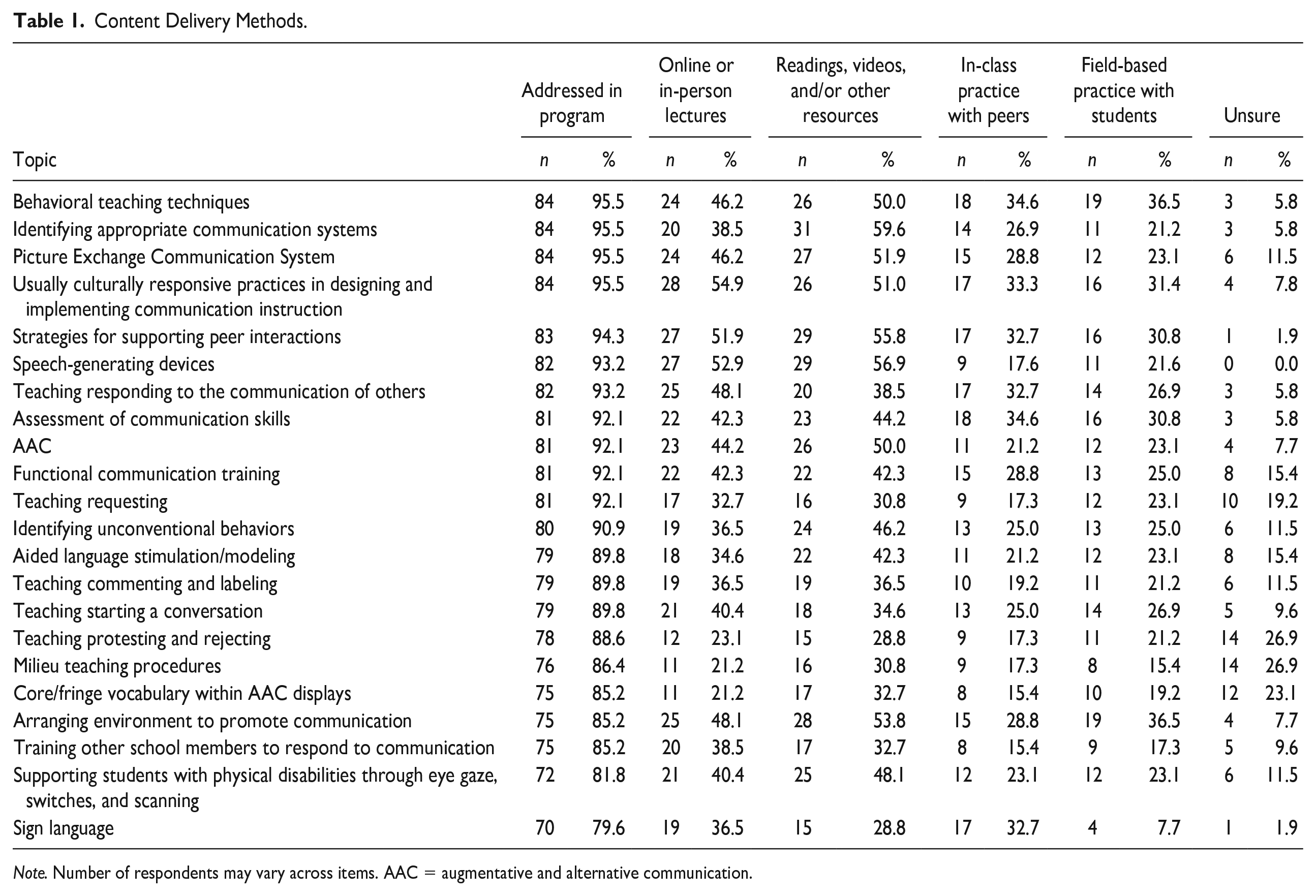
Note. Number of respondents may vary across items. AAC = augmentative and alternative communication.
Perceived Preparedness
Participants’ perceptions of preparedness varied (see Table 2). A majority reported feeling moderately or well prepared across activities. Activities earning the highest rating of preparedness included viewing communication as a right for all students (71.1% well prepared) and collaborating with other school professionals (48.6% well prepared). Several participants indicated inadequate or no preparation in teaching students to use AAC systems (32.8%), teaching skills to students from non-English-speaking backgrounds (32.8%), selecting AAC systems (30.3%), and supporting families (26.3%).
Perceived Preparedness Across Communication Activities.
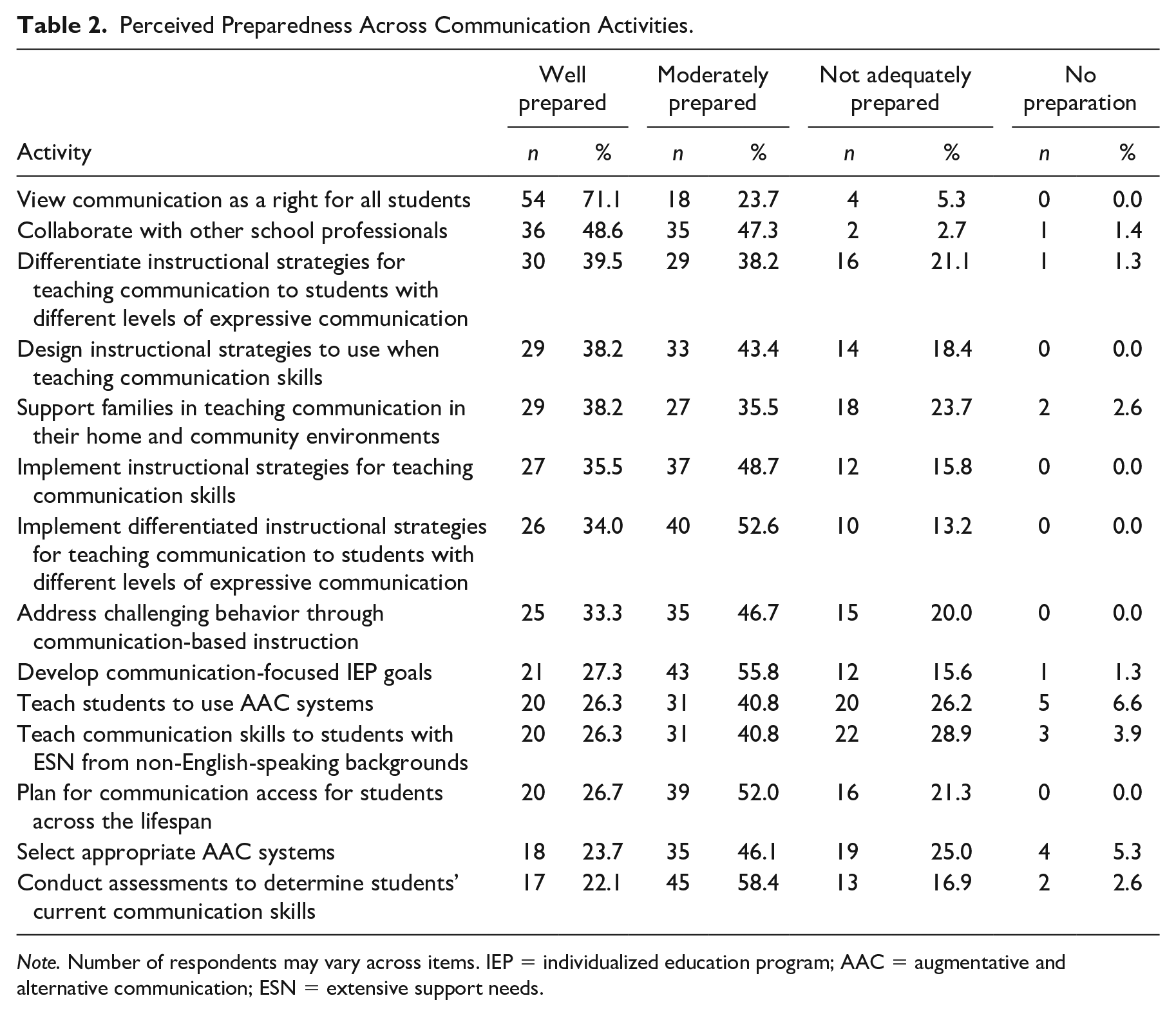
Note. Number of respondents may vary across items. IEP = individualized education program; AAC = augmentative and alternative communication; ESN = extensive support needs.
Perceived Roles in Planning and Implementing Instruction and Developing IEP Goals
The majority of participants (69.4%) indicated responsibility for planning communication instruction should be shared among school professionals, including special education teachers (76.3%), SLPs (71.2%), general education teachers (49.2%), assistive technology (AT) specialists (47.5%), behavior analysts (39.0%), and paraprofessionals (33.9%). One participant (1.7%) offered an alternative response, indicating that planning responsibilities should be informed by student educational placement. Other participants noted that planning should be the sole responsibility of special education teachers (20.0%), SLPs (8.2%), or paraprofessionals (1.2%).
In terms of implementing communication instruction, nearly half of the participants (49.4%) indicated that it should be a shared responsibility among special education teachers (93.7%), general education teachers (73.7%), SLPs (73.7%), paraprofessionals (52.6%), behavior analysts (42.1%), and AT specialists (39.5%). Twenty-six participants (31.3%) reported that special education teachers should assume the primary responsibility for implementation, with others identifying SLPs (9.6%), general education teachers (6.0%), paraprofessionals (2.4%), and, in one case, AT specialists (1.2%).
Fewer participants (38.3%) indicated that developing IEP goals focused on communication instruction should be a shared responsibility among school professionals. In fact, most participants identified special education teachers (46.9%) as the primary school professional responsible in this area, with fewer identifying SLPs (12.3%) or general education teachers (2.5%). Among those who suggested a shared responsibility for IEP goal development, most identified special education teachers (87.1%), SLPs (61.3%), behavior analysts (22.6%), and general education teachers (41.9%) as taking on this shared role. A few participants (22.6%) recommended that paraprofessionals and AT specialists should be included.
Discussion
Communicative independence for students with ESN, in part, relies on the capacity of their teachers to deliver effective communication instruction (e.g., Peckham-Hardin et al., 2018). The purpose of this study was to explore the preparation of preservice special education teachers in communication instruction for students with ESN. Our findings echo those of Pennington et al. (2021) in that many preservice special education teachers may not be adequately prepared to deliver communication instruction to students with ESN. These findings may have been due, in part, to several features of the preparation programs. Although participants noted exposure to communication instruction in multiple class sessions across more than one course, these sessions may not have been adequately connected within their programs. Furthermore, participants reported their preparation programs relied heavily on didactic approaches to content delivery (e.g., in-person lectures, recordings, videos) and nearly a quarter reported having no opportunities to practice strategies in class or field placements. This lack of experiential learning runs counter to recommendations for teacher preparation to focus on experiential approaches (Brownell et al., 2020) and likely would leave candidates feeling unprepared. Finally, candidates reported viewing communication instruction as a team approach across various school professionals, but the majority also reported that special education teachers are alone primarily responsible for IEP development. This perception of sole accountability may have exacerbated some candidates’ concerns about preparedness.
In relation to program content, those participants who reported receiving preparation in communication instruction indicated exposure to a wide breadth of content. In fact, most participants indicated receiving some exposure to each topic presented. The two lowest ranked items were directed at supporting students using eye gaze, scanning, switches, or sign language. This is unfortunate, as it may limit educators’ capacity to consider a full range of topographies when making decisions around students’ communication modalities. Finally, participants reported being prepared across differing content areas. Most participants reported to be prepared to view communication as a right for all students, whereas the fewest reported to be prepared in the areas of communication assessment and selecting response forms, both of which have been identified as critical for teacher preparation (e.g., Peckham-Hardin et al., 2018).
Implications for Practice
Together, findings from this study and Pennington et al. (2021) suggest that special education teachers may leave their programs underprepared to support the communication needs of students with ESN. It will be incumbent upon teacher educators to carefully reconsider the organization of their programs to offer comprehensive and cohesive training that adequately equips special educators for their role in delivering communication supports by including content associated with previously established teacher competencies (e.g., Council for Exceptional Children, 2015; Peckham-Hardin et al., 2018; Ruppar et al., 2018). However, these competencies should be further developed to guide programming decisions. In cases where program instructors do not have expertise in communication instruction, partnerships with other programs, collaboration with outside experts, and content delivery by practicing professionals may be important to consider. Importantly, programs also will need to consider how to embed application opportunities within coursework and field-based experiences with students with ESN (Brownell et al., 2020).
Limitations and Future Research
There are several limitations aside from inherent concerns when relying on self-report. A small sample size makes generalizing these findings challenging. In addition, although we reported findings as the percentage who answered each question, there may have been more flexibility in the data to discover correlational relations had all participants completed the entire survey. Another limitation relates to the time period during which data collection occurred. We gathered survey responses during the COVID-19 pandemic, which might have impacted preservice teacher responses about content delivery and application opportunities. Courses focused on communication instruction traditionally delivered in person may have been delivered online during this time; likewise, field-based placements may have been limited due to visitor restrictions imposed by school districts. Finally, our survey permitted participants to only report whether application opportunities were available within courses and field-based experiences, but did not require them to provide specific examples, thus limiting any substantive analysis. Future researchers may consider examining course syllabi, instructional materials, and programs of study to gain a more nuanced understanding of how teacher preparation programs are preparing preservice teachers to support students with ESN in communication.
Supplemental Material
sj-docx-1-rps-10.1177_15407969221074720 – Supplemental material for Preservice Teachers’ Preparation in Communication Instruction for Students with Extensive Support Needs
Supplemental material, sj-docx-1-rps-10.1177_15407969221074720 for Preservice Teachers’ Preparation in Communication Instruction for Students with Extensive Support Needs by Virginia L. Walker, Robert C. Pennington, Natalie R. Andzik, Melissa C. Tapp and Andy Masud-Werner in Research and Practice for Persons with Severe Disabilities
Footnotes
Declaration of Conflicting Interests
The author(s) declared no potential conflicts of interest with respect to the research, authorship, and/or publication of this article.
Funding
The author(s) received no financial support for the research, authorship, and/or publication of this article.

Supplemental Material
Supplemental material for this article is available online.
Editor-in-Charge: Susan R. Copeland
Author Biographies
References
Supplementary Material
Please find the following supplemental material available below.
For Open Access articles published under a Creative Commons License, all supplemental material carries the same license as the article it is associated with.
For non-Open Access articles published, all supplemental material carries a non-exclusive license, and permission requests for re-use of supplemental material or any part of supplemental material shall be sent directly to the copyright owner as specified in the copyright notice associated with the article.
