







Abstract
Involving people with disabilities (researchers with lived experience of disabilities) as members of research teams enhances the relevance of findings; however, existing research provides limited guidance on how to provide inclusive training on qualitative research methods. This brief report provides lessons learned from an inclusive research training focused on conducting qualitative interviews. The training was co-developed through a partnership between university-based researchers and a community-based organization supporting people with disabilities. Two individuals with moderate intellectual or developmental disabilities participated in the training. Following the training and interviews, five debrief sessions were held with all team members to reflect on the training process. Sessions were recorded, transcribed, and thematically analyzed to identify lessons learned. Findings highlight lessons learned before, during, and after the training: (a) ongoing collaboration and clear role-setting with the community partner, (b) providing accessible training materials, (c) establishing trust, (d) including a facilitator, (e) creating space for practice, (f) soliciting ongoing input, (g) finding supportive systems, and (h) conducting pilot tests. Successful inclusive research requires adequate time for practice, trust-building between team members, opportunities for feedback, and developing supportive systems.
Introduction
Inclusive research entails the collaborative and meaningful involvement of researchers with lived experience of disability (henceforth referred to as researchers with lived experience) in research that furthers knowledge relevant to them (Fletcher-Watson et al., 2021; Garratt et al., 2022). While different terminology for researchers with lived experience exists (e.g., co-researchers), we chose this term to reflect the value of experiential knowledge and to ensure our language reflects that those with lived experience in our team were full research team members. Inclusive research teams have identified the benefits of engagement of researchers with lived experience, including professional development for all team members; however, we explicitly focus on how inclusive research results in projects that are more relevant and meaningful to the population whose lives are impacted by disability (Strnadová et al., 2014; Webb et al., 2022).
Unfortunately, few studies provide guidance for researchers in planning and facilitating research training for people with disabilities (Fullana et al., 2017; Nind et al., 2016). Nind and Vinha (2012) assert that, historically, many people with disabilities educated themselves to participate in research, which contradicts the principle of equity underpinning participatory research (Chevalier & Buckles, 2019; Nind et al., 2016). Authors also advise researchers to consider individual accessibility needs when developing training curricula and to incorporate practical elements, including opportunities for practice (Flood et al., 2013; Fullana et al., 2017). Considering the sparse literature surrounding this area, research is needed to understand how to provide comprehensive and accessible training. More scholarship on participatory qualitative research with people with disabilities could help facilitate meaningful and non-tokenistic engagement.
In this brief report, the authors – including researchers with lived experience, university researchers, and community organization staff – outline their process to develop and complete qualitative research training and post-training support with researchers with lived experience. The authors offer reflections and share lessons learned for other inclusive research teams.
Method
Project Overview and Partnership Development
In this paper, the authors focus on the training conducted with researchers with lived experience and family members of people with disabilities who are members of a community-based organization located in the Midwestern region of the United States. The researchers received training to become interviewers in an inclusive research project to understand how a disability community organization helps individuals with disabilities and their families broker a balance between formal and natural supports. The organization aims to support people with disabilities and families to obtain and direct supports to live in the community. Utilizing a cooperative membership model, people with disabilities take leadership and ownership within the organization. Thus, inclusive practices are at the center of the organization’s operation.
The connection between university researchers and the organization was developed through a pre-existing relationship between a university researcher and the organization’s director. The university researchers and the organization staff conducted regular meetings to design the project. Since the research project concerns disability supports, the university team and organization staff determined early on that it was important to include researchers with lived experience on the team and thus worked together to develop a data collection framework to involve people with disabilities as interviewers. The organization staff selected and asked two active members with disabilities who were comfortable communicating verbally to participate in the training and conduct interviews.
The researchers with lived experience were paid hourly for their time in all tasks. The organization received an honorarium for its involvement in the project. This article addresses the qualitative research training undertaken and the interviews conducted by the researchers with lived experience. The researchers with lived experience have continued to be involved in ongoing phases of the project, including data analysis and knowledge product development.
Participants
The co-authors who offered reflections in this article were the research team members who were a part of the development and delivery of the qualitative training, and the team members who participated in the training as learners. This included two people with disabilities, one facilitator, three traditionally trained university researchers (one of whom is a parent of a child with a disability), one university-based project manager, and two organization staff. Both researchers with lived experience identified as having moderate intellectual or developmental disabilities and could read and communicate verbally. While the training included family members of people with disabilities (i.e., individuals who did not identify as having disabilities), the authors provided lessons learned from the training with the researchers who had lived experience.
Data Collection and Analysis
Data were collected during five debrief sessions among the co-authors once the training and interviews were completed. The co-authors used a list of pre-determined question prompts developed by the lead author during discussion, including what went well with the training and what could have been better. Each session lasted 30 to 45 min and was audio recorded and transcribed by the lead author. A deductive thematic analysis was conducted, guided by a temporal framework to categorize key themes (Braun & Clarke, 2021). The lead author reviewed the transcripts and grouped reflections into broad thematic categories under an overarching deductive structure of what occurred before, during, and after the training (see Supplemental Figure 1). These categories were then discussed and refined with all team members to validate the accuracy of the categorizations. The same research team that participated in the data collection was involved in data analysis.
Findings
Ongoing Collaboration and Clear Role-Setting with the Community Partner
Ongoing collaboration and setting clear roles and expectations between the university team and organization staff were essential for a successful training. Thus, we established communication channels through regular meetings and set clear roles. For example, the university team shared some characteristics of what they thought would make a good interviewer, and the organization’s staff refined these criteria before selecting and inviting individuals to take part by leveraging their strong connections with members. The organization staff also helped to identify an individual who could serve as a facilitator who would attend the training and each interview with the researcher with lived experience, to provide support as needed. The university team and organization staff also discussed shared goals and intentions for the project, expectations for working as a team, and the content and proceedings of the training. The university team sought ongoing feedback from organization staff on the training design (see Supplemental Table 1).
Providing Accessible Training Materials
The university team created a manual that included the PowerPoint slides used during the sessions, tip sheets, and relevant study materials (e.g., the interview questions). All materials went through numerous revisions to ensure they were written in plain language. The university team and organization staff chose not to send the entirety of the manual to the researchers with lived experience ahead of time to avoid providing an overwhelming amount of information at once. Instead, the university team provided a welcome letter and an overview of the project ahead of the training; however, the team had varying opinions about whether the training materials should have been sent ahead of time. While one researcher with lived experience said it may have been overwhelming to receive a large amount of information prior to the training, another indicated it may have lessened her anxiety to review the materials ahead of time. The latter researcher stated:
I just like having all the material on hand beforehand. So I can just like read it over. And if I come across any questions I can like write them down if I want. I like reading things. I like having things to look at and look through and refer back to.
While the researchers with lived experience were overall indifferent to receiving content prior to the training, this nonchalance may have been influenced by the trusting relationship with the organization, making them feel like they were entering into a safe environment, even if they were not aware of all project details.
Most of the training materials shared by the university team were written. However, the researchers with lived experience agreed that it would have been helpful to have a video explaining the purpose of the project, the training, and what they could expect from the training. A researcher with lived experience reported:
Some people would like the binder [of written materials] . . . and other people might say: oh, no, this is too overwhelming. And they might like the video option, whereas people might not like the having the video options. So, it’s really, it’s really a question of each person’s preference, because some like electronics, some like physical. So maybe having the option of having [both] available for them.
Establishing Trust (or Recognizing Its Existence)
The university-based team, researchers with lived experience, and the facilitator spent a significant portion of the training reviewing and rewording the draft interview protocol collaboratively. We also had discussions about the relevance, appropriateness, and comprehensiveness of the interview questions. The university team reported that it was important to foster a safe space and a trusting relationship among all team members, both to encourage honest and open dialogue about the quality of the interview protocol and to ensure that the team felt safe to engage reflexively throughout the research implementation. Providing time for the researchers with lived experience to reflect on their experiences was important to explain how they might react or interpret an interviewee’s response based on their personal experiences.
As previously stated, the team felt that leveraging trusting relationships fostered by the community partner enabled the quick development of trust between the researchers with disabilities and university team members. The training occurred in the organization’s office, where the researchers with lived experience often spend time. The researchers with lived experience indicated that their familiarity with the space made them feel safe.
Including a Facilitator
The organization staff invited a facilitator to join the training; all researchers with lived experience invited the facilitator to attend all interviews. The facilitator had prior experience working with people with disabilities in a range of capacities (but not on research projects) and was familiar with the organization. All team members agreed that engaging the facilitator in the training and in the interviews enabled support for the researchers. First, attending the training enabled the facilitator to understand the purpose of the study, the information the team sought to glean from interviews, and considerations for conducting an interview. This knowledge proved useful as team members worked collaboratively to find supportive systems that met the individual needs of the researchers with lived experience. Reflecting on the role of the facilitator, a researcher with lived experience stated:
Having him there was a big weight off my chest and a big support, just even if he was just sitting there while I was doing the interview. If I had stumbled, he would have helped me . . . Yes, there was pressure, but having him there was halving that pressure and pushing half of it off onto him so that I could actually breathe and do this interview. So that was very much welcome, and so good.
The facilitator also indicated that it was worthwhile to attend the training: “We got to troubleshoot some stuff during the training together . . . instead of somebody like me coming in not having gone [to the training], who knows what kind of misunderstandings or confusion could have happened . . .”
Having the facilitator participate in the training also enabled bonding with the researchers with lived experience, as only one of the researchers had met the facilitator prior to the training. This was evident over shared breaks and lunches when the team was able to bond in a less formal capacity. The researchers with lived experience indicated that having this time to create this shared trust made them feel supported and safe when conducting the interviews.
Creating Space for Practice
While the training included practice interviews, the researchers with lived experience were eager to role-play the interviews earlier in the training so they could understand their roles. The researchers with lived experience and facilitators reported that interactive activities integrated into the training were less meaningful without understanding what it felt like to conduct a full interview. The facilitator stated:
I found [practice interviews] to be one of the most helpful pieces because it gave me a chance to observe a bit before offering my two cents to just see how things naturally unfolded and understand what [the researchers with lived experience] might be experiencing differently from one another.
Accordingly, the university team shifted the schedule to incorporate more practice earlier in the session than planned.
Soliciting Ongoing Input
In the training, the researchers with lived experience quickly identified interview questions that did not make sense (e.g., unclear wording) or that did not fit within their local context. The researchers with lived experience and facilitators reported that the university team members’ openness to making changes based on their feedback made them feel valued. The facilitator stated that the university-based team was “willing to make adaptations, and I thought that was crucial to what I saw in our interviews. . . [Interviews] may not have gone as well if there hadn’t been some back and forth between everyone.” Likewise, the university team members were grateful that the researchers with lived experience shared their feedback to improve the research.
Finding Supportive Systems
After the training, a university team member continued to work with the researchers with lived experience and the facilitator to further adjust strategies to best suit the needs and preferences of the researchers with lived experience. During this time, the team created and tested a system using color-coded cue cards as a non-interruptive method to support the researchers in asking probing questions. The probing questions were put on cue cards and removed from the interview guide itself to make it easier for the researchers with lived experience to follow (see Figure 1). If a specific probe was relevant during an interview, and the researcher with lived experience did not probe, the facilitator slid the cue card to the researcher. The team also created cue cards with generic questions, like “Can you give me an example of that?” The facilitator also went into each interview with blank cue cards so he could write more specific probing questions in the moment.
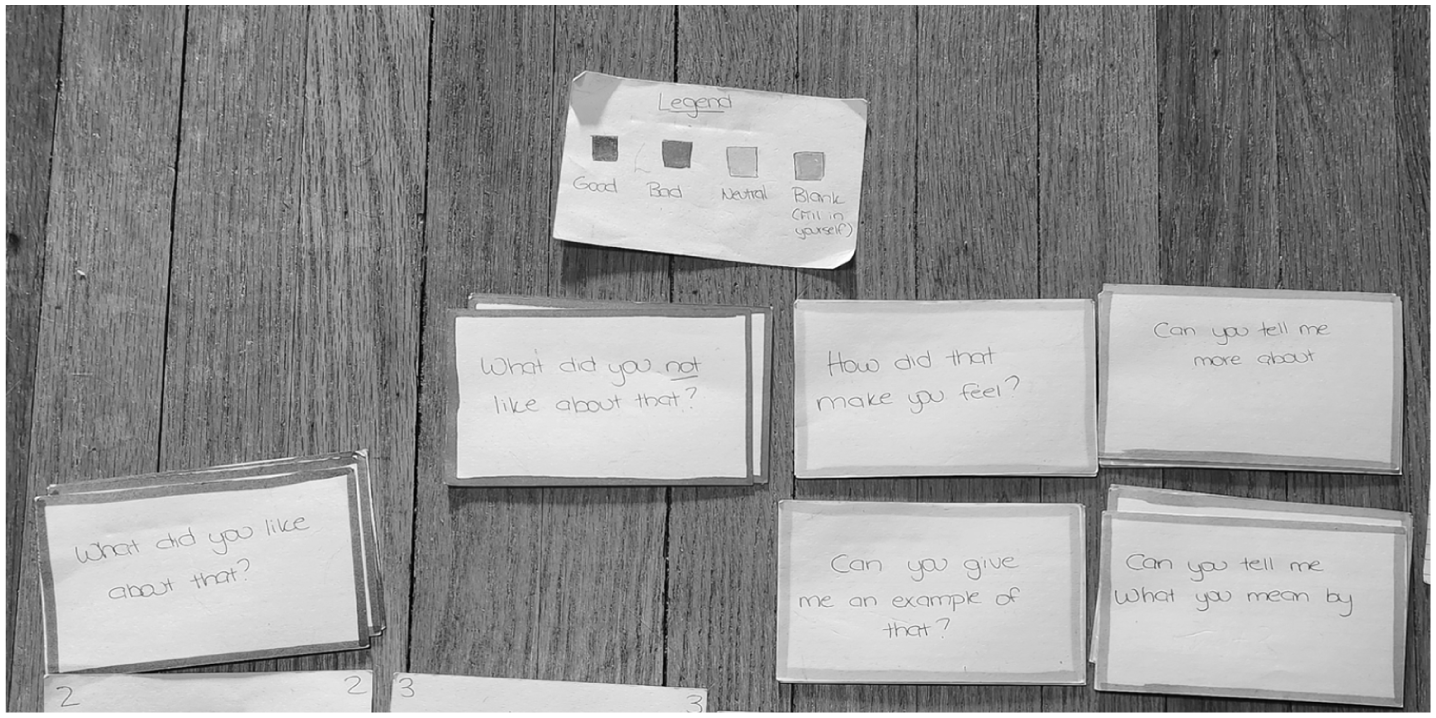
Example of cue cards used to facilitate probing during interviews.
The cue cards were labeled with the associated interview question number (if relevant), and color-coded by type of question (e.g., negative questions were red). The facilitator worked with the researchers ahead of time to discern how they wanted to receive the cue card during the interviews (e.g., facilitator sliding the card to the researcher, facilitator tapping the researcher on the shoulder). Practicing this exchange before an interview made both parties feel comfortable with the process and find a dynamic in which the researcher could lead the interview without feeling overpowered by the facilitator. A researcher with lived experience reported, “With people I was interviewing, they weren’t looking at [the cue cards]. They were looking at me, which is what I wanted.”
The facilitator felt that the system was simple and made it possible to help without being intrusive. Researchers indicated that the system enabled them to focus on reading the primary interview questions without getting confused, and that it reduced pressure to know that the facilitator was listening and would ensure they did not miss important follow-up opportunities.
Conducting Pilot Tests
Each interviewer conducted a pilot interview, which gave the researchers with lived experience a chance to practice and gain confidence in their interviewing skills. The researchers with lived experience reported that the pilot interviews helped to clarify the experience and reduce the pressure going into the first real interview. The researchers with lived experience felt their pilot interviews went well enough to be used as actual data in the study; thus, after receiving consent from participants, interview data from these pilot tests were included in the study. A researcher with lived experience reported:
The first two [practice] interviews done within the training that was real helpful getting us used to it. Getting us comfortable with it and then having the 3rd [pilot test] interview, where it’s set up just as if this is the real thing and making sure we we’re ready for this. To me, that felt really important.
Discussion
In this brief report, our team reflected on the successes and lessons learned from conducting a qualitative interview training with researchers with lived experience for a participatory research study. We recommend that inclusive research teams plan ample time for practice throughout the training. The need for regular practice in qualitative interview training connects with reflections from both instructors and students in training university students on qualitative methods (McGrath et al., 2019; Suhiemat, 2025). Incorporating practice into training connects with adult learning theories, which highlight the importance of self-directed engagement for experiential practice followed by periods of self-reflection (Knowles, 1980; Kolb, 1984).
We also recommend consideration of how trust between researchers with lived experience and other team members can be cultivated and maintained. Without the pre-established trust earned by working with the organization, more time might have been needed to build relationships prior to conducting the training. Research teams should consider the elements of communication and information sharing, trust among team members, space for ongoing feedback from all team members, and flexibility to adjust study procedures based on input. It is important to embed time for informal connection and engagement to enable greater trust and facilitate informal feedback and information sharing. For example, Strnadová et al. (2014) discuss the importance of sharing refreshments and having non-work-related chats as a mechanism to build trust. It is critically important to enable significant opportunities to practice interview skills and gain confidence in interviewing.
Our experiences also highlighted the invaluable role of a facilitator, serving as an invisible-as-possible support person for researchers with lived experience. The skills of this facilitator to offer support without distracting or directing the interview are essential. Research exists on dyadic interviewing in which an individual with a disability has a support person to facilitate their participation (Caldwell, 2014; Mulcahy, 2012; Vega-Córdova et al., 2020). However, research is needed to understand the impact of a support person on the interviewer.
Existing literature emphasizes the need to consider individual accessibility requirements (Fullana et al., 2017). It may also be important for others engaging in this work to consider an optimal balance of information to provide prior to starting the project, especially in the absence of a pre-existing trusting relationship. We also encourage other teams to consider the medium through which they share training materials. This may include translating materials into braille, video recordings, or picture diagrams. While doing so may require more time and resources, these accessibility needs are important to consider when planning an inclusive project.
Recognizing that each researcher with lived experience might have unique support requirements and preferences, and emphasizing the importance of creating accessible practices to empower these researchers, is an important factor when considering the practical suggestions presented in this article (Fraser-Barbour et al., 2025). The experiences shared here reflect the perspectives of our research team but might not transfer to the experiences of others. Future research should explore this topic in greater depth to understand practices that span individual needs and preferences. In addition, the researchers with lived experience in this study did not identify as having extensive support needs. Had this been the case, additional accommodations could be provided based on the specific researcher’s needs. For example, augmentative and alternative communication could have been integrated into the training and interviewing process (Vega-Córdova et al., 2020). While researchers with lived experience were able to use plain language interview guides and cue cards with the assistance of a facilitator, researchers with extensive support needs may have benefited from sound boards or picture cards to express key ideas (de Haas et al., 2022). For example, questions could be loaded into a generated speech program that the researcher could use.
It is also important to note that university-based members received training on disability, inclusion and inclusive research prior to implementing this project, even though we focused on the training of researchers with lived experience for this brief report. We encourage any research teams engaging in inclusive research to ensure all members receive relevant training and to recognize learning as necessary for all team members (Webb et al., 2022).
Limitations
The authors focused on the experiences of researchers with lived experience in the training and interviewing process, and did not reflect on the training experiences of the people without disabilities (family members of individuals with disabilities) who contributed. Having people without disabilities contribute helped make the training inclusive, since inclusive research should include contributions from people with and without disabilities (Hewitt et al., 2023). Future research could explore the reflections of research team members with and without disabilities.
Furthermore, the university-based team did not directly engage the researchers with lived experience in creating the training manual resources due to the timing of selecting researchers. While the skillset of developing and delivering an interview training stemmed from the university-based team, engaging researchers with lived experience in the creation of the materials would have helped ensure content was tailored and appropriate (van Heumen et al., 2024). Having the community organization provide feedback about the manual was helpful in adjusting the language to be more accessible; however, the university-based team could have hired researchers with lived experience to provide feedback at the time of their creation, as well. The university-based team incorporated feedback from the researchers with lived experience into training module revisions that will be used in the future.
Although the researchers with lived experience in this project did not identify as having extensive support needs, many of our recommendations – including generating accessible training materials, establishing trust, including a facilitator, and building in time for practice – would apply to a population with more extensive support needs. However, we recommend that future research ensure tailored and effective supports are provided to include people with extensive support needs as researchers. In addition, as the same team that provided data for this study was also involved in the analysis, engaging a broader range of researchers in evaluating and identifying key issues will be important in future studies.
Despite these limitations, this brief report provided implications for the importance of careful preparation, ongoing communication, and willingness to remain flexible and adapt when working on an inclusive interview training. Our reflections raised areas for future research in inclusive research, including exploration into the role of a facilitator for research with lived experience and supports for persons with extensive support needs. Ongoing reflections on learnings from this type of training are of critical importance to engaging researchers with lived experience in research that concerns them in inclusive and non-tokenistic ways.
Supplemental Material
sj-docx-1-rps-10.1177_15407969261448140 – Supplemental material for Qualitative Interview Training for Researchers with Lived Experience of Disabilities
Supplemental material, sj-docx-1-rps-10.1177_15407969261448140 for Qualitative Interview Training for Researchers with Lived Experience of Disabilities by Caitlin Piccone, Tom Collier, Tiffany Dean, Jasmine Hague, Eric Enger, Becca Obuchowski, Hannah Sheets, Meghan M. Burke and Heather M. Aldersey in Research and Practice for Persons with Severe Disabilities
Supplemental Material
sj-docx-2-rps-10.1177_15407969261448140 – Supplemental material for Qualitative Interview Training for Researchers with Lived Experience of Disabilities
Supplemental material, sj-docx-2-rps-10.1177_15407969261448140 for Qualitative Interview Training for Researchers with Lived Experience of Disabilities by Caitlin Piccone, Tom Collier, Tiffany Dean, Jasmine Hague, Eric Enger, Becca Obuchowski, Hannah Sheets, Meghan M. Burke and Heather M. Aldersey in Research and Practice for Persons with Severe Disabilities
Footnotes

Ethical Considerations
The research described in this manuscript took place as part of a larger project entitled Balancing Act, which was approved by the Queen’s University Research Ethics Committee (approval no. GSRHT-169-23) on June 26, 2023.
Funding
The authors disclosed receipt of the following financial support for the research, authorship, and/or publication of this article: This work was supported by the Social Sciences and Humanities Research Council of Canada (grant number 895-2023-1020).
Declaration of Conflicting Interests
The authors declared no potential conflicts of interest with respect to the research, authorship, and/or publication of this article.
Supplemental Material
Supplemental material for this article is available online.
Editor in Charge: Zach Rossetti
Author Biographies
References
Supplementary Material
Please find the following supplemental material available below.
For Open Access articles published under a Creative Commons License, all supplemental material carries the same license as the article it is associated with.
For non-Open Access articles published, all supplemental material carries a non-exclusive license, and permission requests for re-use of supplemental material or any part of supplemental material shall be sent directly to the copyright owner as specified in the copyright notice associated with the article.
