






Abstract
Parental advocacy for children with disabilities has a long-standing history in U.S. public education. Since its inception, special education has relied on parents’ advocacy on behalf of their children with disabilities to lead to progressively more defined rights. COVID-19 led to remote learning, which brought new challenges and responsibilities to all parents, including parents of children with disabilities. For these parents, parent engagement and advocacy were more necessary than ever to ensure meaningful educational opportunities. Therefore, we examined mothers’ purposes in engaging in advocacy and how they advocated for their children with disabilities who attended PreK–6 public schools in the United States during COVID-19, using disability studies in education and Bourdieu’s theory on capital. Grounded in a phenomenological approach, 15 mothers of children with disabilities were interviewed via Zoom. We identified two themes revealing participating mothers’ purposes and how they advocated for their children. Mothers expressed that their privilege helped them navigate the pandemic, aided their increased levels of educational advocacy, and enabled them to support other families they considered oppressed or marginalized. They persistently engaged in “breaking barriers advocacy” for accessing learning opportunities, inclusive education, and receiving services for newly emerged needs while consistently dismantling deficit views toward their children.
Introduction
Since its inception, the field of special education has relied on parent advocacy on behalf of their children with disabilities to lead to progressively more defined rights. The collective action of parents of children with intellectual disabilities (IDs) launched the landmark court case against the Commonwealth of Pennsylvania in 1972 that laid the groundwork for the passage in 1975 of the Education for All Handicapped Children Act (PL 94-142), now known as the Individuals with Disabilities Education Act (IDEA). With each new iteration and reauthorization of PL 94-142, parents’ rights become increasingly more defined. Today, IDEA (2004) continues to illuminate the importance of parental involvement. Notably, IDEA explicitly defines the rights of parents “to participate in meetings with respect to the identification, evaluation, and educational placement of the child, and the provision of a free appropriate public education to such child” (20 U.S.C. § 1415). However, parental involvement does not necessarily always mean parental advocacy (Trainor, 2010). When considering advocacy, it is important to note how the term advocate is a verb – indicating an action. We consider advocacy as actively working to effect change in policy, practice, and attitudes and beliefs. In this study, we explored the purposes of mothers’ advocacy and how they advocated for their children with disabilities in educational contexts during the pandemic.
The Impact of COVID-19 on Parents of Children With Disabilities
Due to COVID-19, remote learning created various challenges for educators, parents, and students and exacerbated inequities for historically underserved students, including children with disabilities. One such inequity was limited access to reliable internet and devices. Even when children with disabilities had access to the internet and digital devices, they faced challenges navigating the devices and online platforms necessary to access their remote education (Long et al., 2021).
Remote learning shifted the responsibility of supporting and implementing educational programming from school-based professionals to parents (e.g., Fish et al., 2022; Kilinc et al., 2023; Long et al., 2021; Spann et al., 2023). Parents of children with disabilities, especially, were seen as, and served as, teachers for their children, which included various new responsibilities, such as sitting next to their children during remote learning, logging into classes, and even developing lesson plans (Fish et al., 2022; Kilinc et al., 2023; Long et al., 2021). Unfortunately, many factors impacted parents’ ability to provide this newly needed educational support, including lack of time to prepare, mental health concerns, and caring for multiple children (Long et al., 2021). Many women needed to quit their jobs or significantly reduce their work hours to fulfill remote learning responsibilities (Collins et al., 2020).
Remote learning responsibilities, coupled with COVID-19 restrictions, impacted parents’ mental health. Parents, especially those with children with disabilities, had higher levels of stress, mental health issues, burnout, and social isolation (e.g., Kilinc et al., 2023; Manning et al., 2021). For instance, in the United States, Manning et al. (2021) found that parents of children with autism spectrum disorder (ASD) experienced increased stress due to isolation, illness, and financial concerns. Furthermore, the stress level of parents supporting remote learning was increased by factors such as immigration status and differences in language and culture. For instance, Korean immigrant mothers experienced greater stress due to their perceived lack of English proficiency, preventing them from contacting teachers (Hong et al., 2021).
These parental challenges intensified due to the loss or significant decrease in disability-related services due to COVID-19 (Jeste et al., 2020; Rossetti et al., 2023). For example, 74% of surveyed U.S. parents of students with developmental disabilities (DDs), ID, or ASD reported that regular pre-pandemic disability services were not provided (Jeste et al., 2020). The upheaval and change in services, coupled with increased transparency of school practices afforded to parents via remote learning, led parents to take steps to rectify their child’s education (Fish et al., 2022; Kilinc et al., 2023; Rossetti et al., 2023). Only two studies included parent advocacy as part of their findings (Fish et al., 2022; Spann et al., 2023). Their findings revealed that parents, even those previously less active in advocacy, had to advocate for their children with disabilities due to inadequate accommodations and modifications during remote learning, leading some parents to transfer their children to nonpublic schools or homeschool them.
During the pandemic, parents’ advocacy was not confined to the classroom or school level, with some parents taking litigious action due to the alleged failure of school districts to comply with federal disability law. One example is Brennan and James v. Wolf, Rivera, and the Pennsylvania Department of Education (2020), the class action lawsuit in which families alleged that their students were not provided a free and appropriate public education (FAPE). Parents reported a dramatic reduction in service hours from 32.5 per week in brick-and-mortar settings to 1.25 per week in remote schooling. In addition, schools simultaneously failed to follow official protocols for revising students’ individualized education plans (IEPs), violating the parental input provisions of IDEA and constituting a denial of FAPE (Jameson et al., 2020).
Overall, the current literature on parents of children with disabilities during COVID-19 provides a general overview, but it does not examine parents’ in-depth experiences of advocacy. We aim to fill this knowledge gap by unpacking the mothers’ purposes in engaging in advocacy and how they advocated for their children with disabilities who attended PreK–6 public schools in the United States during COVID-19.
Literature Review on Parent Advocacy
Although IDEA explicitly mandates parent participation in special education, the bureaucratic nature of special education systems simultaneously undermines parental participation and creates additional reasons for parents to advocate (Stanley, 2015; Trainor, 2010). Therefore, we examined the recent literature on parent advocacy in special education regarding parents’ goals in advocacy and how they advocate for their children with disabilities.
Why Parents Advocate and Their Advocacy Aims
Harry and Ocasio-Stoutenburg (2020) noted all parents’ desire to advocate for their children, particularly emphasizing its increased importance when a child has a disability. For parents of children with disabilities, a major reason for advocacy is the need to humanize and negotiate the value of their child and their child’s disability with school personnel (Beneke et al., 2021; Burke et al., 2021; Harry & Ocasio-Stoutenburg, 2020; Stanley, 2015; Trainor, 2010).
Parents also advocate for and against specific disability labels throughout the IEP process (Burke et al., 2021; Lalvani, 2012; Ong-Dean, 2009). Parents negotiate disability labels to mitigate the impact that a particular label provokes among school personnel (Lalvani, 2012; Stanley, 2015). For example, Lalvani (2015) found that parents avoided certain labels, such as ID, to prevent teachers from developing low expectations shaped by deficit views of disability.
Many parents list conflicting educational placement decisions as chief among their reasons for advocacy. They advocate for inclusive settings to increase access to opportunities that support the development of their children, while schools push back by insisting on pullout services or segregated, self-contained classrooms (Aceves & Black, 2024; Bacon & Causton-Theoharis, 2013; Beneke et al., 2021; Lalvani, 2012; Stanley, 2015; Trainor, 2010). In Aceves and Black’s (2024) study, an African American mother advocated for an inclusive placement for her son with cerebral palsy; however, educational professionals disagreed, arguing that an inclusive setting would not be beneficial for him. Bacon and Causton-Theoharis (2013) interviewed 17 mothers about their special education and IEP planning experiences and examined their advocacy efforts. The findings indicated that the mothers primarily advocated for inclusive placements for their children with disabilities to promote their social and academic development, while facing various barriers from school professionals, such as issues with scheduling services and educators’ deficit views.
Parents spend considerable time advocating for specific accommodations, modifications, and services for their children to enable their access to meaningful education and enhance their progress (e.g., Aceves & Black, 2024; Burke et al., 2021; Harry & Ocasio-Stoutenburg, 2020; Ong-Dean, 2009). However, they frequently experience resistance from school personnel, asserting multiple obstacles, such as a lack of staffing and finances, to meeting such requests (Aceves & Black, 2024; Bacon & Causton-Theoharis, 2013).
How Parents Advocate in Relation to Their Multiple Identities
Parents’ advocacy types are categorized differently by researchers, such as “everyday advocacy,” breaking barriers advocacy,” and “creating public voice advocacy” (Harry & Ocasio-Stoutenburg, 2020, p. 17) and as “intuitive advocate, the disability expert, the strategist, and the change agent” (Trainor, 2010, p. 40). The meaning of advocacy also takes different forms. For instance, Stanley (2015) examined the advocacy experiences of 12 African American mothers of children with disabilities who defined advocacy as beginning prior to disability identification, utilizing community resources, communicating with educators to raise questions, disagreeing with certain recommendations, making specific requests, attending special education meetings, and being present in their children’s schools. These ranged from attending parent-teacher conferences to engaging in informal conversations with teachers. Their advocacy occurred at both the individual and collective levels. Parental advocacy styles are in relationship with power and privilege associated with parents’ identities and economic, social, and cultural capital (Harry & Ocasio-Stoutenburg, 2020; Ong-Dean, 2009; Trainor, 2010). This highlights the importance of an intersectionality lens for understanding how interlocking systems of power shape parents’ advocacy experiences and opportunities to participate (Crenshaw, 1991).
Harry and Ocasio-Stoutenburg (2020) described various ways parents engaged in advocacy. Everyday advocacy relates to parents’ everyday actions to provide opportunities to their children, such as a mother taking three taxis to ensure her child gets to school. Breaking barriers advocacy can include parents’ actions to gain access to opportunities, such as advocating for an inclusive placement in an IEP meeting. For example, Wilson (2015) found that African American mothers used a “question-asking” advocacy style, formulating specific questions before IEP meetings to get positive outcomes. In creating public voice advocacy, parents engage in collective actions through coalition building to dismantle systemic obstacles, such as joining a local advocacy organization (Harry & Ocasio-Stoutenburg, 2020).
Trainor (2010) further helps conceptualize parent advocacy in special education by identifying four approaches: the intuitive advocate, the disability expert, the strategist, and the change agent. Parents engaging in intuitive advocacy used their knowledge about their children’s strengths, needs, and preferences to support them within the school context. Intuitive advocacy was also described by mothers in multiple studies (Aceves & Black, 2024; Stanley, 2015). In Aceves and Black’s (2024) study, the African American mother relied on her intuition about her son’s need for socioemotional support and possible depression, leading her to seek community counseling services. In Stanley’s (2015) study, African American mothers used their intuition by sharing their children’s strengths and weaknesses with the educators to shape educational decisions. The disability expert aimed to gain knowledge about their child’s specific disability in various ways, including attending workshops, reading articles, and bringing their newfound knowledge to the attention of school personnel. The strategist combined child-specific knowledge, like the intuitive advocate, with knowledge about the special education process (e.g., documents, procedures, evaluations, parental rights) to ensure successful educational outcomes for their children. Burke et al. (2021), whose participants were predominantly mothers of children with disabilities, found that parents who engaged in a strategic advocacy style communicated with the school in various ways (e.g., phone calls, emails, and in-person meetings), identified necessary resources such as support groups and state agencies, conducted research to find specific information, and documented a paper trail. Finally, the change agent, similar to creating public voice advocacy, was motivated by systemic change. For instance, two mothers in Stanley’s (2015) study sought to advocate collectively for their children by attending a local school board meeting to voice their concerns.
Parents’ economic, social, and cultural capital influences the way they advocate and the outcomes of their advocacy (Burke et al., 2021; Ong-Dean, 2009; Stanley, 2015; Trainor, 2010). Ong-Dean (2009) found that “privileged parents,” described as “some combination of white, middle- to high-income, English-speaking, professional, and college-educated” (p. 5), possessed economic, social, and cultural capital. They leveraged this capital to request more hearings than disadvantaged parents and to secure resources, such as reimbursement for services provided to their children with disabilities. For instance, an African American mother in Aceves and Black’s (2024) study had to use her economic capital to pay for external evaluations to support her concerns and requests, with assistance from an attorney. Trainor (2010) identified that parents receiving free and reduced-cost lunch primarily engaged in intuitive advocacy, while parents without free and reduced-cost lunch employed their knowledge of IDEA (2004; i.e., strategist) along with intuitive advocacy. Moreover, Lalvani (2012) found that parents from low socioeconomic backgrounds rarely demanded inclusive education, largely because they were unaware of IDEA’s least restrictive environment (LRE) provision. In contrast, parents of middle to high socioeconomic status demonstrated a greater understanding of IDEA and LRE gained from leveraging their social and cultural capital to access outside opportunities (e.g., webinars, books), resulting in more positive outcomes of advocacy, consistent with other studies (Bacon & Causton-Theoharis, 2013; Ong-Dean, 2009).
Inequities exist in the advocacy process and outcomes because of structural and ideological barriers related to parents’ racial, economic, ethnic, linguistic, and immigration backgrounds. Parents from marginalized backgrounds experience discriminatory practices, such as inflexible meeting times and locations, the inaccessible language used by professionals, and deficit-based and stereotypical assumptions about families, often rooted in ableism and racism (Beneke et al., 2021; Harry & Ocasio-Stoutenburg, 2020; Trainor, 2010; Wilson, 2015). Despite the explicit pro-parent participation stance of IDEA (2004), not all parents are afforded equal opportunities to participate (Ong-Dean, 2009). It is important to note that we did not dichotomize parents based on whether they possessed specific forms of capital; rather, we highlighted how schools systematically privilege certain forms of capital aligned with dominant norms. However, the special education system often undermines the capital of minority parents in their advocacy efforts. For instance, Angell and Solomon (2017) found that Latino parents with high levels of expertise and educational background encountered resistance from schools regarding their requests during IEP meetings, which led them to believe that their ethnic identities were perceived negatively by school personnel. Thus, in this paper, we located the problems within the larger systems rather than the parents.
Most participants in these studies were mothers (e.g., Burke et al., 2021; Lalvani, 2012; Trainor, 2010; Wilson, 2015), and other studies focused exclusively on mothers (e.g., Bacon & Causton-Theoharis, 2013; Beneke et al., 2021; Stanley, 2015). This highlights the central role mothers play in advocacy and caregiving for their children with disabilities, and how gendered caregiving expectations interact with racism, ableism, and classism to shape whose advocacy labor is recognized in special education (Crenshaw, 1991). Cioè-Peña et al. (2024) further extended this by offering the framework of Disability Critical Race Theory Mothering as a politicized action “rooted in defiance and radical love for children dehumanized by intersecting systems of racism and ableism” (p. 2490). Thus, mothering becomes an act of advocacy and resistance. Although the reviewed studies did not consistently use the term extensive support needs, many described children with disability labels (e.g., ID, multiple disabilities, autism) and reported support needs consistent with substantial, ongoing support across home and school contexts (Taub et al., 2017). This study was guided by two research questions:
Theoretical Framework
We used a disability studies in education (DSE) perspective and Bourdieu’s theory on social, cultural, economic, and symbolic capital, along with his theoretical concepts of habitus and field to understand the purpose of and the ways mothers of children with disabilities advocated for their children during COVID-19. DSE considers disability as part of human diversity and examines it in relation to the social, cultural, historical, and political contexts that shape the understanding and meaning of disability (Connor et al., 2008). DSE works toward dismantling ableism, a belief system that shapes cultural and educational practices by devaluing children with disabilities and positioning nondisabled individuals as the norm and thus as inherently superior (Gabel, 2005). Ableism also manifests as deficit thinking, which functions as an ideological barrier by locating problems within children with disabilities rather than examining the impact of external factors (Connor et al., 2008). Ableism and deficit thinking lead to the segregation and exclusion of students with disabilities from general education settings and limit their access to opportunities in inclusive classrooms (Connor et al., 2008). Ableist beliefs and practices are a key reason many parents of children with disabilities advocate for their children to humanize them and negotiate their value and competence with educators (Beneke et al., 2021; Harry & Ocasio-Stoutenburg, 2020). DSE provides insight into how mothers conceptualize disability in their advocacy, which may differ from educators’ views, and navigate the education system to ensure inclusive learning opportunities for their children.
Bourdieu (1986) identified four types of capital – economic, social, cultural, and symbolic – that impacts power and status in society. Economic capital relates to financial means or wealth, thus allowing people to access resources, which in turn brings more capital in the future (e.g., hiring private tutors to support academic outcomes).
Cultural capital has three forms: objectified, embodied, and institutionalized. Objectified capital refers to owning physical materials, such as art and books, that are in a relationship with embodied capital and are transmissible to economic capital (e.g., ownership of artwork can have a monetary outcome; Bourdieu, 1986; Moore, 2014). Bourdieu explained embodied capital as the “long-lasting dispositions of the mind and body” (p. 17), such as taste, language, and lifestyle choices. Embodied capital is acquired consciously and unconsciously throughout life. Finally, institutionalized capital comprises educational qualifications that bring value to its holder.
Social capital refers to membership in a group, providing each member with shared capital that brings power and eases access to other types of capital (Bourdieu, 1986; Moore, 2014). For example, families of children with disabilities may join Facebook groups to exchange information and access resources to better support their children with disabilities (e.g., getting informed about types of resources). Bourdieu considers these three capitals as mutually constitutive. For instance, families with economic capital provide resources and opportunities to support their children’s cultural capital, contributing to their children’s economic capital in the future.
Symbolic capital refers to the prestige or authority a person gains through social recognition of social, economic, and cultural capital as well as “signs of distinction” or differences that convey status, such as race and clothing (Bourdieu, 1986, 2013; Woodward, 2018). Bourdieu and Wacquant (2013) state that “any difference that is recognized, accepted as legitimate, functions by that very fact as a symbolic capital providing a profit of distinction” (p. 297). Woodward highlights that capital activation and institutional acceptance are crucial, meaning that possessing social and cultural capital alone may not suffice without activating it and gaining acceptance. Symbolic capital, such as race, can influence whether a person’s cultural capital is accepted or rejected by institutions.
Bourdieu’s concepts of habitus and field are essential to understanding people’s practices. Habitus is linked to “our ways of acting, feeling, thinking, and being,” shaped within the family and evolving by experience (Maton, 2014, p. 51). For example, habitus can include how teachers and parents perceive disability (e.g., deficit thinking). According to Edgerton and Roberts (2014), “habitus shapes the parameters of people’s sense of agency and possibility; it entails perceptual schemes of which ends and means are reasonable given that individual’s particular position in a stratified society” (p. 195). For instance, some immigrant families, whose habitus differs from that of educators, may refer placement decisions for their children with disabilities to educators. Habitus can change through new experiences, changes in a specific field, and socioanalysis (Maton, 2014). Fields are social spaces (e.g., special education) with formal and informal norms and are subject to change. Within fields, people hold different degrees of power constituted by their habitus and cultural capital, aim to sustain or improve their position, and exist in multiple interdependent fields. For example, a bachelor’s degree from an institution (i.e., education field) helps a person be positioned higher in an economic field.
Social hierarchies and inequalities, along with the harm they cause, are sustained not through physical force but through subtle forms of symbolic domination, a process that Bourdieu called symbolic violence (Schubert, 2014). Symbolic violence operates “at level of obligations, debts, roles, expectations, discourses, and nonverbal communications” (Toshalis, 2010, p. 188). For instance, in IEP meetings (i.e., field), some professionals may use jargon (i.e., symbolic violence) as a form of cultural capital that reflects their habitus to convey their authority, creating hierarchies between professionals and families.
Method
This qualitative study was guided by a phenomenological approach to understand mothers’ advocacy goals and the ways they advocated for their children with disabilities. A phenomenological approach explores “what all participants have in common as they experience a phenomenon” and seeks to describe both what and how participants experience it (Creswell, 2013, p. 76). We focused on the phenomenon of parent advocacy during COVID-19.
Participants
Fifteen mothers who met the inclusion criteria of (a) being older than 18 years of age and (b) having at least one child with a disability attending a PreK–6 public school in the United States during some portion of the COVID-19 pandemic participated in this study. Table 1 presents mothers’ self-reported information about their backgrounds and their children with disabilities. Among the participants, two mothers identified as having a disability, and two reported being single parents. Thirteen mothers reported having a child with extensive support needs, such as ID. We posted flyers in national and Northeast-based Facebook groups for families, inviting them to contact us via email or text to participate in the study. Each participant received a $25 Amazon gift card. Although the research was open to all caregivers, only mothers volunteered to participate. Recruitment ended when redundancy in emerging themes indicated data saturation (Creswell, 2013). We used pseudonyms for all names.
Participants’ Demographics.
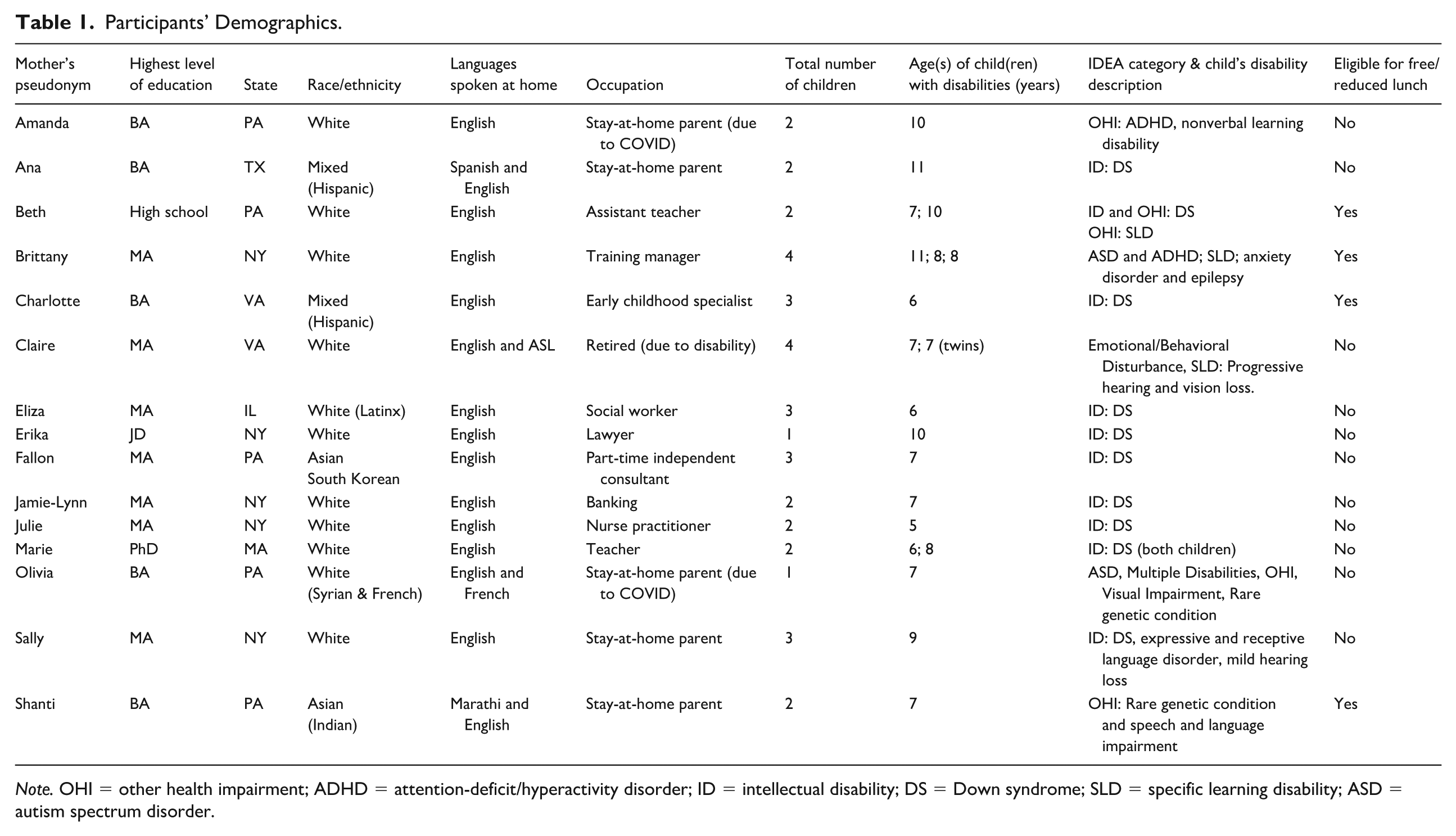
Note. OHI = other health impairment; ADHD = attention-deficit/hyperactivity disorder; ID = intellectual disability; DS = Down syndrome; SLD = specific learning disability; ASD = autism spectrum disorder.
Positionality
Recognizing that researchers’ positionalities influence the research process, we reflected on our multiple identities and how they shape our meaning-making. The first author is a nondisabled cisgender woman whose primary language is Turkish. She speaks English as a second language and has lived in the United States for over a decade. Her experiences navigating an English-speaking context that differs from her cultural background have allowed her to recognize how the use of the dominant language – English – is often associated with smartness and how social contexts influence how individuals’ abilities are perceived by others. Even though she was not a mother during the data collection and analysis process, she is now the mother of a child without a disability, which has helped her better understand the emotional journey and responsibilities the participants shared when she revisited the data. Shared experiences with some participants, such as immigration, contributed to building rapport and to creating a space where they felt comfortable sharing their stories openly.
The second author identifies as a fat, queer, disabled, neurodivergent, cis-white woman with race, cis, education, language, citizenship, and class privilege. She is a nationally recognized advocate, having supported families in all 50 states through IEP meetings, mediation, and due process to ensure their student has access to a fully inclusive setting in the general education classroom with access to the general education curriculum.
Data Collection
Mothers filled out a demographic information survey, including information about their children, via Google Forms before their interview. Fifteen individual semi-structured interviews, which included 18 questions developed based on previous literature, were conducted by the first and second authors via Zoom in English between January and April of 2021, with an average duration of approximately 70 minutes. All interviews were video recorded via Zoom with the participants’ consent. The questions aimed to capture (a) family background and context; (b) the impact of COVID-19 on families and their children with disabilities; and (c) educational experience during the pandemic, including family advocacy and IEP meetings. Some questions were “What have been some new responsibilities you had during the pandemic?” “How has your child’s education looked like during the pandemic?” “How have you been advocating/supporting your child (e.g., in IEP meetings)?” We conducted member checking during the interviews to confirm our interpretations of participants’ responses and used probing questions, such as “Tell me more about that,” for clarification and elaboration.
Data Analysis
The first and second authors engaged in three cycles of inductive and systematic coding processes using NVIVO 12 software to find emergent categories and themes (Saldaña, 2013). Using an online transcription service, the total length of all transcripts was 314 pages. First, using open coding, we coded each transcript with various code types, such as in vivo (e.g., “I’m that parent”), descriptive (e.g., “attorney’s support”), emotional (e.g., “It’s exhausting”), and theoretical (e.g., “economic capital” and “deficit views”). Second, we aimed to identify relationships between various codes across the transcripts by recoding and merging similar codes to find categories and themes. For example, we grouped mothers’ advocacy attempts during COVID-19 based on content. We categorized codes such as “suggesting ideas to teachers,” “requesting modified work,” and “expressing concerns about a lack of participation opportunities” under the “classroom instruction” category. Last, we reviewed each code, category, and theme and reread the excerpts for accuracy to finalize the categories and themes. For example, codes such as “educators underestimating the child’s abilities,” “opposing educators’ deficit thinking that limits her child’s potential,” and “not presuming competence” were grouped under the category of “advocacy for dismantling deficit views.” During each cycle, we held weekly peer debriefing meetings to discuss our reactions, share interpretations, clarify misunderstandings, and resolve disagreements to ensure trustworthiness (Ravitch & Carl, 2016). Throughout the data analysis process, we wrote theoretical and analytical memos to interpret and make sense of the data. We connected our codes, categories, and themes to existing literature.
Findings
We identified two themes: recognizing privilege and breaking barriers in advocacy. The latter included three categories describing mothers’ advocacy goals for accessing learning opportunities and dismantling deficit views, ensuring inclusive education, and receiving services for newly emerged needs. It also described how mothers engage in advocacy.
Recognizing Privilege
Some mothers considered themselves privileged based on one or more identity markers, such as race, economic status, and language, reflecting their economic, social, cultural, and symbolic capital. They expressed that their privilege helped them navigate the pandemic, aided their increased levels of educational advocacy, and enabled them to support other families they considered oppressed or marginalized. Fallon, of South Korean background, shared: Our family was really privileged in the fact that I am mostly a stay-at-home mom, so I was able to make this work [remote schooling]. I know other kids who have IEPs; they’ve had to go to school, and then they’re trying to do all this asynchronous work from home. It’s not really working well. And then they still have therapies on top of that.
Fallon acknowledged that being able to stay at home and support her son with Down syndrome (DS) during remote schooling in the pandemic was a privilege, tied to her husband’s engineering career, which supported their economic capital.
Eliza, self-identified as being White and Latinx, expressed that being able to speak English was a privilege that constituted a form of linguistic capital – a subset of cultural capital – which allowed her to engage more successfully in remote schooling. She used her linguistic privilege to advocate for a student with a disability speaking only Spanish and stated: There is a child in the class who is Spanish-speaking only . . . I talked about the teachers that I feel bad because . . . everything’s in English . . . So, what she [special education teacher] started doing is having the aides who speak Spanish translate stuff into Spanish . . . to kind of close that gap.
Leveraging her privilege as an English speaker, Eliza realized a language barrier during remote learning and advocated for incorporating Spanish into instruction to reduce barriers for the Spanish-speaking child. Her advocacy, akin to the change agent advocacy (Trainor, 2010), raised educators’ awareness of inequitable access to the curriculum for Spanish-speaking students, transforming the existing English-only practice into a more inclusive and accessible one that recognized the Spanish-speaking student’s linguistic capital.
Breaking Barriers Advocacy
Advocacy for Accessing Learning Opportunities and Dismantling Deficit Views
Mothers advocated for their children with disabilities to access educational opportunities that would enhance their development and learning. During remote and hybrid learning, mothers expressed concerns about limited to no differentiation and lack of implementation of accommodations and modifications, grounded in teachers’ deficit perspectives. When asked about this, Ana, who self-identified as mixed and Hispanic and spoke both Spanish and English at home, explained: No. When she was in the classroom, she used to have different materials for her and more on her level. If they are talking about the story that they are reading. I’m just going to be just talking to her about that and then probably more on her level. But I have to go with a special education teacher and tell her, “They’re seeing these, and I don’t have a way to accommodate her.” “Let me look into it. I’ll send you something.” Sometimes I blame myself and sometimes, I just don’t know how to or just don’t have the time.
Here, Ana expressed a lack of differentiation and accommodations for her child with DS, unlike pre-COVID. To ensure her child received an appropriate education, she advocated for her child by initiating email conversations with the special education teacher, requesting accommodations. Although the teacher was responsive to Ana’s request, this process also led her to blame herself for not knowing how to accommodate the educational content.
Charlotte, an early childhood specialist, revealed how deficit perspectives were tied to teachers’ efforts to modify instruction: “Well, he can’t keep up in class.” “You know he can’t write an E. He can’t write letters. We’re working on drawing a straight line. That’s his IEP goal. So why don’t we have a notepad? If you tell us ahead of time the letter of the day’s A, we write A, and then we write a bunch of other letters, and he picks the A up, and he shows it to you? Or he hits it on the keyboard.” They’re like, “Oh, yeah, we could do that.” And I’m not a teacher. But that’s part of the collaboration. We’re all doing something that we’re not used to doing right . . . It’s exhausting because we’re also dealing with biases.
Charlotte challenged the teachers’ deficit assumptions that her son could not keep up with the class – an example of symbolic violence, where power operates subtly to reinforce hierarchies – by offering various suggestions to modify instruction. In this way, she demonstrated her knowledge about disability and a specific strategy (modification), revealing her cultural capital, specifically institutionalized and embodied. She strategically positioned herself as a collaborator while also demonstrating her knowledge about parent involvement in special education policy. However, her words “I’m not a teacher” illustrate a subtle critique of educators’ lack of action and shortcomings in modifying instruction. Her cultural capital and advocacy strategy of acting as a collaborator seemingly helped remove barriers, as teachers were willing to implement her suggestions.
Mothers identified the binary of special and general education teachers’ roles and expectations as structural barriers against inclusive education. For instance, Erika stated: The general education teacher just directs me to her outline. But that’s not how you’re modifying for George. I said, let’s just talk about the big idea. She said, well, the big ideas are in my presentation. Okay, so I have to figure out how to teach him those things in this presentation . . . The culture of everywhere I have ever been, and I don’t know how to change this culture and if it will ever change, is that the general education teachers do not take ownership over the special education students. That’s the special education teacher’s problem. Not mine, I’ve got my class.
Erika expressed that the general education teacher displayed a lack of interest and effort in modifying the curriculum and collaborating with her to figure out possible ways to teach the class materials to her son with DS. Erika perceived the general education teachers’ underlying unresponsiveness as related to the separation of perceived roles and responsibilities between general and special education for children with disabilities, reflecting two distinct habitus shaped by their respective fields. The general education teacher’s lack of ownership over her son’s need for accommodations to access his education may be interpreted as not viewing him as belonging in her general education classroom. Erika described this separation as a “culture” that, despite her frustration, she believed should change to better serve children with disabilities in inclusive classrooms. In this culture, special educators were positioned as the experts in educating children with disabilities.
Overall, mothers primarily relied on their cultural capital, such as demonstrating knowledge about accommodations and modifications, in their advocacy efforts. Their economic capital and their symbolic capital, such as race, also contributed to the activation of their cultural capital. While some mothers’ advocacy was successful, others were not recognized, leading two mothers to leave public school. Sally opted for homeschooling, while the other mother, Fallon, chose to enroll her child in a charter school to provide meaningful learning opportunities.
Advocacy for Ensuring Inclusive Education
All mothers, except one, indicated persistent advocacy throughout their children’s education and a strong belief that inclusive education was the best way to support academic and social goals. For example, Sally challenged educators’ narrow view of inclusion and advocated to ensure her child’s access to inclusive education: They were going to let her go to third grade. But they would only have her with her general education peers for morning meetings, recess, and lunch. They said, “Okay, she’s included” . . . And they kept saying, “Well, it would be with her peers.” And I said, “Well, no, it wouldn’t be with her peers. She’s only spending this limited time with her peers.” . . . I just didn’t feel like they had her best interest in mind. They were just seeing her as a kid with Down syndrome, and she can’t do these things.
The educators’ and Sally’s conceptualizations of inclusive education were distinctly different. While Sally advocated for full inclusion, focusing on her daughter’s strengths, the educators’ narrow view of inclusive education led to her daughter’s exclusion for much of the school day. For Sally, educators could not see the whole child, including her potential and abilities. Sally’s use of the term “best interest” reflected her cultural capital, employing the language of the special education field.
Similarly, Marie, a white English teacher with a PhD, fought for the inclusion of her daughter with DS: Sara did really well for the last half of the year. Nobody really fought me in first grade. She was 90 minutes of pullout. She was out for math, but the other kids in her program were all substantially separate and had been since kindergarten. When we met this past May for [her] annual, we had this wonderful meeting where everyone was saying things like progress, thriving, happy, doing so well, exceeded our goals. At the end of it, they said that they wanted to double her pullout time and make her substantially separate. The reason was that second grade is really hard. What they don’t understand is that my kid’s gonna be included in high school. So, we can either fight these battles every single year, or we can just find a way to make it work because research is really super clear on inclusion, right? They have higher academic achievement, they have higher test scores, they have better social, emotional skills. They’re more likely to graduate. They’re more likely to have a job after graduation. Inclusion is better. I’m not budging on that.
Marie’s advocacy resulted in Sara being placed in an inclusive second grade, illustrating a strong relationship between parental advocacy and inclusive placement, unlike other children with disabilities who had been substantially segregated since kindergarten. Marie’s experiences exemplified symbolic violence; without her advocacy, professionals used their power to perpetuate educational inequities, treating segregation as natural or necessary for children with disabilities through social domination. Professionals still recommended segregated placement for the second grade, assuming without evidence that advancing a grade would be too challenging. This reflected their deficit views, locating possible future problems within the children with disabilities rather than within the social context. Marie demonstrated explicit aspiration for her daughter’s inclusive education for future grades, believing it was key to enhancing Sara’s academic and social outcomes. She positioned herself as a disability expert, brought knowledge from inclusive education research, and used this cultural capital, along with the implicit support of her symbolic capital, such as being white and holding a PhD, to challenge professionals’ decisions on segregation.
Mothers used research evidence, positioning themselves as disability experts (Trainor, 2010), as an advocacy strategy to secure inclusive placement for their children. For instance, Julie, who self-identified as white and was a nurse practitioner, used the language of evidence-based practices to bolster her advocacy: The CPSE [Committee on Preschool Special Education] chair and the CSC [Committee on Special Education] chair both felt very strongly that the 12:1:11 was the best place for her. We just did not agree . . . I know that our goals are the same. We just have very different ideas of the methods to reach those goals . . . I come from the “well, here’s what all the evidence says. Let me send you all the articles that agree with my point of view. If you have research articles that support your point of view, I’m happy to read them.” You do evidence-based practices . . . They were never able to provide me with evidence that supported their positions. They kind of realized that I was not going to change until they did. . . They offered [self-contained classroom] again in the summer when it was decided that all kids in a self-contained class went four to five days a week . . . We just said “no.”
Julie used collaborative language to contest the segregated placement decision for her daughter, employing evidence-based practices as an advocacy strategy to demonstrate her expertise in inclusive education research, reflecting her cultural capital. Initially, the school offered only a self-contained class option for in-person schooling at the onset of the pandemic. However, Julie opposed this proposal, expressing concerns about the potential challenges of returning to a general education classroom post-pandemic.
Advocacy for Receiving Services for Newly Emerged Needs
New educational needs emerged during the pandemic that required mothers’ advocacy. These needs, some as a direct result of the pandemic, were related to behavior and one-on-one support, accommodations, modifications, and summer programs to compensate for learning loss due to remote schooling. In some instances, the mother’s advocacy meant inaction rather than action. For example, Claire, who self-identified as white and disabled, had twins with disabilities, spoke both English and American Sign Language (ASL), explained that she needed to let her daughter fail a test to demonstrate that she needed additional accommodation during math class: During every math test, I would have to sit with her and read and sign the questions even though she has a translator . . . But then she can’t read the questions because it has to be one or the other on her screen. She can’t dually focus . . . I said, “she needs someone to read the questions to her.” Because I can’t always be there . . . so then they put her in with Mr. Evans’ math group . . . and he reads them the questions . . . He verbalizes them with Miss Robinson signing them . . . I know it’s awful, but . . . that way, I could prove a point. I spent two weeks not doing any math with her and just letting her do it on her own. I let her take the test and then she failed it. Now I’m going to go back to them and say, “This is why she needs a math pullout.” Because I did not provide her any mommy support.
In remote learning, all mothers, including Claire, became teachers, providing educational support for their children. Claire’s daughter needed someone who could directly converse using ASL in part to provide the accommodation of reading aloud during math assignments and tests as well as to provide math instruction. While a sign language interpreter was successfully utilized during in-person instruction, a sign language interpreter would not be accessible during online instruction, as it would require her daughter to look at two screens simultaneously. Unfortunately, the school did not acknowledge this new need raised by Claire. Therefore, as an advocacy strategy, she purposefully did not support her daughter for 2 weeks, although she described it as awful. As a result, her daughter failed her math test, allowing Claire to argue that her daughter needed additional math services.
Olivia, who self-identified as Syrian and French, became a stay-at-home mom due to COVID-19. Her son demonstrated new challenging behaviors such as “shouting, screaming, crying, punching, and aggression” during remote schooling, which were not observed in a brick-and-mortar setting. She demanded a specially trained staff support person to provide one-on-one behavior support for her son. However, the school neither acknowledged this new need nor believed the mother that these behaviors were occurring. As part of her advocacy, she recorded his behavior at home and used the behavior specialist’s (BSC) evaluation to provide evidence: I try to stay out of view of the camera so that the teachers can’t see. So, if Dan is punching me, [it’s] out of the camera. But when we’ve done evaluations with his wraparound BSC, she sees all of that because I stay in the camera, and she records it and submits it to them . . . So, we’ve been doing this dance with the school, trying to get them to acknowledge that we need the support here. They’re not believing me. They weren’t believing the BSC. Their position is they cannot approve services that are happening when it’s not in the IEP . . . I’ve sent you video proof. We were in an IEP meeting. I was begging and pleading with the team to just sign the document . . . within a week of him [school principal] being on the call, they were like, “Okay. We’ll sign for it. . .”
Olivia was able to secure therapeutic staff support services after persistent advocacy using different strategies, including intuitive advocacy and being a disability expert (Trainor, 2010), all of which relied on her cultural and social capital.
Similarly, Beth, a white single mother working as an assistant teacher, expressed: We had an IEP meeting in August. I said about wanting a one-to-one in the home. They’re like, “Oh, we don’t know if we can do that. We’ll have to get back to you.” School starts, I’m not hearing anything. I ended up getting an attorney. We had another meeting with the attorney, next thing you know, the ball is rolling, and I get a one-to-one.
Beth used a specialized attorney in special education law to advocate for her daughter’s one-on-one support at home during the pandemic. Beth’s ability to secure a lawyer who took on pro bono cases demonstrated her use of social capital to bolster her advocacy efforts. These examples also showed the relationship between parental advocacy, the utilization of capital, and receiving demanded services.
Discussion
We examined mothers’ purpose in engaging in advocacy and how they advocated for their children with disabilities during the COVID-19 pandemic. The findings revealed that mothers aimed to break interconnected ideological and curricular barriers to have their children access meaningful learning opportunities, inclusive education, and services for newly emerged needs, as well as dismantle deficit views toward their children.
Participating mothers persistently advocated to disrupt educators’ ableist, deficit perspectives – a form of symbolic violence that reproduced inequities and permeated every decision and practice, from educational placement to the accommodation or modification of instruction, thereby significantly limiting their children’s educational opportunities. Thus, mothers found that educators made little to no effort to collaborate with them despite their new roles in supporting and implementing educational programming, which could further exacerbate inequities. Similarly, parents in Rossetti, Burke, Hughes, et al. (2021) reported a lack of collaboration from educators during IEP meetings. They felt that decisions had been made before the meetings or that they had to fight for services. In our study, mothers’ advocacy took the form of initiating conversations with the educators, requesting modified materials, suggesting specific learning accommodations and modifications, and offering solutions to address challenges affecting their children. They drew on their existing knowledge or acquired new information. Their advocacy strategies encompassed intuitive, disability expert, and strategic advocacy (Trainor, 2010). Spann et al. (2023) also found that parents of children with complex support needs reported that their children received inadequate or no differentiation, accommodations, or modifications during remote learning. However, in our study, mothers believed that educators’ deficit views were among the factors contributing to the lack of accommodations and modifications. These challenges were also raised during pre-COVID times (Burke et al., 2021; Stanley, 2015). For instance, Burke et al. documented the unsuccessful advocacy experiences of two mothers, one involving a homework accommodation and the other concerning transitions between classes. However, pre-COVID studies did not report parents’ direct observations of how teachers delivered instruction without accommodations, modifications, and differentiation. In this sense, the study findings on accommodations and modifications are unique, as access to this perspective was gained during remote learning.
Educators’ ableist and deficit-based views also led to decisions to exclude children with disabilities from inclusive general education settings and place them in segregated classrooms. Inclusive education was one of the leading advocacy goals of the participating mothers, consistent with findings from prior research (e.g., Aceves & Black, 2024; Beneke et al., 2021; Trainor, 2010). Prior studies showed that in advocating for inclusive education, parents often had to challenge professionals’ decisions for self-contained placements and were frequently perceived negatively (e.g., pushy), which negatively affected their mental health, leaving them exhausted, overwhelmed, or emotionally drained (Aceves & Black, 2024; Beneke et al., 2021; Rossetti, Burke, Hughes et al., 2021).
Our findings also revealed a relationship between mothers’ advocacy, their forms of capital, and inclusive placements and securing necessary services, aligning with previous literature (Aceves & Black, 2024; Ong-Dean, 2009; Rossetti, Burke, Rios, et al., 2021; Trainor, 2010). For example, some participating mothers hired tutors (economic capital), secured an attorney through their social networks (social capital), and used research-based language to advocate for inclusion (cultural capital). Similarly, an African American mother of two children with disabilities in Aceves and Black’s study (2024) repeatedly used her own financial resources to obtain external evaluations to secure appropriate services for her children.
Some participating mothers perceived themselves as privileged, influencing their advocacy and their children’s educational opportunities, similar to parents described as change agents in Trainor’s (2010) study. They employed various advocacy strategies, such as hiring attorneys, attending conferences on inclusion, engaging in disability organizations, volunteering in schools, and changing schools – as documented in other studies conducted pre-COVID (e.g., Stanley, 2015; Trainor, 2010). These parents advocated not only for their own children but also for others, expressing a commitment to addressing social injustices in schools and society. This exemplifies Disability Critical Race Theory mothering solidarity with others who experience oppression through intersectionality, including ableism (Cioè-Peña et al., 2024). In this way, our study is unique because it took place during a time of physical distancing, when some mothers recognized the need to advocate for other children by using their privilege. It is important to note that while advocacy through privilege can enable parents to leverage resources, it can also perpetuate and highlight structural inequities, as the special education system often undermines marginalized parents’ capital and the ways in which they engage in advocacy. These dynamics contribute to broader educational injustices experienced by children with disabilities based on race, socioeconomic status, language, and immigration background (Angell & Solomon, 2017; Harry & Ocasio-Stoutenburg, 2020; Ong-Dean, 2009; Trainor, 2010).
Limitations
This study has limitations. We recruited participants who contacted us via email or phone in response to advertisements posted in Facebook family groups. Despite several efforts, such as sharing recruitment materials with key educational stakeholders who work with diverse families and using snowball sampling, we were unable to recruit more diverse parents, including Black parents. Many indicated a lack of time due to pandemic-related stress and responsibilities. This resulted in a lack of diversity among our participants. In addition, although we conducted member checking with participants during the interviews to confirm our interpretations, we were unable to do so after finalizing the categories and themes.
Implications for Research and Practice
This study highlights implications for both research and practice to foster inclusive, responsive, and equitable educational environments. A central implication concerns the need to strengthen equity-oriented, strengths-based parent–teacher collaboration that values all parents’ voices in IEP meetings and beyond. Educators should reflect on their assumptions about disability and difference within these partnerships (Bacon & Causton-Theoharis, 2013) and ensure that access to services and inclusive education does not depend on parents’ advocacy, which disproportionately disadvantages families whose capital is undervalued by schools (Harry & Ocasio-Stoutenburg, 2020; Rossetti, Burke, Hughes, et al., 2021). Moreover, schools must proactively develop remote learning plans that address IEP implementation and emerging support needs in anticipation of future disruptions, such as pandemics or natural disasters (Kozleski et al., 2025).
In future research, post-COVID-19 studies could examine parents’ advocacy through the lens of their unique experiences and insights gained during the pandemic. Such studies might also examine why advocacy efforts yield inconsistent outcomes across school settings, especially in relation to resource disparities and variations in parental capital (Voulgarides, 2018). Second, while many studies use qualitative designs, future research could employ quantitative or mixed-method approaches to provide empirical data on these inequities. Finally, research should focus on teacher-parent collaboration projects that prioritize humanizing practices and challenge power hierarchies between parents and educators (Santamaría Graff, 2021).
Supplemental Material
sj-docx-1-rps-10.1177_15407969261448482 – Supplemental material for Mothers’ Advocacy for Breaking Ideological and Structural Barriers During the COVID-19 Pandemic
Supplemental material, sj-docx-1-rps-10.1177_15407969261448482 for Mothers’ Advocacy for Breaking Ideological and Structural Barriers During the COVID-19 Pandemic by Sultan Kilinc, Sara Jo Soldovieri and Megan Elizabeth Cartier in Research and Practice for Persons with Severe Disabilities
Supplemental Material
sj-docx-2-rps-10.1177_15407969261448482 – Supplemental material for Mothers’ Advocacy for Breaking Ideological and Structural Barriers During the COVID-19 Pandemic
Supplemental material, sj-docx-2-rps-10.1177_15407969261448482 for Mothers’ Advocacy for Breaking Ideological and Structural Barriers During the COVID-19 Pandemic by Sultan Kilinc, Sara Jo Soldovieri and Megan Elizabeth Cartier in Research and Practice for Persons with Severe Disabilities
Supplemental Material
sj-docx-3-rps-10.1177_15407969261448482 – Supplemental material for Mothers’ Advocacy for Breaking Ideological and Structural Barriers During the COVID-19 Pandemic
Supplemental material, sj-docx-3-rps-10.1177_15407969261448482 for Mothers’ Advocacy for Breaking Ideological and Structural Barriers During the COVID-19 Pandemic by Sultan Kilinc, Sara Jo Soldovieri and Megan Elizabeth Cartier in Research and Practice for Persons with Severe Disabilities
Footnotes
Acknowledgements
We are deeply grateful for her invaluable contributions to this work. We honor Megan’s legacy by centering the lived experiences of students and families and by continuing to advocate for inclusion in all that we do.
Authors’ Note
We dedicate this paper to the memory of Megan Elizabeth Cartier – our co-author, colleague, and friend.

Funding
The authors disclosed receipt of the following financial support for the research, authorship, and/or publication of this article: This work was supported by the SOURCE Grant Program at Syracuse University.
Declaration of Conflicting Interests
The authors declared no potential conflicts of interest with respect to the research, authorship, and/or publication of this article.
Editor-in-Charge: Elizabeth Biggs
Supplemental Material
Supplemental material for this article is available online.
Notes
Author Biographies
References
Supplementary Material
Please find the following supplemental material available below.
For Open Access articles published under a Creative Commons License, all supplemental material carries the same license as the article it is associated with.
For non-Open Access articles published, all supplemental material carries a non-exclusive license, and permission requests for re-use of supplemental material or any part of supplemental material shall be sent directly to the copyright owner as specified in the copyright notice associated with the article.
